Market Snapshot
Middle bar: base-year value × (1 + CAGR), rounded to two decimals. This is a calculated illustration, not a separately researched annual estimate.
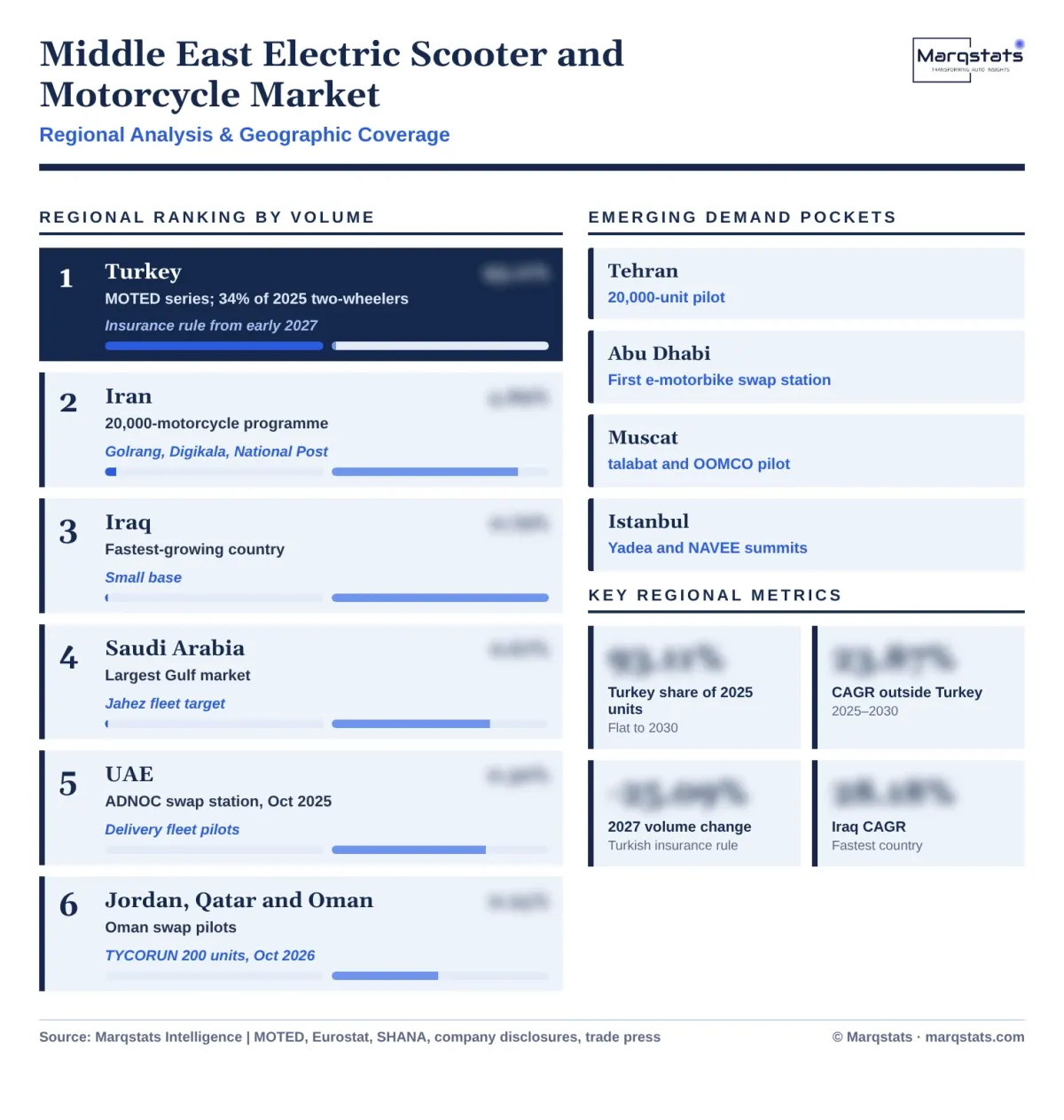
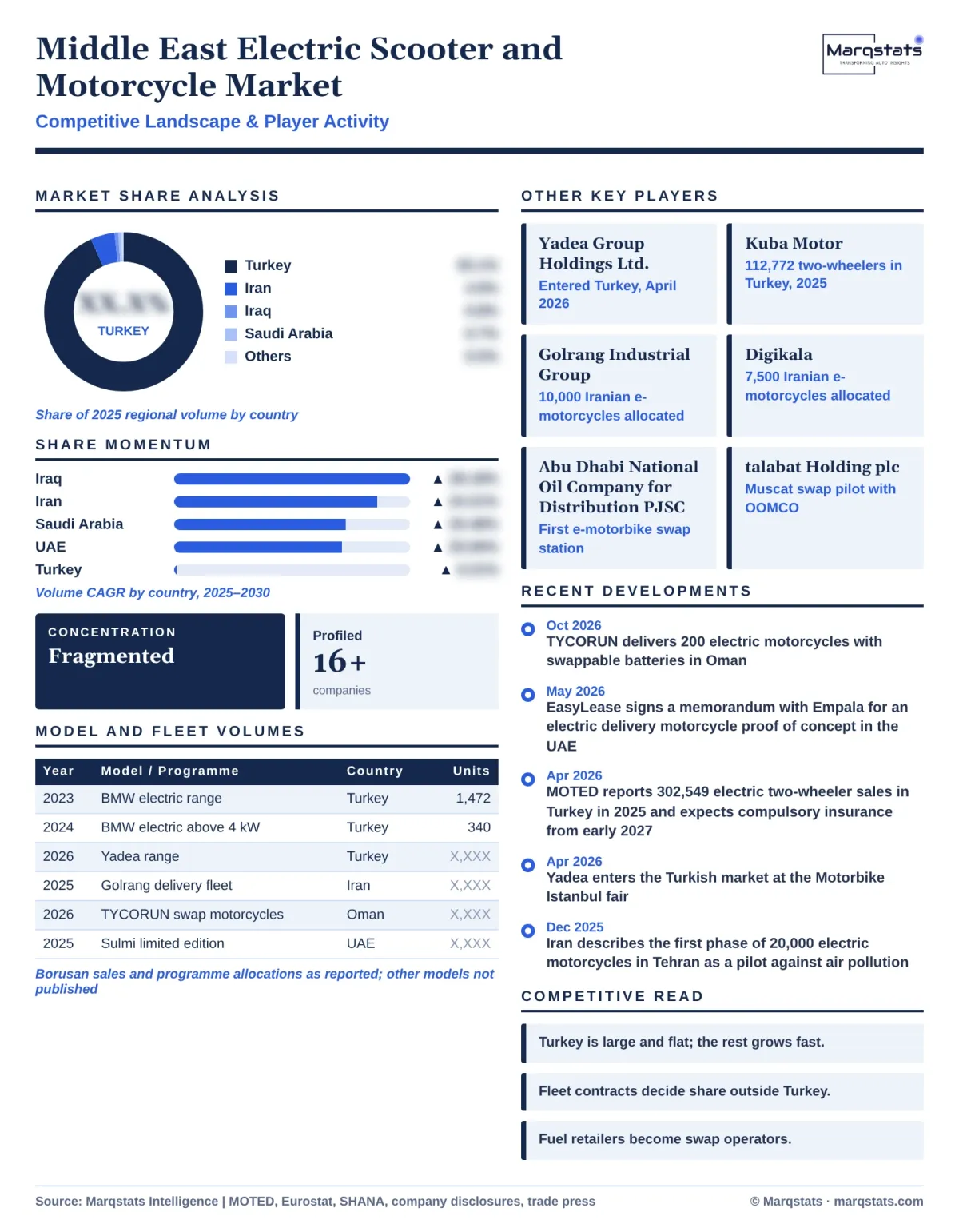
The Middle East electric scooter and motorcycle market is estimated at 324,977 units in 2025 and is projected to reach 371,173 units by 2030, registering a volume CAGR of 2.69% over 2026–2030. In value terms the market is estimated at USD 614.93 million in 2025 and is projected to reach USD 812.42 million by 2030, a CAGR of 5.73%. The market comprises new battery electric mopeds, scooters and motorcycles sold for road use in Turkey, Iran, Iraq, Saudi Arabia, the United Arab Emirates, Jordan, Qatar and Oman. Turkey holds 93.11% of 2025 volume, and Iraq is the fastest-growing country at 28.18% a year.
Market size and forecast figures are generated using Marqstats' proprietary estimation framework, updated as of October 2026.
Turkey's figure follows the Motorcycle Industry Association (MOTED) series of 302,549 electric two-wheelers in 2025, and the other countries follow Marqstats country models. Volume rises 17.16% to 380,730 units in 2026 and falls 25.09% to 285,209 in 2027, when Turkey extends compulsory traffic insurance to electric mopeds under 4 kW. Outside Turkey the market grows from 22,428 units to 65,401 by 2030 at 23.87% a year, led by Iran, Iraq and the Gulf delivery fleets.
Key Takeaways
Market Overview & Analysis
Report Summary
The Middle East electric scooter and motorcycle market covers new battery electric mopeds, scooters and motorcycles sold for road use in eight countries: Turkey, Iran, Iraq, Saudi Arabia, the United Arab Emirates, Jordan, Qatar and Oman. Volume rose from 22,675 units in 2021 to 57,521 in 2022, 183,904 in 2023 and 259,204 in 2024, and reached 324,977 units in 2025, up 25.37%. It peaks at 380,730 units in 2026, falls to 285,209 in 2027 and recovers to 371,173 units by 2030. Shared kick scooters, electric bicycles, used vehicles and petrol motorcycles sit outside the perimeter, and countries not modelled individually, such as Israel, Kuwait and Bahrain, are excluded.
The signature finding is that the regional total hides two different markets. Turkey holds 93.11% of 2025 volume and grows at only 0.21% a year to 305,772 units by 2030, because a regulatory change in 2027 removes the advantage that built its electric moped market. The other seven countries grow from 22,428 units to 65,401, a 23.87% CAGR, and their share of regional volume rises from 6.89% to 17.63%. A supplier that reads the regional CAGR of 2.69% as a slow market misses the fastest-growing countries, and one that reads Turkey's volume as a growth base misses the 2027 reset.
Turkey is a moped market built on rules. MOTED reported total two-wheeler sales of 885,261 units in 2025, down 26%, while electric sales rose 25% to about 302,549 units, a record 34% share, according to CNN Türk in April 2026. Petrol models up to 50 cc fell 23% to 254,300 units, and electric models in the same class rose 25% to about 302,500, because electric mopeds under 4 kW can be ridden on a car licence without compulsory traffic insurance. Electric mopeds and scooters made up 99.32% of Turkey's electric volume in 2025, and electric motorcycles 0.68%.
The 2027 insurance rule resets Turkey's market. Compulsory traffic insurance will apply to vehicles up to 50 cc and electric vehicles under 4 kW from early 2027, and MOTED expects the segment's share of the market to drop from 63% to 20% to 30%. Marqstats follows MOTED's forecast of about 350,000 electric sales in 2026 and models a 30% fall to 245,000 in 2027, with recovery to 305,772 units by 2030 as local production by global brands lowers prices. MOTED expects the total two-wheeler market to settle at 600,000 to 800,000 units a year in the longer term.
Turkey's brands and rules are changing. Kuba led total two-wheeler sales in 2025 with 112,772 units, followed by Honda with 63,440, Mondial with 54,735 and RKS with 49,461, and several of them sell electric mopeds alongside imported brands. Yadea Group Holdings Ltd. entered Turkey at the Motorbike Istanbul fair in April 2026, the same month Turkey published communiqué SGM-2026/5 on domestic content rules for electric scooter production. Borusan, the BMW Motorrad distributor, sold 1,472 BMW electric two-wheelers in 2023 and 340 above 4 kW in 2024, and Turkey tightened shared e-scooter rules with geofencing and data-tracking requirements in December 2025.
Iran is the second-largest market and the largest growth opportunity. Iran's volume rises from 15,900 units in 2025 to 47,011 by 2030, a 24.21% CAGR, lifting its share of regional volume from 4.89% to 12.67%. The National Iranian Oil Refining and Distribution Company signed a memorandum at the Iran Oil Show 2025 with Tehran Municipality, the Department of Environment, the National Post Company and the Traffic Police to replace 20,000 petrol motorcycles with electric ones, allocating 10,000 to Golrang Group's delivery fleet, 7,500 to Digikala, 1,200 to the National Post Company and 300 to the Traffic Police. In December 2025 the government described the first phase of 20,000 electric motorcycles in Tehran as a pilot against air pollution.
The Gulf markets are small and led by delivery fleets. Saudi Arabia holds 2,190 units in 2025 and the United Arab Emirates 990, growing at 20.48% and 20.06% a year. ADNOC Distribution and Terra Tech launched Abu Dhabi's first electric motorbike battery-swap station in October 2025, Virgin Mobile UAE switched its delivery riders to electric motorcycles with Axiom Telecom in March 2025, and EasyLease, a subsidiary of International Holding Company, signed a memorandum with Empala for an electric delivery motorcycle proof of concept in May 2026. Jahez targeted electric vehicles for 25% of its Saudi delivery fleet by 2026.
Oman and Qatar show the swap-and-delivery model spreading. talabat and Oman Oil Marketing Company (OOMCO) piloted 10 electric motorcycles with three swap stations in Muscat in May 2025, and China's TYCORUN delivered 200 electric motorcycles with swappable batteries in Oman in October 2026. EV Technology partnered with Xoom Volt to launch an electric two-wheeler delivery platform in Oman in April 2025, and Qatar's General Directorate of Traffic renewed safety rules for electric scooter and e-bike users in June 2026. Jordan, Qatar and Oman together hold 788 units in 2025 and grow at 13.77% a year.
The average selling price is approximately USD 1,892 in 2025, rising to USD 2,189 by 2030, so value grows at 5.73% against 2.69% for units. The rise reflects the shift of volume from Turkish sub-4 kW mopeds toward higher-power delivery motorcycles in Iran and the Gulf, and toward electric motorcycles in Turkey after the insurance rule. Prices in Turkey and Iran move with their currencies, because most cells and many kits are imported.
The conclusion for suppliers is to plan Turkey and the rest of the region separately. Turkey needs products and pricing for an insured market after 2027, with higher-power electric motorcycles growing fastest, while Iran, Iraq and the Gulf need delivery motorcycles, swap stations and fleet finance. Companies that build delivery-fleet partnerships in the Gulf and Iran now gain the share that grows fastest to 2030.
The value chain differs by country. In Turkey, local brands and assemblers such as Kuba, Mondial and RKS sell through national dealer networks, and domestic content rules from April 2026 reward local production of electric scooters. In Iran, state oil and municipal bodies set up fleet programmes that allocate motorcycles to delivery, postal and police users. In the Gulf, fuel retailers such as ADNOC Distribution and OOMCO, leasing companies such as EasyLease and delivery platforms such as talabat and Jahez organise demand, so the battery and the fleet contract matter more than the dealer.
The forecast path has a clear shape. Regional volume peaks at 380,730 units in 2026, falls to 285,209 in 2027 when Turkish insurance applies, and recovers to 371,173 by 2030. Turkey's electric motorcycles rise from 2,051 to 7,615 units over the period, and the seven other countries add 42,973 units. The recovery after 2027 therefore depends on both a shift to insured, higher-power models in Turkey and continued fleet orders elsewhere.
Market Dynamics
Key Drivers
Five conditions drive the Middle East electric scooter and motorcycle market, and delivery-fleet electrification outside Turkey matters most for growth.
- Delivery-fleet electrification. Virgin Mobile UAE moved its delivery riders to electric motorcycles in March 2025, Jahez targeted 25% electric vehicles in its Saudi fleet by 2026, and Golrang Group and Digikala received 17,500 of Iran's planned 20,000 electric motorcycles. Fleet buyers convert in large blocks, so a single contract can move a Gulf country's annual volume.
- Government programmes in Iran. Iran's 20,000-motorcycle memorandum of 2025 links fuel savings, air quality and fleet renewal in Tehran. Iran's volume grows at 24.21% a year to 47,011 units by 2030.
- Battery-swap infrastructure in the Gulf. ADNOC Distribution and Terra Tech opened Abu Dhabi's first electric motorbike swap station in October 2025, and TYCORUN delivered 200 swappable-battery motorcycles in Oman in October 2026. Swapping removes charging downtime for delivery riders.
- Fuel price shocks. Petrol price spikes linked to the Iran war in 2026 pushed electric two-wheeler makers to accelerate capacity, according to The Economic Times in May 2026. Higher fuel costs raise the running-cost case for riders across the region.
- Licence and insurance advantages in Turkey until 2027. Electric mopeds under 4 kW can be ridden without compulsory traffic insurance until early 2027, which helped electric models reach 34% of Turkey's 2025 two-wheeler sales. MOTED expects about 350,000 electric sales in 2026 before the rule takes effect.
Key Restraints
Four constraints shape the market, and Turkey's 2027 insurance rule is the most important.
- Compulsory insurance for Turkish electric mopeds. Insurance for electric vehicles under 4 kW from early 2027 is expected to cut the segment's share of Turkey's market from 63% to 20% to 30%, according to MOTED. Marqstats models regional volume falling 25.09% in 2027.
- Enforcement against micromobility. Dubai Police seized 13,657 electric scooters for traffic violations in eight months of 2026, and Ajman Police banned electric scooters on public roads in August 2025. Tighter rules on kick scooters signal stricter regulation of all light electric vehicles in the Gulf.
- Small Gulf volumes. Saudi Arabia and the United Arab Emirates together hold 3,180 units in 2025, less than 1% of regional volume. Small markets limit the dealer and service networks brands can justify.
- Currency and import exposure. Turkey and Iran import most cells and many kits, so currency weakness raises local prices, and Turkey's domestic content communiqué of April 2026 adds compliance costs for importers. Local assembly reduces the exposure for brands that invest.
Key Trends
Four shifts show where the market is moving and which companies gain.
- Turkey moves up the power range. Electric motorcycles grow from 2,051 units to 7,615 in Turkey by 2030 at 30.00% a year, as the insurance rule removes the cost advantage of sub-4 kW mopeds. Brands with motorcycle-class products gain share after 2027.
- Chinese brands enter with local production. Yadea entered Turkey in April 2026, and NAVEE held its first MENA partner summit in Istanbul in May 2026. Turkey's domestic content rules favour brands that assemble locally.
- Swap networks follow delivery platforms. talabat and OOMCO piloted swap stations in Muscat in May 2025, and ADNOC Distribution added a swap station in Abu Dhabi in October 2025. Fuel retailers become charging and swap partners for delivery fleets.
- Local brands in the Gulf. UAE maker Sulmi planned 200 limited-edition locally made electric motorbikes in 2025, and EasyLease tested electric delivery motorcycles with Empala in May 2026. Gulf investors use leasing and local brands to build the market.
Market Segmentation
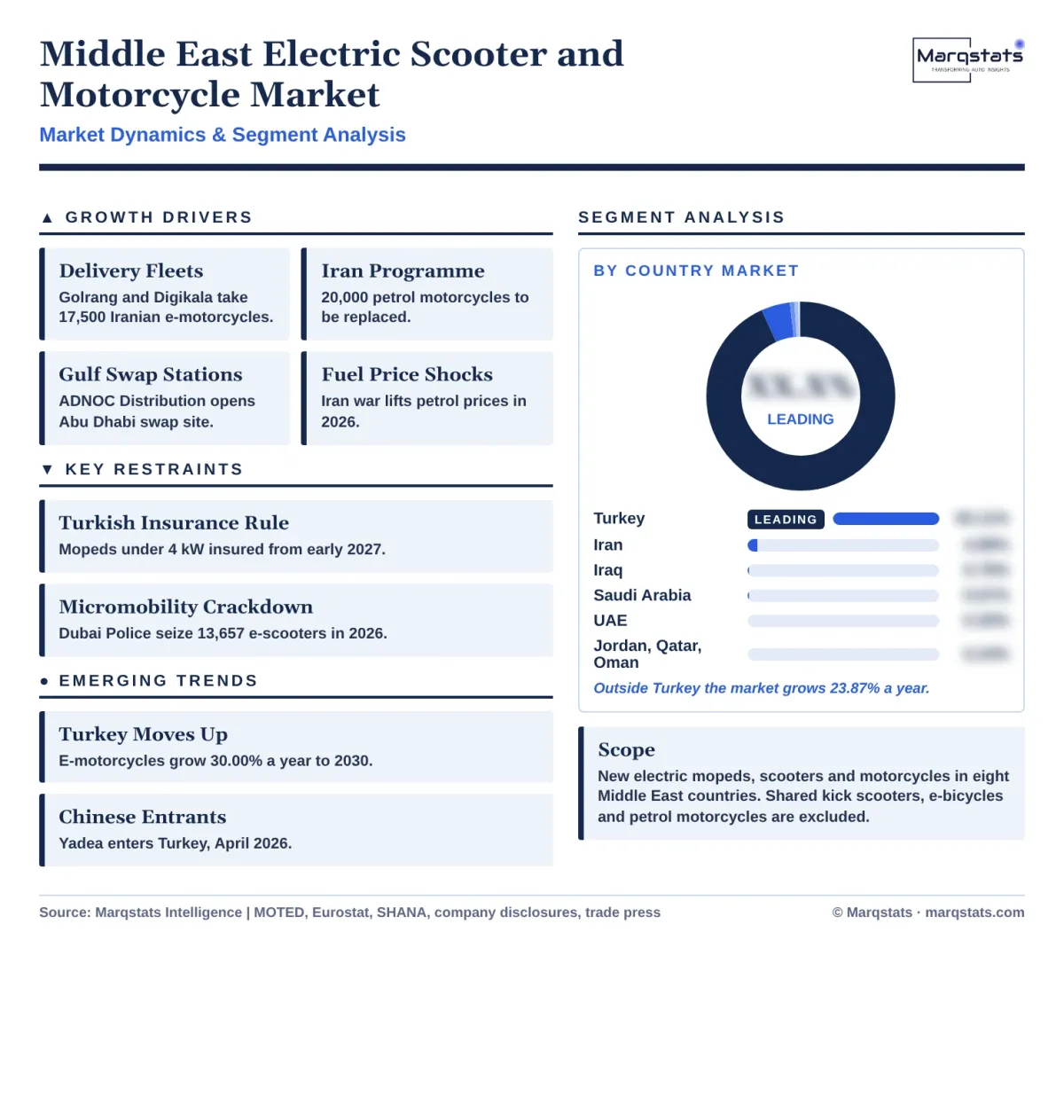
Turkey is the largest market and the slowest-growing. It accounts for 302,549 units in 2025, 93.11% of regional volume, and reaches 305,772 units by 2030 at a 0.21% CAGR, taking 82.37% of the market. Sub-4 kW mopeds dominate until the 2027 insurance rule, after which electric motorcycles grow fastest.
Iran is the second-largest market and the largest source of new volume. It accounts for 15,900 units in 2025, 4.89% of regional volume, and reaches 47,011 units by 2030 at a 24.21% CAGR, taking 12.67% of the market. Golrang Group, Digikala and the National Post Company lead fleet conversion under the 2025 memorandum.
Iraq is the fastest-growing country. It accounts for 2,560 units in 2025, 0.79% of regional volume, and reaches 8,859 units by 2030 at a 28.18% CAGR, taking 2.39% of the market. Volume grows from a small base, and no brand or fleet data are published.
Saudi Arabia is the largest Gulf market. It accounts for 2,190 units in 2025, 0.67% of regional volume, and reaches 5,559 units by 2030 at a 20.48% CAGR, taking 1.50% of the market. Delivery platforms such as Jahez drive demand for electric motorcycles in the main cities.
The United Arab Emirates is the second-largest Gulf market. It accounts for 990 units in 2025, 0.30% of regional volume, and reaches 2,470 units by 2030 at a 20.06% CAGR, taking 0.67% of the market. ADNOC Distribution, Terra Tech, Virgin Mobile UAE and EasyLease build swap and delivery use cases.
Jordan, Qatar and Oman form the smallest group. It accounts for 788 units in 2025, 0.24% of regional volume, and reaches 1,502 units by 2030 at a 13.77% CAGR, taking 0.40% of the market. Oman's swap pilots with talabat, OOMCO and TYCORUN lead activity in the group.
The 1.1–3.0 kW band is the largest band outside Turkey. It accounts for 10,774 units in 2025, 48.04% of volume outside Turkey, and reaches 31,484 units by 2030 at a 23.92% CAGR. Urban scooters and light delivery bikes supply most of its volume.
The up-to-1.0 kW band covers low-speed mopeds. It accounts for 5,034 units in 2025, 22.45% of volume outside Turkey, and reaches 13,995 units by 2030 at a 22.69% CAGR. Its share eases slightly as buyers choose faster models.
The 3.1–5.0 kW band covers delivery motorcycles that match 110 to 125 cc petrol models. It accounts for 3,603 units in 2025, 16.06% of volume outside Turkey, and reaches 10,510 units by 2030 at a 23.88% CAGR. Fleet orders in Iran and the Gulf support the band.
The above-5.0 kW band is the fastest-growing band outside Turkey. It accounts for 3,017 units in 2025, 13.45% of volume outside Turkey, and reaches 9,412 units by 2030 at a 25.55% CAGR. Higher-power motorcycles serve longer delivery routes and premium buyers.
By Geography
Turkey
Turkey holds 93.11% of 2025 volume with 302,549 units and reaches 305,772 units by 2030 at 0.21% a year, after peaking at 350,000 in 2026. Istanbul and the Marmara region form the largest demand centre, and Yadea, Kuba, Mondial and RKS compete with BMW and other premium brands. Shared operator Martı deployed about 23,000 vehicles a day on average in 2025, a mix of e-scooters, e-bikes and e-mopeds that sits partly outside the perimeter, and Turkey tightened shared e-scooter rules in December 2025.
Iran
Iran holds 15,900 units in 2025 and grows at 24.21% a year to 47,011 by 2030. Tehran's 20,000-motorcycle programme concentrates early demand in the capital's delivery and postal fleets.
Iraq
Iraq grows fastest at 28.18% a year, from 2,560 units in 2025 to 8,859 by 2030. No brand or fleet data are published, so growth tracks the Marqstats country model.
Saudi Arabia
Saudi Arabia grows from 2,190 units in 2025 to 5,559 by 2030 at 20.48% a year. Delivery platforms in the main cities drive demand, and Jahez targeted 25% electric vehicles in its fleet by 2026.
United Arab Emirates
The United Arab Emirates grows from 990 units to 2,470 by 2030 at 20.06% a year. Abu Dhabi's first swap station and electric delivery fleets in Dubai lead adoption, while police enforcement against kick scooters tightens the rules for all light electric vehicles.
Jordan, Qatar and Oman
Jordan, Qatar and Oman hold 788 units in 2025 and reach 1,502 by 2030. Oman's delivery and swap pilots and Qatar's renewed safety rules shape early demand.
How Competition Is Evolving
The market is fragmented, and leadership differs by country. In Turkey, Kuba, Honda, Mondial and RKS led total two-wheeler sales in 2025 with 112,772, 63,440, 54,735 and 49,461 units, and electric mopeds come from these brands and Chinese imports. In Iran, fleet buyers such as Golrang Group and Digikala decide volume, and in the Gulf, delivery platforms and fuel retailers set the pace.
Strategies split between Turkish volume and Gulf fleet partnerships. Yadea entered Turkey in April 2026 as domestic content rules favour local assembly, and Borusan sells BMW electric two-wheelers at the premium end. In the Gulf, ADNOC Distribution with Terra Tech, OOMCO with talabat and EasyLease with Empala pair fuel retail, leasing and delivery to build swap-based fleets.
The competitive question to 2030 is who wins Turkey after the insurance reset and who wins the fleets elsewhere. Turkish electric motorcycles grow at 30.00% a year, which rewards brands with motorcycle-class products, while Iran and the Gulf reward companies that combine vehicles, swap stations and fleet contracts. No company holds a top position in both Turkey and the Gulf.
Model and brand data are thin outside Turkey. Borusan's 1,472 BMW electric sales in 2023 and 340 above 4 kW in 2024 are among the few published model-level figures, and Iran's 20,000-unit memorandum is the largest disclosed fleet allocation. Shares outside Turkey are not published, so fleet contracts are the clearest guide to brand position.
Fuel retailers are becoming competitors in their own right. ADNOC Distribution in Abu Dhabi and OOMCO in Muscat have both added electric motorbike swapping to their station networks, and Iran's programme is led by the National Iranian Oil Refining and Distribution Company. These companies control sites, power connections and fleet relationships that vehicle brands lack, so vehicle makers that partner with them reach delivery riders faster than those that build their own networks.
Companies Covered
Companies covered in the report include:
Recent Market Activity
Table of Contents
Coverage & Segmentation
The Middle East electric scooter and motorcycle market comprises new battery electric mopeds, scooters and motorcycles sold for road use in Turkey, Iran, Iraq, Saudi Arabia, the United Arab Emirates, Jordan, Qatar and Oman, sized in units and in USD at retail selling prices. The market is segmented by country market and, outside Turkey, by motor power into four bands (up to 1.0 kW, 1.1–3.0 kW, 3.1–5.0 kW and above 5.0 kW). Regional analysis covers each country, with Jordan, Qatar and Oman grouped.
The base year is 2025, the historical period is 2021–2025 and the forecast period is 2026–2030. Shared kick scooters, electric bicycles, used vehicles and petrol motorcycles are excluded, as are countries not modelled individually. Turkey follows the MOTED and Eurostat zero-emission moped and motorcycle series, which differs from the earlier Marqstats datasheet value, and the other countries follow Marqstats country models that are not independently verified against registrations. Company and programme figures, such as Iran's 20,000-unit memorandum, are as reported.