Market Snapshot
Key Takeaways
Market Overview & Analysis
Report Summary
The India electric scooter battery replacement and warranty services market comprises post-sales services tied to traction-battery lifecycle management in high-speed electric scooters and electric two-wheelers. The defined scope includes original-equipment and authorized battery replacement, extended battery warranty plans, battery-health diagnostics and SOH testing, warranty claims management, refurbished and replacement battery packs, and Battery-as-a-Service contracts. Original-equipment battery packs installed in newly sold scooters fall outside the revenue scope, however the new-vehicle cohort is counted as the installed base that drives later warranty and replacement demand.
India’s electric two-wheeler sales rose from 39,845 units in FY2020-21 to 14.02 lakh units in FY2025-26, per Society of Indian Automobile Manufacturers data, lifting the cumulative on-road base above 4.5 million units. Electric two-wheelers held a 57% share of all electric vehicle registrations in FY2025-26 and crossed 6.5% penetration of the overall two-wheeler market. As the FY2021-22 to FY2023-24 cohorts approach the five-to-eight-year battery service window, warranty claims, health degradation and replacement demand expand.
The 2025 market is estimated at USD 135 million, weighted toward extended warranty plans and Battery-as-a-Service subscriptions, with early replacement and diagnostics forming a smaller share. Near-term replacement volume remains modest, owing to most vehicles retaining original three-to-eight-year battery cover. Modern lithium-ion electric scooter batteries last five to eight years or 50,000 to 80,000 km under normal use, which positions the FY2021-22 and FY2022-23 cohorts at the start of paid replacement demand from 2028. Demand is increasing owing to base expansion, deeper warranty attach rates and the maturing of early cohorts. Forecast value reaches USD 560 million by 2030 as the on-road base crosses 18 million units and out-of-warranty replacement, refurbishment and SOH diagnostics scale.
Warranty terms define competitive positioning. Ather Energy Limited offers the Eight70 plan, which extends the three-year manufacturer warranty by five years for total cover of eight years or 80,000 km and guarantees a free replacement if battery health falls below 70%, priced at ₹4,999. Ola Electric Mobility Limited provides a three-year base warranty with top-up cover extending to eight years and up to 1,25,000 km on eligible models. TVS Motor Company Limited offers a three-year, 50,000 km base warranty extendable to five years and 70,000 km, Bajaj Auto Limited specifies three years and 50,000 km on the Chetak, and Hero MotoCorp Limited markets the Vida Battery+ plan at five years and 60,000 km alongside a comprehensive plan covering the battery and 11 components to five years and 75,000 km.
The value chain spans cell and pack manufacturers, vehicle manufacturers, authorized service networks, diagnostics providers, Battery-as-a-Service operators and recyclers. Cell and pack suppliers such as Exide Industries Limited, Amara Raja Energy & Mobility Limited and Log9 Materials Scientific Private Limited manufacture replacement packs, vehicle manufacturers administer in-warranty service, and operators such as SUN Mobility Private Limited deliver leasing and swap-based models. Localization is deepening as manufacturers internalize cell production to lower replacement costs.
Regulatory and Standards Framework
Electric scooter batteries are governed by the AIS-156 standard for L-category vehicles, administered by the Automotive Research Association of India. Amendment 2, effective 1 October 2022 and implemented in phases from 1 December 2022 and 31 March 2023, strengthened requirements for battery cells, the battery management system, pack design and protection against thermal propagation. The framework mandates an RFID tag linked to every battery pack, IPX7 water-resistance testing, microprocessor-based BMS protections and multiple temperature sensors, establishing traceability that underpins warranty validation and claims management.
The PM E-DRIVE scheme, notified with a ₹10,900 crore outlay, restricts demand incentives to electric two-wheelers fitted with advanced batteries and supports close to 24.79 lakh electric two-wheelers, with incentives extended until 31 July 2026. The Battery Waste Management Rules, 2022 set handling standards for used electric-vehicle batteries and mandate the use of recovered minerals in new batteries, formalizing extended producer responsibility. These provisions create compliance-driven demand for certified replacement packs, refurbishment and end-of-life processing across the service market.
Market Dynamics
Key Drivers
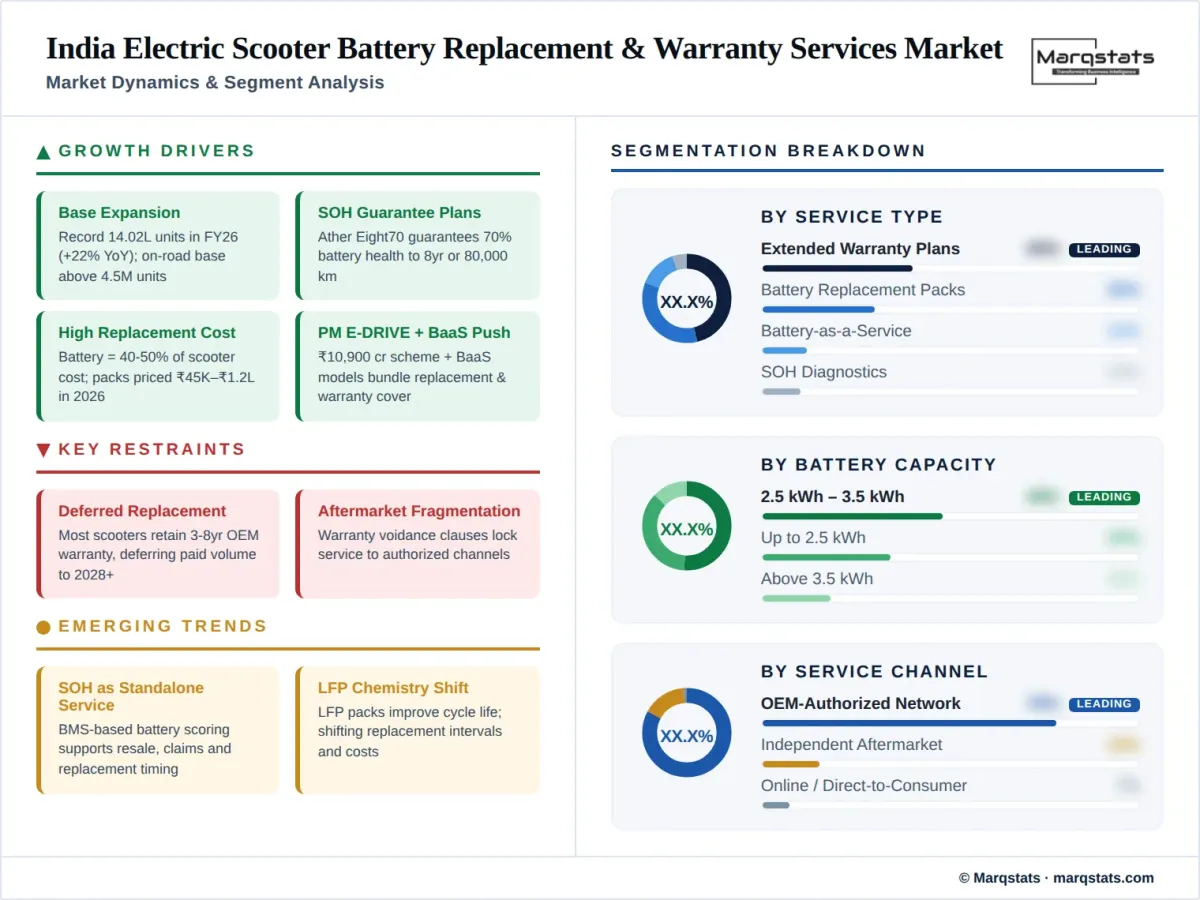
- Electric two-wheeler sales reached a record 14.02 lakh units in FY2025-26, up 22% year on year, lifting the on-road base above 4.5 million units that progress toward warranty and replacement cycles.
- The PM E-DRIVE scheme supports close to 24.79 lakh electric two-wheelers fitted with advanced batteries, with incentives extended until 31 July 2026, sustaining new-cohort battery deployment that feeds later service demand.
- Extended warranty and SOH-linked guarantees, including Ather Energy Limited’s 70% battery-health assurance to eight years, convert battery durability into a paid service line and lift attach rates.
- Battery packs account for 40% to 50% of electric scooter cost, with replacement priced at ₹45,000 to ₹1,20,000 in 2026, creating a high-value out-of-warranty service pool as cohorts age.
- Battery-as-a-Service models, marketed by Hero MotoCorp Limited and TVS Motor Company Limited, decouple battery ownership and bundle extended warranty cover, expanding subscription-based service revenue.
- Component localization is accelerating, with Ola Electric Mobility Limited approving a ₹20 billion investment in electric-vehicle and cell-technology units to lower pack and replacement costs.
Key Restraints
- Near-term replacement volume remains modest, owing to most electric scooters retaining original three-to-eight-year battery warranties that defer paid replacement to later in the forecast period.
- High replacement prices of ₹45,000 to ₹1,20,000 encourage some owners to retain degraded batteries or change vehicles, moderating near-term replacement uptake.
- A fragmented independent aftermarket and limited certified refurbishment capacity constrain out-of-warranty service quality and consumer confidence.
- Warranty terms that void cover on non-authorized battery service concentrate demand within manufacturer networks and restrict third-party replacement growth.
Key Trends
- State-of-health diagnostics and BMS-based battery scoring are emerging as standalone services, supporting resale valuation, warranty claims and replacement decisions.
- Battery chemistry is shifting toward lithium-iron-phosphate packs alongside nickel-manganese-cobalt cells, improving cycle life and influencing replacement intervals.
- Battery-as-a-Service and battery-swapping models are expanding in last-mile delivery fleets, bundling replacement and warranty cover into subscriptions.
- Refurbishment and second-life processing are developing under the Battery Waste Management Rules, creating a recovered-pack and recycling service stream.
- Battery buyback and exchange programmes reduce net replacement cost by 10% to 15%, supporting structured replacement and a secondary supply of recovered packs.
Market Segmentation
Extended warranty plans hold the largest share at approximately 40% of 2025 market value. Ather Energy Limited’s Eight70 plan, Ola Electric Mobility Limited’s top-up cover to eight years, and Hero MotoCorp Limited’s Vida Battery+ at five years and 60,000 km anchor this segment. Plans convert battery durability concerns into recurring service revenue and command attach rates that increase with consumer awareness of replacement costs.
Replacement packs account for close to 30% of value, comprising out-of-warranty, accident-related and early-failure replacements priced between ₹45,000 and ₹1,20,000. Entry packs for the TVS iQube 2.2 kWh and Ola S1 X start near ₹45,000, while premium packs for the Ola S1 Pro+ and TVS iQube ST reach ₹1,15,000. Volume scales sharply from 2028 as the earliest cohorts exit warranty.
Battery-as-a-Service and leasing represent about 12% of value, bundling battery usage, replacement and warranty into subscriptions. TVS Motor Company Limited’s iQube Battery-as-a-Service plan pairs a five-year subscription with a five-year, 70,000 km battery warranty, while swap-based operators serve commercial fleets. The model lowers upfront cost and shifts replacement risk to the operator.
Diagnostics and SOH testing form close to 10% of value and represent the fastest-growing service line. Ather Energy Limited’s battery-health algorithm and BMS data enable SOH scoring that supports warranty claims, resale valuation and replacement timing. Standalone diagnostic services are emerging across authorized and independent networks.
Refurbishment and claims management account for about 8% of value, covering pack repair, module replacement and recovered-cell processing under the Battery Waste Management Rules. This segment expands as cohorts age and end-of-life volumes increase.
Entry packs up to 2.5 kWh, including the TVS iQube 2.2 kWh and Ola S1 X 2.0 kWh, carry the lowest replacement cost at ₹45,000 to ₹50,000 and account for the largest service volume. Affordability supports faster replacement uptake in this band.
Mainstream packs from 2.5 kWh to 3.5 kWh, covering the Ather 450X, Bajaj Chetak 3.5 kWh and TVS iQube 3.4 kWh, form the core on-road base. Replacement costs of ₹60,000 to ₹87,500 position this band as the largest by service value.
Premium packs above 3.5 kWh, including the Ola S1 Pro+ 5.2 kWh and TVS iQube ST 5.3 kWh, carry the highest replacement cost near ₹1,15,000. Higher capacity and value concentrate revenue per service event in this band.
Authorized service networks hold approximately 78% of value, anchored by in-warranty service that manufacturers reserve for approved channels to preserve cover. This channel scales with the on-road base and captures most extended-warranty and SOH-linked replacements.
The independent aftermarket represents close to 15% of value, serving out-of-warranty replacement and lower-cost pack supply. Growth is constrained by warranty terms and limited certified capacity, however the channel expands as cohorts age beyond manufacturer cover.
Online and direct channels account for about 7% of value, supplying replacement packs, diagnostics bookings and warranty plan purchases. Digital channels grow as manufacturers and aggregators formalize service booking and price transparency.
Personal commuting accounts for approximately 85% of service demand, aligned with the dominant use case for electric scooters across urban and semi-urban India. Extended warranty attach and SOH diagnostics concentrate in this segment.
Last-mile delivery fleets represent close to 11% of demand, with high daily utilization accelerating battery degradation and replacement frequency. Fleets favor Battery-as-a-Service and swap models that bundle replacement and warranty.
Shared and rental services account for about 4% of demand, concentrated in metropolitan markets where high utilization shortens battery service intervals.
By Geography
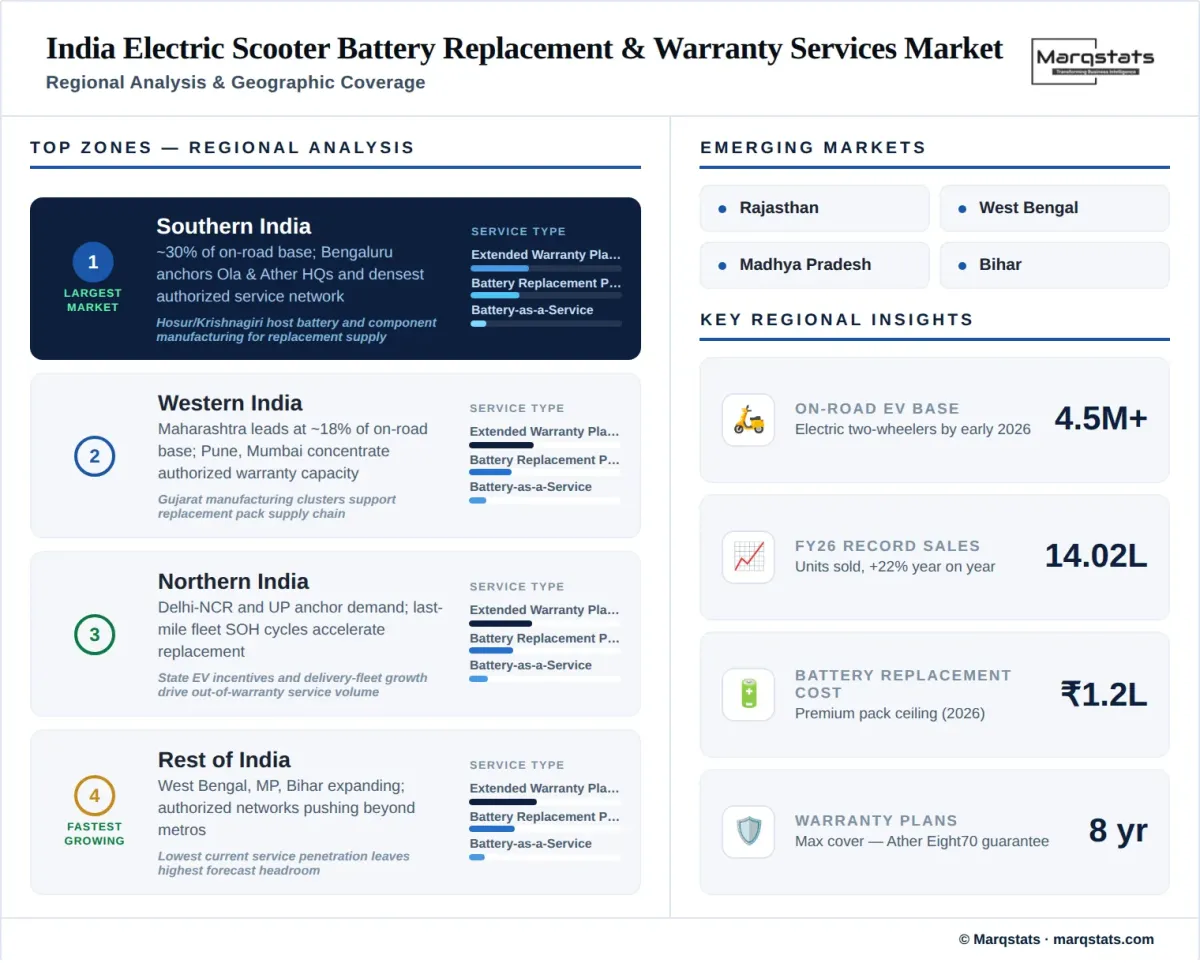
Western India
Maharashtra holds the largest state share of the electric two-wheeler on-road base at approximately 18%, anchoring battery service demand across Pune, Mumbai and Nagpur. Gujarat adds further demand, supported by manufacturing clusters and urban adoption. The region concentrates authorized service capacity and extended-warranty attach.
Southern India
Karnataka records the fastest service-demand growth, anchored by Bengaluru as the headquarters of Ola Electric Mobility Limited and Ather Energy Limited and a dense electric scooter base. Tamil Nadu hosts battery and component manufacturing at Hosur and Krishnagiri, while Telangana and Kerala add urban demand. Southern states together hold close to 30% of the on-road base.
Northern India
Delhi-NCR and Uttar Pradesh anchor northern demand, supported by last-mile delivery fleets and state electric-vehicle incentives. Uttar Pradesh holds a substantial share of the two-wheeler base, while Rajasthan and Haryana add growing service volume across diagnostics and replacement.
Rest of India
Eastern, central and northeastern states form the remaining demand, with West Bengal, Madhya Pradesh and Bihar recording rising adoption. Service capacity is developing as authorized networks and independent workshops expand beyond metropolitan corridors.
How Competition Is Evolving
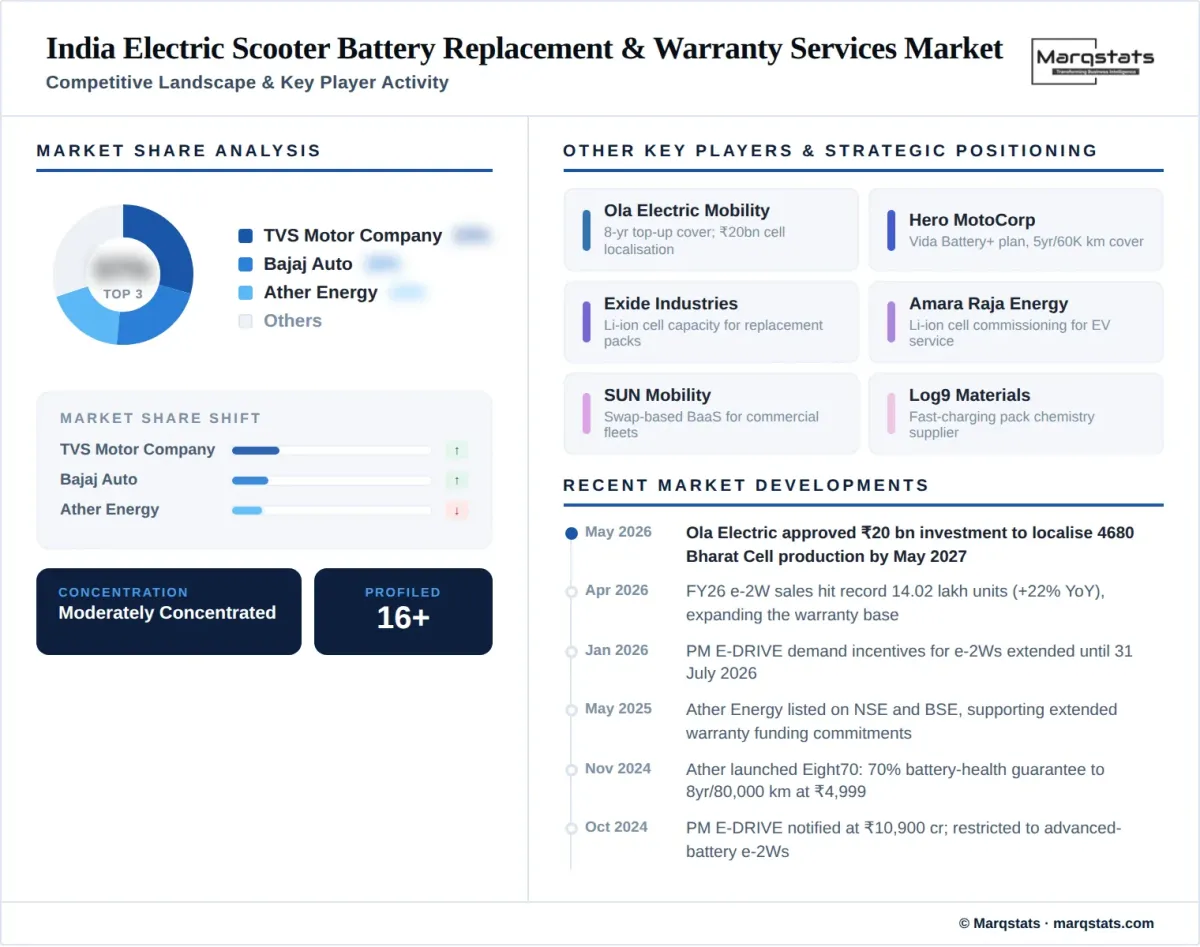
The market is moderately concentrated and stratifies into four layers. Original-equipment manufacturers control in-warranty battery service through authorized networks, cell and pack suppliers manufacture replacement and refurbished packs, Battery-as-a-Service and swap operators serve commercial demand, and an independent aftermarket addresses out-of-warranty replacement. The top original-equipment manufacturers account for close to 80% of electric two-wheeler shipments, which concentrates in-warranty service within a small group.
TVS Motor Company Limited led electric two-wheeler sales in FY2025-26 with 3.41 lakh units, followed by Bajaj Auto Limited, Ather Energy Limited, Hero MotoCorp Limited and Ola Electric Mobility Limited. Manufacturers compete on warranty depth, with Ather Energy Limited’s 70% battery-health guarantee, Ola Electric Mobility Limited’s eight-year top-up cover and Hero MotoCorp Limited’s Vida Battery+ defining the premium tier. Warranty terms and SOH guarantees function as purchase-confidence differentiators.
Cell and pack suppliers compete on cost, chemistry and capacity. Exide Industries Limited and Amara Raja Energy & Mobility Limited are commissioning lithium-ion cell capacity, Log9 Materials Scientific Private Limited supplies fast-charging packs, and Ola Electric Mobility Limited is internalizing 4680 Bharat Cell production through a ₹20 billion investment. TVS Motor Company Limited fits twin IP67-rated lithium-ion packs across iQube variants spanning 2.2 kWh to 5.3 kWh, which broadens its replacement-pack and warranty addressable base. Localization lowers replacement-pack costs and supports warranty economics over the forecast period.
Battery-as-a-Service and swap operators, including SUN Mobility Private Limited, serve commercial fleets with subscription and swap models that bundle replacement and warranty. Refurbishment and recycling capacity is developing under the Battery Waste Management Rules, with recovered-mineral mandates supporting second-life processing. The independent aftermarket remains fragmented, however authorized networks capture most extended-warranty and SOH-linked service revenue, which concentrates value within original-equipment channels.
Companies Covered
The report profiles 16++ companies with full strategy and financials analysis, including:
Recent Market Activity
Table of Contents
Coverage & Segmentation
This report analyzes the India electric scooter battery replacement and warranty services market across the 2021–2025 historical period, a 2025 base year, and the 2026–2030 forecast period. The study quantifies market size in value, segments demand by service type, battery capacity, service channel and application, and profiles the original-equipment, supplier, Battery-as-a-Service and aftermarket layers. Market sizing follows a bottom-up approach calibrated to electric two-wheeler installed-base data and battery service economics, validated against top-down estimates. Forecasts present base, conservative and accelerated scenarios reflecting warranty attach rates, cohort aging and replacement-cost trends.
The scope covers battery replacement packs, extended warranty plans, battery-health diagnostics and SOH testing, Battery-as-a-Service, refurbishment and warranty claims management for high-speed electric scooters and electric two-wheelers. Coverage includes regulatory analysis of the AIS-156 standard, the Battery Waste Management Rules, 2022 and the PM E-DRIVE scheme. The report excludes original-equipment battery packs installed in newly sold scooters, except as the installed base that drives later service demand, along with four-wheeler and three-wheeler battery services except where products are shared.