Market Snapshot
Middle bar: base-year value × (1 + CAGR), rounded to two decimals. This is a calculated illustration, not a separately researched annual estimate.
The Europe electric motorcycle and scooter market is estimated at 65,801 units in 2025 and is projected to reach 138,180 units by 2030, registering a volume CAGR of 16.00% over 2026–2030. In value terms the market is estimated at USD 0.58 billion in 2025 and is projected to reach USD 1.30 billion by 2030, a CAGR of 17.52%. The market comprises new registered battery electric mopeds, scooters and motorcycles in the L1e, L3e and related categories across 17 European countries. France is the largest country at 26.15% of 2025 volume, and the above-5.0 kW band holds 50.43% of units.
Market size and forecast figures are generated using Marqstats' proprietary estimation framework, updated as of October 2026.
Europe sells 1.06% of the world's electric scooters and motorcycles, at an average selling price of approximately USD 8,814, more than five times the global average of USD 1,629. Germany's registrations of electric motorcycles and scooters reached 8,740 in January to September 2026, already 39.35% above the 6,272 registered in all of 2025. Stark Future S.L., Niu Technologies, BMW, Vmoto and Acciona's Silence brand lead registrations in the largest markets.
Key Takeaways
Market Overview & Analysis
Report Summary
The Europe electric motorcycle and scooter market covers new battery electric two-wheelers registered for road use, from L1e mopeds limited to 45 km/h to L3e motorcycles above 11 kW. The market is estimated at 65,801 units in 2025, down 7.23% on 70,930 units in 2024 and below the 2022 level of 87,507 units, and recovers to 76,967 units in 2026, up 16.97%. It reaches 138,180 units by 2030, adding 72,379 units over the forecast period. Pedal-assist electric bicycles, speed pedelecs, stand-up kick scooters, shared fleets operated under municipal licences and internal combustion motorcycles sit outside the perimeter.
Europe is a small, high-value market. The region accounts for 1.06% of global electric scooter and motorcycle volume and USD 0.58 billion of value in 2025, at an average selling price of approximately USD 8,814, rising to USD 9,408 by 2030. The above-5.0 kW band holds 50.43% of units in 2025 and rises to 57.63% by 2030, because European buyers trade up to L3e scooters and motorcycles that compete with 125 cc and larger petrol models. Electric models remain a minority of the region's two-wheeler market: electric registrations were 3.49% of UK new motorcycle registrations in 2025 and 2.48% of Italian two-wheeler registrations.
Mopeds are electrifying far faster than motorcycles. Eurostat data for 2025 show zero-emission vehicles at 61.70% of new moped registrations in Belgium, 33.71% in Sweden, 28.99% in France, 21.75% in Italy and 20.44% in Spain. For motorcycles the shares were much lower: 5.12% in Sweden, 4.06% in Germany, 3.23% in Spain, 2.80% in Belgium, 1.68% in Italy and 1.42% in Poland. Urban mopeds compete on running cost and city access, where electric models already win, while motorcycle buyers weigh range, price and riding character, where petrol still dominates.
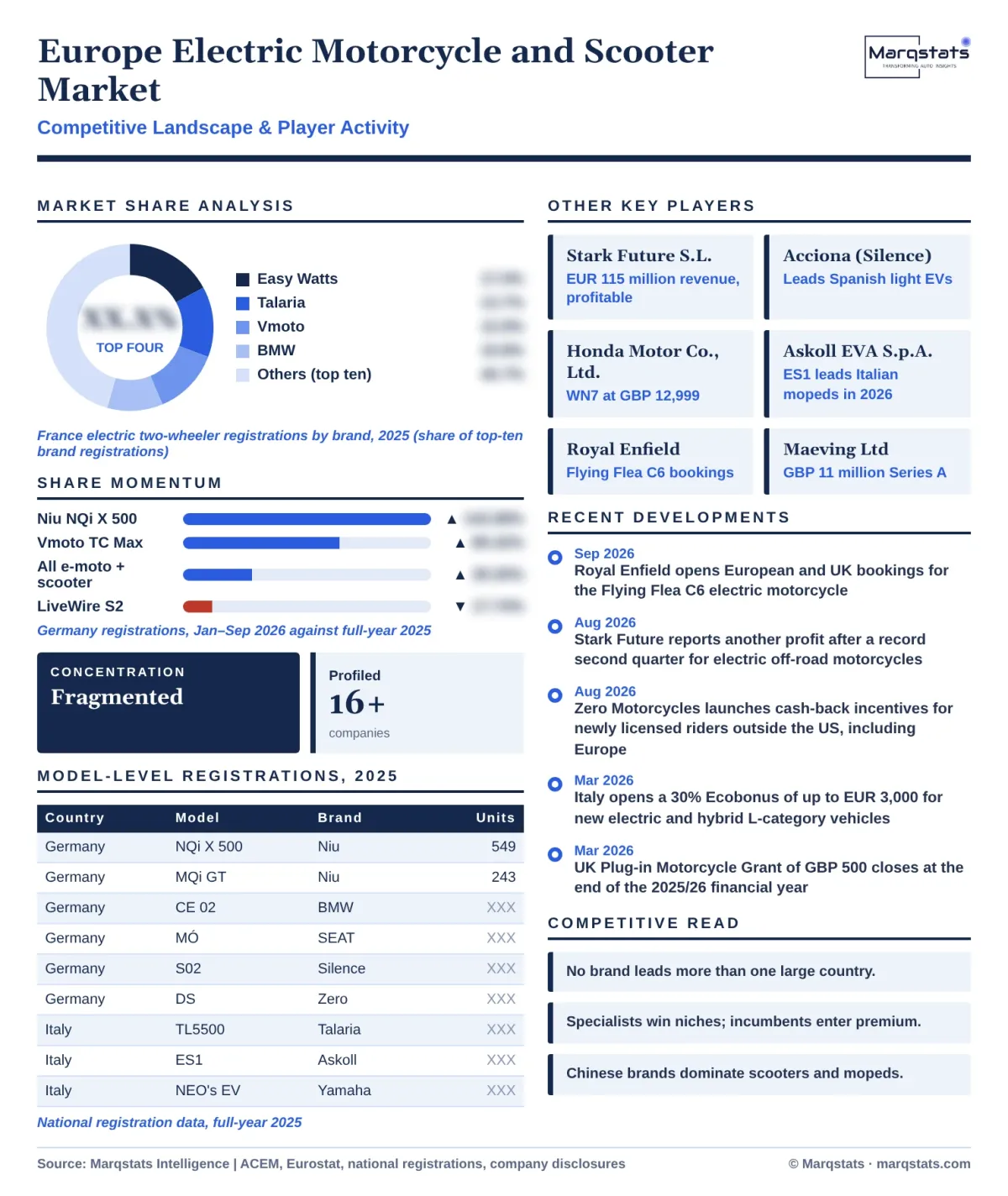
Model-level registration data from Germany show a market led by Chinese scooters and Spanish off-road motorcycles. The Niu NQi X 500 was Germany's top-selling electric scooter in 2025 with 549 registrations, followed by the Niu MQi GT with 243, the BMW CE 02 with 224, the SEAT MÓ with 185 and the Silence S02 with 114. Among electric motorcycles, the Zero DS and the Vmoto TC Max each registered 103 units and the LiveWire S2 Del Mar 62. In January to September 2026, Stark Future's EX and EM models registered 798 units and its SM 680, the NQi X 500 rose to 1,329 and Honda's new WN7 registered 157 in its first months on sale.
Italy shows a moped-led market with Italian and Japanese brands near the top. Italian electric two-wheeler registrations reached 8,561 in 2025, including 2,994 mopeds, 4,850 scooters above moped class and 717 motorcycles, and 8,524 in January to September 2026. The Talaria TL5500 led 2025 electric moped registrations with 381 units, ahead of the Askoll ES1 with 281, the Yamaha NEO's with 280 and the Vmoto Soco CITI L1 with 202. In January to September 2026, the Askoll ES1 led with 319 units and Fantic Motor's ISSIMO City L1 entered second place with 227.
UK registration data show a scooter-led market dominated by delivery use. The MCIA recorded 2,297 electric motorcycles, 913 electric scooters and mopeds and 72 exempt or unclassified electric vehicles in 2025, and 1,626, 585 and 40 respectively in January to September 2026. Vmoto's Super Soco CPx, an electric motorcycle of up to 11 kW used widely by couriers, registered 57 units in September 2026 alone, and Honda's WN7 and LiveWire's ONE appeared in the monthly rankings in small numbers. Zenion's battery-swap cabinets in Bermondsey support CPx rental fleets for delivery riders.
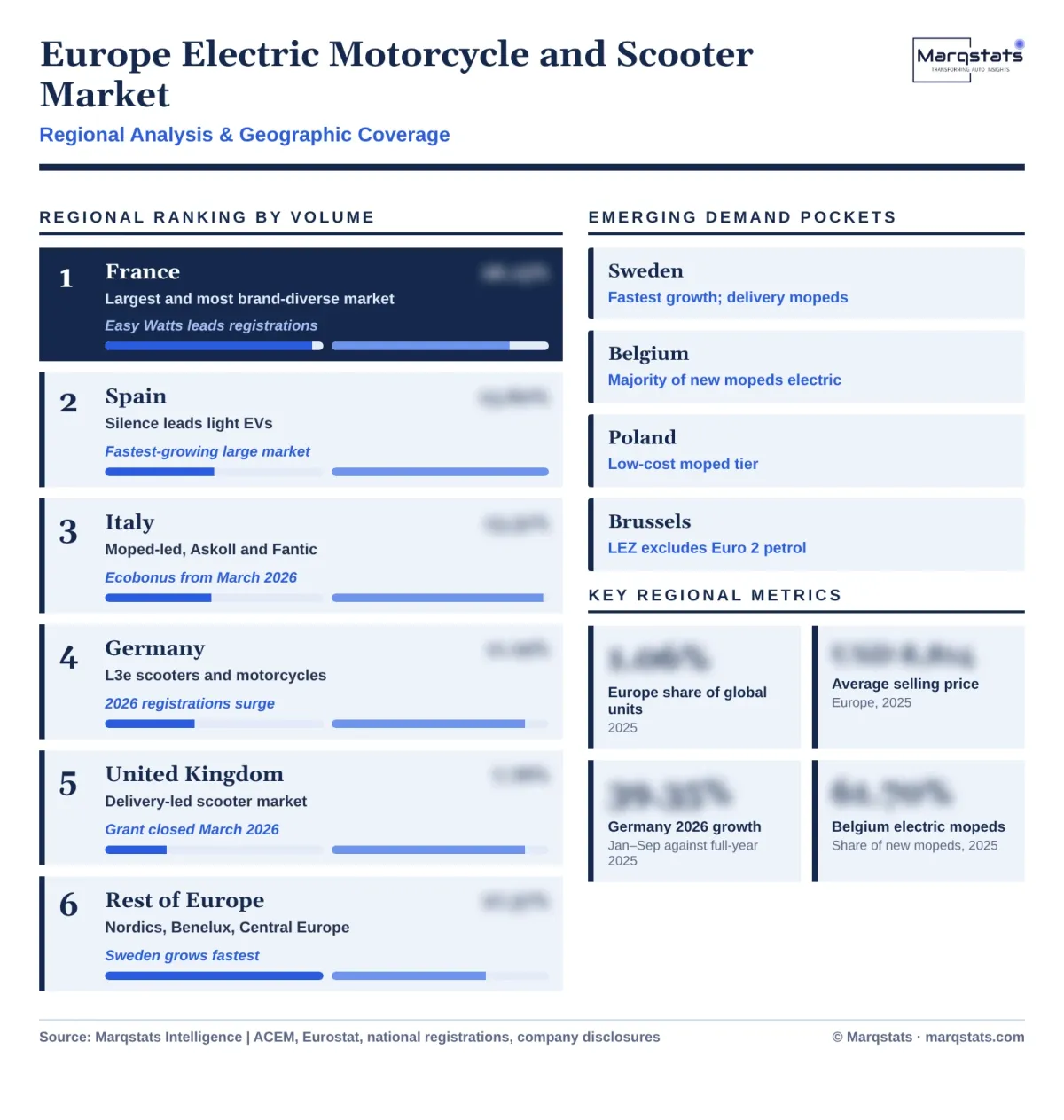
France is the largest market and the most brand-diverse. Electric mopeds and motorcycles registered with the European motorcycle manufacturers' association (ACEM) totalled 17,207 in France in 2025. Easy Watts led brand registrations with 1,257 units, followed by Talaria with 1,008, Vmoto with 951, BMW with 794, Niu with 671, Silence with 600, Pink with 583, Stark with 573, Segway with 475 and Sur-Ron with 460. French volume fell from 36,000 units in 2022 to 17,210 in 2025, and recovers at 15.37% a year to 35,182 units by 2030.
Spain and Poland add depth in the mid-market. Spain registered 8,882 electric two-wheelers in 2025, 3.51% of the national two-wheeler market, and Acciona's Silence brand led Spanish light electric vehicle and electric motorcycle registrations in the first half of 2026. Poland registered 3,660 electric two-wheelers in legal classes in 2025 and 4,658 in January to September 2026, with Sur-Ron and Stark first in electric motorcycles and Vigorous, Bili Bike and E Ride Pro first in scooters and mopeds. Low-cost Chinese brands dominate the moped tier in Poland, while premium brands lead motorcycles.
The installed fleet is small and growing in the Nordic countries. Sweden's electric motorcycle stock in traffic rose from 1,627 at the end of 2019 to 2,983 at the end of 2025, according to Trafikanalys, and 590 electric motorcycles received a first Swedish registration in 2025, 5.04% of all motorcycles. Class II mopeds limited to 25 km/h and 1 kW are not registered in Sweden, so delivery fleets of low-power electric mopeds operated by foodora and GoCimo sit partly outside registration statistics. Denmark and Norway combine high incomes with low volumes, at 4,120 and 2,736 units in 2025.
Market Dynamics
Key Drivers
Five conditions drive the Europe electric motorcycle and scooter market, and new premium products matter more than subsidies.
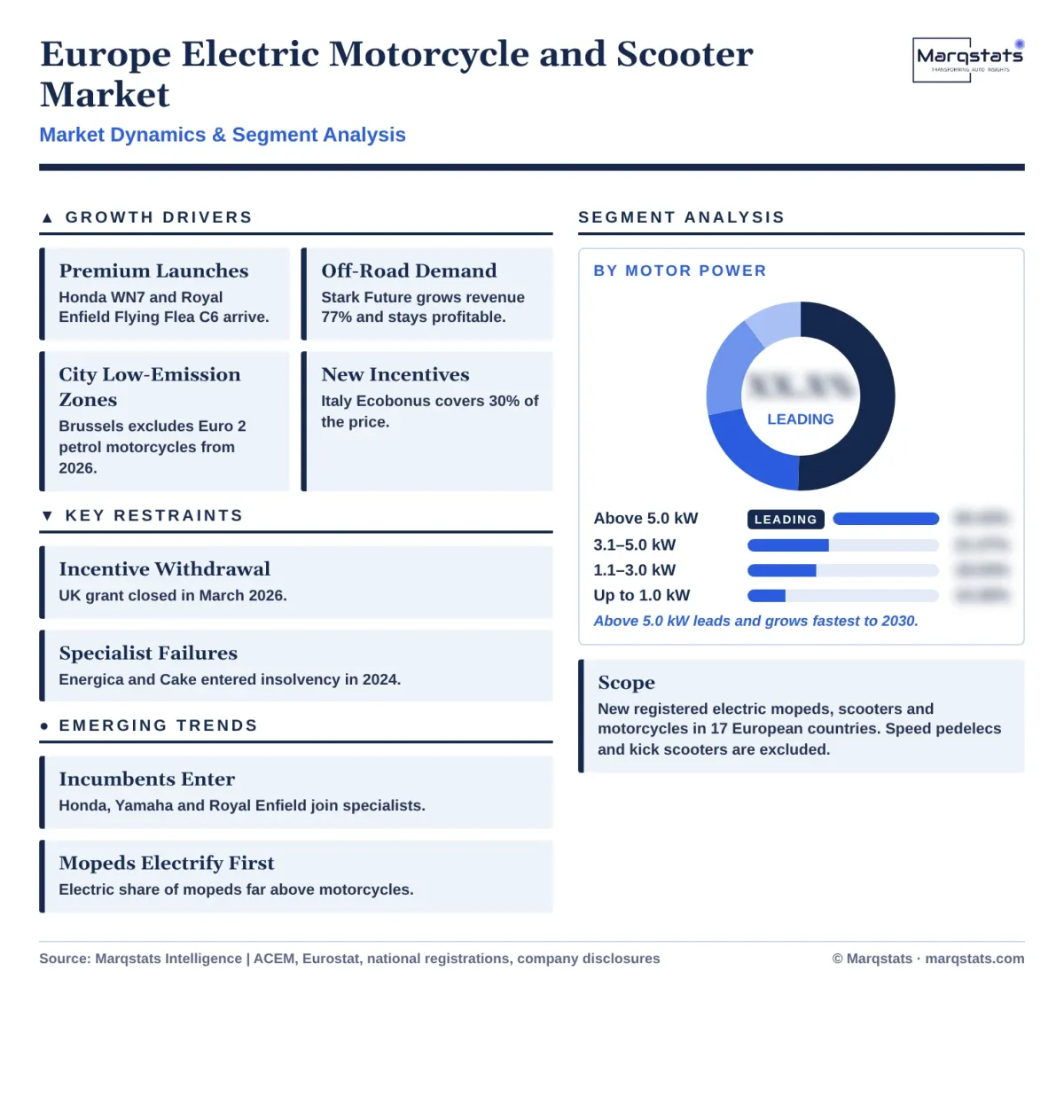
- Premium product launches from established brands. Honda Motor Co., Ltd. unveiled the WN7, its first electric motorcycle, at EICMA in November 2025 and lists it at GBP 12,999 in the UK, and Royal Enfield opened European and UK bookings for the Flying Flea C6 in September 2026. New products lift the above-5.0 kW band, which grows at 19.13% a year.
- Off-road and enduro demand. Stark Future S.L. reported 2025 revenue of EUR 115 million, up 77%, with profitability, and a record second quarter in 2026, and its EX, EM and SM models registered 1,478 units in Germany in January to September 2026. Electric off-road motorcycles avoid range concerns because most riding takes place near home.
- Low-emission zones in European cities. Brussels excluded Euro 2 petrol motorcycles from its low-emission zone from 1 January 2026, and Paris capped shared powered two-wheelers at 5,500 vehicles across three licensed operators. City access rules favour electric mopeds and scooters for daily commuting. Cooltra and Felyx operate shared electric moped fleets in Paris, Brussels and Antwerp, which introduce new riders to electric two-wheelers.
- Delivery fleet electrification. Correos added 800 electric motorcycles to its Spanish delivery fleet in August 2025, foodora reported that electric mopeds carried one-third of its city-centre deliveries in Sweden in December 2025, and Domino's franchisees in London deployed Vmoto VS2 CITI scooters in October 2025. Fleet buyers specify battery-swap or fast-charge models with high daily utilisation.
- New purchase incentives. Italy opened an Ecobonus in March 2026 covering 30% of the price of new electric and hybrid L-category vehicles up to EUR 3,000 without scrappage, and Spain approved the bases of its Auto+ programme in 2026. Wallonia exempts electric motorcycles of up to 11 kW from circulation tax.
Key Restraints
Four constraints limit growth, and incentive withdrawal is the most immediate.
- Incentive withdrawal. The UK's GBP 500 Plug-in Motorcycle Grant closed at the end of the 2025/26 financial year, and UK electric registrations of 2,251 in January to September 2026 put full-year volume on course to fall below the 3,282 of 2025. Poland's Mój elektryk intake for L-category vehicles closed in January 2025.
- Failure of specialist manufacturers. Energica Motor Company and Cake entered insolvency in 2024, and Harley-Davidson's chief executive said in February 2025 that LiveWire needed to perform after another weak sales year. Brand failures leave owners without parts and slow repeat purchases.
- High prices against petrol equivalents. The regional average selling price of approximately USD 8,814 compares with entry 125 cc petrol scooters at a fraction of that price, and the Honda WN7 lists at GBP 12,999. Price, rather than range, is the main barrier for commuters.
- Misclassification and unregistered imports. Polish authorities highlighted misclassified electric vehicles that exceed the speed limits of their declared category in May 2025, and many low-cost Chinese mopeds sold online are not homologated. Enforcement shifts volume to brands with type approval. Italy made plates and insurance mandatory for stand-up electric scooters from 16 May 2026 and Spain required their registration with the DGT under Royal Decree 52/2026, which shows that enforcement across light electric vehicles is tightening.
Key Trends
Four shifts show where the market is moving and which companies benefit.
- Japanese and Indian incumbents enter. Honda's WN7 and CUV e:, Yamaha's NEO's and Royal Enfield's Flying Flea C6 bring established motorcycle brands into a market previously led by specialists, and TVS Motor Company Limited showed the M1-S maxi-scooter at EICMA 2025. Ultraviolette Automotive appointed MotoMondo to run European operations in April 2025 and entered Hungary and Central and Eastern Europe in April 2026.
- Battery swapping for urban fleets. Honda presented a battery-swap electric scooter in Europe in July 2025, GoCimo launched moped battery swapping in Malmö in March 2025, and Zenion added swap cabinets in Bermondsey, London, in February 2026. Uber and Vmoto planned a London pilot of swappable-battery mopeds for couriers in June 2025. Swap networks shorten vehicle downtime for couriers who ride more than 100 km a day.
- Growth of the light off-road segment. Talaria and Sur-Ron rank among the top ten brands in France and lead mopeds and motorcycles in Italy and Poland, and Stark Future's models lead German motorcycle registrations in 2026. Light electric off-road motorcycles are the fastest-moving product category in the region. Many of these lightweight models are sold as mopeds in one country and as motorcycles in another, depending on their declared power and speed.
- Chinese brands consolidate the scooter tier. Niu Technologies' NQi X 500 more than doubled German registrations to 1,329 in January to September 2026, and Vmoto, Horwin and Sunra hold strong positions in scooters across Germany, the UK and Poland. Chinese brands compete with European designs on price and connectivity.
Market Segmentation
The above-5.0 kW band is the dominant and fastest-growing segment. It accounts for 33,184 units in 2025, 50.43% of the total, and reaches 79,637 units by 2030 at a 19.13% CAGR, taking 57.63% of the market. L3e scooters such as the BMW CE 04 and Niu NQi X 500 and motorcycles from Stark Future, Zero and Honda sit in this band. Honda's WN7, with a certified range of 140 km and a UK price of GBP 12,999, is the first volume Japanese entry in the band.
The 3.1–5.0 kW band covers 125 cc-equivalent commuter scooters. It accounts for 13,993 units in 2025, 21.27% of the total, and reaches 27,689 units by 2030 at a 14.62% CAGR, taking 20.04% of the market. Vmoto's Super Soco CPx, the SEAT MÓ and Silence S02 variants compete here with petrol 125 cc scooters.
The 1.1–3.0 kW band is the core of the moped tier. It accounts for 11,875 units in 2025, 18.04% of the total, and reaches 20,474 units by 2030 at a 11.51% CAGR, taking 14.82% of the market. Askoll, Yamaha's NEO's, Fantic's ISSIMO City and Niu's N-Series serve urban riders with L1e licences. Electric mopeds already take 20% to 62% of new moped registrations in Belgium, Sweden, France, Italy and Spain, far above electric shares in larger classes.
The up-to-1.0 kW band is the smallest and slowest-growing segment. It accounts for 6,749 units in 2025, 10.26% of the total, and reaches 10,380 units by 2030 at a 8.99% CAGR, taking 7.51% of the market. Low-power mopeds compete with speed pedelecs and electric bicycles, which need no registration in most countries.
By Geography
France
France is the largest market in the Europe electric motorcycle and scooter market, with 17,210 units in 2025 and 26.15% of regional volume, rising to 35,182 units by 2030 at a 15.37% CAGR. Easy Watts, Talaria, Vmoto, BMW and Niu led 2025 brand registrations, and Paris caps shared powered two-wheelers at 5,500 vehicles. The market fell 29.41% in 2025 from 24,380 units in 2024. Cooltra expanded electric moped sharing in Paris in March 2025, and light off-road brands Talaria, Sur-Ron and Stark together registered 2,041 units in France in 2025.
Spain
Spain holds 9,080 units in 2025, 13.80% of regional volume, and grows fastest among the large markets at 18.77% a year to 21,459 units by 2030. Acciona's Silence brand leads light electric vehicle registrations, Correos electrified 800 delivery motorcycles in August 2025, and the Spanish manufacturers' association ANESDOR published electric sales by channel in January 2026. Spain is also home to Stark Future S.L. in Barcelona.
Italy
Italy holds 8,890 units in 2025, 13.51% of regional volume, and grows at 18.19% a year to 20,502 units by 2030. The 2026 Ecobonus of 30% up to EUR 3,000 supports purchases, and Italian brands Askoll and Fantic Motor compete with Yamaha, Vmoto Soco and Talaria in electric mopeds. Registrations of 8,524 in January to September 2026 almost matched the full-year 2025 total of 8,561.
Germany
Germany holds 7,360 units in 2025, 11.19% of regional volume, and grows at 16.77% a year to 15,977 units by 2030. Registrations of electric motorcycles and scooters reached 8,740 in January to September 2026, 39.35% above full-year 2025, led by Stark Future and Niu. The average selling price of approximately USD 9,615 reflects a mix weighted towards L3e scooters and motorcycles. Electric mopeds are rare in Germany, with 149 zero-emission moped registrations in 2025, against 3,872 electric scooters above moped class, and shared operators such as emmy run electric scooter fleets in major cities.
United Kingdom
The United Kingdom holds 5,120 units in 2025, 7.78% of regional volume, and grows at 16.67% a year to 11,070 units by 2030. The Motorcycle Industry Association (MCIA) recorded 3,282 electric registrations in 2025, 3.49% of the market, before the GBP 500 grant closed in March 2026. Vmoto's Super Soco CPx is the main delivery-fleet model, and Maeving raised GBP 11 million in a Series A round in September 2025.
Rest of Europe
Denmark, Belgium, Austria, Norway, Poland, Sweden and seven smaller markets together hold 18,141 units in 2025, 27.57% of regional volume, and grow at 13.38% a year to 33,990 units by 2030. Sweden grows fastest at 28.96% a year, supported by foodora's target for more than half of its moped deliveries to be electric, and Denmark (4,120 units) and Norway (2,736 units) have the highest selling prices. BMW's CE 02 and CE 04 together took 9.3% of a broad Belgian two-wheeler segment, according to trade reports citing FEBIAC. Belgium allows fully electric motorcycles to be funded under the federal mobility budget, Felyx runs shared electric mopeds in Brussels and Antwerp, and Austria and the Czech Republic grow at 13.68% and 16.30% a year from 2,889 and 1,362 units.
How Competition Is Evolving
The market is fragmented, with different leaders in each country and segment. Easy Watts leads French brand registrations with 1,257 units, Niu Technologies leads German scooters, Stark Future S.L. leads German motorcycles in 2026, Askoll EVA S.p.A. leads Italian mopeds in 2026, and Acciona, S.A.'s Silence leads Spanish light electric vehicles. No single brand leads in more than one of the five largest countries. Vmoto Limited is the only brand that ranks in the top group in France, Germany, Italy and the UK at the same time.
Competitive strategy splits three ways. European specialists, including Stark Future, Silence, Askoll and Fantic Motor S.p.A., compete on design, local service and niche segments such as enduro and urban mobility. Chinese brands, including Niu, Vmoto Limited, Talaria, Sur-Ron and Horwin, compete on price and range across mopeds and L3e scooters. Incumbents, including Bayerische Motoren Werke AG, Honda Motor Co., Ltd., Yamaha Motor Co., Ltd., Piaggio & C. S.p.A. and Eicher Motors Limited's Royal Enfield, enter with premium products and existing dealer networks.
Funding and partnerships show where capital is going. Maeving raised GBP 11 million in September 2025 to scale production of its British-designed electric motorcycles, Silence expanded its partnership with Nissan for last-mile delivery vehicles in June 2025, and Ultraviolette Automotive Private Limited entered Europe through MotoMondo and Elektrorider. SEAT, S.A. sells the MÓ scooter through car dealers, a channel few two-wheeler specialists can match.
The competitive question to 2030 is whether specialists can scale before incumbents take the premium tier. Stark Future's profitability at EUR 115 million revenue shows that a focused specialist can succeed, while Energica and Cake failed and LiveWire Group, Inc. remains loss-making. Honda's WN7, priced at GBP 12,999, sets a reference point for the above-5.0 kW band, and its 157 German registrations in its first months suggest incumbents will take share quickly.
Companies Covered
Companies covered in the report include:
Recent Market Activity
Table of Contents
Coverage & Segmentation
The Europe electric motorcycle and scooter market comprises new registered battery electric mopeds, scooters and motorcycles in L1e, L3e and related categories, sized in units and in USD at manufacturer selling prices. The market is segmented by motor power into four bands: up to 1.0 kW, 1.1–3.0 kW, 3.1–5.0 kW and above 5.0 kW. Geographic coverage spans France, Spain, Italy, Germany, the United Kingdom and the rest of Europe, with 17 countries modelled individually. Russia is included in the rest of Europe, and Turkey is covered separately in Marqstats' Middle East analysis.
The base year is 2025, the historical period is 2021–2025 and the forecast period is 2026–2030. Pedal-assist bicycles, speed pedelecs, stand-up kick scooters, shared micromobility fleets, used vehicles and internal combustion motorcycles are excluded. Brand and model analysis draws on national registration data from Germany, Italy, France, Spain, the UK and Poland, ACEM data and company disclosures.