Market Snapshot
Middle bar: base-year value × (1 + CAGR), rounded to two decimals. This is a calculated illustration, not a separately researched annual estimate.
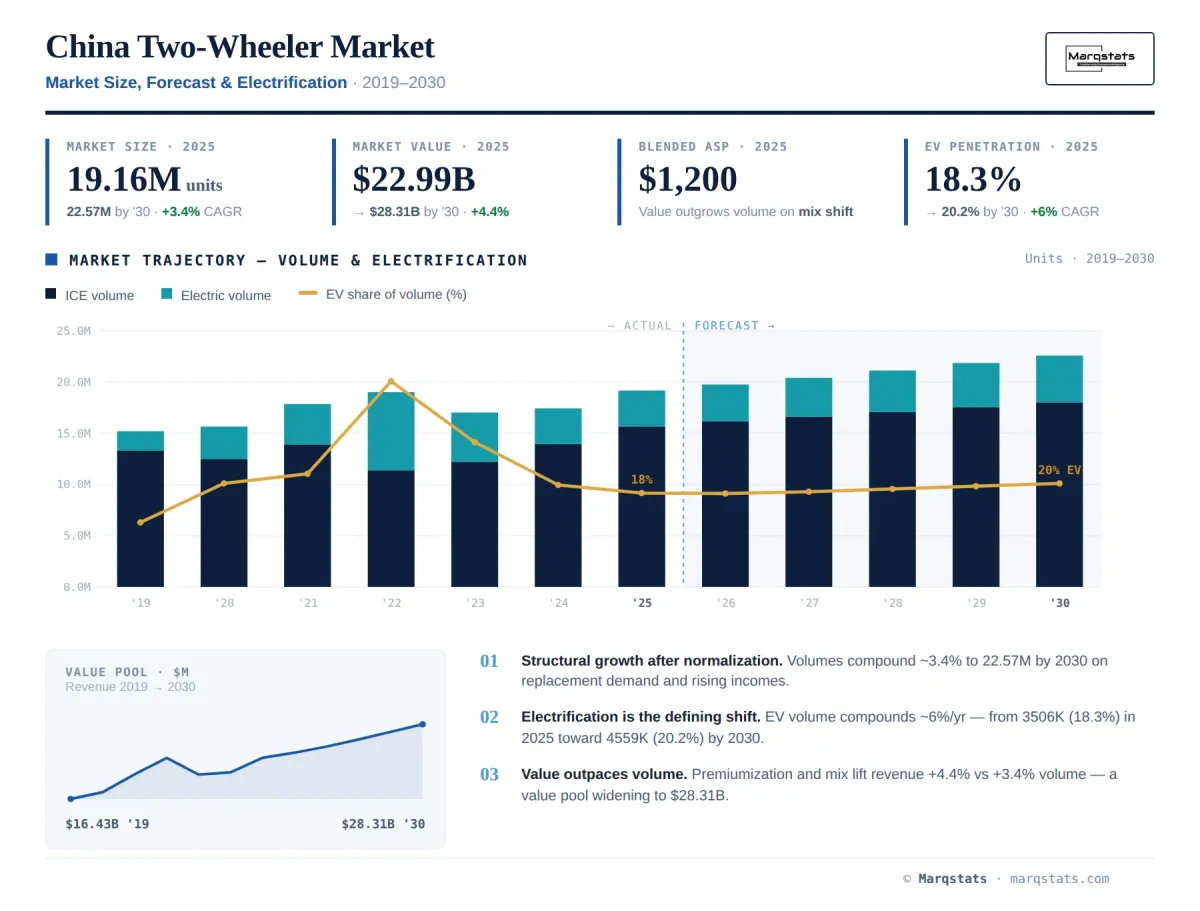
The China two-wheeler market reached 19.16 million units in 2025 and is projected to reach 22.57 million units by 2030, expanding at a 3.40% CAGR across the 2026–2030 forecast period; in value terms the market rises from USD 22.99 billion to USD 28.31 billion. China is both the world's largest producer of two-wheelers and among its largest markets, an industry defined by immense scale, deep fragmentation, and a decisive shift toward electrification and premium models. This study covers motorcycles and higher-power electric scooters and motorcycles; low-speed electric bicycles governed by the national GB 17761 standard are treated as a separate category and are not included in these figures.
Demand is anchored by affordability, with scooters accounting for 70.7% of 2025 volume and entry and mass models representing about two-thirds of the market. The competitive field is unusually fragmented: hundreds of manufacturers compete, and the largest brand, Haojue, holds only around 12% of unit sales. Alongside stable commuter demand, premium and large-displacement leisure motorcycles are the fastest-growing part of the market, propelled by rising incomes and a wave of capable domestic brands such as VOGE, QJMotor, and CFMOTO that are expanding aggressively at home and abroad.
Electrification and exports define the industry's direction. Higher-power electric two-wheelers hold about 18% of 2025 volume and are shifting toward higher-specification models, while a new national safety standard for electric bicycles is reshaping the adjacent low-speed segment. Growth is driven by premiumisation, electrification, and a booming delivery economy, tempered by urban restrictions on motorcycles and rising car ownership, producing a mature, high-volume market whose value grows faster than its units.
Key Takeaways
Market Overview & Analysis
Report Summary
The China two-wheeler market comprises motorcycles, scooters, and mopeds sold for personal and commercial use across internal combustion and electric propulsion. This study segments demand by vehicle type, propulsion type, engine displacement and motor power, price band, end user, sales channel, and brand, with a 2025 base year, historical coverage from 2021 to 2025, and forecasts to 2030. The scope covers motorcycles and higher-power electric scooters and motorcycles, and treats low-speed electric bicycles under the GB 17761 standard as a separate category, so the figures are not directly comparable with headline counts of China's much larger electric-bicycle fleet.
China is the pivot of the global two-wheeler industry, serving simultaneously as a vast domestic market and the world's dominant producer. National output far exceeds domestic sales, and the China Chamber of Commerce for Motorcycle reports motorcycle exports rising strongly, with monthly export value growing at double-digit rates through 2025. Domestically, demand has matured: basic commuter use faces competition from cars and public transport, and several cities restrict motorcycles in urban cores, yet a fast-growing premium and leisure segment offsets softness at the bottom of the range.
Supply is led by domestic manufacturers. Haojue, produced by Jiangmen Dachangjiang and backed by a Suzuki partnership, has been the country's top-selling brand for two decades, followed by Loncin, Zongshen, Zontes, and the Honda joint ventures Sundiro Honda and Wuyang-Honda. Premium and export-oriented brands including VOGE, QJMotor, CFMOTO, Kove, and Benelli are reshaping perceptions of Chinese motorcycles, while electric two-wheelers are contested by specialists such as Yadea, Luyuan, Sunra, NIU, and Aima. Competition spans price, powertrain, battery technology, and increasingly design and connectivity.
The industry's scale is without parallel. China accounts for roughly half of global two-wheeler production, and its manufacturing base spans thousands of assemblers and component suppliers concentrated in Chongqing, Guangdong, and Zhejiang. This depth gives Chinese producers a decisive cost and speed advantage in both combustion and electric platforms, and it underpins a widening export engine that increasingly targets higher-value European and developed markets rather than only price-sensitive emerging ones. Domestically, the market has passed peak volume for basic commuting, so growth now depends on premiumisation, electrification, commercial fleets, and exports rather than first-time ownership, a structural shift that reshapes where value accrues across the value chain.
Market Dynamics
Key Drivers
- Growth is driven by premiumisation, as rising incomes lift demand for large-displacement leisure motorcycles above 250cc, which grow at double-digit rates from a small base.
- The delivery and gig economy expands commercial demand, with food-delivery and logistics platforms sustaining fleet purchases that grow faster than private ownership.
- A deep, mature supply chain in batteries, motors, and components underpins electrification and gives Chinese manufacturers a global cost and scale advantage.
- Export demand supports volume and value, as Chinese brands expand rapidly in Europe, Southeast Asia, and Latin America with competitively priced, higher-specification models.
- E-commerce maturity lifts sales, with online channels reaching about 22% of volume and growing at a double-digit CAGR, the highest online share among major markets.
Key Restraints
- Urban motorcycle restrictions constrain demand, as several major cities limit or ban motorcycles in central districts to reduce congestion and accidents.
- Rising car ownership erodes basic commuter demand, with two-wheelers increasingly positioned as leisure or last-mile vehicles rather than primary transport in wealthier cities.
- Tighter safety regulation raises costs, as the updated GB 17761 electric-bicycle standard imposes stricter weight, speed, and fire-safety requirements that reshape the low-speed segment.
Key Trends
- Electrification is moving upmarket, as manufacturers shift from low-power commuters toward higher-power, higher-specification electric models; the Thailand electric two-wheeler market offers a regional comparison for this transition.
- Battery innovation accelerates, with major brands introducing sodium-ion, graphene, and higher-density lithium systems to improve range, cost, and cold-weather performance.
- Domestic brands premiumise and globalise, as VOGE, QJMotor, CFMOTO, and Benelli win share at home and expand exports to Europe and beyond.
- Connected and smart features spread, with app connectivity, telematics, and anti-theft systems becoming standard across mid and premium electric and combustion models.
Market Segmentation
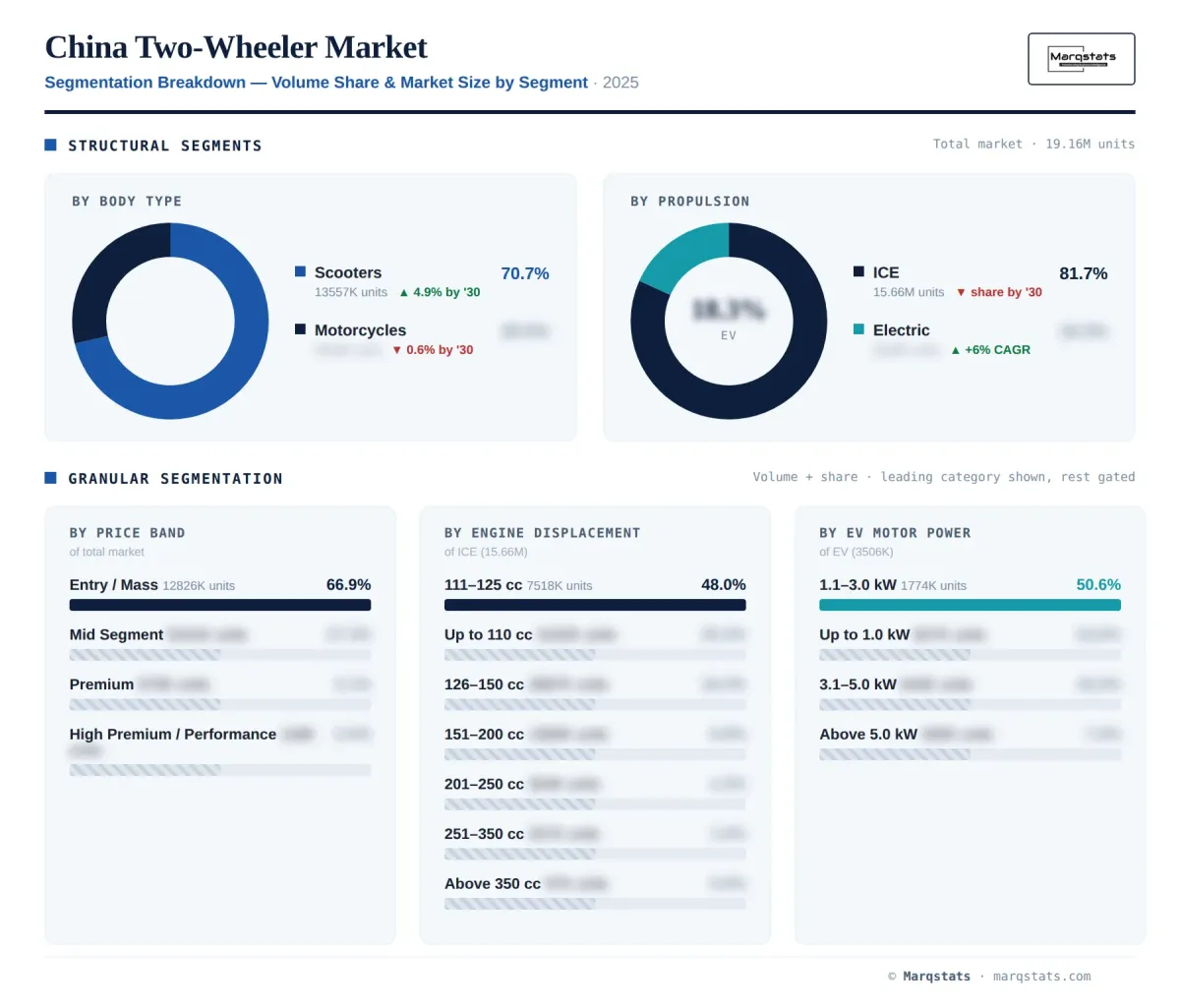
Scooters dominate at 70.7% of 2025 volume, about 13.56 million units, growing at a 4.86% CAGR. Automatic scooters suit dense urban commuting, delivery, and family transport, and they host most electric two-wheeler models. The category's steady growth, against declining conventional motorcycles, reflects a shift toward convenience-oriented, easy-to-ride machines across China's cities and towns. Both combustion and electric scooters benefit from this preference, and the format's practicality for short urban trips and last-mile delivery makes it the natural platform for the market's electrification and connectivity trends.
Conventional motorcycles account for about 5.46 million units in 2025, roughly 28% of volume, and decline marginally at a 0.60% CAGR. Within this segment, entry commuter models soften while premium and large-displacement leisure motorcycles grow strongly, so the category's value holds even as unit volumes edge lower, reflecting a clear premiumisation of demand.
Mopeds account for about 148,000 units in 2025, a small and declining share, as buyers migrate toward more capable scooters and electric models better suited to urban and delivery use.
Combustion models hold about 82% of 2025 volume in this scope, roughly 15.66 million units, growing at a 3% CAGR. Combustion remains central to commuting, rural mobility, and the fast-growing premium and export-oriented leisure segment, supported by a vast, mature manufacturing base and deep distribution across the country. While basic commuter combustion demand is mature, the large-displacement leisure category has revitalised the segment, and China's engine-manufacturing expertise, including contract production for global marques, underpins both domestic premium models and a rapidly expanding export business.
Higher-power electric two-wheelers hold about 18% of 2025 volume in this scope, roughly 3.51 million units, growing at a 6.11% CAGR, after a boom-and-correction cycle that peaked in 2022. Growth is concentrated in higher-power classes above 5 kW, which expand fastest as manufacturers move upmarket. Separately, China operates the world's largest low-speed electric-bicycle fleet under the GB 17761 standard, a distinct category outside this sizing yet central to the country's broader electric-mobility leadership.
Within the higher-power electric segment, competition is intense and technology-led. Yadea, Luyuan, Sunra, and Aima compete on range, price, and smart features, while NIU pioneered a premium, connected scooter model aimed at urban consumers. Combustion incumbents are entering directly, with Honda launching the E-VO through Wuyang-Honda, and battery innovation is a central battleground, spanning sodium-ion, graphene-enhanced, and higher-density lithium chemistries aimed at improving cost, range, and cold-weather performance. China's dominance of the global battery and motor supply chain gives these players a structural advantage as electrification scales.
The entry and mass band is the volume core at about 12.83 million units in 2025, roughly 67% of the market, growing at a 2.9% CAGR, while the mid segment adds about 5.24 million units and grows faster at 5%. Together these bands anchor affordable, high-volume demand that Chinese manufacturers serve at unmatched scale and cost. This affordable core underpins both domestic commuting and the export business, and the gradual migration of buyers from the entry tier into the mid segment is a key indicator of rising incomes and premiumising demand.
Premium volumes grow at a 7% CAGR and the high-premium and performance band at about 9%, the fastest of any price tier. Large-displacement leisure and performance models drive this expansion, as affluent urban riders and enthusiasts adopt motorcycling as a lifestyle, and as domestic premium brands close the gap with established global marques. Models above 250cc, though a small share of total units, are growing at double-digit rates and command far higher prices, so this segment contributes disproportionately to market value and is the primary battleground where domestic brands such as VOGE, QJMotor, and CFMOTO challenge imported premium marques both at home and in export markets.
Private consumers account for about 84% of 2025 volume, spanning commuters, rural users, and a growing enthusiast base. Consumer demand is increasingly bifurcated between affordable commuting and aspirational leisure riding, shaping distinct product and brand strategies. In wealthier cities, motorcycling is shifting from necessity toward lifestyle, supporting premium and large-displacement sales, while in smaller cities and rural areas the two-wheeler remains an essential, affordable mode of everyday transport.
Commercial demand grows faster than private use. Delivery and logistics expands at an 8.2% CAGR as food-delivery and parcel platforms scale, driving demand for durable, fleet-grade two-wheelers and battery-swap solutions that minimise rider downtime in China's vast last-mile networks. The country's food-delivery and e-commerce platforms operate some of the world's largest rider fleets, and their emphasis on uptime, telematics, and route optimisation makes them early adopters of electric and connected two-wheelers, giving the commercial segment strategic weight well beyond its share of volume.
Physical dealerships handle the majority of sales, providing financing, registration, and after-sales service across a dense national network. Dealers remain central for premium and large-displacement machines where test rides and service support influence purchase.
The online channel reaches about 22% of 2025 volume, the highest share among major markets, and grows at a 12.56% CAGR. China's advanced e-commerce ecosystem supports online research, configuration, and direct purchase, particularly for electric and mid-range models, complementing the dealer network. Integrated online-to-offline models, livestream commerce, and direct-to-consumer brand channels have accelerated digital adoption, and manufacturers increasingly use online platforms both for sales and for building brand communities among younger and enthusiast riders.
By Geography
East China
East China, centred on the Yangtze River Delta and cities such as Shanghai, Hangzhou, and Nanjing, is the largest regional market, supported by dense urban populations, high incomes, and mature supply chains. The region leads premium and electric adoption and hosts major delivery-fleet demand. Its concentration of affluent consumers, technology firms, and e-commerce infrastructure makes it the primary market for connected and higher-specification models, and it sets the pace for trends that later diffuse to inland provinces.
South China & the Pearl River Delta
South China, anchored by Guangdong, combines large domestic demand with the country's manufacturing and export heartland. The region concentrates production, component supply, and export logistics, and sustains strong commuter and commercial two-wheeler use across Guangzhou, Shenzhen, and surrounding cities. Its proximity to ports and its dense supplier ecosystem make it the launchpad for both domestic sales and the export models that increasingly define manufacturer strategy.
Western & Southwest China
Western and southwest provinces, including Chongqing, Sichuan, and Yunnan, post some of the fastest volume gains as infrastructure investment and hilly terrain favour two-wheelers. Chongqing is also a historic motorcycle-manufacturing base, home to Loncin, Zongshen, and Lifan. The combination of a large manufacturing cluster and strong local demand gives the region outsized influence over the domestic industry, and its mountainous geography sustains demand for higher-displacement and electric models with greater power and range.
China as the World's Export Hub
Beyond domestic demand, China is the world's dominant two-wheeler producer, exporting millions of motorcycles annually to Southeast Asia, Africa, Latin America, and increasingly Europe. Rising export value, led by premium brands, is a defining feature of the industry and a growing driver of manufacturer strategy. Monthly motorcycle export value has risen at double-digit rates through 2025, reflecting both higher volumes and a shift toward higher-specification, higher-priced models, and this export engine increasingly shapes domestic product development as manufacturers design for European emissions and safety standards to serve global markets.
How Competition Is Evolving
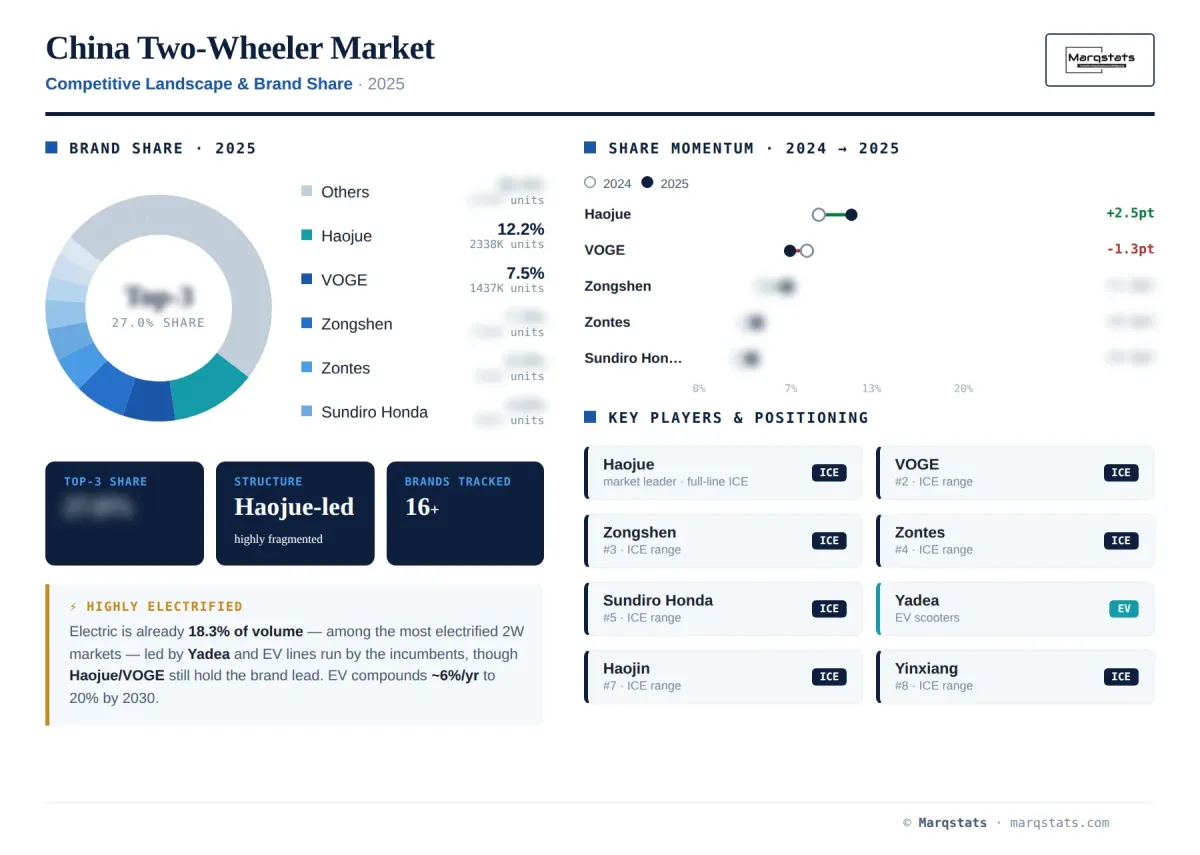
The China two-wheeler market is highly fragmented, with hundreds of manufacturers and no dominant brand. Haojue, produced by Jiangmen Dachangjiang and supported by a long Suzuki partnership, is the largest and has led domestic sales for two decades, yet holds only around 12% of unit sales. Loncin, Zongshen, Zontes, and the Honda joint ventures Sundiro Honda and Wuyang-Honda follow, while a broad tail of smaller producers accounts for a substantial share of the market. This fragmentation reflects China's enormous manufacturing capacity, low barriers to assembly, and strong export demand, which together sustain many mid-sized producers that would struggle to survive in more consolidated markets.
Two competitive shifts stand out. First, premiumisation: domestic brands including VOGE, owned by Loncin, QJMotor and Benelli under Qianjiang, and CFMOTO have moved rapidly upmarket into mid and large-displacement motorcycles, winning affluent domestic riders and expanding exports to Europe on the strength of high specification and competitive pricing. Second, electrification: pure-play electric brands such as Yadea, Luyuan, Sunra, NIU, and Aima compete on battery technology, range, smart features, and design, and are joined by combustion incumbents launching electric models, including Honda's E-VO through Wuyang-Honda.
Competition centres on scale, cost, powertrain, and increasingly brand and technology. Growth is attributed to manufacturers that combine manufacturing scale with credible premium and electric portfolios, moreover rewarding those able to globalise through exports. The market's fragmentation persists because vast production capacity, a deep supply chain, and strong export demand sustain many viable producers, even as premiumisation and electrification gradually concentrate value among the more capable brands.
Companies Covered
Companies covered in the report include:
Recent Market Activity
Table of Contents
Coverage & Segmentation
This report provides a comprehensive assessment of the China two-wheeler market across a 2025 base year, historical data from 2021 to 2025, and forecasts spanning 2026 to 2030. Market sizing is presented in unit-volume terms and complemented by value analysis in United States dollars, with segmentation by vehicle type, propulsion type, engine displacement and motor power, price band, end user, sales channel, and brand. The scope covers motorcycles and higher-power electric scooters and motorcycles; low-speed electric bicycles governed by the GB 17761 standard are treated as a separate category and excluded from this sizing, so figures are not directly comparable with China's much larger electric-bicycle fleet.
The study covers demand drivers, restraints, and structural trends, with particular focus on premiumisation, electrification, the export engine, the delivery economy, and the fragmented competitive structure. Competitive analysis quantifies brand shares and profiles combustion, premium, and electric producers, while segment forecasts identify where volume and value growth concentrate through 2030. An extended forecast to 2035 is available under customization for subscribers requiring a longer planning horizon, alongside deeper cuts by region, brand, or channel on request.