Market Snapshot
Middle bar: base-year value × (1 + CAGR), rounded to two decimals. This is a calculated illustration, not a separately researched annual estimate.
The China electric scooter market is estimated at 3,506,200 units in 2025 and is projected to reach 4,261,349 units by 2030, registering a volume CAGR of 3.98% over 2026–2030. In value terms the market is estimated at USD 5.08 billion in 2025 and is projected to reach USD 6.71 billion by 2030, a CAGR of 5.72%. The market comprises new electric mopeds and electric motorcycles that require a licence plate and a motorcycle driving licence in China, and excludes electric bicycles certified under GB 17761. China is the largest electric scooter market in the world, and the segment equals 5.97% of the 58.77 million electric two-wheelers sold domestically in 2025.
Market size and forecast figures are generated using Marqstats' proprietary estimation framework, updated as of October 2026.
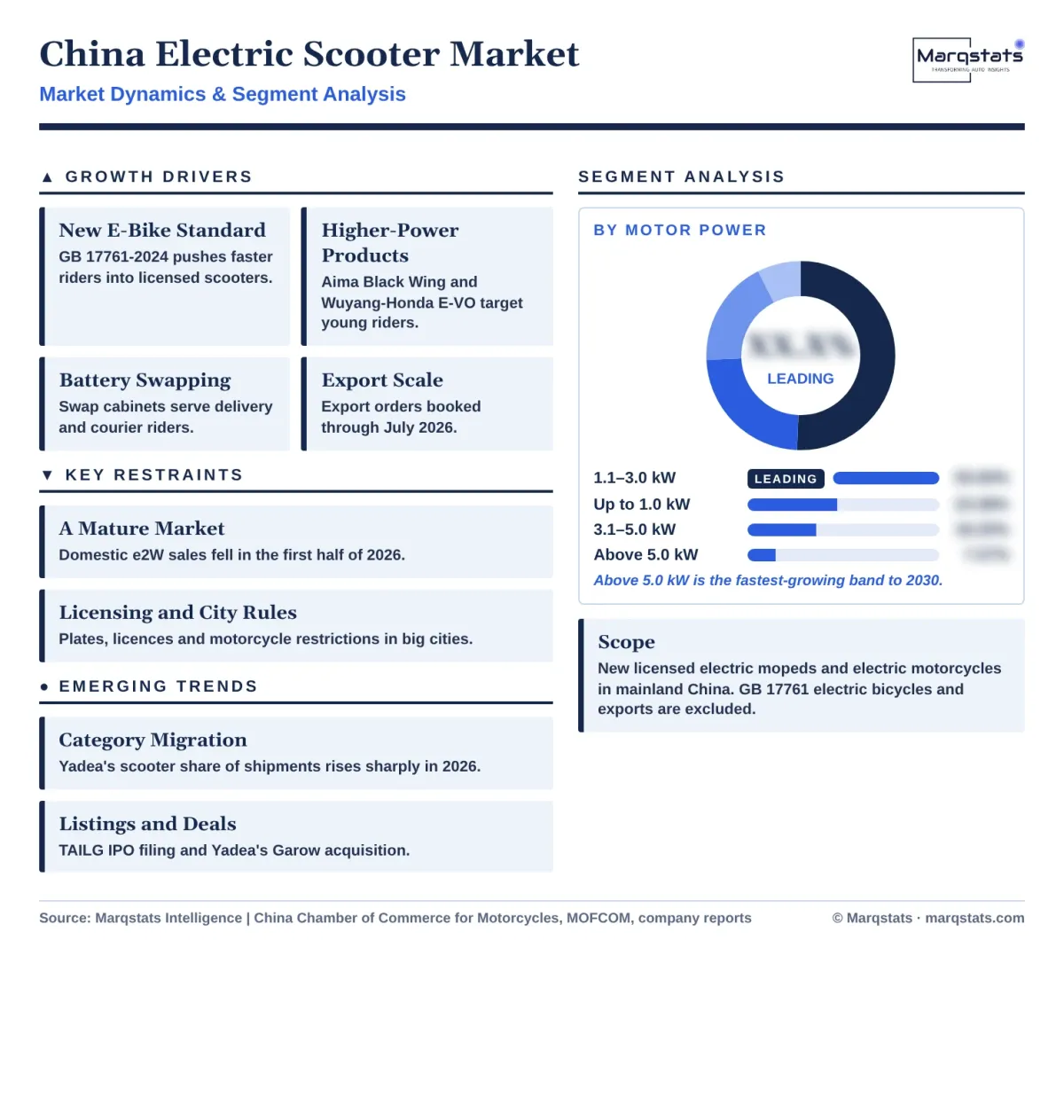
The 1.1–3.0 kW band is the dominant power segment at 50.60% of units, and the above-5.0 kW band is the fastest-growing at 12.63% a year. Yadea Group Holdings Ltd. led electric motorcycle sales in 2025 with 921,100 units according to the China Chamber of Commerce for Motorcycles, ahead of Zhejiang Luyuan with 591,500 and Zongshen with 465,100. Value grows faster than volume because the average selling price rises from USD 1,449 in 2025 to USD 1,575 by 2030 as buyers move to higher-power models.
Key Takeaways
Market Overview & Analysis
Report Summary
The China electric scooter market covers new electric two-wheelers that fall outside the electric bicycle category and must be registered, plated and ridden with a motorcycle driving licence: electric mopeds and electric motorcycles. The market is estimated at 3,506,200 units in 2025, up 1.14% on 3,466,600 units in 2024, and reaches 3,568,260 units in 2026 and 4,261,349 units by 2030, adding 755,149 units. The market peaked at 7,632,700 units in 2022 and fell to 4,810,500 units in 2023, before stabilising at 3,466,600 units in 2024. Electric bicycles under GB 17761, kick scooters, electric tricycles and internal combustion motorcycles sit outside the perimeter.
The licensed electric scooter is a small part of China's electric two-wheeler market. Domestic electric two-wheeler sales reached 58.77 million units in 2025, up 16.6%, which is 16.76 times the 3,506,200-unit licensed market. Most of the domestic total consists of electric bicycles, which need no driving licence and are capped at 25 km/h, and the Ministry of Commerce reported that more than 12.5 million electric bicycles were traded in under the 2025 old-for-new programme. Brand shares quoted on the full basis therefore describe electric bicycles first and licensed electric scooters second, and the licensed segment equals 5.97% of domestic electric two-wheeler volume.
The new national standard is moving demand across the category boundary. GB 17761-2024, issued on 31 December 2024, took effect on 1 September 2025: production of non-compliant electric bicycles stopped on 31 August 2025 and retailers were allowed to sell remaining stock only until 30 November 2025. The standard requires motor assistance to cut off at 25 km/h with anti-tampering protection for controllers and speed limiters, limits non-metallic materials to 5.5% of vehicle weight and shortens the saddle to 350 mm, which discourages carrying adult passengers. Buyers who want higher speed or a passenger seat must now buy a licensed electric moped or motorcycle, which supports the licensed segment while the bicycle category contracts.
Company data show the shift inside the largest manufacturer. Yadea Group Holdings Ltd. shipped 7.632 million two-wheelers in the first half of 2026, of which electric scooters and motorcycles rose 63.7% to 3.484 million and electric bicycles fell 37.8% to 4.148 million, according to its interim results. In full-year 2025, Yadea shipped 16.27 million units, including 11.45 million electric bicycles and 4.82 million electric scooters across domestic and export markets. Aima Technology Group Co., Ltd. sold 10.95 million units in 2025, including 2,615,982 electric motorcycles and 8,334,080 electric bicycles, so electric motorcycles were 23.89% of its volume.
Licensed electric motorcycle sales are led by a different set of companies from the electric bicycle market. The China Chamber of Commerce for Motorcycles ranked Yadea first in 2025 electric motorcycle sales with 921,100 units, followed by Zhejiang Luyuan with 591,500 and Zongshen with 465,100. Zongshen, a Chongqing petrol motorcycle manufacturer, does not appear among the top electric bicycle brands, which shows that licensed electric motorcycles draw on motorcycle-industry capability, distribution and homologation experience. The three leaders together sold 1,977,700 electric motorcycles in 2025, including units sold abroad.
The volume leaders are more profitable than at any point in the past five years. Yadea reported 2025 revenue of RMB 37.01 billion, up 31.1%, and profit attributable to shareholders of RMB 2.91 billion, up 128.8%, with gross margin rising from 15.2% to 19.1%; its electric scooter line generated RMB 9.05 billion of revenue. TAILG reported revenue of RMB 14.8 billion in the first three quarters of 2025, up 38.6%, and net profit of RMB 820 million, after RMB 13.6 billion of revenue in 2024, and sold 7.8 million vehicles in the nine months. Higher profits fund the move into licensed scooters, overseas plants and new brands.
Licensed electric scooters sit inside a growing motorcycle industry. The China Chamber of Commerce for Motorcycles reported 2025 motorcycle output of 22.11 million units, up 10.6%, sales of 21.97 million, up 10.2%, and exports of 13.37 million, up 21.3%. Petrol and electric motorcycles share homologation rules, licensing and dealer networks in China, so motorcycle manufacturers in Chongqing, Guangdong and Zhejiang can add electric models to existing lines at low incremental cost. This structure explains why Zongshen and Luyuan rank alongside Yadea in licensed electric motorcycles, while they are smaller players in electric bicycles.
Domestic demand weakened in 2026. Domestic electric two-wheeler sales fell 37.9% year on year to 2.99 million units in February 2026, affected by holiday timing and the standard transition, and fell 12.6% to 28.25 million units in the first half of 2026. Aima took 24.9% of first-quarter 2026 domestic retail sales with 2.407 million units, ahead of Yadea with 2.073 million, reversing their 2025 ranking on the full basis, where Yadea held 25.5% and Aima 19.4%. The licensed segment grows at 3.98% a year to 2030, slower than other markets, because China's electric scooter market is already mature.
Smart-scooter brands are gaining share on the full basis. Niu Technologies reported 31% revenue growth for 2025, with China sales up 46% to more than 1.11 million units, and China sales of 402,202 units in the second quarter of 2026, up 26.2%, against a falling domestic market. Ninebot Limited sold 4.09 million electric two-wheelers in 2025, up 64.5%, and raised its domestic share by 1.8 percentage points to 6.9%, while TAILG lost 2.4 points to 11.7%. Connected, app-controlled models priced above mass-market scooters are the fastest-growing part of the domestic market.
Exports are the growth outlet for Chinese manufacturers. Orders for Chinese electric motorcycles were booked through July 2026 on export demand from Europe, Southeast Asia and Latin America, and African imports of Chinese electric motorcycles and three-wheelers rose sharply in the first half of 2026. Yadea, Aima, TAILG, Luyuan and Niu Technologies are building plants in Vietnam, Indonesia, Mexico and Thailand, and electric motorcycle exhibitors and buyers increased at the Canton Fair in October 2025. Domestic volume therefore understates the scale of China's electric scooter industry, which serves most of the world's markets from the same production base.
Market Dynamics
Key Drivers
Five conditions drive the China electric scooter market, and the national electric bicycle standard matters more than any subsidy.
- GB 17761-2024 pushes faster vehicles into the licensed category. The 25 km/h cut-off, anti-tampering rules and 350 mm saddle limit that took effect on 1 September 2025 remove speed and passenger capacity from electric bicycles. Yadea's electric scooter and motorcycle shipments rose 63.7% in the first half of 2026 as buyers moved up a category.
- Higher-power products for younger riders. Aima launched the Black Wing performance brand in June 2026 to appeal to young male riders as demand shifts to higher-specification models, and Wuyang-Honda revealed the E-VO, Honda's first electric motorcycle developed for China, in July 2025. The above-5.0 kW band grows at 12.63% a year to 480,826 units by 2030.
- Battery-swap networks for delivery riders. China Tower Corporation Limited's energy unit and private operators run battery-swap cabinets for food-delivery and courier riders in major cities, which removes battery cost and charging time from high-mileage use. Delivery fleets favour 3.1–5.0 kW scooters, a band that grows at 7.57% a year.
- New battery chemistries lower cost and fire risk. Chinese manufacturers invested heavily in sodium-ion batteries for electric scooters in 2025, with sodium-powered models appearing in cities such as Hangzhou, and lithium-iron-phosphate packs replace lead-acid in licensed models. Lower pack costs allow higher range and power at stable prices. Safety-led battery upgrades also help manufacturers meet city fire-safety rules for charging in residential buildings.
- Export demand supports domestic capacity. Orders for Chinese electric motorcycles were booked through July 2026 on export demand, and CIMAMotor 2026 in Chongqing drew more than 1,000 exhibitors in September 2026 with electric motorcycles a major focus. Export scale lowers unit costs for products sold at home.
Key Restraints
Four constraints limit growth, and market maturity is the most important.
- A mature market with high ownership. China's licensed electric scooter market grows at only 3.98% a year to 2030, and domestic electric two-wheeler sales fell 12.6% in the first half of 2026. Replacement demand, rather than first purchases, now drives most sales.
- Licensing and registration requirements. Licensed electric mopeds and motorcycles need plates, a motorcycle driving licence and in many cities face motorcycle traffic restrictions, which keeps many commuters in the electric bicycle category. The up-to-1.0 kW band declines at 0.12% a year, from 826,848 units in 2025 to 822,066 by 2030. Large cities including Beijing, Shanghai and Guangzhou have restricted or capped motorcycle plates for many years, and licensed electric motorcycles fall under the same rules, which limits the addressable market in the richest urban centres.
- End of trade-in support. More than 12.5 million electric bicycles were traded in under the 2025 old-for-new programme, which pulled replacement demand forward into 2025. February 2026 domestic sales fell 37.9% year on year to 2.99 million units as that support faded.
- Price competition and margin pressure. The average selling price of a licensed electric scooter is approximately USD 1,449 in 2025, and Yadea, Aima, TAILG, Ninebot and Niu compete across the same price bands. Overseas expansion is partly a response to domestic margin pressure.
Key Trends
Four shifts show where the market is moving and which companies benefit.
- Category migration from electric bicycles to licensed scooters. Yadea's interim results show electric scooters and motorcycles rising to 45.65% of its first-half 2026 shipments, from 29.63% in full-year 2025, as GB 17761-2024 narrowed the electric bicycle category. The 3.1–5.0 kW band rises from 18.25% of licensed units in 2025 to 21.63% by 2030.
- Capital markets activity. TAILG Technology Co., Ltd. filed for a Hong Kong listing in January 2026, Lobo EV Technologies Ltd. launched a public share offering in January 2025, and a Yadea-affiliated entity agreed to acquire Garow Technology Group in August 2026. Listings fund overseas capacity and component integration.
- New entrants from consumer electronics. Phone maker Transsion Holdings Limited set up a mobility division in June 2025 and expanded into electric two-wheelers, following Ninebot Limited and Niu Technologies, which apply smartphone-style connectivity and app ecosystems to scooters. Consumer-electronics distribution and online retail give these entrants reach without a traditional dealer network.
- Smart and connected scooters. Niu Technologies sold 1.11 million units in China in 2025, up 46%, and shipped 537,457 units worldwide in the third quarter of 2026, up 15.4%, on connected models with app control and anti-theft functions. Connectivity is becoming a standard feature in the licensed segment.
- Battery standards and fire safety tighten. GB 17761-2024 introduced stricter flame-retardant requirements for seat foam and limited non-metallic materials to 5.5% of vehicle weight, and cities including Guangzhou issued new safety rules. Manufacturers respond with lithium-iron-phosphate and sodium-ion packs, which lift the cost and quality of licensed scooters.
Market Segmentation
The 1.1–3.0 kW band is the dominant segment and the core of China's licensed electric moped market. It accounts for 1,774,115 units in 2025, 50.60% of the total, and reaches 2,036,912 units by 2030 at a 2.80% CAGR, taking 47.80% of the market. Commuter electric mopeds from Yadea, Aima, TAILG and Xinri sit in this band, which grows slowly as the market matures. Lead-acid and lithium-iron-phosphate packs both feature in this band, and sodium-ion models launched in 2025 compete on price and safety.
The up-to-1.0 kW band is the declining segment. It accounts for 826,848 units in 2025, 23.58% of the total, and reaches 822,066 units by 2030 at a -0.12% CAGR, taking 19.29% of the market. Low-power licensed mopeds compete directly with electric bicycles, which need no licence, so the band contracts slightly to 2030.
The 3.1–5.0 kW band is the delivery and high-performance commuter segment. It accounts for 639,928 units in 2025, 18.25% of the total, and reaches 921,545 units by 2030 at a 7.57% CAGR, taking 21.63% of the market. Riders who need more than the 25 km/h electric bicycle limit move into this band, and battery-swap fleets for delivery riders specify it.
The above-5.0 kW band is the fastest-growing segment. It accounts for 265,309 units in 2025, 7.57% of the total, and reaches 480,826 units by 2030 at a 12.63% CAGR, taking 11.28% of the market. Electric motorcycles from Zongshen, Luyuan, Aima's Black Wing brand and Wuyang-Honda's E-VO target younger riders and motorcycle buyers. Zhejiang Qianjiang Motorcycle Co., Ltd., part of the Geely group, adds electric models to its QJMotor petrol range for the same buyers.
By Geography
Eastern China
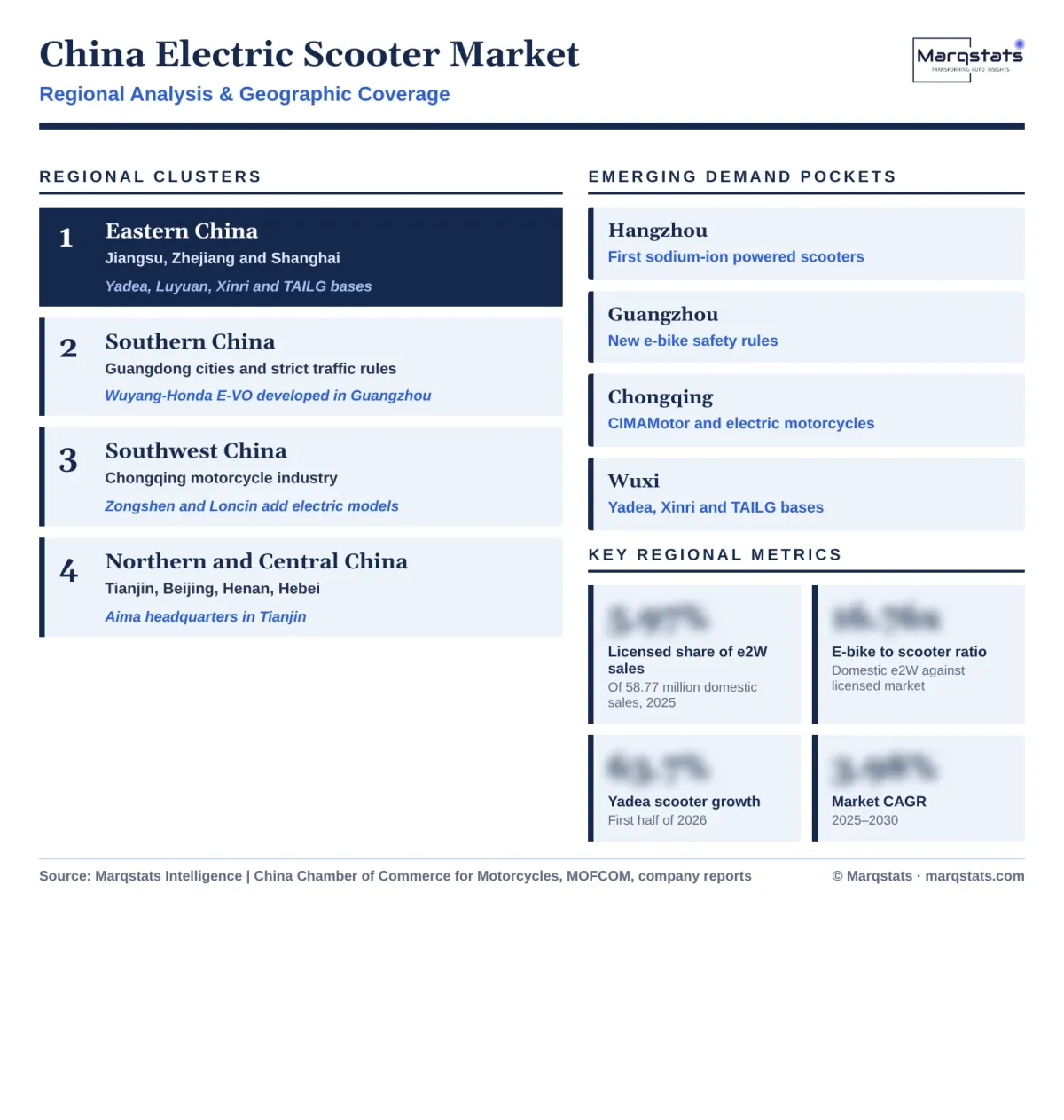
Eastern China, covering Jiangsu, Zhejiang and Shanghai, is the centre of electric scooter manufacturing and the largest consumer market. Yadea is headquartered in Wuxi, Jiangsu, Xinri (Sunra) in Wuxi, Luyuan in Jinhua, Zhejiang, and TAILG in Wuxi and Tianjin, and sodium-ion powered scooters first appeared in Hangzhou in 2025. Dense cities and high delivery volumes make the region the main market for 3.1–5.0 kW scooters. Yadea's Wuxi base and Luyuan's Jinhua base supply 921,100 and 591,500 licensed electric motorcycles respectively, the two largest totals in 2025.
Southern China
Southern China, led by Guangdong, combines high scooter ownership with strict city traffic rules. Guangzhou introduced new electric bicycle regulations with enhanced safety standards after GB 17761-2024, and Wuyang-Honda, based in Guangzhou, developed the E-VO for the Chinese market. Licensing and city restrictions on motorcycles shape the mix between electric bicycles and licensed scooters. Dachangjiang, the Jiangmen-based maker of Haojue motorcycles, and other Guangdong motorcycle manufacturers add electric models to established petrol ranges.
Southwest China
Southwest China, centred on Chongqing, is the base of China's petrol motorcycle industry and an emerging source of electric motorcycles. Zongshen sold 465,100 electric motorcycles in 2025, the third-largest total, and CIMAMotor 2026 in Chongqing drew more than 1,000 exhibitors with electric motorcycles a major focus. Motorcycle-industry suppliers bring homologation and motorcycle distribution experience to the licensed segment. Loncin Motor Co., Ltd., also based in Chongqing, develops electric motorcycles alongside its petrol range, and the city's export-oriented motorcycle plants serve Africa, Southeast Asia and Latin America.
Northern and Central China
Northern and central China, including Tianjin, Beijing, Henan and Hebei, form a large market for low- and mid-power licensed scooters. Tianjin hosts major plants of TAILG, Aima and Yadea, which supply both domestic and export markets. Lead-acid battery models remain common in the lower-price tiers of the licensed segment. Aima, headquartered in Tianjin, led first-quarter 2026 domestic retail sales on the full basis with 2.407 million units and a 24.9% share, and its electric motorcycles accounted for 2,615,982 of its 10.95 million units in 2025.
How Competition Is Evolving
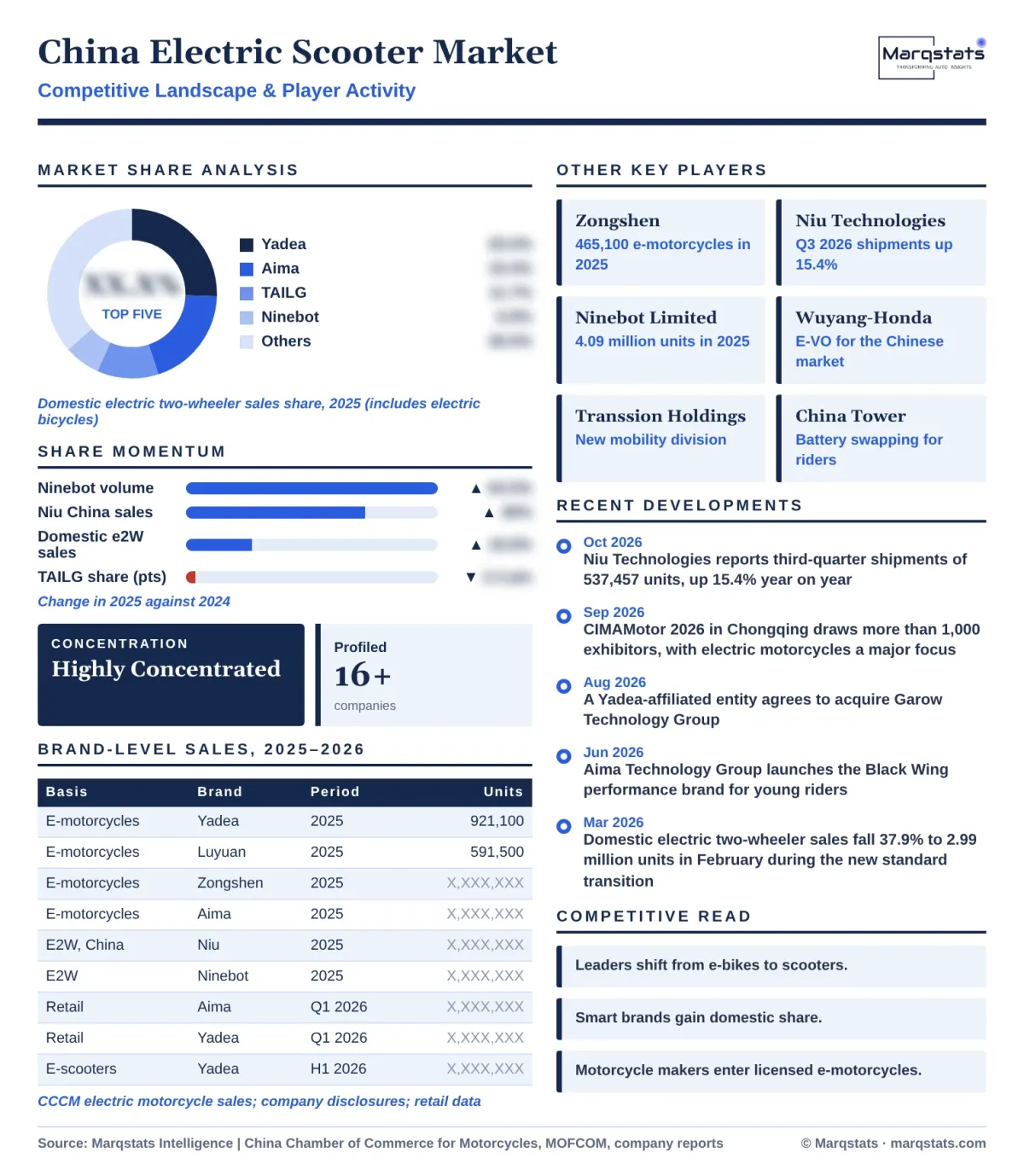
The market is highly concentrated, with five companies dominating the full electric two-wheeler basis. On domestic sales in 2025, Yadea Group Holdings Ltd. held 25.5%, Aima Technology Group Co., Ltd. 19.4%, Tailg Technology Co., Ltd. 11.7%, Ninebot Limited 6.9% and Niu Technologies about 2%, a combined 65.5%. In licensed electric motorcycles, Yadea, Zhejiang Luyuan and Zongshen sold 1,977,700 units between them in 2025. Rankings moved in 2026: Aima took 24.9% of first-quarter domestic retail sales with 2.407 million units, ahead of Yadea with 2.073 million, which shows how quickly share shifts between the two leaders as product mixes change under the new standard.
Competitive strategy splits three ways. Volume leaders Yadea, Aima and TAILG compete on dealer reach, price and overseas plants, and are moving their mix from electric bicycles to licensed scooters as GB 17761-2024 takes hold. Smart-scooter brands Ninebot and Niu compete on connectivity, design and premium pricing, and Ninebot sold 4.09 million electric two-wheelers in 2025, up 64.5%, and 2.844 million in the first half of 2026, up 19%. Motorcycle manufacturers such as Zongshen, Loncin, Dachangjiang and Qianjiang bring licensed electric motorcycles to their existing motorcycle dealers.
Overseas reach is now part of competitive scale. TAILG reported more than 700 overseas sales points at 30 September 2025, Yadea is commissioning a USD 100 million plant in Vietnam to support Southeast Asian growth, and Niu Technologies sold 261,624 units in the first quarter of 2026 across electric motorcycles, mopeds and kick scooters. Ninebot's growth of 64.5% in 2025 came largely from domestic smart scooters, while Yadea combined domestic recovery with rising overseas sales, which shows two different routes to scale.
The competitive question to 2030 is which companies capture the move from electric bicycles to licensed scooters. Yadea's first-half 2026 results show the largest volume leader already shifting, with electric scooters and motorcycles reaching 3.484 million units, while Aima overtook Yadea in first-quarter 2026 retail sales on the full basis. Market maturity at home pushes every leader abroad, so overseas plants in Vietnam, Indonesia and Mexico increasingly decide relative scale.
Companies Covered
Companies covered in the report include:
Recent Market Activity
Table of Contents
Coverage & Segmentation
The China electric scooter market comprises new electric mopeds and electric motorcycles sold in mainland China that require registration, plates and a motorcycle driving licence, sized in units and in USD at manufacturer selling prices. The market is segmented by motor power into four bands: up to 1.0 kW, 1.1–3.0 kW, 3.1–5.0 kW and above 5.0 kW. Regional analysis covers eastern, southern, southwest and northern and central China.
The base year is 2025, the historical period is 2021–2025 and the forecast period is 2026–2030. Electric bicycles certified under GB 17761, kick scooters, electric tricycles, exports and internal combustion motorcycles are excluded. Brand analysis draws on China Chamber of Commerce for Motorcycles data, company annual and interim reports and retail sales data. Volumes are measured as domestic sales of new vehicles in mainland China; Hong Kong, Macau and Taiwan are excluded.