Market Snapshot
Middle bar: base-year value × (1 + CAGR), rounded to two decimals. This is a calculated illustration, not a separately researched annual estimate.
The global high-speed electric scooter market is estimated at 1,236,682 units in 2025 and is projected to reach 2,560,076 units by 2030, registering a volume CAGR of 15.66% over 2026–2030. In value terms the market is estimated at USD 2.51 billion in 2025 and is projected to reach USD 4.99 billion by 2030, a CAGR of 14.73%. The market comprises new road-registered battery electric scooters, mopeds and light motorcycles with motor power of 3.1 to 5.0 kW, the class that reaches 60 to 80 km/h and replaces 100 to 125 cc petrol scooters. The band holds 19.89% of global electric two-wheeler volume in 2025 and 24.75% by 2030.
Market size and forecast figures are generated using Marqstats' proprietary estimation framework, updated as of October 2026.
China is the largest country at 51.74% of 2025 volume, followed by India at 26.39% and Vietnam at 7.22%, and Asia Pacific holds 88.67% of the total. India grows at 24.74% a year against 7.57% for China, and India overtakes China as the largest market by 2030. North America is the fastest-growing region at a 34.20% CAGR, and value grows slightly slower than volume because the average selling price eases from USD 2,030 to USD 1,949 as India gains share.
Key Takeaways
Market Overview & Analysis
Report Summary
The global high-speed electric scooter market covers new battery electric two-wheelers registered for road use with motor power of 3.1 to 5.0 kW. The band sits between commuter scooters rated at 3.0 kW or less and performance scooters and motorcycles rated above 5.0 kW, and its products typically reach 60 to 80 km/h, carry 2.5 to 4 kWh batteries and offer 100 to 150 km of claimed range. The market is estimated at 1,236,682 units in 2025, up 12.12% on 1,103,007 units in 2024, and grows 14.74% to 1,419,020 units in 2026. Electric bicycles, kick scooters, electric three-wheelers and internal combustion scooters sit outside the perimeter.
The series has a cycle. Volume rose from 762,820 units in 2021 to a peak of 1,532,781 units in 2022, fell to 1,172,235 in 2023 and 1,103,007 in 2024, and recovered to 1,236,682 in 2025. The 2022 peak is a China effect, because China supplies more than half of the band's volume, and the recovery from 2025 is led by India. The forecast adds 1,323,394 units by 2030, and the band's share of all electric two-wheeler sales rises from 19.89% to 24.75%, because buyers in India, Southeast Asia and Latin America trade up from low-speed models.
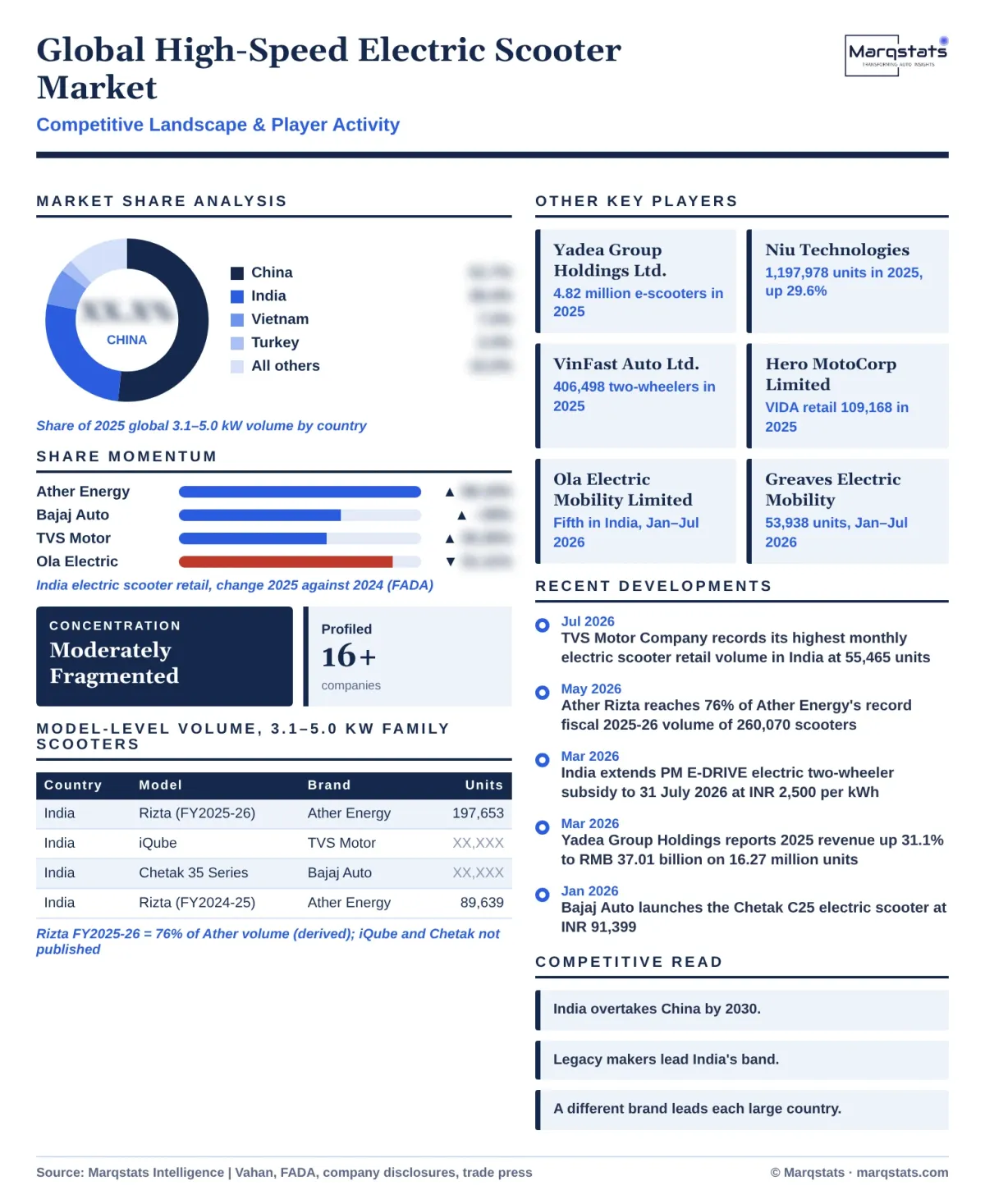
The signature finding is a change of leader. China accounts for 639,928 units in 2025 and India for 326,330, a gap of 313,598 units. India grows at 24.74% a year to 985,441 units by 2030, while China grows at 7.57% to 921,545, so India leads by 63,896 units in 2030 and its share of global volume rises from 26.39% to 38.49%. The 3.1–5.0 kW band already accounts for 25.47% of India's electric two-wheeler volume, against 18.25% in China, where low-power mopeds and electric bicycles dominate.
India's high-speed volume is a family-scooter market. TVS Motor Company Limited retailed 298,881 electric scooters in 2025, up 35.35%, Bajaj Auto Limited 269,847, up nearly 39%, and Ather Energy Limited 200,797, up 58.1%, according to Federation of Automobile Dealers Associations (FADA) retail data reported by Storyboard18. Ola Electric Mobility Limited fell more than 51% to 199,318 units from 407,700, and Hero MotoCorp Limited's VIDA more than doubled to 109,168, in a total market of 1,279,951 units, up 11.36%. The three gainers sell metal- or plastic-bodied family scooters with peak motor ratings of 4.0 to 4.4 kW, which places their core models in this band.
Model data show the shift inside each brand. The Ather Rizta, launched in April 2024 with a 4.3 kW peak motor, took 76% of Ather Energy's record 260,070 scooters in fiscal 2025-26, about 197,653 units, against 58% and 89,639 units in fiscal 2024-25, so Rizta volume more than doubled in a year, according to Autocar Professional. The TVS iQube 3.5 kWh variant uses a 4.4 kW peak hub motor and sells at INR 138,596 ex-showroom, and the Bajaj Chetak 3501 uses a motor of about 4 kW peak and sells at INR 146,132, against INR 146,804 for the Rizta Z 2.9 kWh. TVS retailed more than 307,000 electric scooters in January to July 2026, with a record 55,465 units in July, and Bajaj retailed just under 264,000.
Brand totals and band totals do not map one to one. FADA retail data for TVS and Bajaj alone total 568,728 units in 2025, above India's band estimate of 326,330 units, because both brands sell variants rated below 3.1 kW, such as the Bajaj Chetak C25 launched in January 2026 at INR 91,399 with a 1.8 kW rated and 2.2 kW peak motor. Marqstats assigns models to bands by rated motor power, and marketed peak ratings overstate a model's band; the brand-to-band split is a Marqstats construction and is not independently verified against registrations. The conclusion holds either way: the volume leaders in India's high-speed band are legacy motorcycle makers and Ather, not the performance specialists.
China is the largest market and the slowest-growing large one. Its 639,928 units in 2025 grow at 7.57% a year to 921,545 by 2030. Yadea Group Holdings Ltd. sold 16.27 million electric two-wheelers in 2025, of which 4.82 million were electric scooters and 11.45 million electric bicycles, and its revenue rose 31.1% to RMB 37.01 billion. Niu Technologies sold 1,197,978 units in 2025, up 29.6%, with China sales up 46.5% to 1,112,021 and international sales down 48.0% to 85,957, and its FX electric motorcycle launched in late September 2025 was its top-selling model in the fourth quarter. China halted sales of electric bicycles that fail its new safety standard from 1 December 2025, which pushes some riders who want higher speed toward registered electric mopeds and motorcycles.
Vietnam is the third-largest market. Its band volume of 89,230 units in 2025 grows at 15.77% a year to 185,564 by 2030, and the band accounts for 19.40% of Vietnam's electric two-wheeler volume. VinFast Auto Ltd. delivered 406,498 electric two-wheelers in 2025, up 473%, including 171,962 in the fourth quarter, and Yadea is building a USD 100 million plant in Vietnam. Honda Motor Co., Ltd.'s CUV e: and Yamaha Motor Co., Ltd.'s battery-swap models compete with VinFast in the higher-power scooter tier.
The average selling price is approximately USD 2,030 in 2025 and USD 1,949 by 2030. Indian family scooters in the band sell at about INR 138,000 to INR 147,000 ex-showroom, about USD 1,600 to USD 1,700 at INR 87 per USD, while European and Taiwanese models sell at higher prices. The price falls as India's share rises, so value grows at a lower rate than units.
The value chain favours companies that control motors, batteries and dealers. Cells come mainly from Chinese suppliers, hub and mid-drive motors from Chinese and Indian makers, and vehicle makers assemble packs and scooters close to their home markets. Legacy makers such as TVS and Bajaj add dealer and service networks built over decades for petrol scooters, which lowers the cost of reaching buyers outside large cities. Ather adds battery-as-a-service plans, and Chinese makers add scale, with Yadea selling 4.82 million electric scooters in 2025.
The conclusion for suppliers is that the band's growth to 2030 sits in India and in emerging markets, not in China. China adds 281,617 units over the forecast period, while India adds 659,111 and all other countries 251,437. Component makers, cell suppliers and dealers that build capacity for Indian family scooters and for delivery riders in Latin America and Africa capture most of the new volume, and Chinese brands keep growth only where they win export share.
Market Dynamics
Key Drivers
Five conditions drive the high-speed electric scooter market, and the switch by petrol scooter buyers in India matters most.
- Legacy two-wheeler makers scale family electric scooters. TVS Motor Company Limited, Bajaj Auto Limited and Hero MotoCorp Limited sold a combined 677,896 electric scooters at retail in India in 2025, according to FADA data, through dealer networks built for petrol scooters. Their buyers want 60 to 80 km/h, 100 km-plus range and a large seat, which this band supplies.
- Subsidy support in India runs to July 2026. India extended PM E-DRIVE support for electric two-wheelers to vehicles sold until 31 July 2026 at INR 2,500 per kWh, capped at INR 5,000 per vehicle, for models with an ex-factory price up to INR 150,000, within a cap of 2,479,120 vehicles. The price cap covers most 3.1–5.0 kW family scooters and excludes many performance models.
- Ather's move into family scooters. The Ather Rizta raised its share of Ather Energy's volume from 58% in fiscal 2024-25 to 76% in fiscal 2025-26, and Ather's fiscal 2025-26 volume rose to a record 260,070 units. The brand that built its name on performance scooters now grows mainly through the 4.3 kW peak Rizta.
- Rule changes in China. China halted sales of electric bicycles that fail its new safety standard from 1 December 2025 and revoked old-standard certificates. Riders who want higher speed must move to registered electric mopeds or motorcycles, which supports China's 7.57% band growth.
- Vietnam's electrification push. VinFast Auto Ltd. delivered 406,498 electric two-wheelers in 2025, up 473%, and Yadea is building a USD 100 million plant in Vietnam. Vietnam's band volume grows at 15.77% a year to 185,564 units by 2030.
Key Restraints
Four constraints limit the market, and subsidy dependence is the most immediate.
- Subsidy step-downs in India. PM E-DRIVE support for electric two-wheelers halved from INR 5,000 to INR 2,500 per kWh in April 2025 and applies only to vehicles sold until 31 July 2026. A 3.5 kWh scooter now receives at most INR 5,000, which raises the purchase price gap with petrol scooters.
- Price competition from lower bands. Bajaj launched the Chetak C25 at INR 91,399 in January 2026 with a 2.2 kW peak motor, and lower-power models give cost-sensitive buyers a cheaper route into electric scooters. Brands must justify the INR 40,000 to INR 55,000 premium of 3.1–5.0 kW models.
- Volatile brand leadership. Ola Electric Mobility Limited's retail volume fell more than 51% in 2025, from 407,700 to 199,318 units, and Ola sold only 80,282 units in January to July 2026. A brand that led India's market in 2024 fell to fifth place in 2026, which raises service and resale risk for buyers.
- Weak international demand for Chinese brands. Niu Technologies' international sales fell 48.0% in 2025 to 85,957 units, and fourth-quarter international sales fell 55.0%. Chinese brands depend on export markets for growth beyond their home market, where band growth is the lowest of the large countries.
Key Trends
Four shifts show where the market is moving and which companies gain.
- Battery-as-a-service lowers entry prices. Ather offers the Rizta S from INR 117,000 ex-showroom, or INR 76,000 upfront with a battery-as-a-service plan. Battery subscription moves part of the cost into a monthly payment and narrows the gap with petrol scooters.
- Legacy brands take the lead in India. TVS, Bajaj, Ather and Hero VIDA took the first four places in India's January to July 2026 retail ranking, with Ola fifth at 80,282 units and Greaves Electric Mobility sixth at 53,938. Dealer reach and service networks now decide share.
- Chinese makers add electric motorcycles. Niu's FX electric motorcycle was its top-selling model in the fourth quarter of 2025, and Yadea's electric scooter volume reached 4.82 million units in 2025. Chinese brands widen their ranges upward from low-speed mopeds into the 3.1–5.0 kW band.
- Latin America and Africa grow from small bases. Mexico grows at 36.59% a year, Brazil at 28.55% and Colombia at 28.53%, and Middle East & Africa grows at 18.78%. Delivery riders in these markets buy 3 to 5 kW scooters to match the speed of 110 to 125 cc petrol models.
Market Segmentation
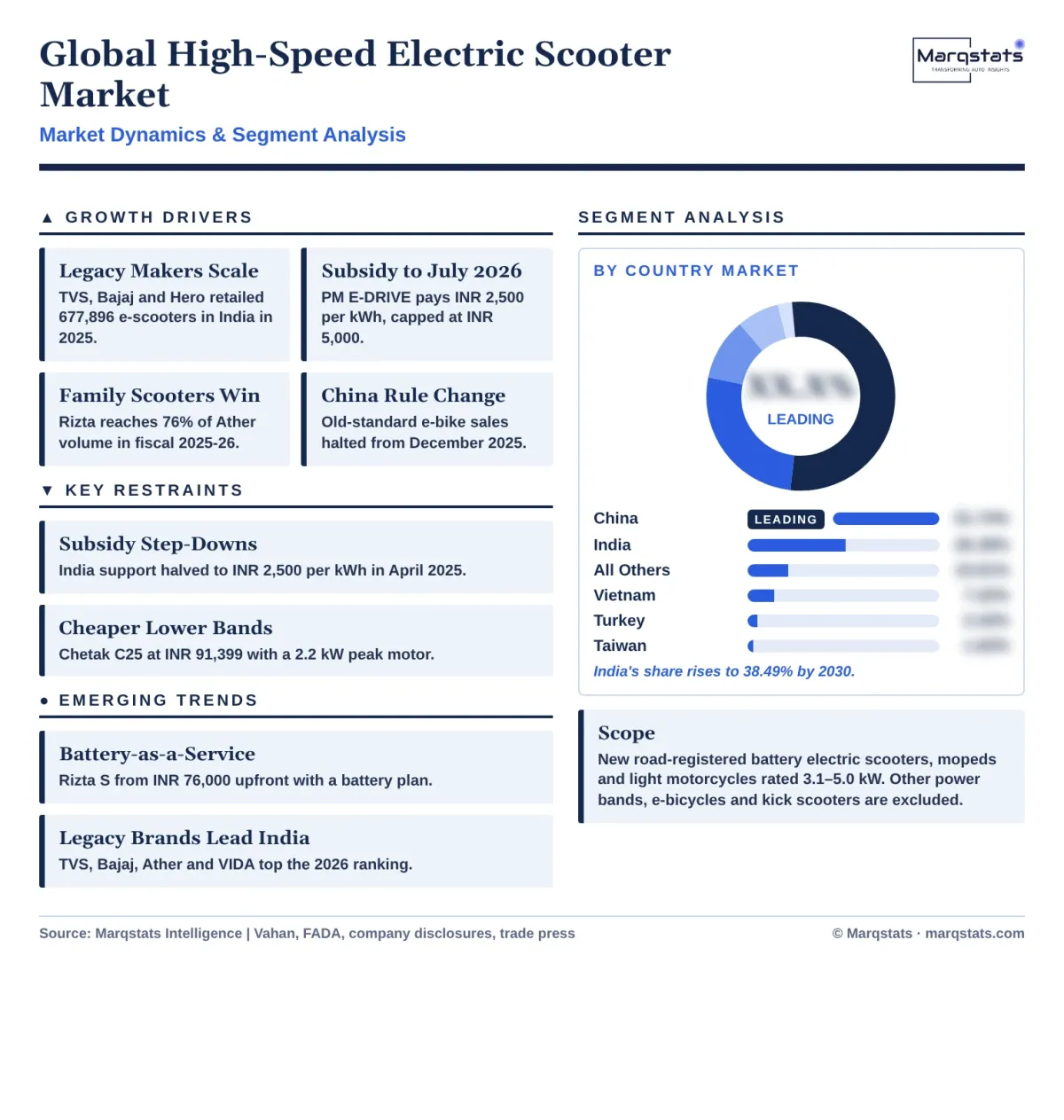
China is the largest country market in 2025 and the slowest-growing large market. It accounts for 639,928 units in 2025, 51.74% of global volume, and reaches 921,545 units by 2030 at a 7.57% CAGR, taking 36.00% of the market. The band makes up 18.25% of China's electric moped and motorcycle volume, supplied by Yadea Group Holdings Ltd., Aima Technology Group Co., Ltd., Niu Technologies and Ninebot Limited.
India is the second-largest market in 2025 and becomes the largest by 2030. It accounts for 326,330 units in 2025, 26.39% of global volume, and reaches 985,441 units by 2030 at a 24.74% CAGR, taking 38.49% of the market. TVS Motor Company Limited, Bajaj Auto Limited and Ather Energy Limited supply most of the volume through the iQube, Chetak and Rizta family scooters.
Vietnam is the third-largest market. It accounts for 89,230 units in 2025, 7.22% of global volume, and reaches 185,564 units by 2030 at a 15.77% CAGR, taking 7.25% of the market. VinFast Auto Ltd. dominates electric two-wheeler sales, and Honda Motor Co., Ltd. and Yamaha Motor Co., Ltd. compete in the higher-power scooter tier.
Turkey is the largest market outside Asia Pacific. It accounts for 29,950 units in 2025, 2.42% of global volume, and reaches 57,419 units by 2030 at a 13.90% CAGR, taking 2.24% of the market. The band makes up 27.03% of Turkey's electric two-wheeler volume, which is mostly imported or assembled from Chinese platforms.
Taiwan is a mature, slow-growing market for this band. It accounts for 19,981 units in 2025, 1.62% of global volume, and reaches 27,407 units by 2030 at a 6.52% CAGR, taking 1.07% of the market. The band makes up 11.10% of Taiwan's electric two-wheeler volume, where Gogoro Inc. and Kwang Yang Motor Co., Ltd. compete on battery-swap and charging models.
The remaining countries form the fastest-growing group. It accounts for 131,263 units in 2025, 10.61% of global volume, and reaches 382,700 units by 2030 at a 23.86% CAGR, taking 14.95% of the market. Mexico, Thailand and Indonesia grow at more than 35% a year, and Brazil and Colombia at more than 28%.
By Geography
Asia Pacific
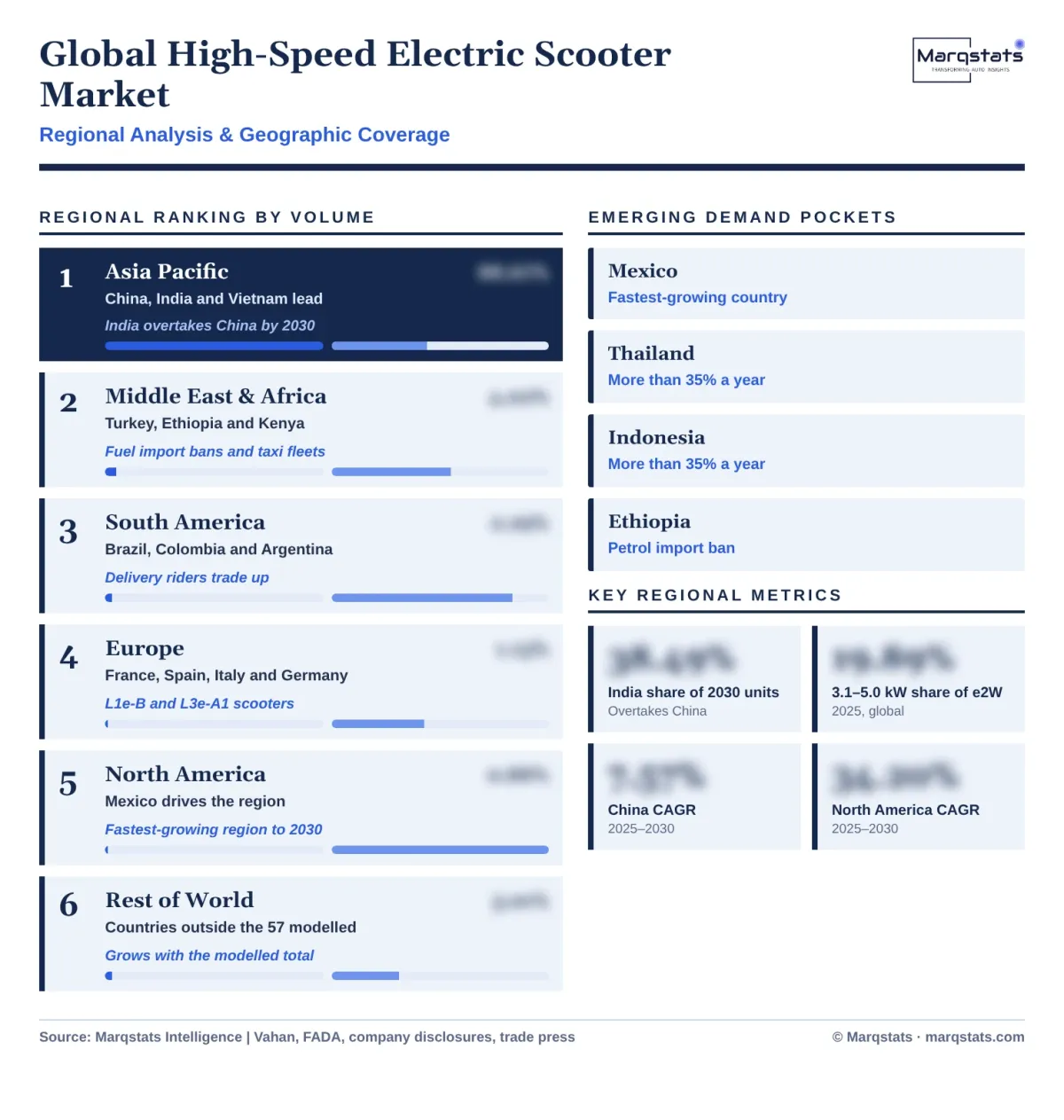
Asia Pacific is the volume centre of the global high-speed electric scooter market, with 1,096,421 units in 2025 and 88.67% of volume, easing to 86.19% by 2030 at a 15.01% CAGR. China, India and Vietnam account for most regional volume, and Indonesia (12,030 units) grows at 35.60% a year and Thailand (2,130 units) at 35.91%. Regional leadership moves from China to India over the forecast period.
Middle East & Africa
Middle East & Africa holds 49,723 units in 2025, 4.02% of volume, and grows at a 18.78% CAGR to 117,568 units by 2030. Turkey leads with 29,950 units, followed by Ethiopia (7,062 units) and Kenya (3,819 units). Ethiopia's ban on petrol vehicle imports from January 2024 and Kenya's motorcycle taxi fleets support demand for 3 to 5 kW products.
South America
South America rises from 28,381 units in 2025 to 98,726 by 2030, a 28.32% CAGR. Brazil leads with 16,230 units and grows at 28.55% a year, Colombia grows at 28.53% from 6,030 units and Argentina at 29.45%. Delivery platforms and imported Chinese scooters drive the growth.
Europe
Europe holds 13,993 units in 2025, 1.13% of volume, and grows at a 14.62% CAGR to 27,689 units by 2030. France (4,010 units), Spain (2,140 units), Italy (2,000 units) and Germany (1,430 units) lead. The band corresponds mainly to L1e-B mopeds at the top of their power range and L3e-A1 scooters, sold by Niu, Yadea and European dealers.
North America
North America is the fastest-growing region, at a 34.20% CAGR from 10,916 units in 2025 to 47,507 by 2030, lifting its share from 0.88% to 1.86%. Mexico grows from 9,103 units to 43,283 at 36.59% a year, while the United States holds 1,533 units. Mexican delivery riders drive most of the regional growth.
Rest of World
Rest of World covers countries outside the 57 markets modelled individually, with 37,248 units in 2025 and 3.01% of volume. The aggregate grows at 10.71% a year to 61,959 units by 2030, and is a Marqstats estimate built from the difference between global and country-level volumes.
How Competition Is Evolving
The global market is moderately fragmented, and leadership is national. In India, TVS Motor Company Limited, Bajaj Auto Limited and Ather Energy Limited lead, while in China Yadea Group Holdings Ltd., Aima Technology Group Co., Ltd. and Niu Technologies compete across bands, and in Vietnam VinFast Auto Ltd. dominates. No brand holds a top position in more than one of the three largest national markets.
India's ranking changed sharply in two years. Ola Electric Mobility Limited led India's electric two-wheeler retail in 2024 with 407,700 units and fell to 199,318 in 2025, while TVS rose 35.35% to 298,881, Bajaj nearly 39% to 269,847 and Ather 58.1% to 200,797. In January to July 2026 TVS led with more than 307,000 units, Bajaj followed with just under 264,000, Ather with just over 200,000 and Hero VIDA with just under 129,000, and Ola fell to fifth at 80,282.
Strategies split between dealer reach and product breadth. Legacy makers such as TVS, Bajaj and Hero MotoCorp Limited use dealer networks built for petrol scooters, while Ather combines a family scooter with battery-as-a-service plans that cut the upfront price to INR 76,000. Chinese makers such as Niu add electric motorcycles such as the FX, and Yadea expands overseas production, including a USD 100 million plant in Vietnam.
Model concentration is high in India. The Rizta alone accounts for about 197,653 units in fiscal 2025-26, and the iQube and Chetak families make up most of TVS and Bajaj volume. Three model families therefore supply the core of India's band, and the competitive question to 2030 is whether Honda Motor Co., Ltd., Hero VIDA and Greaves Electric Mobility Private Limited can win share from them as India becomes the largest market.
Companies Covered
Companies covered in the report include:
Recent Market Activity
Table of Contents
Coverage & Segmentation
The global high-speed electric scooter market comprises new road-registered battery electric scooters, mopeds and light motorcycles with motor power of 3.1 to 5.0 kW, sized in units and in USD at manufacturer selling prices. The market is segmented by country market: China, India, Vietnam, Turkey, Taiwan and all other countries. Geographic coverage spans Asia Pacific, Middle East & Africa, South America, Europe, North America and Rest of World, with 57 countries modelled individually.
The base year is 2025, the historical period is 2021–2025 and the forecast period is 2026–2030. Electric two-wheelers rated at 3.0 kW or less or above 5.0 kW, electric bicycles, kick scooters, electric three-wheelers and internal combustion scooters are excluded. Models are assigned to bands by rated motor power, and brand retail data from FADA cover brands across bands, so brand-to-band splits are Marqstats constructions and not independently verified. Country figures follow the Marqstats country model; the separate country reports for Taiwan, Turkey and Malaysia use official series that differ in scope.