Market Snapshot
Middle bar: base-year value × (1 + CAGR), rounded to two decimals. This is a calculated illustration, not a separately researched annual estimate.
The global tipper trailer market is estimated at USD 4,281.64 million in 2025 and is projected to reach USD 6,067.78 million by 2030, a CAGR of 7.22%, on new deliveries rising from 140,340 to 169,077 trailers at a 3.80% CAGR. Value compounds almost twice as fast as volume because demand shifts toward Europe and North America, where tipper trailers sell for five to seven times the Chinese price, and because lighter aluminium bodies gain share on the strength of legal payload.
Market size and forecast figures are generated using Marqstats' proprietary estimation framework, updated as of October 2026. The estimate is constructed from regional delivery volumes and regional average selling prices, and it is most sensitive to the pace of the European trailer recovery and to the aluminium share of new tipper bodies.
The market covers heavy road-going end tippers, side tippers and bottom dumps built in steel and aluminium, excluding rigid tipper trucks, mining dump trucks and light and farm tipping trailers. End tippers account for 78.88% of 2025 value and Europe is the largest region at 40.64% of value, whereas China leads on units at 39.19% but contributes only 13.49% of value, because a Chinese tipper sells for about USD 10,500 against about USD 58,000 in Europe.
Supply is consolidating around a small number of European trailer groups and component specialists. Schmitz Cargobull, which holds 25% of new trailer registrations in Europe, opened a plant in Oradea, Romania, for 4,000 curtainside and tipper semi-trailers a year, while KRONE and Schwarzmüller formed a partnership in 2025 and JOST completed its acquisition of Hyva in February 2025.
Key Takeaways
Market Overview & Analysis
Report Summary
A tipper trailer, also termed a dump trailer, is a heavy semi-trailer or drawbar trailer whose body tips to discharge bulk cargo, with end tippers lifting the body from the front to unload over the rear, side tippers tilting the body laterally and bottom dumps discharging through gates in the floor. Bodies are fabricated either from steel, frequently abrasion-resistant high-strength plate, or from aluminium. The tipper trailer market is measured as manufacturer revenue from new tipper trailers, including the body, running gear and trailer-mounted tipping hydraulics, and it excludes the tractor, tractor wet kits, sales taxes and used trailers.
No public source reports a global tipper-only total, and manufacturer disclosures are published at the level of all trailer types. CIMC Vehicles sold 112,159 semi-trailers in 2025, up from 101,735 in 2024, and Schmitz Cargobull sold more than 47,000 vehicles in its 2025/26 financial year, yet neither separates tipper volumes. The global total is a Marqstats construction assembled region by region, comprising about 30,000 tipper trailers in Europe, 10,500 in North America, 55,000 in China, 9,240 in India, 3,600 in South Africa and 32,000 in other markets in 2025, each valued at regional prices benchmarked to dealer listings and supplier price guides.
The India figure is consistent with the tipper trailer segment of the Marqstats India truck trailer estimate, with fiscal year 2026 data aligned to calendar 2025 on the same rupee assumptions, and the South Africa figure is consistent with the side-tipper share of the tipper and bulk segment in the Marqstats South Africa truck trailer estimate. The forecast assumes a European sales rebound of about 11% in 2026, in line with industry expectations of low double-digit growth, a dip in North America in 2026 ahead of recovery and slow growth in China while its construction market remains weak.
Tipper Trailer Market Size and Forecast
Volume is the anchor series for the tipper trailer market, and value is derived from regional delivery volumes and a weighted average selling price that rises from about USD 30,509 per trailer in 2025 to USD 35,888 in 2030. Manufacturers delivered an estimated 140,340 new tipper trailers worldwide in 2025, and deliveries are forecast to reach 169,077 by 2030, a 3.80% compound annual growth rate, while market value rises from USD 4,281.64 million to USD 6,067.78 million at 7.22% a year.
The annual path runs through 146,436 trailers and USD 4,648.64 million in 2026, 152,764 trailers and USD 5,029.59 million in 2027 and 158,204 trailers and USD 5,366.68 million in 2028. It continues to 163,546 trailers and USD 5,706.27 million in 2029 before reaching 169,077 trailers and USD 6,067.78 million in 2030.
The market runs ahead of its compound trend in 2026, when value rises 8.57% to USD 4,648.64 million against USD 4,590.77 million on the constant-growth path, because European deliveries recover from a depressed base. ING expected European trailer sales to return to growth in 2026, most likely in the low double digits, after three years of decline that left deliveries at 60% to 80% of pre-pandemic levels in some countries, and unit growth thereafter settles at 3% to 4% a year.
The rise in average value per trailer reflects regional and material mix rather than list-price escalation alone. Europe and North America, where tipper trailers cost five to seven times as much as in China, grow faster than China throughout the forecast, and aluminium bodies averaging about USD 55,720 against USD 24,046 for steel gain share in both of those regions.
Aluminium Bodies Grow Faster Than Steel
Body material is the sharpest structural divide in the tipper trailer market. Aluminium tipper trailers represent 20.41% of 2025 units but 37.27% of value, at an average of about USD 55,720 per trailer against USD 24,046 for steel, and aluminium value grows at 9.34% a year to USD 2,493.75 million by 2030 while steel grows at 5.88% to USD 3,574.03 million, taking aluminium to 41.10% of market value.
Payload economics drive the material decision, because a lighter body allows an operator to carry more legal cargo within the same gross weight limit, and every tonne removed from the trailer becomes a tonne of revenue-earning load. Schmitz Cargobull markets its S.KI AK LIGHT aluminium body on durability and low weight, STAS positions the aluminium Buildstar X for construction alongside the high-strength steel Ferrostar for scrap, and aluminium end dumps such as the Travis Alumatech dominate aggregate hauling in North America.
Steel retains the advantage where cargo is abrasive or dense, since rock, demolition waste and scrap wear aluminium quickly while high-strength steel resists impact and abrasion at a lower purchase price. The aluminium premium is recovered only when the operator uses the additional payload, and an operator adding one tonne of legal payload on two trips a day for 250 days gains 500 tonnes of annual capacity, a return that repays the premium readily on dense aggregates but slowly on light and bulky loads.
Tipper Trailer Pricing and Cost Structure
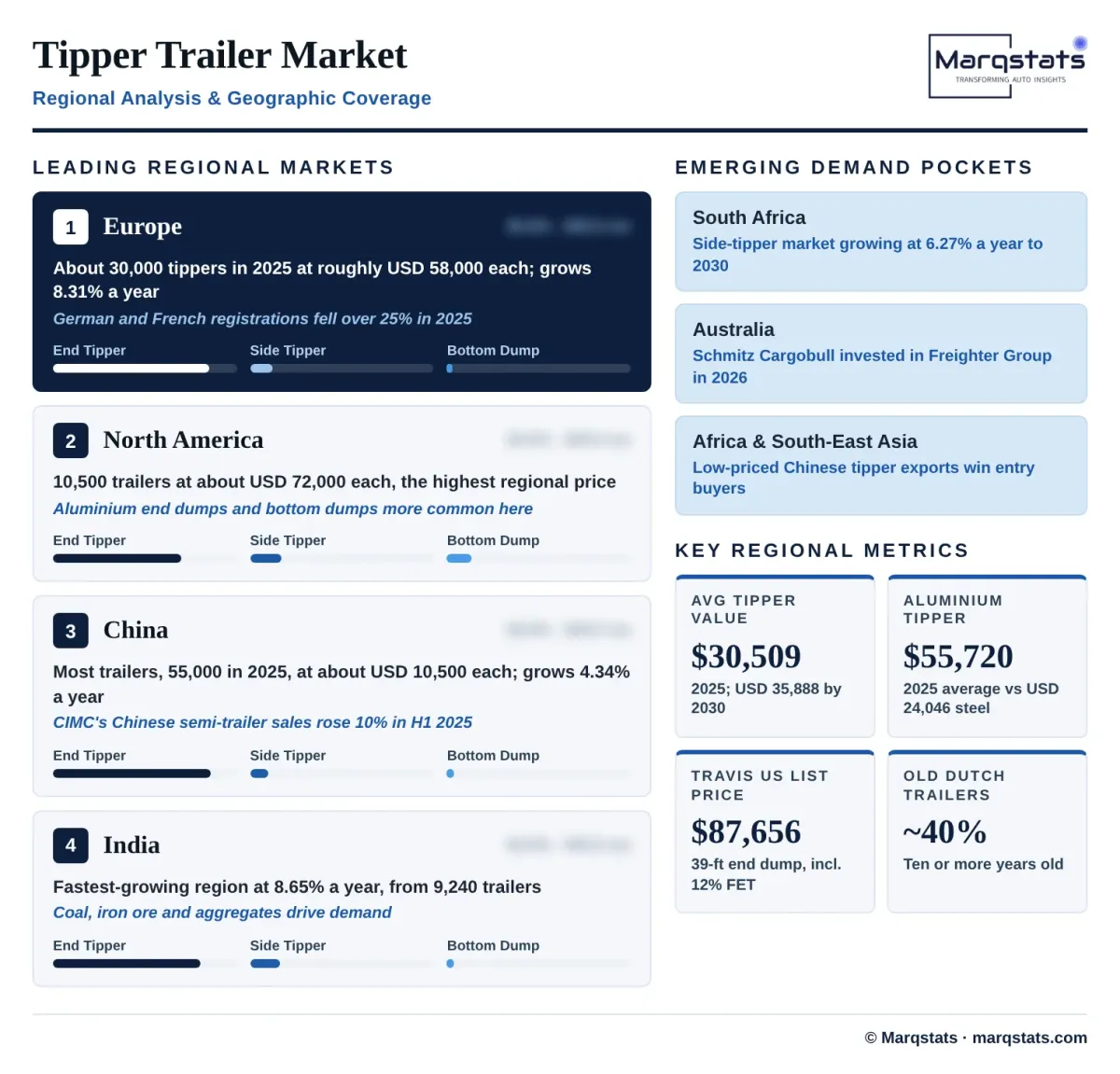
Tipper trailer prices vary more between regions than between brands. A new 39-foot 2026 Travis Alumatech end dump was listed in the United States at USD 87,656 including the 12% federal excise tax and freight, whereas the SATRAC price guide places Indian tipper and bulker trailers at INR 15 lakh to INR 25 lakh, about USD 17,500 to USD 29,000, and a new Afrit 40 m³ side-tipper link was advertised in South Africa at R 860,696 excluding VAT for a two-trailer set.
Average selling prices in 2025 stand at about USD 58,000 in Europe, USD 72,000 in North America, USD 10,500 in China, USD 23,392 in India, USD 26,667 in South Africa and USD 28,000 in other markets. Each figure averages steel and aluminium bodies and end and side tippers within the region, so a global price requires volume weighting rather than a simple average of regional benchmarks.
The cost structure of a tipper trailer comprises four elements. The frame and body account for the steel or aluminium plate, plate thickness, liners, tailgate, sealing and paint, while the running gear covers axles, suspension, brakes, wheels, tyres and landing gear. The discharge system includes the cylinder, the hydraulic pump or tractor wet kit, hoses, controls and tarping, and operating exposure spans tyre and brake wear, cylinder seals, liner replacement, structural fatigue and downtime.
Regulation and Tax
Vehicle approval and taxation requirements differ materially by region and add to the delivered cost of a tipper trailer. Indian trailers require AIS-113 approval, South African heavy trailers must comply with VC8027 and road mass limits, and covered heavy trailers in the United States can attract a 12% federal excise tax on first retail sale. The European Commission has set 2030 CO2-reduction targets of 10% for covered semi-trailers and 7.5% for other covered trailers, although their application to an individual tipper model depends on whether that model falls within the technical scope of the regulation.
Demand by Buyer Group
Demand for tipper trailers originates in four buyer groups, of which construction and aggregates haulers are the largest, moving sand, gravel, crushed stone, asphalt and excavated soil between quarries, plants and sites. Their orders follow public infrastructure budgets and private building cycles, and they buy mainly end tippers, in steel where loads are rough and in aluminium where loads are clean and payload earns a return.
Mining and bulk commodity hauliers constitute the second group, carrying coal, iron ore, manganese, chrome and bauxite by road where rail capacity is constrained or mines sit far from a railhead. In South Africa and India this work favours side tippers and heavy-duty end tippers designed for long runs on mixed road surfaces, and volumes track commodity prices and rail performance rather than construction activity.
Recycling and waste operators form the third group, handling scrap metal, demolition rubble and municipal waste that require high sides, heavy liners and strong tailgates. These loads impose severe wear on tipper bodies, and builders respond with thick high-strength steel and replaceable wear plates, of which the STAS Ferrostar range aimed at scrap is a representative example.
Agriculture and grain buyers complete the demand base, with large farms and grain traders in North America, Europe and Australia operating tipper and bottom-dump trailers at harvest, often for only part of the year. Light farm tipping trailers drawn by tractors fall outside the market scope, and value is not segmented by end use because no public source reports tipper sales by buyer type.
Trade and Export Flows
Tipper trailer production remains largely local to the markets it serves, because bodies are bulky, freight is costly and buyers expect local service, so imports account for only a small share of most national markets. Chinese builders are the principal exception, exporting low-priced tipper semi-trailers to Africa, the Middle East, Central Asia and South-East Asia, where buyers accept weaker service and resale value in exchange for a lower entry price, and CIMC Vehicles reported a 142.55% rise in dump truck sales in the first half of 2025, an indication of how quickly that channel can expand.
European builders export both within their home region and beyond it. Schmitz Cargobull's investment in Freighter Group in July 2026 establishes a position in Australia, one of the highest-priced tipper markets outside Europe and North America, while Polish, Belgian and Austrian builders sell across the European Union and Eastern European plants such as Oradea allow Western brands to compete on cost. Indian and North American builders, by contrast, sell predominantly in their domestic markets.
Lifecycle and Aftermarket
A tipper trailer generates revenue over many years, but its components wear at different rates, and the pattern of wear shapes the economics of ownership. Tyres and brakes wear fastest, liners and floor plates wear with every load of rock or scrap, tipping cylinders require seal kits and periodic inspection, and frames accumulate fatigue from repeated lifting on uneven ground. Downtime is the largest hidden cost, since a tipper idle for a week in peak season forgoes more revenue than a set of seals costs.
Fleets therefore assess resale value, dealer coverage, parts supply and warranty alongside purchase price, and European brands with broad service networks retain resale value well, which supports their price premium. Fleet age sets the replacement cycle, and with nearly 40% of Dutch trailers aged ten years or more and many European fleets having deferred renewal during the 2023 to 2025 downturn, the deferral has accumulated pent-up demand that the recovery is expected to release.
Tipping stability remains a design priority across the market, because discharging on soft or sloping ground can overturn a trailer. Builders add stability aids, tilt sensors and lower-profile designs, and side tippers keep the load lower during discharge, which is one reason the configuration suits long-haul bulk work.
Market Dynamics
Key Drivers
Five demand and supply factors support growth in the global tipper trailer market through 2030.
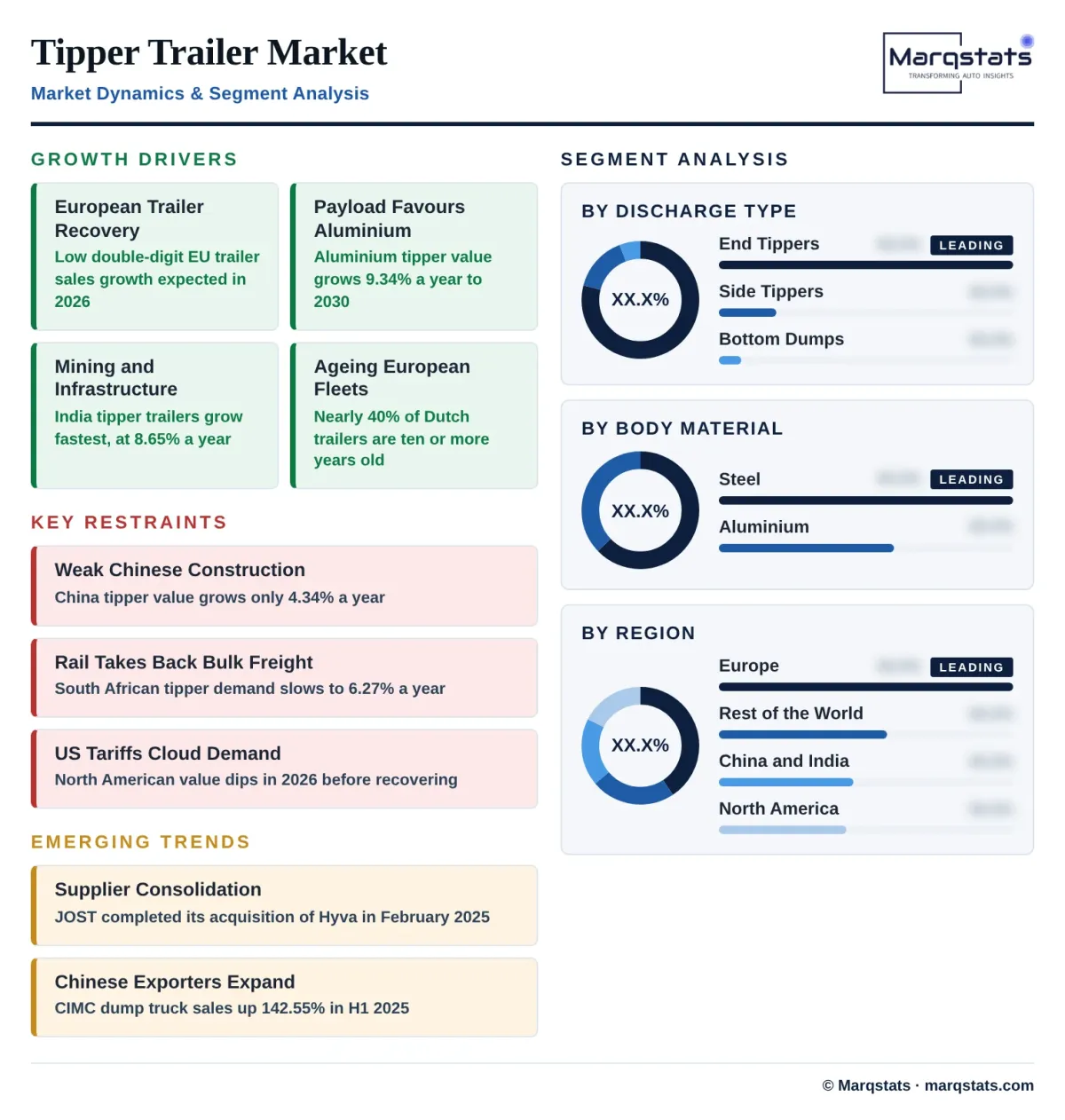
- European trailer market recovery. European trailer sales are expected to return to low double-digit growth in 2026 after three years of decline, and the rebound lifts European tipper trailer value at 8.31% a year to USD 2,593.44 million by 2030.
- Infrastructure and mining haulage. Road building, aggregates and coal and iron ore haulage sustain demand in India, where tipper trailer value grows at 8.65% a year from USD 216.14 million in 2025, the fastest rate of any region.
- Payload economics. Aluminium tipper trailers grow at 9.34% a year against 5.88% for steel between 2025 and 2030, because a lighter body converts saved tare weight directly into legal, revenue-earning payload.
- Fleet age and replacement demand. Nearly 40% of Dutch trailers are ten or more years old, and fleets that deferred renewal during the 2023 to 2025 downturn generate replacement demand as European freight volumes and financing conditions improve.
- Recycling and scrap flows. Construction waste and scrap metal require specialised high-strength steel tippers with replaceable wear plates, which sustains steel at 62.73% of 2025 tipper trailer value despite faster aluminium growth.
Key Restraints
Four constraints moderate growth, concentrated in China, North America and the bulk mining corridors.
- Weak Chinese construction. Subdued property and infrastructure activity limits Chinese tipper trailer value growth to 4.34% a year to 2030, the slowest of any region, even though China accounted for 39.19% of global units in 2025.
- Tariffs and costs in North America. Entrenched tariffs keep United States trailer demand cautious after 2025 orders of 172,100 units, and North American tipper value dips in 2026 before recovering to grow at 6.57% a year over the forecast.
- Rail substitution of bulk freight. In South Africa, a shift of bulk mining freight back to rail slows tipper trailer growth to 6.27% a year, from USD 96.00 million in 2025 to USD 130.11 million by 2030.
- Used equipment competition. Idle contractor fleets and used tippers compete with new trailers whenever construction projects stall, adding to the cyclical pressure on new orders seen during the three-year European trailer decline that preceded the expected 2026 recovery.
Key Trends
Four structural trends are reshaping the tipper trailer supply base.
- Consolidation and partnerships. KRONE and Schwarzmüller formed a partnership in 2025, and JOST completed its acquisition of the tipping hydraulics specialist Hyva in February 2025, combining coupling systems with tipping hydraulics under a single supplier.
- Near-shore capacity in Eastern Europe. Schmitz Cargobull opened a plant in Oradea, Romania, with capacity for 4,000 curtainside and tipper semi-trailers a year, allowing a Western European brand to compete on cost within its home region.
- Lightweight body designs. Aluminium and high-strength steel bodies compete on tare weight and durability, and aluminium is forecast to rise from 37.27% of tipper trailer value in 2025 to 41.10% by 2030.
- Chinese exporters in emerging markets. CIMC Vehicles reported a 142.55% rise in dump truck sales in the first half of 2025 and is expanding in emerging markets where buyers prioritise entry price over service and resale value.
Strategic Implications
- Capacity timing for the European recovery. European manufacturers adding tipper capacity at contained cost ahead of the 2026 to 2027 recovery are best placed to capture it, as the 4,000-unit Schmitz Cargobull plant in Oradea illustrates.
- A dual material offer. Builders offering both aluminium and high-strength steel bodies cover the full range of cargo density and abrasiveness in a market where steel holds 62.73% of 2025 value and aluminium grows at 9.34% a year.
- Bundled hydraulics and service. Hydraulics and axle suppliers gain from bundling tipping systems with service coverage, following the approach established when JOST completed its acquisition of Hyva in February 2025.
- Lifecycle-based procurement. Fleet returns depend on legal payload and lifecycle cost more than on purchase price, given 2025 average prices of about USD 24,046 for steel and USD 55,720 for aluminium.
Market Segmentation
End tippers are the dominant discharge type, generating USD 3,377.52 million or 78.88% of 2025 value from 115,241 trailers, and their value grows at 7.28% a year to USD 4,799.29 million by 2030. The configuration suits construction, aggregates, recycling and agriculture haulage, which makes it the default specification across Europe, China and India.
Side tippers account for USD 650.62 million, or 15.20% of 2025 value, from 18,766 trailers, and grow at 7.06% a year to USD 915.12 million by 2030. The type dominates in South Africa, where side-tipper interlinks carry coal and ore, and it is common in North American and Australian bulk haulage, where a lower load profile during discharge improves stability.
Bottom dumps account for USD 253.50 million, or 5.92% of 2025 value, from 6,333 trailers, and grow at 6.87% a year to USD 353.37 million by 2030. The type is most common in North America, where bottom-dump trailers spread aggregates and asphalt base on road construction projects.
Steel tipper trailers account for USD 2,685.98 million, or 62.73% of 2025 value, from 111,703 trailers at an average of about USD 24,046. Steel value grows at 5.88% a year to USD 3,574.03 million and its share of value declines to 58.90% by 2030, although steel remains dominant in China and India and for abrasive cargo in every region.
Aluminium tipper trailers account for USD 1,595.66 million, or 37.27% of 2025 value, from 28,637 trailers at an average of about USD 55,720, and grow at 9.34% a year to USD 2,493.75 million by 2030. North America and Europe account for most aluminium demand, because payload-sensitive aggregate haulage in those regions justifies the price premium.
By Geography
Europe
Europe is the largest region in the tipper trailer market at USD 1,740.00 million, or 40.64% of 2025 value, from 30,000 trailers, and grows at 8.31% a year to USD 2,593.44 million by 2030. Trailer registrations in Germany and France fell more than 25% in 2025, but the market is expected to recover from 2026, and ageing fleets point to an extended replacement cycle once freight volumes and financing costs improve. Schmitz Cargobull, KRONE, Schwarzmüller, Kögel, STAS and Wielton lead tipper supply, with aluminium bodies common in the Benelux and Scandinavia and high-strength steel preferred in Central and Eastern Europe.
North America
North America accounts for USD 756.00 million, or 17.66% of 2025 value, from 10,500 trailers at about USD 72,000 each, and grows at 6.57% a year to USD 1,039.01 million by 2030. United States trailer orders rose about 6% to 172,100 units in 2025, but builds fell sharply late in the year and tariffs keep 2026 demand cautious. Aluminium end dumps and bottom dumps hold a larger share than in other regions, and the 12% federal excise tax raises the delivered price and can defer orders when freight rates are weak.
China
China is the largest region by volume at 55,000 trailers, or 39.19% of global units, but contributes only USD 577.50 million, or 13.49% of 2025 value, because of its low unit prices. Value grows at 4.34% a year to USD 714.22 million by 2030 as construction activity remains weak, although CIMC Vehicles reported that its Chinese semi-trailer sales rose 10% in the first half of 2025.
India
India accounts for USD 216.14 million, or 5.05% of 2025 value, from 9,240 trailers, and is the fastest-growing region at 8.65% a year to USD 327.25 million by 2030. Coal, iron ore and aggregates haulage drive demand, and the regional figures are consistent with the tipper trailer segment of the Marqstats India truck trailer estimate.
Rest of the World
The rest of the world accounts for USD 992.00 million, or 23.17% of 2025 value, from 35,600 trailers, and grows at 7.04% a year to USD 1,393.86 million by 2030. South Africa contributes USD 96.00 million from about 3,600 trailers dominated by side tippers, rising to USD 130.11 million by 2030 at 6.27% a year, while other markets add USD 896.00 million in 2025 and USD 1,263.75 million by 2030, a 7.12% CAGR. Latin America, the Middle East, Australia, Russia and South-East Asia make up the balance, with Australia among the highest-priced tipper markets globally.
How Competition Is Evolving
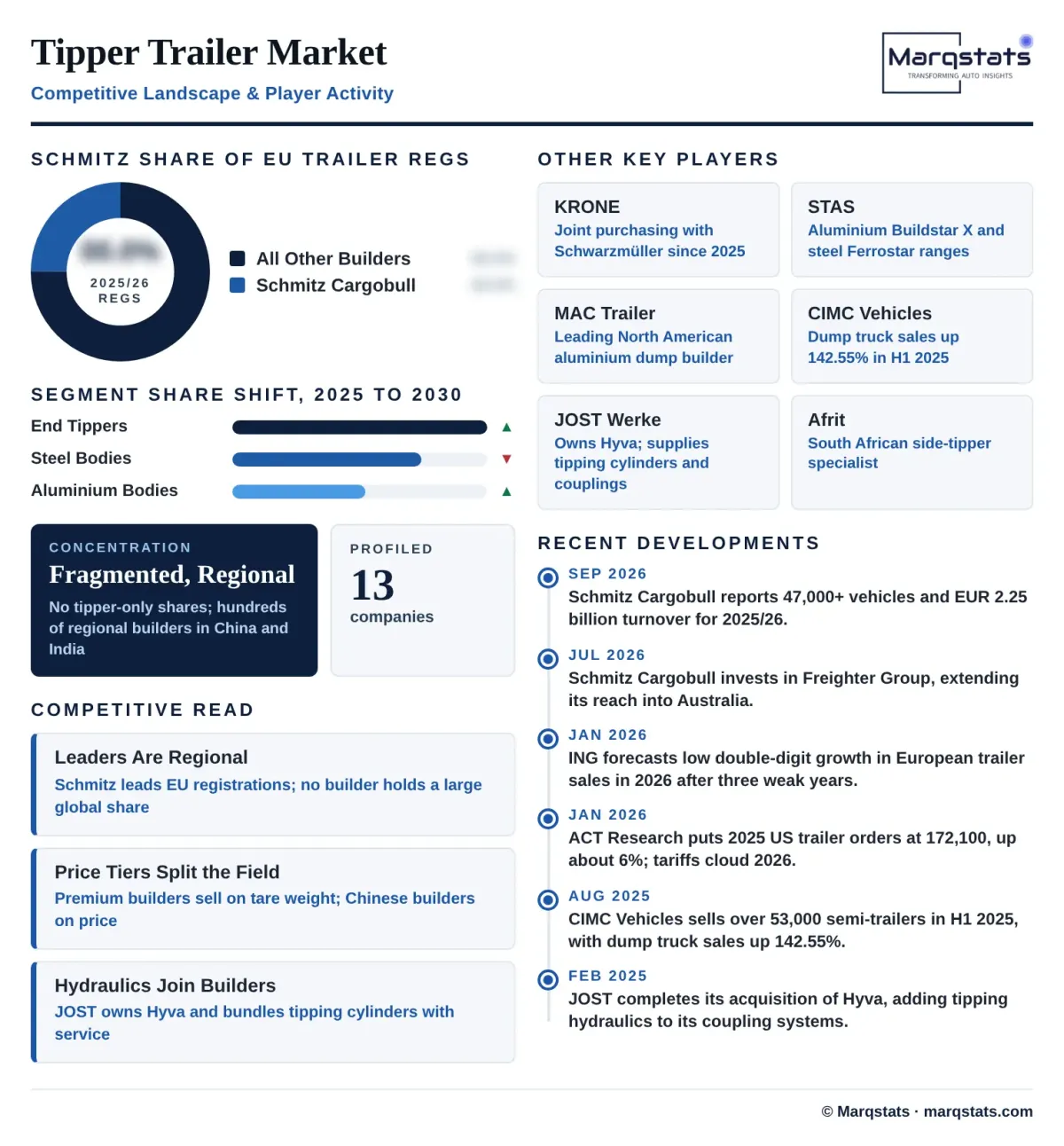
The global tipper trailer market is fragmented, with a small number of large groups leading in each region, no company holding a large global share and hundreds of regional builders competing in China, India and other emerging markets. No source publishes tipper-only company shares, so competitive position is assessed by region and by strategy rather than by share.
Schmitz Cargobull leads European trailer registrations overall with a 25% share and reported turnover of EUR 2.25 billion in its 2025/26 financial year. KRONE and Schwarzmüller coordinate purchasing through their 2025 partnership while retaining separate brands, and Kögel, STAS and Wielton compete strongly in tippers. MAC Trailer, East Manufacturing and Travis Body and Trailer are the leading aluminium dump trailer builders in North America, and CIMC Vehicles is the largest semi-trailer manufacturer globally by units, with 112,159 semi-trailers sold in 2025.
Regional specialists hold strong home-market positions, including Afrit in South Africa and Tata International Vehicle Applications in India. Component suppliers shape competition in every region, and JOST, which now owns Hyva, supplies tipping cylinders and couplings at a scale in hydraulics and service that influences the sourcing decisions of trailer builders. Competition turns on payload, durability, delivery time, financing and service network coverage.
Competitive strategies in the tipper trailer market differ by price tier. Premium European and North American builders compete on tare weight, build quality, telematics and resale value and defend margins through dealer service and financing, whereas Chinese builders compete on price and delivery speed and gain share in markets where buyers replace trailers frequently. Regional builders in India and Africa win on customisation, local approvals and rapid repair, while consolidation continues as large groups acquire low-cost capacity and component makers bundle hydraulics with service.
Companies Covered
Companies covered in the report include:
Recent Market Activity
Table of Contents
Coverage & Segmentation
Coverage spans new heavy tipper trailers worldwide, segmented into Europe, North America, China, India and the rest of the world, with South Africa reported separately within the last of these. The base year is 2025, the historical period runs from 2021 to 2025 and the forecast period from 2026 to 2030. Value is expressed in USD million of manufacturer revenue, excluding the tractor, wet kits, sales and excise taxes and used trailers, and volume is expressed in new trailers delivered. Segmentation covers discharge type across three segments and body material across two, and thirteen companies are profiled.
Rigid tipper trucks, mining dump trucks, farm and light tipping trailers and moving-floor trailers are excluded from the market definition. Company data draw on annual reports and results releases, prices on dealer listings and supplier guides and demand context on trailer order data and industry forecasts, while the India and South Africa figures are consistent with the Marqstats country trailer estimates.