Market Snapshot
Middle bar: base-year value × (1 + CAGR), rounded to two decimals. This is a calculated illustration, not a separately researched annual estimate.
The South Africa trailer market for heavy commercial trailers is estimated at USD 412.22 million (ZAR 7,420.00 million) in 2025 and is projected to reach USD 604.40 million (ZAR 11,423.14 million) by 2030, a CAGR of 7.95% in US dollars and 9.01% in rand. New heavy trailer registrations rise from 14,000 to 16,944 units over the same period, a 3.89% CAGR, from a weak 2025 base in which new heavy trailer registrations fell 20.8% in August and extra-heavy truck sales contracted 10%.
Market size and forecast figures are generated using Marqstats' proprietary estimation framework, updated as of October 2026. The estimate is constructed from monthly national heavy trailer registrations and heavy truck sales trends, valued at manufacturer prices benchmarked to dealer offers, and is most sensitive to the pace of fleet renewal as interest rates ease.
The market comprises new heavy road trailers above 3,500 kg gross vehicle mass used for freight, spanning tipper and bulk trailers, flatdeck and curtainside trailers, refrigerated trailers, tanker trailers and skeletal, low-bed and specialized trailers. Interlink combinations are counted as two registered units, while caravans, light trailers, exports and used trailers are excluded. Flatdeck and curtainside trailers hold the largest share at 28.68% of 2025 value, and interlink units account for 49.44% of value, reflecting the dominance of the interlink in long-haul South African freight.
Rail reform and cold-chain expansion pull the outlook in opposite directions. Transnet allocated network slots to 11 private train operators in May 2026, adding 24 million tonnes of capacity with potential for 52 million tonnes over five years, which slows growth in long-haul bulk trailers. Retail cold chains, port traffic through Durban and fleet renewal after a weak 2025 support demand in the other segments, and manufacturers such as Afrit, with capacity of about 7,000 trailers a year at Rosslyn, are positioned for the recovery.
Key Takeaways
Market Overview & Analysis
Report Summary
The South Africa trailer market measures manufacturer revenue from new heavy commercial trailers in the O3 and O4 categories, which are towed vehicles above 3,500 kg gross vehicle mass coupled to a truck-tractor or rigid truck. The interlink, a truck-tractor pulling two linked semitrailers that registers as two trailers, is the dominant long-haul vehicle in South Africa and accounts for nearly half of market value.
Measured value excludes the truck-tractor, VAT, delivery fees, finance and used or rental equipment, which confines the series to the new towed unit at first registration and keeps it separate from the sizeable South African aftermarket in refurbishment and used trailers.
Official statistics cover registrations but do not provide a clean annual trailer series. NaTIS reported 1,256 new heavy trailer registrations in August 2025 against 1,585 in August 2024, a 20.8% decline for the month, and because a single month cannot be annualised reliably, the annual market size is a Marqstats estimate rather than an extrapolation of monthly data.
The estimate places new heavy freight trailer registrations at about 14,000 units in 2025, consistent with the monthly run rate once non-freight categories are removed, and values them at manufacturer prices benchmarked to dealer offers. A new 2026-model Afrit 40 m³ side-tipper link, for example, was advertised at R 860,696 excluding VAT in September 2025.
The base year is 2025 and the forecast period runs to 2030. Values are converted at ZAR 18.0 per US dollar in 2025, weakening gradually to ZAR 18.9 by 2030, so rand growth runs about one point a year ahead of dollar growth across the forecast window.
Registrations recover by about 4% in 2026 and 5% in 2027 as interest rates fall and fleets replace ageing trailers, then grow at 3% to 4% a year through 2030, while rand prices rise at about 5% a year across the forecast period.
South Africa Trailer Market Size and Forecast
South African fleets registered an estimated 14,000 new heavy freight trailers in 2025, and registrations are forecast to reach 16,944 by 2030, a 3.89% compound annual growth rate. Volume is the anchor series, and value is derived from volume and an average trailer value that rises from about R 530,000 in 2025 to R 674,200 in 2030 as rand prices climb and faster-growing refrigerated and curtainside types gain share.
Registrations rise to 14,533 trailers in 2026, 15,229 in 2027, 15,842 in 2028 and 16,411 in 2029 before reaching 16,944 in 2030. Market value moves from USD 412.22 million (ZAR 7,420.00 million) in 2025 to USD 442.89 million (ZAR 8,050.16 million) in 2026, USD 482.40 million (ZAR 8,854.28 million) in 2027, USD 521.97 million (ZAR 9,674.58 million) in 2028 and USD 562.64 million (ZAR 10,530.69 million) in 2029, ending at USD 604.40 million (ZAR 11,423.14 million) in 2030.
The recovery begins in 2026, when value rises 7.44% to USD 442.89 million, close to the USD 444.99 million implied by the five-year CAGR path, as lower interest rates and a firmer rand ease fleet finance. The chief executive of Serco cited both factors when describing a healthy order pipeline for 2026.
The weak 2025 base reflects a divergence between the passenger and heavy vehicle markets. naamsa reported that the overall new vehicle market grew 15.7% to 596,818 units in 2025, its best result in more than a decade, yet heavy truck and bus sales fell 3.0% to 22,738 and the extra-heavy segment, the principal source of truck-tractors, contracted 10%, so trailer demand tracked trucks rather than cars.
Rail Reform Caps Bulk Trailers While Cold Chain Grows
South African road freight has expanded for nearly two decades while rail volumes stagnated, and rail reform is now addressing that imbalance. Statistics South Africa data cited by Engineering News show monthly road freight rising from 53.5 million tonnes in January 2008 to 78.5 million tonnes in 2026, while rail volumes barely moved. Transnet aims to raise rail volumes from about 180 million tonnes to 250 million tonnes a year by 2030, and in May 2026 it allocated slots on five corridors to 11 private train operators.
The effect on the trailer market is uneven across types. Bulk mining freight such as coal, iron ore and chrome is the cargo most likely to return to rail, so tipper and bulk trailers grow at only 6.27% a year, from USD 112.00 million to USD 151.80 million, and lose two points of share by 2030. Feeder movements to rail sidings and terminals still require trailers, which keeps the segment growing in absolute terms.
Refrigerated trailers move in the opposite direction on the strength of retail cold-chain investment. Retail groups such as Shoprite, Woolworths and Pick n Pay operate large temperature-controlled fleets, and refrigerated trailers grow at 10.32% a year from USD 56.00 million to USD 91.51 million. Serco, which builds refrigerated bodies and trailers, expanded its Boksburg plant in February 2026 and planned a Durban repair facility, evidence that cold-chain fleets continue to invest.
Interlink Sets Register as Two Trailer Units
Interlink combinations require a consistent counting basis, because a truck-tractor pulling two linked semitrailers forms one combination but two registered trailers, and dealers frequently quote prices per set. The South Africa trailer market counts registered units, so interlink units account for 7,189 of the 14,000 trailers registered in 2025, equivalent to about 3,595 sets, and a side-tipper link priced at R 860,696 per set represents roughly R 430,000 per registered trailer.
Legal mass limits shape trailer design as directly as cargo type. Road Traffic Regulation 237 sets a general combination mass ceiling of 56 tonnes alongside axle and vehicle limits, and a truck-tractor with a single driving axle is limited to 48 tonnes. Because the 56 tonnes include the tractor and trailers themselves, weight removed from the trailer becomes paying cargo, which is why aluminium and high-strength steel designs win where cargo is dense.
Heavy Trailer Prices Vary Widely by Type and Specification
Heavy trailer prices in South Africa vary widely by type and specification. Average 2025 values stand at about R 480,000 per registered tipper or bulk trailer, R 400,000 for a flatdeck or curtainside, R 900,000 for a refrigerated trailer, R 1,050,000 for a tanker and R 450,000 for a skeletal, low-bed or specialized trailer, all excluding VAT and the truck-tractor. A used 2021 Afrit 40 m³ side tipper was advertised at R 475,000 excluding VAT, which illustrates how strongly used equipment competes with new.
A full purchase budget covers the trailer or set, hydraulic interfaces, delivery, registration, insurance, finance and working capital. VAT is levied at 15%, but most fleet buyers recover it, so it affects cash flow more than final cost, while running costs span tyres, brakes, axles, hydraulics, structural repairs, tracking, inspections and downtime. Imported components such as axles and suspensions move with the rand, so currency weakness raises part of the bill of materials rather than the whole trailer price.
Large Fleets and Owner-Operators Buy on Different Terms
Heavy trailer buyers in South Africa divide into large fleets and owner-operators, and the two groups purchase on different terms. Large fleets, including retail distribution networks, fuel and chemical carriers and contract hauliers serving mines and manufacturers, buy repeat specifications in volume and judge trailers on guaranteed delivery, maintenance compatibility with the existing fleet, residual value and cost per tonne-kilometre, negotiating service agreements alongside the purchase.
Owner-operators and small fleets buy one or two trailers at a time, and for them the deposit, the monthly instalment and an immediate freight contract decide the purchase, with a used trailer often the realistic alternative. Manufacturer finance, such as Phuma Finance offered by Afrit, and rental fleets help bridge that gap. This group returns to the new-trailer market first when interest rates fall, which makes the cumulative 150-basis-point reduction in rates since September 2024 a central factor in the 2026 recovery.
Compulsory Specifications and Procurement Rules Favour Local Builders
Every heavy trailer operating on South African roads must meet VC8027, the compulsory specification for O3 and O4 trailers administered by the National Regulator for Compulsory Specifications. Importers require approval and homologation before sale, so a low offshore quotation does not make a trailer road-legal, and approval cost, lead time and local support give domestic builders an advantage over imported equipment.
Procurement rules add a further layer of qualification. Public and regulated tenders can score bidders on B-BBEE status and, where applicable, local content; these are tender-specific requirements rather than universal rules for private sales, but they carry weight for builders supplying state-owned enterprises, municipalities and their contractors. Afrit, for example, reports 51% black ownership and B-BBEE Level 4 status.
Regional Exports Support Builders Beyond the Domestic Market
South African trailer builders sell well beyond the domestic market, into neighbouring southern African countries where South African trucks and trailers dominate cross-border freight. These exports fall outside the measured market, which tracks domestic registrations, yet they remain material to builders because export orders can sustain plant utilisation when domestic demand weakens, as it did in 2025.
Export markets carry their own cost structure and service obligations for builders. Buyers outside South Africa require homologation, border documentation and axle and length configurations that match local rules, and they expect spare parts and service along their routes. naamsa reported that heavy truck exports rose 68.4% in 2025, albeit from a low base, indicating that regional demand partly offset the domestic slowdown for the wider heavy vehicle industry.
Repair and Refurbishment Compete With New Trailer Sales
South African trailer builders turn to service revenue when new orders soften. Serco described 2025 as a year in which customers extended asset lifecycles while making selective efficiency investments, and it responded by adding repair space and a speed bay for same-day or next-day repairs. The Route group pairs trailer manufacturing with axle, component, parts and service businesses for the same reason.
Refurbishment and used trailers compete directly with new sales. A well-maintained side tipper can run for many years after a structural rebuild, new tyres and a brake overhaul, and the R 475,000 used price of a 2021 Afrit side tipper shows how much value a trailer retains. Aftermarket work sits outside measured market value, but it shapes how many new trailers fleets buy and when, and builders with strong repair networks retain customers between purchases and stand first in line when replacement comes.
Market Dynamics
Key Drivers
Fleet renewal, cold-chain expansion, port traffic and easing finance conditions support growth in the South Africa trailer market through 2030.
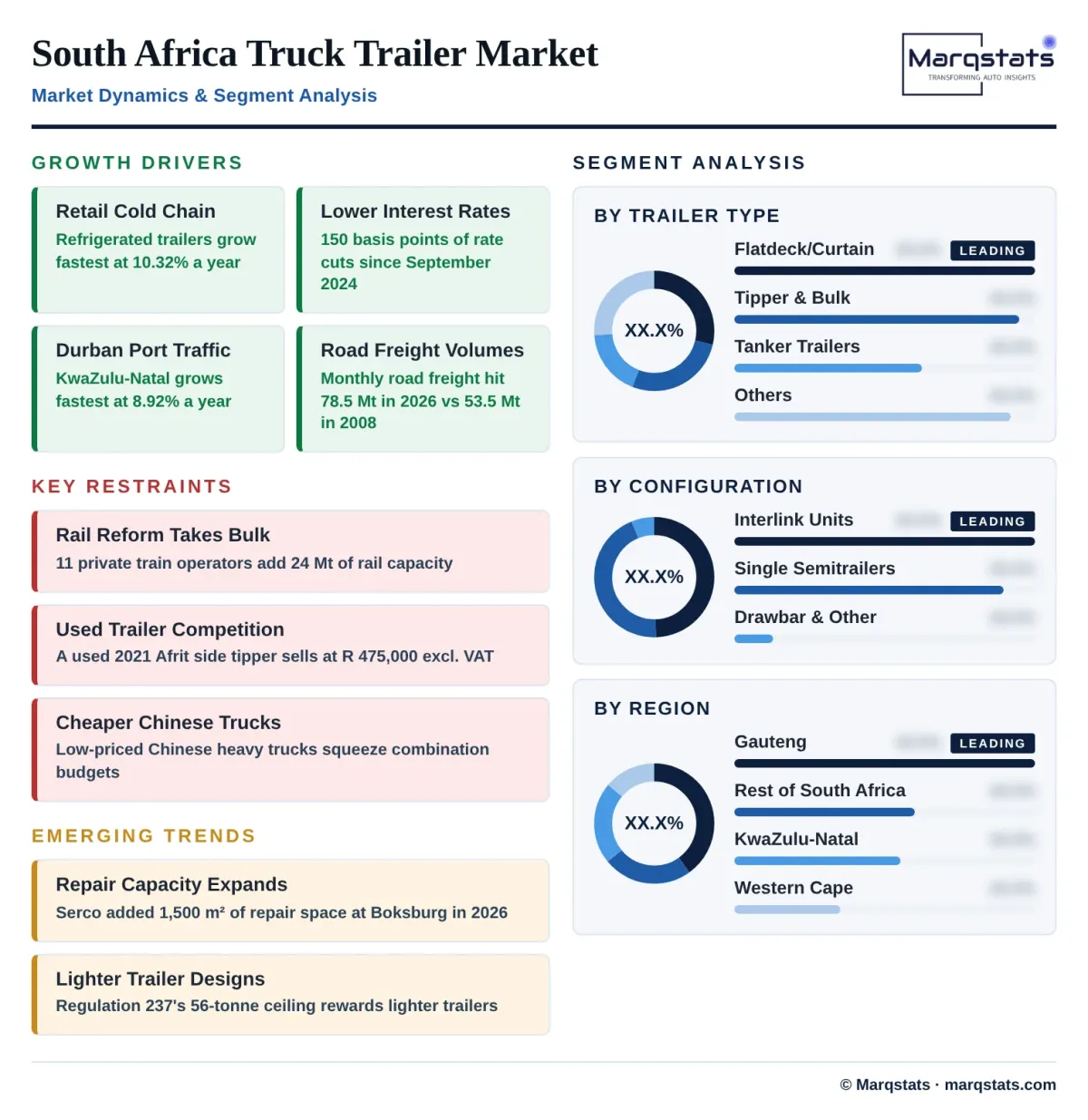
- Fleet renewal after a weak year for heavy truck sales. Heavy truck and bus sales fell 3.0% to 22,738 in 2025, and fleets that extended asset lives replace trailers as interest rates fall, lifting registrations 3.81% in 2026.
- Retail and food cold-chain expansion across supermarket distribution networks. Refrigerated trailers grow at 10.32% a year from 2025 to 2030 as supermarket and food distribution fleets expand, supported by investment such as the Serco Boksburg expansion in February 2026.
- Port and container traffic through Durban and the N3 corridor. Container movement through Durban drives skeletal and container trailer demand, and KwaZulu-Natal grows fastest of the four regions at 8.92% a year to 2030.
- Sustained road freight volumes across the national network. Monthly road freight reached 78.5 million tonnes in 2026 against 53.5 million tonnes in January 2008, keeping the national trailer fleet in steady use and sustaining replacement demand.
- Lower interest rates easing finance for fleets and owner-operators. Cumulative rate cuts of 150 basis points since September 2024 have eased finance for owner-operators and fleets, the buyer group that returns to new trailers first.
Key Restraints
Four constraints limit growth, led by rail reform and by competition from used and rental equipment.
- Rail reform returning bulk freight to the network. In May 2026, 11 private train operators gained network access, adding 24 million tonnes of rail capacity and holding tipper and bulk trailer growth to 6.27% a year.
- Used and rental equipment competing for price-sensitive owner-operators. Used trailers, such as a 2021 Afrit side tipper listed at R 475,000, give owner-operators a cheaper alternative to new equipment, particularly after registrations fell 20.8% in August 2025.
- Low-priced Chinese heavy trucks pressuring truck and trailer budgets. Cheaper Chinese heavy trucks are pressuring traditional truck pricing, which squeezes the budgets fleets set for complete combinations in a market where extra-heavy truck sales contracted 10% in 2025.
- Currency and steel exposure in the bill of materials. Rand weakness from ZAR 18.0 to ZAR 18.9 per US dollar between 2025 and 2030 raises the cost of imported axles, suspensions and couplings, while steel prices drive frame costs.
Key Trends
Four trends are reshaping the market toward service capacity, integrated ownership, captive finance and lighter designs.
- Expansion of repair and service capacity by trailer builders. Serco added 1,500 m² of repair space and 600 m² of steel body assembly at Boksburg in February 2026, raising output by 20 bodies a month, and announced a Durban repair facility to open by April 2026.
- Integrated groups combining trailer manufacturing, components and service. Henred Fruehauf and SA Truck Bodies share the Route group with axle and component businesses, linking trailers, parts and service under common ownership, while Schmitz Cargobull has held a 33% stake in GRW since 2017.
- Captive finance and leasing programmes aimed at owner-operators and small fleets. Afrit offers finance through Phuma Finance and leasing, helping owner-operators buy new trailers as cumulative rate cuts of 150 basis points since September 2024 ease finance costs.
- Lighter trailer designs maximising payload within legal mass limits. The 56-tonne combination mass ceiling under Regulation 237 includes tractor and trailer weight, which pushes buyers toward aluminium and higher-strength steel designs on dense cargo.
Strategic Implications
- Capacity weighted toward refrigerated, curtainside and container trailers aligns production with the fastest-growing segments, led by refrigerated trailers at 10.32% a year, as rail reform slows bulk trailer demand.
- Repair and service networks along the N3 and other freight corridors strengthen builder positions, because fleet uptime outweighs small price differences, as the Serco Durban repair facility announced in November 2025 reflects.
- Bulk trailer purchasing plans tied to rail access protect fleet returns, since part of the mining freight moving by road returns to rail as 11 private operators enter the network from May 2026.
- Rand exposure priced at component level, rather than applied across the whole trailer, reflects a cost structure in which imported axles, suspensions and couplings move with the currency.
Market Segmentation
Tipper and bulk trailers account for USD 112.00 million, or 27.17% of 2025 value, from 4,200 trailers, and grow at 6.27% a year to USD 151.80 million by 2030. Side tippers dominate the segment, mostly in interlink sets carrying coal, ore, grain and aggregates, and the segment is the most exposed of all types to the return of bulk freight to rail.
Flatdeck and curtainside trailers form the largest type at USD 118.22 million, or 28.68% of value, from 5,320 trailers, and grow at 8.45% a year to USD 177.36 million by 2030. The segment serves retail, manufacturing and regional distribution, and it gains share as general freight outgrows bulk haulage over the forecast period.
Refrigerated trailers account for USD 56.00 million, or 13.58% of value, from 1,120 trailers at about R 900,000 each, and grow fastest of all types at 10.32% a year to USD 91.51 million by 2030. Retail and food distribution fleets operated by groups such as Shoprite, Woolworths and Pick n Pay form the core of demand.
Tanker trailers account for USD 73.50 million, or 17.83% of value, from 1,260 trailers, and grow at 7.00% a year to USD 103.07 million by 2030. Fuel, chemicals and bulk liquids require approved vessels and specialized fittings, and tanker buyers weigh safety approvals and discharge systems above purchase price, which favours specialists such as GRW, a leading tanker builder with technical links to Schmitz Cargobull.
Skeletal, low-bed and specialized trailers account for USD 52.50 million, or 12.74% of value, and grow at 8.97% a year to USD 80.66 million by 2030. Container movement through Durban and project cargo drive demand, and port congestion keeps chassis occupied for longer, which can raise the number of trailers required for the same container volume.
Interlink combination units account for USD 203.80 million, or 49.44% of 2025 value, from 7,189 registered units equivalent to about 3,595 sets, and grow at 7.59% a year to USD 293.77 million by 2030. The configuration dominates long-haul bulk and general freight across the national corridors.
Single semitrailers account for USD 182.39 million, or 44.25% of value, from 5,950 trailers, and grow at 8.31% a year to USD 271.80 million by 2030. Refrigerated, tanker and specialized trailers are predominantly single semitrailers, which explains why the configuration outgrows interlinks as cold-chain demand expands.
Drawbar and other trailers account for USD 26.03 million, or 6.31% of value, from 861 trailers, and grow at 8.33% a year to USD 38.83 million by 2030, serving rigid-truck combinations and niche applications outside the semitrailer configurations.
By Geography
Gauteng
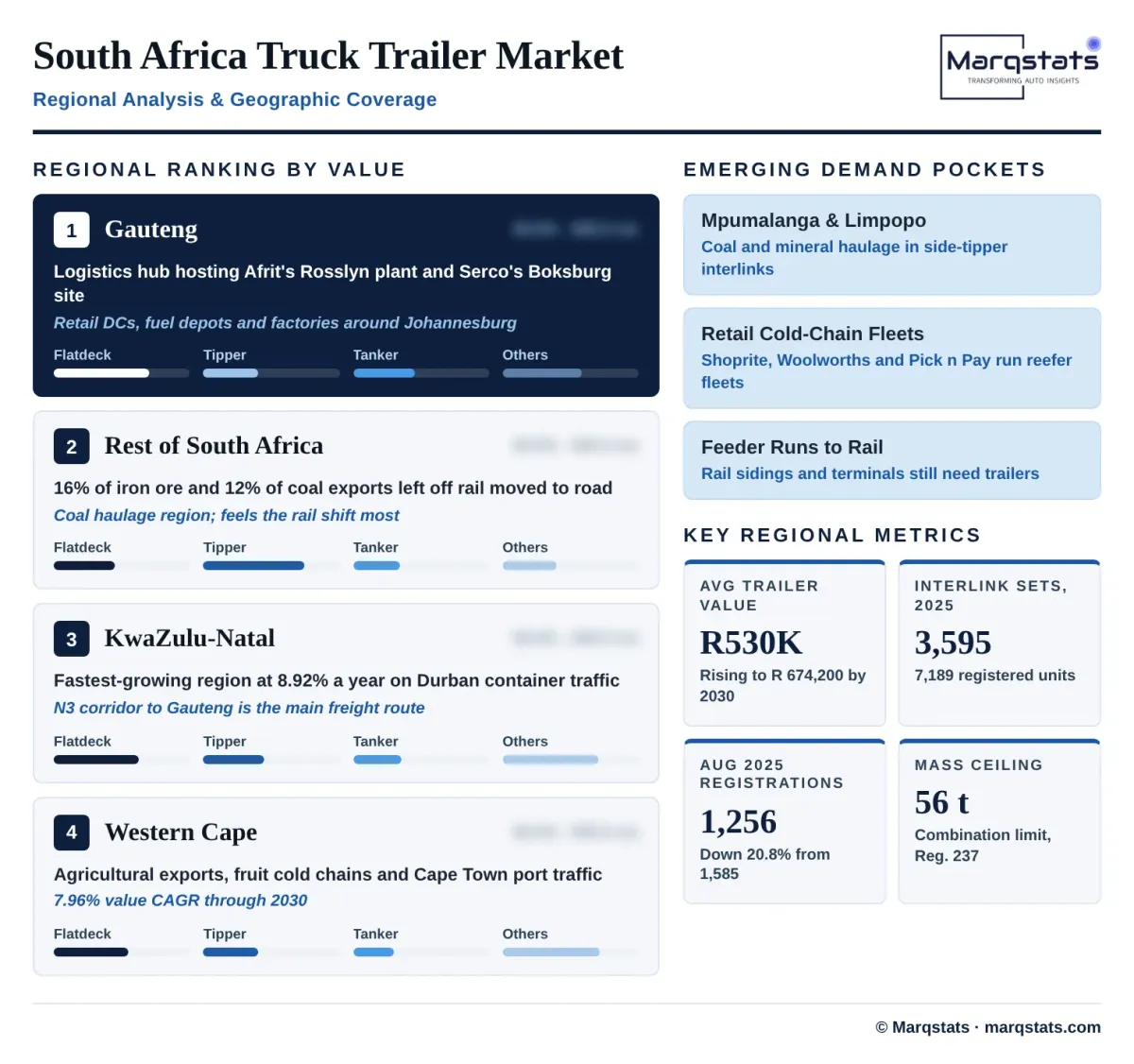
Gauteng is the largest region at USD 164.89 million, or 40.00% of 2025 value, and grows at 7.41% a year to USD 235.71 million by 2030. The province is the national logistics hub and hosts the Afrit plant at Rosslyn and the Serco facility at Boksburg, while retail distribution centres, fuel depots and manufacturing plants around Johannesburg and Pretoria create steady demand for curtainside, refrigerated and tanker trailers. Regional values are modelled allocations by registration province.
KwaZulu-Natal
KwaZulu-Natal accounts for USD 90.69 million, or 22.00% of value, and grows fastest of the four regions at 8.92% a year to USD 139.01 million by 2030. Durban, the busiest container port in the country, drives skeletal and general freight trailer demand, and the N3 corridor to Gauteng is the main national freight route.
Western Cape
Western Cape holds USD 57.71 million, or 14.00% of value, and grows at 7.96% a year to USD 84.62 million by 2030. Agricultural exports, fruit cold chains and Cape Town port traffic support regional demand for refrigerated and general freight trailers.
Rest of South Africa
The rest of South Africa, including Mpumalanga, Limpopo, North West and the Northern Cape, accounts for USD 98.93 million, or 24.00% of value, and grows at 7.96% a year to USD 145.06 million by 2030. Coal and mineral haulage dominates the regional mix, so the region is the most directly exposed to the return of bulk freight to rail. Engineering News reports that ageing infrastructure, theft and vandalism have left 16% of iron ore and 12% of coal export volumes off rail, and much of that cargo has moved by road in side-tipper interlinks.
How Competition Is Evolving
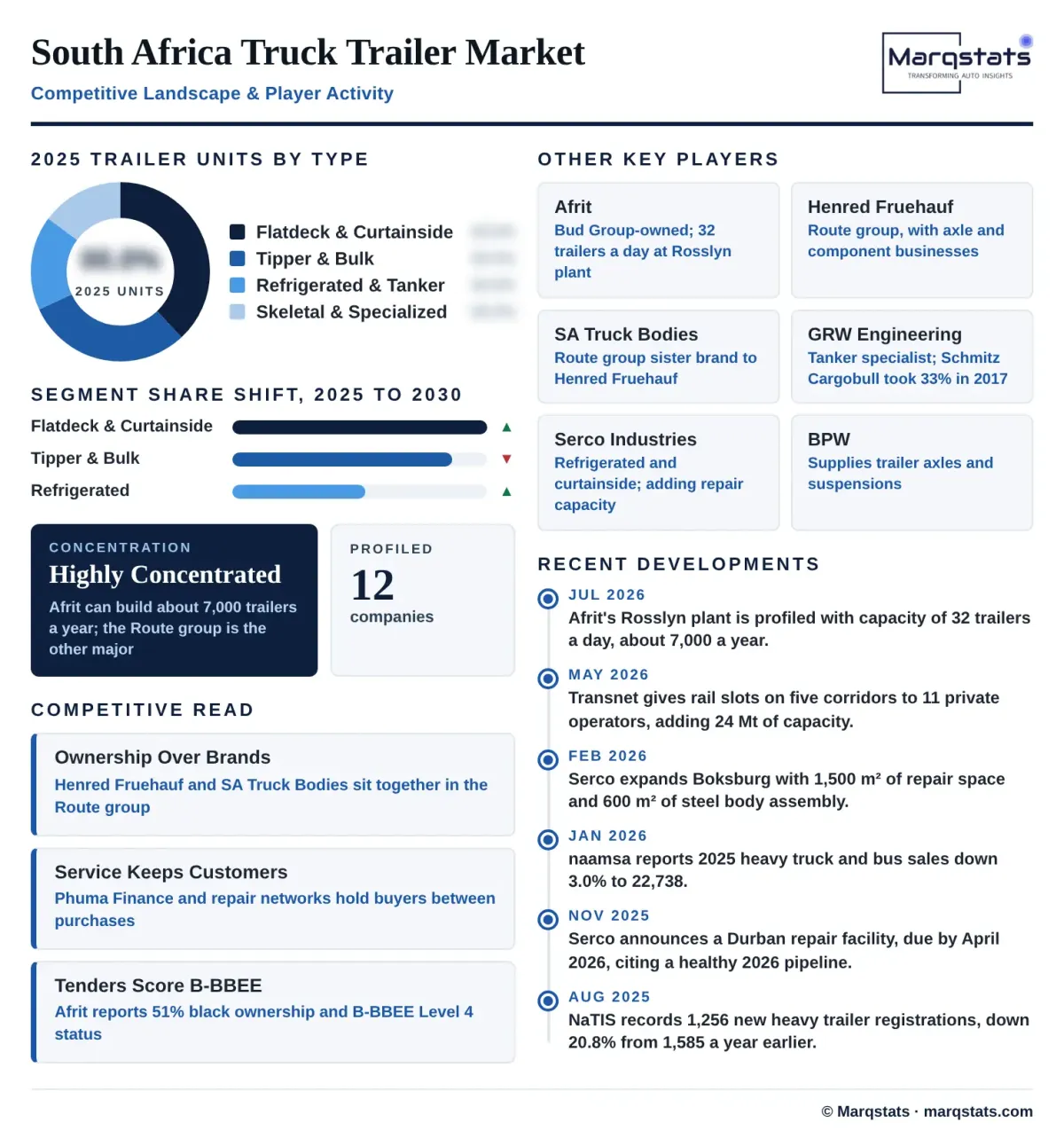
The South Africa trailer market is highly concentrated at the top, where Afrit and the Route group form the two large domestic producers and smaller builders and importers serve niche applications. Afrit, which describes itself as the largest trailer maker in Africa, can build about 32 trailers a day, or 7,000 a year, at its 78,000 m² plant in Rosslyn. Market shares could not be sourced from any public disclosure, so competitive position is assessed by group rather than by share.
Group ownership defines the competitive structure more accurately than brand count. Henred Fruehauf and SA Truck Bodies are related through the Route group, which also owns axle and component businesses, so their brands are assessed together. GRW, a tanker specialist, received a 33% investment from Schmitz Cargobull in 2017 that brought European technology and export links, Afrit is owned by The Bud Group and offers finance through Phuma Finance, and Serco specializes in refrigerated and curtainside bodies and trailers while expanding repair capacity in Gauteng and KwaZulu-Natal.
Competition turns on service, finance and procurement credentials. Large fleets prioritise repeat specifications, maintenance compatibility and residual value, while owner-operators focus on deposits, instalments and immediate work, and public tenders can score B-BBEE status, on which Afrit reports 51% black ownership and Level 4 status. Component suppliers such as BPW, SAF-Holland and JOST supply axles, suspensions and couplings, and truck manufacturers such as Daimler Truck, Volvo and FAW supply the tractors.
Companies Covered
Companies covered in the report include:
Recent Market Activity
Table of Contents
Coverage & Segmentation
Coverage spans new heavy commercial trailers registered in South Africa across Gauteng, KwaZulu-Natal, Western Cape and the rest of South Africa. The base year is 2025, the historical period 2021 to 2025 and the forecast period 2026 to 2030. Value is expressed in USD million of manufacturer revenue converted from rand, with rand values shown alongside, and excludes the truck-tractor, VAT, delivery, finance and used or rental equipment, while volume is measured in registered trailer units with each interlink counted as two units.
Segmentation runs across five trailer types and three configurations, and twelve companies are profiled across trailer builders, component suppliers and truck manufacturers. Caravans, light trailers, agricultural trailers and exports to other African countries are excluded. Registration data draw on NaTIS releases, vehicle market data on naamsa, prices on dealer listings and regulatory content on NRCS, the National Road Traffic Regulations and SARS.