Market Snapshot
Middle bar: base-year value × (1 + CAGR), rounded to two decimals. This is a calculated illustration, not a separately researched annual estimate.
The India bus body building market is estimated at USD 1,073.20 million (INR 9,175.85 crore) in FY2026 and is projected to reach USD 1,597.98 million (INR 14,413.74 crore) by FY2031, a CAGR of 8.29% in US dollars and 9.45% in rupees. New bus bodies built for the domestic market rise from 82,000 to 96,506 over the same period, a 3.31% CAGR, so the market grows principally through higher-value electric and intercity bodies and added compliance content rather than through volume.
Market size and forecast figures are generated using Marqstats' proprietary estimation framework, updated as of October 2026. The estimate is constructed from bus chassis wholesales and electric bus registrations valued at body-only prices, and it is most sensitive to the pace at which intercity and sleeper orders recover from the FY2027 compliance pause.
The market covers new bodies built on bus chassis in India by the captive plants of vehicle makers, by affiliated builders such as Automobile Corporation of Goa and by independent coach builders, together with the body-equivalent value of factory-built electric buses. Value and volume diverge sharply by application, since school, staff and institutional buses account for 51.58% of bodies but only 29.81% of value, while city and urban transit holds the largest value share at 36.70%. Electric buses represent 5.61% of bodies and 14.04% of value.
Regulation is now redistributing work across the builder base. The revised Bus Body Code, AIS-052, has applied since 1 September 2025, and after sleeper-bus fires that the government linked to 145 deaths in six months, the Ministry of Road Transport and Highways stated in January 2026 that sleeper coaches may be built only by automobile makers or government-accredited facilities. India had 886 accredited bus body builders and 49,616 registered sleeper coaches in February 2026.
Key Takeaways
Market Overview & Analysis
Report Summary
Bus body building in India is the construction of the passenger structure on a bus chassis, including the frame, panels, roof, flooring, windows, doors, seats or berths, wiring, lighting, air conditioning ducts, insulation and safety equipment. Most Indian buses leave Tata Motors, Ashok Leyland, VE Commercial Vehicles and other chassis makers as a bare chassis, which is then bodied in the vehicle maker's own plants, at affiliated builders or by one of hundreds of independent coach builders. Electric bus makers such as JBM Auto, Olectra Greentech, PMI Electro Mobility and Switch Mobility build complete vehicles, so their contribution to the market is measured as the body share of vehicle value. The India bus body building market is accordingly defined as body-only manufacturer revenue, excluding the chassis, battery, powertrain and GST.
No public body reports national bus body output or value, and the market size is a Marqstats construction calibrated to SIAM data, cited in trade press, that put FY2026 medium and heavy commercial bus wholesales at 67,149 units. The FY2026 base comprises an estimated 82,000 new bodies built for domestic use, of which about 63,500 sit on medium and heavy diesel and CNG chassis, about 13,900 on light bus chassis and about 4,600 are electric buses. Body values are benchmarked to Automobile Corporation of Goa, whose bus-body revenue per bus sold was about INR 9.17 lakh in FY2026 against INR 8.15 lakh in FY2025.
The market is reported on Indian fiscal years, with FY2026 (April 2025 to March 2026) as the base year and FY2027 to FY2031 as the forecast period, shown as 2026 to 2030 in the data panel. Values are converted at INR 85.5 per US dollar in FY2026, moving to INR 90.2 by FY2031, so rupee growth runs about 1.2 points a year ahead of dollar growth. The forecast depends on three conditions holding together, namely continued growth in school, staff and city demand, a recovery in intercity and sleeper orders after the 2026 compliance pause and rising electric bus deliveries under PM E-DRIVE and state tenders.
India Bus Body Building Market Size and Forecast
Indian vehicle makers and coach builders produced an estimated 82,000 new bus bodies for the domestic market in FY2026, and output is forecast to reach 96,506 bodies by FY2031, a 3.31% compound annual growth rate. Volume is the anchor series, and value is derived from volume and a weighted average body value that rises from about INR 11.19 lakh in FY2026 to INR 14.94 lakh in FY2031, equivalent to USD 13,088 rising to USD 16,558 per body.
The annual path runs from 82,000 bodies worth USD 1,073.20 million (INR 9,175.85 crore) in FY2026 to 81,670 bodies worth USD 1,114.52 million (INR 9,631.67 crore) in FY2027 and 85,400 bodies worth USD 1,232.17 million (INR 10,762.96 crore) in FY2028. The market then reaches 89,030 bodies and USD 1,349.19 million (INR 11,911.95 crore) in FY2029, 92,778 bodies and USD 1,472.49 million (INR 13,140.44 crore) in FY2030 and 96,506 bodies and USD 1,597.98 million (INR 14,413.74 crore) in FY2031, an absolute gain of USD 524.78 million across the forecast.
FY2027 is a pause year in which bodies dip 0.40% and value rises only 3.85% to USD 1,114.52 million, below the USD 1,162.17 million implied by the CAGR path, because intercity and sleeper orders fall about 15% while operators and builders adjust to the new sleeper rules. Ashok Leyland's domestic bus shipments fell 28% to 1,673 units in June 2026, consistent with that slowdown, and unit growth of about 4% a year resumes from FY2028 as intercity and sleeper orders recover.
Three forces lift the average body value faster than volume across the forecast. Electric buses, with a body-equivalent value of about INR 28 lakh, take a rising share of output, intercity coaches add fire detection and suppression, emergency exits and better materials, and general price increases run at about 4% a year after a 5% rise in FY2027. The combined effect is that market value compounds at 8.29% against 3.31% for units, a gap of 4.98 points that places mix and specification, rather than fleet growth, at the centre of the outlook.
Independent Builders Lose Share to OEM and Accredited Plants
The India bus body building market is consolidating toward scale. Captive and OEM-integrated plants, comprising the body plants of vehicle makers, affiliated builders such as Automobile Corporation of Goa and the factories of electric bus makers, held 50.69% of FY2026 value, and their share rises to 59.78% by FY2031 as their value grows at 11.92% a year against 3.96% for independent body builders.
Three structural changes underpin the shift in share toward integrated plants. Every electric bus is built complete by its maker, so the entire increment in electric body value accrues to captive plants. The sleeper-bus rules announced in January 2026 restrict sleeper coaches to vehicle makers and government-accredited facilities, and the minister stated that he had written to Rajasthan about transport officials who allowed self-certification by manual body builders. The revised Bus Body Code has also raised the cost of approvals and testing, which favours builders able to spread those costs across large output.
Independent builders nonetheless retain a substantial position, building 53.84% of bodies in FY2026, concentrated in school, staff and regional buses where customisation, local service and credit terms count for more than scale. Builders that invest in accreditation, such as MG Group with AIS-153 certification across several coach platforms, remain eligible for intercity work, while those unable to fund it are likely to migrate toward school and staff bodies, repairs and refurbishment.
Sleeper Bus Fires Reset the Compliance Floor for Body Builders
Two fatal sleeper-bus fires in October 2025, on the Jaisalmer to Jodhpur and Kurnool to Bengaluru routes, changed the regulatory basis on which Indian bus bodies are built and approved. An inquiry into the Jaisalmer fire found that the bus exceeded the permitted length, its emergency doors were undersized, seats blocked the emergency exit, it carried one roof hatch instead of two, it was fitted with a roof luggage carrier and ladder and its fire detection and suppression system had not been installed as required.
The government responded by moving enforcement to the point of registration. In February 2026 it advised all states and union territories to verify compliance with AIS-052 and with AIS-119, the sleeper-coach standard, at registration and at every fitness inspection under Rule 62 of the Central Motor Vehicles Rules. Existing sleeper coaches must be retrofitted with fire detection systems, emergency exits with hammers, emergency lighting and driver drowsiness alerts, and new sleeper coaches may come only from vehicle makers or accredited facilities.
Compliance carries a fixed cost that weighs most heavily on small builders. ARAI announced measures in May 2026 to reduce bus body certification costs, setting the approval fee at INR 14 lakh plus GST with a typical process of 60 to 90 days depending on readiness. Spread over 100 bodies, that fee adds INR 14,000 per body, falling to INR 1,400 over 1,000 bodies, so a builder producing a few dozen sleepers a year carries a per-body certification cost many times that of an accredited volume plant.
Electric Buses Shift Value to Integrated Makers
Electric buses form the fastest-growing segment of the India bus body building market, although volumes remain small relative to the diesel and CNG base. India registered 2,944 electric buses in the first half of 2026, up 40% on a year earlier, with Switch Mobility, JBM Auto and PMI Electro Mobility together holding about 70% of registrations. A PM E-DRIVE tender for 10,900 electric buses, awarded in December 2025, provides makers with a multi-year order book, and JBM Auto reported a 49% share of registrations in May 2026 alongside an NCR plant that it says can build 20,000 buses a year.
Electric body value is estimated at USD 150.64 million in FY2026 and rises to USD 407.82 million by FY2031 at 22.04% a year, as deliveries grow from about 4,600 to 12,500 units. The government approved PM E-DRIVE in September 2024 with support for 14,028 electric buses and has extended the scheme to March 2028. The Marqstats India Electric Bus Market estimate values complete electric buses at USD 440 million in 2025, and the body share of that vehicle value is roughly a third.
Electric bus bodies must accommodate battery packs, high-voltage wiring, cooling systems and heavier axle loads, which is why makers build them in-house rather than consigning chassis to independent builders.
Bus Body Costs Diverge by Application Rather Than by Builder
Bus body prices in India vary more by application than by builder, because the specification gap between a school bus and a sleeper coach far exceeds any difference in builder pricing. Automobile Corporation of Goa's bus-body revenue works out to about INR 9.17 lakh per bus in FY2026, up from INR 8.15 lakh in FY2025, a 12.5% rise reflecting both price increases and a richer mix. That figure is a segment average rather than a quotation, and it blends school, staff and transit bodies built mostly on Tata Motors chassis.
Average FY2026 body values stand at about INR 3.8 lakh for a light bus, INR 7.5 lakh for a school or staff body on a medium or heavy chassis, INR 10.5 lakh for a diesel or CNG city bus, INR 22 lakh for an intercity coach or sleeper and INR 28 lakh for the body share of an electric bus. Air conditioning, berths, luggage holds, fire detection and suppression and premium interiors account for most of the gap between a school bus and a sleeper.
The cost stack of an Indian bus body comprises materials, labour and plant, compliance and finance. Materials cover structural sections, panels, glazing, flooring, seats, doors, insulation and wiring, while labour and plant cover welding, trimming, painting and inspection, with custom work lowering output per shift. Compliance adds approval fees and testing, and finance covers the chassis held in the plant, bank guarantees and slow-paying public customers, so a lower quoted price can carry a longer cash cycle.
Market Dynamics
Key Drivers
Five demand and policy factors support growth in the India bus body building market through FY2031.
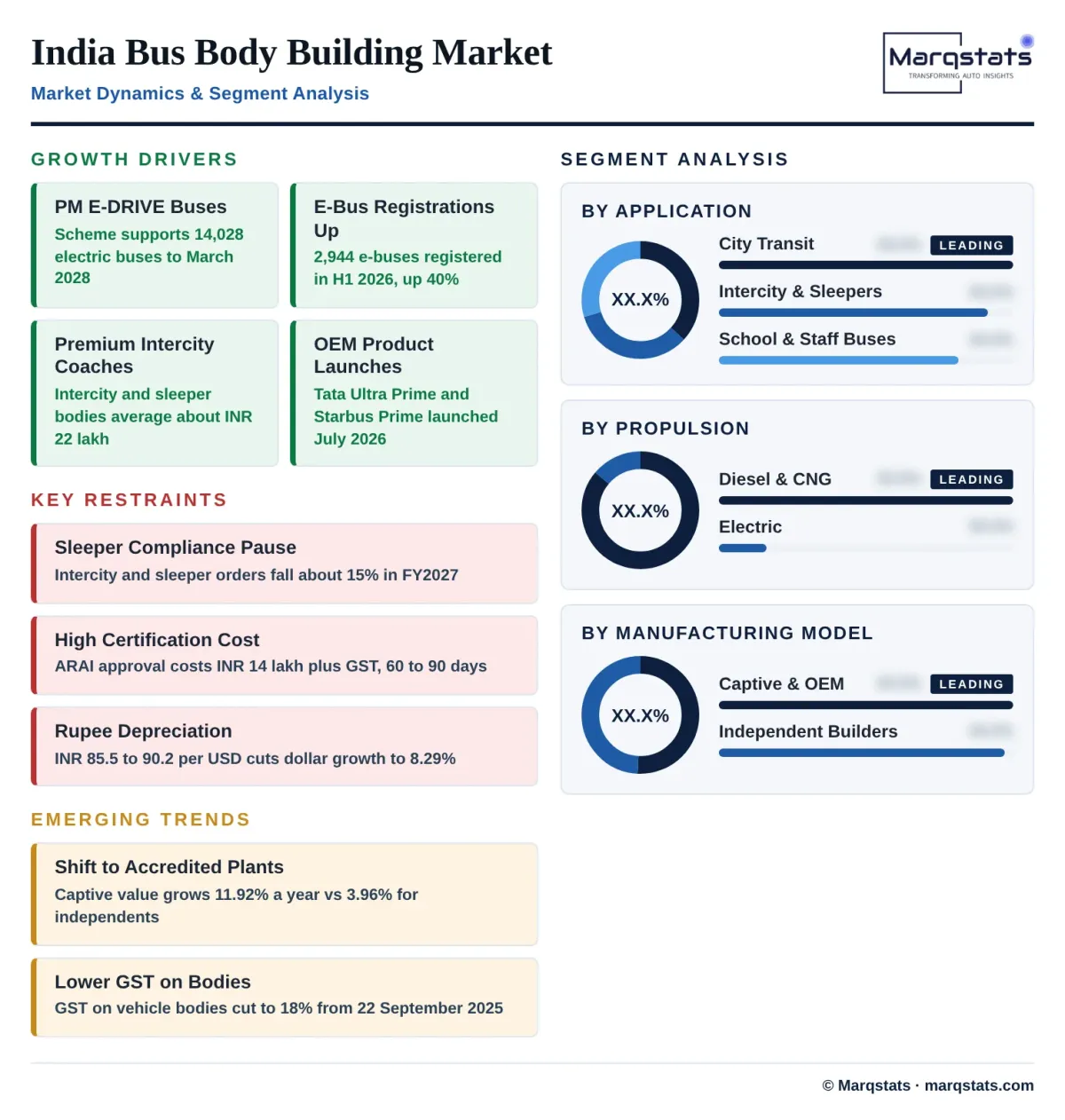
- Electric bus programmes. PM E-DRIVE supports 14,028 electric buses and runs to March 2028, and electric registrations rose 40% in the first half of 2026, which lifts electric body value at 22.04% a year through FY2031.
- Fleet replacement and school demand. School, staff and institutional buses account for 51.58% of bodies, and their numbers grow about 4% a year as schools and employers expand fleets.
- Higher safety content. Fire detection and suppression, additional roof hatches, emergency exits and better materials raise intercity body values by about 2% a year on top of general price increases, following the safety rules introduced after the October 2025 fires.
- Premium intercity coaches. Builders such as MG Group have launched super-premium 13.5-metre coaches, and intercity bodies average about INR 22 lakh each, the highest value of any diesel application in the market.
- OEM product launches. Tata Motors launched its Ultra Prime and Starbus Prime ranges in July 2026, adding chassis programmes for partner and captive body plants and extending the product cycle on which body builders depend.
Key Restraints
Four constraints restrain the market, and their combined effect is sharpest in FY2027.
- Sleeper-bus compliance pause. Intercity and sleeper body orders fall about 15% in FY2027 as operators wait for accredited capacity and retrofit existing coaches, holding market value growth to 3.85% in that year.
- Certification cost. An ARAI approval costs INR 14 lakh plus GST and takes 60 to 90 days under the May 2026 framework, a fixed burden that weighs disproportionately on builders with low annual output.
- Working capital. Builders often hold the customer's chassis while awaiting payment, and state transport orders can carry retention money and long receivable periods, so working capital rather than plant capacity limits the order book of smaller builders.
- Rupee depreciation. The rupee is assumed to weaken from INR 85.5 to INR 90.2 per US dollar between FY2026 and FY2031, which reduces dollar growth to 8.29% against 9.45% in rupees.
Key Trends
Four trends are changing how bus bodies are built and procured in India.
- Consolidation into accredited plants. Captive and OEM-integrated plants rise from 50.69% to 59.78% of market value by FY2031, as accreditation requirements and electric integration concentrate output in larger facilities.
- Factory-built premium coaches. VE Commercial Vehicles sells the factory-built Volvo 9600 in seater and sleeper versions, which competes directly with the established route of a chassis purchase followed by independent bodying.
- Builders becoming brands. MG Group, which has delivered more than 125,000 bus bodies and reports revenue above INR 700 crore, is moving from contract bodying toward its own coach brand in the premium intercity segment.
- Lower GST on bodies. GST on motor vehicle bodies fell to 18% from 22 September 2025 under the revised rate structure, reducing the cost of body work on customer-supplied chassis.
Strategic Implications
- Independent builders. Investment in accreditation and AIS-153 or AIS-119 approvals preserves access to intercity work, while builders without that capacity are better placed concentrating on school, staff and repair work, where scale counts for less.
- Vehicle makers. Expansion of captive and partner body capacity aligns with a nine-point rise in their share of body value by FY2031 and secures the higher-value electric and intercity work that drives market growth.
- Electric bus makers. Standardised body platforms reduce approval cost per unit as electric volumes climb from about 4,600 toward 12,500 a year by FY2031.
- Operators. Sleeper fleet owners face higher body prices and retrofit costs as compliance content keeps rising, with intercity body values growing about 2% a year above general price increases.
Market Segmentation
City and urban transit is the largest application in the India bus body building market at USD 393.86 million, or 36.70% of FY2026 value, from 25,735 bodies. Value grows fastest of the three applications at 10.92% a year to USD 661.16 million by FY2031, raising the segment share to 41.37%, because electric buses for state transport undertakings and city operators carry high body values. Diesel and CNG city bodies decline gradually as cities transition their fleets to electric.
Intercity coaches and sleepers account for USD 359.46 million, or 33.49% of value, from 13,970 bodies at about INR 22 lakh each. Value grows at 6.64% a year to USD 495.84 million by FY2031, restrained by the FY2027 compliance pause and then supported by added safety content and premium coach demand. The segment faces the strictest rules of any application and the sharpest shift of work toward accredited and OEM-integrated plants.
School, staff and institutional buses are the largest application by volume, with 42,295 bodies or 51.58% of the total, but contribute only USD 319.88 million, or 29.81% of value. The segment grows at 6.63% a year to USD 440.98 million by FY2031, with bodies that are simpler and cheaper, at about INR 6.5 lakh on average, and frequently built on light bus chassis. It remains the core market for independent builders, whose advantages in customisation, local service and credit terms carry most weight in this application.
Diesel and CNG buses account for USD 922.56 million, or 85.96% of FY2026 value, from 77,400 bodies. Value grows at 5.23% a year to USD 1,190.16 million by FY2031 while the segment share falls to 74.48% as electric buses expand in city fleets.
Electric buses account for USD 150.64 million, or 14.04% of value, from about 4,600 units, and grow fastest at 22.04% a year to USD 407.82 million by FY2031. Because the body is built by the bus maker, the segment value represents the body share of a complete vehicle, and the entire increment accrues to captive plants.
Captive and OEM-integrated plants account for USD 543.98 million, or 50.69% of FY2026 value, from 37,853 bodies, and grow at 11.92% a year to USD 955.27 million by FY2031. The segment comprises the body plants of vehicle makers, Automobile Corporation of Goa and electric bus factories, and it captures all electric growth together with a rising share of intercity work.
Independent body builders account for USD 529.22 million, or 49.31% of value, from 44,147 bodies, and grow at 3.96% a year to USD 642.71 million by FY2031, when their share falls to 40.22%. The group ranges from large regional coach builders to small workshops, competing on customisation, delivery time, local service and credit terms.
By Geography
South India
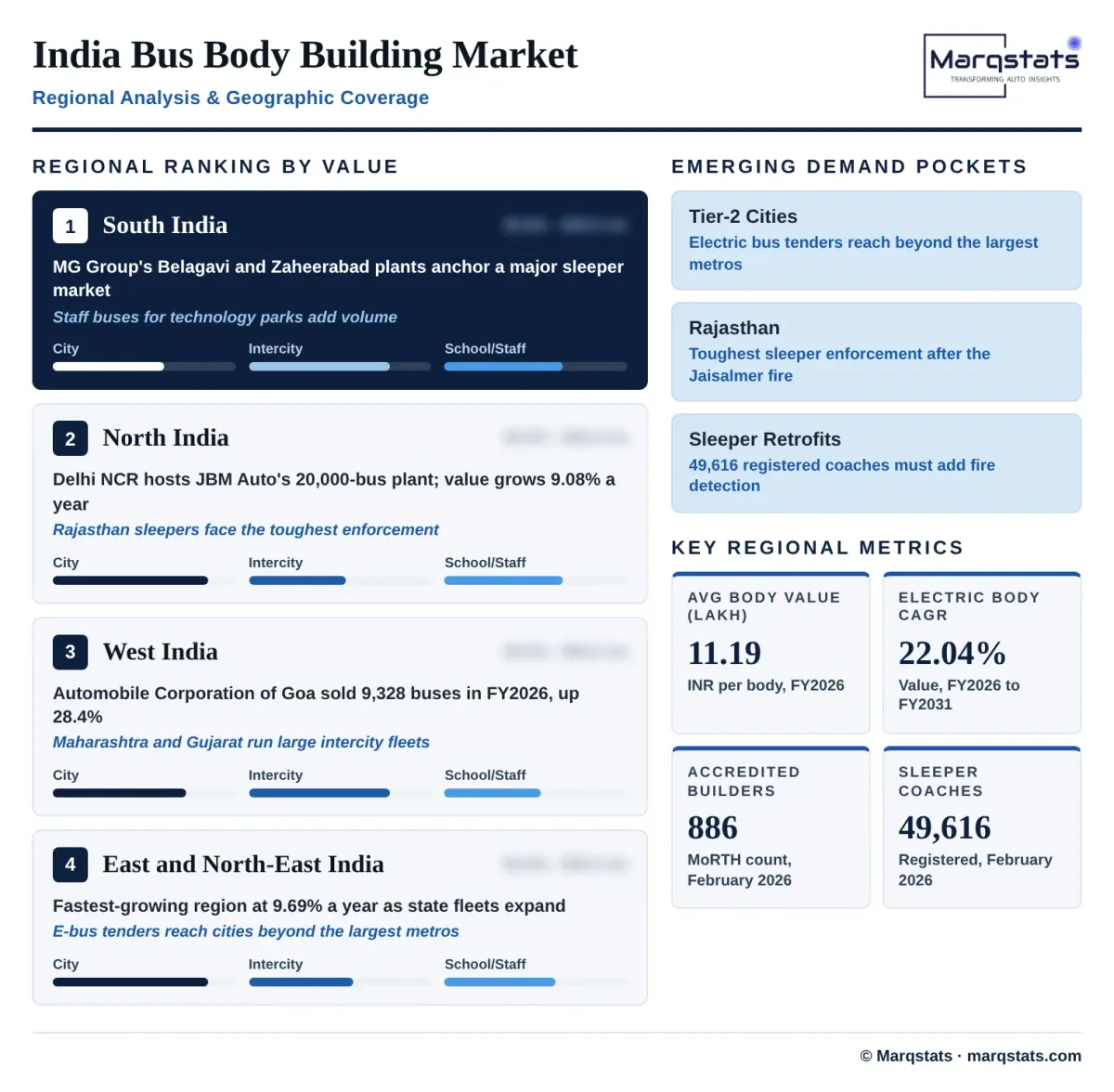
South India is the largest regional market at USD 343.42 million, or 32.00% of FY2026 value, and grows at 7.60% a year to USD 495.37 million by FY2031. Karnataka and Telangana host large builders, including MG Group's plants at Belagavi and Zaheerabad and Veera Vahana Udyog near Bengaluru, and the region is a major market for intercity sleepers and for staff buses serving technology parks. Regional splits are Marqstats allocations, because national body output by state is not published.
North India
North India accounts for USD 289.77 million, or 27.00% of value, and grows at 9.08% a year to USD 447.43 million by FY2031, supported by electric bus deployment in Delhi and the National Capital Region, where JBM Auto builds electric buses, and by large school bus fleets. Rajasthan's sleeper coach fleet faces the toughest enforcement in the region after the Jaisalmer fire of October 2025.
West India
West India holds USD 279.03 million, or 26.00% of value, and grows at 7.44% a year to USD 399.50 million by FY2031. Goa is home to Automobile Corporation of Goa, which sold 9,328 buses in FY2026, while Maharashtra and Gujarat operate large state transport and private intercity fleets that anchor regional demand.
East and North-East India
East and North-East India is the smallest region at USD 160.98 million, or 15.00% of value, but grows fastest at 9.69% a year to USD 255.68 million by FY2031. State transport fleets are expanding from a low base and electric bus tenders are reaching cities beyond the largest metros, which lifts the regional share of national value to 16.00% by FY2031.
How Competition Is Evolving
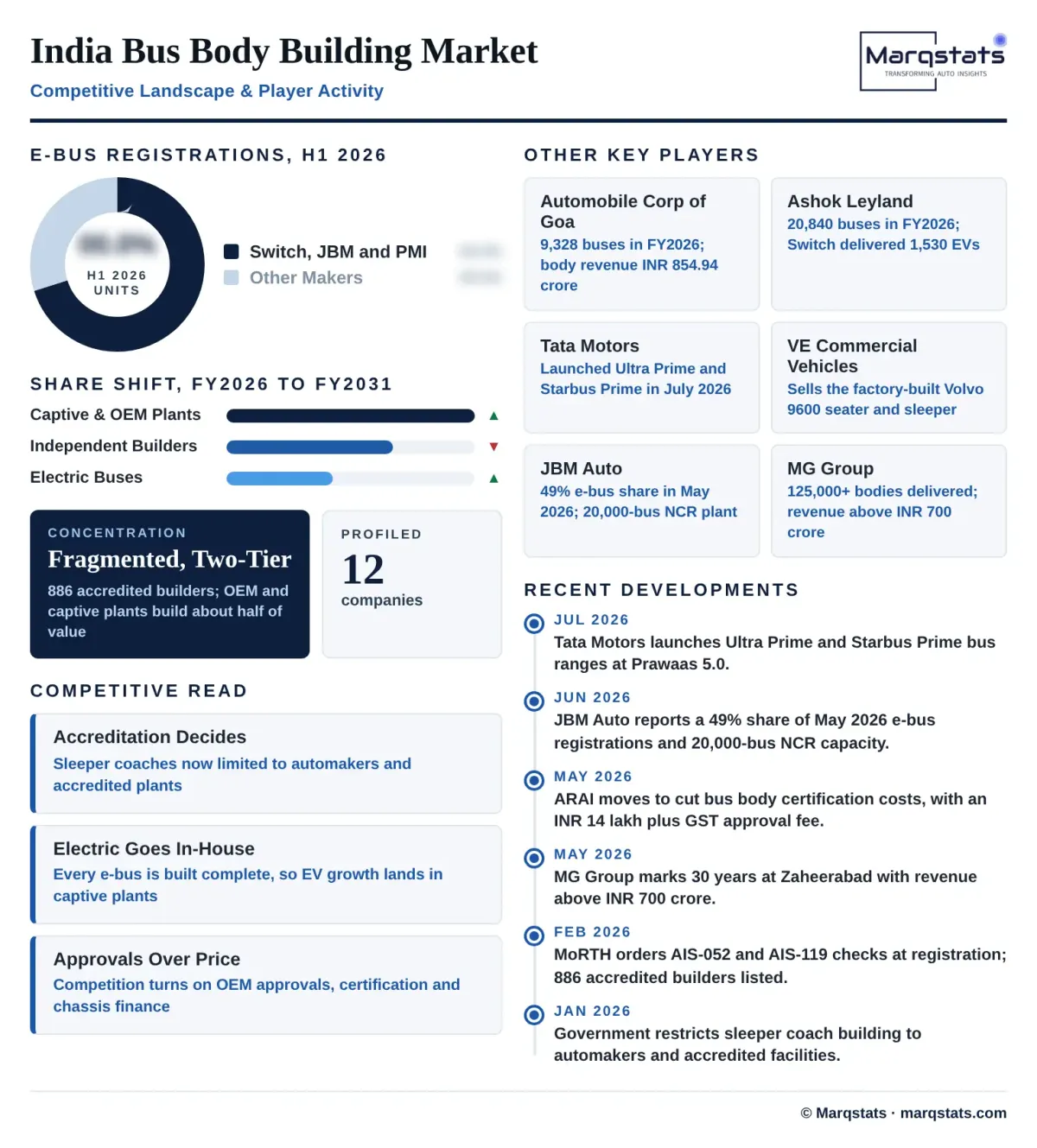
The India bus body building market is fragmented, with vehicle makers, affiliated builders and electric bus makers accounting for about half of body value and hundreds of independent builders sharing the remainder. India had 886 accredited bus body builders in February 2026, although accreditation does not indicate active output, and market shares could not be sourced because no public source reports national builder shares, so competition is analysed by business model.
Automobile Corporation of Goa is the clearest example of a chassis-linked builder, having sold 9,328 buses in FY2026, up from 7,265, with bus-body revenue rising to INR 854.94 crore. Ashok Leyland, which describes itself as the bus segment leader, sold 20,840 medium and heavy buses in India in FY2026, and its electric arm Switch Mobility delivered 1,530 electric buses. Tata Motors refreshed its range with the Ultra Prime and Starbus Prime in July 2026, VE Commercial Vehicles offers the factory-built Volvo 9600 and SML Mahindra joined the Mahindra group in 2025.
Among electric bus makers, JBM Auto, Olectra Greentech, PMI Electro Mobility and Pinnacle Mobility Solutions, under the EKA brand, build complete buses for state and city tenders. Among independent builders, MG Group has delivered more than 125,000 bus bodies from Belagavi and Zaheerabad, Veera Vahana Udyog builds coaches and sleepers near Bengaluru and JCBL builds bus and specialist bodies alongside cargo bodies.
Competition in the market turns on OEM approvals, certification, delivery reliability and the capacity to finance chassis held in the plant, with approvals carrying the greatest weight.
Companies Covered
Companies covered in the report include:
Recent Market Activity
Table of Contents
Coverage & Segmentation
Coverage spans new bus body building in India across South, North, West and East and North-East India, with FY2026 as the base year, FY2022 to FY2026 as the historical period and FY2027 to FY2031 as the forecast period, shown as 2026 to 2030 in the data panel. Value is expressed in USD million of body-only manufacturer revenue converted from rupees, with rupee values reported alongside, and excludes the chassis, battery, powertrain and GST. Volume is measured in new bodies built for domestic use, and the market is segmented by application into three segments, by propulsion into two and by manufacturing model into two, with twelve companies profiled.
Body repairs, refurbishment, retrofits, exported buses and factory-built light passenger vans are excluded from the market. Unit benchmarks draw on SIAM data, company annual reports and Vahan-based electric bus registrations, body values draw on Automobile Corporation of Goa disclosures and regulatory content draws on Ministry of Road Transport and Highways and ARAI releases.