Market Snapshot
Middle bar: base-year value × (1 + CAGR), rounded to two decimals. This is a calculated illustration, not a separately researched annual estimate.
The Australia ute canopy market, covering ute trays, tray-mounted canopies and tub-mounted canopies, is estimated at USD 407.05 million in 2025 and is projected to reach USD 524.14 million by 2030, a CAGR of 5.19%, as installations rise from 121,300 to 132,662 units at 1.81% a year. Value grows almost three times faster than volume because aluminium systems and touring specifications lift the average installation from about AUD 5,204 to AUD 6,127, and Western Australia is the fastest-growing state at 6.32% a year.
Market size and forecast figures are generated using Marqstats' proprietary estimation framework, updated as of October 2026. The estimate is constructed from new ute sales, the registered light commercial vehicle fleet and catalogue prices for trays and canopies, and it is most sensitive to the share of new utes sold in cab-chassis form and to the pace of aluminium substitution.
The market covers new load bodies and secure storage systems fitted to utes in Australia, comprising steel and aluminium trays, full, compact and half canopies mounted on a tray and canopies of fibreglass, ABS, composite or metal that fit an existing pick-up tub. Value is measured at end-customer prices excluding the 10% goods and services tax, which equals about AUD 631.18 million in 2025, and it excludes slide-on campers, tonneau covers, roof racks sold separately and second-hand units. Ute trays are the dominant product at 50.50% of value, while Queensland is the largest state market at 28.78%.
Australian demand for trays and canopies is unusually deep because the ute serves as both the national work vehicle and the principal touring vehicle. Utes accounted for 235,614 new vehicle sales in 2025, of which 212,513 were four-wheel drive, and the Ford Ranger and Toyota HiLux alone sold 107,852 units. The registered light commercial fleet reached 4,195,833 vehicles at 31 January 2025, up 3.07% in a year, and supplies a large retrofit and replacement base in addition to new-vehicle fitments.
Key Takeaways
Market Overview & Analysis
Report Summary
A ute tray is a flat steel or aluminium load deck with drop sides that replaces the factory pick-up tub or completes a cab-chassis ute, while a canopy is a lockable enclosure that sits either on that tray or on the original tub. Australian buyers combine the two into tray-and-canopy packages that convert a ute into a mobile workshop, a farm service vehicle or a touring base, so that a single vehicle installation can contain two saleable products. Trade fleets value tool security, side access and short downtime, agricultural and mining users value durability and repairability, and touring buyers purchase modular storage, water tanks and electrical systems.
No public census of canopy or tray fitments exists in Australia, and the market size is a Marqstats construction built from vehicle sales, the registered fleet and supplier pricing. The construction counts 121,300 installed products in 2025, comprising 69,300 trays, 22,000 tray-mounted canopies and 30,000 tub-mounted canopies, of which 87,800 were fitted to new vehicles and 33,500 were retrofits, replacements or transfers to replacement vehicles. Average end-customer prices excluding GST are about AUD 4,600 for a tray, AUD 8,200 for a tray-mounted canopy and AUD 4,400 for a tub-mounted canopy.
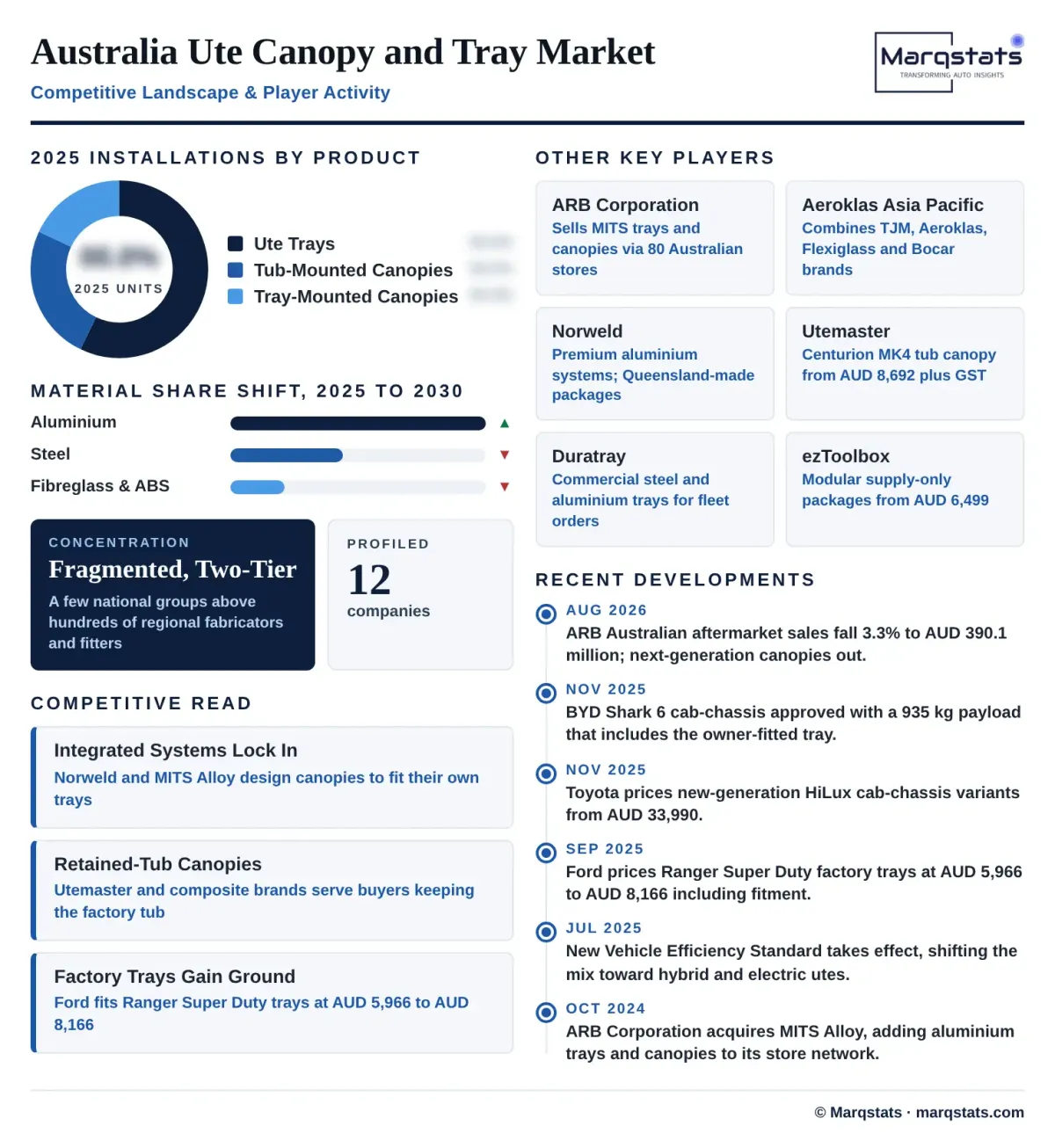
The supply base ranges from national brands to regional fabricators. ARB Corporation acquired MITS Alloy in October 2024 and now sells MITS trays and canopies through its 80 Australian stores, Norweld sells premium aluminium tray and canopy systems that require its own compatible tray or base and Utemaster supplies tub-mounted canopies for buyers who keep the original load body. The Aeroklas Asia Pacific group combines the TJM, Aeroklas, Flexiglass and Bocar brands, while Duratray, ezToolbox and hundreds of local workshops compete on commercial trays, supply-only packages and custom dimensions.
Ute Canopy Market Size and Forecast
Volume is the anchor series for the ute canopy market, and value is derived from installed units and a weighted average selling price that rises from about USD 3,356 per product in 2025 to USD 3,951 in 2030, equivalent to AUD 5,204 and AUD 6,127 at a constant exchange rate of USD 0.6449 per Australian dollar. Installations rise from 121,300 in 2025 to 132,662 by 2030, a 1.81% compound annual growth rate, while market value rises from USD 407.05 million to USD 524.14 million at 5.19% a year, an absolute increase of USD 117.09 million.
The annual path runs through 123,168 units and USD 428.81 million in 2026, 125,460 units and USD 450.81 million in 2027 and 127,805 units and USD 473.99 million in 2028. It continues to 130,205 units and USD 498.41 million in 2029 before reaching 132,662 units and USD 524.14 million in 2030, and value rises 5.35% in 2026, slightly above the constant-growth path of USD 428.18 million, as price increases on aluminium systems outpace a modest unit recovery.
New-vehicle fitment accounts for USD 287.16 million, or 70.55% of 2025 value, and grows at 4.75% a year to USD 362.23 million by 2030, while retrofit and replacement installations grow at 6.19% a year from USD 119.89 million to USD 161.91 million. The faster growth of the installed-base channel reflects an ageing light commercial fleet, the transfer of removable canopies to replacement vehicles and the upgrade of factory tubs to trays once a work ute changes owner.
Aluminium Systems Capture the Value Growth
Material choice is the principal source of value growth in the Australian tray and canopy market. Aluminium products account for USD 225.28 million, or 55.34% of 2025 value, from 52,585 units, and grow at 7.17% a year to USD 318.54 million by 2030, lifting their share of value to 60.77%. Steel products hold USD 126.81 million, or 31.15% of value, from 46,215 units, but grow at only 1.94% a year, and steel unit volumes decline to 44,527 by 2030 as fleet and touring buyers move to lighter bodies.
Payload is the mechanism behind the substitution from steel to aluminium, because a ute with a gross vehicle mass of 3,500 kg and an operating mass of 2,400 kg that removes an 80 kg tub and adds a 350 kg tray and canopy, 150 kg of other accessories and 150 kg of occupants retains only 530 kg for cargo, and every kilogram saved in the load body returns directly to legal payload. The BYD Shark 6 cab-chassis approved in November 2025 carries a 935 kg payload that must include whatever tray is fitted, so the weight of the body becomes part of the purchase decision rather than an afterthought.
Aluminium also commands higher prices and a broader option list. Norweld lists a full-length Basic aluminium canopy at AUD 13,490 including GST and fitting, or about AUD 12,264 excluding GST, before the compatible tray, while Duratray lists its Deluxe steel tray from AUD 6,850 plus fitting. The average aluminium product therefore sells for about USD 4,284 in 2025 against USD 2,744 for steel, and the shift in mix raises market value even in years when unit volumes barely move.
Pricing, Payload and the Installed Cost of a Load Body
Catalogue prices in the Australian ute canopy market vary by architecture, material and inclusions, and a buyer comparing offers must compare installed packages rather than headline shell prices. Utemaster lists its Centurion MK4 tub-mounted canopy at a base price of AUD 8,692 plus GST, or AUD 9,561.20 including GST, while ezToolbox advertises modular tray and canopy supply from AUD 6,499 before freight and fitting. Ford prices factory trays for the Ranger Super Duty at AUD 5,966 to AUD 8,166 including fitment, which places an original-equipment tray in the same price range as aftermarket aluminium designs.
The installed cost of a load body extends well beyond the product price. Manufacturing cost comprises sheet metal or composite shell, extrusion, welding, hinges, locks, seals, coating and purchased electrical parts, and delivered cost adds packaging, interstate freight, dealer margin and inventory. Installation adds tub removal, mounting brackets, rear lights, relocation of sensors or cameras, wiring and fitting labour, and a low advertised shell price can lose its advantage once brackets, paint, freight and electrical work are added to the invoice.
Ownership costs complete the comparison for fleet buyers. Corrosion repair, latch and seal replacement, downtime and the cost of transferring a canopy to a replacement vehicle all affect lifetime cost, and fleets therefore weigh warranty support, parts availability and installer reach alongside price. These factors favour suppliers with national fitting networks and standardised mounting kits, which explains why dealer-delivered packages and large brands win repeat fleet contracts despite higher list prices.
Compliance and Vehicle Platform Change
Vehicle regulation shapes product design in the ute canopy market. Vehicle Standards Bulletin 14 provides the national technical framework for modifications, while state and territory authorities administer approvals separately, and a body fitted before first supply follows the second-stage manufacture pathway under the Road Vehicle Standards legislation rather than the post-registration modification route. A canopy's own load rating does not raise the vehicle's legal carrying capacity, so mass, axle loads, lighting, visibility and attachment must be checked against the completed vehicle.
The New Vehicle Efficiency Standard, which has applied to new vehicle supply since 1 July 2025, influences the mix of utes on sale rather than the cost of each accessory. Plug-in hybrid and electric utes such as the BYD Shark 6 and the battery-electric HiLux announced for 2026 carry heavier drivetrains and tighter payload margins, which strengthens demand for lightweight trays and canopies engineered for each platform.
Platform launches create design work and early dealer opportunities. Toyota priced the new-generation HiLux in November 2025 with single, extra and double cab-chassis WorkMate and SR variants from AUD 33,990, Ford began delivering the Ranger Super Duty with a 4,500 kg gross vehicle mass in early 2026 and the Kia Tasman sold 4,196 units in its first six months in 2025. Each new model requires new mounting geometry and fitment testing, so short model cycles reward suppliers that can engineer quickly and penalise those carrying obsolete stock.
Market Dynamics
Key Drivers
Five factors support steady growth in the Australia ute canopy market through 2030.
- Large and stable ute demand. Australians bought 235,614 new utes in 2025, including 212,513 four-wheel-drive models, and each cab-chassis sale requires a tray before the vehicle can be used for work.
- Payload pressure on new platforms. Heavier hybrid and plug-in hybrid utes such as the BYD Shark 6, whose cab-chassis payload of 935 kg includes the tray, drive demand for aluminium systems that grow at 7.17% a year.
- Growth in touring and recreation. Touring buyers specify canopies with drawers, water and electrical options, and the recreation and touring segment grows at 7.44% a year to USD 167.84 million by 2030.
- Ageing and expanding light commercial fleet. The registered light commercial fleet rose 3.07% to 4,195,833 vehicles in the year to January 2025, sustaining retrofit and replacement demand that grows at 6.19% a year.
- Mining and resources activity in Western Australia and Queensland. Mining support fleets require heavy-duty trays and service canopies, and the two states together account for 44.43% of 2025 market value.
Key Restraints
Four constraints moderate growth, most of them linked to vehicle supply and installation capacity.
- Softer sales of the leading utes. Ford Ranger sales fell 9.6% to 56,555 and Toyota HiLux sales fell 4.1% to 51,297 in 2025, reducing the new-vehicle fitment base on the two largest platforms.
- Installation and labour bottlenecks. Fitting bays and skilled installers constrain practical output, and booking lead times extend in Queensland and Western Australia when mining and touring demand peak together.
- Price competition from imported and supply-only packages. Modular supply packages from AUD 6,499 compete with custom fabrication and fitted packages, compressing margins for regional workshops.
- Payload limits on fully equipped vehicles. A typical 3,500 kg ute retains about 530 kg for cargo after a 350 kg tray and canopy and other accessories, which caps the size and weight of the systems buyers can fit.
Key Trends
Four trends are reshaping product design and distribution in the Australian tray and canopy market.
- Integrated tray-and-canopy systems. Norweld and MITS Alloy design canopies to fit their own trays, which raises order value and switching cost and supports dealer cross-selling of complete packages.
- Consolidation under larger groups. ARB acquired MITS Alloy in October 2024, and the Aeroklas Asia Pacific group brings TJM, Aeroklas, Flexiglass and Bocar under one portfolio, extending national distribution to regional brands.
- Factory and dealer-fitted trays. Ford offers factory trays for the Ranger Super Duty at AUD 5,966 to AUD 8,166 fitted, moving more tray decisions into the vehicle purchase and finance discussion.
- New canopy generations. ARB released next-generation Ascent and Classic canopies during its 2026 financial year, while suppliers develop fitment kits for the new HiLux, the Kia Tasman and the BYD Shark 6.
Strategic Implications
- Engineering speed on new platforms. Suppliers that release tested fitment kits early for the new HiLux, the Ranger Super Duty and the Shark 6 secure dealer relationships before competing products reach the market.
- Lightweight product portfolios. Manufacturers with aluminium and composite ranges are best placed to capture value growth, because aluminium products grow at 7.17% a year against 1.94% for steel.
- Fleet packages with documented installation. Standardised trade packages with replacement parts and short downtime suit fleet buyers, who account for 50.54% of 2025 value in the trade and fleet segment.
- Retrofit and transfer services. Removable canopies and repair services generate demand independent of new vehicle sales in a retrofit channel worth USD 161.91 million by 2030.
Market Segmentation
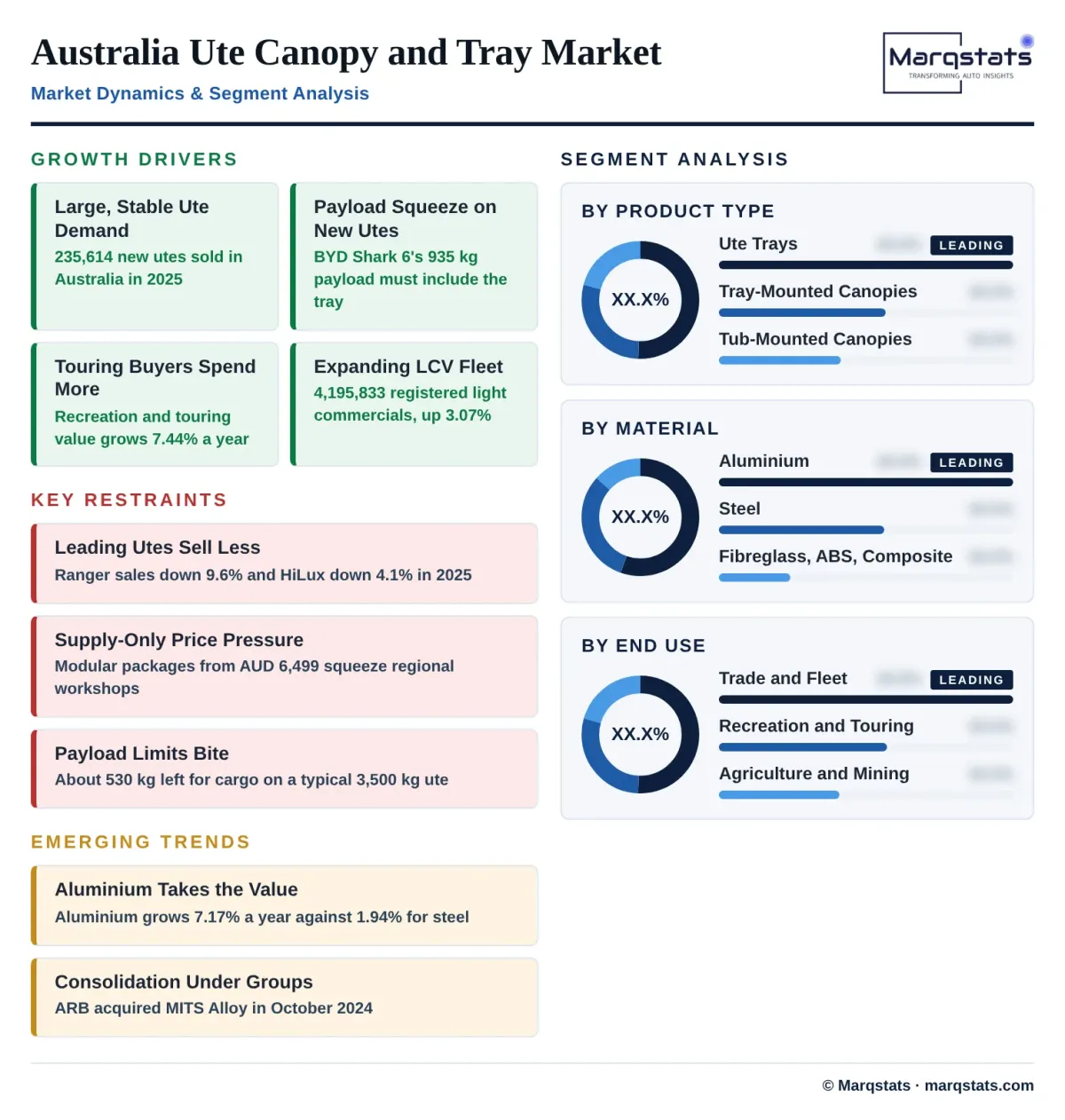
Ute trays are the dominant product at USD 205.58 million, or 50.50% of 2025 value, from 69,300 units at an average of about AUD 4,600 excluding GST. Value grows at 4.74% a year to USD 259.18 million by 2030, and the segment's share of value eases to 49.45% as canopies grow faster, although trays remain the essential first purchase for every cab-chassis ute and for pick-ups converted from the factory tub.
Tray-mounted canopies account for USD 116.34 million, or 28.58% of 2025 value, from 22,000 units, and are the fastest-growing product at 6.64% a year to USD 160.47 million by 2030. At about AUD 8,200 excluding GST, they carry the highest average price in the market because full-length aluminium canopies are built with gas struts, locking doors, drawers and electrical fit-outs for trade and touring use.
Tub-mounted canopies account for USD 85.13 million, or 20.91% of 2025 value, from 30,000 units, and grow at 4.18% a year to USD 104.49 million by 2030. They suit buyers who retain the factory tub, with fibreglass, ABS and composite designs from brands such as Aeroklas, Flexiglass and RSI SmartCap competing against metal canopies such as the Utemaster Centurion.
Aluminium is the largest material segment at USD 225.28 million, or 55.34% of 2025 value, from 52,585 units, and the fastest-growing at 7.17% a year to USD 318.54 million by 2030. Aluminium dominates premium trays and tray-mounted canopies because it saves weight for payload and resists corrosion in coastal and remote conditions.
Steel accounts for USD 126.81 million, or 31.15% of 2025 value, from 46,215 units, and grows at 1.94% a year to USD 139.61 million by 2030. Steel trays remain popular with farm and trade buyers on cost and repairability, but their share of value falls to 26.64% by 2030 as lighter materials gain ground.
Fibreglass, ABS and composite products account for USD 54.96 million, or 13.50% of 2025 value, from 22,500 units, and grow at 3.73% a year to USD 65.99 million by 2030. These materials are used mainly in colour-matched tub-mounted canopies sold through dealers and accessory chains to private and light trade buyers.
Trade and fleet buyers are the largest end-use segment at USD 205.71 million, or 50.54% of 2025 value, from 64,866 units, and grow at 4.26% a year to USD 253.38 million by 2030. Tradespeople, service fleets and government fleets prioritise tool security, access, durability and short downtime, and fleet buyers negotiate fixed pricing and replacement parts for repeat orders.
Agriculture and mining users account for USD 84.11 million, or 20.66% of 2025 value, from 24,725 units, and grow at 4.12% a year to USD 102.92 million by 2030. Heavy-duty trays, service canopies and mine-specification fit-outs dominate the segment, with demand concentrated in Queensland and Western Australia.
Recreation and touring buyers account for USD 117.23 million, or 28.80% of 2025 value, from 31,709 units, and are the fastest-growing end use at 7.44% a year to USD 167.84 million by 2030. Touring packages combine aluminium trays and canopies with drawers, water tanks, fridges and dual-battery systems, which lifts the average order well above the market average.
New-vehicle fitment accounts for USD 287.16 million, or 70.55% of 2025 value, from 87,800 units, and grows at 4.75% a year to USD 362.23 million by 2030. Dealer-delivered packages, factory trays and installations completed before first registration fall in this segment.
Retrofit and replacement installations account for USD 119.89 million, or 29.45% of 2025 value, from 33,500 units, and grow at 6.19% a year to USD 161.91 million by 2030. The segment covers later upgrades, accident replacements and the transfer of canopies to replacement vehicles.
By Geography
Queensland
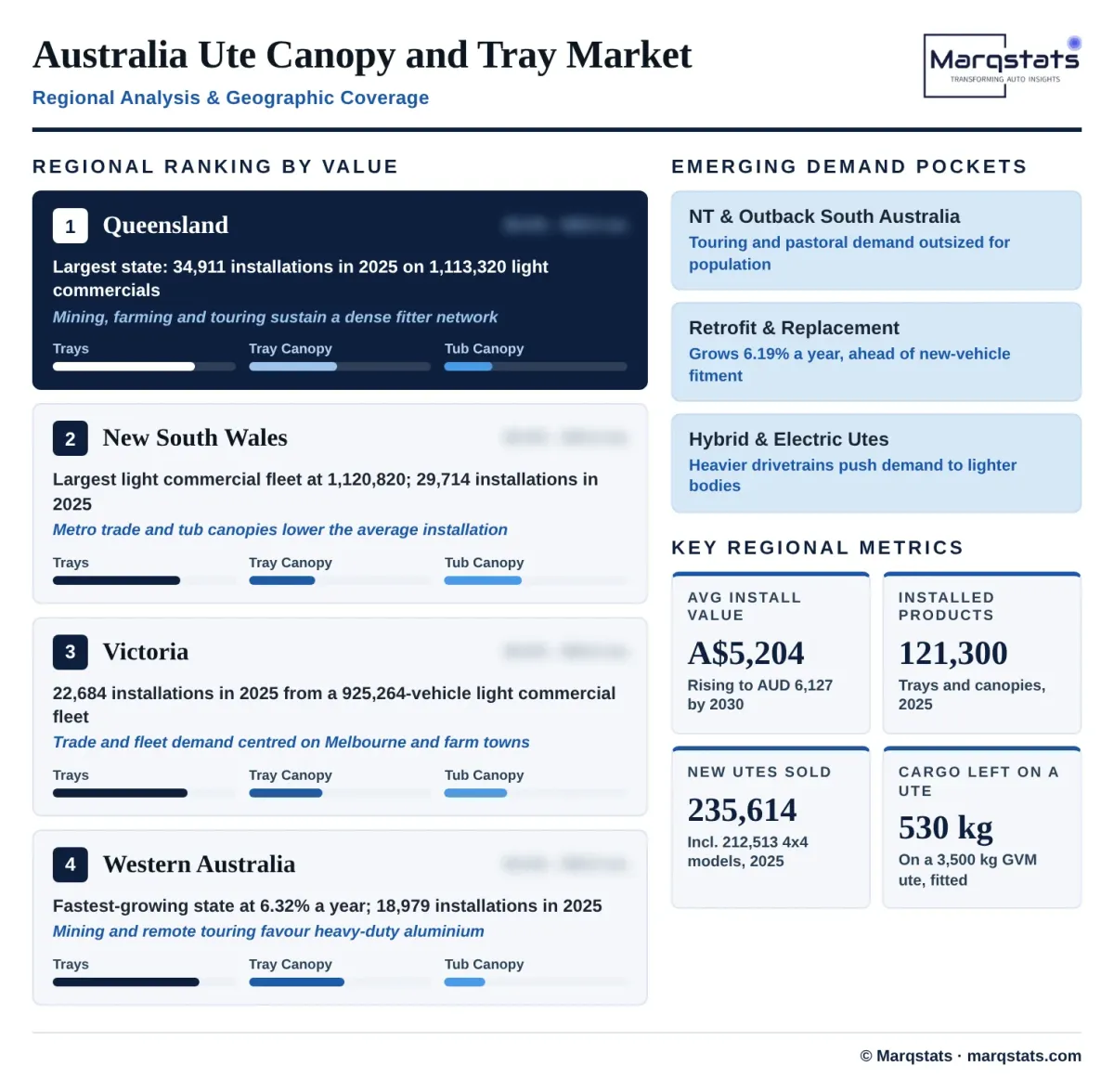
Queensland is the largest state in the ute canopy market at USD 117.15 million, or 28.78% of 2025 value, from 34,911 installations, and grows at 5.59% a year to USD 153.75 million by 2030. The state registered 1,113,320 light commercial vehicles at 31 January 2025, and mining, agriculture and touring demand support a dense network of fabricators and fitters, including Norweld's Queensland-made tray and canopy packages.
New South Wales
New South Wales accounts for USD 99.71 million, or 24.50% of 2025 value, from 29,714 installations, and grows at 4.64% a year to USD 125.12 million by 2030. The state holds the largest registered light commercial fleet at 1,120,820 vehicles, but a higher share of metropolitan trade buyers and tub-mounted canopies keeps its average installation value below that of Queensland and Western Australia.
Victoria
Victoria accounts for USD 76.12 million, or 18.70% of 2025 value, from 22,684 installations, and grows at 4.43% a year to USD 94.56 million by 2030. Its registered light commercial fleet of 925,264 vehicles supports trade and fleet demand concentrated around Melbourne and regional agricultural centres.
Western Australia
Western Australia accounts for USD 63.69 million, or 15.65% of 2025 value, from 18,979 installations, and is the fastest-growing state at 6.32% a year to USD 86.54 million by 2030. Mining and resources fleets, remote-area service vehicles and long-distance touring sustain demand for heavy-duty aluminium systems across a registered light commercial fleet of 520,133 vehicles.
Rest of Australia
South Australia, Tasmania, the Northern Territory and the Australian Capital Territory together account for USD 50.38 million, or 12.38% of 2025 value, from 15,012 installations, and grow at 4.96% a year to USD 64.17 million by 2030. The Northern Territory and outback South Australia show strong demand for touring and pastoral specifications relative to their population.
How Competition Is Evolving
The Australia ute canopy market is fragmented, with many small producers serving local buyers alongside a few national groups. National brands such as ARB, with MITS Alloy, and the Aeroklas Asia Pacific group compete with specialist manufacturers including Norweld, Utemaster and Duratray and with hundreds of regional fabricators and fitters that build trays and canopies to order. No source publishes company market shares or installation capacities, so competitive position is assessed through distribution reach, product breadth and engineering capability rather than through share.
Competitive strategies divide into integrated systems, retained-tub canopies and value supply. Norweld and MITS Alloy design canopies to fit their own trays, which supports repeatable fitting and an integrated offer, while Utemaster and composite canopy brands compete for buyers who retain the original tub. Duratray positions on commercial steel and aluminium trays for repeat fleet orders, and ezToolbox sells modular supply-only packages with transparent online pricing, so the choice for a buyer turns on installed cost, usable volume, weight and warranty support.
Vehicle manufacturers and dealers form a growing channel. Ford supplies factory trays for the Ranger Super Duty and sells ARB accessories under a licensed accessory programme, and Toyota, Isuzu and Mitsubishi supply genuine trays for their cab-chassis utes. ARB's acquisition of MITS Alloy in October 2024 shows how larger groups add tray and canopy capability to national store networks, and further consolidation of regional manufacturers into larger accessory groups is likely as engineering costs for new platforms rise.
Companies Covered
Companies covered in the report include:
Recent Market Activity
Table of Contents
Coverage & Segmentation
Coverage spans new ute trays, tray-mounted canopies and tub-mounted canopies fitted in Australia, segmented by product type, material, end use and fitment type and by five state groupings. The base year is 2025, the historical period runs from 2021 to 2025 and the forecast period from 2026 to 2030. Value is expressed in USD million at end-customer prices excluding GST, converted at a constant USD 0.6449 per Australian dollar, and volume is expressed in installed products, so that a tray and a canopy fitted to one vehicle count as two units.
Slide-on campers, tonneau covers, separately sold roof racks, second-hand trays and canopies and separately invoiced electrical work are excluded from the market definition. The estimate draws on national vehicle sales and registration statistics, company annual reports, supplier catalogues and price lists and federal and state vehicle modification rules, and twelve companies are profiled.