Market Snapshot
Middle bar: base-year value × (1 + CAGR), rounded to two decimals. This is a calculated illustration, not a separately researched annual estimate.
The Australia 4x4 accessories market is estimated at USD 1,316.45 million in 2025 and is projected to reach USD 1,652.19 million by 2030, a CAGR of 4.65%, as unit sales of vehicle-fitted accessories rise from 1,966,745 to 2,125,661 at 1.57% a year. Protection equipment is the largest category at 21.76% of 2025 value, but vehicle electrical and lighting products grow fastest at 5.96% a year and overtake protection as the largest category by 2030, as dual-battery systems, lithium power and lighting become standard on touring builds.
Market size and forecast figures are generated using Marqstats' proprietary estimation framework, updated as of October 2026. The estimate is constructed from new four-wheel-drive ute and wagon sales, the registered light commercial and four-wheel-drive fleet and category prices benchmarked to supplier catalogues, and it is most sensitive to spending per vehicle on touring builds and to the supply of key platforms such as the Ranger, HiLux, Prado and LandCruiser.
The market covers accessories fitted to four-wheel-drive utes, wagons and SUVs in Australia, comprising protection equipment, suspension and GVM upgrades, vehicle electrical and lighting products, roof racks and carrying systems, storage and drawer systems and recovery equipment. Value is measured at end-customer prices excluding the 10% goods and services tax and separately invoiced fitting labour, which equals about AUD 2,041.32 million in 2025, and the definition excludes tyres and wheels, replacement service parts, portable camping products and ute canopies and trays, which Marqstats sizes separately.
Demand softened in 2025 and early 2026 as supply of key platforms tightened, and ARB Corporation, the largest listed supplier, reported Australian aftermarket sales of AUD 390.1 million for the year to June 2026, down 3.3%. Market value is forecast to rise only 1.98% in 2026, with units down 1.38%, before growth returns above 5% a year from 2027 as the new-generation HiLux, the Ranger Super Duty, the BYD Shark 6 and the Kia Tasman create fresh fitment demand.
Key Takeaways
Market Overview & Analysis
Report Summary
Four-wheel-drive accessories are products fitted to off-road capable utes, wagons and SUVs to protect the vehicle, raise its load capacity, extend its range away from mains power and improve recovery and storage. Bull bars, rear bars, side rails and underbody protection guard against animal strikes and rough terrain, suspension kits and GVM upgrades carry heavier loads, and dual-battery systems, DC-DC chargers, lithium batteries, driving lights and compressors power touring equipment. Roof racks and platforms, drawer systems and cargo barriers, and winches and recovery kits complete the core range.
No current public census of Australian accessory sales exists, and the Australian Automotive Aftermarket Association's historical estimate of about AUD 6 billion a year in 2022 covered a broad value chain of manufacture, distribution and sales, including categories outside the core market. The Australia 4x4 accessories market size is a Marqstats construction built from vehicle cohorts and category prices, counting 1,966,745 accessory units in 2025 with an average price of about USD 669, or AUD 1,037, per unit. The protection category includes the Australian bull bar figures of the Marqstats Bull Bar and Frontal Protection estimate exactly, at USD 166.45 million from 115,915 bars in 2025.
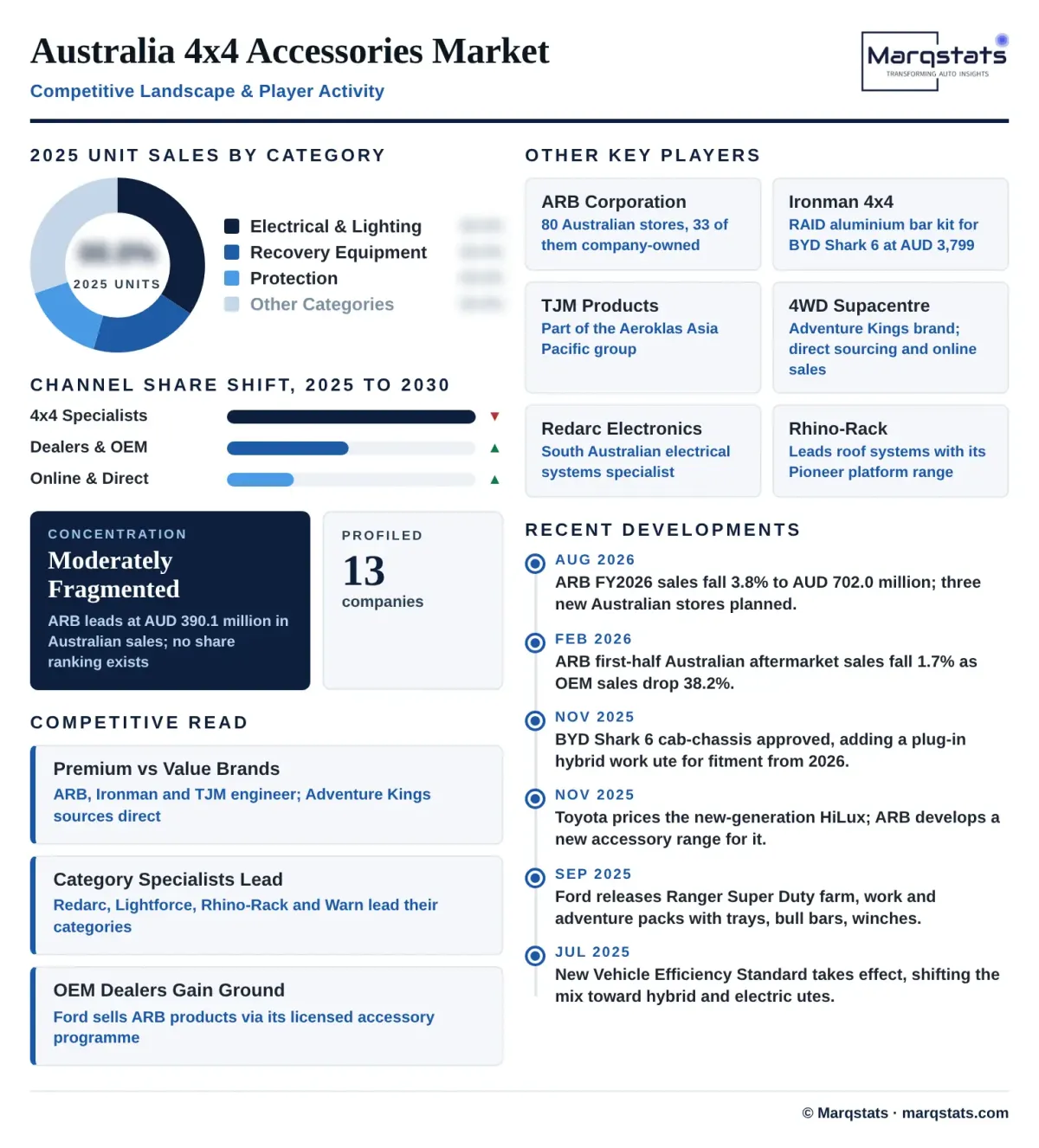
The supply base combines Australian engineering brands, importers and vehicle manufacturers. ARB Corporation operates 80 Australian stores, 33 of them company-owned, and sells through Ford's licensed accessory programme, while Ironman 4x4, TJM within the Aeroklas Asia Pacific group, MSA 4x4, Offroad Animal and Dobinsons compete on vehicle-specific engineering. Adventure Kings, sold by 4WD Supacentre, competes on direct sourcing and online sales, and specialists such as Redarc, Lightforce and Rhino-Rack lead in electrical, lighting and roof systems.
4x4 Accessories Market Size and Forecast
Volume is the anchor series for the 4x4 accessories market, and value is derived from unit sales by category and a weighted average selling price that rises from about USD 669 per unit in 2025 to USD 777 in 2030, equivalent to about AUD 1,037 and AUD 1,205 at a constant exchange rate of USD 0.6449 per Australian dollar. Accessory unit sales rise from 1,966,745 in 2025 to 2,125,661 by 2030, a 1.57% compound annual growth rate, while market value rises from USD 1,316.45 million to USD 1,652.19 million at 4.65% a year, an absolute increase of USD 335.74 million.
The annual path runs through 1,939,562 units and USD 1,342.56 million in 2026, 1,984,001 units and USD 1,413.85 million in 2027 and 2,029,798 units and USD 1,489.07 million in 2028. It continues to 2,077,001 units and USD 1,568.44 million in 2029 before reaching 2,125,661 units and USD 1,652.19 million in 2030, and the 2026 value of USD 1,342.56 million sits below the constant-growth path of USD 1,377.66 million because constrained platform supply holds back new-vehicle fitments.
Price and mix contribute more to value growth than volume. Category prices rise by about 3% to 4% a year as aluminium, lithium and engineered electronics replace simpler products, and the faster growth of higher-value electrical systems lifts the blended average. Utes and four-wheel-drive wagons grow at almost identical rates of 4.64% and 4.67% a year, so the vehicle mix changes little over the forecast.
Vehicle Electrical Systems Overtake Protection by 2030
The defining structural shift in the Australian 4x4 accessories market is the rise of the electrical system as the core of the touring build. Vehicle electrical and lighting products account for USD 270.00 million, or 20.51% of 2025 value, from 675,000 units, and grow at 5.96% a year to USD 360.68 million by 2030, while protection equipment grows at 4.31% a year from USD 286.45 million to USD 353.72 million. Electrical products therefore move from second place to the largest category by 2030, with 21.83% of market value against 21.41% for protection.
Three changes in vehicle use and technology drive the shift toward electrical spending. Touring buyers now run fridges, lighting, water pumps and communications from auxiliary lithium batteries charged through DC-DC chargers and solar panels, newer vehicles with smart alternators and complex electronics require engineered charging and wiring solutions, and plug-in hybrid utes such as the BYD Shark 6 open a new market for vehicle-to-load and auxiliary power integration. Each change raises spending per vehicle on electrical products while protection demand tracks vehicle sales more closely.
Protection equipment remains the anchor of the first purchase. Bull bars account for USD 166.45 million of the category in 2025, and Ironman 4x4 lists its RAID aluminium bull bar and lights kit for the BYD Shark 6 at AUD 3,799, which illustrates how product price rises with aluminium construction, integrated lighting and sensor compatibility. Bull bar units grow at only 0.5% a year, in line with the Marqstats bull bar estimate, so protection value growth depends mainly on price and specification.
Channels, Pricing and the Installed Accessory Basket
Distribution in the Australian 4x4 accessories market has several profit pools, comprising the manufacturer or importer, the wholesaler, the retailer, the installer and the service provider. Specialist 4x4 retailers and fitment centres account for USD 821.95 million, or 62.44% of 2025 value, because most protection, suspension and electrical products require vehicle-specific fitting. Vehicle dealers and OEM accessory programmes account for USD 335.41 million, or 25.48%, and grow at 6.54% a year as buyers add accessories to the vehicle purchase and its finance.
Online and direct-to-consumer sales account for USD 159.09 million, or 12.08% of 2025 value, and are the fastest-growing channel at 9.85% a year, reaching USD 254.44 million by 2030. Value brands combine direct sourcing, online ordering, store collection and frequent bundles, and they compete most strongly on roof racks, recovery gear, lighting and storage, where buyers can fit products themselves or through independent installers.
Customers frequently mix brands on one vehicle, so brand loyalty is best measured by category rather than by vehicle. Installation adds labour hours, mounts, wiring, wheel alignment and sensor or camera calibration, and commercial overhead adds distributor and retailer margins, stock finance, premises, warranty and returns. A premium brand earns on engineering, warranty and dealer service, while a value brand earns on procurement scale and online conversion, and the full installed basket rather than the product price decides most purchases.
Regulation, Approvals and Vehicle Platform Change
Modification rules shape demand for suspension, GVM upgrades and protection equipment in particular. Vehicle Standards Bulletin 14 provides the national code of practice for light vehicle modifications, while state and territory authorities administer approvals, and lifts, suspension changes, tyre changes and mass upgrades must be assessed against the rules of the relevant jurisdiction. Recovery equipment, roof systems and cargo must be assessed as a complete installation, because an accessory rating alone does not authorise a higher gross vehicle mass or axle load.
Lighting and external fittings face separate requirements in each state and territory. New South Wales guidance on fitting accessories covers permitted lamps, visibility, mounting and external projections, and other jurisdictions apply their own rules, so suppliers must document compliance by state. Ford's licensed accessory programme with ARB carries conditional warranty terms, and the warranty terms of one manufacturer programme cannot be assumed for every aftermarket product.
The New Vehicle Efficiency Standard, which has applied since 1 July 2025, affects the mix of vehicles supplied rather than the price of individual accessories. Hybrid and electric utes and wagons require redesigned protection, wiring and charging products, and suppliers that complete compatibility engineering early capture first-fit demand. ARB delivered accessories for the new Toyota HiLux and the Ford Ranger Super Duty during its 2026 financial year, and the Super Duty launched with Farm, Work and Adventure accessory packs that include trays, bull bars and winches.
Market Dynamics
Key Drivers
Five factors support growth in the Australia 4x4 accessories market through 2030.
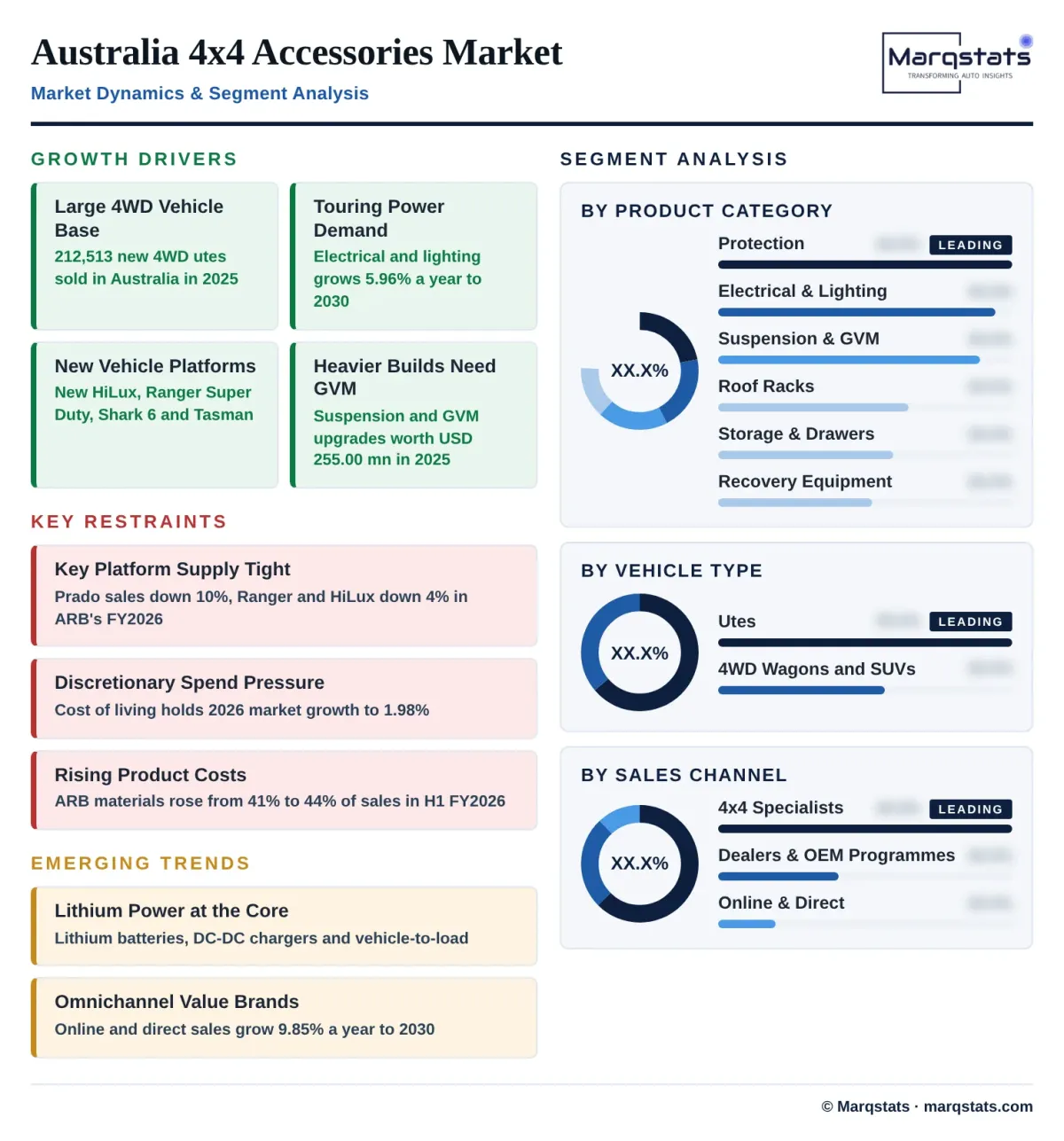
- Large four-wheel-drive vehicle base. Australians bought 212,513 new four-wheel-drive utes in 2025, and the registered light commercial fleet reached 4,195,833 vehicles in January 2025, sustaining both first-fit and replacement demand.
- Touring and remote travel. Touring buyers equip vehicles for remote travel with power, storage and recovery systems, and vehicle electrical and lighting products grow at 5.96% a year to USD 360.68 million by 2030.
- New vehicle platforms. The new-generation HiLux, the Ranger Super Duty, the BYD Shark 6 and the Kia Tasman each require new protection, suspension and electrical products, renewing first-fit demand from 2026.
- Dealer accessory programmes. Licensed programmes such as Ford's with ARB move accessory decisions into the vehicle purchase, and the dealer and OEM channel grows at 6.54% a year to USD 460.34 million by 2030.
- Heavier vehicles and payload demands. Higher kerb weights on hybrid utes and fully equipped touring builds raise demand for suspension and GVM upgrades, worth USD 255.00 million in 2025.
Key Restraints
Four constraints moderate growth, most of them linked to vehicle supply and household spending.
- Constrained supply of key platforms. Ranger and HiLux sales each fell 4% and Prado sales fell 10% in ARB's 2026 financial year, and ARB's Australian aftermarket sales declined 3.3% to AUD 390.1 million.
- Discretionary spending pressure. Touring accessories are discretionary purchases, and cost-of-living pressure leads buyers to defer premium builds, which holds 2026 market growth to 1.98%.
- Installer capacity. Fitting bays, skilled installers and booking lead times limit how quickly retailers convert demand, particularly for suspension, electrical and protection products that require professional fitting.
- Rising product cost. Materials and consumables rose from 41% to 44% of ARB's sales in the first half of its 2026 financial year, illustrating the cost pressure on steel, aluminium and electronic products.
Key Trends
Four trends are reshaping products and channels in the Australian 4x4 accessories market.
- Lithium and integrated power systems. Auxiliary lithium batteries, DC-DC chargers and vehicle-to-load integration are becoming the core of the touring build, lifting average electrical spending per vehicle.
- Omnichannel value brands. Direct-sourcing brands combine online ordering, store collection and bundles, and the online and direct-to-consumer channel grows at 9.85% a year to USD 254.44 million by 2030.
- Aluminium protection and lighter accessories. Aluminium bull bars such as the AUD 3,799 Ironman RAID kit for the BYD Shark 6 reduce weight and preserve payload on heavier vehicles.
- Store network expansion by premium brands. ARB plans three new Australian stores and five flagship upgrades in its 2027 financial year, reinforcing fitting capacity and brand presence.
Strategic Implications
- Early compatibility engineering. Suppliers that complete engineering for hybrid and electric utes ahead of launch secure first-fit demand on the platforms that drive the 2027 recovery.
- Investment in electrical capability. Electrical and lighting products become the largest category by 2030 at USD 360.68 million, rewarding suppliers with in-house power system design and installer training.
- Balanced channel strategies. Premium brands that combine dealer programmes and their own stores with online ordering can defend share against value brands growing through the online channel.
- Fitting capacity in growth states. Retailers that expand fitting bays in Queensland and Western Australia, which together account for 44.11% of 2025 value, capture demand that installation lead times would otherwise defer.
Market Segmentation
Protection equipment is the largest category at USD 286.45 million, or 21.76% of 2025 value, from 300,531 units, and grows at 4.31% a year to USD 353.72 million by 2030. Bull bars account for USD 166.45 million of the category from 115,915 bars at an average of about USD 1,436 each, with rear bars, side rails, rock sliders and underbody protection making up the balance.
Suspension and GVM upgrades account for USD 255.00 million, or 19.37% of 2025 value, from 175,862 units at an average of about USD 1,450, and grow at 4.42% a year to USD 316.62 million by 2030. Lift kits, heavy-duty springs and shock absorbers and engineered mass upgrades let utes carry trays, canopies and touring equipment within legal limits.
Vehicle electrical and lighting products account for USD 270.00 million, or 20.51% of 2025 value, from 675,000 units, and are the fastest-growing category at 5.96% a year to USD 360.68 million by 2030. Dual-battery systems, DC-DC chargers, lithium batteries, solar inputs, driving lights and light bars form the category.
Roof racks and carrying systems account for USD 185.00 million, or 14.05% of 2025 value, from 284,615 units, and grow at 4.33% a year to USD 228.66 million by 2030. Vehicle-specific roof platforms, crossbars and mounting systems such as the Rhino-Rack Pioneer range dominate the category.
Storage and drawer systems account for USD 170.00 million, or 12.91% of 2025 value, from 136,000 units, and grow at 4.74% a year to USD 214.27 million by 2030. Rear drawer systems, fridge slides, cargo barriers and interior storage modules serve both touring and trade buyers.
Recovery equipment accounts for USD 150.00 million, or 11.39% of 2025 value, from 394,737 units, and grows at 3.51% a year to USD 178.24 million by 2030. Winches, recovery boards, straps, shackles and air compressors make up the category, which grows most slowly because many products are durable and replaced infrequently.
Utes account for USD 839.52 million, or 63.77% of 2025 value, from 1,219,689 units, and grow at 4.64% a year to USD 1,053.03 million by 2030. The Ford Ranger, Toyota HiLux, Isuzu D-Max, Mitsubishi Triton and BYD Shark 6 are the principal platforms, and work and touring buyers both fit protection, suspension and electrical products.
Four-wheel-drive wagons and SUVs account for USD 476.93 million, or 36.23% of 2025 value, from 747,056 units, and grow at 4.67% a year to USD 599.16 million by 2030. Large wagons such as the LandCruiser 300, Patrol, Prado and Everest carry the highest spending per vehicle in the category.
Specialist 4x4 retailers and fitment centres are the largest channel at USD 821.95 million, or 62.44% of 2025 value, from 1,219,382 units, and grow at 2.66% a year to USD 937.41 million by 2030. Brand stores, franchise networks and independent fitters provide the engineering advice and installation that most categories require.
Vehicle dealers and OEM accessory programmes account for USD 335.41 million, or 25.48% of 2025 value, from 452,351 units, and grow at 6.54% a year to USD 460.34 million by 2030. Licensed and genuine accessories fitted before delivery can be included in vehicle finance and carry manufacturer warranty terms.
Online and direct-to-consumer sales account for USD 159.09 million, or 12.08% of 2025 value, from 295,012 units, and are the fastest-growing channel at 9.85% a year to USD 254.44 million by 2030. Value brands and supply-only offers dominate the channel, which is strongest in recovery, lighting, roof racks and storage.
By Geography
Queensland
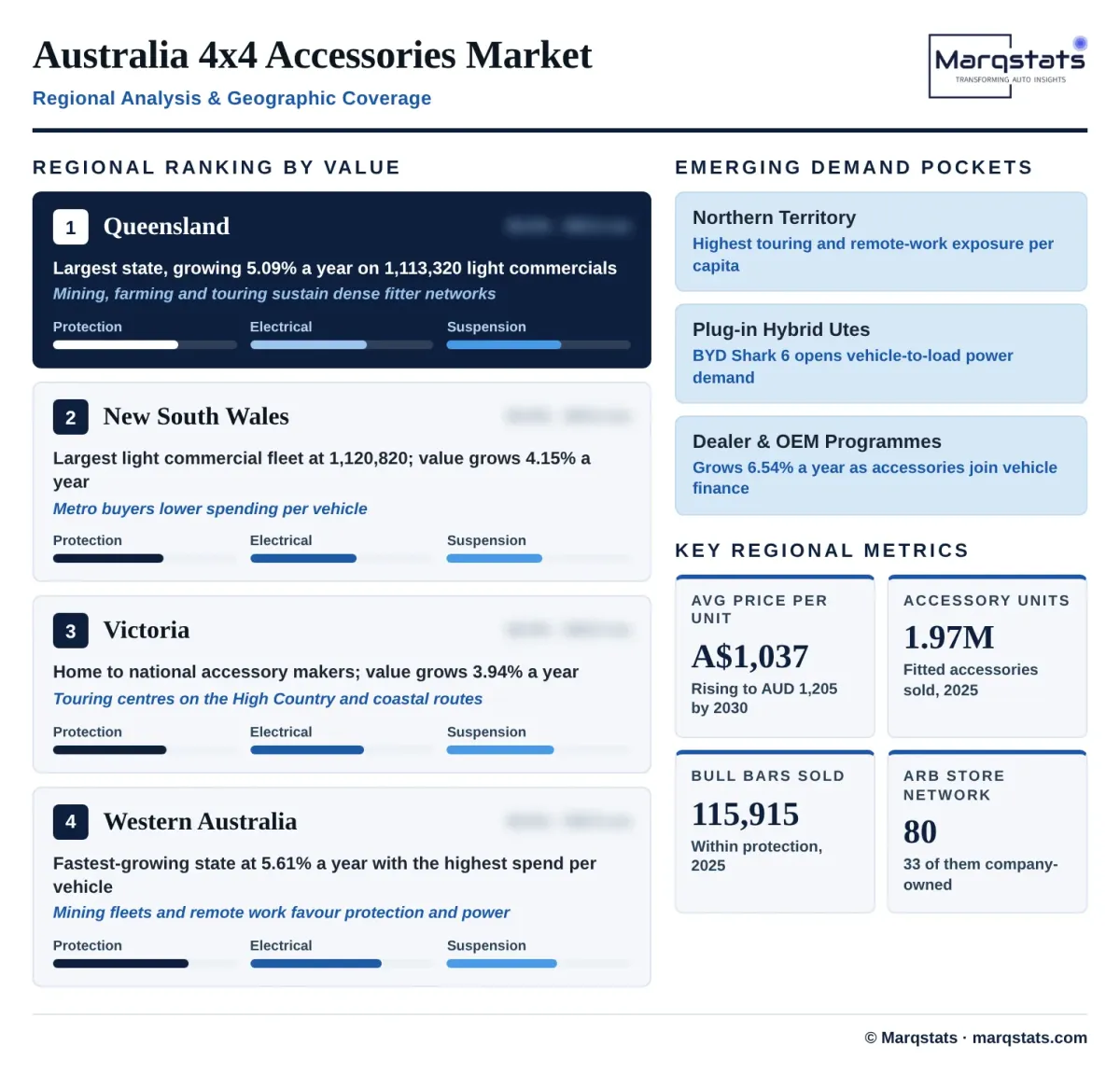
Queensland is the largest state in the 4x4 accessories market at USD 384.83 million, or 29.23% of 2025 value, and grows at 5.09% a year to USD 493.28 million by 2030. A registered light commercial fleet of 1,113,320 vehicles, mining and agricultural activity and popular touring routes support a dense network of 4x4 retailers and fitters.
New South Wales
New South Wales accounts for USD 325.15 million, or 24.70% of 2025 value, and grows at 4.15% a year to USD 398.47 million by 2030. The state has the largest registered light commercial fleet at 1,120,820 vehicles, but a higher share of metropolitan buyers lowers spending per vehicle compared with Queensland and Western Australia.
Victoria
Victoria accounts for USD 251.29 million, or 19.09% of 2025 value, and grows at 3.94% a year to USD 304.88 million by 2030. Melbourne hosts several national accessory manufacturers and distributors, and touring demand centres on the High Country and coastal routes.
Western Australia
Western Australia accounts for USD 195.84 million, or 14.88% of 2025 value, and is the fastest-growing state at 5.61% a year to USD 257.33 million by 2030. Mining fleets, long-distance travel and remote-area work create the highest spending per vehicle on protection, power and recovery equipment.
Rest of Australia
South Australia, Tasmania, the Northern Territory and the Australian Capital Territory together account for USD 159.34 million, or 12.10% of 2025 value, and grow at 4.46% a year to USD 198.23 million by 2030. South Australia is home to electrical specialists such as Redarc and Lightforce, while the Northern Territory has the highest touring and remote-work exposure relative to its population.
How Competition Is Evolving
The Australia 4x4 accessories market is moderately fragmented. ARB Corporation is the largest supplier, with Australian aftermarket sales of AUD 390.1 million in its 2026 financial year and 80 stores, and its sales would equal about a fifth of the estimated market, although ARB reports revenue at a mix of retail and wholesale prices, so the ratio indicates scale rather than market share. No source publishes a ranking of suppliers by national share, and retail outlet counts are not sales shares.
Competition divides between premium engineering brands and value brands. ARB, Ironman 4x4, TJM, MSA 4x4, Offroad Animal and Dobinsons compete on vehicle-specific engineering, testing, warranty and fitting networks, while Adventure Kings competes on direct sourcing, online ordering and bundled offers. Specialists such as Redarc in electrical systems, Lightforce in lighting, Rhino-Rack in roof systems and Warn in winches lead their categories and sell through multiple channels.
Vehicle manufacturers are a growing force in accessory distribution through their dealer networks. Ford sells ARB products through its licensed accessory programme and offers accessory packs for the Ranger Super Duty, and Toyota supplies genuine accessories through its dealers. ARB's acquisition of MITS Alloy in October 2024 and the Aeroklas Asia Pacific group's ownership of TJM, Aeroklas, Flexiglass and Bocar show how larger groups broaden their product range, and further consolidation is likely as engineering costs for new platforms rise.
Companies Covered
Companies covered in the report include:
Recent Market Activity
Table of Contents
Coverage & Segmentation
Coverage spans accessories fitted to four-wheel-drive utes, wagons and SUVs in Australia, segmented by product category, vehicle type and sales channel and by five state groupings. The base year is 2025, the historical period runs from 2021 to 2025 and the forecast period from 2026 to 2030. Value is expressed in USD million at end-customer prices excluding GST and separately invoiced fitting labour, converted at a constant USD 0.6449 per Australian dollar, and volume is expressed in accessory units sold.
Tyres and wheels, replacement service parts, portable camping products and ute canopies and trays are excluded from the market definition, and canopies and trays are sized separately by Marqstats so that the two estimates can be added without double counting. The estimate draws on national vehicle sales and registration statistics, listed company annual reports, supplier catalogues and federal and state vehicle modification rules, and thirteen companies are profiled.