Market Snapshot
Key Takeaways
Market Overview & Analysis
Report Summary
The India two-wheeler suspension system market covers the design, manufacture, and supply of ride control components for motorcycles, scooters, and mopeds across both ICE and electric propulsion platforms. Suspension systems are safety-critical components that directly influence ride comfort, vehicle stability, handling precision, and occupant safety across India’s diverse road conditions—from smooth expressways to unpaved rural roads. The market includes front suspension assemblies (conventional telescopic forks, inverted/upside-down forks, and leading-link systems for scooters), rear suspension units (twin shock absorbers, mono shock absorbers, and gas-charged dampers), and the associated springs, seals, bushings, and electronic control units.
India’s two-wheeler OEM dispatches reached 19.61 million units in FY 2024–25 (SIAM), with retail registrations climbing to 21.42 million units in FY 2025–26 (FADA). Each vehicle requires a complete suspension set, making the suspension system market directly correlated with vehicle production volumes. However, the market is growing faster than vehicle volumes because of a structural shift toward higher-specification suspension—inverted forks replacing telescopic forks on mid-range motorcycles, mono shocks replacing twin shocks on premium scooters, and gas-charged dampers replacing hydraulic units across segments. This specification uplift is increasing the average suspension value per vehicle, driving market growth above the underlying vehicle volume growth rate.
The aftermarket segment, though smaller at approximately 18–20% of total market value, is expanding at an estimated 12–15% annually. India’s registered two-wheeler fleet exceeds 230 million vehicles, and the typical suspension replacement cycle of 30,000–50,000 kilometres drives recurring demand. Rising consumer awareness of ride quality, the proliferation of online automotive parts platforms such as Boodmo and SparesHub, and the availability of branded aftermarket products from Gabriel India and Endurance Technologies are supporting this growth.
Market Dynamics
Key Drivers
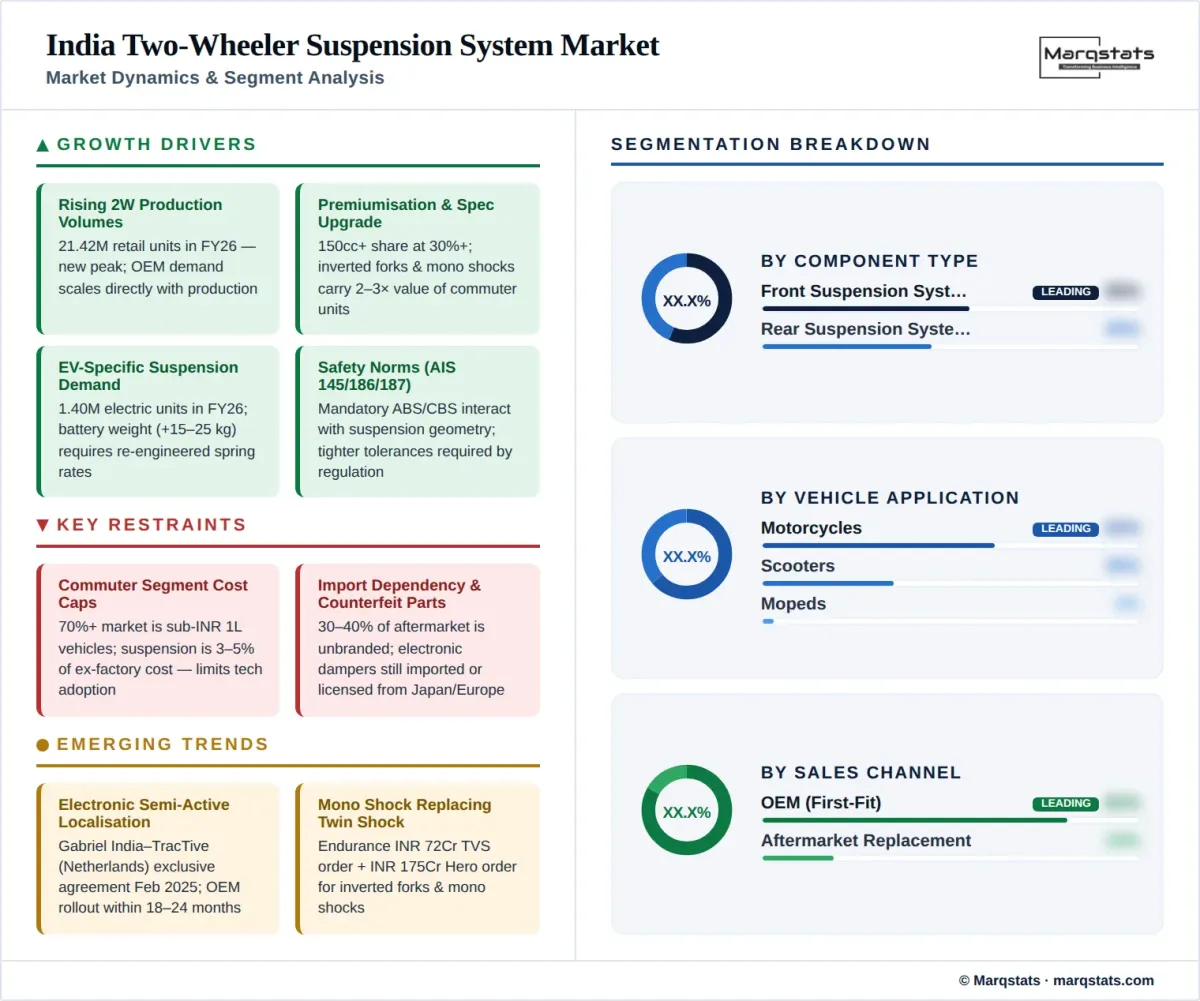
- Rising two-wheeler production volumes creating sustained OEM demand: India’s two-wheeler domestic dispatches have grown from 15.86 million units in FY 2020–21 to 19.61 million units in FY 2024–25, representing a compound annual volume recovery that directly scales suspension component demand. The industry crossed its pre-COVID retail peak of 21.24 million units in FY 2025–26, and volume growth is expected to sustain at 6–8% annually through FY 2030–31, providing a stable demand base for suspension manufacturers.
- Premiumisation driving higher-value suspension specifications: The shift toward motorcycles above 125cc is accelerating across India. Entry-level motorcycles’ share has declined from 75% in FY 2018–19 to 72% in FY 2024–25, while executive (125–200cc) and premium (above 200cc) segments are growing at 12% and 10% respectively. Premium motorcycles typically use inverted front forks, mono rear shocks, and gas-charged dampers—components that carry 2–3x the value of conventional telescopic forks and twin shock absorbers. Royal Enfield’s capacity expansion to 2 million units annually and TVS’s Apache RTR/RR portfolio growth are key demand drivers for premium suspension.
- Electric two-wheeler growth requiring purpose-designed suspension: The electric two-wheeler segment crossed 1.40 million retail units in FY 2025–26, growing 21.8% year-on-year. Electric vehicles have different weight distribution characteristics due to battery placement, typically carrying 15–25 kg of additional mass in the floorboard or frame. This necessitates suspension systems with modified spring rates, enhanced damping characteristics, and lightweight construction to offset the battery weight penalty. Gabriel India launched a dedicated line of suspension products for electric two-wheelers in March 2024, using advanced composites that reduce weight by up to 15%.
- Expanding road network and diverse riding conditions: India’s national highway network has expanded from approximately 132,500 km in 2019 to over 150,000 km in 2025, while rural road construction under the Pradhan Mantri Gram Sadak Yojana continues to connect previously unserved villages. The coexistence of smooth expressways, potholed urban roads, and unpaved rural tracks creates demand for robust, adaptable suspension systems with higher travel ranges and better damping performance compared to markets with uniform road quality.
- Mandatory safety regulations increasing suspension content per vehicle: The implementation of amended Indian standards AIS 145, AIS 186, and AIS 187 mandates advanced safety systems including anti-lock braking systems (ABS) and combined braking systems (CBS) on two-wheelers. These systems interact directly with suspension geometry, requiring OEMs to specify higher-quality suspension components with tighter manufacturing tolerances to ensure consistent braking and stability performance.
Key Restraints
- Cost sensitivity in the commuter segment limiting technology adoption: Over 70% of India’s two-wheeler market consists of commuter vehicles priced below INR 100,000, where suspension represents 3–5% of the vehicle’s ex-factory cost. OEMs in this segment prioritise cost minimisation, limiting the adoption of advanced suspension technologies such as gas-charged dampers and inverted forks. The price-sensitive commuter buyer’s willingness to pay for suspension upgrades remains low, constraining the addressable market for premium components.
- Import dependence for specialised components and materials: High-performance suspension components, particularly electronically adjustable damping units, specialty seals, and advanced spring steels, are still predominantly imported or manufactured under technical licence from Japanese and European partners. KYB Corporation and Showa Corporation (Hitachi Astemo) supply critical technology inputs to Gabriel India and Munjal Showa respectively. This dependence creates foreign exchange risk and potential supply chain vulnerability, particularly amid global trade disruptions.
- Fragmented aftermarket with counterfeit and unbranded products: The two-wheeler aftermarket suspension segment faces competition from low-cost, unbranded shock absorbers manufactured by unorganised workshops, particularly in tier-3 and tier-4 towns. These products, estimated to account for 30–40% of aftermarket volumes, undercut branded products on price but compromise on safety and durability, limiting revenue growth for organised players.
- Subsidy reductions for electric two-wheelers moderating EV growth: The halving of PM E-DRIVE incentives for electric two-wheelers from INR 5,000/kWh to INR 2,500/kWh effective April 2025, with a July 2026 terminal date, may slow the pace of electric two-wheeler volume growth in the near term. Slower EV adoption would moderate the incremental demand for EV-specific suspension solutions.
Key Trends
- Localisation of electronic and semi-active suspension technology: Gabriel India’s February 2025 Technical Assistance Agreement with TracTive Suspension BV of the Netherlands represents a watershed moment for the Indian market. The agreement grants Gabriel India exclusive rights to manufacture and distribute TracTive’s electronically adjustable suspension systems in India. This technology, previously available only on imported premium motorcycles, is expected to be offered on domestically manufactured models within 18–24 months, addressing a growing OEM demand for electronically adjustable ride height and damping.
- Shift from twin shock to mono shock absorbers across segments: Mono shock absorber adoption is expanding beyond premium motorcycles into mid-range and even entry-level scooter platforms. Mono shocks offer superior ride control, reduced unsprung mass, and design flexibility for OEMs. Endurance Technologies, which is the only Indian manufacturer of adjustable and non-adjustable damping force inverted front forks and mono shock absorbers, has secured orders worth INR 72 crore from TVS Motor Company for inverted front forks and rear mono shocks, and INR 175 crore from Hero MotoCorp for suspension components.
- Lightweight materials for electric vehicle applications: The additional weight of battery packs in electric two-wheelers (typically 15–25 kg) is driving OEMs to demand lightweight suspension assemblies that offset the mass penalty. Manufacturers are increasingly adopting aluminium alloys, advanced composites, and hollow-section fork tubes to reduce suspension weight by 10–15% without compromising structural integrity. This material transition is increasing the value content per suspension assembly and expanding the addressable market for technology-focused suppliers.
- Growing aftermarket through digital retail channels: Online automotive parts platforms and OEM-branded e-commerce channels are expanding access to genuine suspension replacement parts, particularly in smaller cities where authorised service networks are sparse. Gabriel India’s aftermarket division, which services both OEMs and the independent aftermarket, is leveraging digital distribution to expand its reach beyond traditional brick-and-mortar auto parts retailers.
Market Segmentation
Front suspension systems account for approximately 55% of the India two-wheeler suspension market by value, reflecting their higher complexity, material content, and precision engineering requirements compared to rear units. Conventional telescopic forks remain the dominant front suspension type across commuter motorcycles and standard scooters, priced at INR 800–2,500 per assembly. Inverted (upside-down/USD) forks, previously confined to premium motorcycles above 250cc, are rapidly migrating to the 150–250cc segment as OEMs seek to differentiate on ride quality and handling. Inverted forks command a significant price premium at INR 4,000–12,000 per assembly and offer superior torsional rigidity, reduced unsprung mass, and better damping control. Leading-link and trailing-link front suspension designs are used on select scooter platforms where packaging constraints preclude telescopic forks.
Rear suspension systems represent approximately 45% of market value. Twin shock absorbers continue to dominate the commuter motorcycle segment by volume, valued at INR 600–1,800 per pair. However, the growth momentum lies firmly with mono shock absorbers, which offer centralised load management, progressive spring rates, and superior packaging flexibility for both ICE and electric platforms. Mono shocks are now standard on most scooters above INR 80,000 and motorcycles above 150cc, with gas-charged variants increasingly specified on premium models. The aftermarket replacement cycle for rear shocks (typically 25,000–40,000 km) is shorter than for front forks, making rear units a higher-frequency replacement item.
Motorcycles account for approximately 62% of India’s two-wheeler suspension demand by volume, correlated with their dominant share of vehicle production. The motorcycle segment exhibits the widest range of suspension specifications: from basic hydraulic telescopic forks and twin shocks on 100cc commuters (Hero Splendor, Honda Shine) to fully adjustable inverted forks and gas-charged mono shocks on performance platforms (TVS Apache RR 310, KTM Duke/Adventure series, Royal Enfield Himalayan 450). The premiumisation trend is the primary value growth driver, with the average suspension value per motorcycle increasing as the segment mix shifts upward.
Scooters represent approximately 35% of suspension demand and are the fastest-growing application segment for suspension systems. The shift to electric propulsion in scooters is creating demand for re-engineered suspension with modified spring rates to accommodate battery weight, typically 10–18 kg in floor-mounted configurations. The TVS iQube, Ather 450X, and Bajaj Chetak represent the new generation of electric scooters specifying higher-grade front forks and rear mono shocks compared to their ICE counterparts. Scooter suspension is also evolving aesthetically, with visible rear mono shock units becoming a design feature on premium platforms.
Mopeds account for a declining share of suspension demand, concentrated in southern India. Moped suspension systems are the simplest and lowest-cost in the market, typically consisting of basic telescopic forks and twin hydraulic shock absorbers. As the moped segment continues to shrink in favour of entry-level electric scooters, the associated suspension demand is expected to decline in both volume and value terms over the forecast period.
The OEM channel accounts for over 80% of the India two-wheeler suspension market by value, reflecting the direct correlation between vehicle production volumes and first-fit suspension demand. OEM procurement is characterised by long-term supply agreements, rigorous qualification processes, and intensive cost negotiation. The top three Indian suspension suppliers—Endurance Technologies, Gabriel India, and Munjal Showa—maintain deep relationships with all major two-wheeler OEMs. OEM demand is increasingly bifurcating between cost-optimised commuter suspensions and technology-intensive premium/EV suspensions, requiring suppliers to maintain dual capability sets.
The aftermarket channel contributes approximately 18–20% of market value and is growing at an estimated 12–15% annually. The addressable aftermarket is large: India’s registered two-wheeler fleet exceeds 230 million vehicles, and the typical suspension replacement interval of 30,000–50,000 km generates recurring demand. Gabriel India is the leading branded aftermarket supplier, leveraging its network of distributors and retail touchpoints. The segment faces competition from unbranded products in price-sensitive rural markets but is benefiting from increasing consumer awareness of ride quality, digital parts retail, and OEM-backed service campaigns.
By Geography
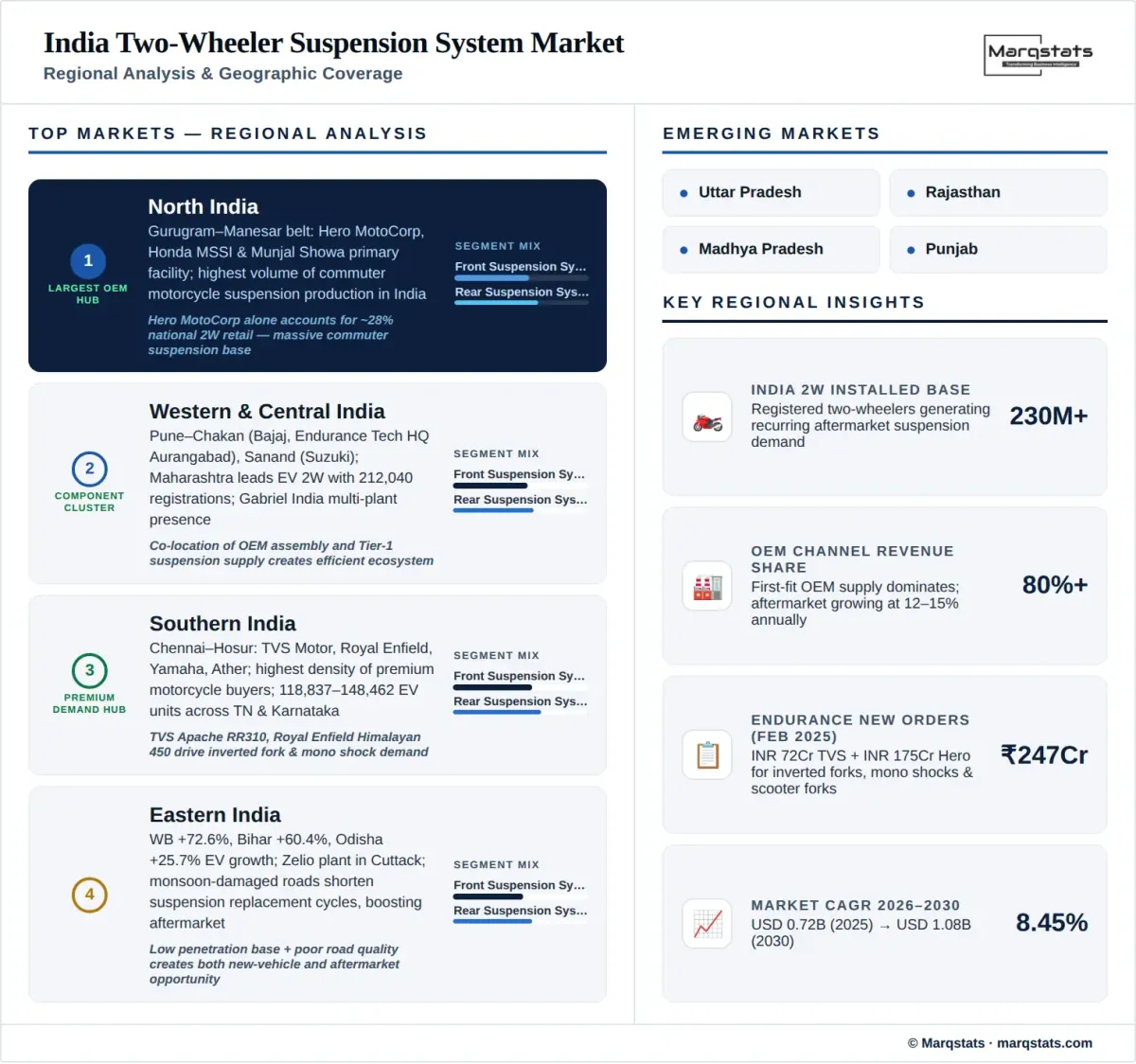
Western and Central India
Western and Central India, anchored by Maharashtra, Gujarat, and Madhya Pradesh, is the largest regional market for two-wheeler suspension systems, driven by the concentration of OEM manufacturing facilities in Pune–Chakan (Bajaj Auto, Tata Motors), Aurangabad (Endurance Technologies), and Sanand (Suzuki). Maharashtra alone accounts for over 212,000 electric two-wheeler registrations in FY 2024–25 and hosts several Tier-1 suspension manufacturing plants. Gabriel India operates multiple facilities in this region. The presence of both vehicle assembly plants and component manufacturing clusters creates an efficient supply chain ecosystem for suspension systems.
Southern India
Southern India, comprising Tamil Nadu, Karnataka, Kerala, Telangana, and Andhra Pradesh, is the manufacturing heartland of the Indian two-wheeler industry and a critical market for suspension systems. The Chennai–Hosur corridor hosts TVS Motor, Royal Enfield, Yamaha, and Ather Energy, creating concentrated demand for front forks, shock absorbers, and specialty suspension components. Endurance Technologies’ Aurangabad and southern India facilities serve this OEM cluster. The region also has the highest density of premium motorcycle buyers (Royal Enfield, KTM), which drives demand for higher-specification suspension assemblies.
Northern India
Northern India, led by the Gurugram–Manesar industrial belt in Haryana, is home to Hero MotoCorp, Honda Motorcycle & Scooter India, and Munjal Showa’s primary manufacturing facility. The region is the largest production base for commuter two-wheelers, which generate high-volume demand for conventional telescopic forks and twin shock absorbers. Uttar Pradesh, India’s most populous state, is also emerging as a significant market for aftermarket suspension products, driven by its large installed two-wheeler fleet and varied road conditions that accelerate suspension wear.
Eastern India
Eastern India, including West Bengal, Odisha, Bihar, and the northeastern states, represents an emerging market for two-wheeler suspension systems. The region has a lower two-wheeler penetration base but is growing rapidly, with states such as Bihar and West Bengal recording 60–73% growth in electric two-wheeler registrations in FY 2024–25. The establishment of new manufacturing facilities, including Zelio E-Mobility’s plant in Cuttack, Odisha, is expected to create localised suspension demand. The region’s road conditions, characterised by monsoon damage and unpaved rural roads, place higher stress on suspension components and shorten replacement cycles.
How Competition Is Evolving
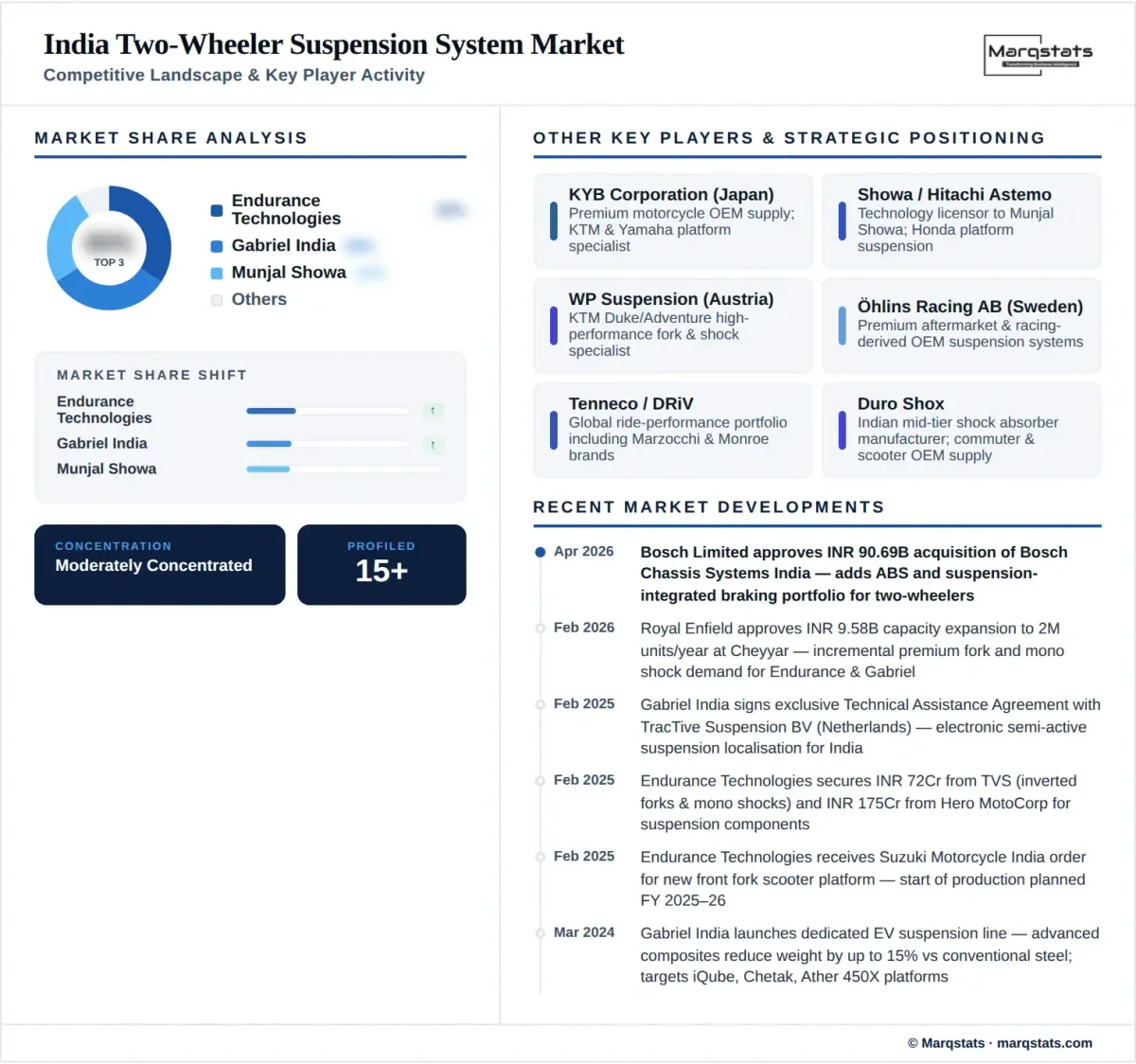
The India two-wheeler suspension system market is moderately concentrated, with three domestic manufacturers—Endurance Technologies Limited, Gabriel India Limited, and Munjal Showa Limited—collectively commanding the majority of OEM supply. These companies have built their positions through long-standing technical collaborations with global suspension technology leaders (Showa/Hitachi Astemo for Munjal Showa; KYB Corporation and Yamaha Motor Hydraulic System for Gabriel India) and deep integration with India’s two-wheeler OEM ecosystem. Endurance Technologies distinguishes itself as the only Indian company that designs, develops, and manufactures inverted front forks and mono shock absorbers in-house, giving it a competitive edge in the premium and electric vehicle segments.
Gabriel India, a flagship company of the Anand Group with annual revenue of INR 34.2 billion in FY 2023–24, operates eight manufacturing facilities and three R&D laboratories in India. The company’s February 2025 Technical Assistance Agreement with TracTive Suspension BV of the Netherlands for exclusive rights to manufacture electronically adjustable suspension in India positions it to capture the emerging semi-active suspension opportunity. Munjal Showa, a joint venture between the Munjal family and Hitachi Astemo (formerly Showa Corporation, Japan), is one of the largest manufacturers of shock absorbers for two-wheeler OEMs in India, supplying Hero MotoCorp, Honda, Yamaha, and several electric vehicle startups from its Gurugram facility.
Global players including KYB Corporation (Japan), WP Suspension GmbH (Austria), Öhlins Racing AB (Sweden), and Tenneco Inc. (USA) participate in the Indian market primarily through premium motorcycle OEM supply (KTM, Ducati, BMW Motorrad) and the high-performance aftermarket. The competitive intensity is increasing as premiumisation and electrification expand the addressable market for advanced suspension technologies, attracting both investment from incumbent players and potential entry from new technology-focused suppliers.
Companies Covered
The report profiles 15++ companies with full strategy and financials analysis, including:
Recent Market Activity
Table of Contents
Coverage & Segmentation
This report provides a comprehensive analysis of the India two-wheeler suspension system market covering the historical period 2021–2025 and forecast period 2026–2030, with 2025 as the base year. The study examines market size and growth in value (USD million) terms, segmented by component type (front suspension, rear suspension), vehicle application (motorcycles, scooters, mopeds), sales channel (OEM, aftermarket), technology (conventional, electronic/semi-active), and geography (state-level clusters). The competitive landscape profiles 15 leading manufacturers with analysis of technology capabilities, OEM relationships, product portfolios, and recent strategic developments.
Primary research includes structured interviews with 40+ industry stakeholders spanning suspension system manufacturers, two-wheeler OEM procurement teams, aftermarket distributors, material suppliers, and technology licensors. Secondary research draws from SIAM production and dispatch data, FADA retail registration data, company annual reports and stock exchange filings, technical publications, and patent databases. All market estimates represent Marqstats Intelligence proprietary calculations based on a bottom-up methodology validated against top-down industry benchmarks.