Market Snapshot
Middle bar: base-year value × (1 + CAGR), rounded to two decimals. This is a calculated illustration, not a separately researched annual estimate.
The US police and emergency vehicle upfitting market is estimated at USD 2,171.90 million in 2025 and is projected to reach USD 3,074.97 million by 2030, a CAGR of 7.20%, on upfit jobs rising from 152,300 to 172,666 at a 2.54% CAGR. Value compounds well ahead of volume because growth comes from heavier equipment content and higher installed prices on each vehicle rather than from larger fleets, and an average full patrol upfit of about USD 21,500 now adds roughly 40% to the price of the pursuit-rated vehicle that carries it.
Market size and forecast figures are generated using Marqstats' proprietary estimation framework, updated as of October 2026. The estimate is constructed from annual vehicle replacements by vehicle type and package values benchmarked to published municipal procurements, and it is most sensitive to municipal budget cycles and to the pace at which equipment content per vehicle rises.
Marked patrol and pursuit vehicles account for 70.60% of 2025 value, and municipal procurement records confirm the scale of each package, with the City of Deer Park paying USD 25,073.32 per upfit in October 2025 on Chevrolet Tahoes that cost USD 53,537 each.
Demand for emergency vehicle upfitters is shaped by a concentrated chassis market, in which Ford Motor Company held a 60.6% share of the US police vehicle segment in the third quarter of 2025, up 9.6 points, while the Dodge Charger pursuit car is scheduled to return as a 2027 model. Upfit value rises 6.11% to USD 2,304.61 million in 2026, slightly below the CAGR path, as agencies absorb higher electronics and metal costs within fixed budgets.
Key Takeaways
Market Overview & Analysis
Report Summary
Police and emergency vehicle upfitting comprises the installation of public-safety equipment on production vehicles, and the market is defined across four equipment types that together determine the value of each package, from warning lighting and sirens through cabin, custody and containment equipment and evidence integration to installation, wiring and graphics.
The market spans marked patrol and pursuit vehicles, unmarked and supervisory vehicles, specialty units such as K9, prisoner transport and command vehicles, and fire and EMS support vehicles such as chief and command SUVs. Equipment transfers from retired vehicles and decommissioning work are included, because agencies routinely reuse lightbars, consoles and radios wherever they fit the replacement vehicle.
No public body counts police upfits and agency fleet data are not published nationally, so the market size is a Marqstats construction built from new-vehicle upfit volumes of about 68,000 pursuit-rated patrol vehicles, 30,000 unmarked and supervisory vehicles, 6,000 specialty units and 14,000 fire and EMS support vehicles in 2025, valued at package prices benchmarked to municipal procurements. Demand context comes from the Bureau of Justice Statistics, which counted 17,541 state and local law enforcement agencies in 2018, and from local police departments employing about 473,000 full-time sworn officers in 2020, although neither series measures fleets directly.
Growth to 2030 depends on three conditions holding together. Agencies must sustain patrol vehicle replacement on four to six-year cycles, with new-vehicle upfits expanding 2% to 3% a year after a flat 2026; installed prices must rise about 4% in 2026 on electronics and metal costs and about 3% a year thereafter; and equipment content per vehicle must continue to increase by about 1.8% a year as connected lighting controls, cameras and data integration spread across fleets. A sustained reduction in municipal budgets would delay vehicle replacements first, which makes replacement timing the principal downside risk to the forecast.
US Police Vehicle Upfitting Market Size and Forecast
US emergency vehicle upfitters, dealers and agency fleet shops completed an estimated 152,300 police and emergency upfit jobs in 2025, comprising 118,000 new-vehicle upfits and 34,300 equipment transfers or decommissioning jobs on retired vehicles. Upfit jobs are the anchor series, and value is derived from job volume and a weighted average new-vehicle package value that rises from about USD 17,534 in 2025 to USD 22,552 in 2030, which lifts the police vehicle upfitting market at 7.20% a year against 2.54% for jobs.
Annual upfit jobs move from 152,300 in 2025, valued at USD 2,171.90 million, to 153,480 in 2026 at USD 2,304.61 million and 158,541 in 2027 at USD 2,485.53 million. The series then reaches 163,768 jobs and USD 2,680.61 million in 2028, 168,162 jobs and USD 2,871.05 million in 2029 and 172,666 jobs and USD 3,074.97 million in 2030, adding 20,366 jobs and USD 903.07 million of annual value across the forecast period.
Marked patrol packages carry the most content, with a full marked upfit valued at about USD 21,500 in 2025 against about USD 7,500 for an unmarked or supervisory vehicle, USD 38,000 for a specialty unit and USD 11,000 for a fire or EMS support vehicle. Equipment transfers average about USD 3,000 and consist mostly of labour, because agencies reuse lightbars, consoles and radios wherever they fit the replacement vehicle.
Unit demand is expected to remain broadly flat in 2026, at 153,480 jobs against 152,300 in 2025, as agencies hold orders while vehicle and equipment prices rise, before growth resumes in 2027 on replacement policies such as the four years or 85,000 miles cited by the City of Alameda and on take-home car programmes that run larger fleets per officer.
The Upfit Adds About 40% to the Cost of a Patrol Vehicle
The scale of the upfit relative to the vehicle is the defining economic feature of the police vehicle upfitting market. In October 2025 the City of Deer Park, Texas, purchased three Chevrolet Tahoes at USD 53,537 each and paid USD 25,073.32 per vehicle to upfit them, a ratio of about 47%. In January 2025 the City of Alameda, California, authorised up to USD 152,735.52 to upfit six Dodge Durangos, or about USD 25,455.92 each, and in March 2025 the City of Joliet, Illinois, authorised USD 188,534.70 for lighting and safety upfits on 21 vehicles, about USD 8,977.84 each, with up to USD 210,000 budgeted separately for IT equipment.
The three benchmarks measure different scopes and cannot be averaged without distortion. Joliet's figure covers lighting and safety only with IT priced separately, Alameda's figure is an authorisation ceiling rather than a final invoice, and Deer Park's figure is a per-unit procurement price. On a normalised basis, the 2025 average for a full marked package excluding radio and computer hardware is about USD 21,500, which places the upfit at about 40% of the cost of a typical pursuit-rated SUV.
The upfit therefore functions as a capital purchase in its own right rather than as an accessory to the vehicle. Agencies evaluate upfit bids with the same scrutiny applied to vehicle bids, favour suppliers already holding state or cooperative contracts and place a premium on an incumbent equipment platform, because standardisation reduces spare parts inventories and officer training even when a competing quote is lower.
Pursuit Vehicle Supply Shapes the Upfit Market
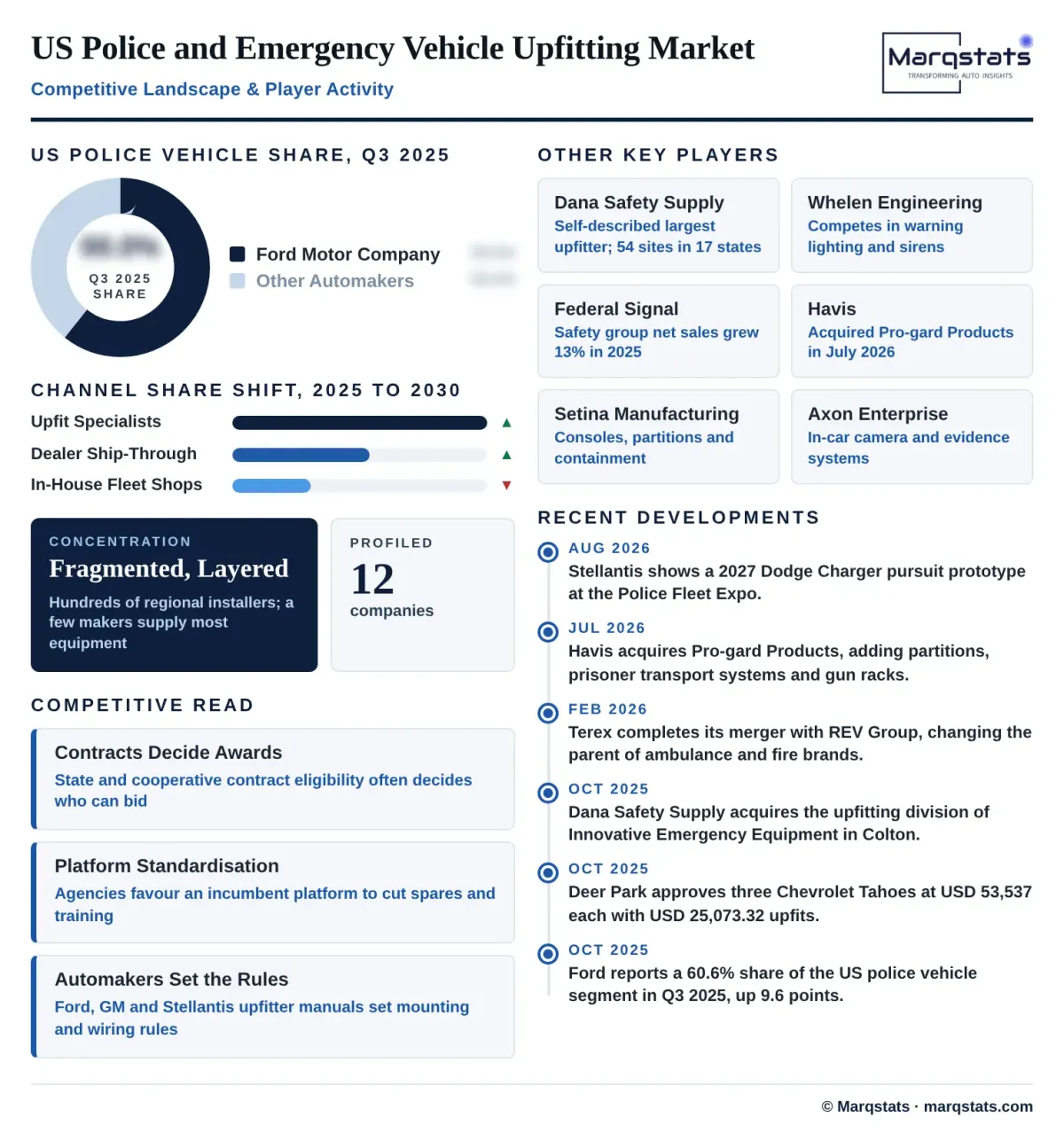
Chassis supply to US police fleets is highly concentrated, with Ford holding a 60.6% share of the police vehicle segment in the third quarter of 2025, up 9.6 points year on year, led by the Explorer-based Police Interceptor Utility. Ford has not built a police sedan since the Taurus ended in 2019, and the Chevrolet Tahoe PPV and Dodge Durango Pursuit account for most of the remaining segment, so upfitter engineering, wiring looms and mounting kits are developed first for the Police Interceptor Utility.
Sedan supply is set to return to the segment through a new Dodge Charger pursuit platform. Stellantis showed a 2027 Dodge Charger pursuit prototype with a 3.0-litre twin-turbocharged engine at the Police Fleet Expo in August 2026, with fleet orders reported to open as early as summer 2027 and production expected no earlier than late 2027. A new sedan platform requires new consoles, partitions and wiring kits, which adds engineering work for equipment makers and is expected to generate a concentrated burst of upfit demand from 2028.
Installation quality is governed more by industry practice than by statute. Upfitters must preserve airbag deployment zones and avoid electromagnetic interference and battery drain, and they must anchor equipment to the crash-safe points defined in OEM police upfitter manuals, while final-stage manufacturer and alterer obligations under 49 CFR Parts 567 and 568 apply where the work alters a certified vehicle. State and local rules govern emergency lighting colours, siren use and vehicle markings, which requires upfitters to adapt otherwise standard packages to each jurisdiction they serve.
Five Equipment Layers Define a Police Upfit Package
A police vehicle upfitting bid comprises five layers, and bids compared without separating them produce misleading conclusions about price. The first layer is warning and vehicle control, covering lightbars, perimeter and interior lights, the siren and speaker, the controller and switches and, increasingly, a networked control system that links lighting to the vehicle's own signals. The second layer is cabin and custody, covering the console, equipment mounts, the partition, rear prisoner seating, door and window bars, weapon storage and push bumpers.
The third layer is communications and evidence, comprising radio installation, antennas, the cellular modem, the computer dock and in-car camera systems, which agencies often fund from a separate IT budget, as Joliet did in 2025. The fourth layer is installation and appearance, covering wiring, fabrication, testing, graphics and paint together with the removal and reinstallation of equipment from the retiring vehicle. The fifth layer is lifecycle support after delivery, including preventive maintenance, electronics repair, downtime cover and decommissioning, which the City of San Leandro purchases for USD 250 a month per patrol vehicle.
Ambulance and fire apparatus work sits outside the market definition, because ambulance builders manage patient modules, medical power, climate control and crash testing under purchaser specifications that may cite NFPA 1900 or Ambulance Manufacturers Division test methods. Excluding those programmes prevents six-figure patient modules from inflating the police upfit market.
Market Dynamics
Key Drivers
Five structural forces support growth in the police vehicle upfitting market through 2030.
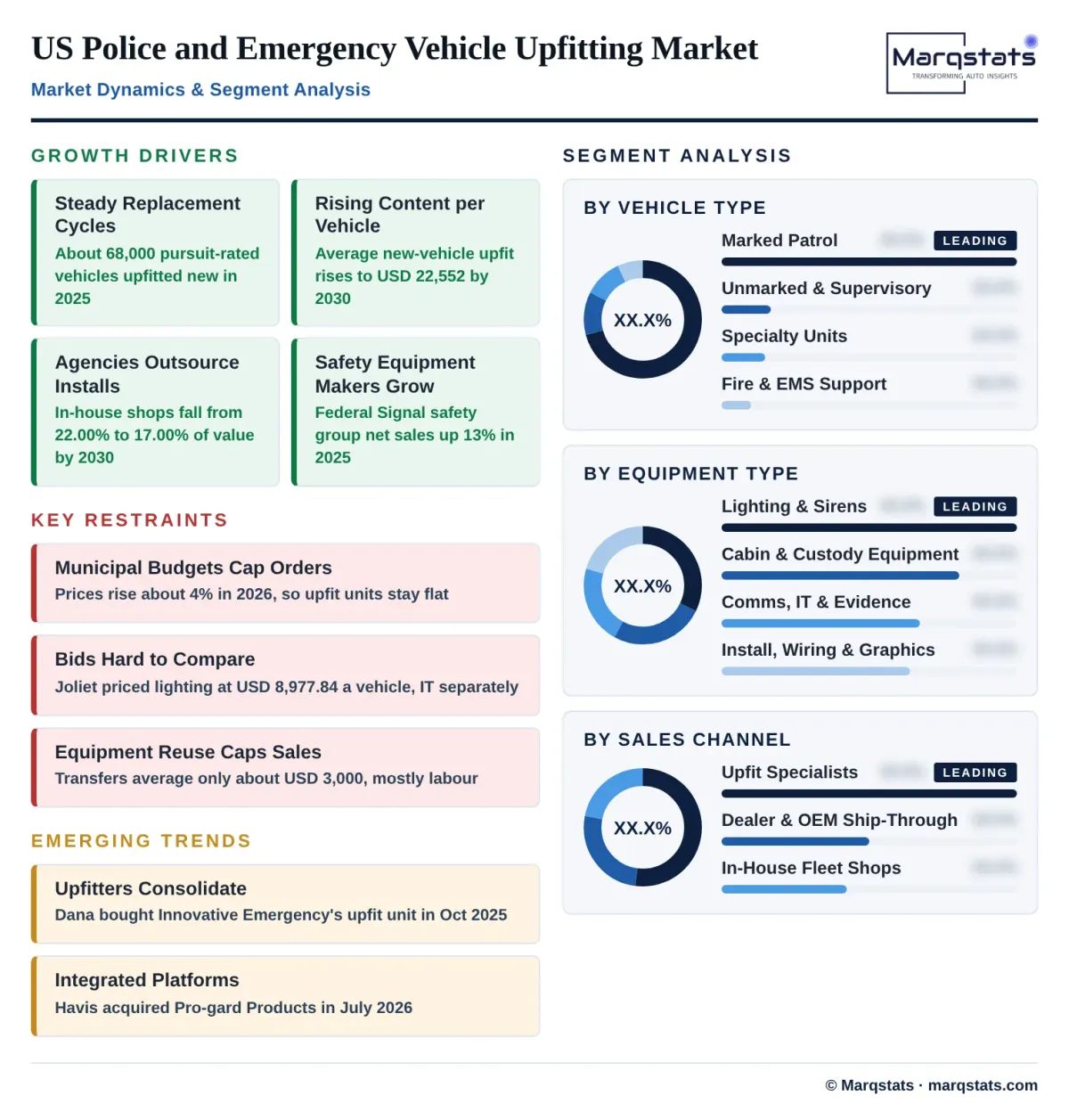
- Steady replacement cycles across state and local patrol fleets. Agencies replace patrol vehicles on four to six-year or mileage-based schedules, such as the four-year or 85,000-mile policy cited by Alameda, which kept about 68,000 pursuit-rated vehicles in the new-upfit pipeline during 2025.
- Rising equipment content per vehicle across connected patrol fleets. Connected lighting controls, in-car cameras, licence plate recognition and data integration add equipment and wiring hours, lifting the average new-vehicle upfit from about USD 17,534 in 2025 to USD 22,552 by 2030.
- Outsourcing of installation from agency shops to specialist upfitters. Specialist upfitters and ship-through programmes are taking share from in-house fleet shops, whose share of market value falls from 22.00% in 2025 to 17.00% by 2030 as agencies move installation to outside specialists.
- Revenue growth among the leading public safety equipment makers. Federal Signal Corporation's Safety and Security Systems Group grew net sales by 13%, or USD 38.6 million, in 2025, mainly on public safety equipment, which reflects sustained agency spending on warning and safety systems.
- New pursuit platforms generating engineering and installation demand. Ford launched the 2025 Police Interceptor Utility nationwide in August 2024, and the 2027 Dodge Charger pursuit car shown in August 2026 will require new consoles, partitions and wiring kits ahead of production from late 2027.
Key Restraints
Four constraints limit the pace at which agencies convert replacement need into upfit orders.
- Municipal budget limits on the timing of fleet replacement. Agencies defer orders when vehicle and equipment prices rise faster than budgets, which holds upfit jobs broadly flat at 153,480 in 2026 even as value rises 6.11% to USD 2,304.61 million.
- Inconsistent bid scopes that obscure the full cost of upfits. Joliet priced lighting and safety at about USD 8,977.84 a vehicle in March 2025 but budgeted up to USD 210,000 for IT separately, so headline upfit prices frequently exclude a large share of total installed cost.
- Equipment reuse that caps sales of new hardware to agencies. Agencies transfer lightbars, consoles and radios to replacement vehicles where they fit, and the 34,300 transfer and decommissioning jobs completed in 2025 averaged only about USD 3,000 each, mostly in labour.
- Chassis concentration that exposes upfit schedules to supply disruption. With Ford holding 60.6% of the police vehicle segment in the third quarter of 2025, a production disruption or model change on a single vehicle line can stall upfit schedules across many agencies at once.
Key Trends
Four structural shifts are changing how US police vehicles are equipped and delivered.
- Consolidation of regional police vehicle upfitters into national installation networks. Dana Safety Supply, owned by AEA Investors since October 2024, acquired the upfitting division of Innovative Emergency Equipment in Colton, California, in October 2025, extending its installation network into the West.
- Integration of consoles, docking and containment into single equipment platforms. Havis acquired Pro-gard Products in July 2026, combining consoles, docking and power management with partitions, prisoner transport systems and gun racks, which allows one supplier to specify most of the cabin package.
- Wider adoption of ship-through delivery for finished police vehicles. Alameda's January 2025 procurement cited faster delivery from ship-through, under which the vehicle moves from the plant to an approved upfitter before reaching the agency, and the channel grows at 9.57% a year to 29.00% of value by 2030.
- Ownership change among adjacent ambulance and fire apparatus manufacturers. Terex completed its merger with REV Group on 2 February 2026, changing the parent of several ambulance and fire apparatus brands that operate alongside the police upfit market.
Strategic Implications
- Platform specification as the decisive advantage for equipment makers. Agencies standardise on a single equipment ecosystem to reduce spares and training, so specification on the Police Interceptor Utility, which underpins Ford's 60.6% segment share, carries more commercial weight than the price of any individual bid.
- Regional density and contract access as the basis of upfitter awards. Dana Safety Supply grew from 43 locations in October 2024 to 54 locations in 17 states by 2026, and cooperative contract eligibility frequently determines which upfitters are permitted to bid.
- Bid normalisation as a precondition for sound agency procurement decisions. Separating equipment, installation, IT, vehicle and recurring service costs and disclosing reused hardware allows like-for-like comparison, since lighting-only and full-patrol quotes can differ by more than USD 15,000 per vehicle.
- Recurring service contracts as the steadier source of investor returns. San Leandro pays USD 250 a month per patrol vehicle and USD 125 per unmarked vehicle for maintenance, revenue that continues between replacement cycles and moderates the cyclicality of new-vehicle upfits.
Market Segmentation
Marked patrol and pursuit vehicles form the largest vehicle type, valued at USD 1,533.40 million in 2025, or 70.60% of the market, and grow at 7.20% to USD 2,170.54 million, or 70.59% of value, by 2030. About 68,000 new pursuit-rated vehicles were upfitted in 2025, predominantly Ford Police Interceptor Utilities, Chevrolet Tahoe PPVs and Dodge Durango Pursuits, each carrying full lighting, containment and evidence packages valued at about USD 21,500.
Unmarked and supervisory vehicles account for USD 256.50 million in 2025, or 11.81% of value, and grow at 6.85% to USD 357.29 million, or 11.62% of value, by 2030. Packages centre on concealed lighting, sirens and communications at about USD 7,500 per new vehicle, which explains why about 30,000 new upfits in 2025 translate into a modest share of market value.
Specialty units account for USD 228.00 million in 2025, or 10.50% of value, and form the fastest-growing vehicle type at 7.78% a year, reaching USD 331.68 million, or 10.79% of value, by 2030. K9 inserts, prisoner transport modules and command consoles lift the average package to about USD 38,000 per vehicle, the highest in the market, on about 6,000 new upfits in 2025.
Fire and EMS support vehicles, including chief, command and utility SUVs, account for USD 154.00 million in 2025, or 7.09% of value, and grow at 6.95% to USD 215.46 million, or 7.01% of value, by 2030. About 14,000 support vehicles were upfitted new in 2025 at about USD 11,000 each, while complete fire apparatus and ambulance patient modules are excluded from the segment.
Warning lighting and sirens form the largest equipment type, valued at USD 697.46 million in 2025, or 32.11% of value, and grow at 7.13% to USD 984.01 million, or 32.00% of value, by 2030. Lightbars, perimeter lights, sirens, controllers and connected control systems from manufacturers such as Whelen, Federal Signal, SoundOff Signal and Code 3 dominate the segment, where networked controls linked to vehicle signals are raising content per installation.
Cabin, custody and containment equipment accounts for USD 560.13 million in 2025, or 25.79% of value, and grows at 7.26% to USD 795.21 million, or 25.86% of value, by 2030. Consoles, partitions, prisoner seats, weapon mounts and push bumpers form the core of marked and specialty packages, and the July 2026 acquisition of Pro-gard Products by Havis brings much of this category under a single supplier.
Communications, computing and evidence integration accounts for USD 469.55 million in 2025, or 21.62% of value, and grows at 7.19% to USD 664.37 million, or 21.61% of value, by 2030. The segment comprises docks, mounts, antennas, modems, in-car camera systems and integration labour, while radio and computer hardware purchased separately through agency IT budgets is excluded from the measure.
Installation, wiring and graphics account for USD 444.76 million in 2025, or 20.48% of value, and grow at 7.26% to USD 631.38 million, or 20.53% of value, by 2030. The segment covers wiring looms, fabrication, testing and graphics, and it captures most of the value of equipment transfers, which average about USD 3,000 per job and consist largely of labour.
Specialist public safety upfitters form the largest sales channel, at USD 1,129.39 million in 2025, or 52.00% of value, and grow at 8.01% to USD 1,660.48 million, or 54.00% of value, by 2030. Regional networks such as Dana Safety Supply, with 54 locations in 17 states, win work on installation capacity, cooperative contract access and continuity of local service.
Dealer and OEM ship-through programmes account for USD 564.69 million in 2025, or 26.00% of value, and form the fastest-growing channel at 9.57% a year, reaching USD 891.74 million, or 29.00% of value, by 2030. Agencies purchase a finished vehicle on a single order, and routing from the assembly plant to an approved upfitter shortens delivery times, as Alameda cited in its January 2025 procurement.
In-house agency fleet shops account for USD 477.82 million in 2025, or 22.00% of value, but grow only 1.81% a year to USD 522.75 million, or 17.00% of value, by 2030. The channel loses share as agencies transfer installation to outside specialists and ship-through programmes with greater installation capacity and shorter delivery times.
By Geography
South
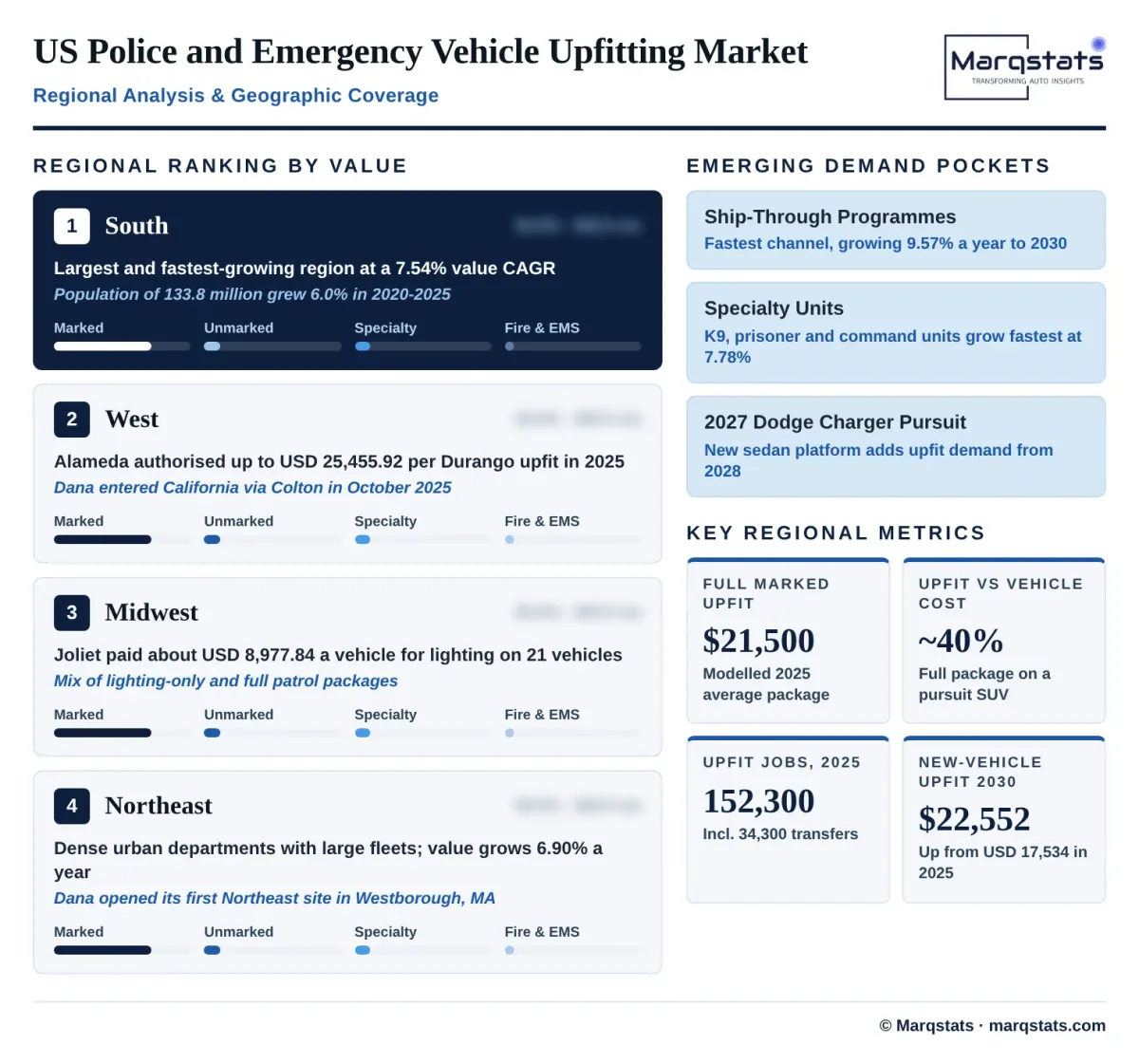
The South is the largest and fastest-growing region, valued at USD 847.65 million in 2025, or 39.03% of the market, and growing at 7.54% to USD 1,219.21 million, or 39.65% of value, by 2030. Its population of 133.8 million grew 6.0% between 2020 and 2025, the fastest of any census region, which supports demand for additional patrol capacity, and the region is home to Dana Safety Supply, which was founded in Miami.
West
The West accounts for USD 517.76 million in 2025, or 23.84% of value, and grows at 7.11% to USD 730.00 million, or 23.74% of value, by 2030. California agencies such as Alameda and San Leandro publish detailed upfit and maintenance contracts, and Dana Safety Supply expanded its installation capacity in the state through the Colton acquisition in October 2025.
Midwest
The Midwest accounts for USD 424.17 million in 2025, or 19.53% of value, and grows at 6.90% to USD 592.09 million, or 19.26% of value, by 2030. Joliet's 2025 lighting and safety upfits on 21 vehicles, priced at about USD 8,977.84 each with IT budgeted separately, illustrate the regional mix of lighting-only and full-patrol packages.
Northeast
The Northeast accounts for USD 382.32 million in 2025, or 17.60% of value, and grows at 6.90% to USD 533.67 million, or 17.36% of value, by 2030. Dense urban departments operating large fleets anchor regional demand, and Dana Safety Supply opened its first Northeast location in Westborough, Massachusetts, as part of its national expansion.
How Competition Is Evolving
The US police vehicle upfitting market is fragmented at the installation level, where hundreds of regional upfitters, dealers and agency fleet shops compete for work, although equipment supply is more concentrated among a small group of manufacturers of lighting, consoles and containment products. Supplier market shares are not publicly disclosed and could not be sourced, and competitive position is therefore assessed across three layers of equipment makers, integrators and vehicle makers rather than through a share ranking.
Dana Safety Supply describes itself as the largest police vehicle upfitter in the United States and has expanded rapidly under AEA Investors, which acquired the company in October 2024 with 43 locations. The company added the upfitting division of Innovative Emergency Equipment in Colton, California, in October 2025 and now reports 54 locations in 17 states.
Among equipment makers, Whelen Engineering, Federal Signal Corporation, SoundOff Signal and the Code 3 brand of ECCO Safety Group compete in lighting and sirens, while Havis, which acquired Pro-gard Products in July 2026, and Setina Manufacturing compete in consoles, partitions and containment. Axon Enterprise and Motorola Solutions supply the in-car camera and evidence systems that upfitters integrate into the vehicle during installation.
Vehicle makers act as both suppliers and channel partners in the market. Ford Motor Company, General Motors Company and Stellantis N.V. publish police upfitter manuals that set mounting and wiring rules and operate ship-through programmes to approved upfitters. Competition therefore turns on access to approved state and cooperative contracts and on regional installation capacity, with platform standardisation and service continuity after delivery determining whether an incumbent retains the account.
Companies Covered
Companies covered in the report include:
Recent Market Activity
Table of Contents
Coverage & Segmentation
Coverage spans police and emergency vehicle upfitting in the United States across the South, West, Midwest and Northeast census regions, with 2025 as the base year, 2021 to 2025 as the historical period and 2026 to 2030 as the forecast period. Value is expressed in USD million of upfit equipment and installation revenue, excluding the vehicle, separately purchased radio and computer hardware, sales tax and recurring maintenance, and volume is measured in upfit jobs including equipment transfers and decommissioning. Segmentation covers four vehicle types, four equipment types and three sales channels, and twelve companies are profiled.
Complete fire apparatus and ambulance patient modules and remounts are excluded, as are recurring maintenance contracts, and each is treated as an adjacent market. Package values are benchmarked to municipal procurements in Alameda, Joliet and Deer Park, agency counts draw on the Bureau of Justice Statistics and regional shares are allocated using Census Bureau Vintage 2025 population estimates.