Market Snapshot
Middle bar: base-year value × (1 + CAGR), rounded to two decimals. This is a calculated illustration, not a separately researched annual estimate.
The off-highway electric vehicle market is a multi-speed electrification story: already commercially meaningful in compact electric construction equipment and underground mining battery-electric vehicles, but still transitional in large surface mining haul trucks and mainstream high-horsepower agricultural tractors. China leads in model breadth with nearly 200 zero-emission construction machinery models on the market by end of 2024, where excavators and loaders account for over 80% of available models and the top 10 manufacturers hold approximately 73% of all offerings. Underground mining has one of the strongest economic cases: battery-electric vehicles consume up to 70% less energy, produce 70% less heat, and dramatically reduce ventilation costs—making electrification a total-system-cost winner rather than just a fuel substitution. The off-highway electric vehicle market size was valued at approximately USD 6.38 billion in 2025 and is projected to reach USD 18.72 billion by 2030, expanding at a CAGR of 24.02% during the forecast period (2026–2030).
The scale and urgency of adoption vary sharply by segment. In construction, Volvo CE presented a zero-emission-only lineup at Bauma 2025 and moved its updated EC230 Electric excavator into commercial availability across North America and select European markets. Komatsu showed five electric hydraulic excavators plus an electric wheel loader prototype at the same show. In underground mining, Sandvik won its largest-ever BEV order—approximately SEK 750 million for South32’s Hermosa project in Arizona (April 2025)—and now has over 600 electric units installed worldwide. Epiroc’s underground BEVs are explicitly sold on 70% lower energy consumption, 70% less heat generation, and substantially lower ventilation costs. At the heavy end of surface mining, BHP received Australia’s first Cat 793 XE battery-electric haul trucks at Jimblebar for on-site testing with BHP and Rio Tinto (December 2025)—marking a milestone for large-truck electrification. In agriculture, John Deere’s E-Power battery-electric utility tractor (up to 130 hp) remains in development, while India published IS 19262:2025 for electric agricultural tractors in December 2025, signalling that standards infrastructure is being built for farm equipment electrification.
Construction machinery alone is responsible for 13% of China’s national mobile-source NOx and 26% of PM emissions, which explains why China is pushing this segment aggressively. In the US, the EPA granted California authority (January 2025) to enforce the 2022 Off-Road Regulation amendments, adding pressure on diesel off-road fleets. European emission-free construction zones (Norway, Germany, Netherlands) and EU NRMM regulations create a regulatory tailwind. The off-highway EV component market—including electric powertrains, battery systems, inverters, and thermal management—is expanding alongside equipment demand, with Tata Elxsi and Infineon partnering (June 2025) on application-ready EV subsystems covering off-highway applications, and Modine launching its EVantage electric compressor and thermal management portfolio specifically for commercial and off-highway EVs. The Marqstats electric vehicle battery components market report provides complementary coverage of the upstream cell-material stack feeding off-highway battery packs.
Key Takeaways
Market Overview & Analysis
Report Summary
The off-highway electric vehicle market covers battery-electric and plug-in hybrid electric equipment across three primary end-use sectors: construction (excavators, loaders, haulers, dozers, compact equipment), mining (underground loaders, haul trucks, drills, surface mining trucks), and agriculture (utility tractors, compact tractors, specialty farm equipment). The scope includes both complete electric machines and the electrified powertrain/component content within them—motors, inverters, battery packs, thermal management systems, and on-site charging infrastructure sold as part of the equipment package. Material handling (forklifts) is excluded as a separate established market. The report covers OEM production, fleet procurement, aftermarket conversion, and the emerging off-highway EV charging infrastructure for remote and jobsite applications.
This is a multi-speed market with segment-specific adoption curves rather than one giant wave. Compact construction equipment and underground mining are already at commercial scale. Mid-size construction equipment is transitioning to serial production. Large surface mining trucks are in pilot and mine-site testing. Agricultural tractors are building standards infrastructure and utility-segment prototypes. The market’s measured size depends heavily on scope: narrow definitions capture BEV equipment only at approximately USD 2–3 billion, while broader definitions including hybrids, components, and charging can exceed USD 13 billion. The overall off-highway vehicle market was approximately USD 544 billion in 2024, meaning electric penetration is still low but growing from a massive addressable base.
Market Dynamics
Key Drivers
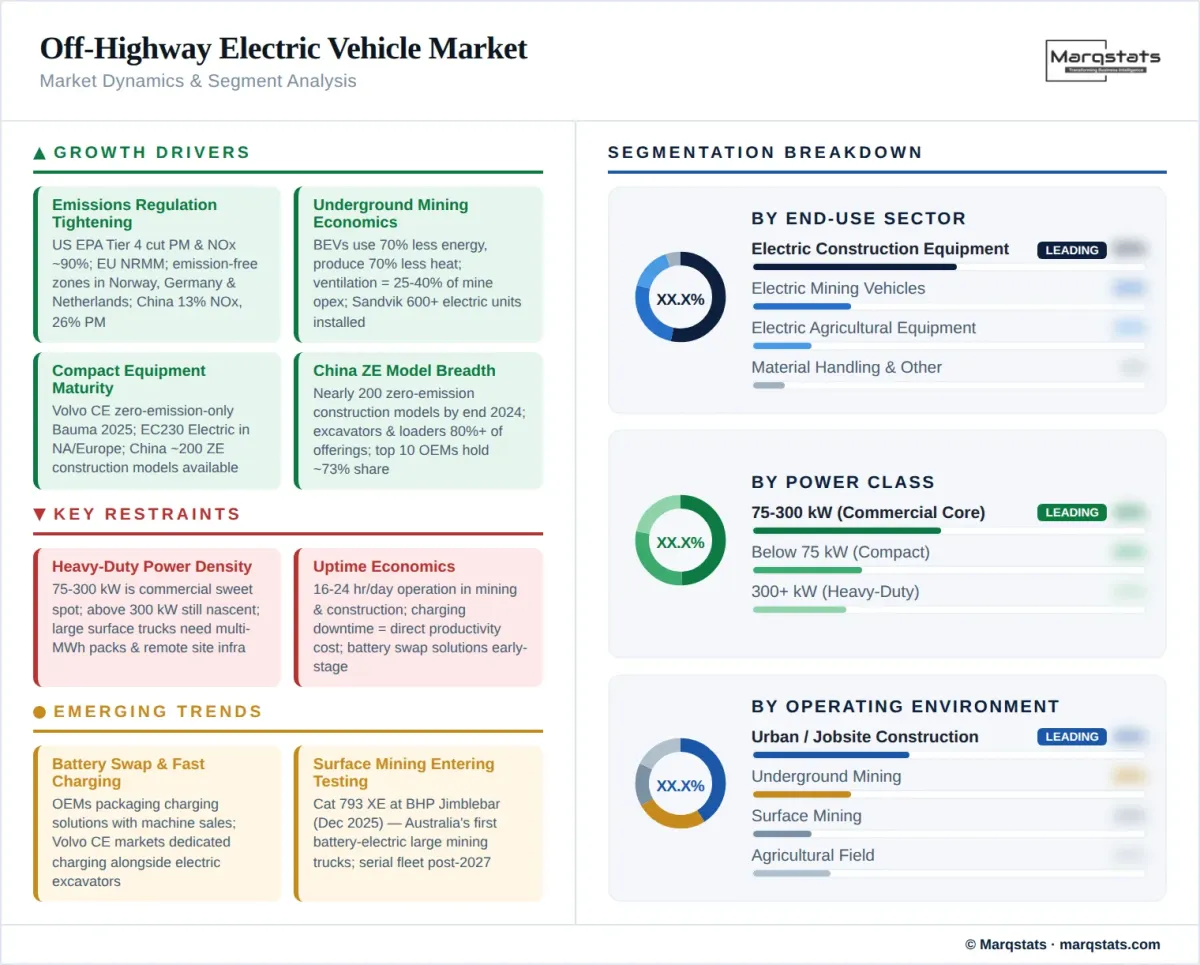
- Emissions regulation tightening across all major markets: US EPA Tier 4 cut nonroad diesel PM and NOx by approximately 90%. California’s EPA-authorised 2022 Off-Road Regulation amendments (January 2025) add pressure on diesel fleets. EU NRMM continues setting type-approval and emissions rules. Emission-free construction zones in Norway, Germany, and the Netherlands mandate zero-tailpipe equipment for urban jobsites. China’s construction machinery contributes 13% of national mobile-source NOx and 26% of PM—driving aggressive zero-emission equipment deployment.
- Underground mining economics favouring BEVs on total system cost: Battery-electric underground vehicles consume up to 70% less energy, produce 70% less heat, and dramatically reduce ventilation costs—which can represent 25–40% of mine operating expenses. Epiroc and Sandvik both position underground BEVs around ventilation savings, lower maintenance, and lower heat loads. Sandvik’s SEK 750 million Hermosa order (April 2025) and 600+ installed electric units demonstrate this is now a fleet-procurement market, not just pilots.
- Compact/urban construction equipment creating near-term commercial volume: Volvo CE’s zero-emission-only Bauma 2025 lineup and the EC230 Electric’s commercial availability across North America and Europe prove compact/mid-size electric construction equipment is serial-production ready. China’s nearly 200 zero-emission construction models create the world’s broadest commercial offering. Electric equipment’s lower noise and zero exhaust enable work in urban locations, indoor sites, and noise-sensitive areas where diesel faces restrictions—expanding accessible working hours and jobsite types.
- Component ecosystem maturing for off-highway EV applications: Tata Elxsi and Infineon’s June 2025 partnership targets application-ready EV subsystems including off-highway vehicles, covering SiC-based inverters, scalable BMS, and thermal management. Modine’s EVantage portfolio delivers electric compressors, cabin climate systems, and 3-way coolant valves specifically designed for commercial and off-highway EVs. Turntide Technologies launched the AF430S axial flux motor (96% efficiency, 7.2 kW/kg) for off-highway and performance applications. Ricardo developed Alumotor, a rare-earth-free reluctance motor suitable for light commercial and off-highway vehicles. This component maturation lowers development costs for OEMs entering off-highway electrification.
- BYD, XCMG, and Chinese OEMs deploying LFP Blade battery technology in construction machinery: Chinese manufacturers are leveraging their LFP battery scale advantage—proven in millions of passenger EVs—to supply cost-competitive battery packs for construction equipment. LFP’s thermal stability and lower cost per kWh make it well-suited for off-highway duty cycles. XCMG leads China’s model count, with SANY, LiuGong, Shantui, and SDLG following. This creates a technology and cost linkage between China’s passenger EV battery ecosystem and the off-highway equipment market.
Key Restraints
- Power density and charging logistics limiting heavy-duty adoption: The biggest constraint is that electrification works very differently by machine class. China’s zero-emission construction market is already broad in the 75–300 kW range, but above 300 kW remains nascent. Large surface mining trucks face extreme energy demands—multi-MWh battery packs, multi-hour charging windows, and site power infrastructure that may not exist at remote mine locations. Off-highway EV charging infrastructure for remote sites is still part of the product rather than an external given.
- Uptime economics constraining adoption in continuous-operation applications: Off-highway equipment often operates 16–24 hours per day in construction and mining, making charging downtime a direct productivity cost. Battery swapping and fast-charging solutions are being developed but remain early-stage for heavy equipment. Fleet operators evaluating electric equipment must calculate total cost of ownership including charging infrastructure capital, energy costs, and lost operating hours versus diesel refuelling time.
- High upfront cost versus diesel incumbency: Battery-electric off-highway equipment carries significantly higher purchase prices than diesel equivalents, even where total cost of ownership is competitive over equipment life. Capital-constrained operators—particularly in emerging markets and smaller construction companies—face adoption barriers. Rental and equipment-as-a-service models may bridge this gap.
Key Trends
- Off-highway EV battery swapping and fast charging emerging as infrastructure solutions: For continuous-operation applications, battery swapping removes charging downtime by exchanging depleted packs at the jobsite. Fast-charging (150 kW+) targets break periods and shift changes. OEMs increasingly package charging solutions with machine sales: Volvo CE markets dedicated charging solutions alongside its electric excavators. Mining OEMs tie BEV sales to full electrification and energy-management packages rather than standalone machine transactions.
- Large surface mining trucks entering real-world mine-site testing: Cat 793 XE battery-electric haul trucks arrived at BHP’s Jimblebar (December 2025) for testing with BHP and Rio Tinto—Australia’s first battery-electric large mining trucks. Caterpillar, Komatsu, and other mining OEMs are moving from concept/demonstration to on-site validation, though serial fleet deployment remains post-2027 for most programs.
- Yanmar launching dedicated electrification business unit for compact off-highway: In March 2025, Yanmar created a dedicated electrification unit for compact off-highway machinery—signalling that suppliers now treat electrification as its own business line rather than a side project. This organisational signal typically precedes investment scaling and dedicated R&D allocation.
- Eaton spinning off Mobility Group including eMobility for off-highway and CV applications: Eaton’s January 2026 announcement to spin off its Vehicle and eMobility segments as an independent company (expected Q1 2027) creates a focused off-highway and commercial vehicle eMobility player with leading positions in EV fuses and valve actuation technologies. This structural move validates off-highway electrification as a standalone business opportunity.
- India’s IS 19262:2025 building institutional infrastructure for electric tractors: Released December 2025, India’s new standard for electric agricultural tractors explicitly aims to facilitate wider adoption and innovation in clean agricultural mechanisation. While India’s off-highway EV market was estimated at only approximately USD 56 million in 2024, the standards publication signals government commitment to building the regulatory infrastructure for agricultural electrification.
Market Segmentation
The largest and most commercially mature segment. China’s nearly 200 zero-emission construction models, with over 80% being excavators and loaders, define the global volume centre. The 75–300 kW power band is the commercial sweet spot, with above 300 kW still nascent. Volvo CE leads Western OEM commercialisation with the EC230 Electric, A30 Electric hauler, and zero-emission urban utility machines. Komatsu showed five electric hydraulic excavators plus an electric wheel loader prototype at Bauma 2025. Compact/urban construction is the entry point: lower daily operating hours, depot/jobsite charging feasibility, noise restrictions favouring electric, and emission-free zone mandates creating compliance demand.
The highest-value segment per unit sold. Underground mining BEVs are at fleet-procurement scale: Sandvik has 600+ electric units installed globally and won its largest-ever BEV order (SEK 750 million, South32 Hermosa). Epiroc positions underground BEVs on 70% energy reduction, 70% heat reduction, and substantially lower ventilation costs. Surface mining is still pilot-stage: Cat 793 XE battery-electric haul trucks began mine-site testing at BHP Jimblebar (December 2025). The underground segment is commercially validated; surface mining is the next frontier requiring multi-MWh battery packs and site-level power infrastructure.
The earliest-stage major segment. John Deere’s E-Power battery-electric utility tractor (up to 130 hp) remains in development. India’s IS 19262:2025 (December 2025) creates standards infrastructure for electric agricultural tractors. CNH/New Holland has publicly shown electric utility tractor programs. The near-term addressable market is utility and specialty tractors (sub-150 hp) where daily operating hours, depot charging, and lower noise/emissions are valued. High-horsepower broad-acre tractors (300+ hp) face the same energy density and uptime constraints as large mining trucks.
The most mature segment by model availability and commercial deployment. Mini excavators, compact loaders, utility tractors, and material-handling equipment. Highest volume, lowest per-unit value. Battery packs typically 30–80 kWh. Yanmar’s dedicated electrification unit (March 2025) targets this segment specifically.
The commercial sweet spot for off-highway electrification. Volvo CE EC230 Electric, Komatsu’s electric excavator lineup, and the majority of China’s 200 zero-emission models fall in this range. Battery packs typically 200–600 kWh. Sufficient energy density for 4–8 hour shift coverage with opportunity charging. This is where the volume growth will be most significant through 2030.
Still nascent. Cat 793 XE (approximately 2,650 kW) represents the most extreme application. Large construction dozers, surface mining trucks, and high-horsepower agricultural tractors. Battery packs exceeding 1 MWh, potentially requiring multi-MW charging or battery swapping. Serial production expected post-2027 for most programs.
By Geography
China
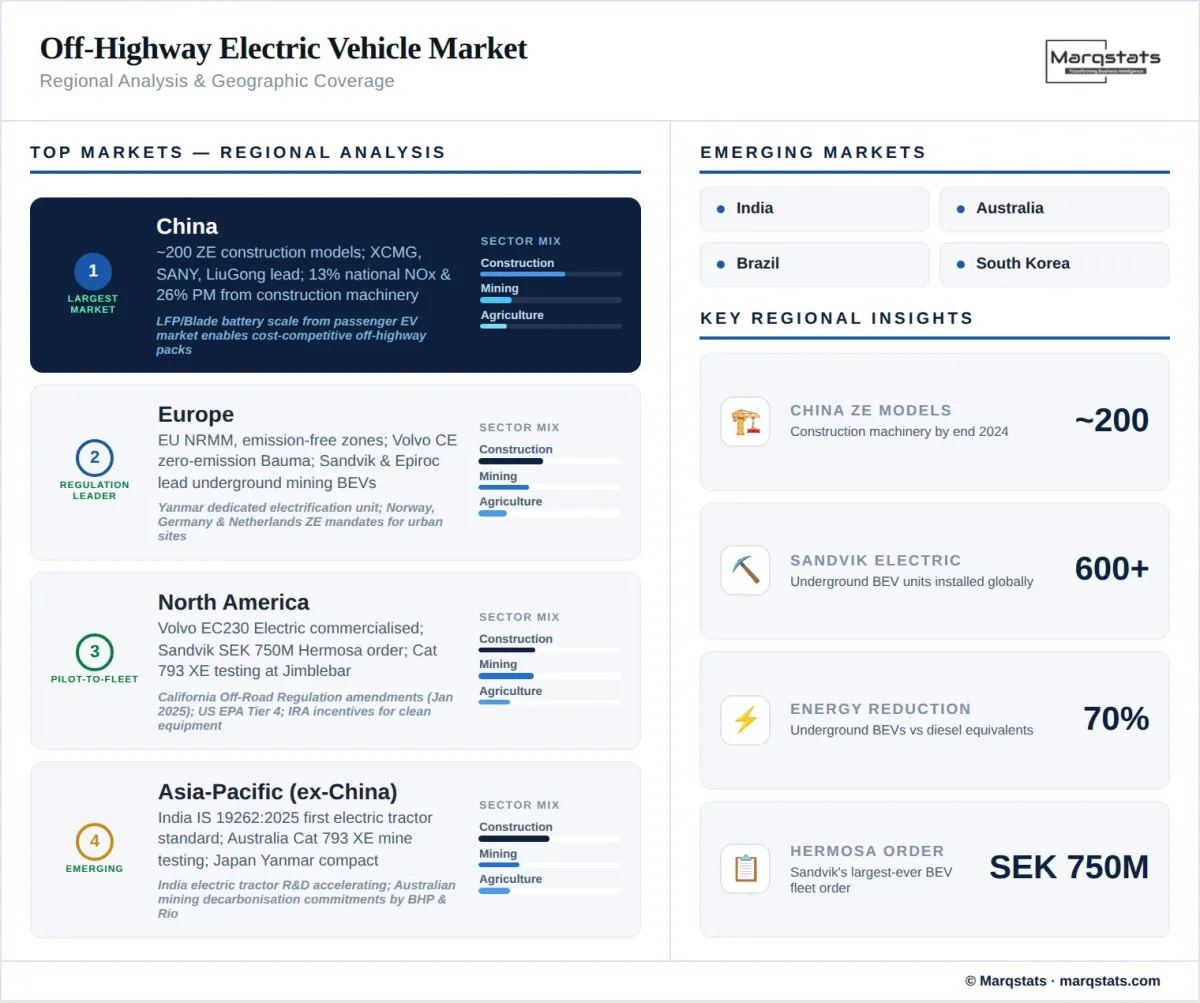
The global leader in zero-emission off-highway equipment breadth. Nearly 200 zero-emission construction machinery models available by end 2024. XCMG leads by model count, followed by SANY, LiuGong, Shantui, and SDLG. Construction machinery contributes 13% of national mobile-source NOx and 26% of PM—creating strong regulatory push. Chinese OEMs leverage LFP/Blade battery scale from the passenger EV market for cost-competitive off-highway battery packs. The 75–300 kW segment dominates current offerings. China also leads in electric forklift and material-handling penetration, though those segments are excluded from this report.
Europe
The strongest regulatory environment for off-highway electrification. EU NRMM emissions rules, emission-free construction zones in Norway, Germany, and the Netherlands, and urban noise restrictions create compliance-driven demand. Volvo CE (Sweden) leads Western OEM commercialisation with a zero-emission-only Bauma 2025 lineup. Komatsu showed its expanded electric excavator range for European availability. Sandvik (Sweden) and Epiroc (Sweden) lead underground mining BEV deployment globally. Yanmar (via its European presence) launched a dedicated compact off-highway electrification unit.
North America
Pilot-heavy but with flagship validation programs. Volvo CE commercialised the EC230 Electric in North America. Sandvik’s SEK 750 million BEV order targets South32’s Hermosa mine in Arizona. Cat 793 XE battery-electric haul trucks are testing at BHP’s Jimblebar mine (Australian operations managed from North America). California’s CARB Off-Road Regulation amendments (January 2025 EPA authorisation) add fleet-level pressure on diesel equipment. US DOE awarded USD 44.8 million for EV battery recycling projects including Caterpillar’s off-highway battery pack design (October 2024). Eaton’s Mobility Group spin-off (January 2026) creates a focused eMobility player for off-highway and CV segments. Octillion’s Nevada battery plant (January 2025, 1 GWh capacity) targets off-highway and commercial applications.
Asia-Pacific (Excluding China)
India is the key emerging market: off-highway EV market estimated at approximately USD 56 million in 2024 but growing with IS 19262:2025 electric tractor standard (December 2025), Volvo CE showing L120 Electric at EXCON 2025, and Tata Elxsi/Infineon partnering on off-highway EV subsystems (June 2025). Japan hosts Komatsu (electric excavator programs), Yanmar (electrification unit), and Hitachi Construction Machinery (compact electric excavators in Asia). Australia is critical for mining electrification: BHP’s Jimblebar is the testing ground for Cat 793 XE.
Rest of World
Africa and Latin America represent long-term mining electrification opportunities where ventilation savings, emission reduction, and energy cost structures favour BEVs in underground operations. Middle East construction and Gulf infrastructure programs may adopt electric equipment for indoor and noise-sensitive urban projects. South32’s Hermosa project (Arizona) demonstrates that global mining companies are making fleet-procurement-scale BEV commitments.
How Competition Is Evolving
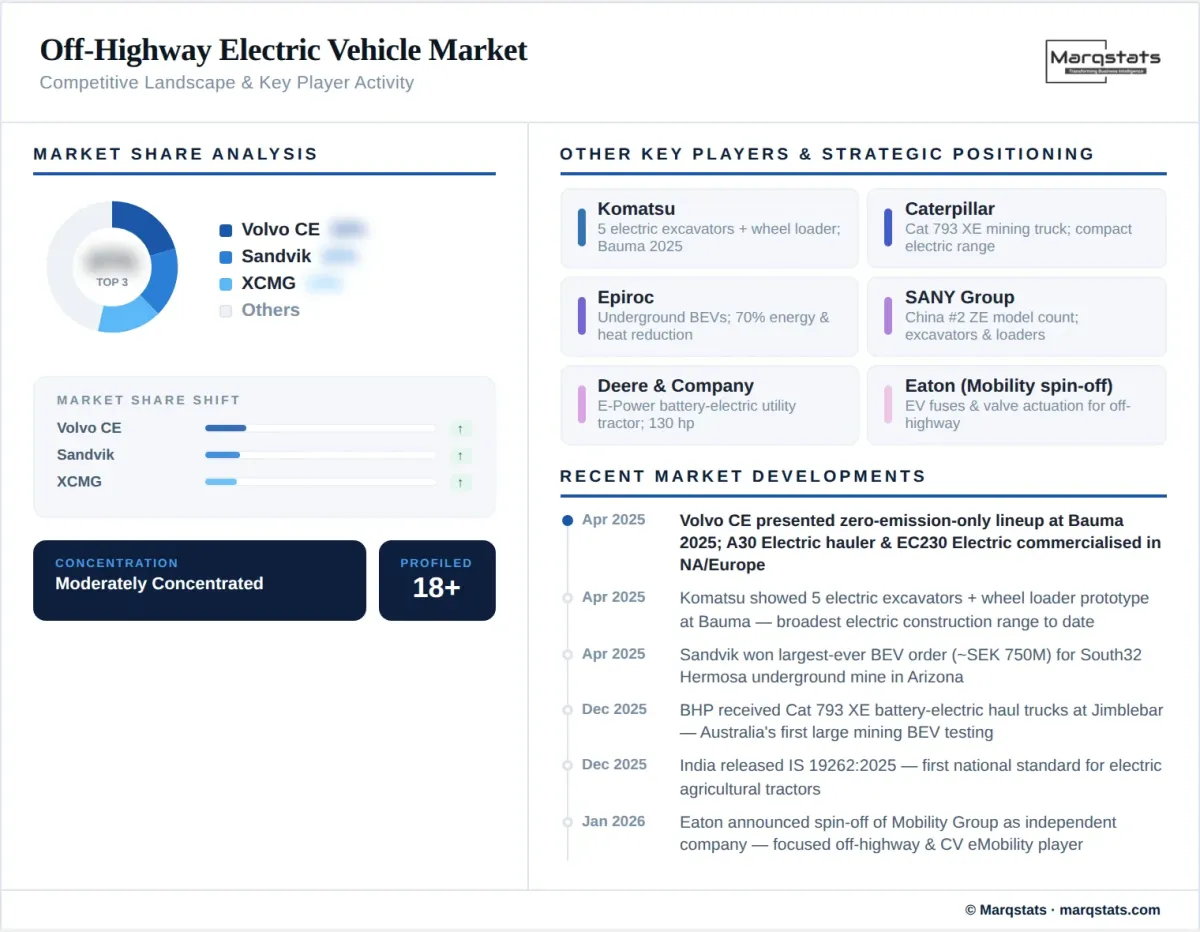
The competitive landscape splits into three sectors with distinct leadership. In construction equipment, Volvo CE leads Western commercialisation with a zero-emission-only lineup, the EC230 Electric, and the A30 Electric hauler. Komatsu is broadening its electric excavator range. Caterpillar and Hitachi Construction Machinery are deploying compact and mid-size electric equipment. Chinese OEMs lead in model breadth: XCMG, SANY, LiuGong, Shantui, and SDLG together offer the world’s largest selection of zero-emission construction machinery, leveraging LFP battery cost advantages.
In mining, Epiroc and Sandvik lead underground BEV fleets with the most installed units and the strongest economic proof points. Sandvik’s 600+ installed electric units and SEK 750 million Hermosa order define the underground segment. Caterpillar is the key name in large surface mining electrification: the Cat 793 XE battery-electric haul truck testing at BHP Jimblebar is the highest-profile heavy-truck BEV pilot globally. Komatsu’s mining division is also developing electric haul trucks.
In agriculture, John Deere leads with its E-Power battery-electric utility tractor programme. CNH Industrial / New Holland has shown electric tractor prototypes. The competitive field in agriculture is earlier and less settled than construction or mining. In the component and supplier layer, Eaton’s Mobility Group spin-off (January 2026) creates a focused off-highway and CV eMobility company. Modine’s EVantage portfolio targets off-highway thermal management specifically. Turntide Technologies’ AF430S axial flux motor and Ricardo’s Alumotor rare-earth-free motor both target off-highway applications. Tata Elxsi/Infineon’s partnership develops SiC inverters and scalable BMS for off-highway EV subsystems.
Companies Covered
Companies covered in the report include:
Recent Market Activity
Table of Contents
Coverage & Segmentation
This report provides a comprehensive analysis of the global off-highway electric vehicle market covering the historical period (2021–2025) and forecast period (2026–2030), with 2025 as the base year. The study examines market size in USD and unit volume across end-use sector (construction, mining, agriculture), equipment type (excavators, loaders, haulers, dozers, drills, tractors, compact equipment), power class (sub-75 kW, 75–300 kW, above 300 kW), propulsion type (battery-electric, plug-in hybrid), and geography covering 20 countries across China, Europe, North America, Asia-Pacific, and Rest of World. Company profiling covers 20+ players across construction, mining, agriculture OEMs, and component/technology suppliers. Policy analysis covers US EPA Tier 4, California CARB Off-Road amendments, EU NRMM, European emission-free construction zones, China zero-emission machinery push, and India IS 19262:2025 electric tractor standard.
Research methodology combines bottom-up modelling from equipment production volumes, zero-emission model counts by market, fleet procurement data (Sandvik 600+ units, BHP/Caterpillar pilots), and component supplier disclosures. Primary research encompasses 40+ interactions with construction/mining/agriculture OEM electrification teams, component suppliers, fleet operators, mining companies, and regulatory specialists across China, Europe, North America, and India.