Market Snapshot
Middle bar: base-year value × (1 + CAGR), rounded to two decimals. This is a calculated illustration, not a separately researched annual estimate.
The bull bar market is estimated at USD 351.25 million in 2025 and is projected to reach USD 438.53 million by 2030, a CAGR of 4.54%, on unit demand rising from 372,779 bars to 395,846 at a 1.21% CAGR. Value compounds well ahead of volume because the blended end-user price per bar climbs from USD 942 to USD 1,108 as sensor-compatible designs take share. Australia and New Zealand account for 49.32% of 2025 bar value from only 8.77% of the eligible new vehicles sold across the nine covered markets.
Market size and forecast figures are generated using Marqstats' proprietary estimation framework, updated as of October 2026. No statistical body counts bull bars, so the estimate is a Marqstats construction built from published 2025 sales of 4,779,272 new pickups, utes and off-road SUVs, fitment rates expressed as bars per 100 new vehicles and end-user prices excluding sales tax and fitting labour, and it is most sensitive to fitment on Australian 4x4 utes and North American pickups.
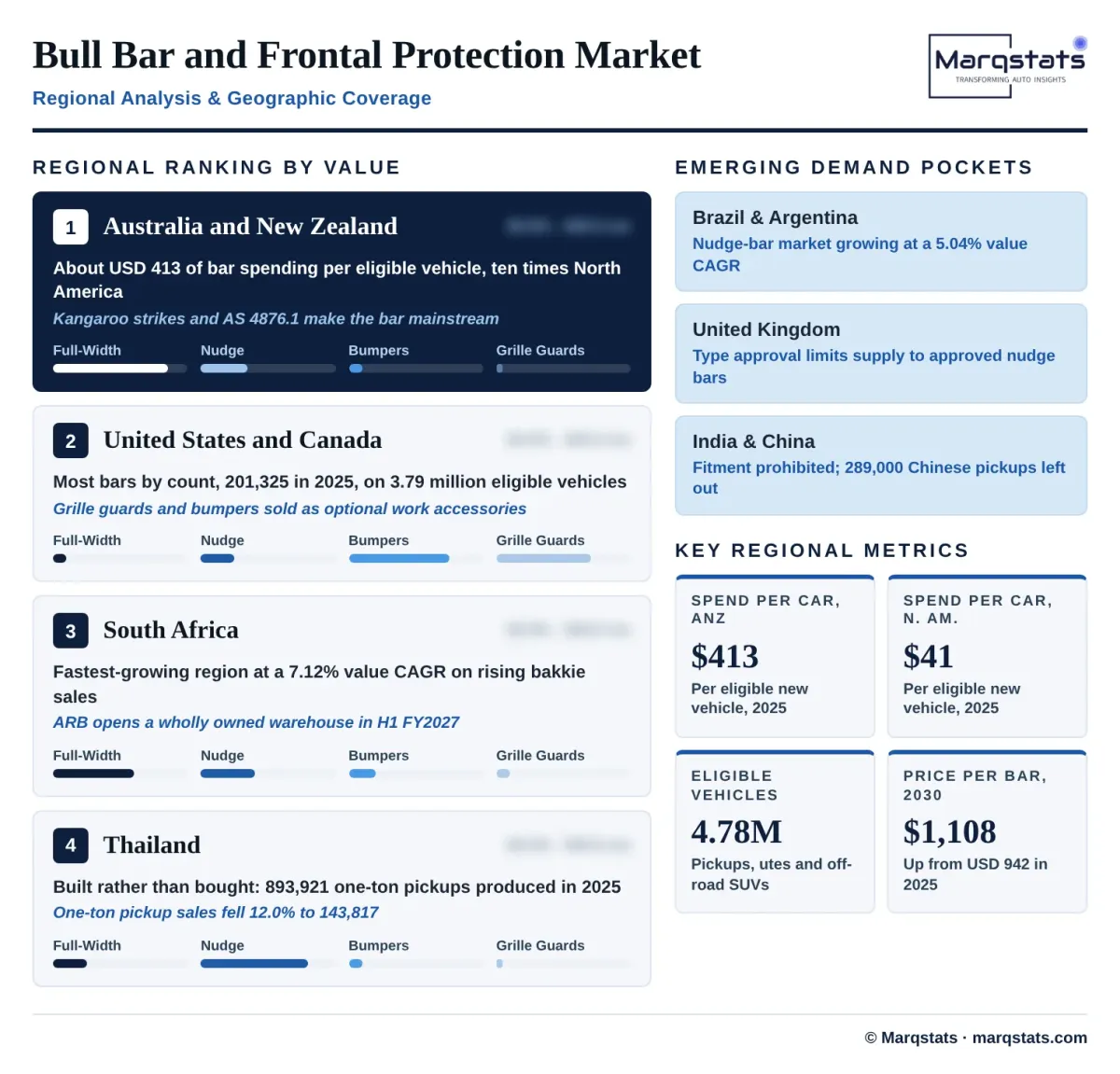
The defining feature of the bull bar market is the concentration of value relative to vehicle volume. Bar spending amounts to about USD 413 per eligible new vehicle sold in Australia and New Zealand, against USD 41 in the United States and Canada, where a far larger pickup fleet treats the grille guard as an optional work accessory rather than as standard equipment for rural roads.
Regulation shapes the geography of demand as strongly as vehicle sales do. Australia sets a design standard for the product in AS 4876.1-2002, with mounting and airbag rules set by the states, while the United States treats a grille guard as motor vehicle equipment without any federal design standard. The European Union and the United Kingdom require type approval, Brazil requires bars on vehicles up to 3,500 kg to come from manufacturers registered with INMETRO, and India and China prohibit fitment, which places both countries outside the quantified total.
Key Takeaways
Market Overview & Analysis
Report Summary
The bull bar market has moved from steel fabrication, in which a bar was cut, bent, welded, powder-coated and bolted to a chassis rail, toward vehicle-specific engineering in which the bar must work with the safety systems of the vehicle it protects. Every new ute sold in Australia carries radar and camera sensors for autonomous emergency braking and adaptive cruise control, Victoria requires that a bar does not interfere with them, and Toyota Motor Corporation Australia describes its genuine bar and the vehicle as one system. Engineering content is the principal reason market value compounds at 4.54% a year against unit growth of 1.21%, with the price of a bar rising faster than the number of vehicles it is sold onto. Suppliers able to validate a bar against the sensors, airbags and crush structure of a specific vehicle before it reaches the showroom therefore hold the strongest competitive position.
The market covers four frontal protection products fitted to light vehicles, namely full-width bull bars, also called roo bars; nudge and tubular bars; grille guards and push bars; and steel or aluminium replacement front bumpers, including winch-ready designs. Light vehicles are defined as pickups, utes, SUVs and 4WD wagons up to the 4.5 tonne gross vehicle mass ceiling used in the New South Wales, Victorian and Western Australian frontal protection rules, together with their North American equivalents, including heavy-duty 2500 and 3500 pickups. Value is measured at the end-user price excluding sales tax and fitting labour across both the aftermarket and the OEM genuine-accessory channel. Rear bars, side steps and rock sliders, standalone winches and separately sold lighting, factory bumpers fitted as standard equipment and bars for medium and heavy trucks are excluded. Coverage spans nine markets in six regions, comprising Australia, New Zealand, the United States, Canada, Thailand, South Africa, Brazil, Argentina and the United Kingdom.
The analysis addresses four groups of decision-makers, beginning with bar manufacturers deciding where to add capacity, for whom the central fact is that North America holds 79.24% of eligible vehicles but only 44.71% of value. Automaker accessory teams choosing between a licensed supplier and in-house genuine parts require the channel economics that follow the FY2026 decline in ARB original-equipment sales. Distributors and retailers weighing an Australian brand for South Africa or the United States require the difference in fitment rates between those markets, and investors assessing a listed accessory group need to separate bar demand from ute sales, because the two moved in opposite directions in Australia in 2026.
Bull Bar Market Size and Forecast
Volume is the anchor series of the bull bar market estimate, and value is derived from volume and a weighted average end-user price per bar that rises from USD 942 in 2025 to USD 1,108 in 2030. Unit demand is estimated from eligible new-vehicle sales and a fitment rate expressed as bars per 100 new vehicles, a measure that captures first fits, second-owner fits and replacements within a single rate tied to new sales. Every vehicle count is a published 2025 sales figure from a national industry body or an automaker, while fitment rates and prices are Marqstats estimates, each anchored on a named observation, so the vehicle base remains verifiable against public sales releases.
Australia has the highest fitment intensity in the market, on a 2025 vehicle base that the Federal Chamber of Automotive Industries (FCAI) VFACTS series records as 212,513 4x4 utes, up 4.7%, 164,558 large SUVs, up 9.5%, 12,290 Toyota LandCruiser 300s and 6,263 Nissan Patrols. Fitment is estimated at 42 bars per 100 new 4x4 utes, 10 per 100 large SUVs and 55 per 100 upper-large wagons. The only published prevalence observation, a 2008 survey by the Centre for Automotive Safety Research at the University of Adelaide, found bars on 49.8% of work utes and 45.4% of 4WDs and SUVs in metropolitan Adelaide, and because no newer count exists it serves as a ceiling rather than as a current measure. New Zealand adds 23,615 units of its four best-selling utes, with fitment estimated at 20 bars per 100 new vehicles.
The North American vehicle base comprises 3,079,601 pickups reported sold by the principal manufacturers in the United States in 2025, excluding medium-duty trucks, a figure that slightly understates the segment because one mid-size model is not reported separately. Canada adds 295,259 units of its four full-size pickup lines, and the off-road SUV base adds 412,134 Jeep Wranglers, Ford Broncos and Toyota 4Runners. Fitment is estimated at 4.5 bars per 100 new pickups and 12 per 100 off-road SUVs. The remaining markets carry fitment of between 4 and 15 bars per 100 on vehicle bases of 143,817 Thai one-ton pickups and 43,916 pickup passenger vehicles, 116,495 South African bakkies across the ten best-selling lines, 128,388 Brazilian mid-size pickups, 103,115 Argentine pickups and 37,308 British pickups.
End-user prices are taken from manufacturer price lists and converted at disclosed 2025 average exchange rates. The Australian blended price of USD 1,436 reflects an average of A$2,450 including GST across full bars, which list at A$2,899 to A$3,225 for steel designs from Ironman 4X4 Pty Ltd, ARB and Offroad Animal Pty Ltd, and lower-priced nudge bars. The North American price of USD 780 sits between Westin Automotive Products, Inc. tubular bull bars priced from USD 328 and grille guards and replacement bumpers priced from USD 977 to USD 2,073. Regional prices stand at USD 650 in South Africa, USD 320 in Thailand, USD 200 in Brazil and Argentina and USD 900 in the United Kingdom.
Growth in the bull bar market to 2030 divides into a modest volume contribution and a larger price contribution. Units in Australia and New Zealand grow 0.50% a year, since 4x4 ute sales fell 11.6% between January and July 2026 while ARB reports improved fitment on the new HiLux and Ranger Super Duty, and the two effects largely offset each other. North American units grow 1.50% a year on pickup sales that rose at every major brand in 2025, South Africa grows 4.00% on bakkie demand and Brazil and Argentina grow 3.00%, while Thailand declines 2.00% a year and the United Kingdom 4.99% after double-cab pickups lost their van tax status. End-user prices rise 4.0% a year in Australia and New Zealand on sensor integration, 3.0% in North America on tariff pass-through and in South Africa, and 2.0% in the remaining markets. The blended price therefore climbs from USD 942 to USD 1,108, a 3.30% CAGR that accounts for the gap between the 4.54% value rate and the 1.21% volume rate. The market is estimated at USD 367.20 million on 377,290 bars in 2026 and adds USD 87.28 million and 23,067 bars between 2025 and 2030.
Australia and New Zealand Buy Half the Bull Bar Market's Value
The largest pickup market in the world is not the largest bull bar market, and the margin between vehicle share and value share is wide. The United States and Canada sold 3,786,994 eligible vehicles in the covered set in 2025, 79.24% of the total, and generate USD 157.03 million of bar value, whereas Australia and New Zealand sold 419,239 eligible vehicles, 8.77% of the total, and generate USD 173.24 million. On a per-vehicle basis, an eligible new vehicle sold in Australia or New Zealand carries about USD 413 of bar spending, roughly ten times the USD 41 recorded in North America and four times the USD 98 recorded in South Africa.
Three factors account for the gap, beginning with use, since kangaroo and livestock strikes on rural roads are frequent enough that Australian bars are designed and tested against them, and the 2008 Adelaide survey found bars on half of all work utes even in a capital city. Price is the second factor, because the Australian product is a heavier full-width bar retailing near A$3,000, while the typical North American unit is a tubular bar or grille guard at about a third of that price. Regulation is the third, as Australia maintains a dedicated standard and state technical specifications that make a compliant bar a recognised road accessory, whereas the United States regulates only what a guard must not do, such as cover headlamps in use.
The ranking of the two largest regions is the least certain result in the bull bar market estimate, and it is disclosed as such. North America would overtake Australia and New Zealand only if its pickup fitment rate exceeded 5.12 bars per 100 new pickups, against the 4.5 estimated. The underlying ratio is considerably more stable than the ranking, since even at double the estimated North American fitment rate, Australia and New Zealand would still hold more than a third of covered bar value from under a tenth of eligible vehicles. A supplier that sizes a North American entry on Australian revenue per vehicle would therefore overestimate the opportunity by an order of magnitude.
Sensor Integration Has Turned the Bar into a Safety Part
Modern bull bars are engineered around the electronics of the vehicle, and that engineering content is what lifts the price. Victoria's Vehicle Standards Information note VSI 1 requires that a bar does not interfere with the sensors and cameras used for autonomous emergency braking, adaptive cruise control and lane support, and that airbag compatibility is certified by the vehicle maker or demonstrated for the specific model. Toyota markets its genuine HiLux steel bars, which add 52.7 to 53 kg, as compatible with Toyota Safety Sense and tested at its Melbourne product centre. ARB Corporation Limited mounts the radar module inside the bar on its Zenith design and states that its Summit MkII mounting for the 2026 HiLux retains the factory crush points.
The commercial cost of a validation failure is now visible in the market. In July 2026 ARB recalled the mounting brackets of its Summit MkII and Commercial bars for the MY26 N90 HiLux under recall PRA2026/20979, covering bars sold from 20 March to 10 July 2026, after brackets loosened on corrugated roads and one bar detached. The recall did not involve sensors, but it demonstrates how quickly a new-model bar now reaches the road after vehicle launch and how quickly a fault surfaces once it does. Validation capacity, crash rigs and bracket engineering are becoming the principal barrier to entry, which favours the large Australian specialists over small fabricators.
Electrified utes strengthen the case for lighter bars, because the BYD Shark 6 carries a 3,500 kg gross vehicle mass and 790 kg of payload, so a 50 kg steel bar consumes more than 6% of payload before any other accessory is fitted. Ironman 4X4 sells a factory-backed gross vehicle mass upgrade for the model that lifts payload to 1,140 kg. Material selection has consequently become a design decision rather than a styling choice, supporting the shift toward aluminium and polyethylene bars on heavier powertrains.
Regulation Splits the Market into Four Regimes
Where a bull bar is legal it is regulated in one of three ways, and in two of the largest emerging pickup markets it is not legal at all. Australia standardises the product through AS 4876.1-2002 and through state rules such as the Transport for NSW technical specification of September 2019, which limits forward projection to 75 mm or 9 degrees, and Western Australia's circular CI-112D. The United States leaves design open, with a National Highway Traffic Safety Administration interpretation of 1998 confirming that no federal standard applies to grille guards, while lighting standard FMVSS 108 forbids covering headlamps in use.
The European Union and the United Kingdom regulate the product through type approval. Regulation (EC) No 78/2009 set approval requirements for frontal protection systems on M1 and N1 vehicles until its repeal by Regulation (EU) 2019/2144 from 6 July 2022, with technical rules now contained in Implementing Regulation (EU) 2021/535, and Great Britain retains Regulation 78/2009 as GB type approval. The barrier is high enough that ARB SmartBar claims its StealthBar is the only bull bar approved for use in Europe in the last ten years. Brazil occupies an intermediate position, since CONTRAN Resolution No. 215 of 14 December 2006 sets requirements for bars on vehicles up to 3,500 kg and limits supply to manufacturers registered with INMETRO.
India and China prohibit fitment, which removes two large pickup markets from the quantified total. The Ministry of Road Transport and Highways advised states on 7 December 2017 that crash guards and bull bars breach Section 52 of the Motor Vehicles Act, 1988. Since 1 September 2019, Section 182A(4) has allowed a fine of Rs 5,000 per alteration. Chinese guidance published by Guangming Online in November 2023, citing Article 16 of the Road Traffic Safety Law, states that anti-collision bars may not be added. China sold an estimated 289,000 pickups domestically in 2025, being 589,000 sales less 300,000 exports reported by the China Passenger Car Association, and none of that volume is counted. India demonstrates that prohibition does not eliminate demand, with Google Keyword Planner recording 1,000 to 10,000 searches a month for 'bull bar' in India, but sales through an unlawful channel cannot be measured and are excluded.
Market Dynamics
Key Drivers
Demand in the bull bar market rests on ute and pickup sales, but the drivers that move value ahead of volume are price and product engineering.
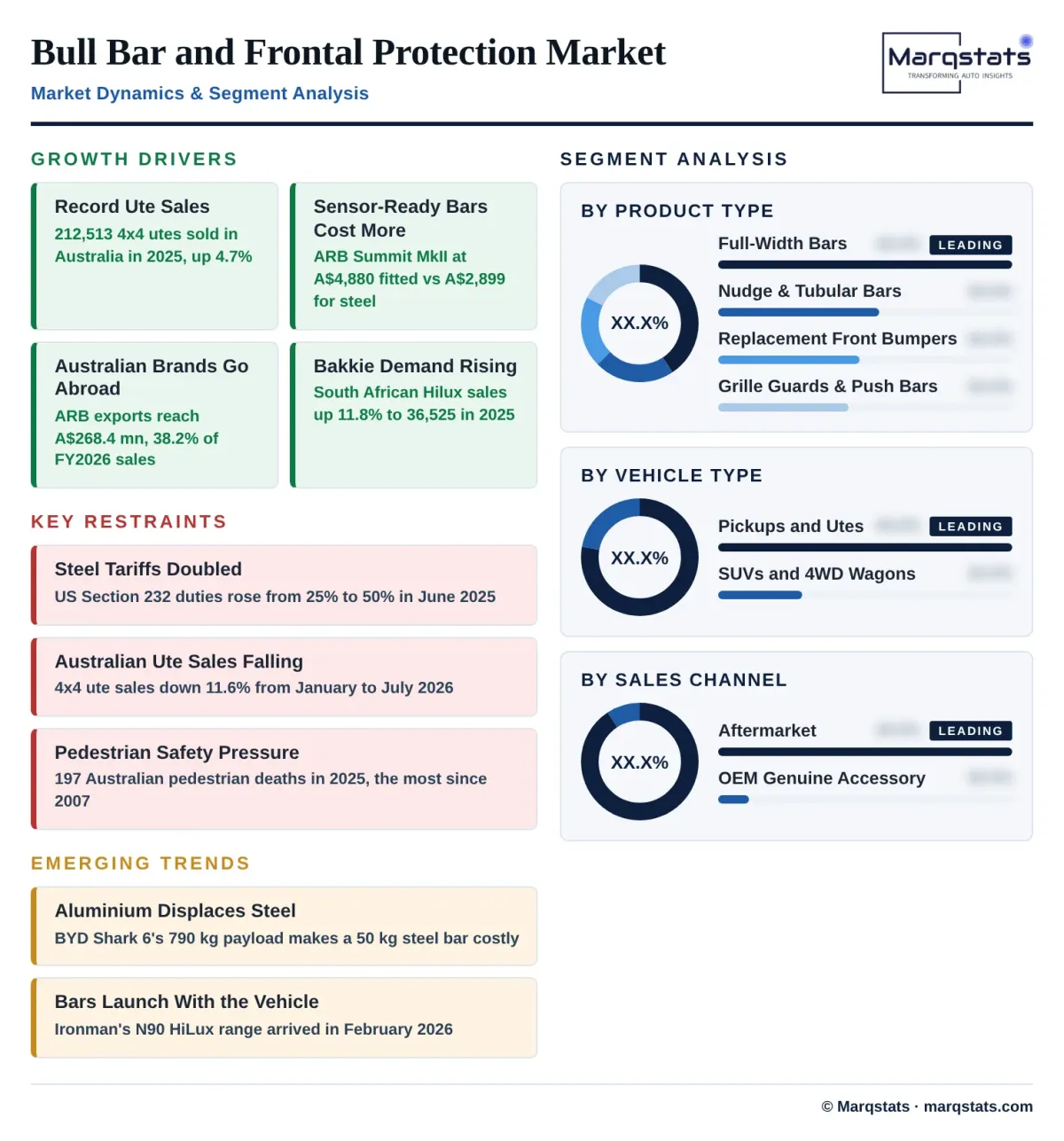
- Ute and pickup sales holding at record levels in the core markets. Australia sold 212,513 4x4 utes in 2025, up 4.7%, and Ford F-Series sales in the United States rose 8.3% to 828,832, with Ford Super Duty recording its best year since 2004.
- Sensor integration raising the price of a compliant bar. The ARB Summit MkII for the 2026 HiLux costs A$4,880 fitted against A$2,899 for a conventional steel deluxe bar on the Next-Gen Ranger, and the difference reflects engineering content rather than steel.
- Australian specialists exporting the full-bar culture to new markets. ARB export sales reached A$268.4 million in FY2026, 38.2% of its total, and its US Performance Vehicle Program for Toyota dealers began in April 2026, extending the Australian product into an established dealer channel.
- South African bakkie demand growing faster than in any other covered region. Toyota Hilux sales rose 11.8% to 36,525 in 2025 and Isuzu D-Max sales 11.7% to 21,194, while total new vehicle sales reached 596,818, up 15.7%.
- Automaker demand for genuine-accessory revenue under the factory warranty. Ford backs ARB accessories for Ranger and Everest under its warranty, while BYD distributor EVDirect sells factory-backed Ironman 4X4 bars for the Shark 6 under a 6-year, 150,000 km warranty. ARB also won two new US OEM contracts in FY2026, widening the licensed-supply model beyond Australia.
Key Restraints
The restraints on the bull bar market are concrete, comprising tariffs on raw material, regulation of the product and volatile vehicle sales in the markets that carry most of the value.
- US tariffs raising the cost of steel and aluminium bars. Section 232 duties on steel and aluminium rose from 25% to 50% on 4 June 2025 under Proclamation 10947, and a 25% auto-parts tariff covering bumpers took effect on 3 May 2025.
- Falling Australian ute sales through the first eight months of 2026. Sales of 4x4 utes dropped 11.6% to 110,858 between January and July 2026 and 27.1% in August alone, removing first-fit opportunities even as fitment per vehicle rises.
- Pedestrian safety pressure building in the largest value market. Australia recorded 197 pedestrian deaths in 2025, the highest since 2007, and simulations cited by the University of Melbourne show that bars raise head-impact speed by about 23% at 30 km/h.
- OEM channel volatility linked to the timing of automaker programs. ARB original-equipment sales fell 38.2% in the first half of FY2026 and 27.2% for the full year to A$43.4 million, after automakers had built up inventory in the prior half.
Key Trends
The trends in the bull bar market point toward lighter materials, earlier launches and greater ownership concentration among accessory groups.
- Steel losing ground to aluminium and polyethylene on heavier vehicles. Ironman 4X4 sells an aluminium Raid MKII bar at 55 kg and Toyota offers aluminium nudge bars on the HiLux, while the 790 kg payload of the BYD Shark 6 makes every kilogram a design decision.
- Bars launching within months of the vehicle they protect. Ironman released its N90 HiLux range in February 2026 and ARB its Kia Tasman range in November 2025, in each case within months of the vehicle reaching showrooms.
- US accessory brands consolidating under financial and industrial owners. Bestop bought Smittybilt from Wheel Pros in August 2026 and RealTruck closed a US$300 million refinancing in April 2026, while LCI Industries has owned Ranch Hand since 2021.
- Australian groups building their own overseas distribution and retail operations. ARB lifted its Off Road Warehouse stake from 30% to 50% for A$25.0 million in FY2025, opened a wholly owned Chinese subsidiary in FY2026 and is opening a South African warehouse in the first half of FY2027.
Strategic Implications
- Premium product rather than volume for North American entrants. At an estimated fitment rate of 4.5 bars per 100 new pickups the region already buys 201,325 bars a year, and the gain lies in selling a validated, sensor-compatible bar at Australian prices to off-road SUV and mid-size pickup buyers, the route ARB is taking through Toyota dealers.
- Validation capacity as the defensive asset for Australian incumbents. Sensor compatibility, crash testing and fast bracket engineering for each new model now determine which supplier sells the first bars on a new ute, and the July 2026 HiLux recall shows the cost when a new-model bar ships with a fault.
- Genuine bars worth owning but not worth building for automaker accessory teams. The channel grows from 9.34% to 10.68% of value by 2030, but the FY2026 swing in ARB original-equipment sales shows that licensing a specialist under the factory warranty transfers program risk, while in-house bars retain it.
- Separation of bar demand from ute sales for distributors and investors. In Australia the two moved in opposite directions in 2026, and in the European Union the binding constraint is type approval rather than demand, so revenue there follows approvals rather than vehicle registrations.
Market Segmentation
Full-width bull bars form the largest segment and set prices across the market, comprising steel, aluminium or polyethylene bars that protect the radiator, lights and front structure against animal strikes. The segment accounts for USD 142.40 million in 2025, 40.54% of value, and grows at a 5.08% CAGR to USD 182.42 million, 41.60% of value, by 2030. Almost all of this value derives from Australian and New Zealand demand, which is why the segment carries the sensor-integration premium. ARB Corporation Limited, Ironman 4X4 Pty Ltd, TJM Products Pty Ltd, MSA 4X4 Accessories Pty Ltd and Offroad Animal Pty Ltd compete for the segment alongside Toyota and Isuzu genuine bars.
Nudge bars and tubular bars are the entry product of the bull bar market, lighter designs that protect the lower grille and carry lights without full-width coverage. The segment is worth USD 77.74 million in 2025, 22.13% of value, and grows most slowly of the four product types, at 2.66% a year, to USD 88.64 million and 20.21% of value by 2030. The segment dominates unit counts in Thailand, Brazil and Argentina, where the quebra-mato is the common form, and in the United Kingdom, where type approval rules out full-width steel designs. Tubular bull bars in the United States are offered by Westin Automotive Products, Inc. at prices starting from USD 328, well below full-width designs.
Replacement front bumpers are the fastest-growing segment, carried by North American off-road SUV and mid-size pickup buyers who require a winch mount and an open approach angle. The segment is worth USD 68.30 million in 2025, 19.45% of value, and grows at 6.36% a year to USD 92.95 million, 21.20% of value, by 2030. The principal suppliers in the segment include Warn Industries, Inc., which owns Fab Fours, Bestop Premium Accessories Group through Smittybilt, Rough Country, LLC and LCI Industries through its Ranch Hand bumpers, priced from USD 1,745 to USD 2,073 on a Ford F-150.
Grille guards and push bars are the North American work-truck product, sold to ranchers, utilities and fleet operators that require headlamp and grille protection on full-size pickups. The segment is worth USD 62.81 million in 2025, 17.88% of value, and grows at 3.48% a year to USD 74.52 million, 16.99% of value, by 2030. Ranch Hand sells its Legend grille guard at USD 976.95 and Westin its HDX grille guard for the F-150 at USD 1,149.99, while RealTruck, Inc. competes through its Go Rhino and N-Fab brands in the same category. Growth trails the wider market because fleets purchase on price and tariffs have raised steel costs.
Pickups and utes form the foundation of the bull bar market, as the vehicle class for which bars are most often designed and the one purchased for work. The class accounts for 292,271 bars and USD 272.98 million in 2025, 77.72% of value, and reaches 311,265 bars and USD 341.20 million, 77.81% of value, by 2030, a value CAGR of 4.56%. The Ford Ranger, Toyota HiLux, Isuzu D-Max and BYD Shark 6 set Australian volume, while the Ford F-Series, Chevrolet Silverado and Ram set the North American base.
SUVs and 4WD wagons form the premium tail of the market, with fewer bars but frequently the highest-priced designs, fitted to vehicles such as the Toyota LandCruiser 300 and 70 Series, Nissan Patrol, Jeep Wrangler and Ford Bronco. The class accounts for 80,508 bars and USD 78.27 million in 2025, 22.28% of value, and grows at 4.46% a year to 84,581 bars and USD 97.33 million, 22.19% of value, by 2030. The upper-large Australian wagon carries the highest fitment rate in the market, at an estimated 55 bars per 100 new vehicles.
The aftermarket accounts for the great majority of the bull bar market, spanning specialist chains, independent fitters, online retailers and dealer-fitted bars sold under the supplier's own brand. The channel accounts for USD 318.43 million in 2025, 90.66% of value, and grows at 4.23% a year to USD 391.68 million, 89.32% of value, by 2030. Fitting capacity rather than demand is the binding constraint, which ARB cited as a limit in the first half of FY2026, and its own network has grown to 80 stores, 33 of them company-owned.
The OEM genuine-accessory channel is small and uneven but grows faster than the market, covering bars sold through new-vehicle dealers that are either built by the automaker or licensed to a specialist under the factory warranty. The channel is worth USD 32.82 million in 2025, 9.34% of value, and grows at 7.38% a year to USD 46.85 million, 10.68% of value, by 2030. Growth at that rate depends on new US OEM programs offsetting the program gaps that reduced ARB original-equipment sales to A$43.4 million in FY2026.
By Geography
Australia and New Zealand
Australia and New Zealand form the region in which the bull bar is a mainstream product, designed for kangaroo strikes and sold to half of all work-ute buyers. The region fits 120,638 bars in 2025 worth USD 173.24 million, 49.32% of value, rising to 123,685 bars and USD 216.09 million, 49.28% of value, by 2030, a 4.52% CAGR. Unit growth is limited to 0.50% a year because ute sales are falling in 2026, so nearly all regional growth comes from price. AS 4876.1-2002 and state technical specifications define what constitutes a legal bar, which gives local specialists such as ARB, Ironman 4X4, TJM and Offroad Animal a home-market advantage.
United States and Canada
The United States and Canada form the volume region of the bull bar market without the Australian fitment culture, with 3,786,994 eligible vehicles in 2025 and the highest bar count, at 201,325, sold at a lower average price. The region is worth USD 157.03 million in 2025, 44.71% of value, and USD 196.11 million by 2030, 44.72% of value, a 4.55% CAGR on unit growth of 1.50% a year. SEMA reports US specialty-equipment sales of USD 52.92 billion in 2025, with pickups accounting for 30%, so the bar is a small line within a large accessory budget. Section 232 tariffs on steel and auto parts add cost to every imported bar.
South Africa
South Africa is the fastest-growing region, a bakkie market whose farm and rural demand resembles that of Australia and which is supported by a strong local distribution base. The region fits 17,474 bars in 2025 worth USD 11.36 million, 3.23% of value, rising to 21,260 bars and USD 16.02 million, 3.65% of value, by 2030, a 7.12% CAGR. Data from the National Association of Automobile Manufacturers of South Africa (naamsa) show 2025 Hilux sales up 11.8% and D-Max sales up 11.7%. Piak bars for the Ranger list at R34,995 through Opposite Lock, and ARB is opening a wholly owned South African warehouse in the first half of FY2027.
Thailand
Thailand functions as a manufacturing base for bull bars more than as a consumption market, having produced 893,921 one-ton pickups in 2025 and exported 728,219, with ARB and Aeroklas, the owner of TJM, both manufacturing in the country. Domestic demand is small and contracting, at 15,897 bars in 2025 worth USD 5.09 million, 1.45% of value, falling to 14,369 bars and USD 5.08 million, 1.16% of value, by 2030, with value broadly flat at a 0.04% annual decline. One-ton pickup sales fell 12.0% to 143,817 in 2025, excluding pickup passenger vehicles, according to Toyota Motor Thailand.
Brazil and Argentina
Brazil and Argentina form a nudge-bar market in which the quebra-mato is the common form and prices are low, while Brazilian supply is governed by CONTRAN Resolution No. 215, which restricts it to manufacturers registered with INMETRO. The two countries fit 15,953 bars in 2025 worth USD 3.19 million, 0.91% of value, rising to 18,493 bars and USD 4.08 million, 0.93% of value, by 2030, a 5.04% CAGR. The Toyota Hilux led Brazilian mid-size pickup sales in 2025 with 49,732 units and was the best-selling model of any type in Argentina, with 30,768 registrations reported by the Asociación de Concesionarios de Automotores de la República Argentina (ACARA).
United Kingdom
The United Kingdom illustrates the effect of type approval on the bull bar market, with 37,308 pickups registered in 2025 but only 1,492 bars fitted, worth USD 1.34 million or 0.38% of value. Value declines 3.01% a year to USD 1.15 million, 0.26% of value, by 2030, as unit demand falls 4.99% a year. The Society of Motor Manufacturers and Traders (SMMT) reports that pickup registrations fell 20.2% in October 2025 and 34.8% in November after double-cab pickups began to be taxed as cars, and GB type approval under retained Regulation 78/2009 limits the product to approved nudge bars and replacement bumpers.
How Competition Is Evolving
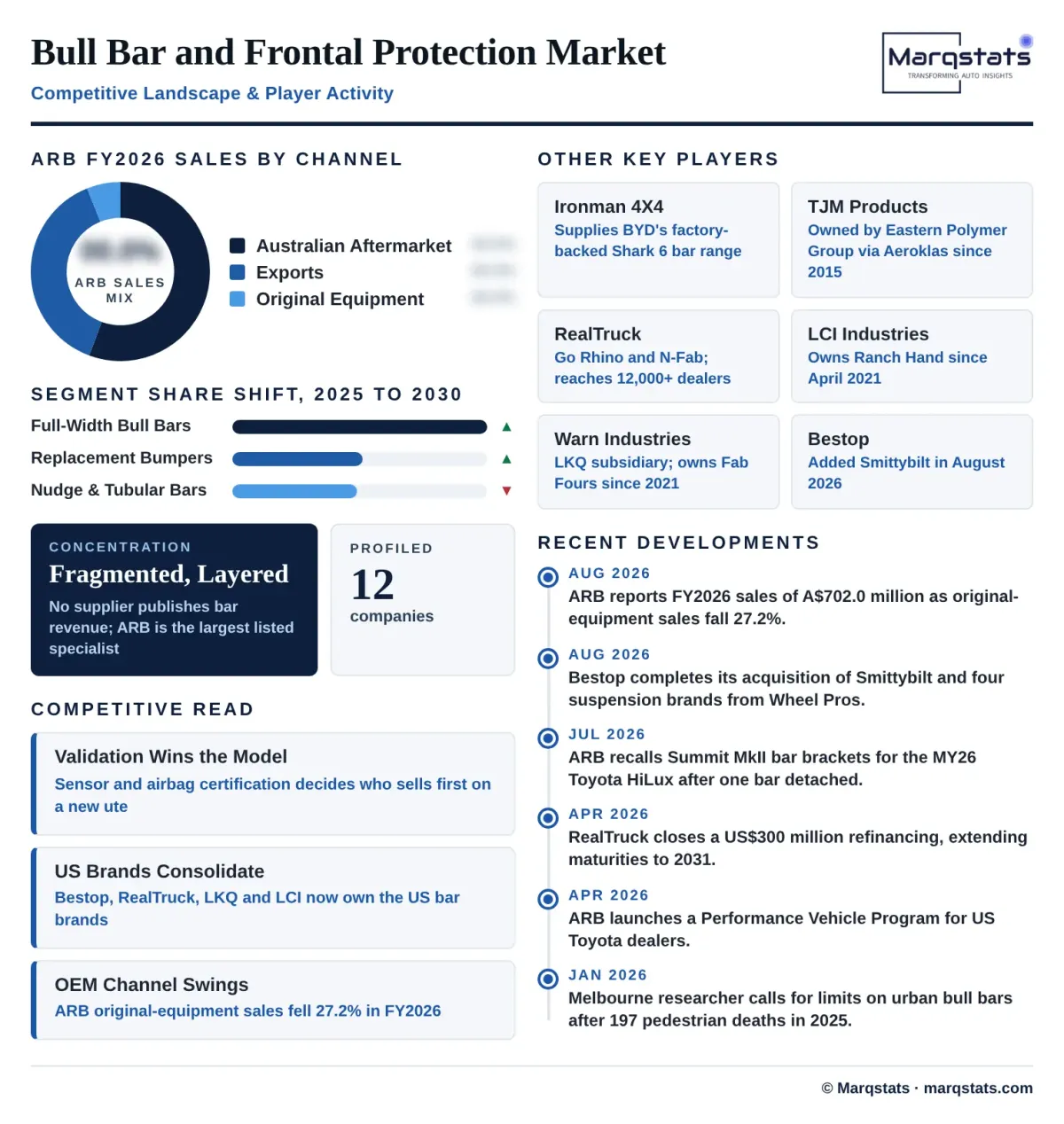
The bull bar market is fragmented, and no supplier publishes revenue for bars specifically. ARB Corporation Limited is the largest listed specialist, with FY2026 sales of A$702.0 million across all accessories, of which A$390.1 million came from the Australian aftermarket, A$268.4 million from exports and A$43.4 million from original equipment, although the company does not disclose the bar share. Below it sits a layer of Australian specialists comprising Ironman 4X4, TJM Products, MSA 4X4 Accessories, Offroad Animal and Dobinsons, alongside a separate North American layer of accessory groups owned by financial or industrial parents. Because supplier shares could not be sourced, competition is described by layer and by dated action rather than by ranking, and the market is classified as fragmented.
Suppliers compete on validation, fitting capacity and automaker relationships more than on steel price. A bar that is certified for airbag deployment and sensor compatibility on a new model, and is available within months of launch, wins the early buyers. ARB holds the Ford licensed accessory program for Ranger and Everest, Ironman 4X4 supplies the BYD factory-backed Shark 6 range and Toyota sells its own bars through dealers. In North America competition turns on distribution, with RealTruck reaching more than 12,000 dealers from 78 facilities while ARB now co-owns the Off Road Warehouse retail chain.
Ownership is concentrating even as the product market remains fragmented. Eastern Polymer Group, through Aeroklas, has owned TJM Products since 2015, and LCI Industries has owned Ranch Hand since April 2021 and ARIES through its CURT subsidiary. Warn Industries, an LKQ Corporation subsidiary since 2017, has owned Fab Fours since August 2021. Bestop, a Kinderhook Industries company, added Smittybilt in August 2026, and RealTruck, which owns Go Rhino and N-Fab, refinanced US$300 million in April 2026 to fund product development and acquisitions. ARB raised its Off Road Warehouse stake to 50% in FY2025 to fund the purchase of 4 Wheel Parts by that chain.
Companies Covered
Companies covered in the report include:
Recent Market Activity
Table of Contents
Coverage & Segmentation
The bull bar market analysis covers frontal protection for light vehicles in nine markets grouped into six regions, comprising Australia and New Zealand, the United States and Canada, Brazil and Argentina, South Africa, Thailand and the United Kingdom. The base year is 2025, the historical period runs from 2021 to 2025 and the forecast period from 2026 to 2030. Value is expressed in USD million at the end-user price excluding sales tax and fitting labour, converted at constant 2025 average rates of USD 0.6449 per Australian dollar from the Australian Taxation Office calendar-year table, 17.8782 rand and 5.5891 reais per US dollar from Federal Reserve data and 32.87 baht per US dollar derived from the Australian Taxation Office table. Volume is expressed in bars, and segmentation covers product type across four segments, vehicle type across two and sales channel across two.
India and China are excluded because fitment is prohibited, and the European Union is excluded because no 2025 pickup registration series from a permitted source was available, while the Gulf states, Mexico, Japan, Indonesia and the Philippines are excluded for the same absence of a verifiable 2025 vehicle base. Rear bars, side steps, standalone winches and lighting, standard-fit factory bumpers and medium and heavy truck bars fall outside the measure. Twelve suppliers are profiled across the Australian specialist layer and the North American accessory groups.