Market Snapshot
Key Takeaways
Market Overview & Analysis
Report Summary
The electric heavy-duty truck market comprises battery-electric and hydrogen fuel-cell freight trucks above 15 tonnes gross vehicle weight, corresponding to the heavy-freight-truck class and broadly equivalent to Class 8. The 2025 market of about 230,000 units and USD 38.50 billion spans rigid trucks, tractor-trailers, tippers and mixers, and vocational trucks used across urban and regional distribution, long-haul freight, port and drayage, and construction and mining. The market is sized by both unit volume and value, reflecting that Chinese and Western trucks differ sharply in price and that battery cost is the dominant vehicle-value component.
The underlying inflection is unusually steep. Global electric heavy-freight-truck sales rose about 174% in 2025 to roughly 230,000 units, and total electric truck sales including medium trucks exceeded 400,000, about double the prior year and 9% of truck sales. China took more than 90% of global volume, its electric heavy-truck penetration reaching about 22% in the first half of 2025, 28% by August, and about 46% for the full year, with monthly new-energy heavy-truck registrations exceeding half of the market by December. Around 40% of Chinese deployments are battery-swap capable, so plug-in charging and swapping operate as parallel refuelling pathways in that market.
China's dominance reflects cost, policy, and infrastructure advantages. Battery-electric heavy trucks in China reach total-cost parity with diesel earlier than elsewhere, supported by low-cost lithium iron phosphate batteries, standardized swappable packs such as those built around large commercial cell modules, government incentives, and dense industrial and port routes. Nine Chinese manufacturers account for roughly 80% of global electric-truck volume, and Chinese makers now export heavy electric trucks to Italy, Poland, Spain, Mexico, and beyond, extending Chinese scale into Western and emerging markets. A phase-out of national trade-in subsidies and anticipation of new purchase-tax costs in 2026 pulled some Chinese demand forward into late 2025, yet the underlying growth rests on lower total cost of ownership rather than incentives alone, indicating durable demand as the market matures.
Western markets are early yet structurally distinct. Fewer than 1% of heavy trucks are electric across the United States, Europe, and India, against about 22% in China, reflecting high upfront prices, charging gaps, and fragmented ownership. Volvo Trucks is the foremost Western manufacturer, having delivered about 5,000 electric trucks across 50 countries, and Daimler Truck's eActros 600 long-haul model, with a 500-kilometre range on a 600-kilowatt-hour lithium iron phosphate battery, anchors European long-haul electrification, supported by orders such as more than 200 units for a major logistics operator across the United Kingdom and Germany. In the United States, Tesla began mass production of its Semi at a dedicated Nevada facility with 50,000-unit annual capacity, projecting 5,000 to 15,000 deliveries in 2026.
Range is expanding rapidly, opening long-haul segments. The average declared range of available heavy-freight-truck models neared 310 kilometres in 2025, and manufacturers are pushing well beyond it: Volvo and Renault target 600-kilometre models in 2026, Sany already offers a heavy truck exceeding 800 kilometres on a single charge, and Tesla targets 800-kilometre deliveries in 2026. Because roughly two-thirds of European long-haul journeys fall under 500 kilometres, current and near-term ranges already address the majority of predictable, high-mileage routes where electrification economics are strongest, accelerating fleet adoption on planned corridors. The pairing of longer ranges with megawatt charging, which can add substantial range in a driver's mandatory rest break, progressively removes the last operational barrier to long-haul battery-electric trucking on major freight corridors.
Market Dynamics
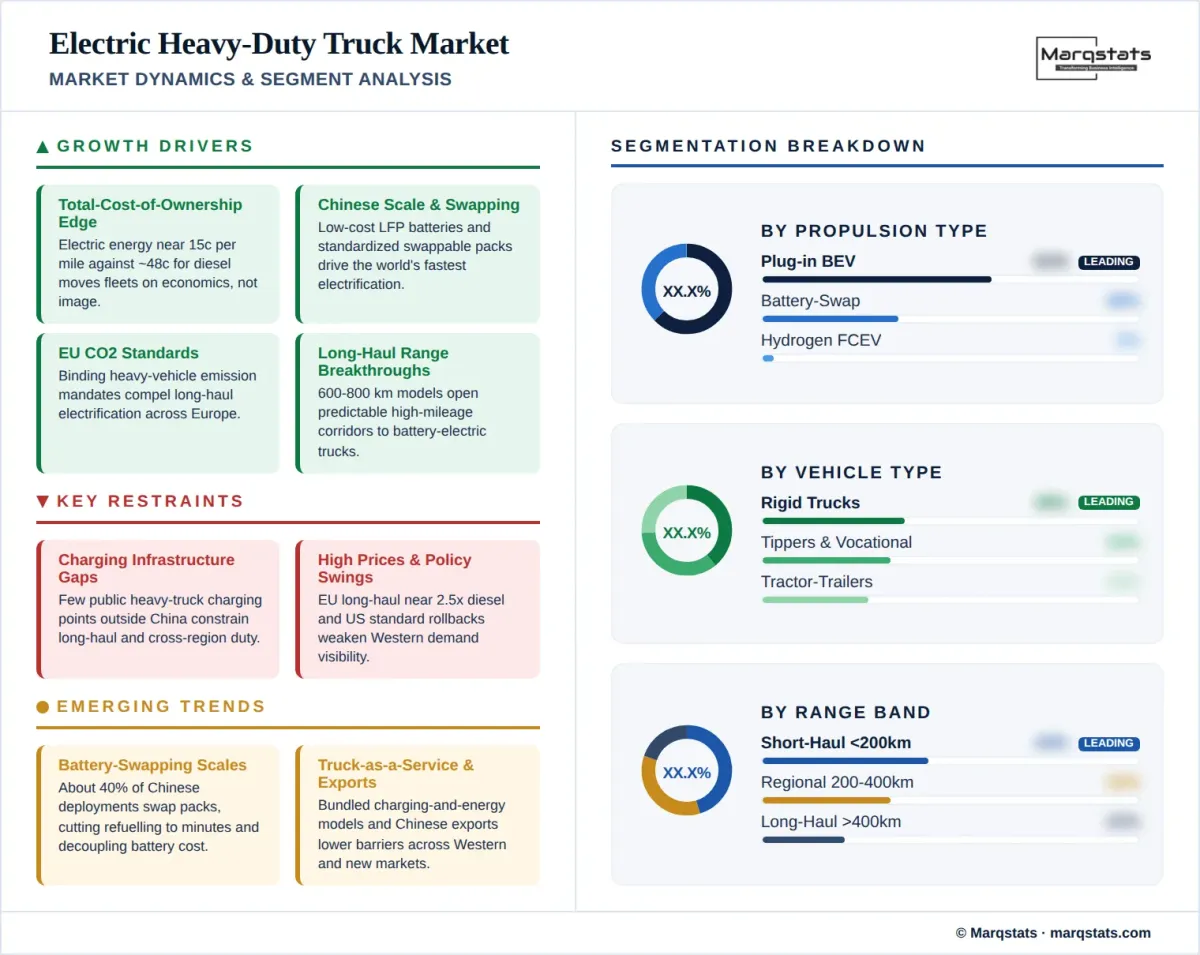
Key Drivers
- Total-cost-of-ownership advantage, with electric-truck energy costs near 15 US cents per mile against about 48 cents for diesel, moves fleets on economics.
- Chinese scale, low-cost lithium iron phosphate batteries, and standardized swappable packs drive the world's fastest heavy-truck electrification.
- European carbon-dioxide standards for heavy vehicles mandate steep emission reductions, compelling long-haul electrification across the region.
- Long-haul range breakthroughs beyond 600 kilometres open predictable high-mileage corridors to battery-electric trucks.
- Falling battery prices and improving energy density lower purchase price and raise payload and range across models.
- Fleet decarbonization commitments and shipper sustainability requirements pull demand on defined, high-utilization routes.
Key Restraints
- Charging infrastructure gaps, with few public heavy-truck charging points outside China, constrain long-haul and cross-region operations.
- High upfront prices, with European electric long-haul trucks around 2.5 times their diesel equivalents, slow adoption without support.
- Uneven and shifting policy support, including United States climate-standard rollbacks, weakens Western demand visibility.
- Fragmented fleet ownership and residual-value uncertainty complicate financing and total-cost calculations for small operators.
Key Trends
- Battery-swapping scales in China to about 40% of deployments, cutting refuelling to minutes and decoupling battery cost from the truck.
- Truck-as-a-service and bundled charging-and-energy models remove upfront capital barriers for Western fleets.
- Chinese manufacturers expand exports and local assembly across Europe, Latin America, and Southeast Asia.
- Long-haul model launches beyond 600 kilometres and megawatt-charging compatibility extend the electrifiable route base.
Market Segmentation
Battery-electric trucks dominate the market at about 97% of electric heavy-truck volume, spanning plug-in charging and battery-swapping variants. Falling lithium iron phosphate battery costs, improving range, and total-cost parity with diesel make battery-electric the default technology across China, Europe, and North America. The segment anchors the overwhelming majority of market volume and value throughout the forecast period, with range and charging speed the primary differentiators.
Battery-swap electric trucks are a distinct and fast-growing pathway concentrated in China, reaching about 40% of Chinese deployments. Standardized swappable packs built around large commercial cell modules allow refuelling in minutes and decouple battery ownership from the truck, improving uptime for high-utilization construction, mining, and port fleets. The model is largely China-specific and shapes the country's dominant position, with limited near-term adoption elsewhere.
Hydrogen fuel-cell heavy trucks remain a small niche within the market, positioned for long-haul and high-payload duty where battery weight and charging time are constraints. Limited hydrogen refuelling infrastructure and high cost restrain adoption, and fuel-cell trucks represent a minor share of volume across the forecast period, concentrated in demonstration fleets and specific long-haul and heavy-payload applications.
Rigid trucks are a large segment, widely used in urban and regional distribution where predictable routes and return-to-base operation suit current battery ranges. Manufacturers including Renault target urban logistics with rigid electric models, and the segment reaches electrification economics early on high-utilization city and regional duty, anchoring near-term volume in distribution applications.
Tractor-trailer semi trucks are the highest-value and fastest-growing segment, central to long-haul freight and the focus of flagship models including the Daimler eActros 600, Volvo FH Electric, Tesla Semi, and Sany and Windrose long-haul tractors. Rising range beyond 600 kilometres and megawatt charging open long-haul corridors to electric semis, and the segment concentrates the highest per-unit value and the strongest long-run growth. Because semi tractors carry the largest batteries and command the highest prices, they contribute disproportionately to market value even where unit volumes remain below rigid and vocational trucks, and Western manufacturers concentrate their flagship engineering and brand competition in this segment.
Tippers, mixers, and vocational trucks are a substantial segment led by China, where construction, mining, and industrial duty cycles with short, repeatable routes and heavy payloads suit battery-swap electric trucks. High utilization and return-to-site operation make these applications among the earliest to electrify economically, and Chinese manufacturers dominate the vocational electric-truck segment worldwide.
Short-haul trucks up to 200 kilometres serve urban distribution, port drayage, and vocational duty with frequent return-to-base charging, and reach electrification economics earliest given smaller batteries and predictable routes. The band anchors high-volume near-term adoption across distribution and industrial applications where dwell time supports depot charging.
Regional-haul trucks between 200 and 400 kilometres match the average declared range of available heavy-freight-truck models and suit regional distribution and shuttle operations. This band represents the current commercial core of European and North American electric-truck line-ups, balancing battery cost against route coverage for predictable regional duty.
Long-haul trucks above 400 kilometres are the fastest-growing range band, enabled by 600-kilometre and 800-kilometre models from Daimler, Volvo, Renault, Sany, and Tesla and by megawatt charging. Because most long-haul journeys fall under 500 kilometres, expanding ranges progressively address the majority of high-mileage routes, concentrating future value growth in long-haul-capable models.
Urban and regional distribution is the largest near-term application, with predictable routes, return-to-base charging, and high-mileage economics that favour electrification. Retail and parcel fleets deploy rigid and regional-haul electric trucks on planned routes, and the application anchors Western adoption where charging can be scheduled with certainty at depots.
Long-haul freight is the highest-value and fastest-growing application, addressed by expanding-range tractor-trailers and megawatt charging along corridors. Two-thirds of European long-haul journeys under 500 kilometres are already electrifiable, and fleet and mobility-as-a-service operators electrifying freight and logistics anchor demand on defined high-mileage routes.
Port, drayage, mining, and construction applications reach electrification economics earliest through short, repeatable, high-utilization routes. Chinese vocational and battery-swap trucks and Western port-drayage pilots concentrate here, and the high duty cycles of these operations make them among the most economically compelling early electric-truck applications worldwide.
By Geography
China
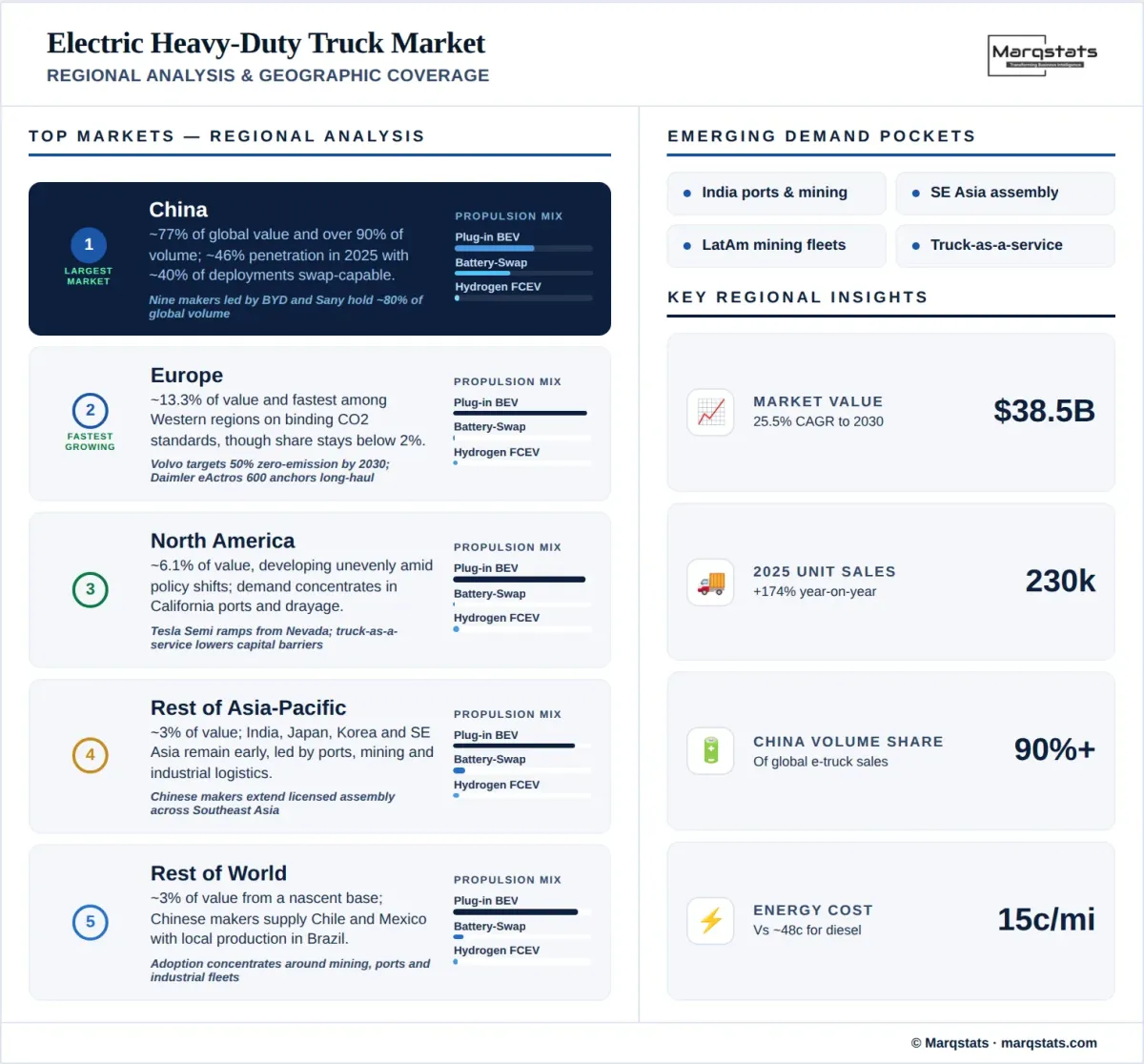
China is the world's dominant electric heavy-duty truck market, the core of Asia-Pacific's roughly 77% share of 2025 global value and more than 90% of global volume. Electric heavy-truck penetration reached about 46% for 2025, monthly new-energy heavy-truck registrations exceeded half the market by December, and around 40% of deployments are battery-swap capable. BYD and Sany lead a group of nine manufacturers accounting for roughly 80% of global volume, supported by low-cost lithium iron phosphate batteries, standardized swappable packs, government incentives, and dense industrial, port, and mining routes. China both dominates domestic demand and exports heavy electric trucks aggressively into Western and emerging markets.
Europe
Europe is the foremost regulation-driven market outside China, contributing about 13.3% of 2025 global value and growing fastest among Western regions on binding carbon-dioxide standards for heavy vehicles. European electric truck sales grew about 40% in 2025, yet the electric heavy-truck share remained below 2%, indicating early adoption against a large diesel base. Volvo Trucks leads regionally and targets 50% zero-emission truck sales by 2030, Daimler's eActros 600 anchors long-haul at 500 kilometres, and Renault and Scania expand regional and long-haul line-ups. High upfront prices around 2.5 times diesel and charging gaps restrain the market, while carbon standards and range growth accelerate it. European carbon-dioxide standards require steep fleet-average emission reductions across the coming decade, and because roughly two-thirds of European long-haul journeys fall under 500 kilometres, the region's electrifiable route base is already large, positioning Europe as the strongest Western growth market through 2030.
North America
North America contributes about 6.1% of 2025 global value, developing unevenly amid shifting policy. Zero-emission medium- and heavy-duty truck registrations reached only about 0.56% of the United States market in 2024, and demand concentrates in California ports, drayage, and regional distribution. Tesla began mass production of its Semi at a Nevada facility with 50,000-unit annual capacity, projecting 5,000 to 15,000 deliveries in 2026, and dominated California voucher applications, while Daimler's Freightliner eCascadia, Volvo VNR Electric, and PACCAR models compete. Federal climate-standard rollbacks and incentive uncertainty weaken near-term demand visibility even as total-cost economics improve. Emerging truck-as-a-service and bundled charging-and-energy models, which package the vehicle, charging infrastructure, and energy supply into a single monthly payment, are lowering the capital barrier that has constrained North American fleet adoption, and drayage and port pilots continue to expand despite the policy headwinds.
Rest of Asia-Pacific
The rest of Asia-Pacific, including India, Japan, South Korea, and Southeast Asia, contributes about 3% of 2025 global value and remains early outside China. India recorded a small yet rising base concentrated around ports, mining, and industrial logistics, and Chinese manufacturers extend licensed assembly across Southeast Asia. The region is a long-run growth pool as freight electrification scales and Chinese and domestic manufacturers expand availability.
Rest of World
The rest of world, spanning Latin America, the Middle East, and Africa, contributes about 3% of 2025 global value from a nascent base. Chinese manufacturers supply fleets across Chile, Mexico, and other markets, and licensed local production has begun in Brazil, while adoption concentrates around mining, ports, and industrial logistics. Public data remain sparse, and the region advances gradually with Chinese imports, mining and port fleets, and early manufacturer entry.
How Competition Is Evolving
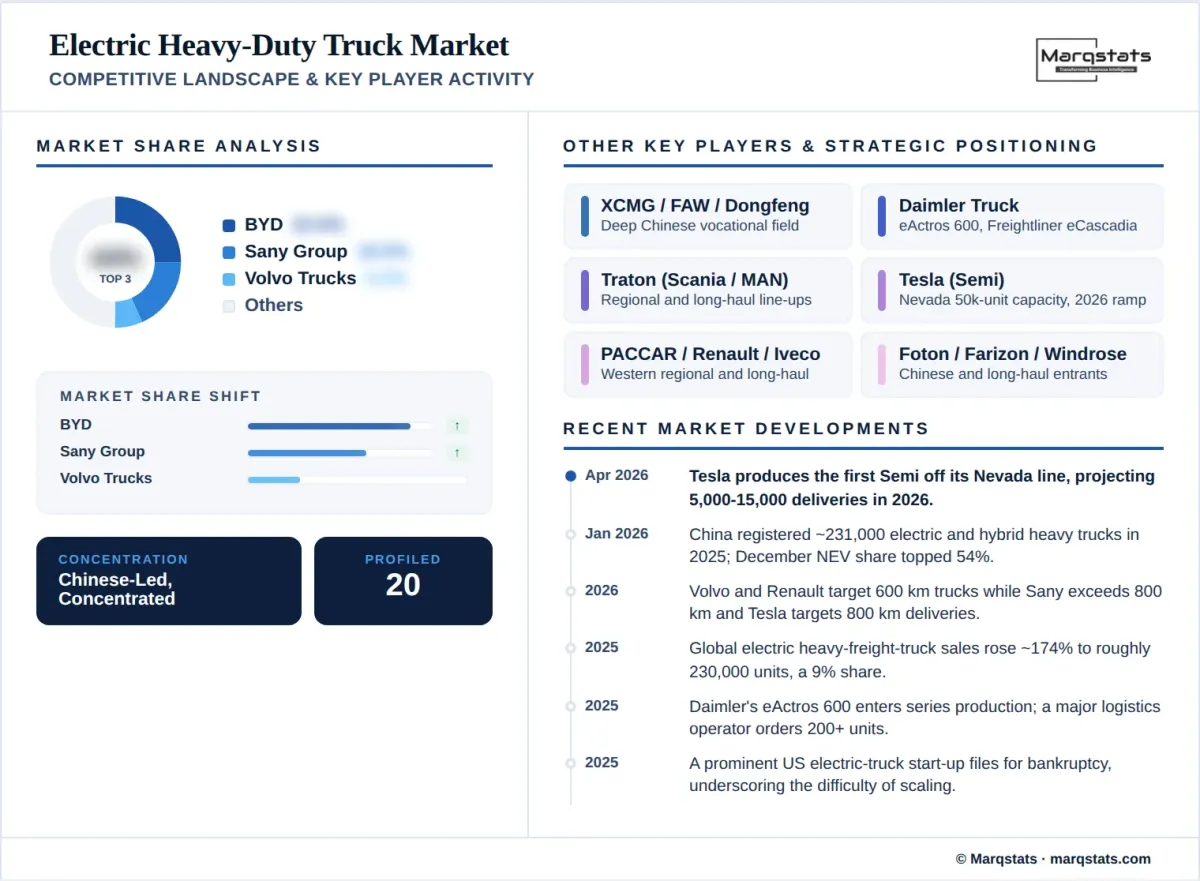
The electric heavy-duty truck market is led by Chinese manufacturers and contested by established Western truck makers, with more than 40 companies competing globally and a concentrated top group. Nine Chinese manufacturers account for roughly 80% of global electric-truck volume, and BYD and Sany lead the market, combining low-cost lithium iron phosphate batteries, battery-swapping, and vocational and long-haul models across construction, logistics, and tractor applications. XCMG, FAW Jiefang, Dongfeng, Foton, Geely's Farizon, and SAIC Hongyan complete a deep Chinese field that both dominates domestic demand and exports into Europe, Latin America, and Southeast Asia.
Western truck makers hold technology and brand strength yet small volumes. Volvo Trucks is the foremost Western manufacturer, having delivered about 5,000 electric trucks across 50 countries and targeting 50% zero-emission sales by 2030, and Daimler Truck anchors European long-haul with the eActros 600 and North American operations through Freightliner. Traton, spanning Scania, MAN, and International, and PACCAR, spanning Kenworth, Peterbilt, and DAF, alongside Renault Trucks and Iveco, expand regional and long-haul line-ups. Tesla entered volume production of its Semi in 2026 with a 50,000-unit Nevada capacity and strong California voucher demand, while Windrose targets long-haul semis positioned against Tesla.
Competition increasingly turns on range, total cost of ownership, and charging or swapping ecosystems rather than vehicle specification alone. Chinese makers compete on price, battery-swapping, and export scale; Western makers on range, brand, service networks, and regulatory-driven home demand; and new entrants on bundled truck-as-a-service and energy models. The bankruptcy of a prominent United States start-up underscored the difficulty of scaling without cost and infrastructure advantages, and positioning is measured through unit deliveries, model range, penetration, and export reach as the market scales toward 2030.
Companies Covered
The report profiles 20++ companies with full strategy and financials analysis, including:
Recent Market Activity
Table of Contents
Coverage & Segmentation
This report provides a comprehensive analysis of the global electric heavy-duty truck market covering the historical period 2021 to 2025 and the forecast period 2026 to 2030, with 2025 as the base year. The study defines electric heavy-duty trucks as battery-electric and hydrogen fuel-cell freight trucks above 15 tonnes gross vehicle weight, corresponding to the heavy-freight-truck class and broadly equivalent to Class 8, and covers rigid trucks, tractor-trailers, tippers and mixers, and vocational configurations. Medium-duty trucks below 15 tonnes, electric buses, vans, and light commercial vehicles are excluded and treated as adjacent markets. Market size is presented in both unit volume and value terms (USD), reflecting sharp price differences between Chinese and Western trucks.
The study segments the market by propulsion type, vehicle type, range, and application, and examines regional demand across China, Europe, North America, the rest of Asia-Pacific, and the rest of world, alongside cost, policy, range, charging, and competition. Market sizing is built bottom-up from regional unit sales and average selling prices, anchored to International Energy Agency data on electric-truck sales and penetration and to manufacturer disclosures, then aggregated to global volume and value. Because Chinese and Western trucks differ sharply in price, value is modeled by region and segment. The competitive section profiles 20 manufacturers spanning China, Europe, North America, and Asia.