Market Snapshot
Middle bar: base-year value × (1 + CAGR), rounded to two decimals. This is a calculated illustration, not a separately researched annual estimate.
Market Size (2025, Base Year): USD 100.52 Million
Estimated Value (2026): USD 132.65 Million
Forecast Value (2030): USD 329.75 Million
CAGR: 26.82% | Forecast Period: 2026 – 2030
Growth — Absolute: USD 229.23 Million
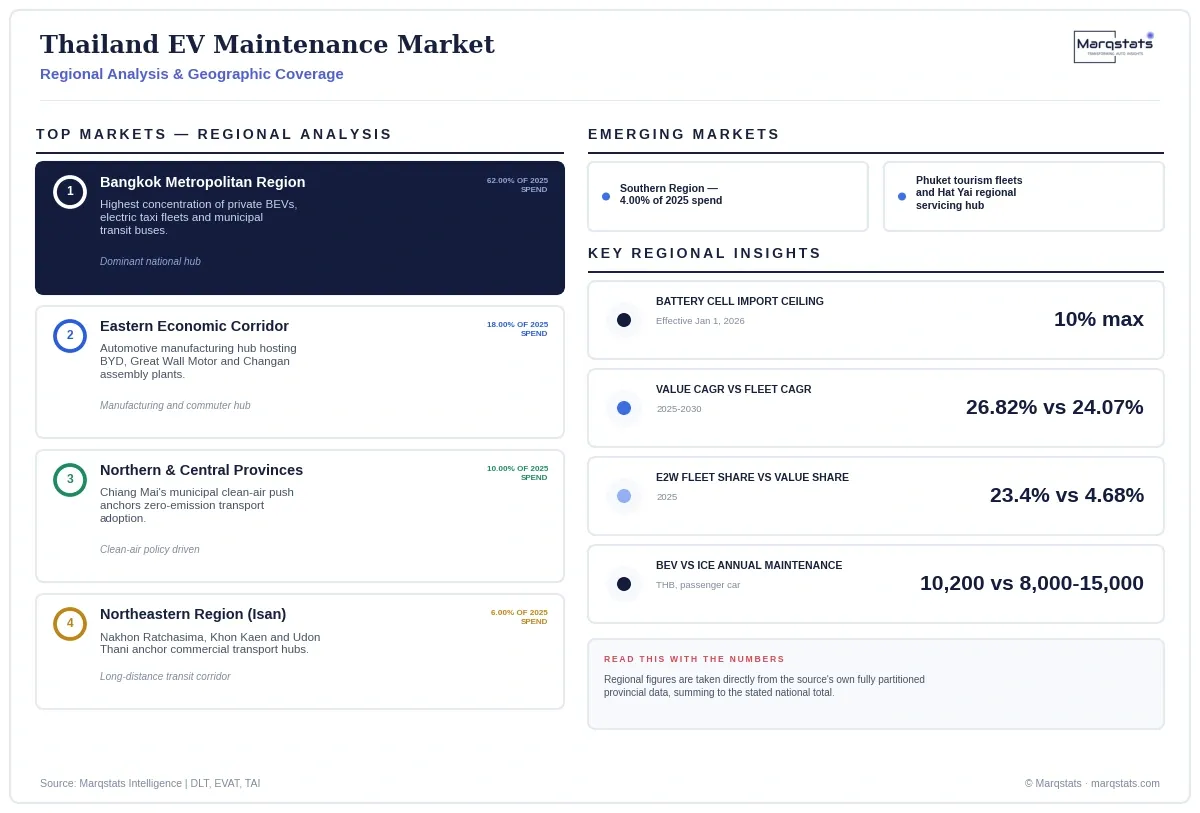
Largest Market: Bangkok Metropolitan Region (62.00% of 2025 maintenance spend)
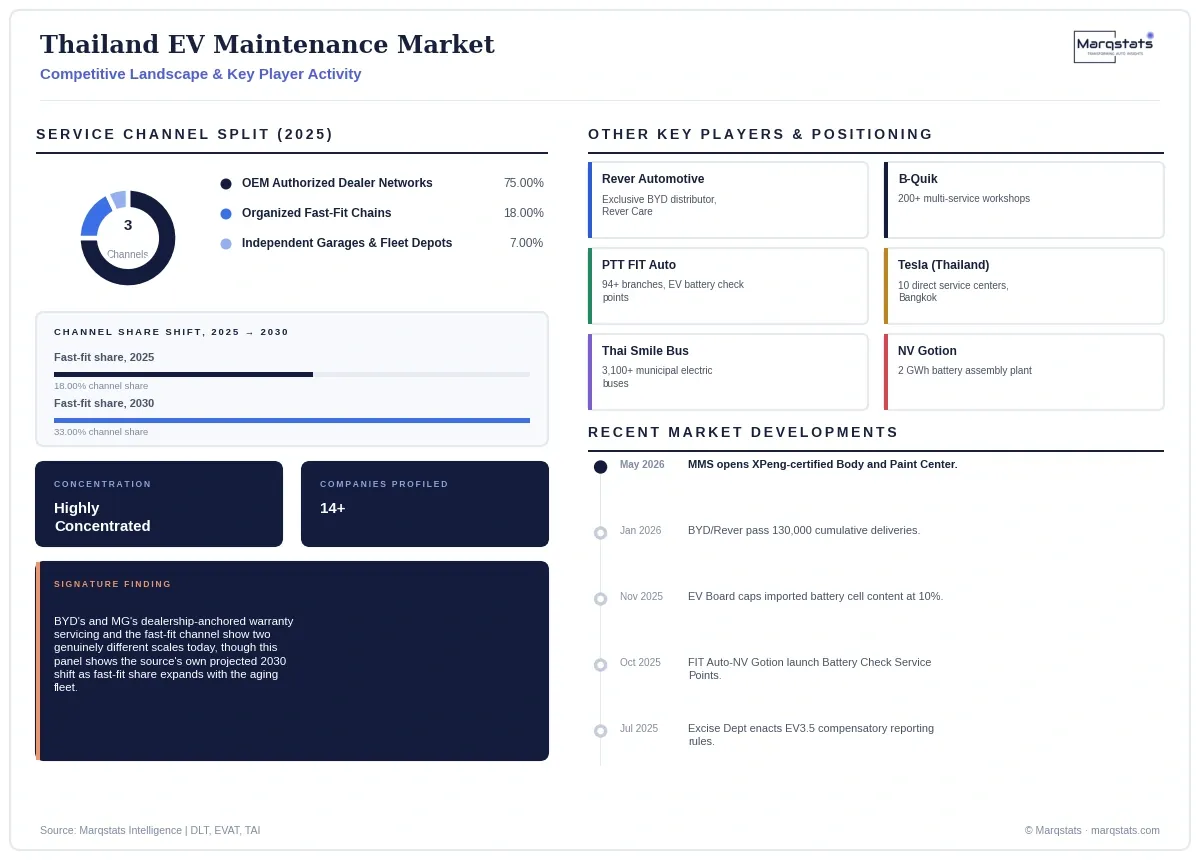
Fastest Growing: Organized Fast-Fit Chains (18.00% to 33.00% share, 2025-2030)
Dominant Segment: OEM Authorized Dealer Networks (75.00% channel share, 2025)
Market Concentration: Moderately Fragmented
Base Year: 2025 | Historical Period: 2021 – 2025 | Forecast Period: 2026 – 2030
Units Considered: Value (USD Million)
Segments Covered: 3 | Regions Covered: 5 | Companies Profiled: 14
Report Pages: 240 | Deliverables: PDF, Excel, PPT
Key Takeaways
Market Overview & Analysis
Report Summary
This analysis reads Thailand's own fully worked sizing chain, regional distribution data, and named-scenario regulatory framework together as a single coherent picture rather than isolated data points, since the underlying research itself was structured to support exactly that kind of integrated reading.
Thailand's EV maintenance market is measured across running gear and tires, routine inspection and fluids, powertrain and battery diagnostics, and low-voltage electrical servicing, valued at USD 100.52 million (THB 3,447.78 million) in 2025. This figure is taken directly from the underlying research's own fully worked sizing chain, anchored to Department of Land Transport registration data covering an active plug-in road fleet of 372,451 units across five vehicle categories.
Structurally, this is a market shaped by an industrial policy mechanism most consumers never encounter directly -- a battery cell localization tax rule -- layered on top of a conventional warranty-driven dealership-to-fast-fit-chain aftermarket transition, and a genuinely distinctive volume-versus-value split between electric two-wheelers and passenger BEVs.
The analysis is built for four reader types making different decisions: an independent workshop or fast-fit chain operator weighing EV tire and battery-diagnostic capacity investment, a battery cell manufacturer evaluating Eastern Economic Corridor assembly capacity, a franchised dealer group defending warranty-anchored revenue, and an investor tracking how Right-to-Repair policy and technician certification pace shape this market's scenario range.
A Tax Rule About Excise Revenue That Accidentally Fixed a Parts Problem
Most industrial localization policies are framed around protecting domestic manufacturing jobs. Thailand's battery cell rule was written for a narrower reason, and it's worth tracing the actual mechanism through to what it does for repair shops.
To keep the preferential 2% excise tax rate that makes their vehicles price-competitive, automakers must source at least 90% of battery cell content domestically, a ceiling that took effect January 1, 2026. Miss that threshold and the excise rate jumps to 10% -- a genuinely material cost automakers cannot absorb quietly. That single fiscal lever is why CATL, SVOLT, Gotion High-Tech, and CALB all established local battery pack assembly in the Eastern Economic Corridor. None of that investment was aimed at the aftermarket. But because replacement battery modules and pack components are now produced domestically rather than imported, collision and warranty repair wait times for Thai EV owners are structurally shorter than they would be otherwise -- a benefit created entirely by a policy never designed with the maintenance sector in mind.
A Fleet Where the Biggest Vehicle Count Isn't the Biggest Revenue Line
Electric two-wheelers are, by unit count, nearly as large a category as passenger BEVs in Thailand's active fleet. Their share of maintenance revenue tells a very different story, and it's worth understanding why.
With 87,151 units on the road in 2025 -- projected to reach 240,000 by 2030 -- electric two-wheelers are the second-largest vehicle category in this market by count, sustained by commercial battery-swapping networks serving Bangkok's food delivery and courier fleets. Yet they capture just 4.68% of 2025 maintenance value. The reason isn't low utilization -- these vehicles see intense daily use -- it's low per-unit service complexity: a drive belt, brake pads, and a 12V auxiliary swap cost a fraction of what a passenger BEV's tire, suspension, and battery-diagnostic servicing runs. Volume and value simply decouple here in a way they don't for the passenger car segment.
Market Dynamics
Key Drivers
- Thailand's food delivery and courier economy is directly sustaining electric two-wheeler battery-swapping network expansion, growing the fleet even as per-unit maintenance value remains modest relative to passenger vehicles.
- This market's own fully worked sizing chain shows running gear, suspension and EV tires already the single largest service category at 37.00% of total value, a structural signal that specialized tire inventory and suspension component capacity represent the most immediate revenue opportunity for workshops entering this market.
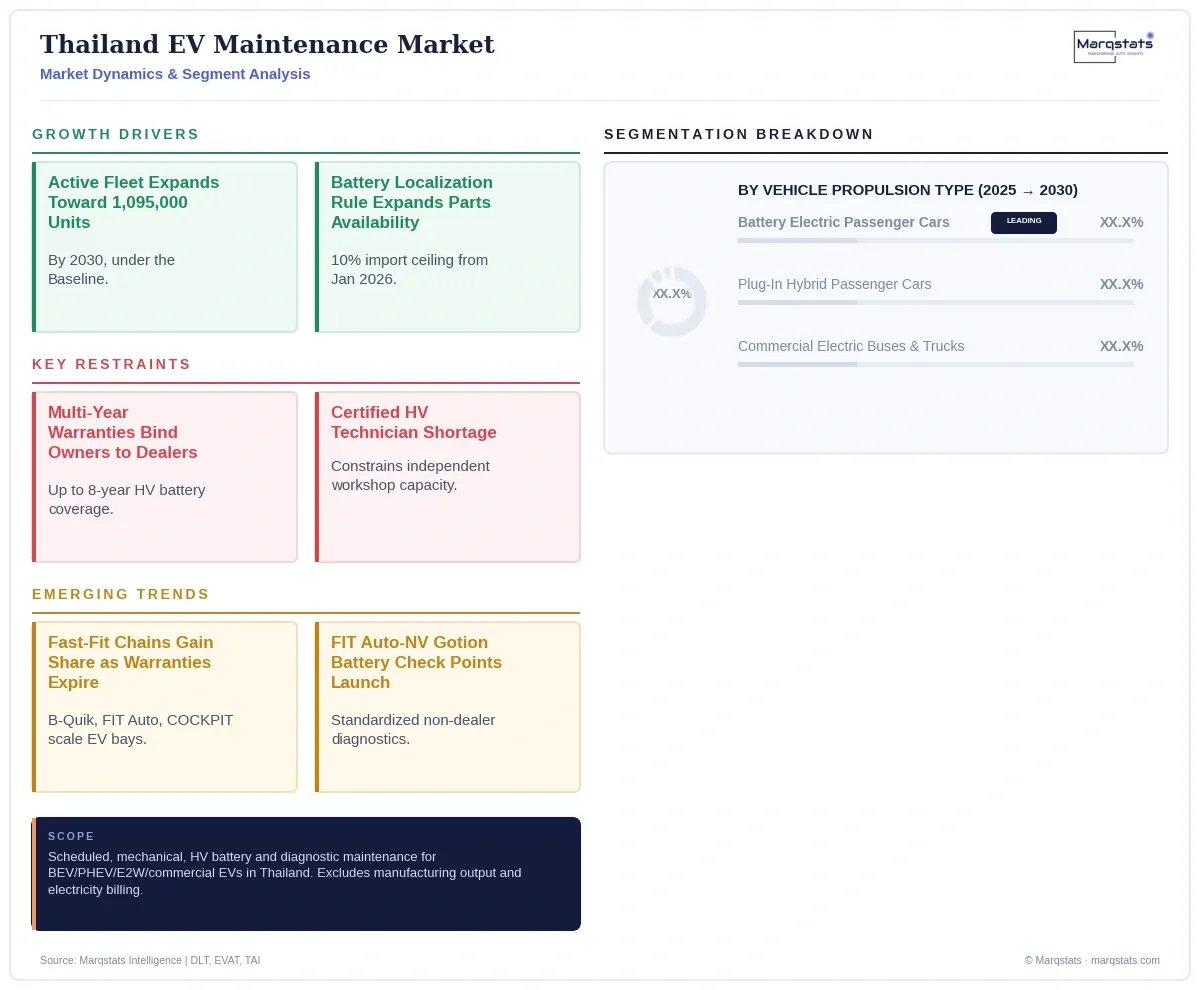
- Thailand's active plug-in fleet is expanding rapidly, from 372,451 units in 2025 toward a projected 1,095,000 units by 2030 under the Baseline Structural Trajectory, directly growing the addressable base for recurring EV aftermarket maintenance demand.
- The EV3.5 program's escalating domestic production offset ratios (1:2 in 2026, 1:3 in 2027) and the January 1, 2026 battery cell localization ceiling are directly pulling CATL, SVOLT, Gotion and CALB into Eastern Economic Corridor pack assembly, expanding domestic replacement-parts availability.
- Organized fast-fit chains -- B-Quik's 200-plus locations, PTT's 94-plus-location FIT Auto network, and Bridgestone's COCKPIT franchise -- are directly expanding dedicated EV tire and battery-diagnostic service bay capacity nationwide.
- The Department of Skill Development's EV-HRD initiative, targeting certification of 150,000 technicians through the Automotive Human Resource Development Academy, is directly expanding the national pool of qualified high-voltage repair labor.
- Aftermarket value expanding at a 26.82% CAGR against a slower 24.07% fleet CAGR is directly signaling that per-vehicle maintenance spend intensifies as the fleet matures into heavier out-of-warranty servicing cycles.
Key Restraints
- Multi-year manufacturer warranty lock-ins -- including BYD's 8-year/160,000 km coverage and MG's lifetime battery warranty for original buyers -- structurally bind owners to authorized dealer networks during the initial ownership cycle, directly constraining independent and fast-fit workshop volume.
- TIS 63056-2567's compulsory lithium battery safety standard directly restricts unauthorized third-party battery module swapping, setting a high regulatory threshold that independent workshops must clear before offering battery remanufacturing services.
- This market's own three-scenario framework spans a genuinely wide 2030 range, from USD 245.48 million under the Compensatory Default Scenario to USD 379.30 million under the Accelerated IAM Deregulation Scenario -- a disclosed spread reflecting real uncertainty in credit conditions and technician training pace, not a narrow band around a single central estimate.
- A shortage of certified high-voltage technicians directly constrains independent workshop capacity, since the national EV-HRD initiative's 150,000-technician target has not yet been met, leaving out-of-warranty servicing lead times elevated in several provinces.
Key Trends
- Battery cell manufacturers are directly building out Eastern Economic Corridor assembly capacity in response to the January 2026 localization ceiling, a trend that should continue reshaping domestic parts availability well beyond the current forecast window.
- Organized fast-fit chains are directly gaining share against franchised dealers, projected to expand from 18.00% to 33.00% of total market spend by 2030 as early warranty cohorts age out and B-Quik, FIT Auto and COCKPIT scale dedicated EV bays.
- PTT's FIT Auto partnership with NV Gotion and Nuovo Plus, launched in October 2025, is directly establishing standardized EV Battery Check Service Points across Bangkok and the Eastern Economic Corridor -- a model for non-dealer battery diagnostics.
- Commercial fleet operators are directly building centralized in-house maintenance depots, exemplified by Thai Smile Bus's more than 3,100-vehicle municipal bus fleet servicing infrastructure.
- Component suppliers are directly shifting product mix toward cabin filtration, specialized dielectric coolants, and heavy-duty EV-rated chassis components as conventional filtration and ignition inventory demand declines.
Strategic Implications
- Franchised dealers should also weight battery-diagnostic and thermal-loop parts inventory heavily nationwide, given how directly both categories anchor this market's fastest-growing service revenue line.
- Battery cell and component suppliers should prioritize Eastern Economic Corridor manufacturing footprint specifically, given how directly the localization ceiling ties market access to physical presence rather than import relationships alone.
- Independent aftermarket investors should avoid competing directly with franchised dealers for warranty-protected high-voltage powertrain repairs specifically, instead deploying capital toward specialized running-gear, tire fitment, and ADAS calibration networks positioned for the post-warranty volume wave.
- Incumbent multi-brand dealership operators should restructure service bay allocations specifically, investing in certified Class 0 PPE, insulated hydraulic lift tables, and battery module balancers to protect high-margin warranty servicing as pure ICE servicing demand declines.
- Component and tooling suppliers should prioritize domestic EV tire production and IEC 60900-compliant insulated diagnostic tooling specifically, given the high-margin commercial window to supply vocational institutes, dealership groups and fast-fit chains simultaneously.
- Investors and analysts should track Right-to-Repair mandate enactment timing and EV-HRD technician certification pace as the two clearest variables separating this market's Accelerated and Compensatory Bottleneck scenarios.
Outlook
The underlying research presents three genuinely distinct trajectories diverging on named regulatory and credit-market trigger conditions. This market's own forecast horizon reaches 2030 directly, requiring no Marqstats extrapolation.
Under the Baseline Structural Trajectory, the EV Board strictly enforces the EV3.5 offset schedule -- two domestic BEVs assembled for every imported CBU in 2026, three in 2027 -- while the 10% ceiling on imported battery cell value remains enforced; the active fleet reaches 1,095,000 units by 2030, generating USD 329.75 million (THB 11,310.30 million) in total market value at a 26.82% CAGR, with franchised dealers retaining 57% overall value share via 8-year warranty lock-in.
Under the Accelerated IAM Deregulation and Fleet Commercialization Scenario, the Ministry of Transport and DLT enact statutory Right-to-Repair mandates by late 2027, forcing OEMs to license CAN-bus diagnostic protocols to third-party workshops, alongside expanded commercial fleet electrification tax deductions; the active fleet expands to 1,280,000 units by 2030, lifting total market value to USD 379.30 million (THB 13,010.00 million) at a 30.42% CAGR.
Under the Compensatory Default and Technician Bottleneck Scenario, weaker consumer purchasing power and tight auto-loan credit underwriting cause second-tier Chinese importers to miss their 1:2 domestic offset quotas in 2026-2027, while the DSD's EV-HRD program falls short of its 150,000-technician training goal; the active fleet reaches only 860,000 units by 2030, with total market value reaching only USD 245.48 million (THB 8,420.00 million) at a 19.55% CAGR.
Market Segmentation
USD 37.19 million (37.00% share) in 2025, growing to USD 118.71 million (36.00% share) by 2030. The largest category, driven by constant tire turnover and suspension damper replacement on heavy battery-laden chassis.
USD 35.18 million (35.00% share) in 2025, growing to USD 98.92 million (30.00% share) by 2030. Encompasses mandatory safety inspections and HEPA filter replacement; its relative share contracts as mechanical repairs claim more billing.
USD 18.09 million (18.00% share) in 2025, growing to USD 79.14 million (24.00% share) by 2030. The fastest-growing category, driven by out-of-warranty battery state-of-health assessments as early cohorts reach 5-8 years.
USD 10.05 million (10.00% share) in 2025, growing to USD 32.98 million (10.00% share) by 2030. Anchored by 12V auxiliary swaps and radar/camera sensor recalibration after wheel alignment.
USD 75.39 million (75.00% share) in 2025, growing to USD 187.96 million (57.00% share) by 2030. Sustained by up to 8-year battery warranties from Rever Automotive, MG and Great Wall Motor.
USD 18.09 million (18.00% share) in 2025, growing to USD 108.82 million (33.00% share) by 2030. The fastest-growing channel, led by B-Quik, FIT Auto and COCKPIT.
USD 7.04 million (7.00% share) in 2025, growing to USD 32.98 million (10.00% share) by 2030. Constrained to low-voltage and mechanical work absent HV certification, plus commercial in-house depots.
USD 62.45 million (62.13% share) in 2025, growing to USD 214.11 million (64.93% share) by 2030. The core of the market, driven by BYD, Changan, SAIC and Great Wall Motor local assembly scale.
USD 26.13 million (25.99% share) in 2025, growing to USD 57.08 million (17.31% share) by 2030. The highest single-vehicle maintenance expense of any consumer segment, though its share compresses as BEV sales outpace it.
USD 7.11 million (7.07% share) in 2025, growing to USD 43.40 million (13.16% share) by 2030. High-value line items from severe duty cycles anchored by Thai Smile Bus and NEX Point.
USD 4.70 million (4.68% share) in 2025, growing to USD 14.34 million (4.35% share) by 2030. Large vehicle count sustained by commercial battery-swapping for delivery couriers, but low per-unit value.
USD 0.14 million (0.14% share) in 2025, growing to USD 0.82 million (0.25% share) by 2030. A small niche anchored by MuvMi's urban micro-transit platform.
By Geography
Bangkok Metropolitan Region (BMR)
62.00% of 2025 maintenance spend (USD 62.32 million), the densest concentration of private passenger BEVs, electric taxi fleets and municipal transit buses, though the DLT's own 70%-plus registration figure is inflated by corporate fleets registering at Bangkok headquarters while operating provincially.
Eastern Economic Corridor (EEC)
18.00% of 2025 maintenance spend (USD 18.09 million), the industrial base for automotive manufacturing hosting BYD, Great Wall Motor and Changan assembly plants, sustaining dense commuter travel and commercial truck activity to the Laem Chabang deep-water port.
Northern & Central Provinces
10.00% of 2025 maintenance spend (USD 10.05 million), anchored by Chiang Mai's municipal zero-emission transport push to reduce seasonal PM2.5 pollution, though maintenance capacity in secondary provinces remains sparse.
Northeastern Region (Isan)
6.00% of 2025 maintenance spend (USD 6.03 million), centered on Nakhon Ratchasima, Khon Kaen and Udon Thani, constrained by long inter-provincial driving distances and lower public charging density.
Southern Region
4.00% of 2025 maintenance spend (USD 4.02 million), focused on Phuket and Koh Samui tourism-fleet rentals and the Hat Yai logistics and regional servicing hub.
How Competition Is Evolving
Overall market concentration is genuinely expected to shift somewhat by 2030.
No single company in this market spans local-assembly OEM production, warranty-anchored dealership servicing, and organized fast-fit chain capability simultaneously, leaving genuine competitive white space for any group capable of bridging BYD's and MG's dealership-anchored warranty servicing with the fast-fit channels this market's own scenario framework shows expanding sharply by 2030.
Competition spans local-assembly OEMs, exclusive distributors, organized fast-fit chains, and specialized commercial fleet operators. Rever Automotive, BYD's exclusive distributor, has delivered over 130,000 cumulative vehicles through its Rever Care service network. BYD Auto Thailand operates a 150,000-unit annual capacity plant in Rayong; SAIC Motor-CP (MG) and Great Wall Motor maintain parallel Rayong and Chonburi assembly bases. PTT Oil and Retail's FIT Auto (94-plus branches) and B-Quik (200-plus workshops) lead organized independent servicing, while Bridgestone's COCKPIT franchise supplies specialized EV tires nationally. Tesla operates 10 directly owned service centers across Greater Bangkok outside the traditional dealer model.
In the commercial segment, Thai Smile Bus operates more than 3,100 municipal electric buses with centralized depot maintenance, while NEX Point assembles commercial e-buses and heavy logistics trucks. Battery supply is anchored by NV Gotion (a Gotion-Nuovo Plus joint venture operating a 2 GWh assembly plant) and Energy Absolute's Amita Technology gigafactory. Regulatory oversight rests with the Excise Department (fiscal policy), TISI (technical standards), and the Department of Skill Development (technician certification).
Companies Covered
Companies covered in the report include:
Recent Market Activity
Table of Contents
Coverage & Segmentation
The analysis measures scheduled periodic maintenance, statutory roadworthiness inspections, running gear and chassis repairs, EV-specific tire replacement, friction brake servicing, thermal loop conditioning, and high-voltage diagnostics across BEVs, PHEVs, electric two-wheelers, commercial electric buses and heavy trucks, and electric three-wheelers in Thailand, across a 2025 base year and a 2026 to 2030 forecast period, denominated in United States dollars at the pack's own stated Bank of Thailand 2025 average rate of 34.30 THB per USD. It excludes whole-vehicle manufacturing output, primary wholesale distribution margins, insurance underwriting premiums, and retail electricity consumption billing.
The analysis spans three segmentation dimensions — service category, service channel and vehicle propulsion type — five regional groupings, and 14 profiled entities across manufacturers, service chains and fleet operators. Fleet figures trace to Department of Land Transport registration data; market value and all three segmentation dimensions trace directly to the underlying research's own fully worked sizing model, with both 2025 and 2030 figures directly source-stated throughout.