Market Snapshot
Key Takeaways
Market Overview & Analysis
Report Summary
Vietnam's EV maintenance market is measured across scheduled routine maintenance, mechanical and electrical repairs, electronic diagnostics, high-voltage battery servicing, and consumable replacement for operational electric road vehicles, valued at USD 94.20 million in 2025. This figure is taken directly from the underlying research's own fully partitioned sizing chain, confirmed against vehicle registration and delivery data from VinFast, GSM, and Vietnam's statutory transport registry.
Structurally, this is a market where the four-wheeled passenger segment now dominates value despite the electric two-wheeler segment having built the market's early foundation, and where OEM authorized networks capture the substantial majority of expenditure through warranty retention and proprietary software restrictions that structurally exclude independent workshops from high-voltage diagnostic and repair work.
The analysis is built for four reader types making different decisions: a diagnostic equipment supplier weighing investment in third-party high-voltage tools against the pace of independent aftermarket share gains, a commercial fleet operator like GSM or a logistics courier deciding between fixed-battery ownership and battery-swapping subscription models, a foreign OEM entrant like BYD structuring warranty and extended-protection programs to compete against VinFast's integrated service network, and an investor tracking how Directive 20/CT-TTg's enforcement timing and battery-swap standardization together shape this market's Downside-to-Upside scenario range.
The Market Vietnam's EV Boom Story Usually Skips
Most coverage of Vietnam's electric vehicle transformation centers on VinFast's remarkable passenger car delivery growth — 97,399 vehicles globally in 2024, nearly doubling to 196,919 in 2025. That story is real, but it obscures a more fundamental one: Vietnam's EV maintenance market didn't start with passenger cars at all. In 2021, when VinFast's entire active fleet numbered roughly 240 vehicles nationwide, the maintenance market was already generating USD 7.84 million in expenditure — over 85% of it from lead-acid battery replacements and mechanical repairs on electric two-wheelers, a segment that gets a fraction of the industry attention passenger EVs receive.
This ordering matters for anyone trying to understand where Vietnam's aftermarket expertise, workshop density, and consumer familiarity with electric powertrains actually originated. The technicians, parts distributors and component suppliers who built early capability in Vietnam's EV space cut their teeth on two-wheeler battery packs and hub motors, not passenger car high-voltage systems — a foundation that shapes which companies and which technical competencies are best positioned to scale into the now-larger passenger segment.
Why GSM's Fleet Growth, Not Consumer Demand, Explains the Real Inflection Point
Vietnam's maintenance market shows a genuine step-change starting in 2023, when annual expenditure jumped from USD 11.20 million to USD 19.40 million — and the underlying research's own driver attribution is specific: this was "deployment and scaling of the GSM electric taxi fleet," not organic private consumer adoption. GSM's cumulative car allocations grew from roughly 20,000 in 2023 to 98,741 by year-end 2025, and because commercial taxis log dramatically higher annual mileage than private vehicles, each fleet vehicle added generates outsized maintenance demand relative to a private buyer.
This has a direct practical consequence for anyone forecasting this market's near-term trajectory: GSM's own fleet expansion decisions, not broader consumer EV sentiment, are the single most concentrated variable driving commercial-segment maintenance revenue. A workshop network, parts distributor or diagnostic equipment supplier assessing near-term demand should weight GSM's own disclosed fleet-scaling plans more heavily than national EV adoption surveys, given how disproportionately concentrated commercial fleet demand has been in explaining this market's actual historical growth.
Market Dynamics
Key Drivers
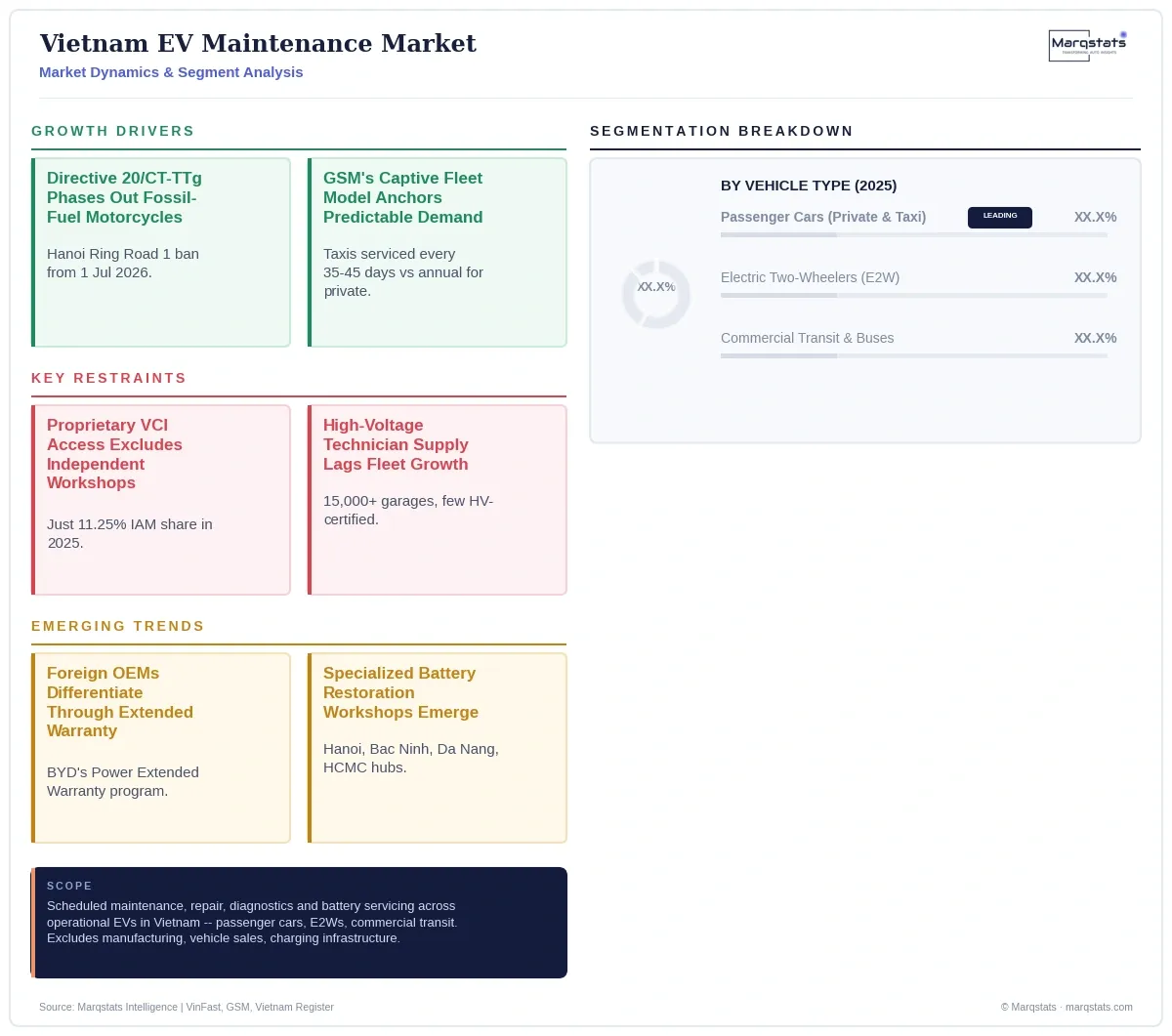
- Vietnam's fully partitioned sizing model shows commercial and captive fleet channels structurally anchoring baseline demand independent of consumer sentiment cycles, since GSM's own fleet-scaling decisions, not broader EV adoption surveys, explain the majority of this market's documented 2023-2025 growth acceleration.
- Prime Minister's Directive 20/CT-TTg, enacted 12 July 2025, mandates a phased fossil-fuel motorcycle ban across Hanoi's ring roads — Ring Road 1 from 1 July 2026, Ring Road 2 from 1 January 2028, and Ring Road 3 by 2030 — directly accelerating electric two-wheeler adoption and shifting repair-shop work from small-displacement combustion engines to modular electrical drivelines.
- Government Decree 202/2026/ND-CP, enacted 8 June 2026, extends Vietnam's 100% battery electric vehicle registration fee exemption through 31 December 2030, removing a persistent cost disparity against internal combustion platforms taxed at 10% to 12% of list price and sustaining long-term fleet expansion.
- GSM's captive fleet maintenance model, requiring Level 1 scheduled servicing every 35 to 45 days for high-mileage taxis against an annual cycle for private vehicles, generates concentrated, predictable, high-frequency maintenance demand that anchors baseline market volume independent of broader consumer EV sentiment.
- VinFast's extensive battery-swapping infrastructure, targeting 60,000 cabinets nationwide through partnerships with retail networks like The Gioi Di Dong, alongside Selex Motors' VGX joint venture with Petrolimex deploying shared cabinets across retail gas stations, is expanding commercial two-wheeler electrification by decoupling battery ownership risk from vehicle purchase.
- Vietnam's QCVN 09:2024/BGTVT technical regulation, aligned with UN ECE R100 and R13-H, mandates specific high-voltage safety and ingress-protection thresholds for all electric vehicles, creating concrete compliance requirements that drive continuous investment in specialized diagnostic and safety equipment across the service network.
Key Restraints
- Foreign battery recycling and second-life infrastructure remains genuinely underdeveloped relative to fleet growth, meaning a substantial share of Vietnam's earliest-generation EV batteries reaching end-of-life over the next several years will depend on manufacturer-run take-back programs rather than a mature independent recycling industry.
- Major OEMs do not make proprietary vehicle communication interfaces and software security certificates publicly accessible, structurally confining Vietnam's roughly 15,000 independent workshops to low-voltage auxiliary systems, mechanical suspensions and tire work, limiting independent aftermarket capture to just 11.25% of maintenance expenditure in 2025.
- The domestic supply of certified high-voltage technicians has not kept pace with fleet growth; servicing battery electric platforms requires foundational training in electrical hazards, contactor safety, arc flash prevention and de-energization procedures that most of Vietnam's existing combustion-trained technician workforce lacks.
- Tire wear accelerated 25% to 35% by instant electric motor torque and higher curb weights partially offsets the 30% to 50% powertrain maintenance savings EVs otherwise deliver, with fleet-operated VinFast models requiring tire replacement every 30,000 to 38,000 km against roughly 50,000 km for comparable combustion sedans.
- High-voltage industrial battery recycling infrastructure remains limited in Vietnam, forcing automotive manufacturers to rely on second-life Battery Energy Storage System repurposing and financial contributions to the Vietnam Environment Protection Fund rather than domestic large-scale recycling capacity, under Extended Producer Responsibility requirements established by Decree 08/2022/ND-CP.
Key Trends
- Battery-swapping subscription pricing is converging toward a standardized monthly-fee-plus-per-swap model across competing operators, with VinFast's VND 175,000 to VND 300,000 monthly subscription tiers and VND 9,000 per-swap fee establishing a pricing benchmark other network operators are increasingly matching.
- Foreign OEM entrants are structuring differentiated warranty and extended-protection programs to compete against VinFast's integrated network — BYD's Power Extended Warranty program lets fleet operators purchase an 8-year/300,000 km battery protection extension for approximately VND 9,800,000, converting long-term degradation risk into predictable upfront capital expenditure.
- Specialized battery restoration workshops are emerging in industrial centers around Hanoi, Bac Ninh, Da Nang and Ho Chi Minh City, using cell cyclers, balancing chargers and thermal imaging to repair individual degraded cell groups rather than replacing entire battery packs priced between VND 80,000,000 and VND 150,000,000.
- Large aftermarket workshop chains including Auto365, with over 100 franchise locations, and regional operators like Tien Phong Auto are retrofitting facilities with high-voltage testing tools and EV-specific service bays, while international franchises including Bosch Car Service extend standardized diagnostic capability to domestic and imported electric platforms.
- VinFast has signed formal training agreements with 30 universities and vocational colleges across Vietnam, donating operational vehicles, battery packs and diagnostic software suites to build a direct employment pipeline into its authorized service network, addressing the domestic high-voltage technician shortage at its source.
Strategic Implications
- Foreign OEM entrants evaluating Vietnam market entry should treat VinFast's integrated manufacturing-distribution-service model, rather than any single competitor's product specifications, as the actual competitive benchmark to plan against, given how deeply that vertical integration shapes cost structure and service-network economics across the entire domestic market.
- OEM network operators, led by VinFast and BYD, should prioritize expanding Level 2 technical service capacity and module-level battery repair capability across regional facilities as the earliest fleet vehicles reach their fourth and fifth operating years, establishing structured fast-track service lanes for high-mileage commercial fleets to prevent service bay congestion.
- Independent aftermarket operators should focus initial investment on high-wear mechanical repairs — tire optimization, regenerative brake servicing, suspension rebuilding — where they already hold competitive share, before layering in universal high-voltage diagnostic platforms and IEC 60900-certified insulated tools as post-warranty fleet volume genuinely materializes.
- Commercial fleet operators, including ride-hailing networks and urban logistics providers, should prioritize predictive maintenance through vehicle telematics, tracking battery pack state-of-health and cooling loop pressure in real time to address minor issues during scheduled charging windows rather than risking costly on-road breakdowns, following GSM's own demonstrated 95%+ fleet operational availability model.
- Diagnostic equipment manufacturers and vocational training institutions should expand software support specifically for domestic Vietnamese vehicle models and deepen collaborative training programs with manufacturers, since the technician shortage — not equipment availability alone — is the binding constraint on how quickly independent workshops can capture post-warranty maintenance share.
Outlook
Three genuinely distinct, evidenced trajectories emerge from named regulatory trigger conditions rather than differing growth-rate assumptions applied to the same story. Under the Downside Delayed Transition Scenario, municipal authorities postpone or narrow Directive 20/CT-TTg's inner-city fossil-fuel motorcycle ban due to social resistance and charging infrastructure delays, and commercial ride-hailing fleet turnover slows; the active four-wheeled EV fleet reaches 1,050,000 units by 2030 and the electric two-wheeler fleet reaches 6,200,000 units, with total maintenance expenditure reaching USD 285.50 million at a 24.83% CAGR.
Under the Baseline Progressive Policy Scenario, Directive 20/CT-TTg and Decree 202/2026/ND-CP are enforced on their stated timelines, and the four-wheeled EV fleet reaches 1,450,000 units by 2030, generating USD 372.40 million in annual maintenance expenditure at a 31.64% CAGR.
Under the Upside Accelerated Decarbonization Scenario, Hanoi and Ho Chi Minh City enforce low-emission zones ahead of statutory schedules, supported by direct vehicle conversion subsidies, and the national government enacts mandatory interoperability standards for electric two-wheeler battery packs, accelerating shared battery-swapping network deployment across the VGX joint venture and VinFast's own infrastructure. Under this trigger set, the four-wheeled EV fleet expands to 1,850,000 units by 2030 and the electric two-wheeler fleet exceeds 11,200,000 units, lifting total maintenance expenditure to USD 485.60 million at a 38.82% CAGR, as the independent aftermarket modernizes rapidly with universal diagnostic platforms operating across most multi-brand workshops.
Market Segmentation
USD 54.60 million (57.96% share) in 2025, the largest value segment despite lower per-kilometer maintenance costs than commercial platforms, driven by high fleet volume and electronic diagnostics; projected to reach USD 224.20 million (60.20% share) by 2030.
USD 28.50 million (30.25% share) in 2025, built on battery renewals and swapping station subscriptions across a fleet of 2.45 million units; projected to reach USD 98.40 million (26.42% share) by 2030.
USD 11.10 million (11.78% share) in 2025, covering heavy-duty depot servicing and high-voltage charging checks across Vietnam's 1,946-unit electric bus fleet; projected to reach USD 49.80 million (13.37% share) by 2030.
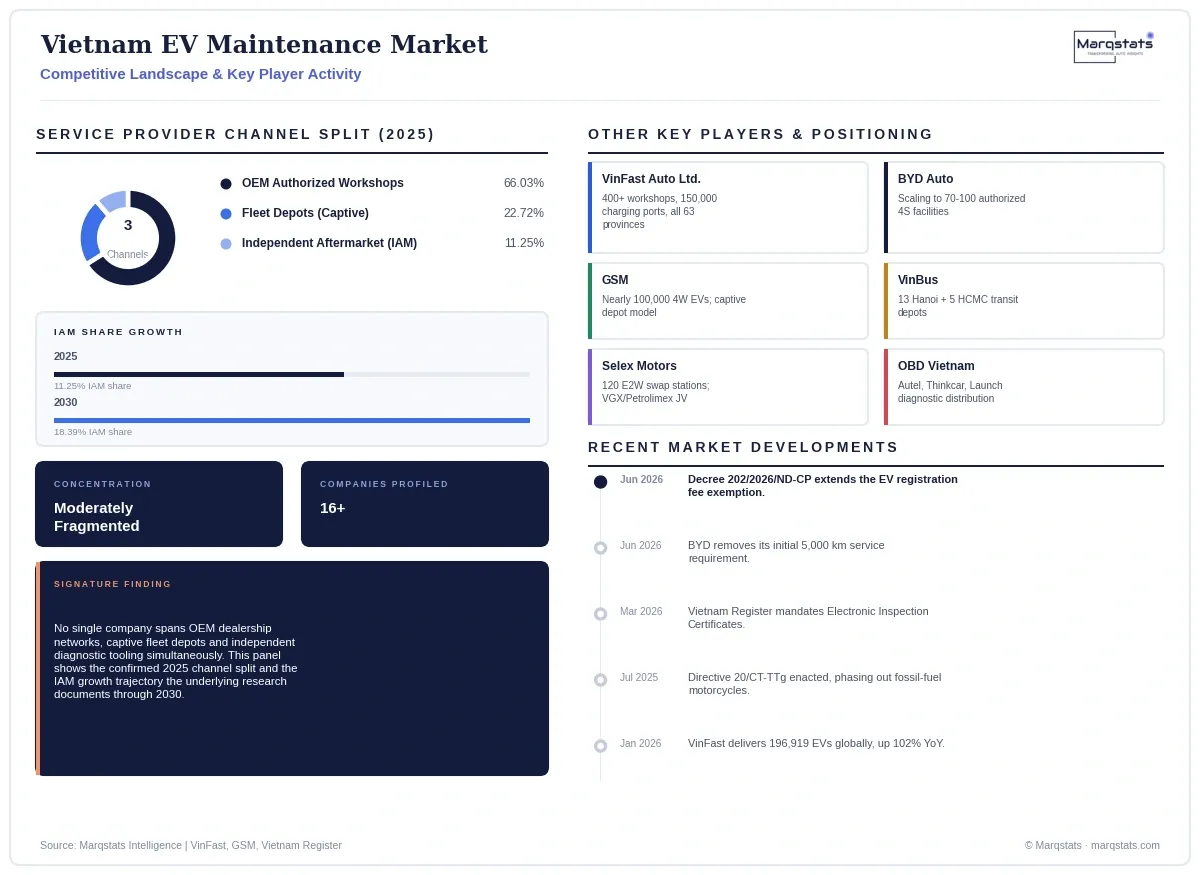
USD 62.20 million (66.03% share) in 2025, anchored by warranty retention and proprietary software diagnostic lock-in; projected to decline to USD 218.60 million (58.70% share) by 2030 as the parc ages past warranty.
USD 21.40 million (22.72% share) in 2025, covering centralized maintenance operations run by GSM, VinBus and Selex Motors; projected to reach USD 85.30 million (22.91% share) by 2030.
USD 10.60 million (11.25% share) in 2025; projected to expand fastest of the three channels to USD 68.50 million (18.39% share) by 2030 as post-warranty mechanical and tire service demand grows.
USD 38.60 million (40.98% share) in 2025, the largest cost category, driven by fast tire wear and specialized dielectric cooling fluids; projected to reach USD 158.40 million (42.53% share) by 2030.
USD 31.80 million (33.76% share) in 2025, covering high-voltage diagnostic labor and periodic roadworthiness testing; projected to reach USD 118.20 million (31.74% share) by 2030.
USD 23.80 million (25.27% share) in 2025, covering BMS modules, suspension struts and battery repairs; projected to reach USD 95.80 million (25.72% share) by 2030.
By Geography
A note on regional distribution
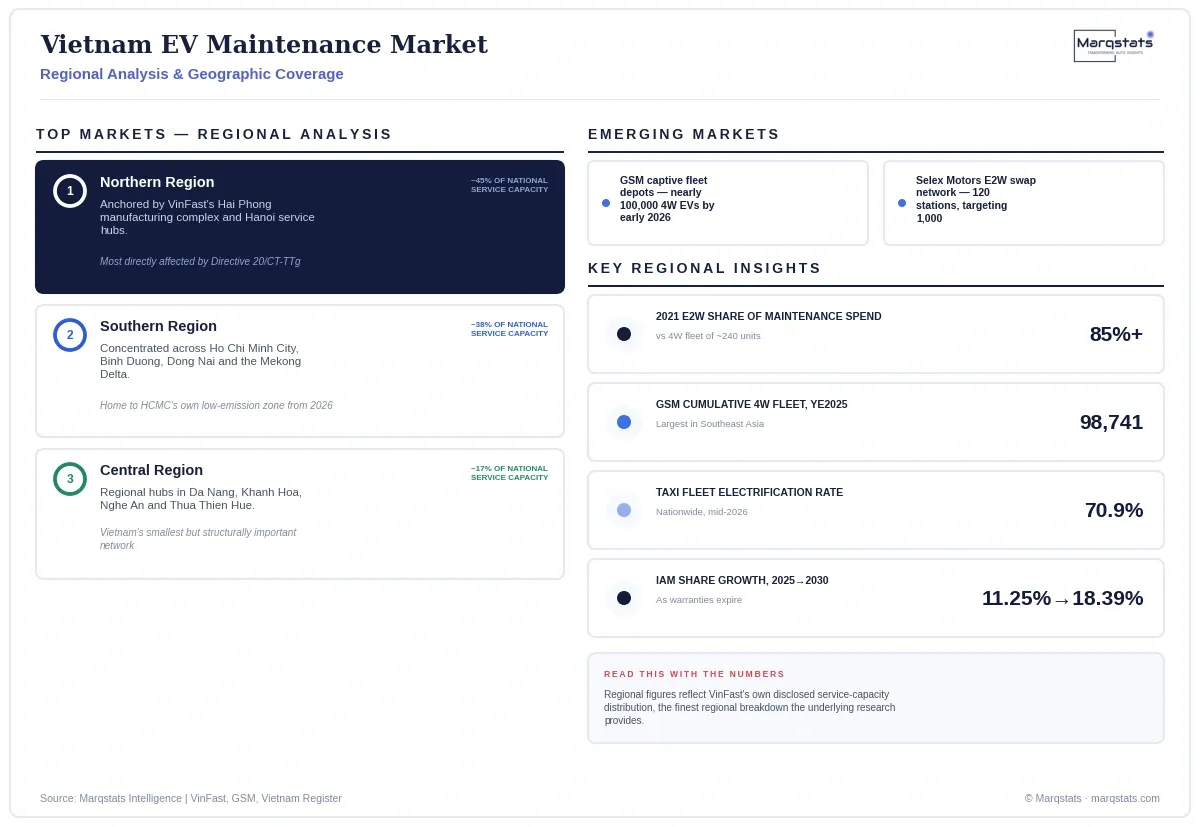
Vietnam's EV maintenance demand is not reported as a direct regional revenue split in the underlying research. The shares below reflect VinFast's own disclosed authorized service capacity distribution, which closely mirrors vehicle registration density nationally.
Northern Region
Approximately 45% of national EV service capacity, anchored by VinFast's manufacturing complex in Hai Phong, assembly facilities in Ha Tinh, and high-density service hubs in Hanoi — the region most directly affected by Directive 20/CT-TTg's phased fossil-fuel motorcycle ban.
Southern Region
Approximately 38% of national EV service capacity, concentrated across Ho Chi Minh City, Binh Duong, Dong Nai and the Mekong Delta corridor, home to Ho Chi Minh City's own low-emission zone restricting commercial two-wheelers below Euro 2 standards from 2026.
Central Region
Approximately 17% of national EV service capacity, with regional service hubs in Da Nang, Khanh Hoa, Nghe An and Thua Thien Hue, representing Vietnam's smallest but structurally important regional service network.
How Competition Is Evolving
Competition spans OEM authorized networks, captive commercial fleet depots, and an independent aftermarket still building high-voltage technical capability. VinFast Auto Ltd. operates the dominant integrated network, with over 400 authorized service workshops and 150,000 public charging ports across all 63 provinces, structured into Level 1 routine-service workshops and Level 2 regional technical hubs equipped with cleanroom inverter repair benches and isolated de-energization quarantine bays. BYD Auto, which entered Vietnam in July 2024, is scaling toward 70 to 100 authorized 4S facilities and has differentiated its service model by eliminating the initial 5,000 km service requirement and introducing its Power Extended Warranty program for commercial fleet operators.
On captive fleet maintenance, Green and Smart Mobility (GSM) operates the largest corporate electric vehicle fleet in Southeast Asia through internalized depot operations and IoT telematics-driven predictive servicing, while VinBus manages municipal transit electrification across 13 Hanoi depots and 5 Ho Chi Minh City depots. Selex Motors anchors commercial two-wheeler battery-swapping through its VGX joint venture with Xuan Cau Holdings and the Vietnam National Petroleum Group (Petrolimex). On the independent aftermarket side, diagnostic equipment distributor OBD Vietnam supplies Autel, Thinkcar and Launch tools, workshop equipment supplier Tan Phat ETEK provides insulated high-voltage tooling, and franchise chains including Auto365 and Bosch Car Service are progressively adding EV-specific service capability.
Companies Covered
The report profiles 16+ companies with full strategy and financials analysis, including:
Recent Market Activity
Table of Contents
Coverage & Segmentation
This report measures scheduled routine maintenance, mechanical and electrical repairs, electronic diagnostics, high-voltage battery servicing, chassis wear overhauls, and consumable replacement across operational electric road vehicles in Vietnam — passenger cars, electric two-wheelers and commercial transit buses — across a 2025 base year and a 2026 to 2030 forecast period, denominated in United States dollars. It excludes general automotive manufacturing turnover, vehicle retail purchase transactions, public charging electricity sales, and grid infrastructure investment.
The analysis spans three segmentation dimensions — vehicle type, service provider channel and cost component — each independently verified to sum to the stated market total, three regional geographies, and 16 profiled entities across OEMs, fleet operators, diagnostic suppliers and regulatory bodies. Fleet and delivery figures trace to VinFast, GSM and Vietnam's statutory transport registry; market value and segment splits trace to the underlying research's own fully partitioned sizing model.