Market Snapshot
Middle bar: base-year value × (1 + CAGR), rounded to two decimals. This is a calculated illustration, not a separately researched annual estimate.
Market Size (2025, Base Year): USD 40.57 Million
Estimated Value (2026): USD 55.94 Million
Forecast Value (2030): USD 160.10 Million
CAGR: 31.60% | Forecast Period: 2026 – 2030
Growth — Absolute: USD 119.53 Million
Largest Market: Región Metropolitana (84.20% of national maintenance expenditure)
Fastest Growing: Independent Certified Repair Facilities (8.00% to 15.00% share, 2025-2030)
Dominant Segment: Urban Transit Buses (68.70% revenue share, 2025)
Market Concentration: Moderately Fragmented
Base Year: 2025 | Historical Period: 2021 – 2025 | Forecast Period: 2026 – 2030
Units Considered: Value (USD Million)
Segments Covered: 3 | Regions Covered: 6 | Companies Profiled: 15
Report Pages: 240 | Deliverables: PDF, Excel, PPT
Key Takeaways
Market Overview & Analysis
Report Summary
This analysis reads Chile's own fully worked sizing chain, regional distribution data, and named-scenario regulatory framework together as a single coherent picture rather than isolated data points, since the underlying research itself was structured to support exactly that kind of integrated reading.
Chile's EV maintenance market is measured across scheduled preventative maintenance, mechanical wear and tire servicing, electrical powertrain repair, and high-voltage battery diagnostics, valued at USD 40.57 million (CLP 37.93 billion) in 2025. This figure is taken directly from the underlying research's own fully worked sizing chain, anchored to DTPM operating registers and statutory fleet data covering 24,237 active plug-in vehicles.
Structurally, this is a market anchored by heavy-duty transit buses rather than private passenger vehicles, shaped by strict concession uptime mandates that compel continuous telemetry monitoring, alongside a genuine certified-technician shortage constraining independent workshop expansion into high-voltage servicing.
The analysis is built for four reader types making different decisions: an independent workshop operator weighing ChileValora P-4520-7412-001-V01 certification investment against post-warranty passenger vehicle opportunity, a transit concessionaire like Metbus managing 98% fleet availability mandates, an importer like Inchcape defending warranty-anchored dealership revenue, and an investor tracking how DTPM concession tenders and corporate fleet mandates shape this market's Baseline-to-Accelerated scenario range.
A Market Where the Minority of Vehicles Generates the Majority of Revenue
Most aftermarket sizing exercises implicitly assume vehicle count and service revenue track together, roughly proportionally. Chile's own data shows that assumption breaking down sharply, and the mechanism is worth understanding directly.
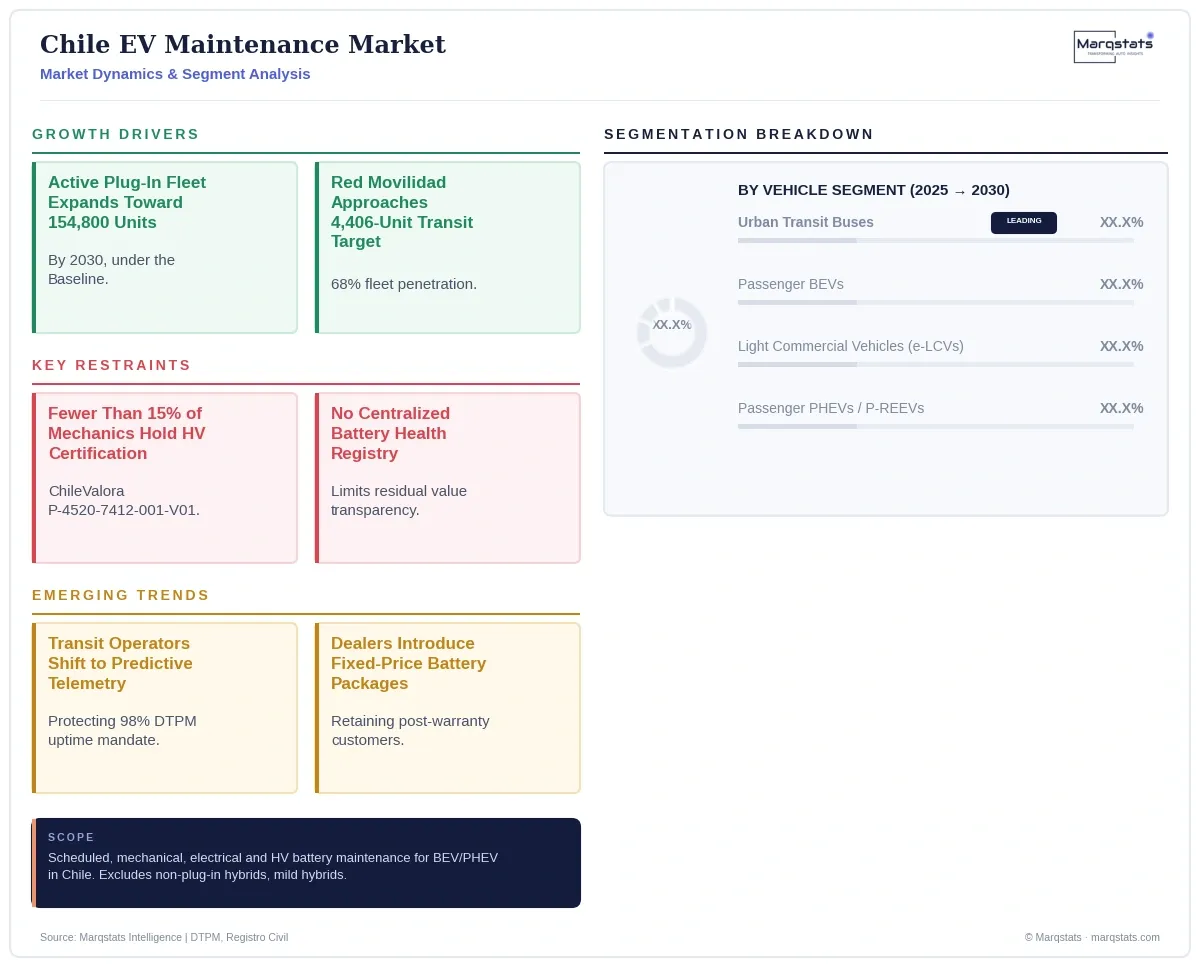
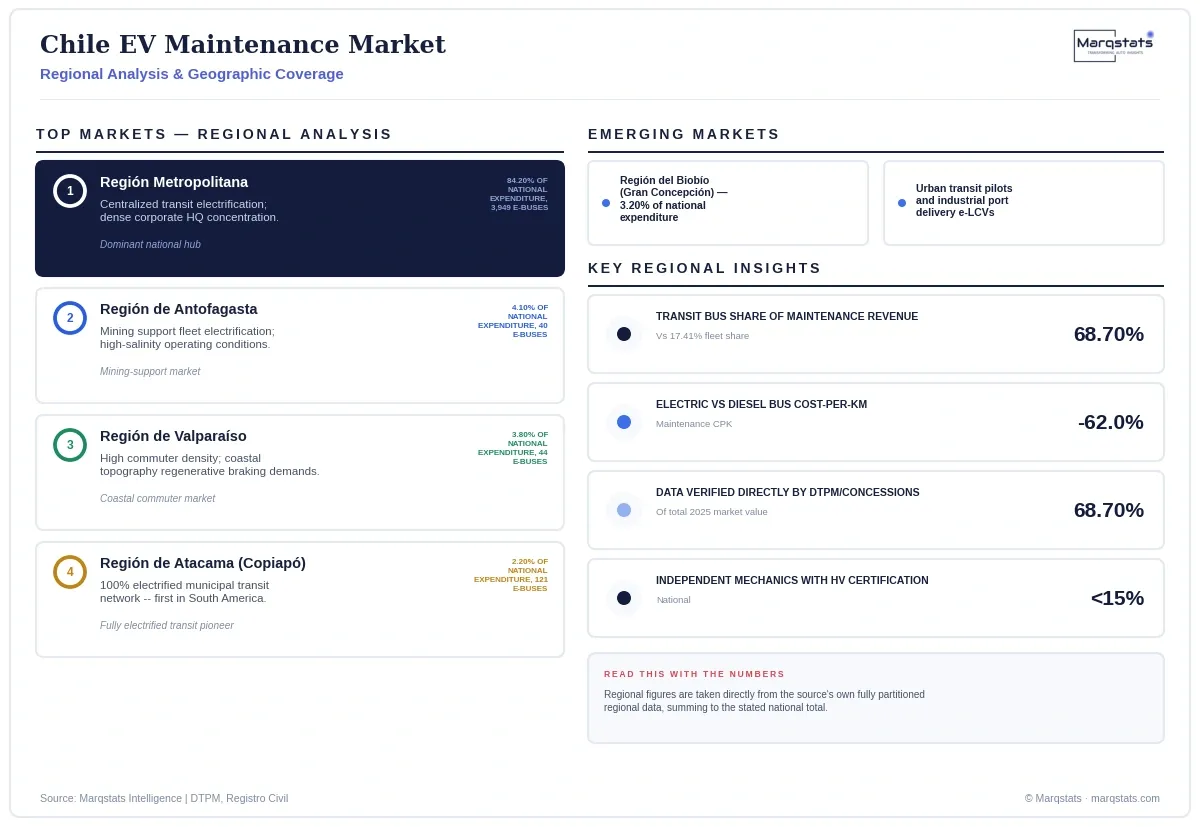
Transit buses hold just 17.41% of Chile's active plug-in fleet but generate 68.70% of maintenance revenue. The underlying driver isn't simply that buses are bigger vehicles -- it's the combination of intense daily mileage, contractually enforced 98% availability requirements, and a documented cost-per-kilometer of CLP 95.00 against CLP 220 to CLP 280 for equivalent diesel buses. That CLP 95.00 figure isn't a rough estimate either; DTPM and public concession disclosures provide direct verification for 68.70% of the entire national market's value, a level of data transparency this coverage set doesn't always see. For anyone assessing Chile's real aftermarket opportunity, Santiago's transit concession relationships matter more than private-passenger dealership coverage, at least through the current forecast window.
Why a 98% Uptime Requirement Changes How Maintenance Actually Gets Done
Most vehicle maintenance, even in commercial fleets, follows a scheduled cadence -- service at fixed intervals, replace parts on a calendar. Chile's transit concession structure pushes operators toward something different.
DTPM's concession contracts mandate fleet availability above 98%, with direct financial deductions for any unscheduled downtime during peak operating hours. That contractual pressure is why Red Movilidad concessionaires run continuous telemetry systems monitoring individual cell voltages, temperature variations, and motor insulation resistance in real time, rather than waiting for a scheduled inspection to catch a developing fault. It's a genuinely different maintenance philosophy than most private passenger fleets operate under, and it's a direct structural consequence of how the concession contracts themselves are written.
Market Dynamics
Key Drivers
- Chile's documented data-provenance transparency, with public concession disclosures directly verifying over two-thirds of total market value, provides a genuinely stronger empirical foundation for workshop investment planning than markets relying more heavily on derived pricing estimates.
- Chile's own regional data shows a meaningful gap between where corporate fleet vehicles are registered and where they actually circulate, since leasing fleets registered under Greater Santiago headquarters disperse a documented 12% to 15% of their real-world operating activity into northern mining and southern agricultural zones, sustaining service demand pure registration data alone would understate.
- Chile's own fully worked sizing chain shows scheduled preventative maintenance already the single largest service category at 42.00% of total value, a structural signal that systematic multi-point inspection capability represents the most immediate revenue opportunity for workshops entering this market.
- Chile's active plug-in fleet is expanding rapidly, from 24,237 units in 2025 toward a projected 154,800 units by 2030 under the Baseline Regulatory Trajectory, directly growing the addressable base for recurring EV aftermarket maintenance demand.
- Red Movilidad's continued transit electrification, progressing from 2,505 buses at end-2024 toward a state target of 4,406 units, is directly expanding the anchor segment generating the majority of national maintenance revenue.
- Copiapó's May 2026 launch of South America's first fully electrified municipal transit network (121 buses) is establishing the first regional transit depot maintenance facility outside Santiago, demonstrating the model's replicability nationally.
- The ANAC-ChileValora institutional agreement to certify 10,000 automotive technicians between 2026 and 2027 is directly addressing the certified high-voltage labor shortage constraining independent workshop expansion.
- Imported Chinese nameplates offering competitive purchase pricing, including urban hatchbacks priced below CLP 13 million, are accelerating private passenger BEV adoption and expanding the future maintenance-eligible fleet.
Key Restraints
- Chile's persistent shortage of certified high-voltage technicians genuinely constrains near-term independent workshop capacity, since ChileValora certification requires meaningful training investment beyond standard automotive vocational curricula, a gap the ANAC-ChileValora institutional agreement is only beginning to close at national scale.
- This market's own two-scenario framework spans a genuinely wide 2030 range, from USD 160.10 million under the Baseline Regulatory Trajectory to USD 208.45 million under the Accelerated Electrification Trajectory -- a disclosed spread reflecting real uncertainty in green tax reform timing and corporate fleet mandate enforcement, not a narrow band around a single central estimate.
- Fewer than 15% of mechanics in independent workshops currently hold ChileValora certification under Perfil Ocupacional P-4520-7412-001-V01, a severe labor bottleneck constraining independent high-voltage servicing capacity nationally.
- Workshop bays and charging depots must comply with SEC Pliego Técnico Normativo RIC N°15, mandating physical floor isolation, dedicated grounding linkages, and emergency power-cutoff systems, representing genuine compliance investment for independent operators.
- Chile lacks a centralized public registry tracking battery health, cell degradation rates, or traction battery warranty claims across vehicle platforms, restricting transparent residual value modeling in the secondary vehicle market.
- Corporate registration clustering means Greater Santiago's headline 88% share of cumulative EV registrations overstates the region's true share of on-road servicing demand, since 12% to 15% of these corporate fleets actually operate continuously in northern mining or southern agricultural zones.
Key Trends
- Regional service capacity is beginning to diverge sharply between the Santiago Metropolitan Region and Chile's more peripheral northern and southern zones, raising genuine open questions about whether mobile diagnostic units or additional regional depot investment will emerge as the preferred way to extend high-voltage capability nationally.
- Fleet operators managing high-mileage commercial electric vans in mining support applications across Antofagasta and Calama are increasingly negotiating dedicated maintenance contracts directly with authorized dealer networks offering centralized high-voltage competence, given the documented harsh high-salinity operating conditions these platforms experience.
- Dealer networks are introducing fixed-price service packages for battery thermal management systems and dedicated service bays for corporate commercial fleets to retain customers as vehicles exit manufacturer warranty coverage.
- Transit operators are moving from scheduled preventative maintenance toward predictive telemetry monitoring and negotiating second-life energy storage partnerships to offset future battery replacement costs as early Red Movilidad battery tranches age past 2027.
- Vocational institutions including Duoc UC and INACAP are expanding dedicated high-voltage training bays and manufacturer partnerships, exemplified by Hyundai Chile's August 2026 EV technical academy launch preparing specialists for 800V architectures.
- Independent workshops including León Servicio Automotriz and ZS Motor are investing in insulated high-voltage tooling and ChileValora-certified technician training to position for expanding post-warranty passenger vehicle volume.
Strategic Implications
- Component suppliers should also weight EV-specific tire and thermal coolant inventory planning very heavily nationwide.
- Independent workshop operators should prioritize ChileValora P-4520-7412-001-V01 certification investment specifically, positioning ahead of the wave of private passenger vehicles exiting manufacturer warranties, given the documented shortage of certified high-voltage technicians nationally.
- Transit operators and commercial fleet managers should build internal telemetry capacity and negotiate second-life battery energy storage partnerships specifically, given how directly protecting the 98% DTPM availability mandate depends on predictive rather than scheduled maintenance approaches.
- Authorized dealership networks should introduce fixed-price battery thermal management service packages and dedicated corporate fleet bays specifically, given how directly the underlying research shows early-moving independent chains positioned to capture post-warranty customers otherwise.
- Investors and analysts should track DTPM regional transit concession tender timing nationwide and Climate Change Framework Law corporate fleet mandate enforcement as the two clearest variables separating this market's Baseline and Accelerated scenarios.
Outlook
Unlike most other markets in this coverage set, the underlying research presents only two named forward scenarios rather than a full three-tier framework, and both represent growth at different rates rather than a growth-versus-contraction range: a Baseline Regulatory Trajectory and an Accelerated Electrification Trajectory. No Downside or Conservative scenario is provided in the source, and Marqstats presents only these two growth scenarios rather than constructing a contraction scenario the underlying research did not give.
Under the Baseline Regulatory Trajectory, DTPM completes its fleet renewal program in alignment with the National Electromobility Strategy's 2035 zero-emission urban transit target, and light and medium vehicle electrification progresses along ANAC's base forecast, capturing 15.7% of annual new vehicle sales by 2030; the total active plug-in fleet reaches 154,800 units by 2030 (9,800 transit buses, 18,500 light commercial e-LCVs, 82,000 passenger BEVs, 44,500 passenger PHEVs), generating USD 160.10 million (CLP 149.69 billion) in total market value at a 31.60% CAGR, with independent certified workshops expanding to 15.0% of total maintenance turnover.
Under the Accelerated Electrification Trajectory, green tax reforms extend the annual circulation tax exemption for electric vehicles alongside accelerated depreciation allowances for corporate e-LCVs, and corporate fleet procurement mandates under the Climate Change Framework Law require logistics operators to electrify 50% of urban delivery vehicles by 2028; zero-emission models achieve 36.6% of annual light and medium sales by 2030, expanding the active plug-in fleet to 231,000 units by 2030 (11,000 transit buses, 32,000 light commercial e-LCVs, 188,000 passenger BEVs/PHEVs), lifting total market value to USD 208.45 million (CLP 194.90 billion) at a 38.73% CAGR, with independent certified workshops capturing 22.0% of the servicing market.
Market Segmentation
USD 17.04 million (42.00% share) in 2025, growing to USD 57.64 million (36.00% share) by 2030. Anchored by Kaufmann S.A. and Dercocenter multi-point inspections and thermal coolant flushes.
USD 12.58 million (31.00% share) in 2025, growing to USD 54.43 million (34.00% share) by 2030. Anchored by León Servicio Automotriz and ZS Motor, driven by high curb weight tire wear.
USD 6.09 million (15.00% share) in 2025, growing to USD 27.22 million (17.00% share) by 2030. Anchored by Enel X and DTPM concessionaire inverter and DC-DC converter diagnostics.
USD 4.87 million (12.00% share) in 2025, growing to USD 20.81 million (13.00% share) by 2030. The fastest-growing category, anchored by BYD Chile and Tesla Service.
USD 27.87 million (68.70% share) in 2025, growing to USD 67.63 million (42.24% share) by 2030. The dominant 2025 segment, anchored by BYD K9, Foton eBus and Yutong platforms operated by Metbus and Subus.
USD 4.18 million (10.31% share) in 2025, growing to USD 23.68 million (14.79% share) by 2030. Anchored by Maxus eDeliver 3, Renault Kangoo E-Tech and Peugeot e-Partner.
USD 5.14 million (12.68% share) in 2025, growing to USD 38.54 million (24.07% share) by 2030. Anchored by Tesla Model Y/3, Volvo EX30, BYD Dolphin and Geely EX2.
USD 3.37 million (8.30% share) in 2025, growing to USD 30.26 million (18.90% share) by 2030. Anchored by Changan CS55 iDD, BYD Song Plus and Deepal S07.
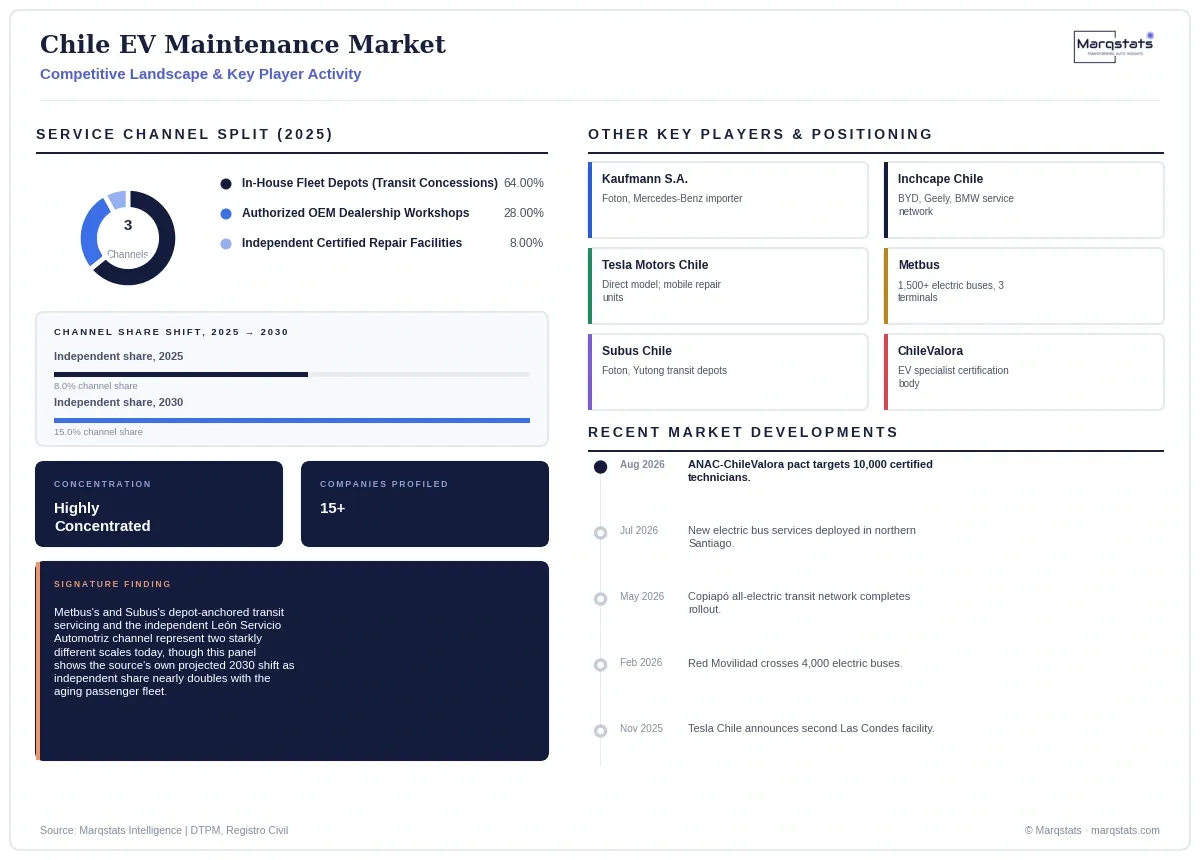
USD 25.96 million (64.00% share) in 2025, growing to USD 72.05 million (45.00% share) by 2030. Anchored by Metbus, Subus Chile, Buses Vule and Voy Santiago terminal yards.
USD 11.36 million (28.00% share) in 2025, growing to USD 64.04 million (40.00% share) by 2030. Anchored by Kaufmann, Inchcape, Tesla Chile and Astara Chile.
USD 3.25 million (8.00% share) in 2025, growing to USD 24.02 million (15.00% share) by 2030. The fastest-growing channel, expanding nearly twofold as warranties expire.
By Geography
Región Metropolitana (Santiago)
84.20% of national maintenance expenditure (3,949 Red Movilidad e-buses, over 80% of passenger BEVs/PHEVs), driven by centralized public transit electrification and dense corporate headquarters concentration.
Región de Antofagasta
4.10% of national maintenance expenditure (40 urban e-buses plus specialized electric mining support fleets), reflecting electrification of open-pit light vehicle transport under harsh high-salinity, high-altitude operating conditions.
Región de Valparaíso
3.80% of national maintenance expenditure (44 Gran Valparaíso urban transit e-buses plus interurban fleets), driven by high commuter density and coastal topography requiring regenerative braking maintenance.
Región del Biobío (Gran Concepción)
3.20% of national maintenance expenditure, anchored by urban transit pilots and industrial port delivery e-LCVs supporting regional capital transport modernization.
Región de Atacama (Copiapó)
2.20% of national maintenance expenditure (121 Red Copiapó transit buses, a 100% electrified municipal network), reflecting complete replacement of municipal ICE urban transit.
Rest of Chile (Coquimbo, O'Higgins, Los Lagos, Magallanes)
2.50% of national maintenance expenditure, comprising scattered regional route modernizations in Rancagua, Puerto Montt and Punta Arenas with southern low-temperature battery thermal diagnostic needs.
How Competition Is Evolving
This landscape is expected to consolidate somewhat by 2030 as clear leaders emerge nationally.
Chile's overall competitive landscape remains genuinely fluid entering the 2027-2028 warranty expiration window.
No single company in this market spans transit concession depot operation, franchised warranty-anchored dealership servicing, and independent multi-brand workshop capability simultaneously, leaving genuine competitive white space for any group capable of bridging Metbus's and Subus's depot-anchored transit servicing with the independent channels this market's own scenario framework shows nearly doubling by 2030.
Competition spans automotive importer/dealer networks, transit concessionaires, infrastructure providers and technical training institutions. Kaufmann S.A., distributor of Mercedes-Benz, Foton and Freightliner, manages a substantial share of electric bus maintenance through long-term Red Movilidad fleet contracts. Inchcape Chile, following its acquisition of Derco, operates high-voltage repair bays across Santiago, Concepción and Viña del Mar for BYD, Geely and BMW. Tesla Motors Chile operates outside the traditional importer model with direct retail and mobile repair units. The public transport operators managing Red Movilidad -- Metbus, Subus Chile, Buses Vule and Voy Santiago -- operate the largest high-voltage depot repair facilities in South America.
On the independent side, León Servicio Automotriz and ZS Motor have invested in insulated high-voltage tooling and ChileValora-certified technician training to service post-warranty vehicles. Duoc UC and INACAP provide the technical labor foundation through dedicated high-voltage training bays and regional vocational programs. Regulatory and standards oversight rests with the SEC (workshop electrical safety), MTT/DTPM (transit contracting and uptime compliance), and ChileValora (occupational certification standards).
Companies Covered
Companies covered in the report include:
Recent Market Activity
Table of Contents
Coverage & Segmentation
The analysis measures scheduled preventative maintenance, unscheduled electrical and powertrain repairs, high-voltage battery health diagnostics and cell-balancing interventions, and chassis wear servicing performed on BEV and PHEV vehicles across passenger, light commercial, and urban transit categories in Chile, across a 2025 base year and a 2026 to 2030 forecast period, denominated in United States dollars at the pack's own stated 2025 annual average exchange rate of CLP 935.00 per USD. It excludes conventional non-plug-in hybrids and mild hybrids, whose service profiles remain anchored to internal combustion mechanics.
The analysis spans three segmentation dimensions — service category, vehicle segment and service channel — six regional groupings, and 15 profiled entities across importer/dealer networks, transit operators and regulatory bodies. Fleet figures trace to DTPM and Servicio de Registro Civil e Identificación; market value and all three segmentation dimensions trace directly to the underlying research's own fully worked sizing model, with both 2025 and 2030 figures directly source-stated throughout.