Market Snapshot
Key Takeaways
Market Overview & Analysis
Report Summary
This analysis reads Mexico's own fully partitioned sizing chain, regional distribution data, and named-scenario trade-policy framework together as a single coherent picture rather than isolated data points, since the underlying research itself was structured to support exactly that kind of integrated reading.
Mexico's EV maintenance market is measured across preventative servicing, high-voltage diagnostics, dual-powertrain PHEV maintenance, and collision and corrective repair, valued at USD 201.32 million in 2025. This figure is taken directly from the underlying research's own fully partitioned sizing chain, anchored to INEGI statutory registration data and Electro Movilidad Asociacion (EMA) circulating fleet figures.
Structurally, this is a market defined by a stark cost bifurcation between low-cost routine servicing and disproportionately expensive collision repair, layered on top of a genuine supply chain decoupling: legacy OEM domestic assembly is contracting sharply even as retail EV demand, increasingly satisfied by imported Chinese models, continues to accelerate.
The analysis is built for four reader types making different decisions: an insurer like AXA Seguros recalibrating premium structures against rising collision claim severity, a fleet operator weighing VEMO-style private charging and maintenance hub investment against public infrastructure scarcity, an independent workshop operator confronting OEM diagnostic-tool access barriers, and an investor tracking how a prospective Ley de Electromovilidad and tariff policy together shape this market's Downside-to-Upside scenario range.
The two analyses below unpack findings that a single headline growth figure cannot convey on its own -- read together with the segment and regional data above, they explain both why this market's average cost figures can mislead and why its manufacturing and sales data appear to contradict each other.
Why the Average Cost Figure Hides the Number That Actually Matters
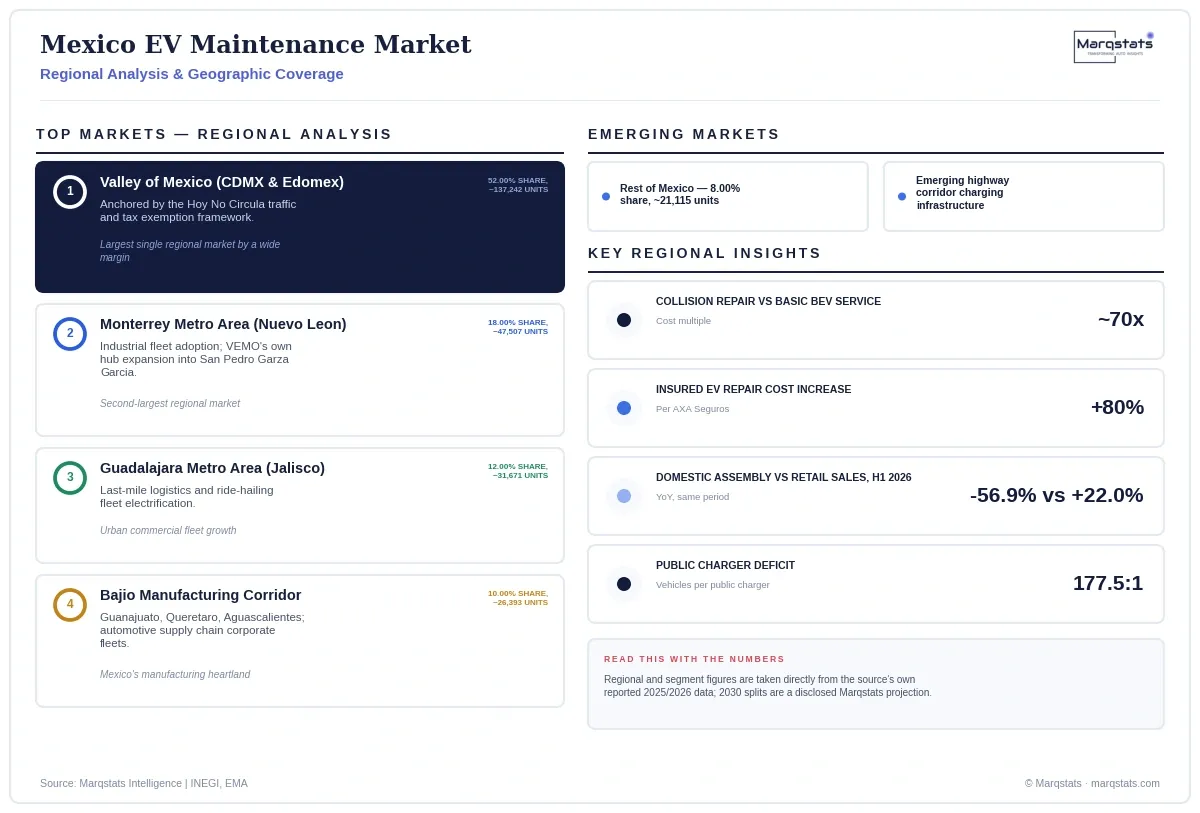
A blended average of MX$18,500 per vehicle per year sounds like a manageable, predictable cost. It also obscures a genuinely dramatic split underneath: routine preventative servicing at a franchised BYD dealer starts around MX$1,279, while a single collision repair claim averages over MX$90,000 — roughly 70 times the basic service price, and 60% to 70% higher than an equivalent gasoline-vehicle collision claim.
This split matters enormously for anyone pricing insurance, budgeting fleet operations, or planning workshop capacity. A blended average tells you almost nothing useful about the actual financial exposure a single incident creates. The real planning question isn't "what does average annual maintenance cost," it's "what happens financially the day a vehicle is in an accident" — and Mexico's own insurance industry data shows that number has grown disproportionately large specifically because of imported battery pack and ADAS component replacement costs.
A Manufacturing Collapse That Somehow Coincided With a Sales Boom
Two numbers from the same six-month window, reported by the same news cycle, would normally be read as contradictory: combined domestic EV assembly by General Motors, Ford and Toyota fell 56.9% year-over-year in H1 2026, while retail EV sales grew 22.0% over the exact same period. A production collapse and a sales boom, happening simultaneously, in the same country.
The reconciliation reveals a genuine structural shift rather than a data error: US-affiliated legacy OEMs are pulling back Mexican assembly specifically tied to export-market policy shifts, while Mexican retail demand is increasingly being satisfied by imported, affordably priced Chinese EV models rather than domestically assembled vehicles. For the aftermarket specifically, this means growing dependence on imported Asian replacement components even as the domestic manufacturing base that once anchored parts availability continues to contract — a supply chain risk worth tracking independently of the headline sales growth figure.
Market Dynamics
Key Drivers
- Mexico's fully partitioned segment data shows battery diagnostics and thermal system servicing already established as a distinct high-value category at 13% of 2025 value, a structural signal that specialized component supply, exemplified by ZF Friedrichshafen's own market presence, represents a genuine near-term growth vector independent of overall fleet expansion.
- Mexico's active circulating electrified fleet is expanding rapidly, reaching 263,928 units by June 2026 with H1 2026 retail sales up 22.0% year-over-year, directly expanding the addressable base for recurring aftermarket maintenance demand.
- Collision and corrective repair, already the largest single service category at 52.0% of 2025 market value, is being reinforced by rising insurance claim severity following AXA Seguros's own documented 80% increase in overall insured EV repair costs.
- VEMO Clean Mobility's announced 5-year USD 1.5 billion infrastructure capital expenditure plan, targeting 23,000 charging positions, demonstrates genuine institutional capital confidence in vertically integrated charging-and-maintenance hub economics as a response to public infrastructure scarcity.
- Local Chinese OEM assembly, exemplified by JAC Motors' Sahagun, Hidalgo facility, is establishing a genuine parts-availability advantage over purely imported nameplates facing 45-day shipping delays, supporting more predictable and standardized service pricing.
- Regional adoption incentives, particularly the Hoy No Circula traffic and tax exemption framework in the Valley of Mexico, continue to anchor over half of national EV maintenance demand within a single metropolitan corridor with dense service infrastructure and a mature franchised dealer network.
Key Restraints
- The underlying research's own 2030 segment projections rely on Marqstats directional construction rather than a source-stated breakdown across all three segmentation dimensions, since the pack provides fully sourced 2025 and 2026 splits but no corresponding forward-year segment table -- a genuine data-availability gap disclosed explicitly throughout this analysis.
- Over 85% of advanced diagnostic tools and battery management software remain restricted to OEM authorized dealership networks, creating a genuine technical barrier that concentrates high-voltage service capability among franchised dealers regardless of independent workshop willingness to invest.
- A 2026 VAT law amendment treating insurance VAT as an unrecoverable operational cost increased insurer expenses by 20%, pushing EV insurance premiums up 10% to 35% — a direct fiscal policy cost that compounds already-elevated collision repair severity.
- Mexico's public charging deficit, at 177.5 vehicles per public charger position, forces significant private capital investment into charging infrastructure that public policy has not yet adequately addressed, with 97.5% of the country's charging positions being private home or depot installations.
- Domestic EV assembly by legacy US-affiliated OEMs fell 56.9% year-over-year in H1 2026, increasing aftermarket dependence on imported Asian replacement components and creating a genuine parts-availability and lead-time risk as the vehicle mix shifts toward imported nameplates.
Key Trends
- Home wallbox charger economics are shaping which buyer segments can realistically rely on private charging, with the MX$20,000 upfront installation cost functioning as a genuine capital screen that favors higher-income buyers and corporate fleet operators over price-sensitive retail purchasers.
- Fleet operators and cleantech firms are increasingly building vertically integrated private charging and maintenance hubs rather than relying on public infrastructure, following VEMO's own expansion into Monterrey, Mexico City, and its broader 23,000-position national buildout plan backed by institutional capital including Vision Ridge Partners' USD 250 million Series B investment.
- Insurers are actively recalibrating underwriting standards in response to collision claim severity, with AXA Seguros both raising premiums and demanding local module repair standards to reduce dependence on full imported battery pack replacement.
- PHEV and dual-powertrain servicing is emerging as a distinct, high-value technical skill set workshops must plan for separately from pure-BEV service capability, given PHEVs' roughly double routine maintenance expenditure relative to BEVs, driven specifically by the dual thermal management systems, combustion oil and filter changes, and spark plug schedules these vehicles still require alongside their electric drivetrain components.
- Fleet operators are optimizing vehicle utilization specifically around total cost of ownership break-even thresholds, with TIP Mexico's own fleet data showing the 70% running-cost savings EVs can deliver are only fully realized above 40,000 annual kilometers of use.
Strategic Implications
- Regulatory bodies including AMIA and AMDA should treat the domestic assembly decline as a genuine industrial-policy signal worth monitoring closely, given how directly a continued widening of the 56.9% manufacturing contraction could deepen Mexico's aftermarket dependence on imported Asian components beyond what current forecasts anticipate.
- Insurers should treat collision claim severity data, not blended average maintenance cost figures, as the primary variable for EV-specific premium structuring, given how disproportionately collision repair costs exceed routine servicing costs in the Mexican market specifically.
- Independent workshop operators and diagnostic equipment suppliers should prioritize securing OEM-authorized diagnostic tool access as a near-term strategic investment, given how directly the current 85%-plus restriction rate constrains independent capture of high-voltage servicing demand regardless of technician skill or facility investment.
- Fleet operators evaluating EV conversion should model total cost of ownership specifically against the 40,000 annual kilometer break-even threshold TIP Mexico's own data establishes, rather than assuming EV economics favor conversion uniformly across all usage patterns.
- Investors and analysts should track Ley de Electromovilidad legislative progress and Asian EV tariff policy as the two clearest variables separating this market's Downside and Upside scenarios, given how directly both feed the underlying research's own named trigger conditions and how quickly either could shift the market's trajectory materially.
Outlook
Three genuinely distinct, evidenced trajectories emerge from named regulatory and trade-policy trigger conditions rather than differing growth-rate assumptions applied to the same story. Under the Downside Scenario, the government imposes 20% protectionist tariffs on imported Asian EVs in late 2026 combined with electrical grid interconnection delays halting private charging hub construction; the active circulating fleet reaches only 510,000 units by 2030, with total maintenance expenditure reaching USD 580.00 million.
Under the Base Scenario, policy stability holds with Hoy No Circula exemptions maintained in CDMX and Estado de Mexico, zero tariffs on non-signatory EV imports maintained through 2027, and charging infrastructure reaching 15,000 public positions by 2030; the active circulating fleet reaches 770,000 units by 2030, generating USD 862.40 million in annual maintenance expenditure at a 33.76% CAGR.
Under the Upside Scenario, the Mexican Congress enacts a national Ley de Electromovilidad by late 2026, granting direct VAT rebates on EV purchases and accelerated tax depreciation for commercial EV fleet servicing infrastructure; the active circulating fleet expands to 1,020,000 units by 2030, lifting total maintenance expenditure to USD 1,150.00 million, as independent and specialized fleet hubs capture a growing share of servicing demand.
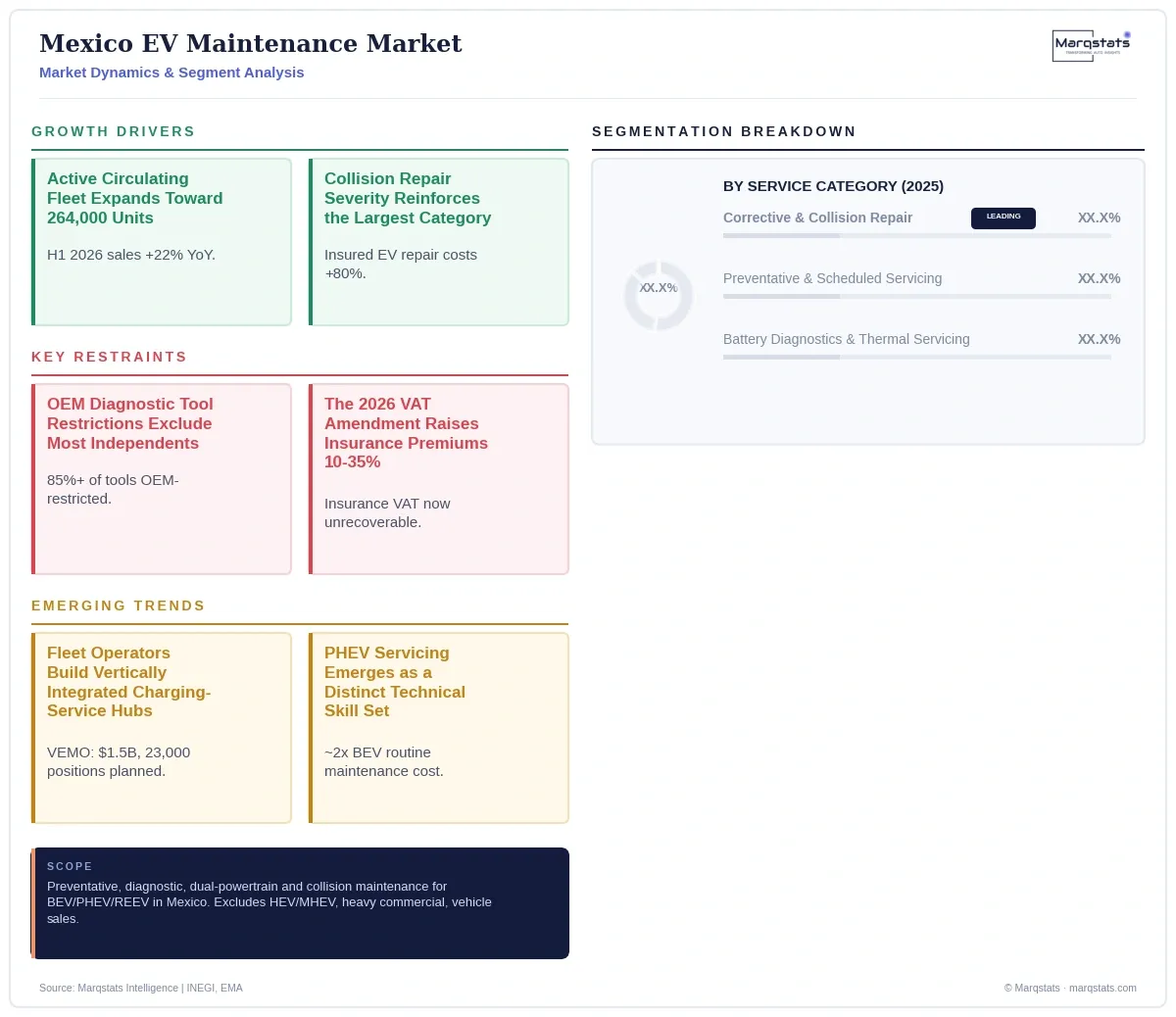
Market Segmentation
USD 70.46 million (35.00% share) in 2025; projected at USD 258.72 million (30.00% share) by 2030. Anchored by BYD Company Limited's franchised dealer menu pricing.
USD 104.69 million (52.00% share) in 2025; projected at USD 431.20 million (50.00% share) by 2030. The largest category by a wide margin, anchored by AXA Seguros's own claims severity data.
USD 26.17 million (13.00% share) in 2025; projected at USD 172.48 million (20.00% share) by 2030. The fastest-growing category as the fleet ages, anchored by ZF Friedrichshafen AG's component supply.
USD 163.35 million (54.00% share) in 2025; projected at USD 344.96 million (40.00% share) by 2030. Anchored by BYD Company Limited; generates roughly double the routine maintenance spend of BEVs.
USD 136.12 million (45.00% share) in 2025; projected at USD 474.32 million (55.00% share) by 2030. The fastest-growing propulsion segment by share, anchored by Tesla, Inc.
USD 3.02 million (1.00% share) in 2025; projected at USD 43.12 million (5.00% share) by 2030. A small but growing niche, anchored by Stellantis N.V. / Leapmotor International.
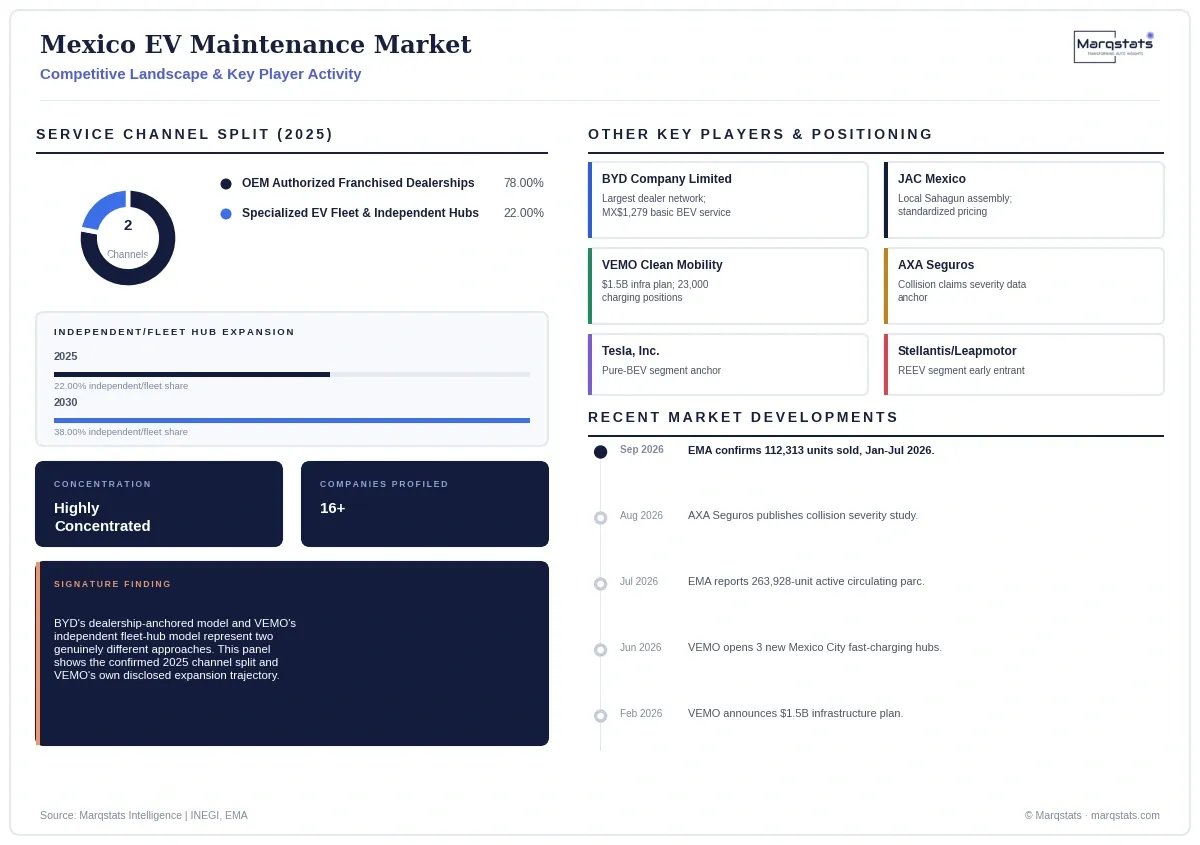
USD 157.03 million (78.00% share) in 2025; projected at USD 534.69 million (62.00% share) by 2030. Anchored by BYD Iztacalco; dominant due to diagnostic tool and software access restrictions.
USD 44.29 million (22.00% share) in 2025; projected at USD 327.71 million (38.00% share) by 2030. The fastest-growing channel, anchored by VEMO Clean Mobility S.A.P.I. de C.V.
By Geography
Valley of Mexico Metropolitan Area (CDMX & Estado de Mexico)
52.00% share (approximately 137,242 units) in 2026, anchored by the Hoy No Circula traffic and tax exemption framework that structurally favors electrified vehicle ownership across Mexico's largest metropolitan corridor.
Monterrey Metropolitan Area (Nuevo Leon)
18.00% share (approximately 47,507 units) in 2026, driven by industrial fleet adoption and VEMO's own hub expansion into San Pedro Garza Garcia and surrounding areas.
Guadalajara Metropolitan Area (Jalisco)
12.00% share (approximately 31,671 units) in 2026, driven by last-mile logistics and ride-hailing fleet electrification.
Bajio Manufacturing Corridor (Guanajuato, Queretaro, Aguascalientes)
10.00% share (approximately 26,393 units) in 2026, driven by automotive supply chain corporate fleet deployment across Mexico's manufacturing heartland.
Rest of Mexico (Puebla, Veracruz, Border States)
8.00% share (approximately 21,115 units) in 2026, driven by emerging highway corridor charging infrastructure still in early-stage deployment.
How Competition Is Evolving
No single company in this market spans franchised dealership servicing, specialized fleet hub operations and collision insurance underwriting simultaneously, leaving genuine competitive white space for any group capable of bridging BYD's dealership-anchored warranty servicing with the independent and insurance-driven channels this market's own segmentation shows already capturing over half of total expenditure today.
Competition spans OEM authorized franchised dealerships, specialized fleet and independent service hubs, and an insurance-driven collision repair ecosystem, with diagnostic tool access restrictions structurally favoring the first channel. BYD Company Limited anchors the largest single market share through its dealership network, led by BYD Iztacalco's published preventative and dual-powertrain service menus. Anhui Jianghuai Automobile Group Corp., Ltd. (JAC Mexico) leverages local assembly in Sahagun, Hidalgo to standardize routine servicing pricing at MX$13,744 across its dealer network, establishing a parts-availability advantage over purely imported Chinese nameplates. Tesla, Inc. anchors the pure-BEV segment, while Stellantis N.V., through its Leapmotor International partnership, is establishing an early foothold in the range-extended electric vehicle category.
On fleet and independent servicing, VEMO Clean Mobility S.A.P.I. de C.V. anchors the specialized hub model, backed by Vision Ridge Partners' USD 250 million Series B investment and its own announced USD 1.5 billion, 23,000-position infrastructure expansion plan across Mexico City and Monterrey. On insurance and collision repair, AXA Seguros S.A. de C.V. anchors underwriting and claims severity analysis for the segment, directly shaping premium structures and repair standards industry-wide. Regulatory and statistical oversight rests with INEGI (statutory registration data), the Electro Movilidad Asociacion (EMA), the Asociacion Mexicana de la Industria Automotriz (AMIA), and the Asociacion Mexicana de Distribuidores de Automotores (AMDA).
Companies Covered
The report profiles 16+ companies with full strategy and financials analysis, including:
Recent Market Activity
Table of Contents
Coverage & Segmentation
This report measures routine preventative servicing, high-voltage battery diagnostic checks, dual-powertrain mechanical maintenance for PHEVs and REEVs, thermal management system fluid replacement, and collision and corrective component repairs for battery electric, plug-in hybrid, and range-extended electric vehicles in Mexico, across a 2025 base year and a 2026 to 2030 forecast period, denominated in United States dollars at a fixed reference rate of 17.00 MXN/USD reflecting June 2026 benchmarks. It excludes non-plug-in conventional hybrids (HEVs, MHEVs), heavy commercial vehicles monitored by ANPACT, and whole vehicle sales revenue.
The analysis spans three segmentation dimensions — service category, propulsion type and service channel — five regional geographies, and 16 profiled entities across OEMs, fleet operators, insurers and regulatory bodies. Fleet and registration figures trace to INEGI and EMA; market value and 2025/2026 segment splits trace to the underlying research's own fully partitioned sizing model, with 2030 segment projections disclosed as a Marqstats construction.