Market Snapshot
Key Takeaways
Market Overview & Analysis
Report Summary
This analysis reads Portugal's own fully worked sizing chain, regulatory framework, and regional distribution data together as a single coherent picture rather than isolated data points, since the underlying research itself was structured to support exactly that kind of integrated reading.
Portugal's EV maintenance market is measured across tyres and alignment, scheduled preventive servicing, high-voltage diagnostics, mechanical suspension and braking, and traction battery repair, valued at USD 207.88 million (EUR 192.48 million) in 2025. This figure is taken directly from the underlying research's own fully worked sizing chain, anchored to statutory fleet data covering 441,567 active plug-in vehicles.
Structurally, this is a market shaped by a genuine regulatory quirk: a March 2026 mandatory recall inspection rule systematically redirects electric vehicles back to franchised dealers regardless of independent workshop capability, even as the broader aging parc and surging used vehicle imports otherwise favor independent and fast-fit channel growth.
The analysis is built for four reader types making different decisions: an independent workshop operator weighing SERMI accreditation and CEPRA technician certification investment against the recall-driven dealer channel advantage, a fast-fit chain expanding high-voltage bay coverage into secondary towns, a corporate leasing provider negotiating centralized maintenance agreements, and an investor tracking how parc aging and used-import volume shape this market's forward channel mix.
A Regulation That Quietly Undoes Years of Independent Workshop Progress
Portugal's independent aftermarket has been building genuine capability for years -- SERMI accreditation, CEPRA-certified technicians, dedicated high-voltage bays. A single roadworthiness inspection rule, effective March 2026, threatens to redirect a meaningful share of that hard-won volume back to franchised dealers, almost as a side effect.
The mechanism has nothing to do with technical competence. An independent workshop with full SERMI accreditation and a Nível 3 certified technician can perform the actual repair work an open recall requires -- but they can't close the recall alert on the statutory vehicle database, because that specific action requires authorized OEM diagnostic credentials independents don't hold. Since electric vehicles carry elevated recall frequency for battery management firmware and high-voltage relays specifically, this narrow administrative gap has outsized consequences precisely for the vehicle category independents have invested most heavily in servicing.
Why the Routine-Savings Story Gets More Complicated as Vehicles Age
Portugal's own cost data confirms the familiar EV maintenance story at a glance: 35% to 45% lower scheduled maintenance than ICE equivalents. Read further into the same data, and the picture becomes genuinely more nuanced.
Certified high-voltage labor in Portugal costs EUR 65.00 to EUR 95.00 per hour, against EUR 42.00 to EUR 65.00 for standard mechanical work -- a premium that specifically applies to the diagnostic and battery-related work that becomes more frequent as the fleet ages. The pack's own average-annual-spend projections make this explicit: average BEV expenditure rises from EUR 295.00 in 2021 to a projected EUR 442.00 by 2030, driven specifically by vehicles entering the six-to-ten-year age bracket requiring suspension renewals, contactor replacements, and battery re-balancing. The routine-savings advantage is real early in a vehicle's life; it narrows considerably as the fleet matures into exactly the servicing categories that command the highest labor premium.
Market Dynamics
Key Drivers
- SERMI accreditation and CEPRA technician certification, while representing genuine capital and training investment for independent workshops, also function as a durable competitive differentiator once achieved, since they directly unlock the security-gated diagnostic access dealer networks would otherwise monopolize.
- Portugal's own regional data shows a meaningful gap between where vehicles are registered and where they actually circulate, since corporate leasing fleets registered in the Lisbon metropolitan area disperse a documented 15% to 20% of their real-world driving activity into Norte and Centro, sustaining service demand across regional networks outside the capital that pure registration data alone would understate.
- Portugal's own fully worked sizing chain shows tyres, alignment and balancing already the single largest service category at 34.50% of total value, a structural signal that specialized tyre inventory and precision alignment capability represent the most immediate revenue opportunity for workshops entering this market, given the region's high curb weights and instant torque delivery.
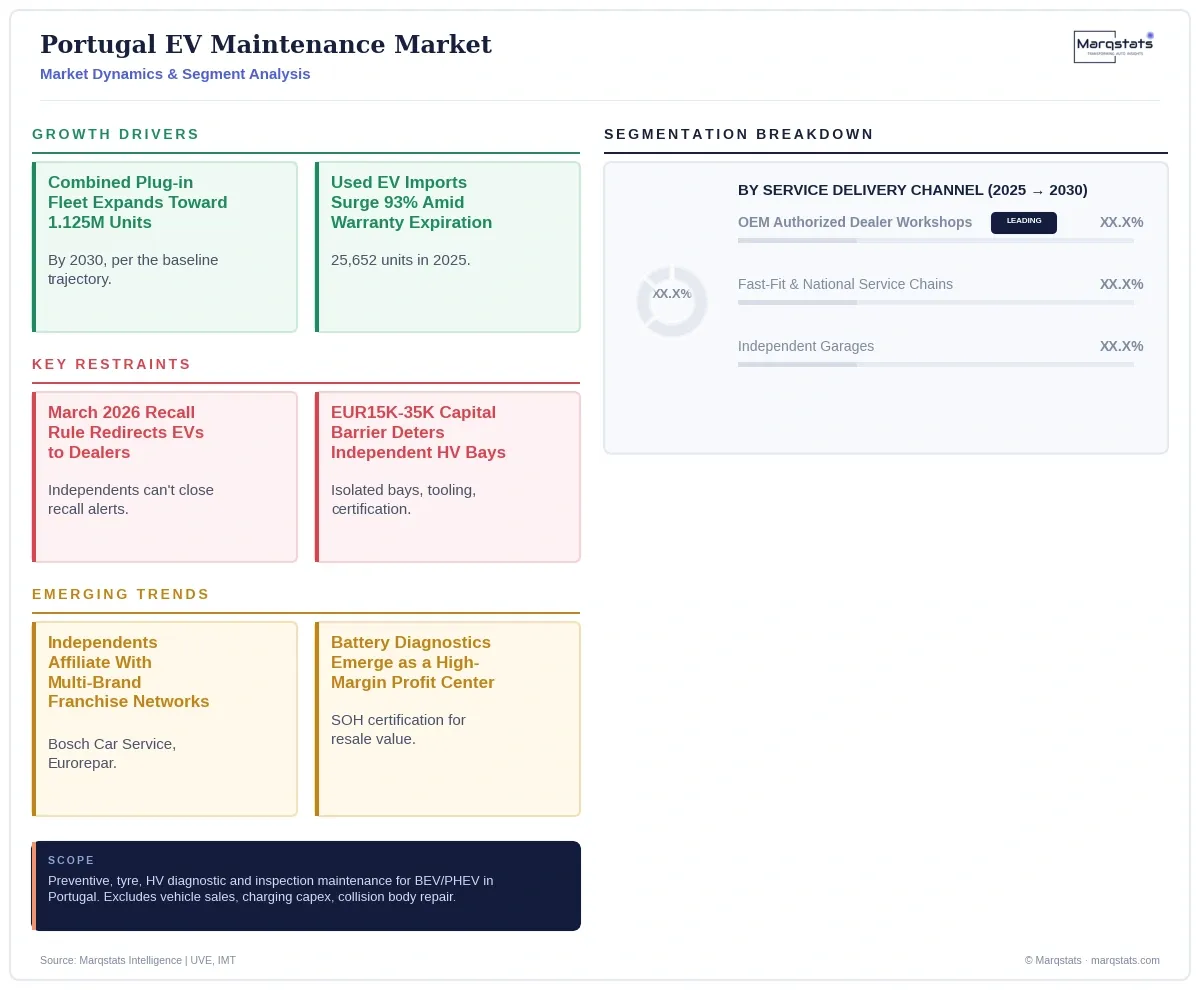
- Portugal's combined plug-in fleet is expanding rapidly, from 441,567 units in 2025 toward a projected 1,125,000 units by 2030, directly growing the addressable base for recurring EV aftermarket maintenance demand.
- Imported used electric vehicles surged 93.10% over 2024 volumes to 25,652 units in 2025, arriving near or beyond factory warranty expiration and bypassing authorized dealer networks entirely upon registration, directly accelerating independent and fast-fit channel demand.
- Corporate leasing providers Ayvens, Arval and Leasys, managing the majority of Portugal's electrified fleet, are sustaining structured framework agreements that favor service networks offering nationwide coverage and automated billing interfaces.
- Fast-fit chains including MyForce (90-plus sites nationwide) and Roady (EV servicing across over 60% of its national network) are scaling certified scheduled maintenance and tyre service capacity specifically for the growing electric fleet.
- The entry of Chinese manufacturers BYD, XPENG, MG and Zeekr, partnering with established distribution groups like Salvador Caetano rather than building independent retail networks, is expanding authorized high-voltage repair coverage in Lisbon and Porto.
Key Restraints
- Portugal's aging national vehicle parc, averaging 13.4 years across all powertrains, sits in genuine contrast to the still-young electrified fleet, meaning workshops built around the country's dominant ICE servicing base may need meaningful reinvestment to capture the specific high-voltage servicing opportunity this younger, fast-growing electrified segment represents.
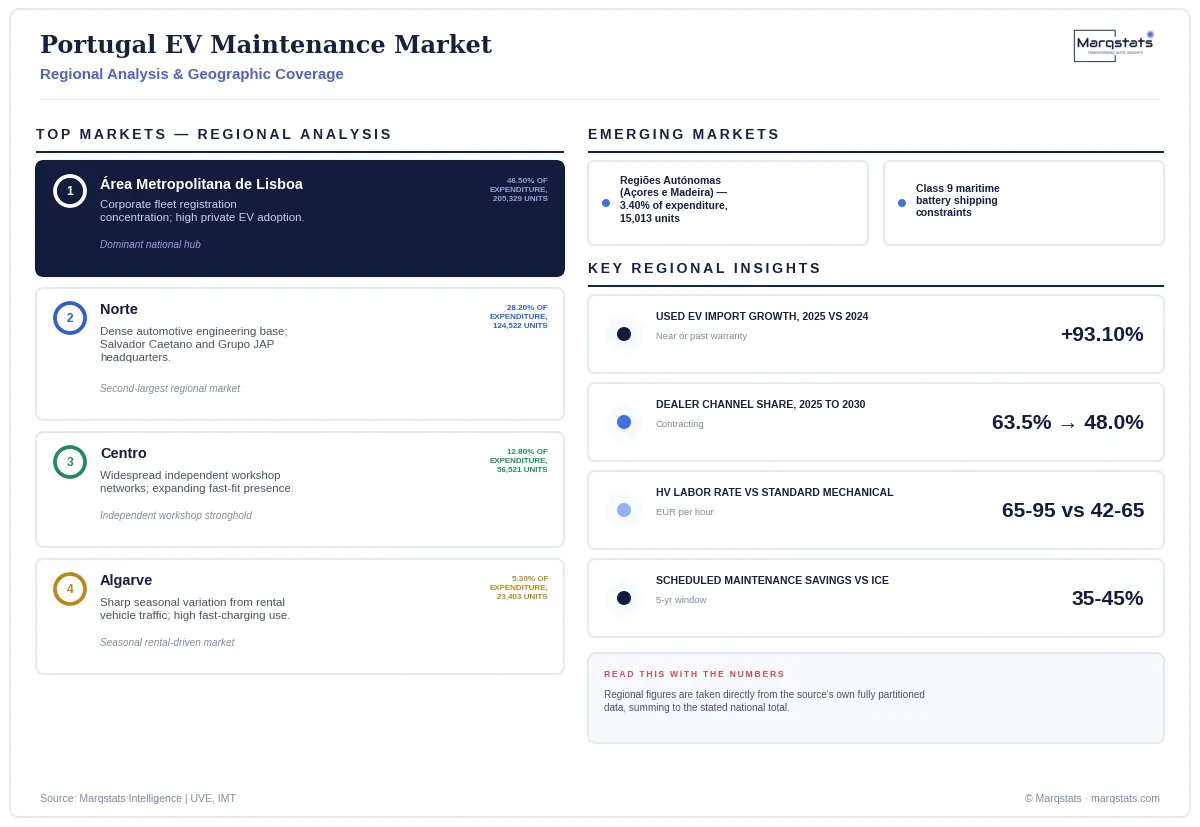
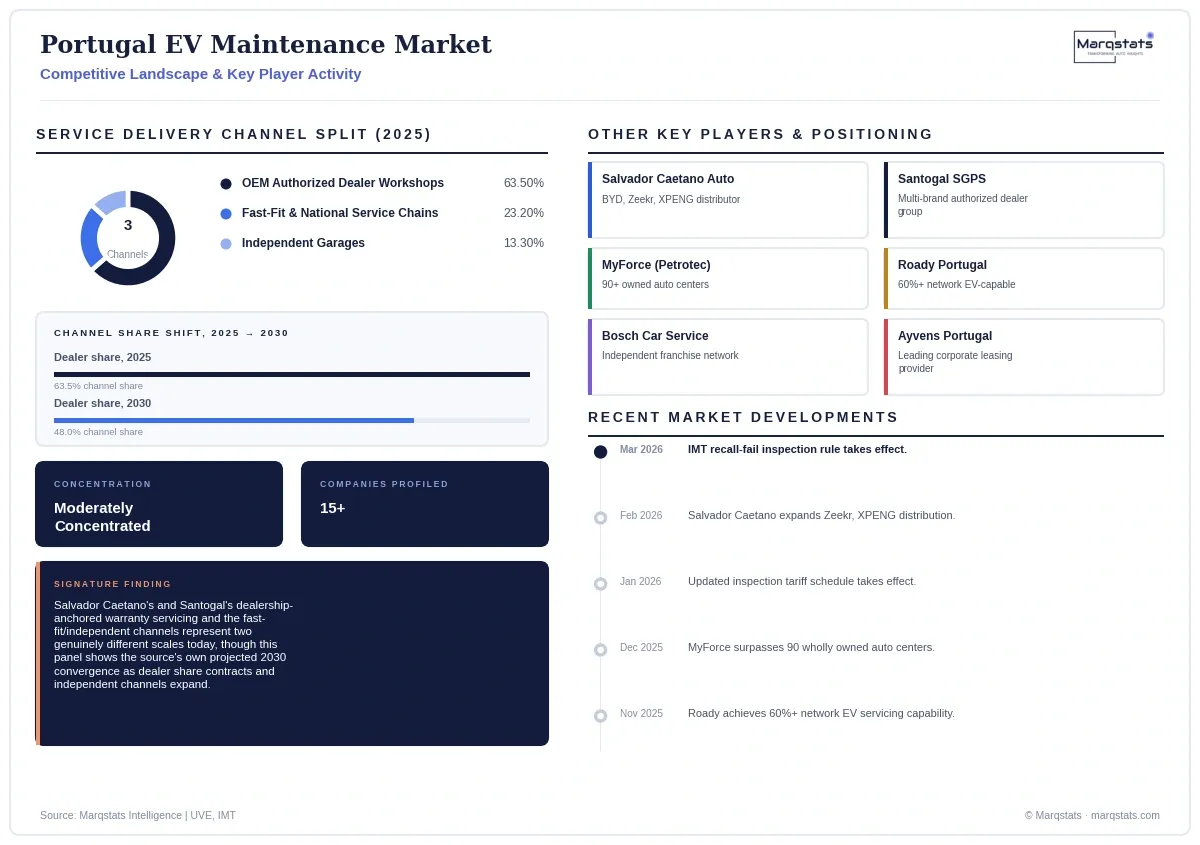
- This market's own channel-share projections show a genuinely significant structural shift underway, with authorized dealer share contracting 15.5 percentage points from 63.50% to 48.00% between 2025 and 2030 -- a disclosed trajectory reflecting real confidence in independent and fast-fit channel expansion, not a marginal adjustment around a stable status quo.
- An IMT directive effective March 2026 requires automatic inspection failure for any vehicle with an uncompleted manufacturer recall, systematically redirecting electric vehicles -- which exhibit elevated recall frequency -- back to franchised dealers regardless of independent workshop technical capability or SERMI accreditation status.
- Equipping a workshop for high-voltage intervention requires EUR 15,000 to EUR 35,000 in dedicated capital investment for isolated lift bays, insulated tooling and technician certification, a genuine barrier accelerating consolidation pressure on single-bay independent garages.
- Proprietary Over-the-Air telemetry systems and encrypted Security Gateways increasingly restrict diagnostic and maintenance access for connected electric vehicles, requiring ongoing SERMI accreditation renewal for independent workshops to retain fair, non-discriminatory repair data access.
- The Autonomous Regions of the Azores and Madeira face genuine island logistics barriers, since international maritime regulations prohibit air freight shipment of degraded or damaged high-voltage traction batteries, requiring Class 9 hazardous maritime cargo transport that lengthens repair turnaround and raises costs.
Key Trends
- Regional service capacity is beginning to diverge meaningfully between the Lisbon-Porto corridor and Portugal's more dispersed interior and island regions, raising genuine open questions about whether fast-fit expansion or mobile diagnostic units will emerge first to close the servicing gap facing Alentejo and the Autonomous Regions specifically.
- Corporate fleet managers are increasingly negotiating dedicated maintenance service level agreements directly with fast-fit chains offering nationwide coverage, given the documented automated billing and consistent turnaround these networks can offer over fragmented independent-garage relationships.
- Independent workshops are increasingly affiliating with multi-brand franchise networks including Bosch Car Service and Eurorepar to access shared technical support, pooled training resources and collective commercial agreements, rather than absorbing high-voltage capital costs individually.
- Specialized battery diagnostic testing and state-of-health certification are emerging as high-margin profit centers, supplying the verified technical valuations needed to protect used electric vehicle residual values across Portugal's expanding secondary market.
- CEPRA's expanded 2026 vocational curriculum is increasing national output of Nível 2 certified high-voltage technicians, directly easing the workshop labor bottleneck constraining multi-brand repair center expansion.
- Fast-fit chains are extending EV servicing capability into secondary towns and regional markets outside the primary Lisbon-Porto corridor, reducing the geographic servicing disparities the underlying research documents across Portugal's more dispersed regions.
Strategic Implications
- Component suppliers should also weight low-conductivity dielectric coolant and specialized EV tyre inventory planning heavily nationwide, given how directly the underlying research ties both categories to the fleet's largest single service revenue drivers.
- Independent workshop operators should prioritize SERMI accreditation and CEPRA Nível 2/3 technician certification specifically to remain competitive as the parc ages past warranty, while recognizing that the March 2026 recall-inspection rule will continue channeling a share of EV volume back to dealers regardless of independent technical readiness.
- Fast-fit and national service chains should continue expanding high-voltage bay coverage into secondary towns and regional markets, given how directly the underlying research shows this channel capturing share from franchised dealers as the fleet matures toward the six-to-ten-year servicing-intensive age bracket.
- Corporate leasing providers and fleet managers should negotiate maintenance agreements that explicitly account for the recall-inspection channel dynamic, ensuring fleet vehicles maintain current recall status to avoid unplanned dealer-network routing during statutory inspection cycles.
- Investors and analysts should track independent workshop SERMI accreditation rates and CEPRA technician certification output nationwide as the clearest variables shaping whether this market's channel mix shifts toward independents as projected, or remains constrained by the recall-inspection dynamic favoring dealers.
Outlook
Unlike several other markets in this coverage set, the underlying research presents a single directly-stated baseline trajectory reaching 2030 within its own forecast horizon, requiring no Marqstats extrapolation, rather than a fully quantified multi-scenario framework with named Downside and Upside 2030 figures. The pack's own narrative discussion identifies three structural forward drivers shaping this trajectory instead of naming alternate scenarios.
Total market value grows from USD 207.88 million (EUR 192.48 million) in 2025 to USD 563.38 million (EUR 521.65 million) by 2030, a 22.07% CAGR, as Portugal's combined plug-in fleet expands from 441,567 units to a projected 1,125,000 units. This trajectory is driven by three named structural shifts: the aging domestic parc combined with surging used-vehicle imports will steadily diminish franchised dealer dominance, with OEM authorized dealer channel share projected to contract from 63.50% in 2025 to 48.00% by 2030 as fast-fit networks and independent garages expand to 31.50% and 20.50% respectively; capital expenditure requirements for high-voltage servicing infrastructure (EUR 15,000 to EUR 35,000 per workshop) will accelerate consolidation among independent operators toward multi-brand franchise networks; and corporate operational leasing providers will continue determining commercial terms and channel distribution across the aftermarket, given their management of the majority of the national electric vehicle parc.
Marqstats presents this single baseline trajectory throughout this analysis rather than constructing alternate Downside or Upside scenario figures the underlying research did not provide, consistent with house policy against fabricating scenario numbers absent from the source.
Market Segmentation
USD 132.00 million (63.5% share) in 2025, growing to USD 270.42 million (48.0% share) by 2030. Sustained by manufacturer warranty conditions and corporate leasing service agreements, led by Salvador Caetano and Santogal.
USD 48.23 million (23.2% share) in 2025, growing to USD 177.46 million (31.5% share) by 2030. Expanding fastest, led by MyForce, Norauto, Midas, Roady and Feu Vert.
USD 27.65 million (13.3% share) in 2025, growing to USD 115.49 million (20.5% share) by 2030. Constrained by high-voltage capital costs, led by Bosch Car Service and Eurorepar affiliates.
USD 71.72 million (34.5% share) in 2025. The largest category, driven by rapid torque delivery and high curb weight from battery packs.
USD 51.97 million (25.0% share) in 2025. Anchored by cabin filtration, brake fluid analysis and statutory inspection preparation.
USD 35.34 million (17.0% share) in 2025. Anchored by BMS firmware calibration, telematics updates and bus communication error resolution.
USD 31.18 million (15.0% share) in 2025. Anchored by silent block degradation, ball joint play and brake disc corrosion.
USD 17.67 million (8.5% share) in 2025. Anchored by module re-balancing, coolant loop flushes and high-voltage contactor wear.
By Geography
Área Metropolitana de Lisboa (AML)
46.50% of national expenditure (205,329 active plug-in units), driven by corporate fleet registration concentration and high private electric vehicle adoption, with an estimated 15% to 20% of registered corporate vehicles circulating continuously in Norte and Centro.
Norte (Porto, Braga, Aveiro)
28.20% of national expenditure (124,522 active plug-in units), supported by a dense automotive engineering base and the corporate headquarters of major retail groups including Salvador Caetano and Grupo JAP.
Centro (Coimbra, Leiria, Viseu)
12.80% of national expenditure (56,521 active plug-in units), characterized by widespread independent workshop networks and expanding fast-fit franchise presence.
Algarve (Faro, Portimão)
5.30% of national expenditure (23,403 active plug-in units), exhibiting sharp seasonal variations in fleet utilization linked to rental vehicle traffic and high fast-charging utilization.
Alentejo (Évora, Beja)
3.80% of national expenditure (16,779 active plug-in units), presenting structural servicing challenges from geographic dispersion and low workshop density.
Regiões Autónomas (Açores e Madeira)
3.40% of national expenditure (15,013 active plug-in units), where island geography reduces range anxiety but introduces Class 9 hazardous maritime shipping requirements and costs for damaged battery transport.
How Competition Is Evolving
Portugal's OEM authorized channel remains genuinely competitive against new entrants.
No single company in this market spans franchised warranty-anchored dealership servicing, national fast-fit chain operations, and independent multi-brand affiliation simultaneously, leaving genuine competitive white space for any group capable of bridging Salvador Caetano's and Santogal's dealership-anchored warranty servicing with the fast-fit and independent channels this market's own scenario framework shows gaining nearly 16 percentage points of combined share by 2030.
Competition spans OEM authorized dealer conglomerates, national fast-fit chains, and affiliated independent workshops. Salvador Caetano Auto, Santogal, Grupo JAP, Carclasse and C. Santos VP anchor the dominant authorized dealer channel, with Salvador Caetano further expanding as the Portuguese distribution partner for Chinese entrants BYD, Zeekr and XPENG. On the fast-fit side, MyForce (Petrotec Group) operates over 90 wholly owned auto centers nationwide, while Roady Portugal has achieved EV servicing capability across more than 60% of its national network and Norauto Portugal continues expanding high-voltage bay coverage.
Independent workshops increasingly affiliate with multi-brand franchise networks including Bosch Car Service, Eurorepar and TOPCAR to access shared technical support and pooled training resources. Corporate fleet demand is mediated by leasing providers Ayvens (combining ALD Automotive and LeasePlan), Arval and Leasys. Regulatory and standards oversight rests with the Instituto da Mobilidade e dos Transportes (IMT), CEPRA (technician certification), and trade associations ARAN, ANECRA and DPAI/ACAP (SERMI accreditation coordination with SGS).
Companies Covered
The report profiles 15+ companies with full strategy and financials analysis, including:
Recent Market Activity
Table of Contents
Coverage & Segmentation
The analysis measures scheduled preventive servicing, unscheduled mechanical repairs, chassis wear parts, tyre replacements, high-voltage electrical diagnostics, and statutory vehicle inspections for BEV and PHEV vehicles in Portugal, across a 2025 base year and a 2026 to 2030 forecast period, denominated in United States dollars at the pack's own stated benchmark rate of 1.08 USD per EUR. It excludes vehicle sales, charging infrastructure capital costs, and structural collision body repairs.
The analysis spans two segmentation dimensions — service delivery channel and technical service category — six NUTS II regional geographies, and 15 profiled entities across OEM distributors, fast-fit chains and regulatory bodies. Fleet figures trace to the Associação de Utilizadores de Veículos Elétricos; market value and both segmentation dimensions trace directly to the underlying research's own fully worked sizing model, with both 2025 and 2030 figures directly source-stated throughout.