Market Snapshot
Middle bar: base-year value × (1 + CAGR), rounded to two decimals. This is a calculated illustration, not a separately researched annual estimate.
Market Size (2025, Base Year): USD 252.26 Million
Estimated Value (2026): USD 308.36 Million
Forecast Value (2030): USD 659.68 Million
CAGR: 21.21% | Forecast Period: 2026 – 2030
Growth — Absolute: USD 407.42 Million
Largest Region: Utrecht, Flevoland & Noord-Holland (8.00% of national BEV parc each)
Fastest Growing: Light Commercial BEVs (8.32% to 9.85% share, 2025-2030)
Dominant Segment: Tires, Wheels & Alignment (42.50% of 2025 market value)
Market Concentration: Moderately Fragmented
Base Year: 2025 | Historical Period: 2021 – 2025 | Forecast Period: 2026 – 2030
Units Considered: Value (USD Million)
Segments Covered: 2 | Regions Covered: 12 | Companies Profiled: 14
Report Pages: 240 | Deliverables: PDF, Excel, PPT
Key Takeaways
Market Overview & Analysis
Report Summary
This analysis reads the Netherlands' own fully worked sizing chain, regional distribution data, and named-scenario fiscal framework together as a single coherent picture rather than isolated data points, since the underlying research itself was structured to support exactly that kind of integrated reading.
The Netherlands pure BEV maintenance market is measured across tires and alignment, routine servicing, high-voltage systems, and cabin/software diagnostics, valued at USD 252.26 million (EUR 232.50 million) in 2025. This figure is taken directly from the underlying research's own fully worked sizing chain, anchored to RVO and CBS registry data covering an active passenger BEV fleet of 770,453 units and an e-LCV fleet of 66,080 units as of August 2026.
Structurally, this is a market defined by a genuine industry-wide revenue paradox -- fleet growth accelerating while total workshop revenue contracts -- layered on top of a conventional Motor Vehicle Tax phase-out, a commercial LCV segment reshaped almost overnight by regulatory mandate, and a documented technician certification bottleneck.
The analysis is built for four reader types making different decisions: an independent garage operator weighing NEN 9140 and SERMI compliance investment against declining per-vehicle ticket size, a lease company or fleet manager navigating the MRB tax phase-out, a franchised dealer group defending warranty-anchored revenue, and an investor tracking how zero-emission zone enforcement and weight-based tax surcharges shape this market's scenario range.
A Market Where More Cars on the Road Means Less Money in the Workshop
Most EV maintenance markets in this coverage set tell a growth story. The Netherlands tells a genuinely different one, and it's worth tracing through exactly how a bigger fleet produces a smaller revenue pool.
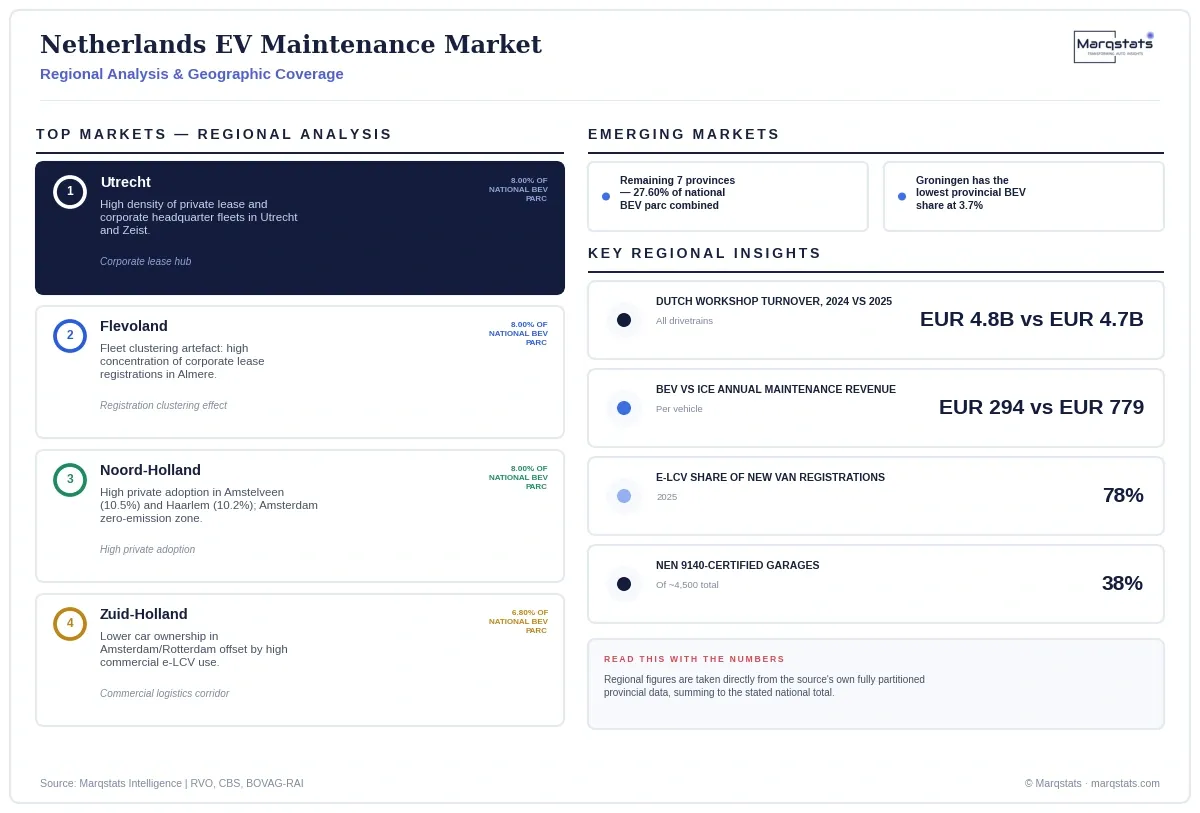
Total Dutch workshop aftersales turnover across all drivetrains fell EUR 100 million in 2025, from EUR 4.8 billion to EUR 4.7 billion, even as the country's total active passenger car fleet expanded to 9.4 million vehicles -- more cars generating less total workshop revenue. The mechanism is direct and quantifiable: a pure BEV generates EUR 294 in annual maintenance revenue, against EUR 779 for the conventional car it's replacing, a 62.26% reduction per vehicle, every single year that vehicle stays on the road. Fleet growth is real and fast, but it cannot mathematically offset a per-vehicle revenue cut of that size once BEV adoption crosses a certain share of the fleet. Workshops aren't losing customers here -- they're keeping the same customers and making meaningfully less money from each of them.
Why a Repealed Tax Exemption Reshaped an Entire Vehicle Segment in One Year
Commercial light commercial vehicle electrification in the Netherlands didn't happen gradually. It happened because one specific tax change made the ICE alternative suddenly uneconomical, and it's worth understanding the mechanism.
The January 2025 repeal of BPM tax exemptions for ICE vans, combined with mandatory zero-emission city logistics zones, drove electric vans to a 78% share of new LCV registrations in 2025. The flip side of that number is just as striking: ICE van sales collapsed 84%, from 130,000 units in 2024 to just 20,774 in 2025. That's not a gradual segment shift -- it's a near-total reversal within a single calendar year, rapidly converting commercial fleet aftersales toward the lower-maintenance-revenue electric powertrains that anchor the structural revenue-compression story told throughout this analysis.
Market Dynamics
Key Drivers
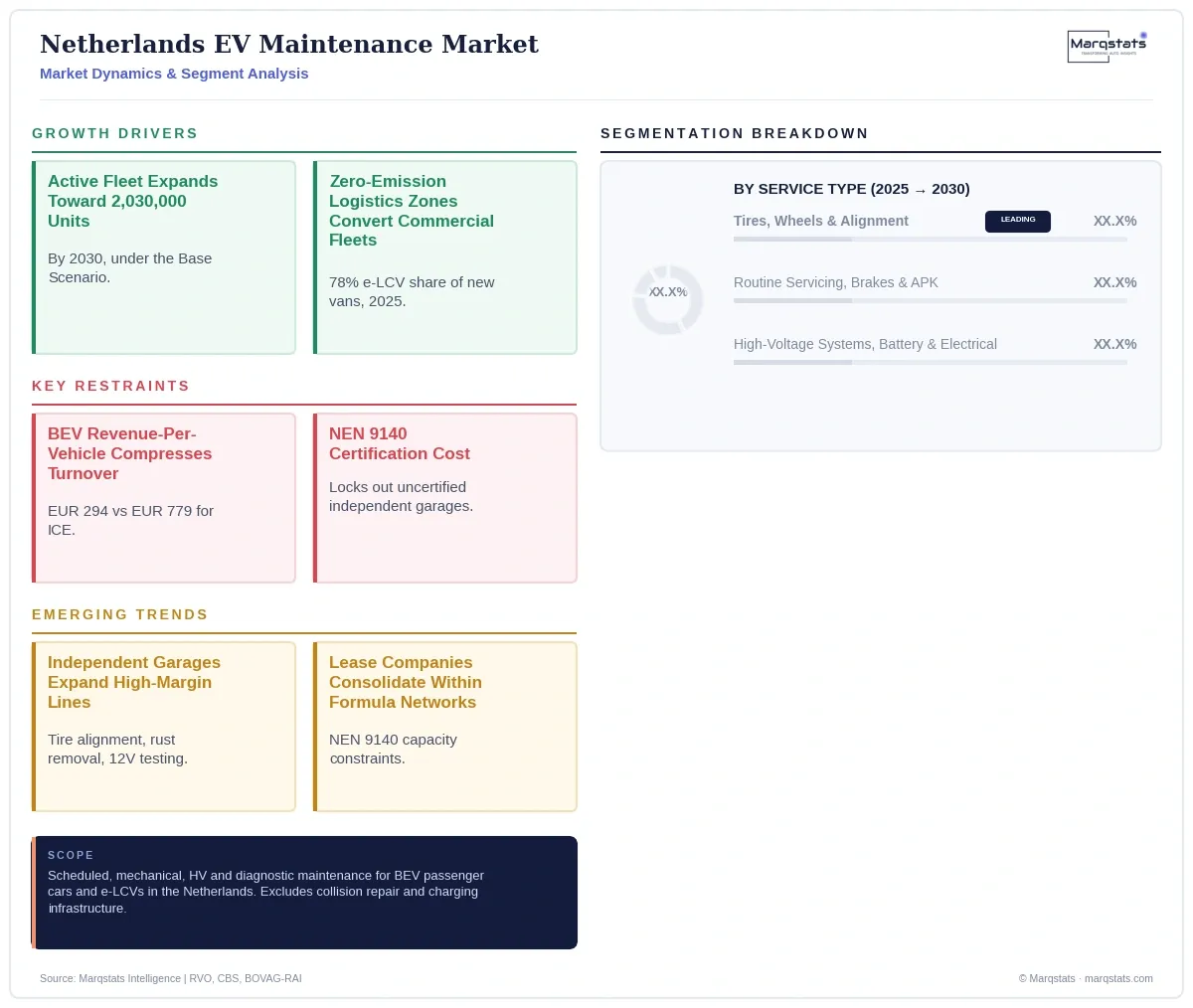
- The 78% e-LCV share of new commercial registrations in 2025, following the collapse of ICE van sales, is directly accelerating a wholesale conversion of commercial fleet aftersales toward electric-specific servicing categories nationwide.
- Private lease drivers under all-inclusive maintenance contracts, visiting workshops 1.45 times per year, are directly generating fixed contract revenue for garage networks that private outright-ownership buyers -- who spend 22% less annually and skip optional inspections until mandatory APK dates -- do not sustain to the same degree.
- This market's own regional data shows a genuine corporate registration effect, since lease fleets registered under Flevoland and Utrecht headquarters disperse a documented share of real-world commuting and delivery mileage into surrounding provinces, sustaining service demand pure registration data alone would understate.
- This market's own fully worked sizing chain shows tires, wheels and alignment already the single largest service category at 42.50% of total value, a structural signal that specialized low-rolling-resistance tire inventory represents the most immediate revenue opportunity for workshops entering this market.
- The Netherlands' active BEV fleet is expanding rapidly, from 783,000 units in 2025 toward a projected 2,030,000 units by 2030 under the Base Scenario, directly growing the addressable base for recurring EV aftermarket maintenance demand.
- Mandatory zero-emission city logistics zones and the January 2025 BPM exemption repeal for ICE vans are directly converting commercial fleet aftersales toward electric powertrains, with e-LCVs reaching a 78% share of new LCV registrations in 2025.
- First-generation BEVs passing their 8-year/160,000 km factory battery warranty limits are directly expanding demand for battery health diagnostic certification and 12V auxiliary battery replacements as essential independent workshop services.
- Innovam's NEN 9140 certification programs and OOMT's technician upskilling grants are directly expanding the pool of high-voltage-qualified Work Responsible (EV-VP) technicians available to independent garages.
- The used EV market's expansion to 2.1 million transactions in 2025 is directly widening the pool of out-of-warranty BEVs requiring independent-channel battery health diagnostics and mechanical servicing.
Key Restraints
- Commercial depot charging maintenance spend sitting outside statutory vehicle aftersales series genuinely understates total enterprise fleet EV uptime expenditure nationwide, a documented gap the underlying research itself flags as unresolved.
- The 12V lead-acid auxiliary battery failure mode -- accounting for 18% of non-scheduled BEV garage interventions despite the vehicle's massive high-voltage traction pack -- genuinely constrains the narrative that electrification eliminates roadside breakdown risk, sustaining a recurring low-voltage service category most owners don't anticipate.
- The Netherlands' documented gap in official reporting on out-of-warranty high-voltage battery module repair spend genuinely constrains market transparency for independent workshops and analysts alike, since neither RDW nor NEN publishes a breakdown between OEM franchised dealers and independent garages for this specific service category.
- A pure BEV generating 62.26% less annual maintenance revenue than the ICE vehicle it replaces directly compresses total workshop turnover industry-wide, a structural headwind fleet volume growth alone cannot offset once BEV adoption crosses a critical fleet share.
- NEN 9140 certification costing EUR 1,500 to EUR 3,000 per technician directly locks independent garages lacking that investment out of lease fleet maintenance networks, since only 38% of the roughly 4,500 active garage businesses currently hold this certification.
- The Motor Vehicle Tax (MRB) discount phase-out from 75% in 2025 to 0% by 2030 directly raises total cost of ownership for private EV owners, increasing price sensitivity for out-of-warranty aftersales services precisely as the fleet ages into that servicing window.
- This market's own three-scenario framework spans a genuinely wide 2030 range, from USD 537.29 million under the Downside Scenario to USD 776.32 million under the Upside Scenario -- a disclosed spread reflecting real uncertainty in zero-emission zone enforcement and weight-based tax surcharge timing, not a narrow band around a single central estimate.
Key Trends
- Fleet operators managing heavy-duty e-LCVs under zero-emission city logistics mandates are directly negotiating dedicated depot maintenance contracts with commercial-focused service providers, given the documented higher annual mileage and heavier duty cycles these platforms carry relative to passenger BEVs.
- Regional service capacity is beginning to diverge sharply between the corporate lease corridors of Utrecht and Flevoland and the rural provinces of Groningen and Fryslan, raising genuine open questions about whether NEN 9140-certified capacity will expand evenly or continue concentrating around the lease-heavy corridors driving this market's current growth.
- Universal independent garages are directly expanding high-margin service lines -- precision tire alignment, brake disc rust removal, climate control heat-pump maintenance, and preventive 12V auxiliary battery testing -- to offset declining scheduled-service revenue per vehicle.
- SERMI diagnostic accreditation is directly channeling high-voltage battery management system access toward certified formula chains, since independent garages lacking accreditation cannot perform BMS software resets and forfeit EV fleet maintenance contracts as a result.
- Lease companies controlling roughly 50% of the active BEV passenger fleet are directly consolidating maintenance work within major formula networks as NEN 9140 technician capacity constraints limit independent-garage eligibility for fleet contracts.
- Brake service is directly shifting from pad replacement toward disassembly, cleaning and rust removal, since regenerative braking cuts wear rates 2 to 3 times slower than ICE vehicles but under-use accelerates surface corrosion and caliper seizure.
Strategic Implications
- Franchised dealers should also weight preventive 12V auxiliary battery testing heavily in scheduled-service upsell menus nationwide, given how directly this unexpected failure mode sustains recurring revenue even as scheduled fluid-service line items disappear entirely under electrification.
- Insurers and lease companies should also weight brake disc rust removal and caliper seizure prevention heavily in maintenance contract design nationwide, given how directly regenerative braking's reduced wear intervals interact with the Netherlands' wet maritime climate to shift failure modes from pad wear to corrosion.
- New market entrants should commit capital directly to high-density regional lease corridors such as Utrecht, Flevoland and Noord-Holland specifically, establishing dedicated EV facilities with NEN 9140-certified technicians to secure high-margin commercial fleet contracts from major VNA lease companies.
- Universal independent garage operators should upgrade workshop bays to NEN 9140 safety standards and secure SERMI diagnostic accreditation immediately specifically, to prevent customer churn and protect margins against declining scheduled-service revenue.
- Parts distributors and equipment manufacturers should shift inventory allocation away from engine consumables toward low-rolling-resistance EV tires, suspension bushings, and high-voltage insulation tools specifically, given how directly these categories anchor this market's largest documented service revenue drivers.
- Investors and analysts should track municipal zero-emission zone enforcement pace and weight-based MRB surcharge implementation timing as the two clearest variables separating this market's Upside and Downside scenarios.
Outlook
The underlying research presents three genuinely distinct trajectories diverging on named regulatory and fiscal trigger conditions. This market's own forecast horizon reaches 2030 directly, requiring no Marqstats extrapolation.
Under the Base Scenario, the Ministry of Finance's enacted Motor Vehicle Tax (MRB) step-down schedule proceeds as legislated -- the discount falling from 75% in 2025 to 30% for 2026-2028, 25% in 2029, and 0% in 2030 -- while commercial e-LCV adoption continues steadily; the active fleet reaches 2,030,000 units by 2030, generating USD 659.68 million (EUR 608.00 million) in total market value at a 21.21% CAGR.
Under the Upside Scenario, municipal councils enforce zero-emission city logistics zones strictly across 30-plus cities by January 2027, forcing 100% electrification of urban delivery fleets and backed by low-cost BEV imports; the active fleet expands to 2,350,000 units by 2030, lifting total market value to USD 776.32 million (EUR 715.50 million).
Under the Downside Scenario, unmitigated weight-based MRB surcharges take full effect in 2028, penalizing heavy battery electric cars and stalling private second-hand EV adoption; the active fleet reaches only 1,680,000 units by 2030, with total market value reaching only USD 537.29 million (EUR 495.20 million).
Market Segmentation
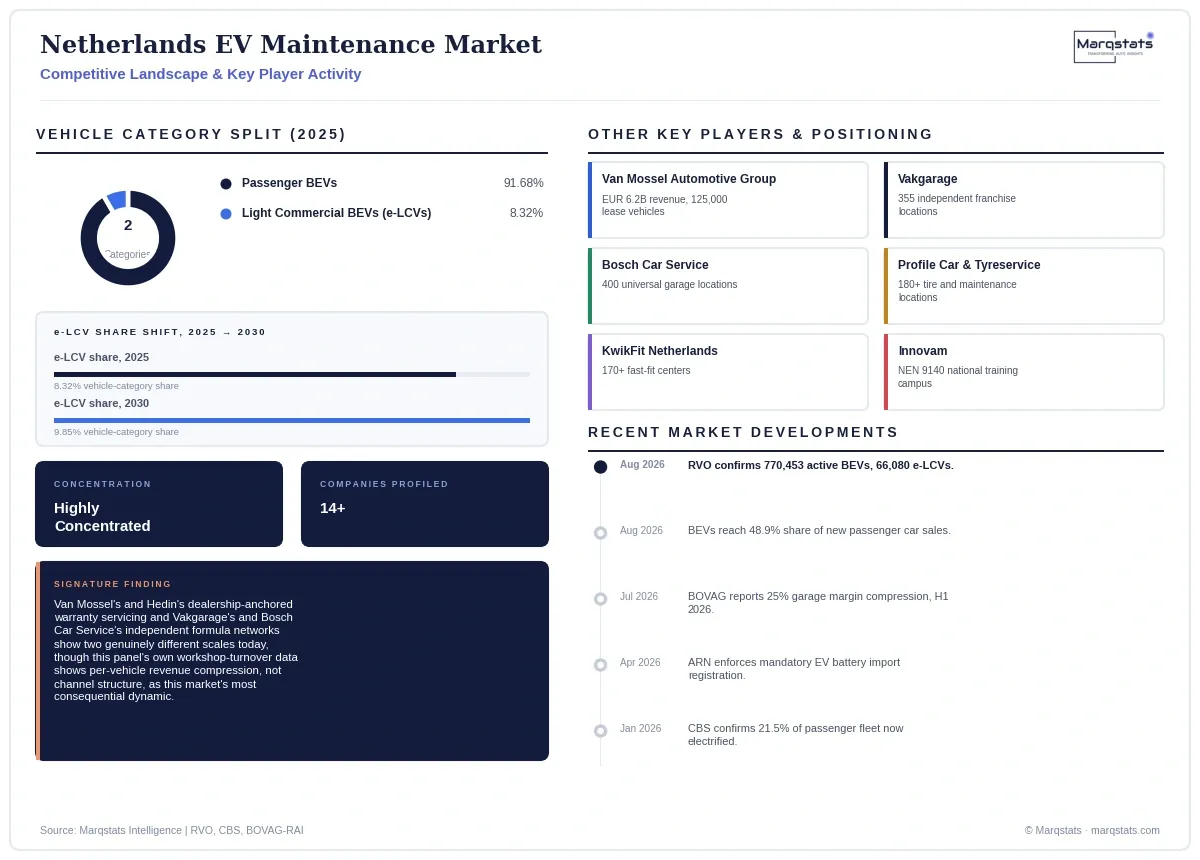
USD 231.27 million (91.68% share) in 2025, growing to USD 594.70 million (90.15% share) by 2030. Anchored by Tesla, Volkswagen and Kia, driven by private and lease-fleet passenger adoption.
USD 20.99 million (8.32% share) in 2025, growing to USD 64.98 million (9.85% share) by 2030. Anchored by Mercedes-Benz eSprinter and Stellantis platforms, driven by zero-emission city logistics mandates.
USD 107.21 million (42.50% share) in 2025, growing to USD 286.96 million (43.50% share) by 2030. The largest category, driven by tire wear rates 25-35% faster than ICE equivalents; anchored by Profile, KwikFit and VACO.
USD 88.29 million (35.00% share) in 2025, growing to USD 224.29 million (34.00% share) by 2030. Anchored by Vakgarage and Bosch Car Service, encompassing statutory roadworthiness inspection.
USD 36.58 million (14.50% share) in 2025, growing to USD 95.65 million (14.50% share) by 2030. Anchored by Innovam-trained technicians and SERMI-accredited diagnostic access.
USD 20.18 million (8.00% share) in 2025, growing to USD 52.77 million (8.00% share) by 2030. Anchored by JAMES Autoservice and dealer networks handling over-the-air firmware updates.
By Geography
Flevoland
8.00% of the national BEV parc (62,640 units), marked by a corporate lease registration clustering effect concentrated in Almere.
Utrecht
8.00% of the national BEV parc (62,640 units), showing high density of private lease and corporate headquarter fleets in Utrecht and Zeist.
Noord-Holland
8.00% of the national BEV parc (62,640 units), driven by high private adoption in Amstelveen (10.5% EV share) and Haarlem (10.2%), alongside Amsterdam's zero-emission zone driving 9.6% penetration.
Zuid-Holland
6.80% of the national BEV parc (53,244 units), where lower car ownership per capita in Amsterdam/Rotterdam is offset by high commercial e-LCV use around the Port of Rotterdam logistics corridor.
Noord-Brabant
6.10% of the national BEV parc (47,763 units), sustained by strong commuter BEV penetration around the Brainport Eindhoven region.
Remaining Provinces
27.60% of the national BEV parc across Gelderland, Overijssel, Zeeland, Drenthe, Fryslan, Limburg and Groningen, spanning rural vehicle profiles, tourism corridor mileage effects, and cross-border traffic, with Groningen recording the lowest provincial BEV share at 3.7%.
How Competition Is Evolving
Consolidation pressure on smaller independent operators is genuinely likely to increase further.
This landscape genuinely continues consolidating around a small number of formula-network anchors as SERMI and NEN 9140 compliance costs rise.
Overall market concentration is genuinely expected to shift somewhat by 2030 as independent aftermarket share expands alongside the aging out-of-warranty fleet.
No single company in this market spans franchised dealer warranty servicing, universal independent formula networks, and fast-fit tire and alignment specialization simultaneously, leaving genuine competitive white space for any group capable of bridging Van Mossel's and Hedin's dealership-anchored warranty servicing with the independent networks this market's own revenue-compression dynamics will increasingly push volume toward.
Competition spans franchised dealer groups, universal independent formula networks, and specialized fast-fit chains. Van Mossel Automotive Group is the largest Dutch automotive dealer group, generating EUR 6.2 billion in revenue and managing 125,000 lease vehicles. Hedin Mobility Group, Emil Frey Nederland, Louwman Group, Broekhuis Groep and AutoBinck Group operate multi-brand dealership and aftermarket distribution networks nationwide. Vakgarage is the largest independent garage formula in the Netherlands with 355 franchise locations, while Bosch Car Service operates 400 locations as a universal garage network.
Profile Car & Tyreservice operates 180-plus tire and maintenance locations, KwikFit Netherlands runs 170-plus fast-fit centers offering EV maintenance and APK inspection, and JAMES Autoservice operates nearly 80 independent franchise locations. Innovam trains technicians for NEN 9140 EV certification at its Nieuwegein campus, supported by OOMT upskilling grants. VNA represents lease companies controlling roughly 50% of the active BEV passenger fleet. Regulatory oversight rests with RDW (vehicle registry, APK, SERMI rollout), NEN (technical safety standards), and ARN (battery recycling and end-of-life processing).
Companies Covered
Companies covered in the report include:
Recent Market Activity
Table of Contents
Coverage & Segmentation
The analysis measures routine scheduled servicing, mechanical and electrical repairs, tire replacement and alignment, high-voltage battery system diagnostics, and statutory APK roadworthiness inspections for pure battery-electric passenger cars and light commercial vehicles in the Netherlands, across a 2025 base year and a 2026 to 2030 forecast period, denominated in United States dollars at the pack's own stated fixed 2025 rate of 1.085 USD per EUR. It excludes collision repair, public and residential charging infrastructure maintenance, high-voltage grid upgrades, bodywork customization, and warranty-covered repairs reimbursed directly by manufacturers.
The analysis spans two segmentation dimensions — vehicle category and service type — twelve provincial groupings, and 14 profiled entities across dealer groups, independent formula networks and regulatory bodies. Fleet figures trace to RVO and CBS statutory data; market value and both segmentation dimensions trace directly to the underlying research's own fully worked sizing model, with both 2025 and 2030 figures directly source-stated throughout.