Market Snapshot
Key Takeaways
Market Overview & Analysis
Report Summary
This analysis reads Japan's own fully computed sizing chain, technician workforce demographic data, and named-scenario regulatory framework together as a single coherent picture rather than isolated data points, since the underlying research itself was structured to support exactly that kind of integrated reading.
Japan's EV maintenance market is measured across statutory Shaken inspection labor, tire and chassis wear, OBD diagnostics, thermal management, and high-voltage battery servicing, valued at USD 274.24 million in 2025. This figure is taken directly from the underlying research's own fully computed sizing chain, anchored to CEV-PC statutory fleet data covering 645,614 plug-in vehicles as of March 2025.
Structurally, this is a market shaped by two forces working in different directions: a kei-class micro-vehicle segment that is driving disproportionate unit growth while generating below-average per-vehicle maintenance revenue, and a rapidly aging, wage-constrained independent repair workforce that is struggling to fund the capital investment required to service high-voltage systems at scale.
The analysis is built for four reader types making different decisions: an independent workshop operator weighing Electronic Control System Maintenance certification investment against declining routine mechanical revenue, a franchised dealership group managing a 41.11% average drop in maintenance billing per electric vehicle, a diagnostic tooling manufacturer building affordable multi-brand scan platforms, and an investor tracking how right-to-repair policy and commercial fleet electrification shape this market's Baseline-to-Upside scenario range.
Why the Cheapest Car to Maintain Is Driving Japan's EV Aftermarket Growth
Market forecasters usually expect aftermarket revenue growth to track vehicle value: bigger, more expensive platforms with larger battery packs and more complex systems should generate more maintenance revenue per unit. Japan's own data shows the opposite pattern driving this market's actual growth.
Kei-class micro-vehicles, led overwhelmingly by the Nissan Sakura since its May 2022 launch, expanded from a negligible 19,242 units in FY2019 to 136,696 units by FY2024 -- a 47.96% five-year CAGR that dwarfs every other segment in the market. These are precisely the vehicles generating the lowest per-unit maintenance revenue: Nissan's own pricing data shows the Sakura's maintenance package costs 38.83% less than its ICE Dayz counterpart, the smallest reduction of any platform tier the pack measured. Japan's EV aftermarket is growing fastest exactly where it monetizes least per vehicle -- a structural dynamic unique to Japan's kei-car-dominant automotive culture among the markets in this coverage set, and one that should reshape how workshops and dealers think about unit economics here specifically.
A Workforce Problem That Compounds Faster Than the Certification Problem
Much of the commentary around EV service capacity constraints focuses on certification and capital -- the cost of scan tools, calibration bays, and training courses. Japan's own labor data suggests a second, harder-to-fix constraint sitting underneath the certification numbers.
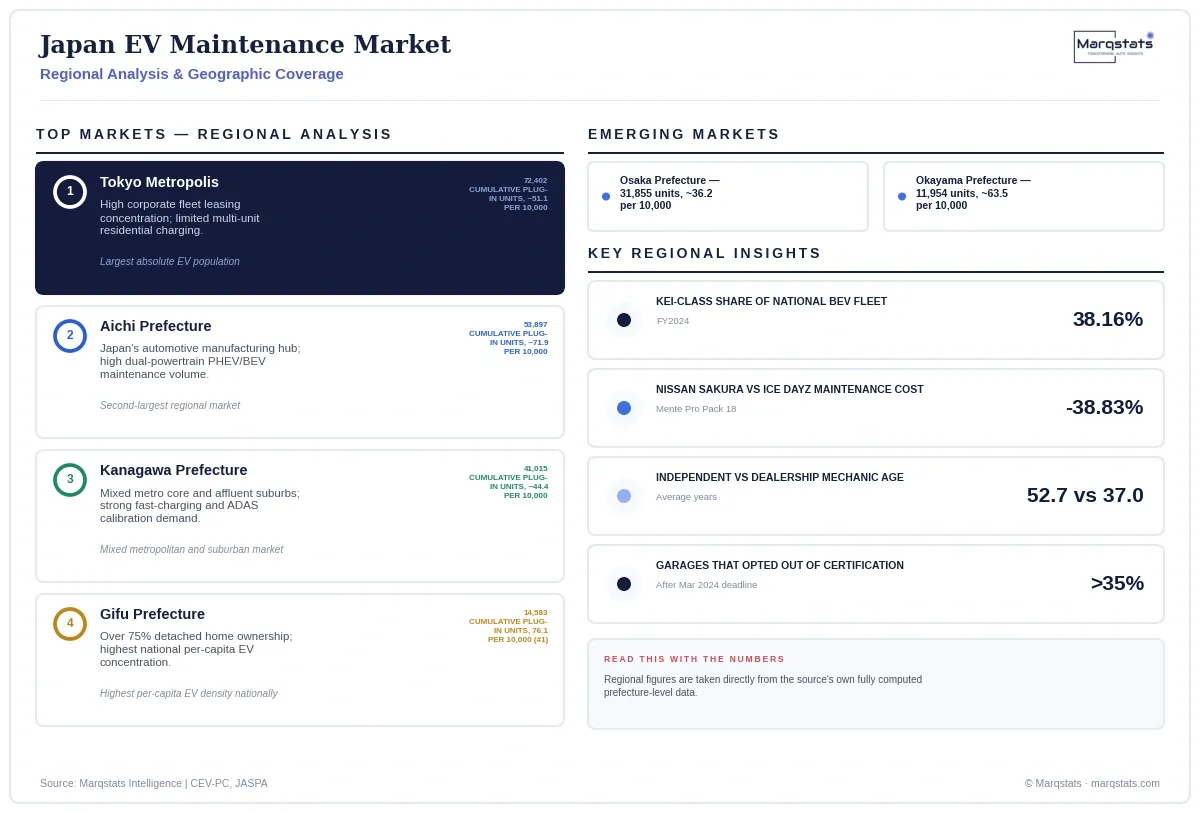
Independent garage mechanics average 52.7 years old, against just 37.0 years at franchised dealerships -- a 15.7-year gap. Younger technicians are disproportionately choosing dealership careers, where average annual wages run JPY 5.09 million against JPY 4.01 million at independent shops, a genuine, persistent compensation gap independents will struggle to close without fundamentally rethinking their labor economics. A workshop can fund a scan tool purchase in a single budget cycle. Reversing a multi-decade demographic and wage trend, with a mechanic job-openings ratio already running 5.09 to 5.28 times the national average, is a fundamentally slower problem -- one that will likely outlast whatever certification and tooling gaps get solved first.
Market Dynamics
Key Drivers
- Regional per-capita adoption patterns favor single-family home ownership over urban density -- Gifu Prefecture, not Tokyo, leads national EV penetration -- signaling that suburban and rural workshop investment may capture proportionally more growth than metropolitan expansion alone would suggest.
- Japan's own fully computed sizing chain shows statutory Shaken inspection labor already the single largest service category at 42.00% of total value, a structural signal that compulsory biennial inspection capacity, not discretionary mechanical work, represents the most durable revenue floor for workshops entering this market.
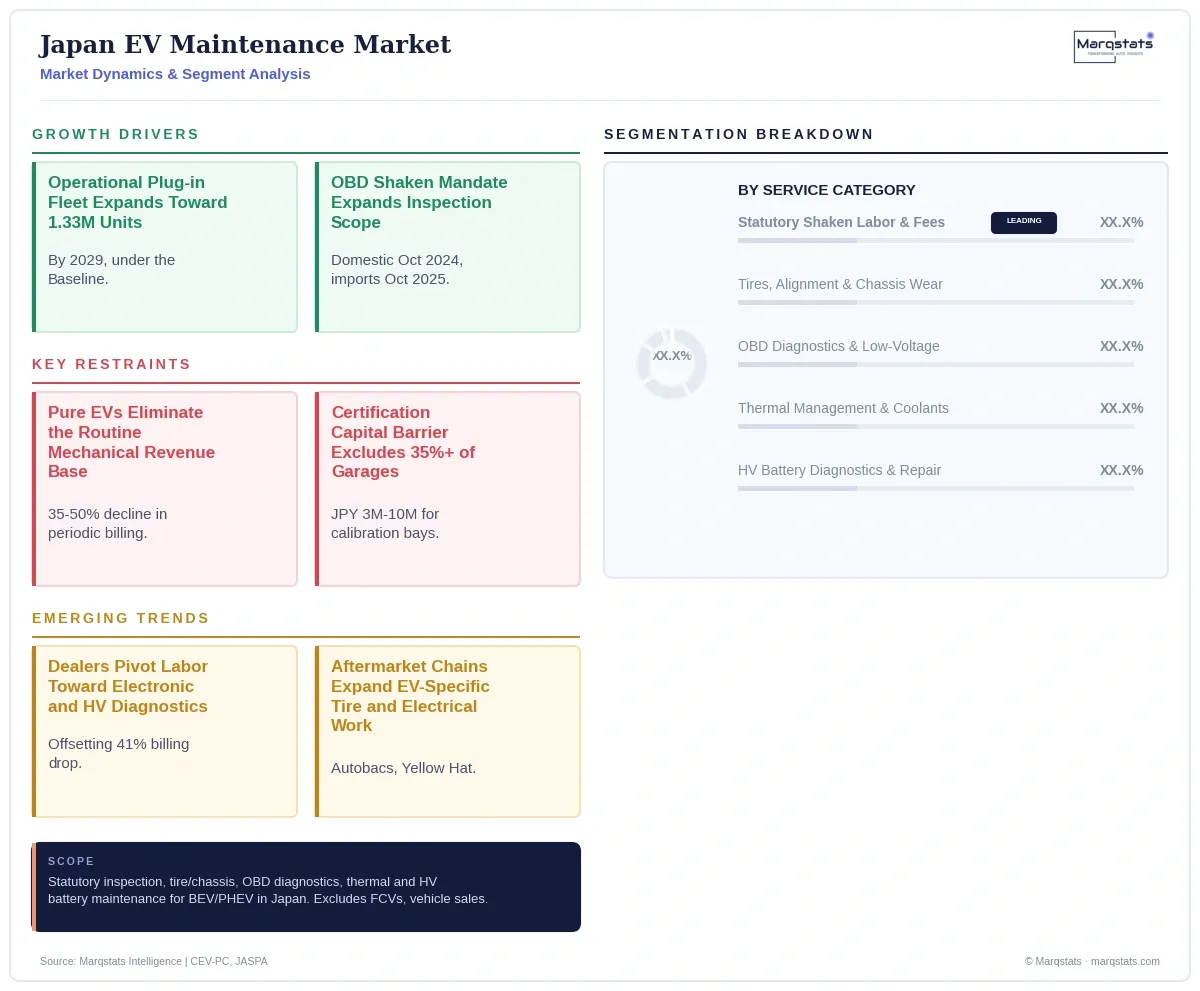
- Japan's operational plug-in fleet is expanding rapidly, from 645,614 units in March 2025 toward a projected 1,330,000 units by 2029 under the Baseline Scenario, directly growing the addressable base for recurring EV aftermarket maintenance demand.
- The mandatory nationwide rollout of On-Board Diagnostics Vehicle Inspection (OBD Shaken), effective October 2024 for domestic vehicles and expanding to imported nameplates from October 2025, is directly increasing the volume and complexity of statutory inspection work workshops must perform.
- Statutory biennial Shaken inspection labor and fees already represent 42.00% of total EV maintenance revenue, a durable, compulsory revenue floor independent of consumer discretionary maintenance decisions.
- National aftermarket retail chains including Autobacs Seven and Yellow Hat are actively investing in TUV Rheinland-certified EV pits and MHLW high-voltage safety training, providing a genuine growth channel for high-turnover, non-invasive EV maintenance work.
- Institutional workforce development through JASPA, representing over 92,000 certified repair garages, is coordinating nationwide technician training and new diagnostic standard rollout, supporting the broader industry's transition capacity.
Key Restraints
- This market's own three-scenario framework spans a genuinely wide 2029 range, from JPY 61.500 billion under the Downside Contraction Scenario to JPY 96.400 billion under the Upside Expansion Scenario -- a disclosed spread reflecting real uncertainty in right-to-repair rulemaking and technician workforce trends, not a narrow band around a single central estimate.
- Pure electric vehicles eliminate the recurring fluid and wear-item services -- oil changes, spark plug updates, transmission flushes -- that independent garages have historically relied on for shop traffic and overhead absorption, driving a 35% to 50% decline in lifetime periodic service billing per vehicle.
- Outfitting a service bay to secure Electronic Control System Maintenance certification requires JPY 400,000 to JPY 800,000 for legal diagnostic scan tools alone, plus JPY 1.5 million to JPY 3.5 million for ADAS calibration rigs and JPY 3 million to JPY 10 million for designated calibration bay facility modifications -- a capital barrier over 35% of certified garages have already declined to clear.
- Independent workshops face restricted access to proprietary OEM battery health algorithms and bidirectional ECU reprogramming tools, directing post-warranty battery servicing and major software updates back into franchised dealership networks regardless of certification status.
- A pronounced technician age and wage divide -- independent mechanics averaging 52.7 years against 37.0 years at dealerships, with a JPY 1.08 million annual wage gap -- constrains independent workshops' ability to attract the younger technical talent needed for digital bus protocol and high-voltage battery safety retraining.
Key Trends
- Fleet operators managing high-mileage commercial delivery vans are increasingly negotiating dedicated maintenance contracts directly with aftermarket chains and specialized fleet service providers, given the documented steady, frequent maintenance schedules commercial electric platforms already require regardless of powertrain.
- Franchised dealership networks are transitioning technician labor toward advanced electronic troubleshooting, high-voltage battery health assessments, and connected software servicing, specifically to offset the 41.11% average drop in periodic maintenance billing per electric vehicle.
- National aftermarket retail chains are expanding EV-specific tire, suspension, and low-voltage electrical service offerings, positioning themselves as a lower-cost alternative to dealership labor rates for non-powertrain maintenance.
- Independent repair cooperatives are beginning to form regional service alliances to share access to expensive sensor aiming rigs, wheel alignment systems, and approved diagnostic scanners, lowering the effective capital barrier for individual garages.
- Diagnostic equipment manufacturers including Inter Support and Altia are developing unified multi-brand scanning tools combining statutory NALTEC OBD querying, ADAS calibration, and battery health reporting into a single technician workflow.
Strategic Implications
- Independent repair operators should establish regional service cooperatives to share access to expensive calibration and diagnostic equipment, while adapting service menus toward high-margin EV wear components -- specialized tires, precision alignment, brake slider pin lubrication -- to offset the structural loss of engine lubrication billing.
- Franchised dealership networks should transition technician labor deliberately toward advanced electronic troubleshooting and high-voltage battery health assessment, given how directly the 41.11% average maintenance billing reduction threatens standard prepaid package profitability.
- National aftermarket retail chains should continue expanding EV-specific tire and low-voltage electrical service offerings, given their structural cost advantage over dealership labor rates for the high-turnover, non-invasive maintenance categories driving their current market share gains.
- Investors and analysts should track METI and MLIT right-to-repair rulemaking progress and commercial delivery fleet electrification rates nationwide as the two clearest variables separating this market's Baseline and Upside scenarios, given how directly both feed the underlying research's own named trigger conditions.
Outlook
The underlying research presents three genuinely distinct trajectories diverging on named regulatory and commercial trigger conditions. The 2030 figures below are Marqstats extrapolations of the pack's own directly stated 2029 endpoints, held one additional year at each scenario's own five-year CAGR, disclosed explicitly; the pack's own 2029 figures are given for reference alongside.
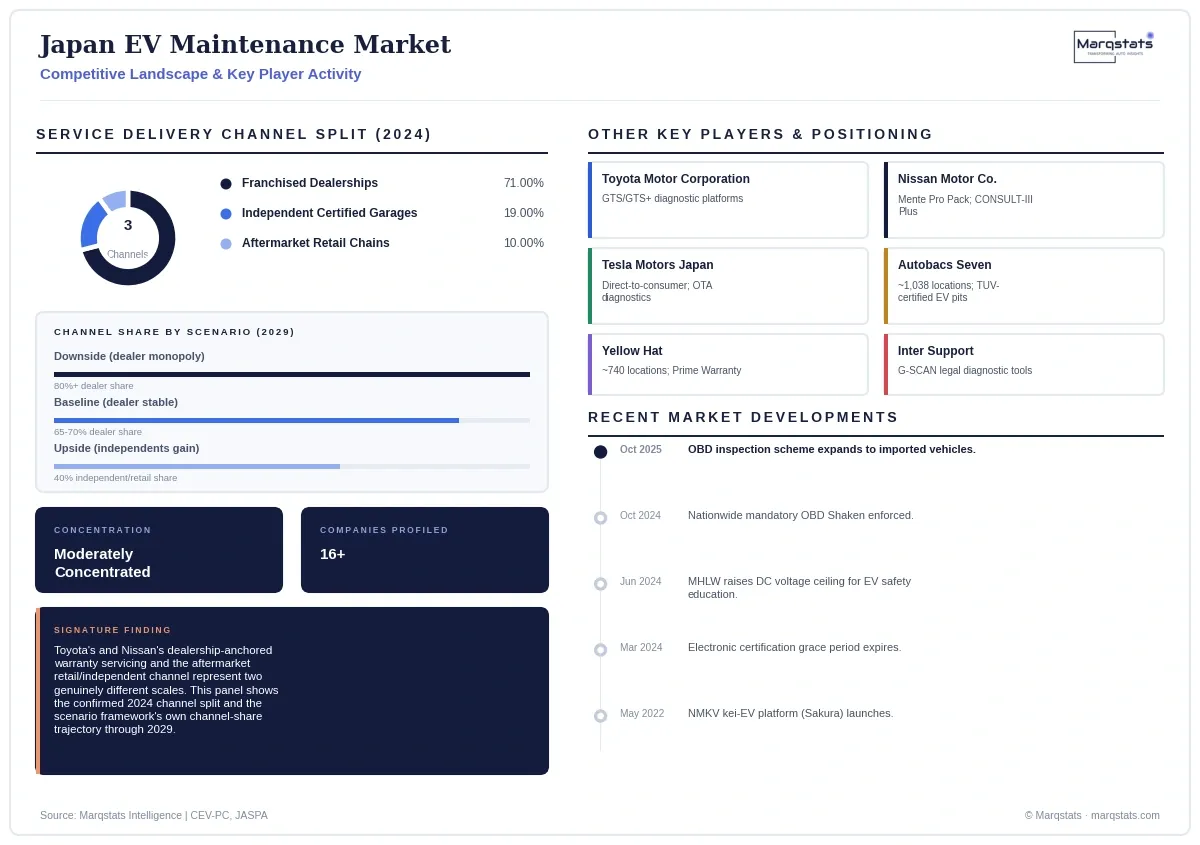
Under the Baseline Forecast Scenario, existing Clean Energy Vehicle purchase subsidies remain in place and the phased rollout of OBD inspections for imported vehicles proceeds smoothly, with franchised dealerships retaining a 65% to 70% market share; the operational plug-in fleet reaches 1,330,000 units by 2029 (JPY 78.120 billion / USD 513.95 million), extrapolated to JPY 91.182 billion (USD 599.88 million) by 2030 at a 16.95% CAGR.
Under the Upside Expansion Scenario, METI and MLIT implement comprehensive right-to-repair regulations requiring OEMs to share open diagnostic APIs with independent workshops, alongside commercial fleet operators deploying over 150,000 electric delivery vans; independent and retail chains capture 40% of market turnover, with the fleet reaching 1,650,000 units by 2029 (JPY 96.400 billion / USD 634.21 million), extrapolated to JPY 117.338 billion (USD 771.96 million) by 2030.
Under the Downside Contraction Scenario, governments reduce CEV purchase subsidies while introducing distance-based road taxes, and the mechanic shortage worsens as vocational school enrollments drop; dealerships maintain an 80%-plus service monopoly, with the fleet reaching only 1,050,000 units by 2029 (JPY 61.500 billion / USD 404.61 million), extrapolated to JPY 68.419 billion (USD 450.13 million) by 2030.
Market Segmentation
USD 115.18 million (42.0% share) in 2025. The largest category, anchored by compulsory biennial inspection cycles.
USD 65.82 million (24.0% share) in 2025. Anchored by curb weight and instant torque accelerating tire tread wear.
USD 52.11 million (19.0% share) in 2025. Anchored by the MLIT OBD inspection mandate and auxiliary 12V battery servicing.
USD 30.17 million (11.0% share) in 2025. Anchored by low-conductivity coolant systems and dual PHEV thermal loops.
USD 10.97 million (4.0% share) in 2025. Anchored by battery State of Health assessments, largely covered under OEM warranty.
USD 194.71 million (71.0% share) in 2025. Sustained by bundled prepaid maintenance packs, 8-year/160,000km battery warranties, and proprietary diagnostic tools.
USD 52.11 million (19.0% share) in 2025. Constrained by the capital costs of certified electronic aiming tools and scan equipment.
USD 27.42 million (10.0% share) in 2025. Focused on high-turnover wear items including tires, cabin air filtration, and 12V battery replacements.
USD 148.09 million (54.0% share) in 2025. Anchored by higher pack capacities and dual-motor AWD systems.
USD 112.44 million (41.0% share) in 2025. Driven by the Nissan Sakura and Mitsubishi eK X EV despite lower per-unit maintenance cost.
USD 13.71 million (5.0% share) in 2025. A high-utilization segment with steady, frequent maintenance schedules.
By Geography
Tokyo Metropolis
72,402 units cumulative plug-in parc (~51.1 per 10,000 residents), the largest absolute EV population nationally, driven by corporate fleet leasing concentration and premium import dealership service demand, though constrained by limited multi-unit residential charging access.
Aichi Prefecture
53,897 units cumulative plug-in parc (~71.9 per 10,000 residents), Japan's automotive manufacturing hub, generating a high volume of dual-powertrain PHEV and domestic BEV maintenance work.
Kanagawa Prefecture
41,015 units cumulative plug-in parc (~44.4 per 10,000 residents), spanning mixed metropolitan core and affluent suburban commuter belts, generating strong demand for fast-charging maintenance, ADAS calibration, and tires.
Osaka Prefecture
31,855 units cumulative plug-in parc (~36.2 per 10,000 residents), a densely populated urban center with lower per-capita car ownership, anchored by urban dealership reliance and expanding commercial delivery van maintenance.
Gifu Prefecture
14,583 units cumulative plug-in parc, Japan's highest per-capita EV concentration at 76.1 vehicles per 10,000 residents for ten consecutive years, driven by over 75% detached home ownership enabling unrestricted Level-2 wall charger installation and high multi-vehicle household reliance.
Northern Prefectures (Hokkaido, Aomori, Iwate)
Minimal market penetration (Hokkaido 0.22%, Aomori 0.24%, Iwate 0.31%), driven by sub-zero winter temperatures degrading lithium-ion battery range and dispersed regional road networks presenting charging challenges; garages here handle rust mitigation, auxiliary heating checks, and battery diagnostics.
How Competition Is Evolving
No single company in this market spans franchised warranty-era dealership servicing, national aftermarket retail chain operations, and legal diagnostic tooling manufacturing simultaneously, leaving genuine competitive white space for any group capable of bridging Toyota's and Nissan's dealership-anchored warranty servicing with the aftermarket retail and independent channels this market's own scenario framework shows capturing between 20% and 40% of turnover by 2029.
Competition spans domestic OEM franchised dealership networks, foreign OEM direct and franchised models, and national aftermarket retail chains. Toyota Motor Corporation, Nissan Motor Co. and Honda Motor Co. anchor the dominant domestic dealership channel, with Nissan's “Mente Pro Pack” framework using proprietary CONSULT-III Plus diagnostics to deliver certified EV battery usage diagnostics across its Leaf, Sakura and Ariya lineup, and Toyota servicing its bZ4X and Lexus RZ platforms via proprietary GTS and GTS+ software. Tesla Motors Japan operates a direct-to-consumer model using over-the-air remote diagnostics and mobile service vans, while BYD Auto Japan has built a traditional franchised dealership network across Japan's 47 prefectures.
On the aftermarket retail side, Autobacs Seven operates approximately 1,038 domestic service locations with TUV Rheinland Japan-certified EV pits, while Yellow Hat operates roughly 740 retail and service centers offering independent Shaken inspections and its Prime Warranty program. Kobac Co. anchors the standardized vehicle inspection franchise sector with over 500 locations. Diagnostic tooling manufacturers Inter Support (G-SCAN series), Altia and Banzai anchor the legal scan tool and ADAS calibration hardware independent garages depend on. Regulatory oversight rests with MLIT, NALTEC, MHLW, and JASPA, which represents over 92,000 certified repair garages nationwide.
Companies Covered
The report profiles 16+ companies with full strategy and financials analysis, including:
Recent Market Activity
Table of Contents
Coverage & Segmentation
This report measures statutory Shaken inspection labor, tire and chassis wear servicing, OBD diagnostics and low-voltage electrical work, thermal management servicing, and high-voltage battery diagnostics for BEVs and PHEVs in Japan, across a 2025 base year and a 2026 to 2030 forecast period, denominated in United States dollars at the pack's own stated exchange rate of JPY 152.00 per USD. It excludes fuel cell electric vehicles (FCVs) and whole vehicle sales revenue.
The analysis spans three segmentation dimensions — service category, service delivery channel and vehicle platform classification — six regional geographies, and 15 profiled entities across OEMs, aftermarket retail chains, diagnostic tooling manufacturers and regulatory bodies. Fleet and registration figures trace to CEV-PC; market value and all three segmentation dimensions trace directly to the underlying research's own fully computed sizing model, with the 2030 endpoint disclosed as a Marqstats extrapolation of the pack's own stated 2029 figures.