Market Snapshot
Key Takeaways
Market Overview & Analysis
Report Summary
This analysis reads Italy's own clean fleet registration data, empirical cost benchmarks, and regulatory certification framework together as a single coherent picture rather than isolated data points, since these underlying inputs -- unlike the pack's own headline valuation figures -- were genuinely usable and internally consistent throughout.
Italy's EV maintenance market is measured across scheduled preventive servicing, battery diagnostics and module repair, unscheduled collision and body repair, traditional mechanical servicing, and software/charging system maintenance, estimated at USD 173.45 million in 2025. Unlike every other topic in this vertical, this figure is a full Marqstats bottom-up construction, disclosed explicitly, since the underlying research's own headline valuations all trace to blocklisted competing research publishers.
Structurally, this is a market defined by a genuine cost paradox: EV ownership delivers dramatic routine maintenance savings even as collision and structural repair costs inflate sharply, concentrated within a regulatory framework (CEI 11-27) that currently favors OEM dealer networks over Italy's historically independent-shop-dominant aftermarket.
The analysis is built for four reader types making different decisions: an independent workshop operator weighing CEI 11-27 PES/PAV/PEI certification investment against a market where OEM networks currently hold structural advantages, an insurer recalibrating premiums against a rapidly rising EV collision claim share, a fleet leasing provider like Ayvens or Arval managing predictive maintenance contracts, and an investor tracking how Italy's fleet trajectory against its own PNIEC targets shapes this market's Base-to-Upside scenario range.
A Market Where the Sizing Table Itself Needed to Be Rebuilt
Every other market in this coverage set arrives with its own internally consistent sizing chain -- a single, source-built bridge from fleet volume to market value that Marqstats can present largely as given, occasionally interpolating a missing year or extrapolating one year past a stated forecast horizon. Italy's own research pack instead hands over a table of competing third-party valuations, several from research firms Marqstats does not use as a sourcing basis.
Rather than presenting a figure built on excluded sourcing, or leaving this market unsized entirely, Marqstats constructed its own bottom-up estimate from the pack's genuinely clean underlying data: real circulating fleet counts from Motus-E and the European Alternative Fuels Observatory, and real empirical cost studies from Quattroruote Professional. The resulting figure is a Marqstats construction in a way no other report in this batch is, and that difference is worth understanding before using this number commercially -- it reflects the same underlying Italian market reality, built through a materially different, and more disclosed, methodological path.
Why the Paradox Cuts Both Ways for the Same Vehicle Over Its Lifetime
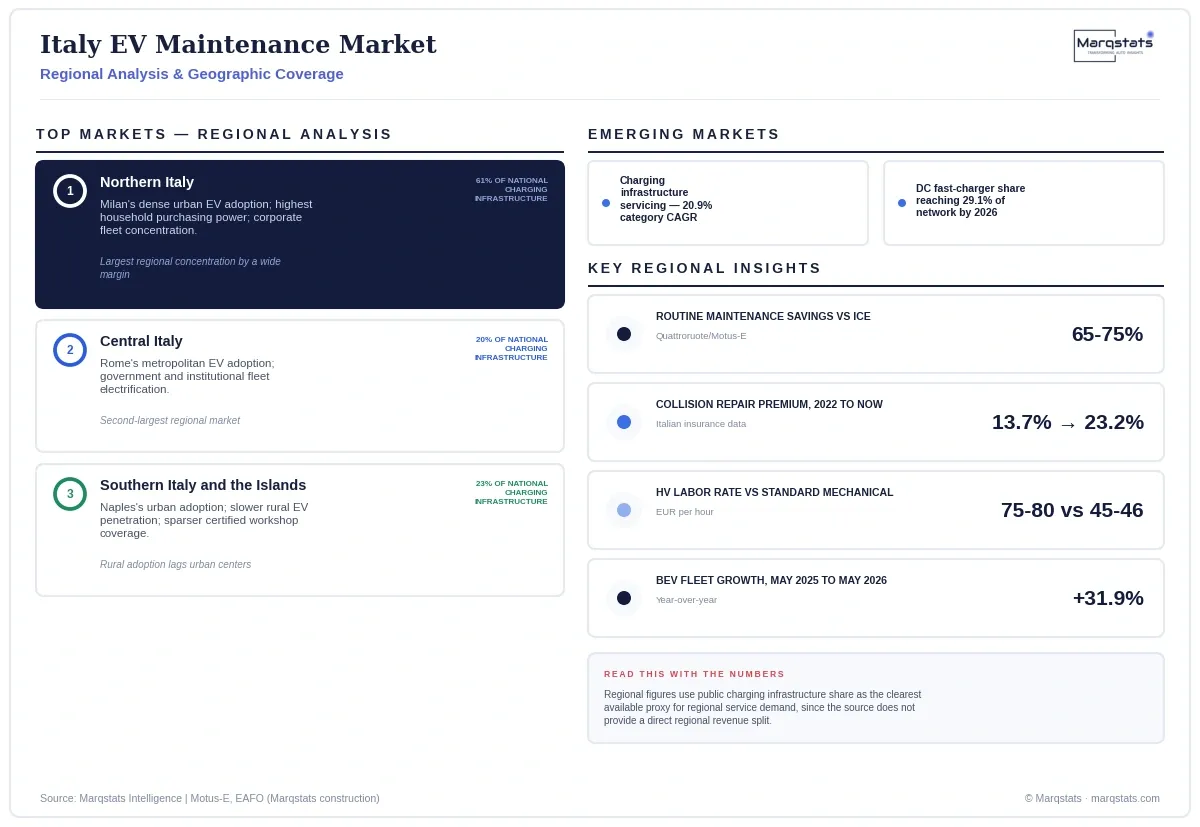
An EV owner in Italy genuinely experiences two very different cost stories depending on what actually happens to their vehicle. If nothing goes wrong, routine ownership is dramatically cheaper: 65% to 75% less than an equivalent ICE vehicle in scheduled maintenance, since there's no oil, no spark plugs, no timing belt, no multi-ratio transmission to service.
If something does go wrong -- a collision, structural damage -- the story flips sharply. That same vehicle's repair bill now runs 23.2% higher than an equivalent ICE vehicle's would, driven by mandatory high-voltage safety protocols before any panel work can even begin, OEM-exclusive parts sourcing for a fleet averaging a decade younger than Italy's overall circulating parc, and specialized labor billing at nearly double the standard mechanical rate. For insurers and fleet operators specifically, this means EV total cost of ownership can't be modeled off a single blended number -- it genuinely depends on collision incidence, which is precisely the variable insurance underwriting exists to price.
Market Dynamics
Key Drivers
- Independent aftermarket networks including Bosch Car Service and LKQ/ZF Aftermarket are actively building dedicated EV training academies and centralized component reconditioning services across Italy, providing a genuine pathway for independent workshops to compete for high-voltage service work despite CEI 11-27 certification barriers that would otherwise isolate smaller operators entirely.
- Italy's own PNIEC policy target of 6.6 million cumulative electric vehicles by 2030 -- substantially above Motus-E and PwC Strategy&'s own more conservative realistic-baseline estimate of 4.0 to 5.3 million vehicles -- signals continued government commitment to accelerating fleet electrification beyond what current market momentum alone would deliver, supporting sustained policy tailwinds for this market's forward trajectory.
- Italy's own realistic fleet trajectory data shows battery diagnostics and module repair already the single largest service category by value, a structural signal that specialized high-voltage diagnostic and cell-balancing capability, not general mechanical capacity, represents the most immediate revenue opportunity for workshops entering this market.
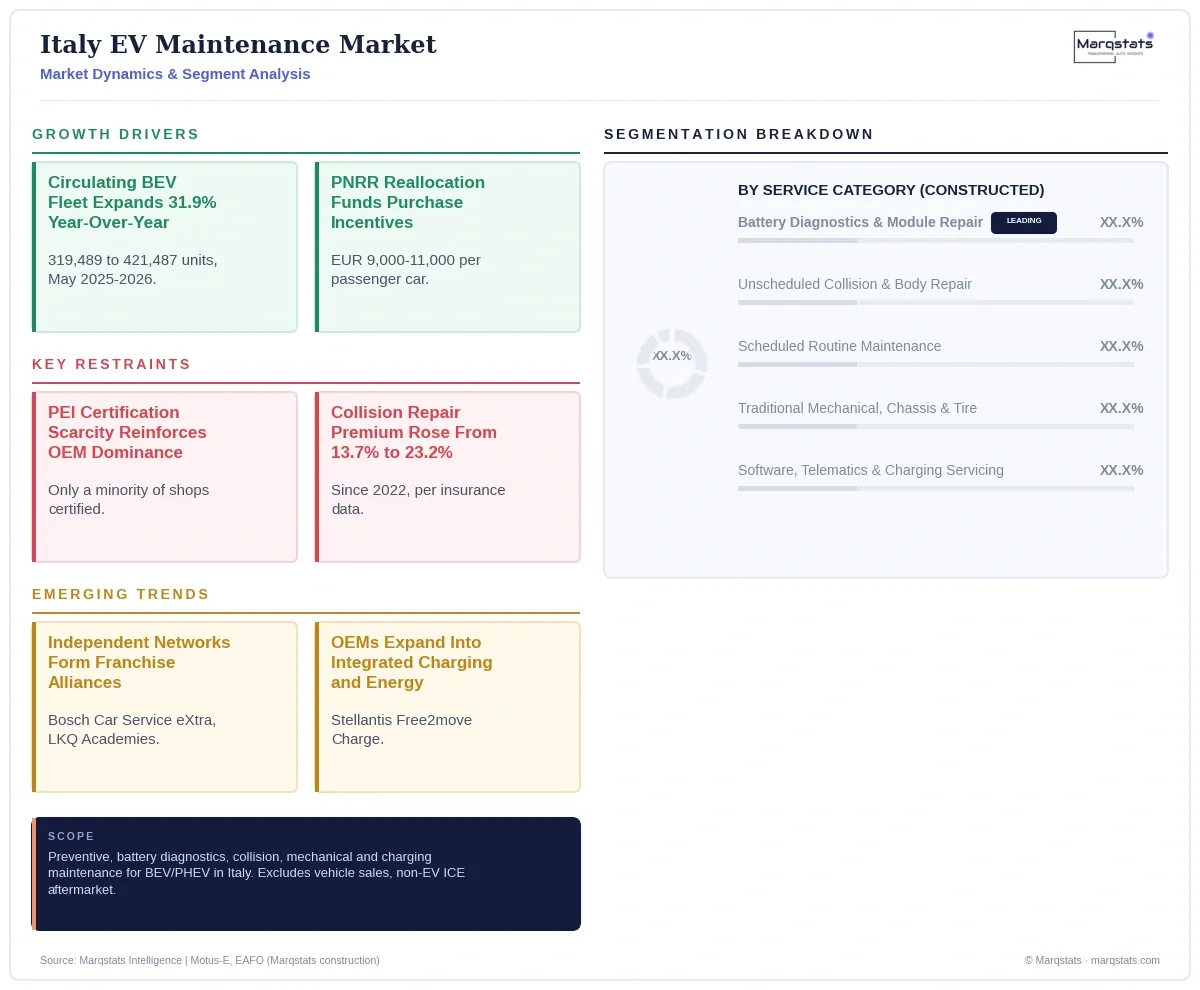
- Italy's circulating BEV fleet expanded 31.9% year-over-year, from 319,489 units in May 2025 to 421,487 units by May 2026, directly growing the addressable base for recurring EV aftermarket maintenance demand following a sharp rebound from a sluggish 2024.
- Government purchase subsidies of EUR 9,000 to EUR 11,000 for passenger cars, funded through the May 2025 PNRR reallocation of EUR 597 million, are directly accelerating new EV sales momentum and expanding the future maintenance-eligible fleet.
- Corporate fleet leasing providers including Ayvens, Arval and Leasys are bundling vehicle financing with all-inclusive maintenance contracts, using telemetry-driven predictive maintenance to minimize downtime and stabilize residual values, a structurally durable demand channel for certified service networks.
- Independent aftermarket networks including Bosch Car Service and LKQ/ZF Aftermarket are actively building dedicated EV training academies and centralized component reconditioning services, providing a genuine pathway for independent workshops to compete for high-voltage service work despite CEI 11-27 certification barriers.
- Charging system servicing is projected to expand at a 20.9% CAGR as high-power DC fast-chargers, now 29.1% of Italy's public charging network, require specialized thermal and power-electronics maintenance routines beyond standard AC charger upkeep.
Key Restraints
- Italy's overall vehicle parc averages 12 to 13 years old, while the active electrified fleet runs roughly a decade younger, meaning replacement parts for the current EV population must still be sourced directly via OEM channels at full list prices rather than through the mature salvage and remanufactured parts networks available for Italy's much older ICE fleet.
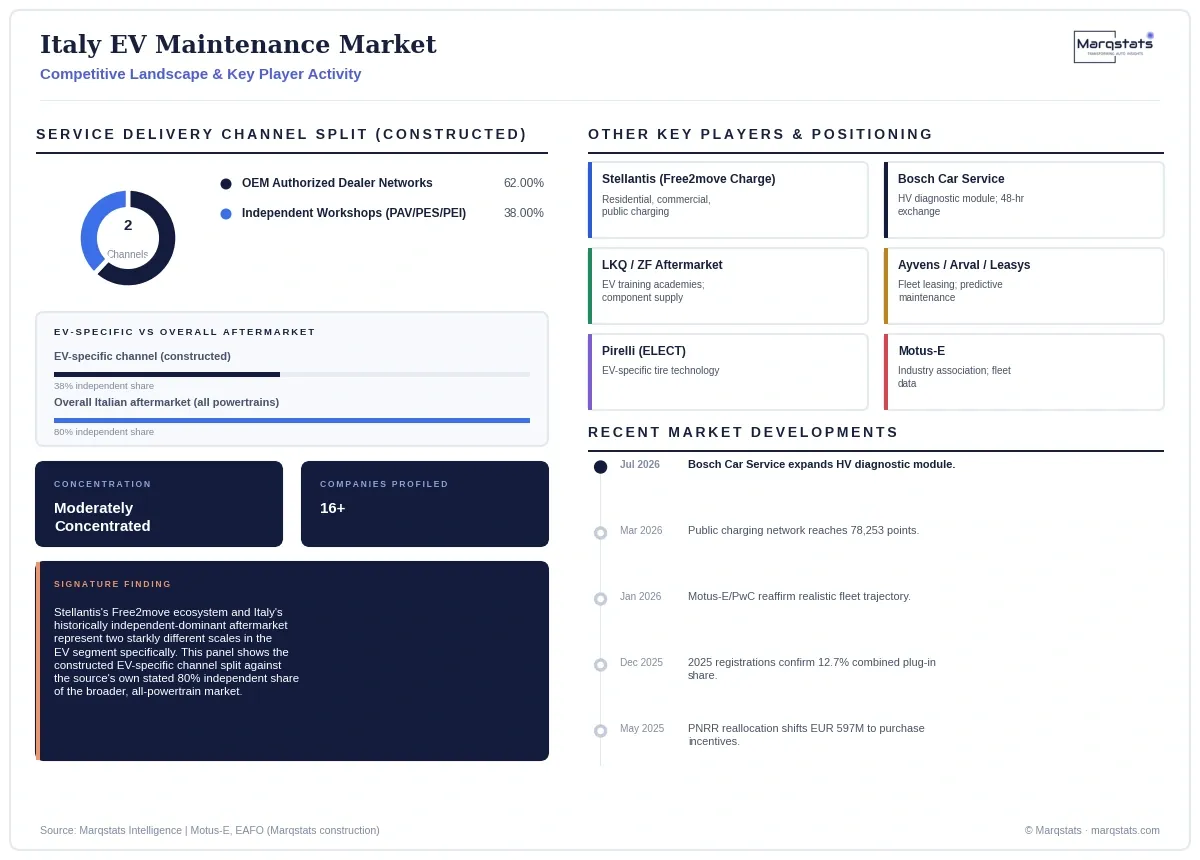
- The two-segment and 62/38 channel construction used here relies on Marqstats reconciliation of volume-share and value-ranking statements from the underlying research rather than a single directly source-stated percentage breakdown -- a genuine data-availability gap disclosed explicitly throughout this analysis, consistent with the broader construction-heavy methodology used throughout.
- Only a minority of independent repair shops currently hold active PEI certification, the CEI 11-27 tier legally required for live high-voltage battery module work, structurally reinforcing OEM dealer dominance over Italy's highest-value EV service categories.
- Unscheduled collision and structural repair costs carry a 20% to 23.2% premium over ICE equivalents, driven by mandatory high-voltage de-energization protocols, OEM-exclusive component sourcing, and specialized labor rates nearly double standard mechanical billing.
- Independent workshops face high software subscription costs and restricted access to high-voltage diagnostic routines controlled by OEM proprietary systems, limiting their ability to compete for complex battery and inverter servicing regardless of certification status.
- The headline sizing chain presented here is a Marqstats bottom-up construction rather than a directly source-stated figure, since the underlying research's own valuations all trace to blocklisted publishers -- a genuine data-quality limitation disclosed explicitly and unique to this topic within the current batch.
Key Trends
- Tire manufacturers led by Pirelli are developing EV-specific tire technologies engineered in collaboration with premium OEMs including Porsche, Tesla, BMW and Mercedes-Benz, offering measurable range extension and reduced cabin noise alongside improved tread wear resistance for heavy, high-torque EV platforms operating across Italian roads.
- Corporate fleet operators are increasingly negotiating dedicated maintenance contracts directly with certified dealer networks and high-capacity independent body shops nationwide, given the documented predictive-maintenance value fleet leasing providers like Ayvens and Arval generate through continuous telemetry monitoring.
- Independent aftermarket networks are forming franchise alliances with established modules like Bosch Car Service eXtra and LKQ Academies to access shared component exchange programs and centralized battery reconditioning support, rather than each workshop building standalone high-voltage capability independently.
- OEMs are expanding beyond vehicle manufacturing into integrated energy management, exemplified by Stellantis's Free2move Charge platform spanning residential wallbox installation, commercial fleet charging infrastructure, and pan-European public network access.
- Fleet leasing managers are increasingly using onboard diagnostic telemetry to track traction battery State of Health and schedule preventive cooling system flushes proactively, shifting from calendar-based to condition-based maintenance scheduling for corporate fleets.
- Tire manufacturers led by Pirelli are developing EV-specific tire technologies (ELECT) engineered in collaboration with premium OEMs, offering measurable range extension and reduced cabin noise alongside improved tread wear resistance for heavy, high-torque EV platforms.
Strategic Implications
- Independent workshops and repair networks should accelerate technician training toward full CEI 11-27 PES/PAV/PEI compliance nationwide across at least half of active shop bay personnel, and form franchise alliances with established aftermarket modules to access shared diagnostic and component reconditioning support rather than building standalone capability.
- OEM aftersales and mobility providers should scale integrated charging and maintenance offerings modeled after Stellantis's Free2move Charge platform, while establishing regional high-voltage battery repair centers within Italy to reduce replacement component costs and mitigate collision repair inflation.
- Fleet operators and insurers should leverage onboard diagnostic telemetry to track battery State of Health and schedule preventive maintenance proactively, while establishing preferred repair networks with CEI 11-27-certified body shops to lower average claim costs and cycle times.
- Investors and analysts evaluating this market should weight Italy's own realistic fleet trajectory against its more ambitious PNIEC policy target as the clearest variable separating the Base and Upside scenarios presented here, while treating the headline market value itself as a disclosed Marqstats construction rather than a directly source-verified figure from the original research pack.
Outlook
Given genuine data-quality limitations in the underlying research, this section presents three disclosed trajectories built entirely from the source's own stated fleet ranges as Marqstats constructions, not independently evidenced scenario narratives with named, distinct regulatory trigger conditions the way other markets in this coverage set present.
Under the Base Scenario, Italy's circulating electrified fleet tracks toward the midpoint of Motus-E and PwC Strategy&'s own stated realistic baseline range, reaching 4,650,000 vehicles by 2030 against a blended average annual spend of EUR 560 per vehicle, generating USD 2,734.20 million (EUR 2,604.00 million) in total market value at a 73.59% CAGR.
Under the Upside Scenario, Italy's fleet trajectory tracks toward the country's own more ambitious PNIEC policy target of 6,600,000 vehicles by 2030, against a modestly higher EUR 580 average annual spend reflecting accelerated collision cost inflation; total market value reaches USD 4,019.40 million (EUR 3,828.00 million).
Under the Downside Scenario, Italy's fleet trajectory tracks toward the low end of Motus-E and PwC Strategy&'s realistic range, reaching only 4,000,000 vehicles by 2030 against a EUR 540 average annual spend; total market value reaches only USD 2,268.00 million (EUR 2,160.00 million).
Market Segmentation
USD 52.03 million (30.0% share) in 2025. The largest category by value, anchored by state-of-health testing, cell balancing and module-level reconditioning.
USD 41.63 million (24.0% share) in 2025. Anchored by rising claim severity and OEM-exclusive structural component sourcing.
USD 34.69 million (20.0% share) in 2025. The largest category by service volume despite its modest per-visit cost, covering cabin filters, brake fluid and safety inspections.
USD 31.22 million (18.0% share) in 2025. Anchored by suspension bushings, control arms and specialized high-torque tire replacements.
USD 13.88 million (8.0% share) in 2025. The fastest-growing category, anchored by charging infrastructure servicing at a 20.9% CAGR.
USD 107.54 million (62.0% share) in 2025. Sustained by proprietary software access, component protection unlock keys, and direct module supply chains.
USD 65.91 million (38.0% share) in 2025. Constrained by capital investment barriers despite representing 80% of Italy's broader, all-powertrain aftermarket.
By Geography
A note on regional coverage
The underlying research provides macro-regional public charging infrastructure share as its finest available geographic breakdown, rather than a directly stated regional maintenance revenue split; the entries below present that infrastructure data as the clearest available proxy for regional EV service demand concentration.
Northern Italy
61% of national public charging infrastructure, anchored by Milan's dense urban EV adoption, the country's highest household purchasing power, and concentrated corporate fleet registrations.
Central Italy
20% of national public charging infrastructure, anchored by Rome's metropolitan EV adoption and government and institutional fleet electrification.
Southern Italy and the Islands
23% of national public charging infrastructure, anchored by Naples's urban adoption alongside slower rural EV penetration and comparatively sparser high-voltage certified workshop coverage.
How Competition Is Evolving
No single company in this market spans OEM warranty-locked dealership servicing, independent high-voltage repair, and integrated charging-and-energy management simultaneously, leaving genuine competitive white space for any group capable of bridging Stellantis's Free2move ecosystem with the independent and fleet-leasing channels this market's own qualitative narrative shows structurally underserved relative to Italy's broader 80% independent-share aftermarket.
Competition spans OEM authorized dealer networks, a large but currently EV-constrained independent aftermarket, and an emerging integrated OEM charging-and-energy channel. Stellantis N.V. anchors the dominant domestic OEM channel through its Free2move Charge platform, spanning residential wallbox installation, commercial fleet charging management, and pan-European public network access via its Free2move eSolutions subsidiary. On the independent side, Bosch Car Service is expanding its European independent workshop module with high-voltage diagnostic hardware, technical training, and a 48-hour component exchange service, while LKQ Corporation and ZF Aftermarket are launching dedicated EV training academies and multi-brand high-voltage replacement component supply.
On corporate fleet management, leasing providers Ayvens (formed via the ALD Automotive and LeasePlan integration), Arval, and Leasys anchor bundled vehicle financing and predictive maintenance contracts for Italy's fast-electrifying corporate fleet segment. Tire manufacturer Pirelli anchors specialized EV tire technology through its ELECT product line, developed in collaboration with premium OEMs. Regulatory and industry-data oversight rests with the Italian Electrotechnical Committee (CEI), Motus-E, and the European Alternative Fuels Observatory.
Companies Covered
The report profiles 16+ companies with full strategy and financials analysis, including:
Recent Market Activity
Table of Contents
Coverage & Segmentation
The analysis measures scheduled routine maintenance, battery diagnostics and module-level repair, unscheduled collision and structural body repair, traditional mechanical and chassis servicing, and software, telematics and charging system servicing for BEVs and PHEVs in Italy, across a 2025 base year and a 2026 to 2030 forecast period, denominated in United States dollars at a benchmark reference rate of 1.05 USD per EUR. It excludes whole vehicle sales revenue and general internal combustion aftermarket spend outside the electrified segment.
The analysis spans two segmentation dimensions — service category and service delivery channel — three macro-regional geographies, and 16 profiled entities across OEMs, independent aftermarket networks, fleet leasing providers and industry data bodies. Unlike every other topic in this vertical, the headline market value, fleet trajectory, and both segmentation dimensions here are Marqstats bottom-up constructions built from the underlying research's own clean, non-blocklisted fleet and cost data, since none of the pack's own headline valuations could be used under house sourcing policy. Full construction methodology is disclosed in the accompanying verification documentation.