Market Snapshot
Middle bar: base-year value × (1 + CAGR), rounded to two decimals. This is a calculated illustration, not a separately researched annual estimate.
Market Size (2025, Base Year): USD 349.25 Million
Estimated Value (2026): USD 443.53 Million
Forecast Value (2030): USD 1,062.59 Million
CAGR: 24.92% | Forecast Period: 2026 – 2030
Growth — Absolute: USD 713.34 Million
Largest Market: Niederösterreich (largest absolute electrified fleet population)
Fastest Growing: Independent Aftermarket (IAM) (24.10% to 31.00% share, 2025-2030)
Dominant Segment: Authorized OEM Dealers (61.90% channel share, 2025)
Market Concentration: Moderately Fragmented
Base Year: 2025 | Historical Period: 2021 – 2025 | Forecast Period: 2026 – 2030
Units Considered: Value (USD Million)
Segments Covered: 3 | Regions Covered: 6 | Companies Profiled: 14
Report Pages: 240 | Deliverables: PDF, Excel, PPT
Key Takeaways
Market Overview & Analysis
Report Summary
This analysis reads Austria's own fully worked sizing chain, regulatory framework, and regional distribution data together as a single coherent picture rather than isolated data points, since the underlying research itself was structured to support exactly that kind of integrated reading.
Austria's EV maintenance market is measured across tires and chassis, routine service and diagnostics, mechanical wear and thermal servicing, statutory inspections, and high-voltage battery repair, valued at USD 349.25 million (EUR 309.07 million) in 2025. This figure is taken directly from the underlying research's own fully worked sizing chain, anchored to statutory fleet data covering 361,110 active plug-in passenger vehicles.
Structurally, this is a market shaped by a genuine fiscal policy reversal: an April 2025 motor tax reform ended the era of unconditional EV tax exemption, measurably increasing owner cost-consciousness around aftermarket spending, even as a rigorous four-tier high-voltage technician certification framework continues concentrating complex repair work within authorized dealers and certified independent networks.
The analysis is built for four reader types making different decisions: an independent workshop operator weighing OVE-Richtlinie R 19:2024 HV-2/HV-3 certification investment against the capital cost of high-voltage tooling, a franchised dealer group defending warranty-anchored service revenue as the fleet matures, a parts distributor and training academy operator scaling certification capacity, and an investor tracking how battery warranty expiration and cantonal registration patterns shape this market's forward trajectory.
A Tax Break That Quietly Ended, and What It's Doing to Owner Behavior
For years, Austrian electric vehicle owners could treat running costs, including maintenance, as a secondary consideration — the tax exemption alone made EV ownership feel financially frictionless. That changed on April 1, 2025, and the aftermarket is already feeling the downstream effect.
The new motor-related insurance tax isn't itself a workshop expense — it's a separate annual running cost based on vehicle weight and motor output. But the underlying research documents something genuinely notable: this purely fiscal change has made owners measurably more attentive to every other cost line too, including labor rate comparisons and preventative maintenance choices they might previously have deferred or handled without much scrutiny. A policy change with no direct connection to workshop pricing is reshaping how owners engage with workshop pricing anyway.
Why Vienna's EV Numbers Don't Mean What They Appear To
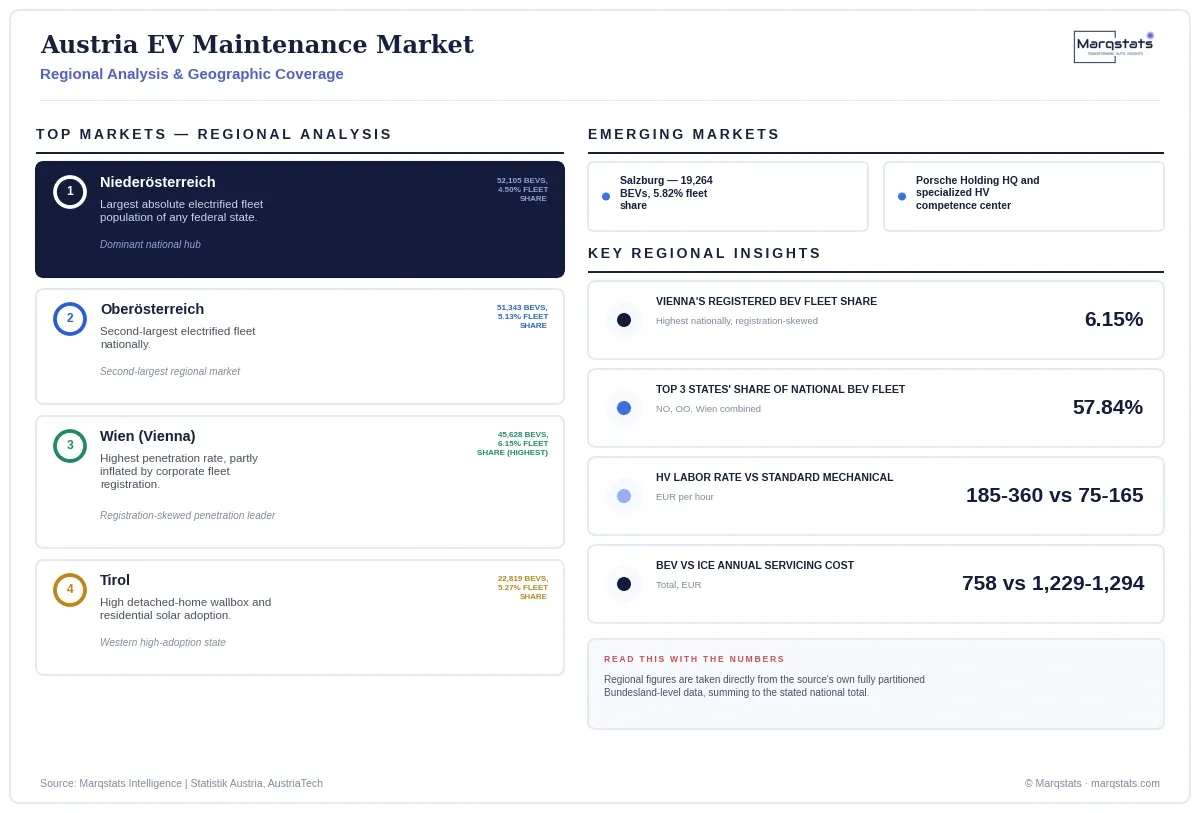
Vienna posts the highest EV penetration rate of any Austrian federal state at 6.15% — a headline figure that would suggest the capital is where Austria's electric vehicle servicing demand is most concentrated. The underlying research shows that reading is only partly right.
Major corporate leasing providers and mobility operators headquarter in Vienna and register their entire nationwide vehicle fleets there, under Viennese plates, regardless of where those vehicles actually operate day to day. A meaningful share of those vehicles are driven daily in commuter corridors across Lower Austria, Upper Austria and Styria — meaning the maintenance and tire-servicing demand those vehicles generate lands in suburban and regional workshops, not necessarily in central Vienna. Anyone reading Vienna's registration share as a direct proxy for where to site service capacity is working from a number that overstates the capital's actual role.
Market Dynamics
Key Drivers
- Austria's own regional data shows a meaningful gap between where corporate fleet vehicles are registered and where they actually circulate, since leasing fleets registered under Viennese plates disperse a documented share of real-world driving activity into Lower Austria, Upper Austria and Styria, sustaining service demand across regional networks that pure registration data alone would understate.
- Austria's own fully worked sizing chain shows tires and chassis alignment already the single largest service category at 31.00% of total value, a structural signal that specialized tire inventory and precision alignment capability represent the most immediate revenue opportunity for workshops entering this market.
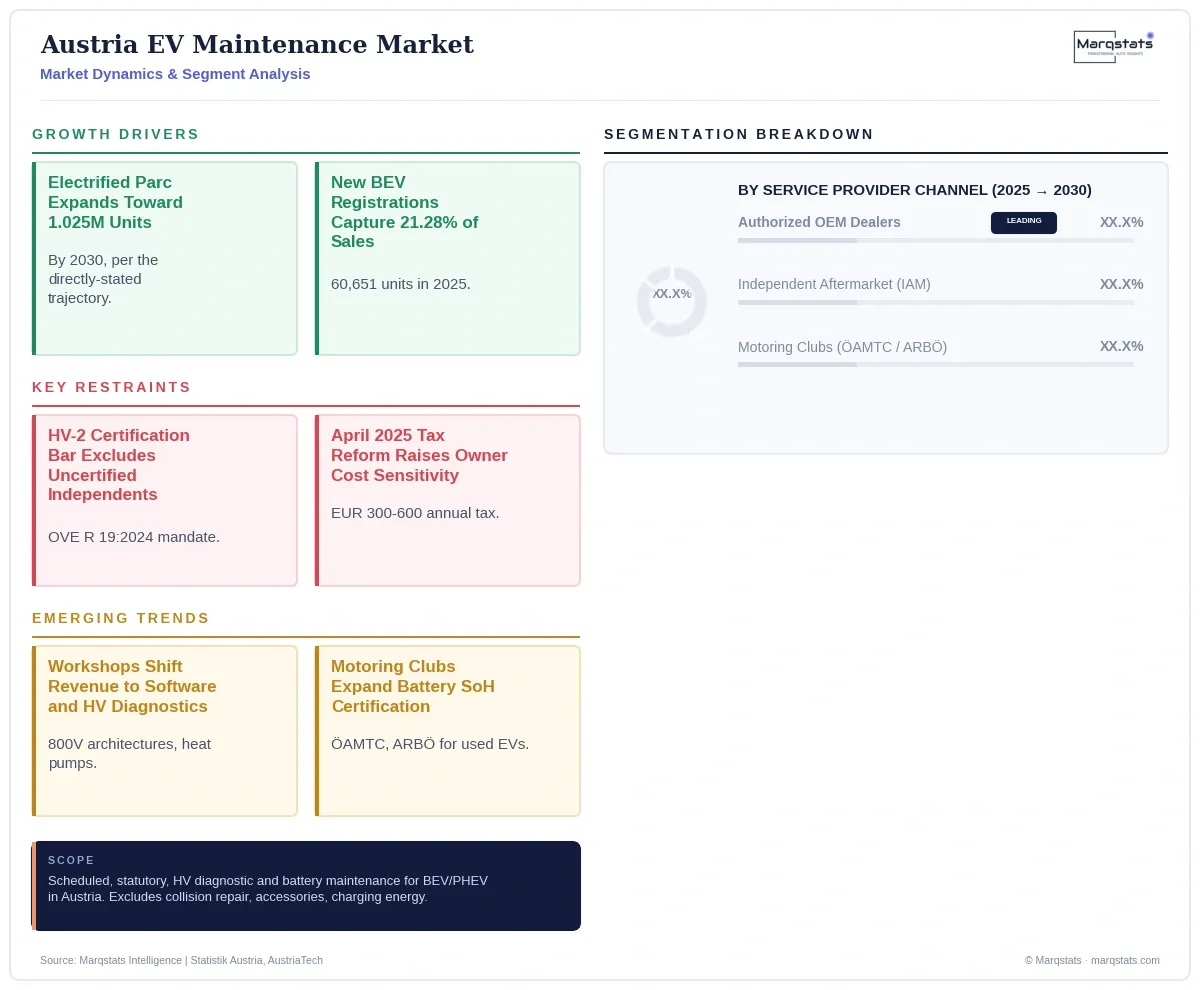
- Austria's electrified light vehicle parc is expanding rapidly, from 380,383 units in 2025 toward a projected 1,024,500 units by 2030, directly growing the addressable base for recurring EV aftermarket maintenance demand.
- New battery electric car registrations reached 60,651 units in 2025 (21.28% of all new passenger car sales), even as total new registrations grew a more modest 12.3%, demonstrating electrified powertrains capturing disproportionate share of new demand.
- First-generation volume-market electric vehicles registered between 2019 and 2022 are approaching the conclusion of their standard eight-year factory battery warranties, directly expanding demand for third-party battery diagnostic testing and State-of-Health certification.
- Lucky Car's absorption of 22 former ATU branches and its EUR 80 million 2025 revenue (+15% YoY) demonstrates independent networks successfully scaling high-voltage certified capacity to capture commercial fleet maintenance contracts.
- Federal eMOVE Austria decarbonization grants, extended by the Federal Ministry for Climate Action in December 2025, continue subsidizing commercial vehicle fleet electrification and depot charging infrastructure, sustaining fleet electrification momentum.
Key Restraints
- Austria's persistent shortage of HV-3 certified master technicians genuinely constrains near-term high-voltage repair capacity, since the credential requires 24 hours of advanced training on top of at least 12 months of documented field experience as an HV-2 technician, a meaningfully longer qualification path than most other technical automotive certifications.
- This market's own forecast trajectory reaches 2030 through a single directly-stated path rather than a quantified scenario range, a disclosed methodological choice that leaves less room to gauge how sensitive the headline figure is to macroeconomic or policy variation than markets in this coverage set with a fully quantified Downside/Upside framework.
- Independent workshops lacking HV-2 certified personnel are legally barred under OVE-Richtlinie R 19:2024 from performing advanced high-voltage repairs, concentrating electrical diagnostic and battery servicing within authorized dealerships and certified specialist networks.
- Establishing certified high-voltage service capability requires EUR 35,000 to EUR 60,000 in capital investment per workshop for insulated tooling, quarantine bays and technician training, a genuine barrier for smaller independent operators in lower-volume regions.
- The April 2025 motor tax reform, while not itself a workshop expense, has made fleet and private buyers more cost-conscious regarding aftermarket parts choices and labor rates, potentially pressuring margins for providers unable to differentiate on service quality.
- Regional disparities in high-voltage maintenance capacity persist, since workshops in rural Carinthia and southern Styria face longer payback periods on high-voltage tooling investment due to lower local electric vehicle volumes than western Austria or the Vienna commuter belt.
Key Trends
- Corporate fleet managers are increasingly negotiating dedicated maintenance service level agreements directly with authorized dealer networks offering centralized high-voltage competence, given the documented benefit-in-kind and VAT deduction incentives tying commercial EV adoption specifically to authorized channel loyalty.
- Automotive workshops are increasingly generating revenue through software-based diagnostics, electrical insulation testing, and thermal management fluid maintenance as 800-volt charging architectures and multi-loop heat-pump circuits become standard on new electric models.
- Motoring clubs ÖAMTC and ARBÖ, alongside diagnostic hardware manufacturers like AVL DiTEST, are expanding standardized battery degradation verification and State-of-Health certification services for the growing used electric vehicle remarketing segment.
- Independent workshop chains are partnering with regional parts distribution academies, such as the Birner Akademie, to ensure technical personnel attain HV-2 and HV-3 qualifications ahead of declining internal combustion vehicle service volumes.
- Diagnostic equipment manufacturers including AVL DiTEST are scaling automated cell balancing and module conditioning instruments, such as the VAS 6910A, enabling component-level battery repair that avoids full pack replacement.
Strategic Implications
- Motoring clubs should continue expanding independent battery State-of-Health certification services nationwide, given how directly this neutral third-party role positions them to capture used-vehicle remarketing demand as the first-generation warranty cohort matures toward resale.
- Component suppliers should also weight EV-specific tire and dielectric coolant inventory planning heavily nationwide, given how directly both categories anchor this market's largest documented service revenue drivers.
- Independent workshop operators should prioritize OVE-Richtlinie R 19:2024 HV-2 and HV-3 certification investment specifically, positioning ahead of the wave of first-generation vehicles exiting eight-year factory battery warranties between 2027 and 2030.
- Franchised dealership networks should continue leveraging proprietary diagnostic access and warranty covenants to defend near-term revenue, while building battery lifecycle management and State-of-Health certification capability to capture used-vehicle remarketing demand as warranties expire.
- Parts distributors and training academies should scale HV certification capacity specifically in western Austria and the suburban Vienna commuter belt, given how directly the underlying research shows these regions carrying disproportionate real-world servicing demand relative to simple registration counts.
- Investors and analysts should track battery warranty expiration timing for the 2019-2022 vehicle cohort nationwide and independent workshop HV-2/HV-3 certification rates as the clearest variables shaping whether this market's projected channel realignment toward independents actually materializes on schedule.
Outlook
Unlike several other markets in this coverage set, the underlying research presents a single directly-stated forecast trajectory reaching 2030 within its own forecast horizon, requiring no Marqstats extrapolation, rather than a fully quantified multi-scenario framework with named Downside and Upside 2030 figures. The pack's own year-by-year table aligns this trajectory with targets embedded in the Austrian Integrated National Energy and Climate Plan and federal transport decarbonization scenarios.
Total market value grows from USD 349.25 million (EUR 309.07 million) in 2025 to USD 1,062.59 million (EUR 940.35 million) by 2030, a 24.92% CAGR, as Austria's electrified light vehicle parc expands from 380,383 units to a projected 1,024,500 units. This trajectory is shaped by three structural dynamics discussed at length in the underlying research: the decoupling of routine mechanical servicing from diagnostic and high-voltage labor billing as 800-volt architectures and multi-loop heat-pump circuits become standard; growth in battery lifecycle management and State-of-Health certification as the 2019-2022 vehicle cohort approaches the conclusion of its eight-year factory battery warranty; and aftermarket channel realignment as independent workshop chains, led by operators like Lucky Car, capture an expanding share of out-of-warranty vehicles by investing in OVE-Richtlinie R 19:2024 compliance.
Marqstats presents this single directly-stated trajectory throughout this analysis rather than constructing alternate Downside or Upside scenario figures the underlying research did not provide, consistent with house policy against fabricating scenario numbers absent from the source.
Market Segmentation
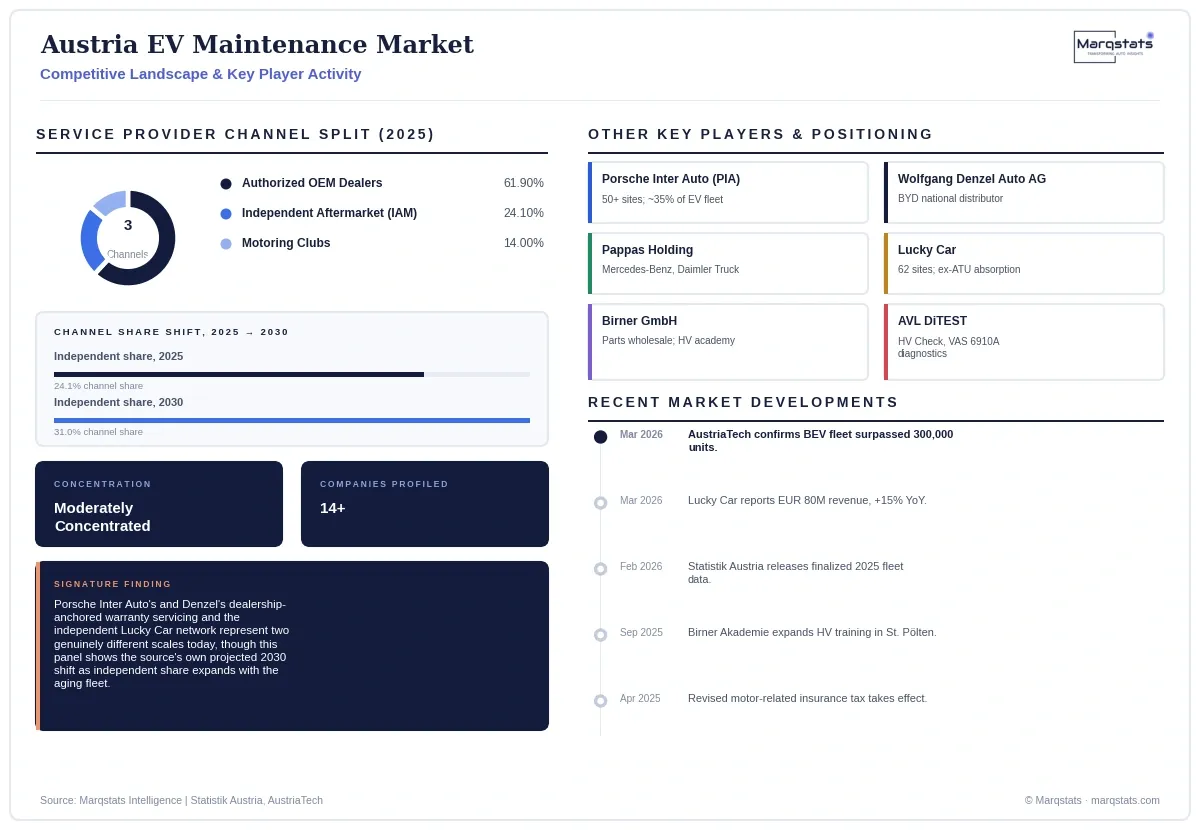
USD 216.19 million (61.90% share) in 2025, growing to USD 584.42 million (55.00% share) by 2030. Anchored by Porsche Inter Auto and Wolfgang Denzel Auto AG, sustained by 8-year battery warranties.
USD 84.17 million (24.10% share) in 2025, growing to USD 329.40 million (31.00% share) by 2030. The fastest-growing channel, led by Lucky Car's 62-location network.
USD 48.90 million (14.00% share) in 2025, growing to USD 148.76 million (14.00% share) by 2030. Anchored by statutory § 57a inspection authority and neutral battery SoH certification.
USD 108.27 million (31.00% share) in 2025, growing to USD 329.40 million (31.00% share) by 2030. The largest category, driven by heavy curb weights and mandatory seasonal tire changeovers.
USD 96.04 million (27.50% share) in 2025, growing to USD 276.27 million (26.00% share) by 2030. Anchored by high-voltage insulation testing and CAN/DoIP diagnostic scans.
USD 78.58 million (22.50% share) in 2025, growing to USD 255.02 million (24.00% share) by 2030. Anchored by brake corrosion from Alpine brine road treatment and suspension fatigue.
USD 41.21 million (11.80% share) in 2025, growing to USD 122.20 million (11.50% share) by 2030. Anchored by the "3-2-1" periodic cadence and high-voltage inspection protocols.
USD 25.15 million (7.20% share) in 2025, growing to USD 79.69 million (7.50% share) by 2030. Anchored by contactor replacement, BMS calibration and module rebalancing.
USD 203.26 million (58.20% share) in 2025, growing to USD 584.42 million (55.00% share) by 2030. Anchored by VAT deduction and benefit-in-kind tax incentives, sustaining authorized dealer loyalty.
USD 145.99 million (41.80% share) in 2025, growing to USD 478.17 million (45.00% share) by 2030. Growing fastest, driven by a 71.5% surge in private new registrations and migration toward independents.
By Geography
Niederösterreich (Lower Austria)
52,105 BEVs and 71,044 PHEVs (4.50% BEV fleet share), 11,251 new BEV registrations in 2025, the largest absolute electrified fleet population of any federal state.
Oberösterreich (Upper Austria)
51,343 BEVs and 20,570 PHEVs (5.13% BEV fleet share), 11,174 new BEV registrations in 2025, the second-largest electrified fleet nationally.
Wien (Vienna)
45,628 BEVs and 18,280 PHEVs (6.15% BEV fleet share, the highest of any federal state), 12,607 new BEV registrations in 2025, though affected by a commercial fleet registration anomaly: nationwide corporate vehicle pools register under Viennese plates even though many operate in surrounding commuter counties.
Tirol (Tyrol)
22,819 BEVs and 9,150 PHEVs (5.27% BEV fleet share), supported by high rates of detached-home wallbox installation and residential solar photovoltaic adoption.
Salzburg
19,264 BEVs and 7,720 PHEVs (5.82% BEV fleet share), home to Porsche Holding's headquarters and a specialized high-voltage competence center.
Combined Remaining States (Vorarlberg, Kärnten, Burgenland)
35,798 BEVs across the three smallest federal states, exhibiting the lowest electrification rates nationally (3.44% to 5.94%), reflecting older average fleets and lower public fast-charging density in the southeast.
How Competition Is Evolving
Austria's franchised dealer channel remains genuinely competitive against new entrants overall.
No single company in this market spans franchised warranty-anchored dealership servicing, independent multi-brand franchise operation, and motoring-club statutory inspection authority simultaneously, leaving genuine competitive white space for any group capable of bridging Porsche Inter Auto's and Denzel's dealership-anchored warranty servicing with the independent and club channels this market's own segmentation shows gaining combined share as the fleet ages past warranty.
Competition spans OEM authorized dealer conglomerates, independent workshop franchise networks, and motoring clubs. Porsche Holding GmbH, through its retail division Porsche Inter Auto, is the largest automotive retail organization in Austria and Europe, operating over 50 locations and providing service coverage for approximately 35% of the domestic EV fleet as the authorized partner for Volkswagen, Audi, Škoda, SEAT, CUPRA and Porsche. Wolfgang Denzel Auto AG serves as BYD's national distribution and service partner, building specialized infrastructure for BYD's Blade Battery LFP chemistry as BYD reached 9% of new Austrian BEV sales in 2025. Pappas Holding GmbH anchors Mercedes-Benz and Daimler Truck servicing including electric commercial vehicles.
On the independent side, Lucky Car Franchise & Betreiber GmbH is Austria's largest multi-brand independent repair franchise, operating 62 locations after absorbing 22 former ATU branches. Birner GmbH anchors parts wholesale distribution and, through the Birner Akademie, delivers OVE-Richtlinie R 19:2024 certified HV-1/HV-2/HV-3 training. AVL DiTEST GmbH, headquartered in Graz, develops the HV Check diagnostic instrument and VAS 6910A battery conditioning platform used across dealership networks. Regulatory oversight rests with the WKO Bundesinnung Fahrzeugtechnik (9,811 member enterprises), the OVE (technical safety standards), and motoring clubs ÖAMTC and ARBÖ (statutory inspection authority and neutral battery certification).
Companies Covered
Companies covered in the report include:
Recent Market Activity
Table of Contents
Coverage & Segmentation
The analysis measures scheduled mechanical and electrical inspections, statutory roadworthiness testing (§ 57a KFG), high-voltage system diagnostics, insulation integrity validation, battery pack and module condition testing, wear-and-tear mechanical maintenance, thermal management servicing, and specialized EV tire replacement for BEV and PHEV vehicles in Austria, across a 2025 base year and a 2026 to 2030 forecast period, denominated in United States dollars at the pack's own stated benchmark rate of 1.13 USD per EUR. It excludes collision sheet-metal repairs, cosmetic refinishing, third-party accessories, insurance administration fees, and electric vehicle charging energy costs.
The analysis spans three segmentation dimensions — service provider channel, service category and customer type — six regional groupings across Austria's nine federal states, and 14 profiled entities across OEM dealers, independent chains and regulatory bodies. Fleet figures trace to Statistik Austria and AustriaTech; market value and all three segmentation dimensions trace directly to the underlying research's own fully worked sizing model, with both 2025 and 2030 figures directly source-stated throughout.