Market Snapshot
Key Takeaways
Market Overview & Analysis
Report Summary
This analysis reads Brazil's own fully partitioned sizing chain, regional distribution data, and named-scenario tariff framework together as a single coherent picture rather than isolated data points, since the underlying research itself was structured to support exactly that kind of integrated reading.
Brazil's EV maintenance market is measured across preventive servicing, high-voltage battery diagnostics, tire and running gear wear, thermal management, and regenerative braking maintenance, valued at USD 302.98 million in 2025. This figure is taken directly from the underlying research's own fully sourced and partitioned sizing chain, anchored to statutory fleet registration data and converted at the Banco Central do Brasil's own stated 2024 benchmark exchange rate.
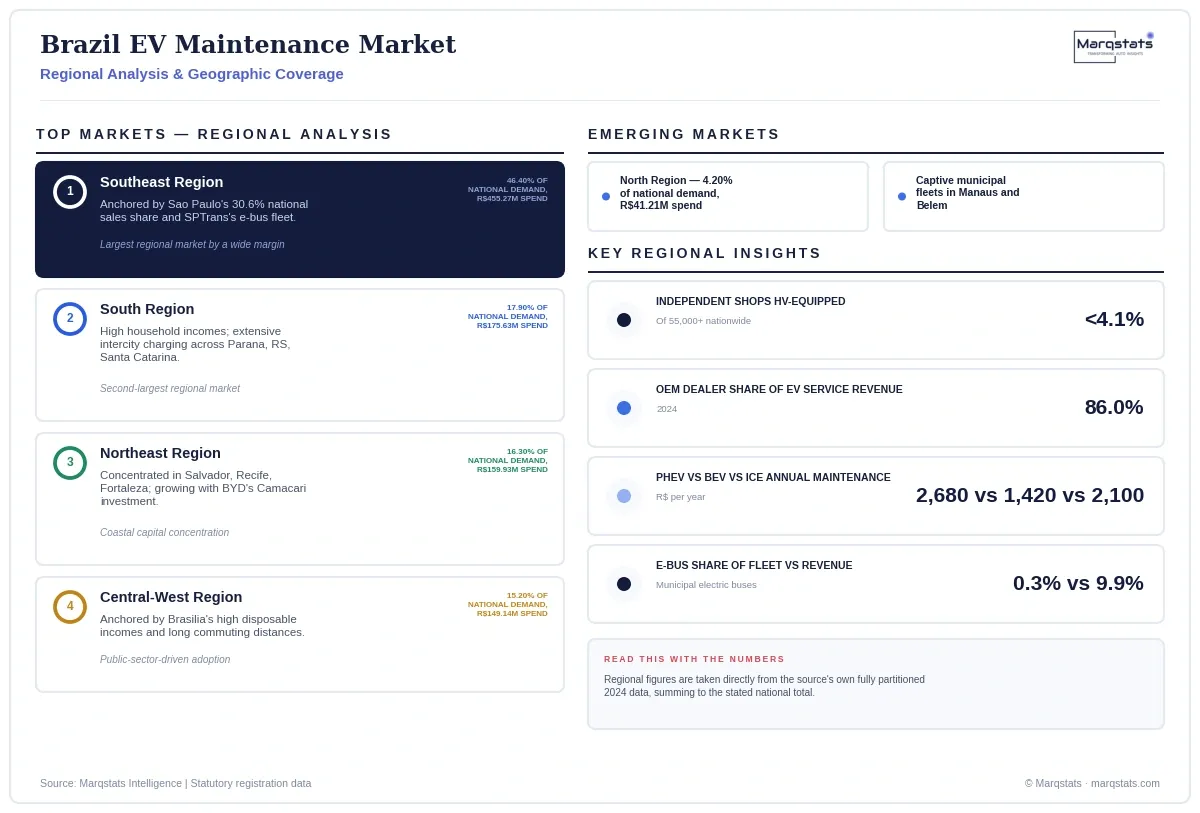
Structurally, this is a market defined by a stark channel concentration reinforced by long manufacturer warranties: OEM authorized dealerships capture 86.0% of light electrified vehicle service revenue, while fewer than 4.1% of Brazil's 55,000-plus independent repair businesses have cleared the technical and capital barriers to compete for high-voltage service work.
The analysis is built for four reader types making different decisions: an independent workshop operator weighing ABNT PR 1025 and NR-10 certification investment against a market where warranty lock-in still dominates, a domestic OEM like BYD or GWM navigating the phased import tariff structure toward its own local assembly ramp-up, a fleet operator managing municipal electric bus servicing economics, and an investor tracking how tariff policy and vocational certification scale-up together shape this market's Baseline-to-Restrained scenario range.
Why 55,000 Independent Workshops Still Can't Touch Most EVs
Brazil's independent automotive repair sector is genuinely enormous — over 55,000 businesses nationwide, a workforce and geographic footprint most countries in this coverage set can't match. And yet fewer than 4.1% of them have actually cleared the bar to compete for high-voltage EV service work.
The barrier isn't a single obstacle but a stack of them, each individually manageable but collectively steep: ABNT PR 1025 and NR-10 certification requirements, 1,000V insulated tooling and dedicated high-voltage bays, and recurring diagnostic scanner subscription costs running R$ 12,000 to R$ 28,000 per vehicle brand family annually — four to five times the ICE equivalent. For a workshop weighing whether the investment pays back, that stack of requirements, not any single line item, is what's actually keeping independent capture at 4.1% while dealerships hold 86.0%.
A Tariff Deadline That Splits This Market's Entire Future in Two
Most market forecasts hedge across a range of plausible outcomes. Brazil's own scenario framework is more specific than that: both of its forward trajectories hinge on a single, dated policy event — whether BYD's Camacari plant and GWM's Iracemapolis plant reach planned production volumes before the final 35% import tariff tier takes full effect in July 2026.
If domestic assembly gets there first, the Baseline Scenario plays out: tariff exposure gets absorbed by local production, vehicle prices stay competitive, and the fleet keeps expanding toward 1,965,000 units by 2029. If the tariff deadline arrives first, the Restrained Supply Scenario takes over instead: import costs bite before local capacity is ready, retail prices rise, and fleet growth slows to 1,480,000 units. The difference between those two outcomes isn't a matter of degree — it's a genuinely binary production-timeline race against a fixed regulatory date, worth tracking as closely as any single variable in this market.
Market Dynamics
Key Drivers
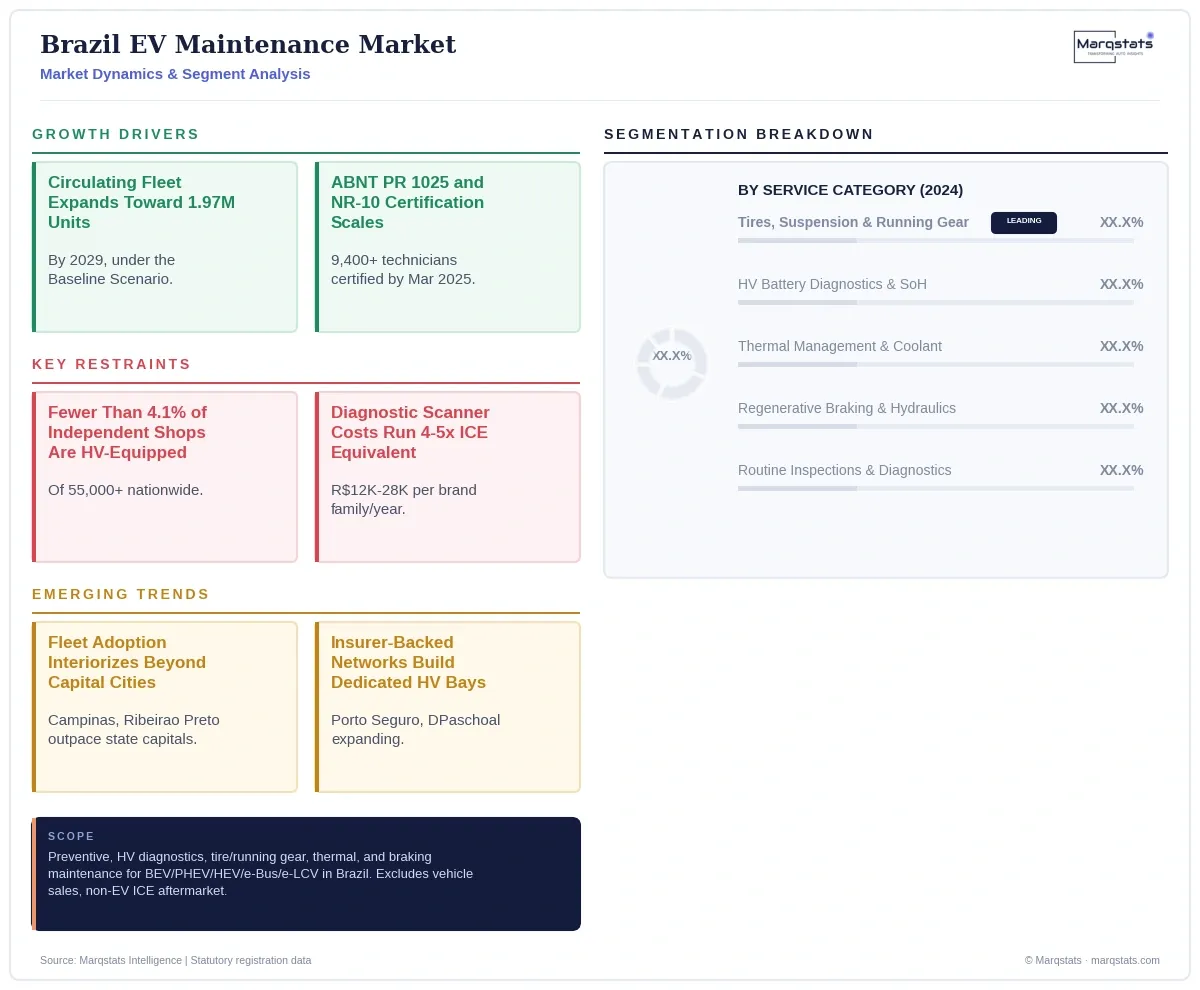
- Brazil's fully partitioned service category data shows tires, suspension and running gear already the single largest category at 31.5% of 2024 value, a structural signal that specialized tire inventory and precision alignment capability, not general mechanical capacity, represent the most immediate revenue opportunity for workshops entering this market.
- Brazil's circulating electrified fleet is expanding rapidly, from 397,765 units at year-end 2024 to a projected 1,965,000 units by 2029 under the Baseline Scenario, directly growing the addressable base for recurring high-voltage aftermarket maintenance demand.
- ABNT PR 1025 and NR-10 vocational certification programs delivered through SENAI and IQA are actively expanding the qualified technician pool, with over 9,400 automotive professionals certified nationwide by March 2025, directly enabling broader independent workshop participation in high-voltage service.
- Municipal electric bus fleets, anchored by São Paulo's SPTrans network expanding past 700 units by September 2024, generate disproportionately concentrated maintenance revenue and sustain demand for specialized depot-level high-voltage service contracts.
- Programa Mover, formally established into law in June 2024 with BRL 19.3 billion in tax credits tied to emissions and domestic R&D through 2028, is directly incentivizing the domestic assembly ramp-up this market's own Baseline scenario depends on.
- Component suppliers including Acumuladores Moura and WEG are building domestic battery diagnostics, reconditioning, and industrial electric motor manufacturing capacity, supporting the localized parts and component supply chain this market's own forward trajectory requires.
Key Restraints
- The underlying research's own 2030 endpoint relies on Marqstats extrapolation rather than a source-stated figure, since the pack's own forecast horizon runs through 2029 -- a genuine methodological gap disclosed explicitly throughout this analysis rather than presented as a directly source-stated number.
- Fewer than 4.1% of Brazil's over 55,000 independent repair businesses have invested in the high-voltage bay isolation, insulated tooling, and technician certifications required to compete for high-voltage service work, structurally confining the vast majority to non-electrified mechanical repairs.
- Independent workshops face annual diagnostic software licensing and scanner subscription costs of R$ 12,000 to R$ 28,000 per vehicle brand family, a recurring financial barrier compounding the upfront high-voltage tooling investment already required.
- A phased import tariff increase reaching 35% for BEVs by July 2026 under Resolucao Gecex no. 542 creates a genuine, dated policy risk that could raise retail vehicle prices and slow fleet growth if domestic assembly ramp-up does not keep pace.
- Elevated tire wear, running 20% to 30% faster due to heavier curb weights and instant motor torque, combined with a 25% to 40% retail price premium on EV-specific tires, is shifting routine consumer maintenance expenditure heavily toward tire replacement and suspension alignment.
Key Trends
- Electrified fleet adoption is interiorizing beyond Brazil's capital cities, with non-capital municipalities including Campinas, Ribeirão Preto and Uberlândia recording sales exceeding several state capitals, pushing aftermarket networks to expand diagnostic coverage into agro-industrial corridors.
- Specialized service networks including Porto Seguro Centros Automotivos and DPaschoal are outfitting dedicated high-voltage service bays specifically to support corporate fleets and insured customers, representing a genuinely distinct channel from both pure dealership and pure independent models.
- Franchised dealerships are introducing specialized retention services — high-voltage coolant loop flushes, precision suspension alignments, and certified battery health assessments for the emerging used EV market — specifically to protect margin as routine inspection billings run lower than traditional combustion servicing.
- Domestic component manufacturing is scaling to support tropical-climate-specific requirements, with priority investment areas including low-conductivity dielectric cooling fluids formulated for Brazil's high ambient temperatures and regional battery diagnostics and recycling facilities.
Strategic Implications
- Independent repair businesses should sequence their EV service capability build specifically: target underserved mechanical services — EV-specific tire mounting, suspension bushing overhauls, air-conditioning maintenance — before committing capital to advanced battery pack cell balancing or module repairs, following the underlying research's own recommended investment sequencing.
- Authorized dealership networks should introduce competitive service tiers specifically timed to retain customers as early PHEVs exit factory warranty periods nationwide, given how directly warranty expiration threatens to shift routine combustion-engine-side maintenance toward independent shops.
- Component suppliers and aftermarket investors should prioritize domestic production of tropical-climate dielectric cooling fluids and regional battery diagnostics facilities in established automotive hubs including São Paulo, Minas Gerais and Paraná specifically, given how directly localized supply chains determine which of this market's own two scenarios plays out.
- Investors and analysts should track domestic assembly ramp-up progress at BYD's Camacari and GWM's Iracemapolis plants against the July 2026 final tariff deadline as the single clearest variable separating this market's Baseline and Restrained Supply scenarios and their genuinely different 2030 outcomes.
Outlook
The underlying research presents two distinct forward trajectories, diverging on a single named tariff-policy trigger: the pace of domestic assembly ramp-up ahead of the final import tariff tier taking full effect. The 2030 figures below are Marqstats extrapolations of the pack's own directly stated 2029 endpoints, held one additional year at each scenario's own five-year CAGR, disclosed explicitly; the pack's own 2029 figures are given for reference alongside.
Under the Baseline Scenario, domestic assembly plants operated by BYD in Camacari and GWM in Iracemapolis reach full operationalization by early 2026, offsetting the final 35% import tariff under Resolucao Gecex no. 542; Programa Mover disbursements continue through 2028, and vocational training qualifies over 25,000 independent technicians under ABNT PR 1025. The circulating electrified fleet reaches 1,965,000 units by 2029 (BRL 5,296.03 million / USD 981.82 million), extrapolated to BRL 7,419.74 million (USD 1,375.53 million) by 2030 at a 35.34% CAGR, with independent workshops capturing 18.5% of out-of-warranty service volume.
Under the Restrained Supply Scenario, the 35% tariff ceiling implemented in July 2026 takes effect before domestic assembly ramps reach planned volumes, causing retail vehicle prices to rise and slowing annual sales; proprietary software encryption and slow workshop certification limit independent garage participation, concentrating maintenance within franchised dealership networks. The circulating fleet reaches only 1,480,000 units by 2029 (BRL 3,860.00 million / USD 715.60 million), extrapolated to BRL 5,075.13 million (USD 940.87 million) by 2030, with franchised dealerships retaining over 85% of service revenue and component backlogs for imported platforms lengthening repair times.
Market Segmentation
USD 95.44 million (31.5% share) in 2024. The largest category, driven by accelerated tire wear and Brazilian road-surface suspension strain.
USD 75.14 million (24.8% share) in 2024. Anchored by cell impedance balancing and busbar corrosion cleaning rather than full pack replacement.
USD 56.35 million (18.6% share) in 2024. Anchored by Brazil's high ambient temperatures requiring continuous high-voltage cooling.
USD 43.02 million (14.2% share) in 2024. Anchored by humidity-driven brake rotor oxidation in coastal cities despite extended pad life.
USD 33.02 million (10.9% share) in 2024. Covers megohmmeter insulation testing and 12V auxiliary battery servicing.
397,765 units (88.9% of maintenance value) in 2024, split between private commuters and commercial ride-hailing drivers on platforms like 99 (DiDi Chuxing) accumulating up to 8,000 km monthly.
1,250 units (9.9% of maintenance value) in 2024, representing just 0.3% of the fleet by unit count but a disproportionate revenue share anchored by São Paulo's SPTrans transit system.
3,500 units (1.1% of maintenance value) in 2024, utilized in urban last-mile logistics by companies including Mercado Livre and DHL.
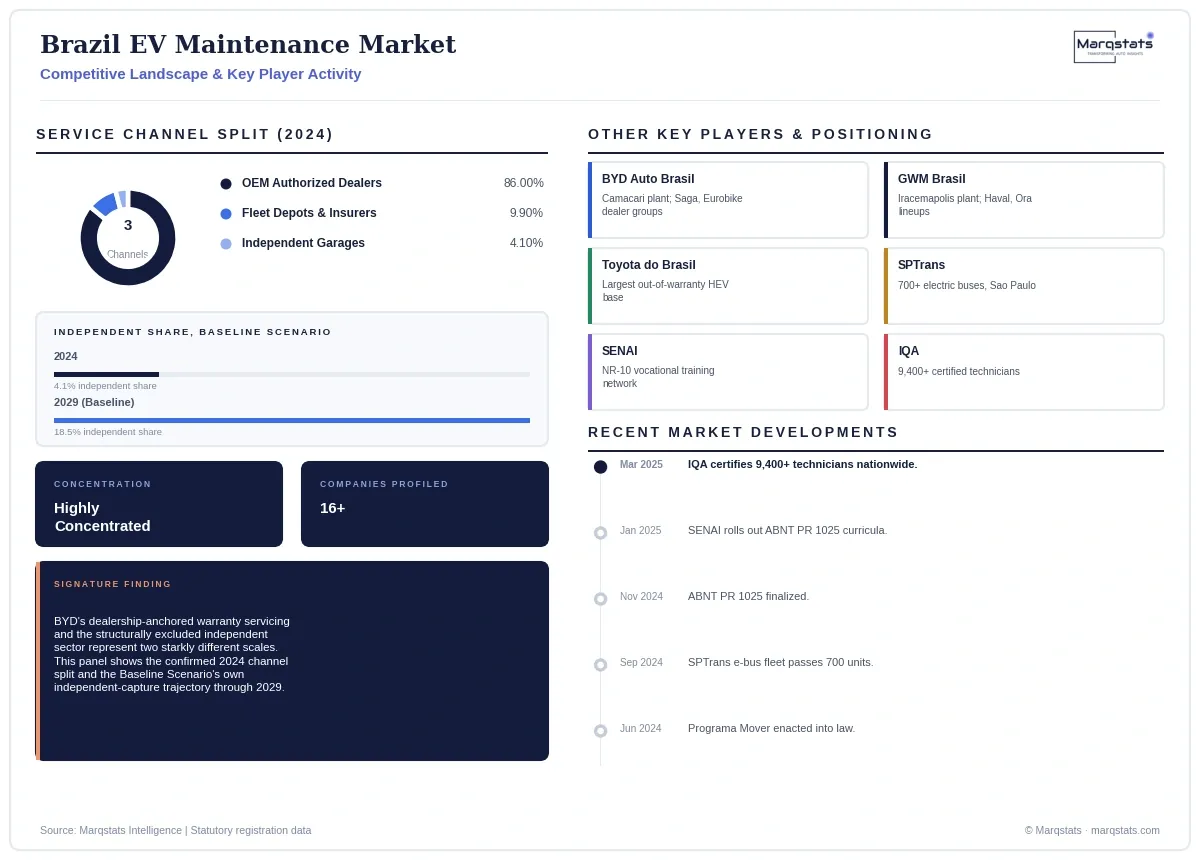
86.0% share in 2024, sustained by 5-to-8-year manufacturer warranties on high-voltage batteries and electric drive units; the Baseline Scenario's own trajectory implies this share moderating as the fleet ages past warranty.
9.9% share in 2024, anchored by specialized networks including Porto Seguro Centros Automotivos and DPaschoal outfitting dedicated high-voltage bays for corporate and insured fleets.
4.1% share in 2024, growing to 18.5% under the Baseline Scenario's own 2029 projection as ABNT PR 1025 and NR-10 certification expands the qualified independent technician pool.
By Geography
Southeast
46.4% of national maintenance demand, BRL 455.27 million in 2024 spend, anchored by São Paulo State's 30.6% share of national sales and the City of São Paulo's 28,212 2025 registrations (12.6% of the national total), operating the continent's largest municipal battery-electric bus fleet under SPTrans.
South
17.9% of national maintenance demand, BRL 175.63 million in 2024 spend, driven by high household incomes and extensive intercity charging networks across Paraná, Rio Grande do Sul and Santa Catarina, with Curitiba recording 6,488 2025 sales as the regional operational center.
Northeast
16.3% of national maintenance demand, BRL 159.93 million in 2024 spend, concentrated in coastal state capitals Salvador, Recife and Fortaleza, with Bahia demand growing following BYD's industrial investment in Camacari expanding regional technical support networks.
Central-West
15.2% of national maintenance demand, BRL 149.14 million in 2024 spend, anchored by the Federal District (Brasília), which recorded 21,639 2025 registrations driven by high disposable incomes among public-sector employees and long daily commuting distances.
North
4.2% of national maintenance demand, BRL 41.21 million in 2024 spend, with adoption limited to captive municipal fleets in Manaus and Belém due to vast transit distances and sparse regional charging infrastructure.
How Competition Is Evolving
No single company in this market spans OEM warranty-locked dealership servicing, independent high-voltage repair and fleet-depot operations simultaneously, leaving genuine competitive white space for any group capable of bridging BYD's dealership-anchored warranty servicing with the independent and fleet-depot channels this market's own Baseline scenario shows growing fastest through 2029.
Competition spans OEM authorized dealership networks, a structurally constrained independent repair sector, and an emerging fleet depot and insurer-backed channel. BYD Auto Brasil leads the battery-electric and plug-in hybrid passenger vehicle segments through franchised dealer groups including Saga and Eurobike, while establishing domestic assembly at its Camacari complex in Bahia. Great Wall Motor (GWM) Brasil operates a specialized retail network for its Haval hybrid and Ora BEV lineups, supported by its Iracemapolis assembly plant. Toyota do Brasil maintains the largest national base of out-of-warranty electrified vehicles through its domestic Corolla and Corolla Cross HEV Flex platforms. In the commercial heavy-duty sector, Mercedes-Benz do Brasil and Eletra Industrial lead municipal bus supply, providing dedicated technical support to transit fleets.
On industry standardization, SINDIREPA Brasil and SINDIREPA-SP represent independent repair businesses, advocating for open diagnostic access, while Sindipecas tracks circulating fleet statistics for the domestic parts industry. The Instituto da Qualidade Automotiva (IQA) anchors technical auditing and ABNT PR 1025 certification, accredited by INMETRO. On component and training infrastructure, Acumuladores Moura anchors high-voltage battery diagnostics and reconditioning research, WEG S.A. anchors industrial electric motor and inverter manufacturing, and the Servico Nacional de Aprendizagem Industrial (SENAI) anchors NR-10 and high-voltage vocational training across upgraded hubs in São Paulo, Rio de Janeiro and Bahia.
Companies Covered
The report profiles 16+ companies with full strategy and financials analysis, including:
Recent Market Activity
Table of Contents
Coverage & Segmentation
This report measures scheduled preventive maintenance, high-voltage battery diagnostics and state-of-health monitoring, tire and running gear servicing, thermal management and dielectric coolant maintenance, and regenerative braking and hydraulic component service for BEVs, PHEVs, HEVs, electric buses and electric light commercial vehicles in Brazil, across a 2025 base year and a 2026 to 2030 forecast period, denominated in United States dollars at the pack's own stated BCB 2024 annual average commercial exchange rate of R$ 5.3941 per USD. It excludes whole vehicle sales revenue and general internal combustion aftermarket spend outside the electrified segment.
The analysis spans three segmentation dimensions — service category, vehicle classification and service provider channel — five regional geographies, and 16 profiled entities across OEMs, trade associations, component suppliers and vocational bodies. Fleet and registration figures trace to statutory sources; market value and segment splits trace to the underlying research's own fully partitioned sizing model, with the 2030 endpoint disclosed as a Marqstats extrapolation of the pack's own stated 2029 figures.