Market Snapshot
Middle bar: base-year value × (1 + CAGR), rounded to two decimals. This is a calculated illustration, not a separately researched annual estimate.
Market Size (2025, Base Year): USD 78.40 Million
Estimated Value (2026): USD 102.70 Million
Forecast Value (2030): USD 294.60 Million
CAGR: 30.31% | Forecast Period: 2026 – 2030
Growth — Absolute: USD 216.20 Million
Largest Market: Dubai (58.00% of 2025 maintenance spend)
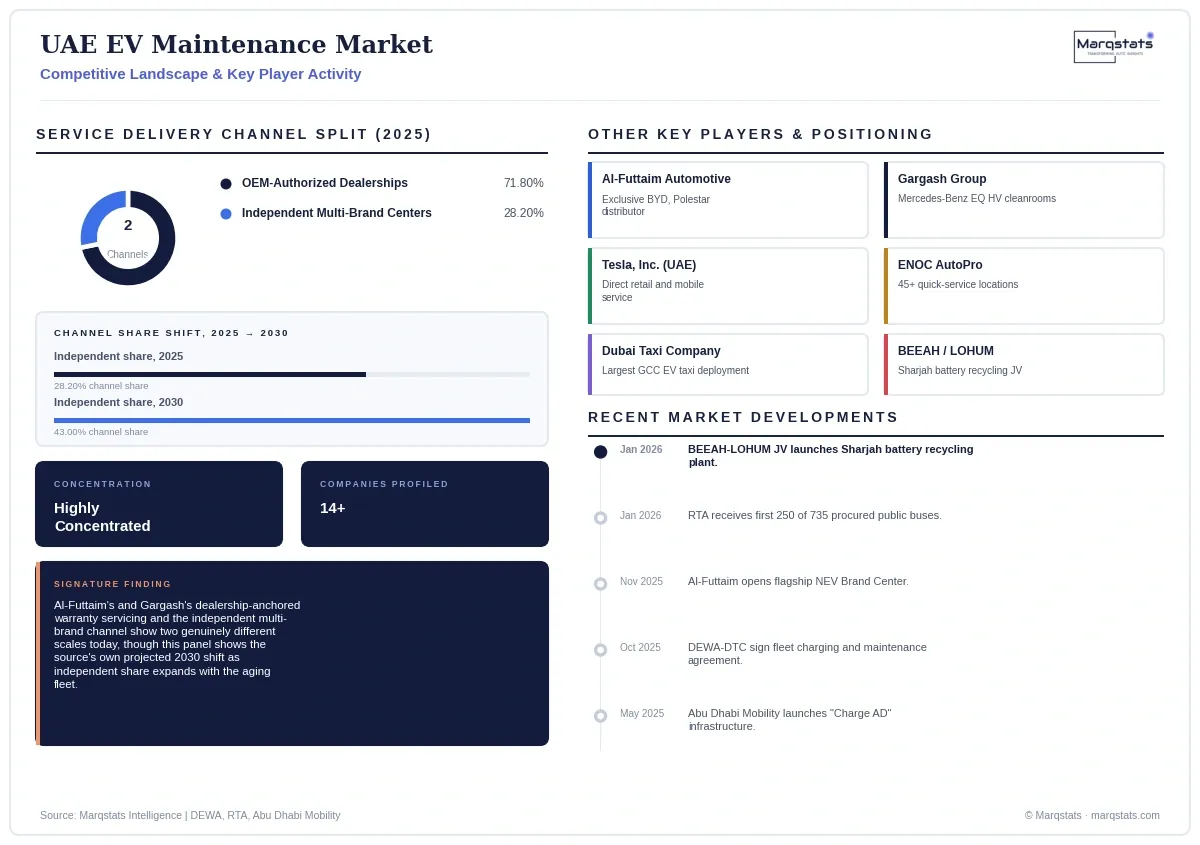
Fastest Growing: Independent Multi-Brand Centers (28.20% to 43.00% share, 2025-2030)
Dominant Segment: OEM-Authorized Dealerships (71.80% channel share, 2025)
Market Concentration: Moderately Fragmented
Base Year: 2025 | Historical Period: 2021 – 2025 | Forecast Period: 2026 – 2030
Units Considered: Value (USD Million)
Segments Covered: 3 | Regions Covered: 4 | Companies Profiled: 14
Report Pages: 240 | Deliverables: PDF, Excel, PPT
Key Takeaways
Market Overview & Analysis
Report Summary
This analysis reads the UAE's own fully worked sizing chain, emirate-level distribution data, and named-scenario regulatory framework together as a single coherent picture rather than isolated data points, since the underlying research itself was structured to support exactly that kind of integrated reading.
The UAE's EV maintenance market is measured across tire and mechanical wear, thermal management, electrical powertrain, battery diagnostics, and software/ADAS calibration, valued at USD 78.40 million (AED 287.92 million) in 2025. This figure is taken directly from the underlying research's own fully worked sizing chain, anchored to DEWA, RTA and Abu Dhabi Mobility statutory registration data covering an active operational BEV fleet of 84,200 units.
Structurally, this is a market shaped by genuine climate-driven engineering realities -- an AC compressor failure that can immobilize a vehicle, flood-risk battery economics that can total a car outright, and extreme heat that shortens routine service intervals -- layered on top of a conventional warranty-driven dealership-versus-independent aftermarket transition.
The analysis is built for four reader types making different decisions: an independent workshop operator weighing high-voltage certification investment against the parallel-import parts opportunity, a fleet operator like Emirates Transport scaling commercial electrification, a franchised dealer group defending warranty-anchored revenue, and an investor tracking how workshop capacity and grey-market vehicle volume shape this market's Downside-to-Upside scenario range.
Why a Broken Air Conditioner Can Strand an EV in the Gulf
Most coverage of EV climate control treats it as a comfort feature. In the UAE, it's worth understanding why that framing genuinely breaks down.
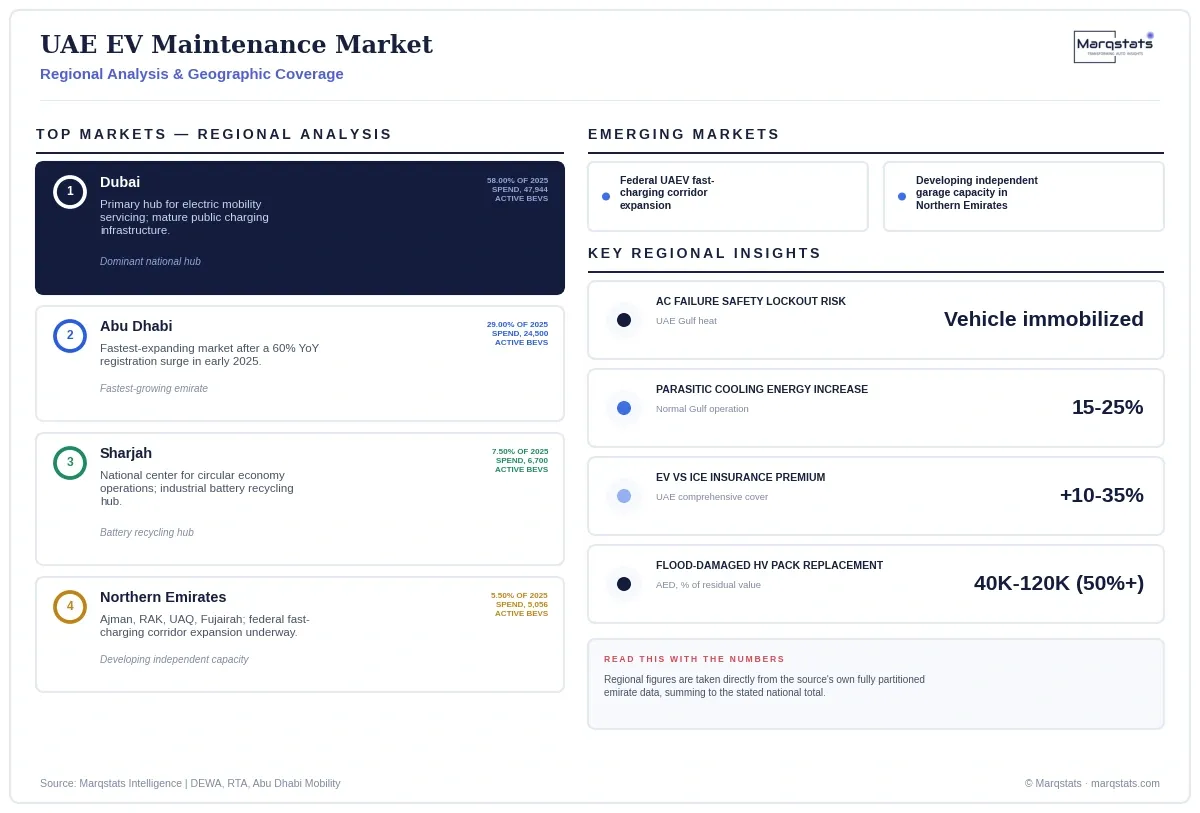
Sustained lithium-ion cell temperatures above 40C accelerate battery degradation, and Gulf summer conditions -- ambient air above 48C, asphalt surfaces above 60C -- push past that threshold routinely. Electric vehicles here depend on continuous active chiller cooling just to keep operating safely, a parasitic load that already raises energy consumption by 15% to 25% under normal conditions. When the electric AC compressor driving that cooling loop fails, the vehicle's own high-voltage safety interlocks step in and prevent it from operating at all, to stop the battery from overheating. A repair category that's routine maintenance everywhere else in this coverage set becomes a powertrain-critical failure mode here specifically.
What April 2024's Flooding Revealed About EV Total-Loss Economics
Comprehensive motor insurance premiums for UAE EVs already run 10% to 35% above ICE equivalents. The events of April 2024 explain why that gap widened further, and what it reveals about a structural risk specific to battery-electric vehicles.
High-voltage battery packs submerged in floodwater face water intrusion risks that compromise electrical isolation resistance -- not a cosmetic problem, but a genuine safety hazard requiring full pack replacement. That replacement costs AED 40,000 to AED 120,000, frequently exceeding 50% of the vehicle's residual market value. Combine that with modern EVs' large structural aluminum underbody castings, where even minor impact damage to the battery shield can trigger a total constructive loss over risk of internal cell puncture, and flood and impact risk both convert into total-loss economics far more readily for EVs than for comparable ICE vehicles.
Market Dynamics
Key Drivers
- The UAE's grey-market parallel-import vehicle population, running proprietary firmware and non-standard charging hardware, sustains a genuinely distinct independent-workshop revenue stream unavailable to authorized dealers bound by franchise agreements, since only independent multi-brand centers can legally and commercially service vehicles outside official distribution channels.
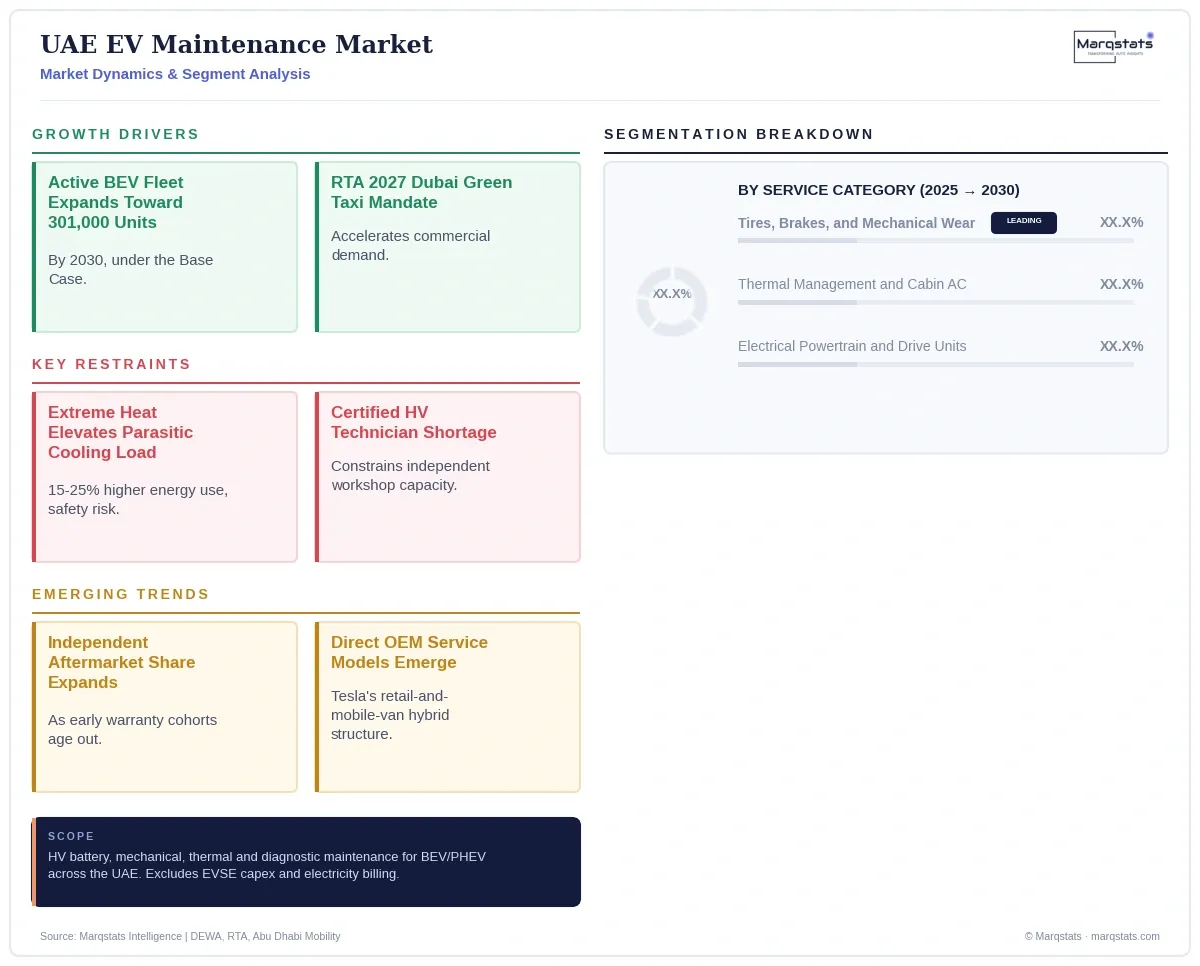
- This market's own fully worked sizing chain shows tires, brakes and mechanical wear already the single largest service category at 36.20% of total value, a structural signal that heavy-load chassis component inventory and specialized EV tire capacity represent the most immediate revenue opportunity for workshops entering this market.
- The UAE's active BEV fleet is expanding rapidly, from 18,200 units in 2021 toward a projected 301,000 units by 2030 under the Base Case Scenario, directly growing the addressable base for recurring EV aftermarket maintenance demand.
- RTA's mandate to transition all Dubai taxis to 100% eco-friendly platforms by 2027, and Emirates Transport's structured roadmap to electrify eligible segments of its 55,000-vehicle commercial portfolio by 2030, are directly accelerating high-mileage commercial fleet maintenance demand.
- Al-Futtaim Automotive's collaboration with the UK Institute of the Motor Industry, which certified more than 2,100 associates across IMI Levels 1 through 4 by late 2025, is directly expanding certified high-voltage technician capacity.
- The January 15, 2026 BEEAH-LOHUM battery recycling joint venture in Sharjah, designed to process 1,500 tonnes of lithium-ion batteries in 2026 and 3,000 tonnes by its third year, is directly establishing domestic circular battery infrastructure.
- Independent providers including ENOC AutoPro, Royal Swiss Auto Services and PitStopArabia are directly capturing parallel-imported (grey-market) EV servicing volume that lacks authorized local dealer support.
Key Restraints
- The UAE's lack of domestic replacement-parts stockholding for parallel-imported vehicle platforms genuinely extends repair turnaround times industry-wide, since independent workshops must source high-voltage contactors and inverter modules from overseas suppliers with multi-month lead times rather than local distribution networks.
- This market's own three-scenario framework spans a genuinely wide 2030 range, from USD 184.20 million under the Downside Scenario to USD 368.50 million under the Upside Scenario -- a disclosed spread reflecting real uncertainty in workshop capacity and diagnostic-access policy, not a narrow band around a single central estimate.
- Manufacturer high-voltage battery warranties spanning 6 to 10 years structurally bind owners to authorized dealer networks during the initial ownership cycle, directly constraining independent workshop volume until early adoption cohorts exit warranty coverage around 2028.
- Extreme Gulf heat conditions requiring continuous active battery chiller cooling directly elevate parasitic energy consumption by 15% to 25% and convert AC compressor failures into safety-critical powertrain lockouts, a genuinely climate-specific operational risk this market must manage that most other markets in this coverage set do not face at this intensity.
- A shortage of certified high-voltage technicians directly constrains independent workshop capacity, since only a small fraction of the thousands of mechanical technicians across Al Quoz and Mussafah industrial zones hold verified credentials to safely isolate and repair systems above 60V DC.
- Grey-market parallel-imported vehicles running proprietary firmware and GB/T charging hardware different from the UAE's CCS2 standard directly extend independent-shop repair times through multi-month supply delays for replacement high-voltage contactors and inverter modules.
Key Trends
- Insurance providers are beginning to differentiate EV coverage by flood-exposure zone and impact-damage total-loss thresholds specifically, given how directly submerged or structurally compromised battery packs convert routine collision claims into disproportionately expensive total-loss settlements relative to comparable ICE vehicles.
- Fleet operators managing high-mileage commercial vans and taxis are increasingly negotiating dedicated maintenance contracts directly with fleet-focused service providers, given the documented severe duty-cycle wear these platforms experience accumulating more than 100,000 kilometers annually under Gulf operating conditions.
- Independent multi-brand workshops are directly gaining share by servicing parallel-imported EVs lacking authorized dealer support, projected to expand from 28.20% to 43.00% of total market spend by 2030 as early warranty cohorts age out.
- Direct OEM service models, led by Tesla's retail-and-mobile-van hybrid structure outside the traditional dealership concessionaire model, are directly demonstrating an alternative aftersales architecture to the franchised-dealer norm.
- Fleet operators are directly shifting toward internal depot-based maintenance infrastructure, exemplified by Dubai Taxi Company's internal fleet depots and Emirates Transport's internal workshop upgrade programs.
- Commercial fleet electrification is directly shifting the vehicle-class revenue mix, with commercial share projected to rise from 36.50% to 44.00% of total maintenance spend by 2030 as duty-cycle-intensive taxi and logistics fleets convert.
Strategic Implications
- Franchised dealers should also weight thermal-loop and battery-diagnostic parts inventory heavily specifically, given how directly both categories sit at the center of this market's most climate-exposed service failure mode.
- Regulators should treat climate-driven safety interlocks as a genuine consumer-protection education priority specifically, since a stranded-vehicle safety lockout reads very differently to a driver than a routine maintenance advisory.
- Component suppliers should also weight EV-specific tire and thermal coolant inventory planning heavily nationwide, given how directly both categories anchor this market's largest documented service revenue drivers under sustained Gulf climate stress.
- Independent workshop operators should prioritize IMI Level 2 through Level 4 high-voltage certification investment specifically, positioning ahead of the 2028-onward wave of early adoption vehicles exiting 6-to-8-year manufacturer warranties.
- Franchised dealership networks should extend proactive climate-specific preventative service programs specifically, given how directly extreme Gulf heat converts a routine AC compressor failure into a safety-critical powertrain lockout that could otherwise become an unplanned, high-severity customer incident.
- Fleet operators and insurers should factor flood and impact total-loss risk into vehicle acquisition and coverage decisions specifically, given how directly AED 40,000-to-120,000 battery pack replacement costs frequently exceed 50% of residual vehicle value.
- Investors and analysts should track MoIAT workshop-certification enforcement pace and Right to Repair diagnostic-data-sharing rule enactment as the two clearest variables separating this market's Downside and Upside scenarios.
Outlook
The underlying research presents three genuinely distinct trajectories diverging on named regulatory and workshop-capacity trigger conditions. This market's own forecast horizon reaches 2030 directly, requiring no Marqstats extrapolation.
Under the Base Case Scenario, National Electric Vehicles Policy targets remain on schedule, RTA achieves green taxi conversion targets by 2027, and the Sharjah recycling plant scales to 3,000 tonnes; the active BEV fleet reaches 301,000 units by 2030, generating USD 294.60 million (AED 1,081.92 million) in total market value at a 30.31% CAGR, with the independent aftermarket capturing 43% market share.
Under the Upside Scenario, the Ministry of Economy enacts formal "Right to Repair" diagnostic data-sharing rules and municipal mandates require zero-emission last-mile logistics fleets by 2029; the active fleet expands to 365,000 units by 2030, lifting total market value to USD 368.50 million (AED 1,353.32 million), as competitive aftermarket emergence brings EV repair cost parity with ICE vehicles.
Under the Downside Scenario, delays in municipal commercial bus and taxi conversions combine with stringent MoIAT workshop requirements that sideline independent garages; the active fleet reaches only 225,000 units by 2030, with total market value reaching only USD 184.20 million (AED 676.47 million), as dealerships retain more than 75% market control and elevated repair costs keep EV insurance premiums high.
Market Segmentation
USD 28.38 million (36.20% share) in 2025, growing to USD 98.69 million (33.50% share) by 2030. The largest category, driven by EV tire rotation and regenerative brake caliper lubrication.
USD 19.21 million (24.50% share) in 2025, growing to USD 76.60 million (26.00% share) by 2030. The fastest-growing category, reflecting cumulative heat degradation across Gulf summer cycles.
USD 13.17 million (16.80% share) in 2025, growing to USD 53.03 million (18.00% share) by 2030. Anchored by onboard charger testing and DC-DC converter repair.
USD 10.51 million (13.40% share) in 2025, growing to USD 41.24 million (14.00% share) by 2030. Anchored by cell-level SoH scans and module capacity balancing.
USD 7.13 million (9.10% share) in 2025, growing to USD 25.04 million (8.50% share) by 2030. Anchored by firmware updates and radar/LiDAR calibration after collision repair.
USD 56.29 million (71.80% share) in 2025, adjusting to USD 167.92 million (57.00% share) by 2030. Led by Al-Futtaim Automotive, Gargash Group and Al Tayer Motors, reinforced by 8-year high-voltage battery warranties.
USD 22.11 million (28.20% share) in 2025, expanding to USD 126.68 million (43.00% share) by 2030. The fastest-growing channel, led by ENOC AutoPro, Royal Swiss Auto Services and PitStopArabia.
USD 49.78 million (63.50% share) in 2025, moderating to USD 164.98 million (56.00% share) by 2030 as commercial fleet electrification accelerates.
USD 28.62 million (36.50% share) in 2025, rising to USD 129.62 million (44.00% share) by 2030, driven by RTA's 2027 Dubai green taxi mandate and Emirates Transport's fleet electrification program.
By Geography
Dubai
58.00% of 2025 maintenance spend (USD 45.47 million), anchored by 47,944 active BEVs (up 27.90% from 37,486 at year-end 2024), the primary hub for electric mobility servicing, supported by mature public charging infrastructure and RTA's green taxi transition mandate.
Abu Dhabi
29.00% of 2025 maintenance spend (USD 22.74 million), the fastest-expanding market, following a 60% year-on-year registration surge in early 2025 and the planned deployment of 1,000 unified "Charge AD" charging stations across 400 hubs.
Sharjah
7.50% of 2025 maintenance spend (USD 5.88 million), anchored by 6,700 active BEVs, positioned as the national center for circular economy operations on the strength of the industrial battery processing infrastructure established in Al Saja'a.
Northern Emirates
5.50% of 2025 maintenance spend (USD 4.31 million) spanning Ajman, Ras Al Khaimah, Umm Al Quwain and Fujairah, anchored by an active BEV parc of 5,056 units, supported by the federal UAEV fast-charging corridor expansion and developing independent garage capacity.
How Competition Is Evolving
Overall market concentration is genuinely expected to shift somewhat by 2030 as independent aftermarket share expands.
No single company in this market spans franchised warranty-anchored dealership servicing, direct OEM retail-and-mobile service, and independent multi-brand workshop capability simultaneously, leaving genuine competitive white space for any group capable of bridging Al-Futtaim's and Gargash's dealership-anchored warranty servicing with the independent channels this market's own scenario framework shows expanding sharply by 2030.
Competition spans legacy automotive trading conglomerates, direct OEM service operations, a state-backed fuel retailer diversifying into technical care, and specialized independent aftermarket providers. Al-Futtaim Automotive occupies the premier position as exclusive distributor for BYD and Polestar, operating dedicated Discovery Centers plus 18 multi-brand Al-Futtaim Auto Centers staffed by more than 2,100 IMI-certified associates. Gargash Group operates authorized high-voltage cleanrooms for Mercedes-Benz's EQ line, Al Tayer Motors maintains specialized aftersales centers for Ford and Lincoln electric models, and Al Habtoor Motors allied with JBM Electric Vehicles in September 2025 for zero-emission city bus servicing infrastructure.
Tesla operates a direct retail-and-mobile-service model outside the traditional dealership concessionaire structure, maintaining hubs in Dubai and Abu Dhabi supported by a mobile service van fleet, and is separately licensed by DEWA as an independent Charge Point Operator. BYD, through Al-Futtaim Electric Mobility, supports its lineup with dedicated aftersales centers focused on Blade Battery cell-to-pack servicing. On the independent side, ENOC AutoPro operates more than 45 quick-service locations across Dubai and the Northern Emirates, Royal Swiss Auto Services offers multi-brand cell balancing and diagnostic tuning for parallel-imported vehicles, and PitStopArabia provides mobile EV maintenance packages. Large enterprise fleet operators -- Dubai Taxi Company and Emirates Transport -- shape commercial demand through internal depot maintenance programs.
Companies Covered
Companies covered in the report include:
Recent Market Activity
Table of Contents
Coverage & Segmentation
The analysis measures recurring operational maintenance, scheduled mechanical and electrical servicing, high-voltage battery diagnostic scanning and balancing, thermal management system maintenance, low-voltage control integration, electronic safety inspections, and component wear replacements for BEV and PHEV vehicles across all seven Emirates, across a 2025 base year and a 2026 to 2030 forecast period, denominated in United States dollars at the pack's own stated peg of 3.6725 AED per USD. It excludes new and pre-owned whole-vehicle transaction values, EVSE capital expenditure, and electricity consumption billing.
The analysis spans three segmentation dimensions — service category, delivery channel and vehicle operating class — four emirate/regional groupings, and 14 profiled entities across dealer conglomerates, OEM direct-service operators, independent networks and fleet operators. Fleet figures trace to DEWA, RTA and Abu Dhabi Mobility statutory data; market value and all three segmentation dimensions trace directly to the underlying research's own fully worked sizing model. One citation to a blocklisted competing research publisher was identified and excluded from this build; see the Verification Log.