Market Snapshot
Key Takeaways
Market Overview & Analysis
Report Summary
Indonesia's electric two-wheeler market is the clearest case in this catalogue of a market whose published narrative and published numbers point in opposite directions. It is routinely described through targets, subsidy announcements and entrant launches, and it has contracted in each of the last two reporting periods. The base year is a decline, the current year is a steeper decline, and the growth case rests almost entirely on a policy instrument that has not yet been paid.
The measure is the retail value of new electric motorcycle, scooter and moped sales in Indonesia, covering swappable and fixed-battery models, locally assembled and imported units, and both battery ownership models. Where a battery is sold by subscription rather than with the vehicle, the vehicle price is counted and the subscription is not, because a subscription is a service revenue stream rather than a vehicle sale. Conventional motorcycles are excluded at roughly 6.36 million units in 2025, and three-wheelers, electric cars and commercial vehicles are excluded.
The analysis is written for manufacturers deciding whether to commit assembly capacity ahead of a subsidy that has slipped four times, fleet and ride-hailing operators for whom the running-cost case holds regardless of subsidy, infrastructure investors sizing swap networks against a 260,000-unit 2030 vehicle base, and investors who need the difference between the four published volume series stated before any share figure is read.
Indonesia Electric Two-Wheeler Market Size and Forecast
Electric two-wheeler retail value is estimated at USD 75.38 million in 2025 and USD 317.26 million by 2030, an increase of USD 241.88 million on 204,941 additional units. Volume moves from 55,059 to 260,000 units at 36.40%, while average transaction value falls from IDR 23.0 million to IDR 20.5 million, or USD 1,369 to USD 1,220 at a constant IDR 16,800 per USD.
Value compounds 3.10 points below volume at 33.30% against 36.40%. This is the third Indonesian panel in this catalogue to invert that way, after the hybrid and plug-in hybrid segments, and the mechanism is the same in all three: local assembly and volume models pull average transaction value down while units multiply. In Indonesia a falling transaction value is a sign of a segment reaching its market rather than of a segment losing pricing power.
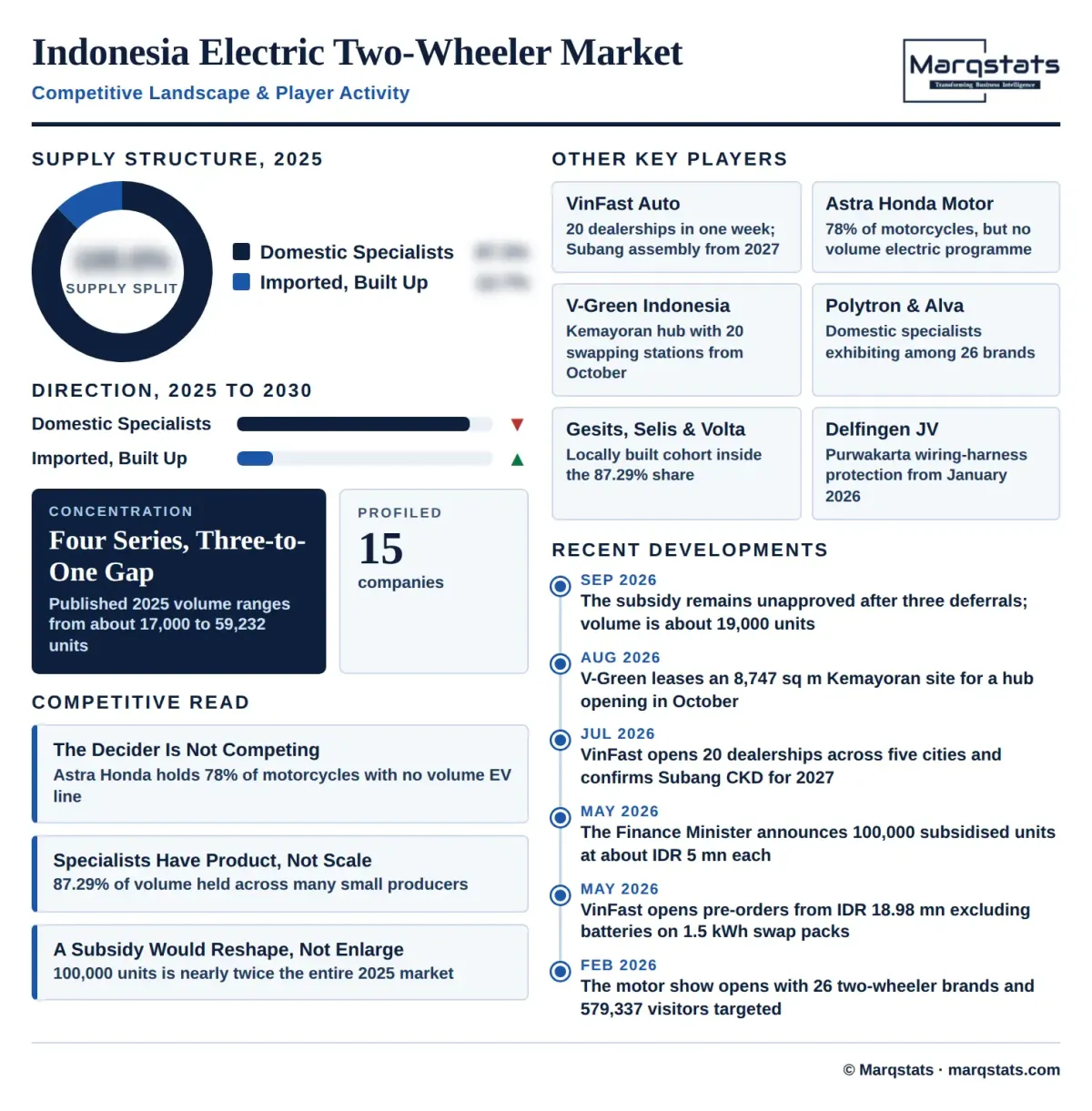
Electric two-wheelers were 0.86% of the 6,412,769 motorcycles sold in Indonesia in 2025 and 0.59% of the 3.13 million sold in the first half of 2026, reaching an estimated 2.89% of a forecast 8.99 million by 2030. The conventional market is not the constraint: it grew 0.80% in the first half of 2026 while the electric segment inside it fell 27.40%.
The published band is 150,000 to 400,000 units for 2030, and the spread is policy rather than demand. The low end assumes the announced subsidy continues to slip and the segment recovers only on fleet economics; the high end approaches the industry body's own base scenario of 400,000 units by 2029. No other page in this catalogue carries a band this wide, and the reason is that a 2 million unit target for this same market was delivered at roughly 3%.
The Subsidy Announcement Has Cost More Volume Than the Subsidy Will Deliver
In May 2026 the Finance Minister announced a stimulus package subsidising 100,000 electric motorcycles at about IDR 5 million each, alongside 100,000 electric cars, with implementation targeted for early June 2026. The programme moved to July, then to August pending a policy review, and as of 3 September 2026 it remained unapproved and had not begun.
The effect on demand is documented rather than inferred. The association chairman describes the current position as simply waiting, and reports buyers arriving at dealers, asking about the subsidy and leaving without purchasing. Through August 2026 the market had reached roughly 19,000 units, against a further 36,000 needed to match 2025 and 41,000 to reach the 60,000-unit industry target.
The arithmetic explains why buyers wait. An entry electric scooter sells from about IDR 19 million, so an unpaid IDR 5 million subsidy is a 26% discount available to anyone willing to defer. Four scheduled start dates have passed, and each deferral extends the option rather than closing it. A subsidy that is announced and unpaid is a stronger reason not to buy than no subsidy at all.
The forecast therefore dates the recovery from implementation rather than from announcement, and treats the 100,000-unit allocation as a single-period step rather than a growth rate. That allocation is itself nearly twice the entire 2025 market, which is why the upper end of the published band sits so far above the lower end.
Four Published Series Size This Market Differently
Reading any share or growth figure for this market requires naming the series it comes from. Ministry type-registration data puts 2025 at 55,059 units. A figure compiled from the motorcycle association alongside the coordinating ministry and the statistics agency puts it at 59,232. The motorcycle association's own member-only series reports roughly 17,000 units, and the electric motorcycle association reports roughly 50,000.
The gap between the lowest and highest is more than three to one, and it is structural rather than a timing difference. The member-only series captures the established manufacturers that dominate conventional motorcycles and misses the specialist electric brands entirely, while registration data captures every unit that receives type approval regardless of who built it.
This panel uses the ministry type-registration basis at 55,059 units for 2025, because it is the only series that covers the whole market rather than a membership. The half-year comparison, at 18,487 units against 25,463, is carried on the association-plus-ministry basis and is used for direction rather than level. Both conventions are stated so a reader can reconcile this panel against any of the four.
The practical consequence is that published penetration rates for this market vary by a factor of three depending on which numerator meets which denominator. A specialist brand sizing its share against the member-only series will overstate it by roughly three times; an investor reading the member-only series as the market will understate the market by the same margin.
Battery Swapping Is the Structural Change, Not the Subsidy
The infrastructure being built is swap rather than charge. V-Green leased an 8,747 square metre site at Kemayoran in central Jakarta for a hub opening in October 2026 with 20 battery-swapping stations for motorcycles alongside 36 car chargers, serving 220 motorcycles and 56 cars simultaneously. A separate agreement covers charging at 29 rest areas along the Trans-Sumatra toll road.
The vehicles are being designed for it. VinFast opened pre-orders in May 2026 for the Evo at IDR 18.98 million, the Feliz II at IDR 20.1 million and the Viper at IDR 24.41 million, all excluding batteries, each running two 1.5 kWh lithium iron phosphate swap packs and a 5,200 W in-wheel motor, with range of up to 150 km on the Evo and 145 km on the other two. Honda's ICON e: moped, already released here, uses a detachable battery.
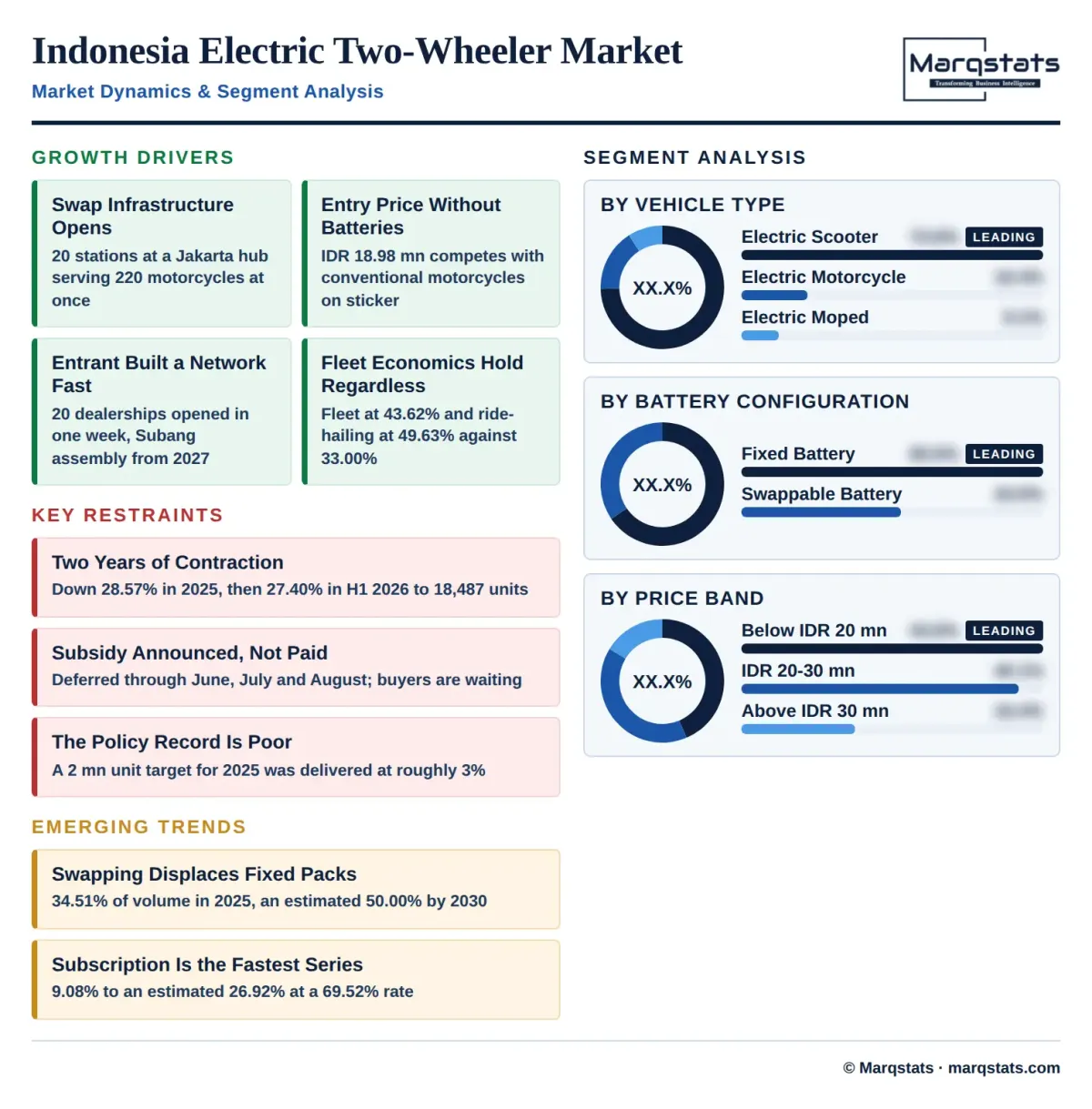
Swappable-battery models move from an estimated 34.51% of volume in 2025 to an estimated 50.00% by 2030 at a 46.91% compound rate, against 29.24% for fixed-battery models. Battery subscription, the commercial model swapping enables, moves from an estimated 9.08% of volume to an estimated 26.92% at a 69.52% compound rate, the fastest series on the page.
Swapping changes the purchase decision more than a subsidy does because it removes the battery from the purchase price permanently rather than once. An entry scooter at IDR 18.98 million excluding batteries competes against a conventional motorcycle on sticker price without any subsidy at all, which is why the lower end of the published band still shows growth.
The Entrant Is Foreign and the Incumbent Is Almost Absent
VinFast opened 20 official electric motorcycle dealerships between 19 and 25 July 2026 in cities including Jakarta, Bandung, Semarang, Medan and Makassar, having signed agreements with seven strategic dealer partners in February 2026. All current units are imported complete built up, with assembly planned at a Subang facility in West Java from 2027. Indonesia is one of five priority markets for the programme alongside the Philippines, India, Thailand and Malaysia.
The incumbent that would decide this market has not moved at scale. Astra Honda Motor held 78% of the national motorcycle market in 2025, and the motorcycle business underpinned an automotive and mobility division net profit of IDR 11,365 billion, against IDR 11,401 billion in 2024. Its electric presence is the ICON e: moped rather than a volume programme.
The domestic specialists occupy the space in between. Alva, Polytron and Indomobil E-Motor exhibited among 26 two-wheeler brands at the February 2026 motor show, which targeted more than IDR 8 trillion in transactions and 579,337 visitors, alongside Gesits, Selis, United and Volta in the locally built cohort. None has the distribution reach of the incumbent or the capital commitment of the entrant.
Supplier localisation has begun ahead of the volume. Delfingen and PT Askara Internal formed a joint venture in January 2026 to produce wiring-harness protection at Purwakarta for automotive, two-wheeler and electric mobility applications, which is the kind of component investment that precedes assembly rather than follows it.
Market Dynamics
Key Drivers
- An announced subsidy covers 100,000 electric motorcycles at about IDR 5 million each, nearly twice the entire 2025 market of 55,059 units, once implementation begins.
- Dedicated swap infrastructure opens from October 2026, with 20 swapping stations at an 8,747 square metre Jakarta hub serving 220 motorcycles simultaneously.
- Entry pricing excluding batteries has reached IDR 18.98 million, which competes with conventional motorcycles on sticker price without any subsidy.
- A foreign entrant opened 20 dealerships in one week in July 2026 and plans local assembly at Subang from 2027, replacing complete built up imports.
- Fleet and ride-hailing demand grows at 43.62% and 49.63% against 33.00% for personal commuting, because running-cost economics hold without subsidy.
Key Restraints
- Volume fell 28.57% in 2025, from 77,078 units to 55,059, and a further 27.40% in the first half of 2026, from 25,463 units to 18,487.
- The announced subsidy has been deferred through June, July and August 2026 and remained unresolved in September, with buyers deferring purchases in expectation of it.
- A 2 million unit target set in 2022 for 2025 was delivered at 55,059 units, roughly 3% of it, which is the record any policy-led forecast must be read against.
- The incumbent holding 78% of the national motorcycle market has no volume electric programme, leaving the segment to specialists and a single foreign entrant.
Key Trends
- Swappable-battery models move from an estimated 34.51% of volume to an estimated 50.00% by 2030 at a 46.91% compound rate.
- Battery subscription moves from an estimated 9.08% of volume to an estimated 26.92% at a 69.52% compound rate, the fastest series on the page.
- Volume below IDR 20 million rises from an estimated 43.59% to an estimated 53.85%, pulling average transaction value down 10.87% across the window.
- Ride-hailing and delivery fleets rise from a combined estimated 23.61% of volume to an estimated 32.69%, as commercial duty cycles justify the purchase without policy support.
Market Segmentation
Electric scooters accounted for an estimated 41,059 units in 2025, 74.57% of volume, reaching an estimated 190,000 units or 73.08% by 2030 at a 35.85% compound rate. The category covers the entrant and specialist product alike, from the VinFast Evo at IDR 18.98 million excluding batteries to the locally built Alva, Polytron, Gesits and Volta ranges.
Electric motorcycles accounted for an estimated 9,000 units in 2025, 16.35% of volume, reaching an estimated 48,000 units or 18.46% by 2030 at a 39.77% compound rate, the fastest vehicle type. Higher-output models such as the VinFast Viper at IDR 24.41 million excluding batteries sit here, and the category gains share as fleet and performance buyers enter.
Electric mopeds accounted for an estimated 5,000 units in 2025, 9.08% of volume, reaching an estimated 22,000 units or 8.46% by 2030 at a 34.49% compound rate. Honda's ICON e: Class 1 moped with a detachable battery, released in Indonesia alongside Vietnam and Pakistan and built in Vietnam, is the reference model.
Swappable-battery models accounted for an estimated 19,000 units in 2025, 34.51% of volume, reaching an estimated 130,000 units or 50.00% by 2030 at a 46.91% compound rate. Two 1.5 kWh lithium iron phosphate packs is the emerging standard on entrant product, and the Kemayoran hub opening in October 2026 adds 20 swapping stations serving 220 motorcycles at once.
Fixed-battery models accounted for an estimated 36,059 units in 2025, 65.49% of volume and the majority, reaching an estimated 130,000 units or 50.00% by 2030 at a 29.24% compound rate, the slowest configuration. The category holds most of the locally built specialist base and loses its majority by the end of the window without losing absolute volume.
Models sold with batteries included accounted for an estimated 50,059 units in 2025, 90.92% of volume, reaching an estimated 190,000 units or 73.08% by 2030 at a 30.57% compound rate. The model keeps the full vehicle cost in the purchase price, which is why an unpaid IDR 5 million subsidy against a roughly IDR 23 million transaction value has so much influence on timing.
Subscription models accounted for an estimated 5,000 units in 2025, 9.08% of volume, reaching an estimated 70,000 units or 26.92% by 2030 at a 69.52% compound rate, the fastest series on the page. VinFast prices all three models excluding batteries, at IDR 18.98 million to IDR 24.41 million, and lets the buyer choose subscription or purchase. Subscription revenue is excluded from this panel as a service stream.
The entry band accounted for an estimated 24,000 units in 2025, 43.59% of volume, reaching an estimated 140,000 units or 53.85% by 2030 at a 42.29% compound rate, the fastest band. The VinFast Evo at IDR 18.98 million excluding batteries anchors it, and the band's growth is what pulls average transaction value down across the window.
The mid band accounted for an estimated 22,059 units in 2025, 40.06% of volume, reaching an estimated 90,000 units or 34.62% by 2030 at a 32.47% compound rate. The Feliz II at IDR 20.1 million and the Viper at IDR 24.41 million excluding batteries sit here, alongside most of the established domestic range.
The premium band accounted for an estimated 9,000 units in 2025, 16.35% of volume, reaching an estimated 30,000 units or 11.54% by 2030 at a 27.23% compound rate, the slowest band. It loses nearly a third of its share as subsidy-eligible and swap-enabled product fills the bands beneath it.
Locally assembled models accounted for an estimated 48,059 units in 2025, 87.29% of volume, reaching an estimated 225,000 units or 86.54% by 2030 at a 36.17% compound rate. Gesits, Alva, Polytron, Selis, United, Uwinfly and Volta are all built in Indonesia, and the entrant plans to join them at Subang from 2027.
Imported complete built up units accounted for an estimated 7,000 units in 2025, 12.71% of volume, reaching an estimated 35,000 units or 13.46% by 2030 at a 37.97% compound rate. Every VinFast unit sold through the 20 dealerships opened in July 2026 is currently imported, and Honda's ICON e: moped is built in Vietnam.
Personal commuting accounted for an estimated 42,059 units in 2025, 76.39% of volume, reaching an estimated 175,000 units or 67.31% by 2030 at a 33.00% compound rate, the slowest end use. It is also the use case most exposed to subsidy timing, because a private buyer can defer a purchase in a way a fleet renewing on a duty cycle cannot.
Fleet and last-mile delivery accounted for an estimated 9,000 units in 2025, 16.35% of volume, reaching an estimated 55,000 units or 21.15% by 2030 at a 43.62% compound rate. Commercial duty cycles recover the price premium through running cost within the ownership period, which makes this demand largely independent of the subsidy.
Ride-hailing accounted for an estimated 4,000 units in 2025, 7.26% of volume and the smallest end use, reaching an estimated 30,000 units or 11.54% by 2030 at a 49.63% compound rate, the fastest end use. High daily distance and dense urban operation make swap networks more valuable here than anywhere else in the market.
By Geography
Jakarta and Greater Jabodetabek
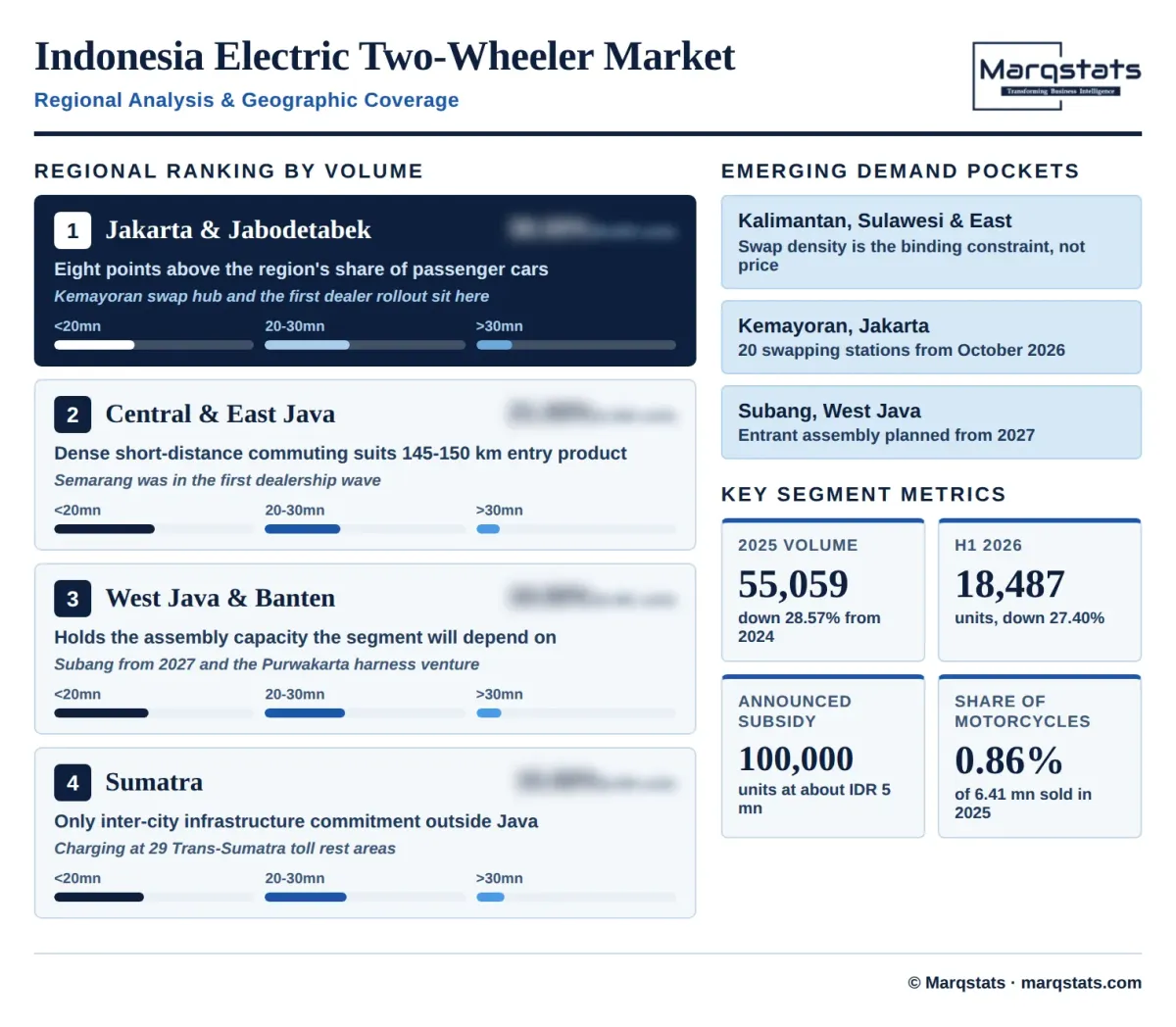
Jakarta and the surrounding metropolitan area account for an estimated 20,923 registrations in 2025, 38.00% of national electric two-wheeler volume, eight points above the region's 30.00% share of passenger cars. The Kemayoran swap hub opens here in October 2026, the entrant's dealer rollout began here, and dealer distribution started in Jabodetabek in the second quarter of 2026.
Central and East Java
Central and East Java account for an estimated 11,562 registrations, 21.00% of volume. Semarang was among the first cities in the July 2026 dealership rollout, and the region's dense short-distance commuting pattern suits the range of entry product at 145 km to 150 km on a full charge.
West Java and Banten
West Java and Banten account for an estimated 10,461 registrations, 19.00% of volume, and hold the assembly capacity the segment will depend on, including the Subang facility planned for 2027 and the Purwakarta wiring-harness joint venture formed in January 2026. Bandung was in the first dealership wave.
Sumatra
Sumatra accounts for an estimated 8,259 registrations, 15.00% of volume. Medan was included in the July 2026 dealership rollout, and the agreement covering charging at 29 rest areas along the Trans-Sumatra toll road is the only inter-city infrastructure commitment outside Java.
Kalimantan, Sulawesi and Eastern Indonesia
Kalimantan, Sulawesi and eastern Indonesia account for an estimated 3,854 registrations, 7.00% of volume, six points below the cluster's share of passenger cars and the smallest regional position. Makassar was in the first dealership wave, but swap density outside Java is the binding constraint rather than price.
How Competition Is Evolving
The structure of this market is unusual: the company that would decide it is not competing in it. Astra Honda Motor held 78% of the national motorcycle market in 2025 and its parent's automotive and mobility division earned IDR 11,365 billion in net profit, against IDR 11,401 billion in 2024. Its electric presence is the ICON e: moped, a Vietnam-built Class 1 model with a detachable battery, rather than a volume programme built on its distribution.
The most committed competitor is a foreign entrant with no conventional base here. VinFast opened 20 official dealerships between 19 and 25 July 2026 across Jakarta, Bandung, Semarang, Medan and Makassar, after signing seven strategic dealer partners in February, and priced the Evo, Feliz II and Viper at IDR 18.98 million, IDR 20.1 million and IDR 24.41 million excluding batteries. Current supply is imported, with Subang assembly planned from 2027, and the affiliated infrastructure company is building the swap network the vehicles depend on.
Between them sits a domestic specialist cohort with product but not scale. Alva, Polytron and Indomobil E-Motor exhibited among 26 two-wheeler brands at the February 2026 show, which targeted more than IDR 8 trillion in transactions and 579,337 visitors, alongside Gesits, Selis, United, Uwinfly and Volta in the locally built group. Their combined position is the estimated 87.29% of 2025 volume that was locally assembled, held across many small producers rather than a few large ones, which is why a subsidy allocation of 100,000 units would reshape the competitive order rather than simply enlarge it.
Companies Covered
The report profiles 15+ companies with full strategy and financials analysis, including:
Recent Market Activity
Table of Contents
Coverage & Segmentation
The analysis measures the retail value of new electric motorcycle, scooter and moped sales in Indonesia from 2021 to 2030, with 2025 as the base year and 2026 to 2030 as the forecast period, covering vehicle type, battery configuration, battery ownership model, price band, assembly origin and end use, together with the swap infrastructure and subsidy framework that govern the demand path. Conventional motorcycles are excluded at roughly 6.36 million units in 2025, and three-wheelers, electric passenger cars and electric commercial vehicles are excluded, each sized separately. Battery subscription revenue is excluded as a service stream rather than a vehicle sale. Values are expressed in USD at a disclosed constant IDR 16,800 per USD.
Coverage spans three vehicle types, two battery configurations, two ownership models, three price bands, two assembly origins and three end uses, with five regional clusters analysed on registration volume. Segment volume is carried as the unit series at 55,059 in 2025 and average transaction value as a derived series at IDR 23.0 million, and both are published alongside the value panel because the unit base multiplies while transaction value falls. Fifteen entities are profiled across vehicle manufacturers, the conventional incumbent group, domestic specialists, infrastructure operators and component suppliers.