Market Snapshot
Middle bar: base-year value × (1 + CAGR), rounded to two decimals. This is a calculated illustration, not a separately researched annual estimate.
The Southeast Asia electric motorcycle market is estimated at 600,480 units in 2025 and is projected to reach 1,355,277 units by 2030, registering a volume CAGR of 17.68% over 2026–2030. In value terms the market is estimated at USD 1.04 billion in 2025 and is projected to reach USD 2.60 billion by 2030, a CAGR of 20.11%. The market comprises new road-registered battery electric motorcycles, scooters and mopeds in Vietnam, Indonesia, the Philippines, Thailand, Malaysia and Singapore. Vietnam is the largest country at 76.61% of 2025 volume, and Southeast Asia's share of global electric two-wheeler volume rises from 9.66% to 13.10% by 2030.
Market size and forecast figures are generated using Marqstats' proprietary estimation framework, updated as of October 2026.
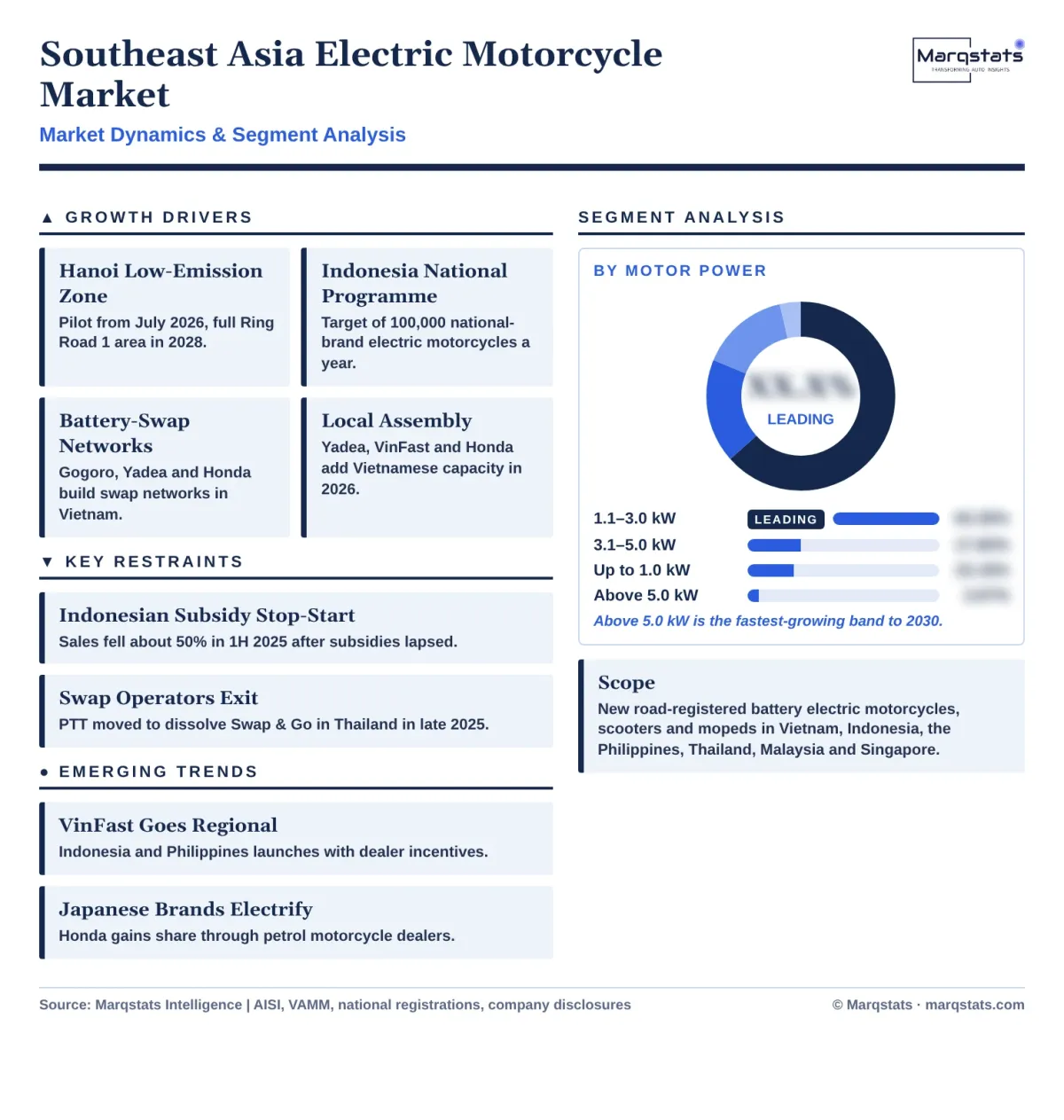
The 1.1–3.0 kW band is the dominant power segment at 63.35% of units, and the above-5.0 kW band is the fastest-growing at 23.61% a year. Indonesia is the fastest-growing large country at a 37.45% CAGR, lifting its share from 9.16% to 19.91% by 2030. Value grows faster than volume because the average selling price rises from USD 1,732 in 2025 to USD 1,918 by 2030 as buyers move to higher-power scooters.
Key Takeaways
Market Overview & Analysis
Report Summary
The Southeast Asia electric motorcycle market covers new battery electric two-wheelers registered for road use in six countries, from sub-1.0 kW mopeds to motorcycles above 5.0 kW. The market is estimated at 600,480 units in 2025, up 26.21% on 475,770 units in 2024, and has grown almost fourfold from 162,040 units in 2021. It reaches 699,913 units in 2026 and 1,355,277 units by 2030, adding 754,797 units over the forecast period. Electric bicycles, kick scooters, electric three-wheelers and tricycles, and internal combustion and hybrid motorcycles sit outside the perimeter.
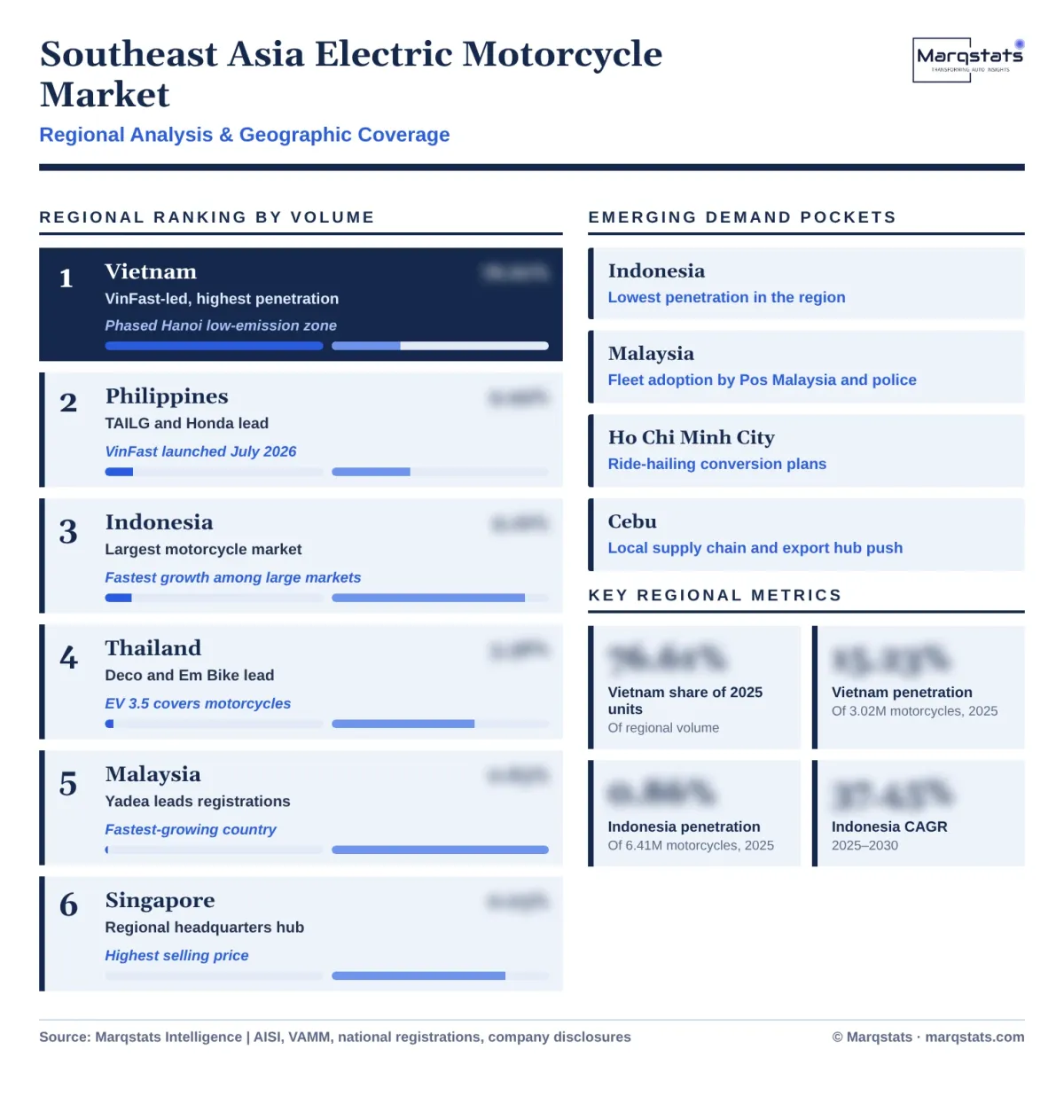
Penetration, rather than motorcycle demand, separates the region's markets. Vietnam sold 3.02 million motorcycles in 2025, including VinFast, of which 460,000 were electric, a penetration of 15.23%. Indonesia sold 6.41 million motorcycles according to the Indonesian Motorcycle Industry Association (AISI), of which 55,000 were electric, a penetration of 0.86%, and Thailand's 20,310 electric units compare with approximately 1.7 million annual motorcycle registrations. Southeast Asia's largest motorcycle market is therefore its least electrified, and Indonesian policy, not consumer preference, decides how much of the regional forecast is realised.
Vietnam is the engine of the market. Its volume rises from 460,000 units in 2025, up 31.43%, to 865,144 units by 2030, a CAGR of 13.47%. Demand accelerated after the Prime Minister's Directive No. 20/CT-TTg of July 2025 targeted petrol motorcycles inside Hanoi's Ring Road 1, and VinFast delivered more than 120,000 electric two-wheelers in the third quarter of 2025, up 73% quarter on quarter. Hanoi has since converted the restriction into a phased low-emission zone: an 11-street pilot from 1 July 2026, a 3.6 km² zone in 2027 and the full Ring Road 1 area in 2028.
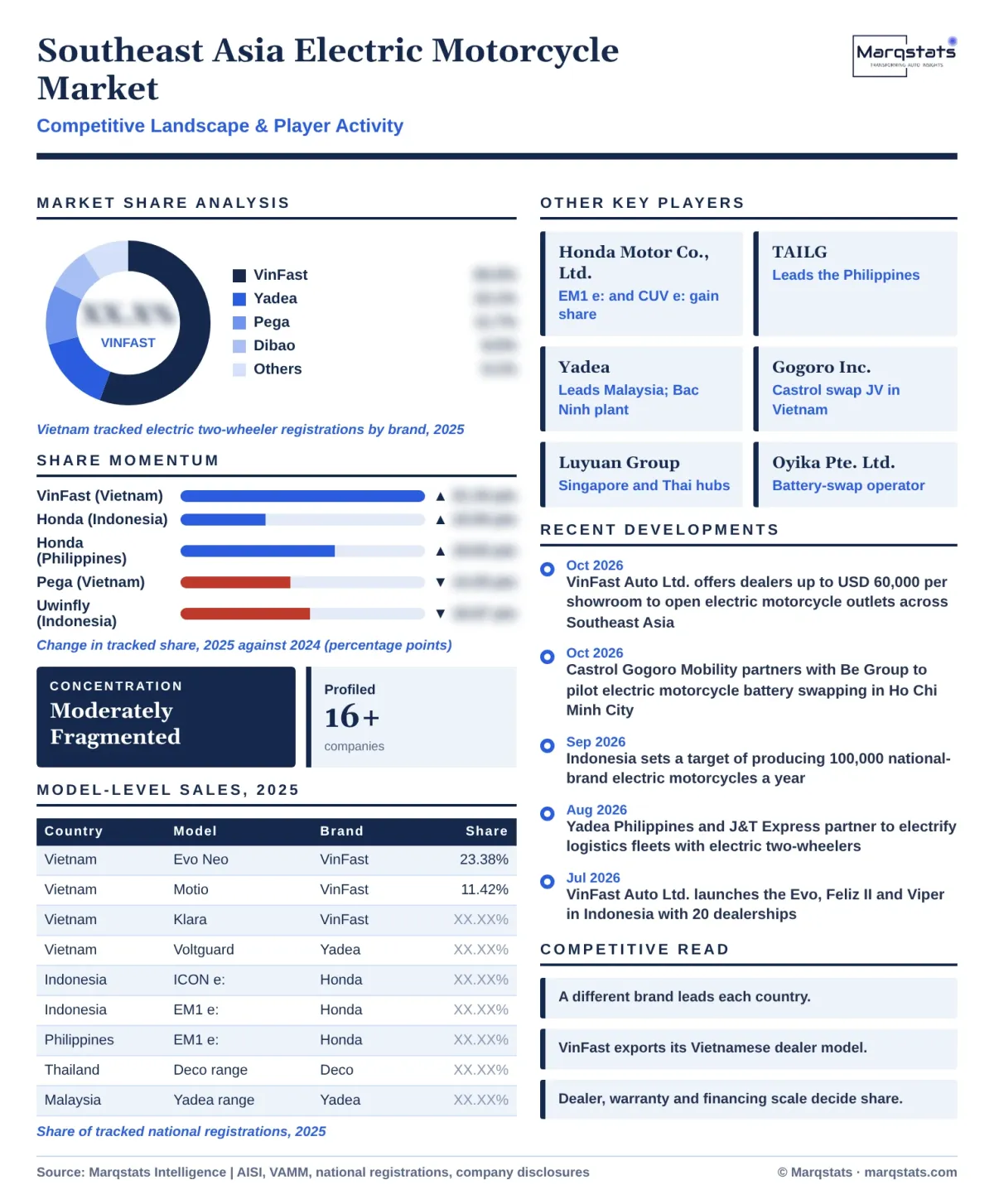
Model-level registration data show that Vietnam has become a one-brand market. VinFast Auto Ltd. took 55.54% of tracked Vietnamese electric two-wheeler registrations in 2025, up from 24.20% in 2024, while Yadea Group Holdings Ltd. fell from 23.94% to 15.10% and Pega from 25.99% to 11.74%. The VinFast Evo Neo alone took 23.38%, the Motio 11.42% and the Klara 8.19%, and Dibao held 8.48%. VinFast set a 2026 target of 1 million electric motorbike deliveries and offered dealers up to USD 60,000 per showroom in October 2026 to widen its network across the region.
Price ladders inside Vietnam explain VinFast's gain. The Motio, aimed at students, sells at approximately USD 471, the Evo Neo at USD 698 and the Klara at USD 1,682, so a single brand covers the region's three lowest price tiers with one dealer network. VinFast added the low-cost ZGOO and FLAZZ in November 2025 and the Kinet and Kyo before the 2026 school year, and announced a six-year warranty in August 2025. Local brands Pega, Dibao, Anbico and DK Bike, which sold mainly through independent shops, lost share as buyers moved to warranty-backed products financed through VinFast's agreements with 12 banks.
Indonesia's market contracted in 2025 after purchase subsidies lapsed. Volume fell 12.91% to 55,000 units, and electric motorcycle sales fell about 50% in the first half of 2025, according to industry data. Brand leadership turned over in the same year: Uwinfly's share of tracked registrations fell from 33.99% to 17.32%, Honda Motor Co., Ltd. rose from 2.68% to 13.62% with the ICON e:, EM1 e: and CUV e:, and Yadea held 12.87%. Polytron took 6.62% in its first year, while Smoot fell from 12.32% to 3.59%, which shows that local brands without a petrol-motorcycle dealer network lose share once incentives stop.
The Philippines, Thailand and Malaysia are importer-led markets. TAILG took 33.37% of tracked Philippine registrations in 2025, up from 28.89%, and Honda's EM1 e: rose from 0.78% to 20.41%, ahead of Yadea at 9.73% and Rejus at 6.93%. In Thailand, Deco led with 32.81%, followed by Em Bike at 21.01%, Lion at 10.75% and Sleek EV at 6.83%. In Malaysia, Yadea took 49.31% of tracked registrations, ahead of TAILG at 12.36%, Vmoto Limited at 4.29% and BMW at 2.13%, and VinFast named Malaysia among its five initial international scooter markets in January 2026.
Value is concentrated in Vietnam even more than volume. Vietnam's market is valued at USD 0.81 billion in 2025, at an average selling price of approximately USD 1,751, against USD 1,514 in Indonesia, USD 1,598 in the Philippines, USD 2,031 in Thailand and USD 2,576 in Malaysia. The regional market rises from USD 1.04 billion to USD 2.60 billion by 2030, a 20.11% CAGR, and Vietnam reaches USD 1.69 billion. Higher Malaysian and Thai prices reflect imported 2.5 to 4.0 kW scooters, while Indonesian prices are held down by low-speed mopeds.
Battery-swap infrastructure is the region's largest unbuilt asset. Vingroup's charging-infrastructure unit estimated in October 2025 that Vietnam will need about 500,000 battery-swap cabinets for electric motorcycles, and V-GREEN signed memoranda with Bataan province in the Philippines in May 2026 to build charging and swap infrastructure. A Pasig City barangay opened the area's first battery-swap station with E88 Ventures in February 2026, Ten Pao Group entered battery swapping in Thailand in April 2025, and Toshiba and naturenix moved a Thai battery-subscription trial to a paid pilot in August 2025. Swap networks are the condition under which battery-swap models such as the VinFast Evo reach petrol price parity, so network density sets the ceiling on adoption outside Vietnam.
Capacity is moving into the region ahead of demand. Yadea inaugurated a USD 100 million factory in Bac Ninh in February 2026, VinFast received approval in March 2026 for a VND 13.25 trillion Ha Tinh plant with capacity of up to 2 million units, and Honda moves UC3 production from Thailand to its Phu Tho plant in Vietnam from September 2026. Luyuan Group set up a Singapore ecosystem centre and a Thai supply integration centre in May 2026, and EP Manufacturing Bhd. began SoloEra assembly in Malaysia with capacity of 12,000 units a year.
Market Dynamics
Key Drivers
Five conditions drive the Southeast Asia electric motorcycle market, and city-level emission rules in Vietnam matter more than national subsidy.
- Low-emission zones in Hanoi and Ho Chi Minh City. Directive No. 20/CT-TTg of July 2025 targeted petrol motorcycles inside Hanoi's Ring Road 1, and Hanoi now phases the restriction from an 11-street pilot in July 2026 to the full 26 km² zone in 2028. Ho Chi Minh City proposed converting 400,000 ride-hailing motorbikes to electric in May 2025.
- National electric motorcycle programmes in Indonesia. Indonesia set a target of producing 100,000 national-brand electric motorcycles a year in September 2026, outlined a programme for 200,000 petrol-to-electric conversions a year in March 2026, and still plans purchase incentives pending a Finance Ministry regulation. Indonesia grows at 37.45% a year to 269,829 units by 2030.
- Battery-swap networks lower the purchase price. Castrol Gogoro Mobility began pilots with Be Group in Ho Chi Minh City in October 2026, Yadea signed a battery-swap agreement with VGX in May 2026, and Honda plans its Power Pack Exchanger e: network in Vietnam in 2026. VinFast's Evo, Feliz and Viper models in Indonesia and the Philippines are sold for use with battery swapping, which removes the battery from the purchase price.
- Delivery and logistics fleet electrification. Yadea Philippines and J&T Express partnered to electrify logistics fleets in August 2026, and Pos Malaysia's fleet reached 1,585 electric vehicles in September 2026, with one in three parcels delivered electrically. Fleet riders cover the longest daily distances, so the running-cost saving is largest for them.
- Local assembly by global brands. Yadea's USD 100 million Bac Ninh factory, VinFast's 2-million-unit Ha Tinh plant and Honda's UC3 line in Phu Tho add capacity inside the ASEAN tariff area. Local production supports the 19.70% growth of the 3.1–5.0 kW band, where imported models carry the largest price premium.
Key Restraints
Four constraints limit adoption, and the largest is the stop-start pattern of Indonesian incentives.
- Subsidy uncertainty in Indonesia. Electric motorcycle sales fell about 70% year on year in January 2025 as the subsidy programme stalled, and full-year volume fell 12.91% to 55,000 units. The government delayed the 2026 incentive rollout in June 2026, so buyers defer purchases whenever a new scheme is announced.
- Policy gaps in the Philippines. The Department of Trade and Industry (DTI) defended excluding electric motorcycles from current electric vehicle incentives in September 2026. The Philippines grows at 15.24% a year, below the regional rate of 17.68%.
- Price gap against petrol scooters. The regional average selling price of USD 1,732 in 2025 compares with entry petrol scooters below USD 1,200 in Indonesia and Vietnam. VinFast priced the Evo at about IDR 18.98 million in Indonesia in May 2026, close to a Honda BeAT, which shows that price parity requires a battery-swap model.
- Exit of battery-swap operators. Thailand's state energy group PTT moved to dissolve its Swap & Go battery-swap unit in November 2025, and Thailand's electric volume fell 18.82% to 20,310 units in 2025. A swap network needs scale to break even, and operators in smaller markets exit before reaching it.
Key Trends
Four shifts show where the market is moving and which companies benefit.
- VinFast exports its Vietnamese model. VinFast entered Indonesia in February 2026, launched the Evo, Feliz II and Viper there with 20 dealerships in July 2026, and opened 21 showrooms in the Philippines the same month. PT Prima Multi Usaha Indonesia acquired a 34% stake in a VinFast dealer in West Java in September 2026.
- Japanese incumbents electrify through existing dealers. Honda's share of tracked registrations rose to 13.62% in Indonesia and 20.41% in the Philippines in 2025, and Honda Vietnam rolled out the locally built ICON e: in March 2025. Yamaha Motor Co., Ltd. sells the E-01 in Indonesia and Thailand through its petrol motorcycle network.
- Chinese brands set up regional hubs. Luyuan Group opened a Singapore ecosystem centre and a Thai supply integration centre in May 2026, and Yadea stepped up its Thailand expansion in March 2026. OMOWAY opened a 10-storey regional headquarters in Jakarta in December 2025.
- Mix moves to higher power. The 3.1–5.0 kW band rises from 17.82% of units in 2025 to 19.40% by 2030, and the above-5.0 kW band from 3.67% to 4.70%. The shift lifts the average selling price from USD 1,732 to USD 1,918.
- Fuel prices and ride-hailing conversion lift demand. Electric two-wheeler demand surged in Ho Chi Minh City in April 2026 as prices eased and fuel costs rose, and VinFast reported record orders and dealer shipments in March 2026. Ho Chi Minh City planned a pilot in July 2025 to convert 20,000 ride-hailing and delivery motorcycles to electric.
Market Segmentation
The 1.1–3.0 kW band is the dominant segment and the volume base of the market. It accounts for 380,378 units in 2025, 63.35% of the total, and reaches 817,483 units by 2030 at a 16.53% CAGR, taking 60.32% of the market. Vietnam supplies 301,727 of these units, led by the VinFast Evo Neo, Motio and Klara and by Yadea's Voltguard.
The 3.1–5.0 kW band is the main source of value growth. It accounts for 106,986 units in 2025, 17.82% of the total, and reaches 262,933 units by 2030 at a 19.70% CAGR, taking 19.40% of the market. Family scooters with 3 kW-plus motors, including the Polytron range in Indonesia and Em Bike models in Thailand, compete most directly with 125 cc petrol scooters.
The up-to-1.0 kW band serves the lowest-price tier. It accounts for 91,051 units in 2025, 15.16% of the total, and reaches 211,188 units by 2030 at a 18.33% CAGR, taking 15.58% of the market. Low-speed mopeds sold to students and urban commuters dominate the band, including Uwinfly in Indonesia.
The above-5.0 kW band is the smallest and fastest-growing segment. It accounts for 22,065 units in 2025, 3.67% of the total, and reaches 63,673 units by 2030 at a 23.61% CAGR, taking 4.70% of the market. The Philippines supplies 9,998 units and Vietnam 9,709, led by the Honda CUV e: and the VinFast Theon.
By Geography
Vietnam
Vietnam is the volume centre of the Southeast Asia electric motorcycle market, with 460,000 units in 2025 and 76.61% of regional volume, easing to 63.84% by 2030 as it grows at 13.47% a year to 865,144 units. Hanoi's phased low-emission zone and Ho Chi Minh City's ride-hailing conversion plan sustain demand, and the Ministry of Transport targeted a 22% electric motorcycle share in February 2025. VinFast Auto Ltd., Yadea Group Holdings Ltd., Pega, Dibao and Honda Motor Co., Ltd. supply the market.
Indonesia
Indonesia is the largest growth opportunity, rising from 55,000 units in 2025 to 269,829 by 2030 at a 37.45% CAGR, with its share rising from 9.16% to 19.91%. Penetration of 0.86% of 6.41 million motorcycle sales leaves the widest gap in the region, and Danantara said in August 2026 that state-owned banks were ready to finance the national electric motorcycle programme. Honda, Yadea, Uwinfly, Polytron, Volta and VinFast compete for the market. Prosecutors sealed a warehouse of 21,801 electric motorcycles procured under the Free Nutritious Meals programme in June 2026 as part of a corruption probe into the programme's procurement. TVS Motor Company Limited opened iQube bookings in Indonesia in June 2025, and OMOWAY opened pre-orders for the OMO-X with a seven-year battery warranty in April 2026.
Philippines
The Philippines holds 60,000 units in 2025, 9.99% of regional volume, and grows at 15.24% a year to 121,957 units by 2030. Above-5.0 kW models make up 9,998 units, the largest high-power pool in the region outside Vietnam. TAILG, Honda and Yadea lead tracked registrations, and VinFast's 21-showroom launch in July 2026 adds a fourth national-scale brand. Cebu stakeholders pushed in September 2026 to build a local electric two-wheeler supply chain and export hub, and Trio Industrial Electronics Group agreed an electric two-wheeler deployment with Bayambang City in October 2025, showing that local government units, rather than national incentives, are driving fleet demand.
Thailand
Thailand holds 20,310 units in 2025, 3.38% of regional volume, and grows at 27.68% a year to 68,904 units by 2030. The EV 3.5 programme covers electric motorcycles, and Thailand rolled out measures in August 2025 to become an integrated electric vehicle manufacturing hub. Deco, Em Bike, Lion and Sleek EV lead tracked registrations, and Sleek EV closed a USD 8.5 million Series A first tranche in February 2026. India's Mercstone partnered with Assara Electric in July 2026 to manufacture electric scooters in Thailand.
Malaysia
Malaysia holds 5,000 units in 2025, 0.83% of regional volume, and is the fastest-growing country at a 41.85% CAGR to 28,719 units by 2030. Blueshark, EP Manufacturing Bhd. and Modenas build local supply, and Pos Malaysia and the Royal Malaysia Police are adopting electric motorcycles in their fleets. Yadea leads tracked registrations with 49.31%. Blueshark and iMotorbike launched a ReCycle trade-in programme in April 2026 to move petrol motorcycle owners to electric, and Malton Bhd signed a memorandum with Dongguan Benling Vehicle Technology in January 2026 to explore local assembly.
Singapore
Singapore holds 170 units in 2025 and grows at 33.62% a year to 724 units by 2030. The city-state's average selling price of approximately USD 8,765 is the highest in the region, and its role is as a regional headquarters location for Luyuan Group and Oyika Pte. Ltd. rather than as a volume market.
How Competition Is Evolving
The market is moderately concentrated at country level and fragmented across the region. VinFast Auto Ltd. took 55.54% of tracked Vietnamese registrations in 2025, which makes it the regional volume leader, because Vietnam accounts for 76.61% of regional volume. Outside Vietnam, leadership belongs to TAILG in the Philippines, Deco in Thailand, Yadea in Malaysia and Uwinfly in Indonesia, and no brand leads more than one country.
Competitive strategy splits three ways. VinFast competes on price, battery swapping and dealer incentives of up to USD 60,000 per showroom, and is exporting the model to Indonesia, the Philippines and Malaysia. Honda Motor Co., Ltd. and Yamaha Motor Co., Ltd. sell electric models through petrol motorcycle dealers, which helped Honda gain 10.94 percentage points of tracked Indonesian share in one year. Chinese brands including Yadea, TAILG, Luyuan and Niu Technologies localise assembly and set up regional hubs in Singapore, Thailand and Vietnam.
Vietnam's local brands are the clearest losers of 2025. Pega's share of tracked registrations fell from 25.99% to 11.74%, Dibao's from 13.41% to 8.48% and Anbico's from 5.08% to 2.49%, while Yadea Group Holdings Ltd. fell from 23.94% to 15.10% despite its new Bac Ninh plant. Honda Motor Co., Ltd. entered the tracked ranking at 1.42% with the locally built ICON e:, and Dat Bike raised USD 4 million from Thien Viet Securities in March 2026 to compete in higher-power motorcycles. Scale in dealers, warranty and financing, rather than product specification, decided share.
The competitive question to 2030 is whether VinFast can repeat its Vietnamese share in Indonesia, the market that grows fastest. Indonesia's national electric motorcycle programme and its 100,000-unit domestic brand target favour local producers, while Honda already holds the strongest dealer network in the country. Battery-swap operators form a second competitive layer: Gogoro Inc. through its Castrol joint venture in Vietnam, Oyika Pte. Ltd. and Zion Mobility in Singapore and Thailand, and VinFast's own V-GREEN network.
Companies Covered
Companies covered in the report include:
Recent Market Activity
Table of Contents
Coverage & Segmentation
The Southeast Asia electric motorcycle market comprises new road-registered battery electric motorcycles, scooters and mopeds, sized in units and in USD at manufacturer selling prices. The market is segmented by motor power into four bands: up to 1.0 kW, 1.1–3.0 kW, 3.1–5.0 kW and above 5.0 kW. Geographic coverage spans Vietnam, Indonesia, the Philippines, Thailand, Malaysia and Singapore.
The base year is 2025, the historical period is 2021–2025 and the forecast period is 2026–2030. Electric bicycles, kick scooters, electric three-wheelers and tricycles, used-vehicle transactions and internal combustion motorcycles are excluded. Brand and model analysis draws on national registration series and company disclosures for Vietnam, Indonesia, the Philippines, Thailand and Malaysia.