Market Snapshot
Middle bar: base-year value × (1 + CAGR), rounded to two decimals. This is a calculated illustration, not a separately researched annual estimate.
The Nigeria electric motorcycle market is estimated at 5,100 units in 2025 and is projected to reach 23,329 units by 2030, registering a volume CAGR of 35.54% over 2026–2030. In value terms the market is estimated at USD 7.04 million in 2025 and is projected to reach USD 35.30 million by 2030, a CAGR of 38.05%. The market comprises new battery electric motorcycles, mopeds and scooters sold for road use in Nigeria, most of them used as commercial motorcycle taxis and delivery bikes. The 1.1–3.0 kW band holds 50.00% of 2025 units, and the above-5.0 kW band grows fastest at 53.04% a year.
Market size and forecast figures are generated using Marqstats' proprietary estimation framework, updated as of October 2026.
Volume more than doubled in 2025, up 112.50% from 2,400 units, after Spiro began operations in July 2024 and cut prices in September 2025, and grows 54.71% to 7,890 units in 2026. Spiro, Metro Africa Xpress (MAX) and Transsion Holdings' REVOO brand lead an organised market built on battery swapping, pay-as-you-go finance and Lagos retail stores. Electric sales in 2025 equal about 0.034% of Nigeria's fleet of more than 15 million motorcycles, so conversion has barely begun.
Key Takeaways
Market Overview & Analysis
Report Summary
The Nigeria electric motorcycle market covers new battery electric motorcycles, mopeds and scooters sold for road use in Nigeria. Volume rose from 1,200 units in 2021 to 1,360 in 2022, 1,880 in 2023 and 2,400 in 2024, and more than doubled to 5,100 units in 2025. The market grows 54.71% to 7,890 units in 2026 and reaches 23,329 units by 2030, adding 18,229 units over the forecast period. Electric tricycles, cars and buses, pedal-assist bicycles, kick scooters, used vehicles and petrol motorcycles sit outside the perimeter.
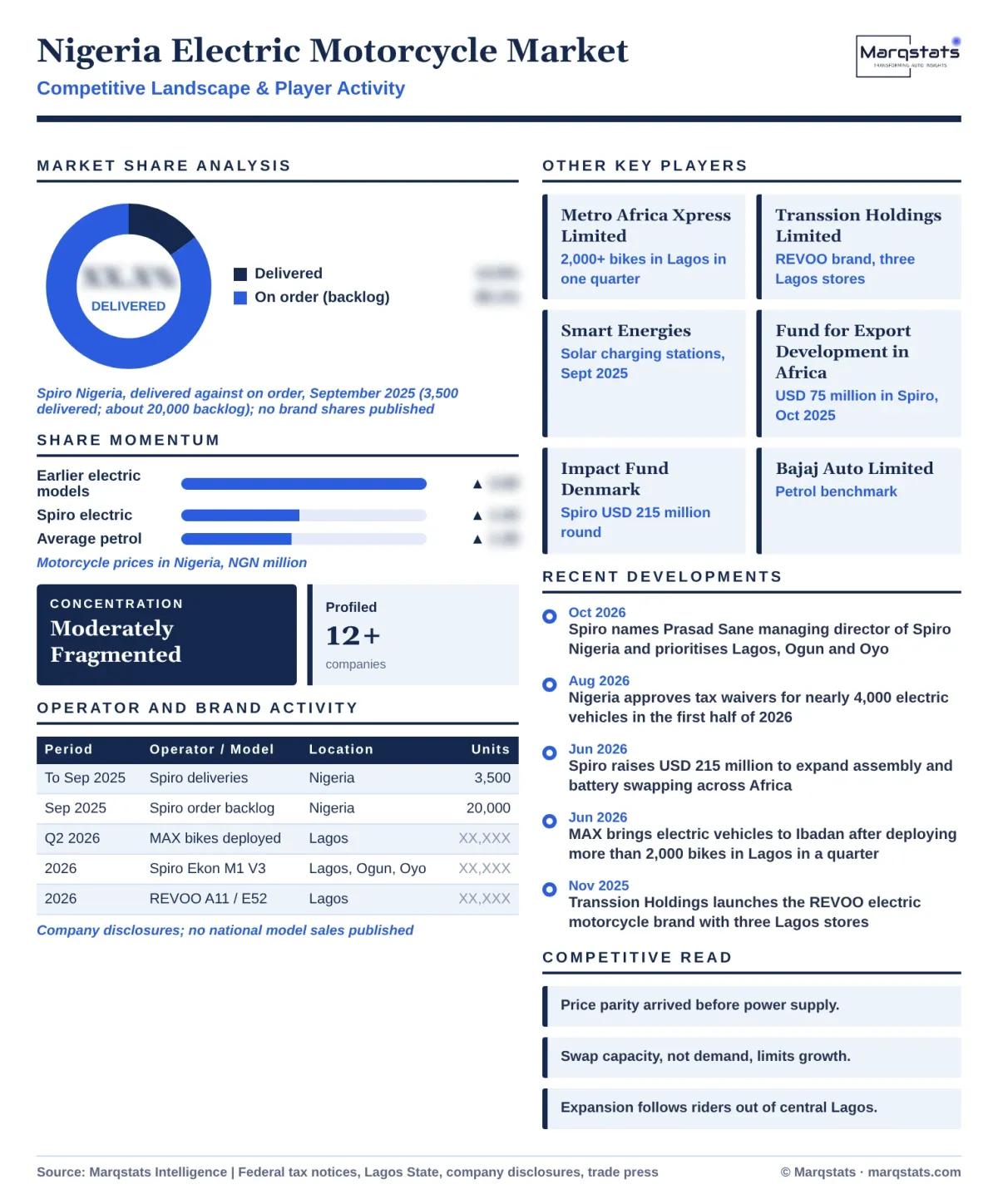
The signature finding is that price parity has arrived before infrastructure. Spiro's current models cost about NGN 1.44 million (USD 964), against an average of NGN 1.35 million (USD 903) for petrol motorcycles, a gap of 6.67%, after earlier electric models cost up to NGN 3 million, according to Techpoint Africa in September 2025. Nigeria's grid supplies about 4,000 MW to more than 220 million people, roughly 20 W per person, and the country had about 48 public charging stations in late 2025, mostly in Lagos and Abuja, according to Reuters-reviewed data reported by Automotive World in August 2026. Battery swapping is therefore the business model, not an option: operators charge batteries at stations with their own power supply and riders exchange them in under a minute.
Fuel costs created the demand. Nigeria removed its petrol subsidy in 2023, which raised fuel costs for the motorcycle taxi riders who carry passengers and goods in most Nigerian cities. Spiro estimates that a 100 km trip costs about NGN 2,000 on an electric motorcycle against about NGN 3,000 on petrol, and that riders save about 36% on fuel and maintenance, while its founder puts daily savings at up to 40%. For a rider covering more than 100 km a day, the saving pays for the swap subscription and adds to daily income.
Policy support has moved from statements to tax measures. Electric vehicles have been exempt from VAT since 2024, Nigeria cut electric vehicle import duties from 5% to zero earlier in 2026, and the government approved tax waivers for nearly 4,000 electric vehicles in the first half of 2026 as the first tranche of a programme that links incentives to local assembly. The government targets electric vehicles at 60% of the vehicle parc by 2050. The waiver tranche is not split by vehicle type, so its electric motorcycle share is not published. Nigeria's Energy Transition Plan projects only about 60 public charging stations by 2030, so policy supports vehicle prices more than it supports charging, and operators must fund their own swap and power infrastructure.
Spiro is the largest organised player. Spiro began Nigerian operations in July 2024, had delivered about 3,500 motorcycles in Nigeria by September 2025 with an order backlog of about 20,000, and operated 64 swap stations in Lagos at that time, according to Techpoint Africa. The company raised USD 100 million in October 2025, led by the Fund for Export Development in Africa (FEDA) of Afreximbank with USD 75 million, and USD 215 million in June 2026 from investors including Impact Fund Denmark and Equitane, and reported 100,000 vehicles and 2,500 swap stations across seven markets. Nigeria hosts one of Spiro's assembly plants and a battery recycling plant, and Prasad Sane became Spiro Nigeria's managing director in October 2026, naming Lagos, Ogun and Oyo as priority states.
Nigeria sits inside a fast-growing African network. Spiro had more than 60,000 bikes and about 1,500 swap stations across six countries in October 2025, rising to 100,000 vehicles and 2,500 stations across seven markets by June 2026, and battery swaps rose from 4 million in 2022 to more than 27 million in 2025. Nigeria is one of four Spiro assembly locations, with Kenya, Rwanda and Uganda, and Spiro does not publish a Nigerian share of its fleet. Spiro's operating experience in East Africa gives it know-how in station siting and rider finance that newer Nigerian entrants lack.
Fleet financiers and new brands widen supply. Metro Africa Xpress (MAX) reported more than 2,000 bikes deployed in Lagos in the quarter to June 2026, operates in more than 18 cities including Lagos, Abeokuta, Onitsha, Ilorin and Ibadan, and offers pay-as-you-go instalment plans to riders. Transsion Holdings, the owner of TECNO, Infinix and itel, opened its REVOO electric motorcycle brand at the Lagos Trade Fair Complex in November 2025 with four models and three stores, and Smart Energies introduced electric motorcycles with solar charging stations in September 2025. Company figures are as reported and not independently verified, and MAX's deployment figure is not split by powertrain.
The average selling price in the market is approximately USD 1,380 in 2025, rising to USD 1,513 by 2030. The average sits above Spiro's USD 964 retail price because the market includes higher-power and imported models. The rise to 2030 reflects the growing share of 3.1–5.0 kW and above-5.0 kW models.
Regulation shapes where demand forms. Lagos State banned commercial motorcycles in six local government areas from 1 June 2022 and extended the ban to Kosofe, Oshodi-Isolo, Shomolu and Mushin and five local council development areas from 1 September 2022. The bans push commercial riders to outer Lagos and neighbouring Ogun and Oyo states, which is where Spiro and MAX have expanded. Operators that secure permits and work with state transport agencies gain access to riders that independent dealers cannot reach.
The conclusion for suppliers is that power supply, not price or demand, sets the pace of growth to 2030. Spiro's backlog of about 20,000 orders in 2025 exceeds total 2025 market volume several times, so the binding limit is swap capacity and the power behind it. Operators that combine assembly, swap stations with their own generation and rider finance hold the strongest position.
The value chain runs from imported cells to swap stations. Cells, motors and kits arrive mainly from China, and assemblers such as Spiro build motorcycles locally to qualify for incentives that link tax relief to local assembly. Spiro uses second-life batteries imported from Togo in its Nigerian swap stations and runs a battery recycling plant in Nigeria, which extends battery life and lowers the cost per swap. Downstream, swap operators, pay-as-you-go financiers such as MAX and retail chains such as REVOO's three Lagos stores reach the rider, and the operator that owns the battery holds the customer relationship.
Rider economics decide adoption. Commercial riders pay for the motorcycle from daily fares, so the saving of about NGN 1,000 per 100 km that Spiro estimates matters more than the purchase price. A rider covering 150 km a day saves about NGN 1,500 a day on Spiro's estimate, which is enough to cover a large part of an instalment payment. The case weakens where swap stations are far apart, because detours to swap cut the distance a rider can sell.
The forecast assumes swap capacity grows with demand. Volume grows from 5,100 units in 2025 to 23,329 units by 2030, and the 3.1–5.0 kW and above-5.0 kW bands raise their combined share from 19.22% to 28.11% as operators deploy faster models. If Spiro reaches its target of 2,000 Nigerian stations, the binding constraint shifts from stations to the power supply behind them, so operators with off-grid solar or gas generation grow fastest.
Market Dynamics
Key Drivers
Five conditions drive the Nigeria electric motorcycle market, and fuel costs after the subsidy removal matter most.
- Petrol subsidy removal. Nigeria removed its petrol subsidy in 2023, raising fuel costs for more than 15 million motorcycles. Spiro estimates riders save about 36% on fuel and maintenance, with a 100 km trip costing NGN 2,000 electric against NGN 3,000 petrol.
- Price parity with petrol motorcycles. Spiro's models cost about NGN 1.44 million against NGN 1.35 million for the average petrol motorcycle, a 6.67% gap, after Spiro cut prices in September 2025. Earlier electric models cost up to NGN 3 million.
- Tax and duty incentives. Electric vehicles have been VAT-exempt since 2024, import duty fell from 5% to zero in 2026, and tax waivers for nearly 4,000 electric vehicles were approved in the first half of 2026. Incentives tied to local assembly favour Spiro and other assemblers over importers of fully built motorcycles, and the government's target of 60% electric vehicles in the parc by 2050 signals that support continues.
- Capital for battery-swap networks. Spiro raised USD 100 million in October 2025 and USD 215 million in June 2026, and operates 2,500 swap stations across seven markets. Spiro targeted 1,000 Nigerian stations by early 2026 and 2,000 later, against 64 in Lagos in September 2025.
- Pay-as-you-go finance. MAX offers instalment plans to riders across more than 18 cities and reported more than 2,000 bikes deployed in Lagos in one quarter of 2026. Finance turns the purchase into a daily payment that riders cover from fares.
Key Restraints
Four constraints slow the market, and weak power supply is the most serious.
- Weak electricity supply. Nigeria's grid supplies about 4,000 MW to more than 220 million people, about 20 W per person, against about 3,530 W in the United States. Pakistan has about 43,500 MW for 235 million people and Indonesia about 70,000 MW for 280 million, so Nigeria supplies about a tenth of Pakistan's power per person. Swap stations need their own generation or solar power, which raises capital cost per station.
- Thin charging infrastructure. Nigeria had about 48 public charging stations in late 2025, mostly in Lagos and Abuja, and its Energy Transition Plan projects about 60 by 2030. Riders outside swap networks have few charging options, so adoption outside Lagos waits for operators to build stations.
- Restrictions on commercial motorcycles. Lagos banned commercial motorcycles in six local government areas from June 2022 and in four more from September 2022. The bans apply to electric and petrol motorcycles alike and limit demand in central Lagos.
- Currency and import costs. Spiro's NGN 1.44 million price equalled USD 964 in September 2025, and naira weakness raises the local price of imported cells and kits. Local assembly reduces the exposure, while cells remain imported and priced in dollars, so currency swings pass through to swap fees and vehicle prices.
Key Trends
Four shifts show where the market is moving and which companies gain.
- Expansion beyond Lagos. Spiro named Lagos, Ogun and Oyo as priority states in October 2026, and MAX began bringing electric vehicles to Ibadan in June 2026. Growth follows commercial riders into neighbouring states and the cities on the Lagos to Ibadan corridor.
- Consumer electronics brands enter. Transsion Holdings opened REVOO with four models and three Lagos stores in November 2025. Brands with national retail and after-sales networks for phones bring a new distribution route for electric motorcycles.
- Local assembly and recycling. Spiro assembles motorcycles in Nigeria, runs a battery recycling plant there and uses second-life batteries from Togo in swap stations. Assembly qualifies for incentives and cuts import costs.
- Solar-powered charging. Smart Energies introduced electric motorcycles with solar charging stations in September 2025. Off-grid charging addresses the grid gap and suits cities outside Lagos and Abuja, where grid power is least reliable.
Market Segmentation
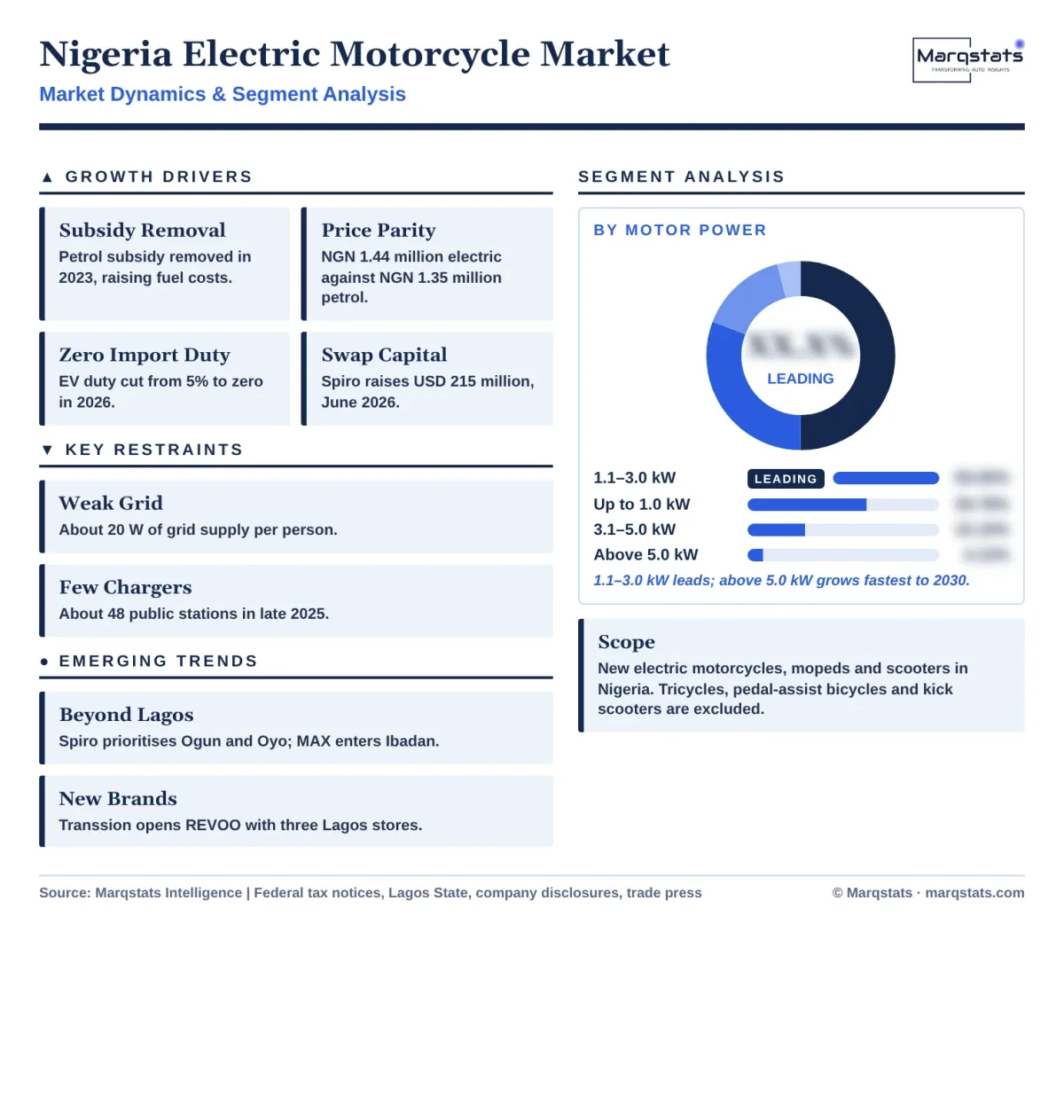
The 1.1–3.0 kW band is the dominant segment and covers commuter scooters and motorcycle taxis for city routes. It accounts for 2,550 units in 2025, 50.00% of the total, and reaches 11,081 units by 2030 at a 34.16% CAGR, taking 47.50% of the market. Swap-based fleet motorcycles and many imported Chinese models compete in this band, which keeps its lead to 2030.
The up-to-1.0 kW band covers low-speed mopeds and light scooters. It accounts for 1,570 units in 2025, 30.78% of the total, and reaches 5,691 units by 2030 at a 29.38% CAGR, taking 24.39% of the market. Its share falls to 2030 as riders choose faster models for passenger and goods work.
The 3.1–5.0 kW band covers motorcycles for longer taxi and delivery routes. It accounts for 770 units in 2025, 15.10% of the total, and reaches 4,794 units by 2030 at a 44.16% CAGR, taking 20.55% of the market. Its share rises as operators deploy higher-power models for riders who cover more than 100 km a day.
The above-5.0 kW band is the smallest and fastest-growing segment. It accounts for 210 units in 2025, 4.12% of the total, and reaches 1,763 units by 2030 at a 53.04% CAGR, taking 7.56% of the market. Higher-power models suit inter-city routes in the south-west, and the band grows from a small base of premium imports to the largest rate of any band in the market.
Riders buy or lease the motorcycle and pay per swap or by instalment, the model used by Spiro and MAX. The model removes the battery from the upfront price and avoids home charging, which suits a country with about 20 W of grid supply per person.
Riders buy the motorcycle and battery from retail stores such as REVOO's three Lagos outlets and charge at home or at work. Outright purchase suits private commuters with reliable power, a smaller group than commercial riders. Consumer brands such as REVOO target this group with retail stores in busy trading districts.
By Geography
Lagos
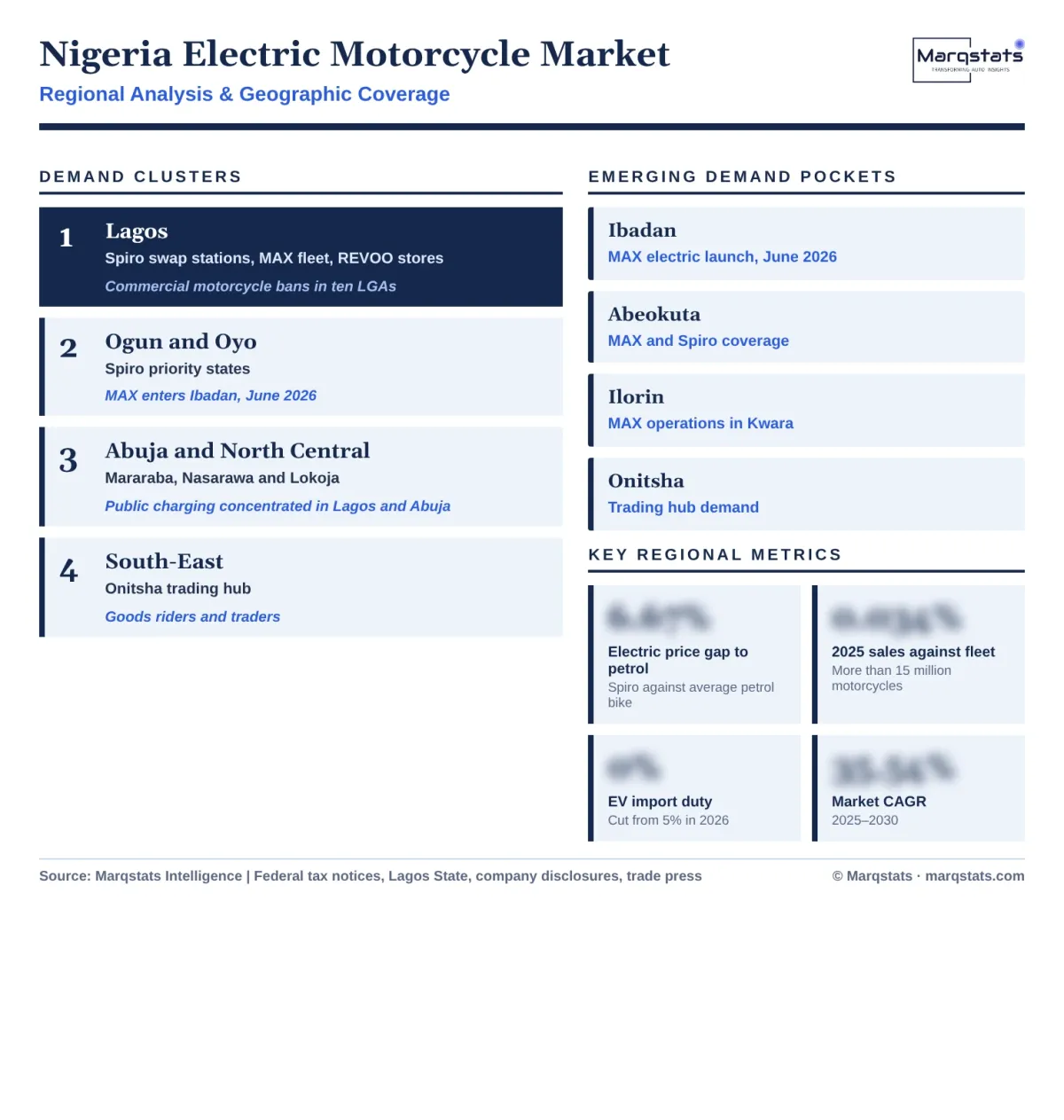
Lagos is the largest market, with Spiro's first 64 swap stations, MAX's deployment of more than 2,000 bikes in a single quarter of 2026 and REVOO's three stores. Commercial motorcycle bans in ten local government areas push riders to outer Lagos, where swap networks concentrate. Lagos remains the largest market to 2030, because swap stations, fleet financiers, retail stores and riders all concentrate there.
Ogun and Oyo
Ogun and Oyo are Spiro's other priority states, and MAX operates in Abeokuta and Iseyin and began bringing electric vehicles to Ibadan in June 2026. Proximity to Lagos lets operators extend existing networks, and the corridor between Lagos, Abeokuta and Ibadan is the most likely second market to reach scale.
Abuja and North Central
Abuja hosts many of Nigeria's public charging stations, and MAX operates in Mararaba, Nasarawa and Lokoja. Demand in the north central zone depends on operators extending swap coverage from the capital, and Mararaba and Nasarawa sit on commuter routes into Abuja.
South-East
Onitsha in Anambra State is a major trading hub where MAX operates, and motorcycles carry goods between markets. Traders and goods riders form the main buyer group, and their daily distances make running-cost savings the main purchase reason.
South-West and Kwara
MAX operates in Osogbo, Ilorin and Ekiti, which extends coverage across the south-west and into Kwara. These cities depend on operators adding swap stations with their own power supply.
How Competition Is Evolving
The market is moderately fragmented. Spiro, Metro Africa Xpress (MAX) and REVOO, owned by Transsion Holdings, form the organised core, while importers sell unbranded Chinese models without published volumes. Spiro's about 3,500 deliveries by September 2025 compare with 5,100 units of total 2025 market volume, so no single company publishes enough data to establish shares.
Strategies split between swap ecosystems and retail. Spiro combines assembly, swap stations, battery recycling and rider finance, and raised USD 215 million in June 2026 from investors including Impact Fund Denmark and Equitane, after USD 100 million led by FEDA in October 2025. MAX finances riders through pay-as-you-go plans across more than 18 cities, and REVOO uses Transsion's consumer retail model with stores in Trade Fair, Agege and Alaba.
Petrol motorcycle brands remain the benchmark. Bajaj Auto Limited, TVS Motor Company Limited and Chinese brands are among the main suppliers of Nigeria's more than 15 million motorcycles, and the average petrol price of NGN 1.35 million sets the target that electric models now match. Petrol brands keep an advantage in rural areas without swap coverage.
The competitive question to 2030 is who builds powered swap capacity fastest. Spiro's backlog of about 20,000 orders shows demand ahead of supply, and its target of 2,000 Nigerian stations would give it the densest network. Companies that secure state permits, local assembly incentives and off-grid power gain share, and new entrants need partners with these assets.
Product cycles are speeding up. Spiro unveiled the Ekon M1 Version 3 at its Nigerian event in October 2026, REVOO launched four models at once in November 2025, and Spiro cut prices in September 2025 to NGN 1.44 million from earlier levels of up to NGN 3 million. Faster model and price changes favour operators that control both the vehicle and the battery, because they can update one without stranding the other. Unbranded importers compete on purchase price alone and lose ground wherever riders gain access to swap networks.
Companies Covered
Companies covered in the report include:
Recent Market Activity
Table of Contents
Coverage & Segmentation
The Nigeria electric motorcycle market comprises new battery electric motorcycles, mopeds and scooters sold for road use in Nigeria, sized in units and in USD at retail selling prices. The market is segmented by motor power into four bands (up to 1.0 kW, 1.1–3.0 kW, 3.1–5.0 kW and above 5.0 kW) and by ownership model into battery swap and pay-as-you-go, and outright retail purchase. Regional analysis covers Lagos, Ogun and Oyo, Abuja and North Central, the South-East, and the South-West and Kwara, and is qualitative.
The base year is 2025, the historical period is 2021–2025 and the forecast period is 2026–2030. Electric tricycles, cars and buses, pedal-assist bicycles, kick scooters, used vehicles and petrol motorcycles are excluded. No official series records electric motorcycle sales or registrations in Nigeria, so the market size is a Marqstats construction from import, assembly and company data and is not independently verified against registrations. Company figures from Spiro and MAX are as reported, and the tax waiver total covers all electric vehicle types.