Market Snapshot
Middle bar: base-year value × (1 + CAGR), rounded to two decimals. This is a calculated illustration, not a separately researched annual estimate.
The Latin America electric motorcycle market is estimated at 149,207 units in 2025 and is projected to reach 518,156 units by 2030, registering a volume CAGR of 28.27% over 2026–2030. In value terms the market is estimated at USD 0.36 billion in 2025 and is projected to reach USD 1.36 billion by 2030, a CAGR of 30.45%. The market comprises new battery electric motorcycles, scooters and mopeds for road use in Mexico and South America, whether or not they are entered in national registration systems. Brazil is the largest country at 36.87% of 2025 volume, and the region is the fastest-growing in the world, lifting its share of global electric two-wheeler volume from 2.40% to 5.01% by 2030.
Market size and forecast figures are generated using Marqstats' proprietary estimation framework, updated as of October 2026.
The 1.1–3.0 kW band is the dominant power segment at 47.37% of units, and the above-5.0 kW band is the fastest-growing at 36.07% a year. Mexico is the fastest-growing large country at a 34.49% CAGR, rising from 35,240 units to 155,053 by 2030. The average selling price rises from USD 2,413 in 2025 to USD 2,625 by 2030 as delivery fleets move to 3 kW-plus motorcycles.
Key Takeaways
Market Overview & Analysis
Report Summary
The Latin America electric motorcycle market covers new battery electric two-wheelers for road use in Mexico and ten South American countries, from sub-1.0 kW mopeds to motorcycles above 5.0 kW. The market is estimated at 149,207 units in 2025, up 62.02% on 92,090 units in 2024, and has grown almost fourfold from 39,614 units in 2021. It reaches 202,671 units in 2026 and 518,156 units by 2030, adding 368,949 units over the forecast period. Pedal-assist electric bicycles, stand-up kick scooters, shared scooter fleets, electric three-wheelers and internal combustion motorcycles sit outside the perimeter.
Most of the market operates outside the registration system. The Brazilian vehicle dealers' federation (Fenabrave) recorded 8,552 registered electric motorcycles in 2025, 0.39% of 2,197,308 registered motorcycles and 15.55% of Brazil's 55,000-unit market. Colombia's automotive association Andemos recorded 1,353 formal electric motorcycle registrations in 2025, down 35.42%, against a market of 27,290 units, and the Colombian motorcycle chamber of the National Business Association (ANDI) reported in February 2026 that about 98% of electric units sold since July 2025 were not entered in the national transit register (RUNT). In Mexico City, only about 2% of an estimated 200,000 electric scooters and electric bicycles on the road were registered in October 2026. Registration data therefore measure the formal premium tier, not the market.
Regulation is now catching up with the informal market, and it is the largest short-term swing factor. Brazil's National Traffic Council (CONTRAN) Resolution 996 of June 2023 separated electric mopeds from pedal-assist bicycles and personal mobility devices, Colombia's Law 2486 of 2025 took effect in April 2026 with age limits, helmet rules and fines above COP 10 million, and Mexico City began mandatory registration and plates for electric vehicles above 25 km/h from 1 July 2026. Retailers in Mexico expected sales to dip after registration began, and the shift moves volume from informal importers to brands with homologated products and dealer networks.
Brazil is the largest and most commercially organised market. Volume rises from 55,000 units in 2025, up 83.33%, to 185,259 units by 2030, a CAGR of 27.49%. Delivery riders drive demand: the federal Move Brasil credit line for delivery workers and professional motorcyclists began operating in July 2026, and the delivery platform 99 committed more than BRL 45 million to YvY Capital's Two-Wheel Electromobility Fund alongside iFood in May 2026. Vammo, a São Paulo electric motorcycle and battery-swap operator, raised USD 45 million in a Series B round in November 2025 and passed 10 million battery swaps in October 2026.
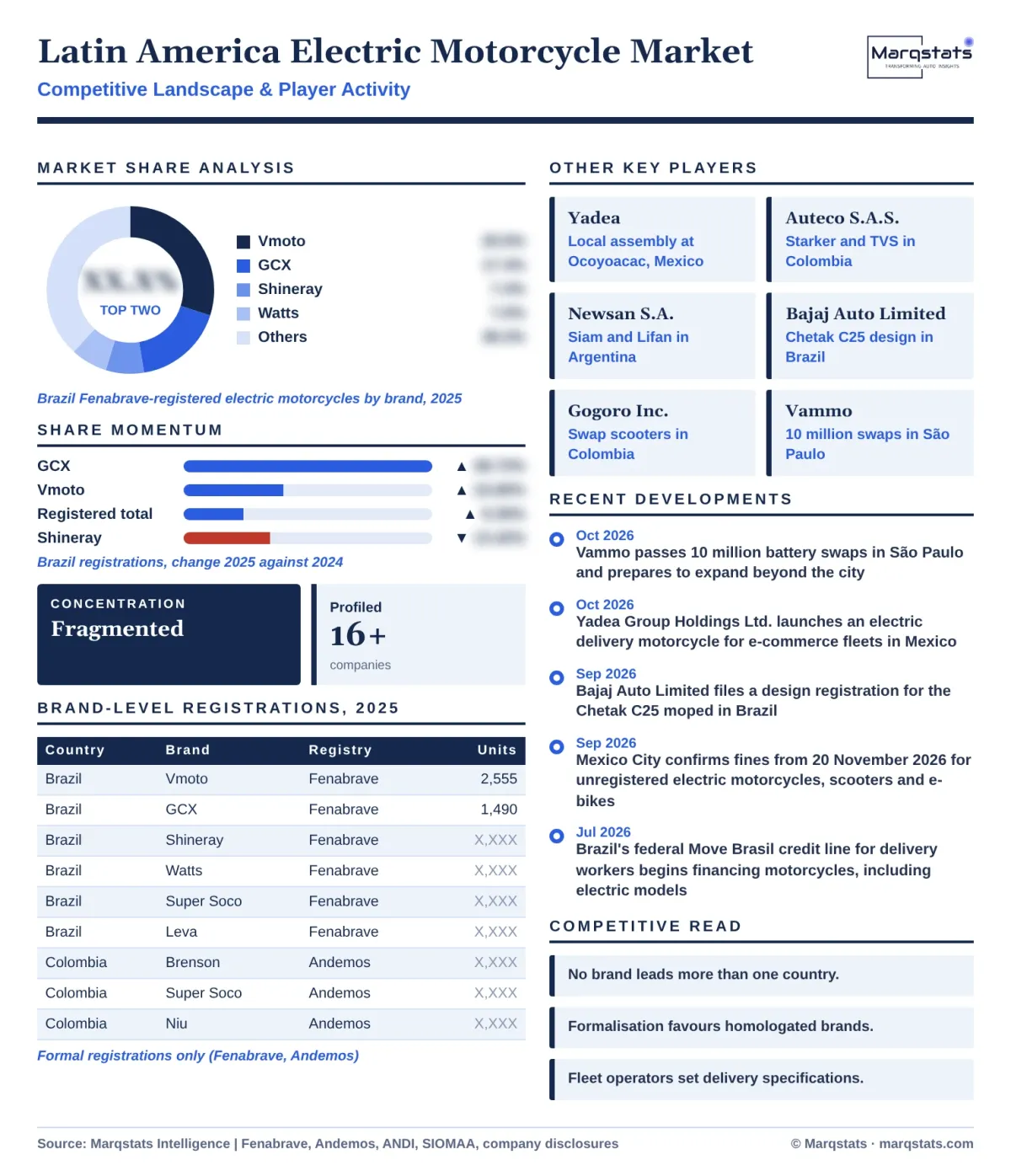
Brand-level registration data show a market that changes leader every few years. Vmoto Limited took 29.88% of Fenabrave-registered electric motorcycles in 2025 with 2,555 units, up 15.66% on 2,209 units in 2024, followed by GCX with 1,490 units and 17.42%, up 38.73%. Shineray do Brasil S.A. took 7.39%, Watts 7.03%, Super Soco 4.61%, Shengqi 3.02% and Leva 2.81%, while Chinese brands Tailing, Aima and Luyuan took 1.84%, 1.09% and 0.87%. Voltz held 62.4% of registrations in 2022 with 4,546 units and fell to 1,734 units in 2023, after iFood acknowledged that its 2022 electric motorcycle project with Voltz did not work as planned.
Mexico is the fastest-growing large market and the most import-dependent. Volume rises from 35,240 units in 2025 to 155,053 by 2030, a CAGR of 34.49%, lifting Mexico's share of regional volume from 23.62% to 29.92%. About 90% of electric motorcycles sold in Mexico enter as parts at a 5% tariff rather than as finished vehicles, according to August 2026 industry reporting, and Mexico raised import duties on 1,463 tariff lines for Asian goods in December 2025. Yadea Group Holdings Ltd. assembles at Ocoyoacac in the State of Mexico, unveiled the Keeness flagship at EXPO MOTO in December 2025 and launched a delivery motorcycle for e-commerce fleets in October 2026.
Colombia shows how brand leadership splits between registered and unregistered tiers. Among formal Andemos registrations in 2025, Brenson led with 199 units, Super Soco followed with 150, Niu Technologies with 99 and Gogoro Inc. with 77, while Auteco's Starker brand, which held 38.24% of formal sales in January to May 2024, stated sales of about 2,000 units in 2025 across registered and unregistered products. TVS Motor Company Limited's iQube, sold through Auteco, reached an 11% share in early 2026, and Minca projected about 3,000 electric moped sales in 2025, up 97%.
Value is more concentrated than volume. Brazil accounts for USD 0.19 billion of the USD 0.36 billion regional market in 2025, at an average selling price of approximately USD 3,450, against USD 1,862 in Mexico, USD 1,826 in Colombia and USD 1,574 in Argentina. The regional market rises to USD 1.36 billion by 2030, a 30.45% CAGR, and Brazil reaches USD 0.70 billion. Brazilian prices reflect locally registered motorcycle-class products and delivery fleet specifications, while Mexican and Colombian prices are held down by kit-assembled and informal moped-class imports.
Argentina's formal market is small and led by local distributors. Elpra Electric, the only electric-only brand identifiable in the Argentine motorcycle chamber's (SIOMAA) patent data, registered 366 units in January to October 2023 and 264 in the same period of 2024, down 27.9%. Newsan S.A. stated in 2024 that its Siam brand sold one in four electric motorcycles in Argentina, and in February 2025 it signed an exclusive agreement to sell Lifan electric motorcycles. Sunra and Okinoi compete with locally assembled urban models, and the national electric motorcycle market contracted in 2026 as registrations fell year on year.
Shared micromobility fleets sit outside the perimeter and compete for the same short urban trips. Whoosh planned to triple its Latin American electric scooter fleet to more than 30,000 units in 2026 and launched rentals in Mexico City in June 2026, and Mexico City's shared scooter pilot ended in September 2026 after about 117,000 trips in 60 days with Lime, JET and Whoosh. JET entered Chile's shared scooter market in September 2025. Shared fleets absorb a share of trips under 5 km that would otherwise go to low-power mopeds, which is one reason the up-to-1.0 kW band grows more slowly than the motorcycle-class bands.
Market Dynamics
Key Drivers
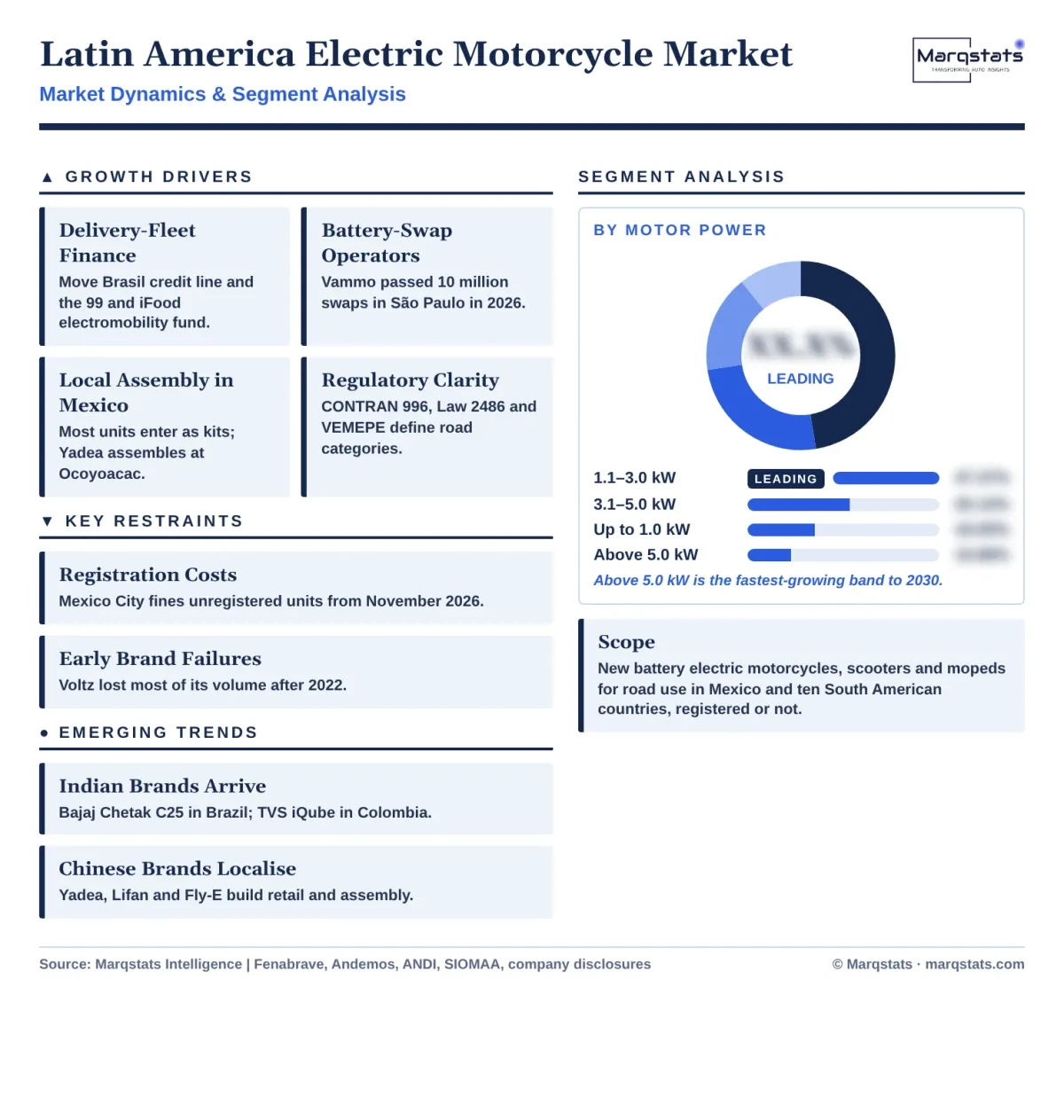
Five conditions drive the Latin America electric motorcycle market, and delivery-fleet finance matters more than consumer subsidy.
- Delivery-fleet finance in Brazil. The federal Move Brasil credit line began operating in July 2026 for delivery workers and professional motorcyclists, and the Empreender Clima initiative offered credit for electric two-wheelers in Presidente Prudente in December 2025. The delivery platforms 99 and iFood funded YvY Capital's Two-Wheel Electromobility Fund in May 2026.
- Battery-swap operators remove the battery cost. Vammo passed 10 million battery swaps in São Paulo in October 2026 and is preparing to expand beyond the city, and Gogoro Inc. expanded battery-swap scooters in Colombia from January 2025. Swap models lower the entry price for riders who cover 100 km or more a day, supporting the 30.53% growth of the 3.1–5.0 kW band.
- Local assembly in Mexico. Yadea Group Holdings Ltd. assembles at its Ocoyoacac plant, and about 90% of electric motorcycles sold in Mexico enter as parts at a 5% tariff. Higher duties on 1,463 Asian tariff lines from December 2025 favour local assembly, and Mexico grows at 34.49% a year.
- Running-cost advantage at high fuel prices. Delivery riders in São Paulo, Mexico City and Bogotá cover the longest daily distances in the region, so electricity costs per kilometre deliver the largest saving for them. The above-5.0 kW band, which serves highway-capable delivery and commuter motorcycles, grows at 36.07% a year.
- Regulatory clarity for road-legal products. Colombia's Law 2486 of 2025, Brazil's CONTRAN Resolution 996 and Mexico City's VEMEPE registration rules define electric mopeds and motorcycles as road vehicles. Clear categories let finance companies and insurers serve the segment, which favours brands with homologated products.
Key Restraints
Four constraints limit the formal market, and enforcement of new registration rules is the most immediate.
- Registration costs and enforcement. Mexico City fines unregistered electric motorcycles, scooters and electric bicycles from 20 November 2026, and retailers expected sales to dip after registration began in July 2026. Colombia's formal registrations fell 35.42% in 2025 to 1,353 units as buyers moved to unregistered moped-class products.
- Failure of early brands. Voltz fell from 4,546 registered units and a 62.4% share in 2022 to 1,734 units in 2023, and iFood reported that its 2022 electric motorcycle project did not work as planned. Brand failures leave owners without parts or service and slow repeat purchases.
- Low penetration of the motorcycle market in Brazil. Registered electric motorcycles were 0.39% of Brazil's 2,197,308 registered motorcycles in 2025, against 0.53% in 2022. Brazilian buyers of 125 to 160 cc petrol motorcycles from Honda and Yamaha have dealer finance and resale values that electric brands do not yet match.
- Market contraction in Argentina. Argentina's electric motorcycle registrations fell sharply in the first half of 2026. Argentina grows at 25.75% a year from 10,730 units, the slowest rate among the four largest markets apart from Colombia.
Key Trends
Four shifts show where the market is moving and which companies benefit.
- Indian brands enter Latin America. Bajaj Auto Limited filed a design registration for the Chetak C25 moped in Brazil in September 2026 ahead of a mass-market launch, and TVS Motor Company Limited's iQube reached an 11% share in Colombia in early 2026 through Auteco. Both use existing petrol motorcycle distribution in the region.
- Chinese brands localise and build retail. Yadea launched the OVA smart scooter in Mexico in June 2026 and a delivery motorcycle in October 2026, Newsan S.A. signed an exclusive agreement to sell Lifan electric motorcycles in Argentina in February 2025, and Fly-E Group, Inc. opened its first South American store in August 2025. Chinese brands Tailing, Aima and Luyuan each entered Brazil's 2025 registration ranking, signalling direct entry by the largest Chinese manufacturers.
- Local Brazilian brands emerge. Leva Motors opened its first São Paulo dealership in October 2025 and took 2.81% of 2025 registrations, and Lev Group's Onn brand launched a Brazilian-designed scooter in Rio de Janeiro in June 2025. Local design lets brands meet CONTRAN categories and price points directly.
- Imports of low-cost electric mopeds surge. Peru imported 41,043 electric motorcycles in 2025, up 95%, almost all from China, at an average customs value of about USD 395 a unit in early 2026. These low-speed units fall largely outside the road-going perimeter, and the up-to-1.0 kW band grows at only 24.08% a year.
Market Segmentation
The 1.1–3.0 kW band is the dominant segment and the commuter base of the market. It accounts for 70,681 units in 2025, 47.37% of the total, and reaches 227,544 units by 2030 at a 26.34% CAGR, taking 43.91% of the market. Brazil supplies 25,850 of these units, led by urban scooters from Shineray, Watts and Super Soco.
The 3.1–5.0 kW band is the delivery-fleet segment and the main source of value growth. It accounts for 37,484 units in 2025, 25.12% of the total, and reaches 142,009 units by 2030 at a 30.53% CAGR, taking 27.41% of the market. Vmoto, GCX and the battery-swap fleets operated by Vammo serve riders who need motorcycle-class speed for app deliveries.
The up-to-1.0 kW band serves the lowest-price tier and is the declining share. It accounts for 24,845 units in 2025, 16.65% of the total, and reaches 73,063 units by 2030 at a 24.08% CAGR, taking 14.10% of the market. Low-speed mopeds sold through informal channels in Colombia, Peru and Mexico dominate the band.
The above-5.0 kW band is the fastest-growing segment. It accounts for 16,197 units in 2025, 10.86% of the total, and reaches 75,540 units by 2030 at a 36.07% CAGR, taking 14.58% of the market. Brazil supplies 6,940 units and Mexico 4,231, as highway-capable motorcycles enter delivery and commuter use.
By Geography
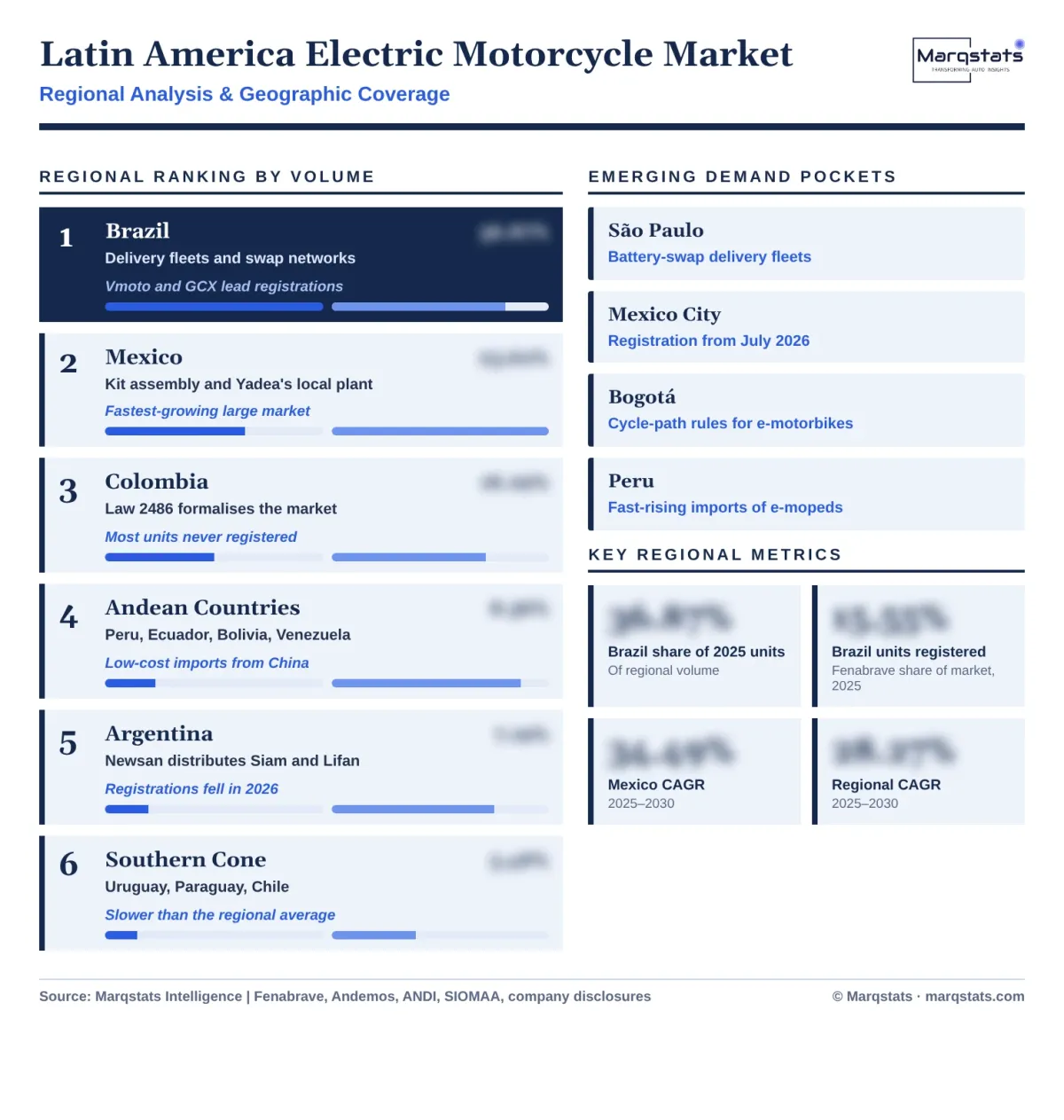
Brazil
Brazil is the volume centre of the Latin America electric motorcycle market, with 55,000 units in 2025 and 36.87% of regional volume, rising to 185,259 units by 2030 at a 27.49% CAGR. The market is valued at USD 0.19 billion in 2025, at an average selling price of approximately USD 3,450, the highest in the region. Delivery-fleet finance, battery swapping in São Paulo and the arrival of Bajaj Auto Limited sustain growth, and Vmoto Limited and GCX lead registrations. Fenabrave-registered electric motorcycles rose from 1,615 units in 2021 to 8,552 in 2025, so the formal tier has grown more than fivefold while remaining a minority of Brazilian electric two-wheeler sales.
Mexico
Mexico holds 35,240 units in 2025, 23.62% of regional volume, and grows fastest among the large markets at 34.49% a year to 155,053 units by 2030. Kit imports at a 5% tariff and Yadea's local assembly keep prices low, while Mexico City's VEMEPE registration rules from July 2026 formalise the market. INEGI data showed the number of businesses selling electric motorcycles, mopeds and scooters grew about 1,900% between 2021 and 2026. Segway expanded in Mexico in August 2026 with commuter electric scooters priced from MXN 25,999, and Mexico City authorities closed informal electric scooter shops in the Historic Centre in February 2026 amid scrutiny of unregistered Chinese imports.
Colombia
Colombia holds 27,290 units in 2025, 18.29% of regional volume, up 93.68%, and grows at 24.37% a year to 81,191 units by 2030. Law 2486 of 2025 took effect in April 2026, and pending legislation in June 2026 set out rules for electric motorbikes on Bogotá's cycle paths. Auteco's Starker and TVS brands, Brenson, Super Soco, Niu and Gogoro compete in the formal tier. ANDI estimated, from customs data, that about 167,000 electric two-wheelers of all types entered Colombia in 2025, a total that includes electric bicycles and low-speed devices outside the road-going perimeter.
Argentina
Argentina holds 10,730 units in 2025, 7.19% of regional volume, and grows at 25.75% a year to 33,735 units by 2030. Newsan S.A. distributes Lifan and Siam electric motorcycles, Okinoi expanded its locally assembled range in April 2025, and new Chinese brands entered in August 2025. Electric motorcycle registrations fell year on year in 2026 even as electric and hybrid car sales grew. Argentina recorded 1,929 electric motorcycle sales in 2022 according to SIOMAA, and Newsan estimated about 1,400 to 1,500 units in 2023, so the market has expanded from a very small formal base.
Andean Countries
Peru, Ecuador, Bolivia and Venezuela together hold 12,768 units in 2025, 8.56% of regional volume, and grow at 30.07% a year to 47,542 units by 2030. Peru is the largest at 4,060 units and grows at 31.92% a year, and Venezuela grows at 34.41% from 3,250 units. Indecopi flagged more than 1,000 electric scooters with short-circuit risk in Peru in August 2025, which shows the quality gap in imported low-cost products. Futur, a new venture from a gaming-business group, entered Peru's electric motorcycle market in July 2026.
Southern Cone
Uruguay, Paraguay and Chile together hold 8,179 units in 2025, 5.48% of regional volume, and grow at 13.46% a year to 15,376 units by 2030. Uruguay is the largest at 4,250 units, and Chile, with 1,360 units, is where Gogoro Inc. appointed a brand representative in October 2025. The sub-region grows more slowly than the regional average of 28.27%.
How Competition Is Evolving
The market is fragmented, and leadership is national and short-lived. Vmoto Limited leads Brazilian registrations with 29.88% and GCX follows with 17.42%, while in Colombia's formal tier Brenson, Super Soco, Niu Technologies and Gogoro Inc. each hold less than 15%. Yadea Group Holdings Ltd. is the only brand with local assembly in Mexico, and no company leads in more than one country.
Competitive strategy splits three ways. Chinese manufacturers including Yadea, Tailg Technology Co., Ltd., Aima Technology Group Co., Ltd. and Luyuan Group Holding (Cayman) Limited compete on price through distributors and kit assembly. Indian manufacturers TVS Motor Company Limited and Bajaj Auto Limited enter through partners with petrol motorcycle networks, such as Auteco in Colombia. Battery-swap and fleet operators such as Vammo, backed by delivery platforms 99 and iFood, buy in volume and set product specifications for the delivery segment.
Fleet operators and delivery platforms are becoming the largest single buyers. Vammo raised USD 45 million in November 2025 and operates a battery-swap network that passed 10 million swaps in São Paulo, Didi Global Inc.'s 99 increased its Brazilian investment in September 2025 and backed the YvY electromobility fund in May 2026. Fleet buyers specify battery-swap compatibility and service contracts, which shifts bargaining power from brands to operators.
The competitive question to 2030 is which brands survive formalisation. Registration rules in Mexico City, Colombia and Brazil favour brands with homologated products, dealer service and finance partners, and penalise informal importers that sell most of today's units. Voltz held 62.4% of Brazilian registrations in 2022 and lost most of its volume within a year, so share in this market depends on after-sales capability more than on first-mover position.
Companies Covered
Companies covered in the report include:
Recent Market Activity
Table of Contents
Coverage & Segmentation
The Latin America electric motorcycle market comprises new battery electric motorcycles, scooters and mopeds for road use, sized in units and in USD at manufacturer selling prices, including units not entered in national registration systems. The market is segmented by motor power into four bands: up to 1.0 kW, 1.1–3.0 kW, 3.1–5.0 kW and above 5.0 kW. Geographic coverage spans Brazil, Mexico, Colombia, Argentina, the Andean countries (Peru, Ecuador, Bolivia and Venezuela) and the Southern Cone (Uruguay, Paraguay and Chile).
The base year is 2025, the historical period is 2021–2025 and the forecast period is 2026–2030. Pedal-assist electric bicycles, stand-up kick scooters, shared micromobility fleets, electric three-wheelers and internal combustion motorcycles are excluded. Brand analysis draws on Fenabrave registrations in Brazil, Andemos registrations in Colombia, company disclosures and customs data.