Market Snapshot
Middle bar: base-year value × (1 + CAGR), rounded to two decimals. This is a calculated illustration, not a separately researched annual estimate.
The Philippines electric motorcycle market is estimated at 60,000 units in 2025 and is projected to reach 121,957 units by 2030, registering a volume CAGR of 15.24% over 2026–2030. In value terms the market is estimated at USD 95.89 million in 2025 and is projected to reach USD 217.57 million by 2030, a CAGR of 17.81%. The market comprises new battery electric motorcycles, scooters and mopeds sold for road use in the Philippines, from low-speed mopeds to motorcycles above 5 kW. The 1.1–3.0 kW band holds 54.36% of 2025 units, and electric models took about 3.35% of the 1,793,219 motorcycles the industry expected to sell in 2025.
Market size and forecast figures are generated using Marqstats' proprietary estimation framework, updated as of October 2026.
The brand order of the Philippine market changed in a single year. Honda's EM1 e: rose from 0.78% to 20.41% of tracked electric registrations between 2024 and 2025, while MotorStar's Viber, the top model in 2024 with 21.59%, fell to 0.61%. VinFast Auto Ltd. launched its electric motorcycles with 21 showrooms in July 2026, and the zero-tariff treatment of electric motorcycles under Executive Order No. 62 runs until 2028.
Growth slows from the 2024 and 2025 pace and stays well above the motorcycle market. Volume grows 16.20% in 2026 and at 15.24% a year to 2030, against about 4% growth expected for all motorcycles in 2026, so the electric share rises every year of the forecast. Value grows faster, at 17.81% a year, as swap-ready scooters from VinFast, Honda and Gogoro raise the average selling price. TAILG, Honda and Yadea enter the forecast period as the three largest brands, and VinFast is the main new challenger.
Key Takeaways
Market Overview & Analysis
Report Summary
The Philippines electric motorcycle market covers new battery electric two-wheelers sold for road use in the Philippines, including low-speed electric mopeds, scooters and motorcycles registered with the Land Transportation Office (LTO). The market is estimated at 60,000 units in 2025, up 71.43% on 35,000 units in 2024, and has grown fifteen times from 4,000 units in 2021. It grows 16.20% to 69,720 units in 2026 and reaches 121,957 units by 2030, adding 61,957 units over the forecast period. Electric tricycles, pedal-assist bicycles, stand-up kick scooters, used vehicles and petrol motorcycles sit outside the perimeter.
The Philippines is one of Asia's largest motorcycle markets with one of its smallest electric shares. The Motorcycle Development Program Participants Association (MDPPA) reported member sales of 1,398,314 units in January to September 2025 and projected 1,793,219 units for the full year, up 6.7%, and members sold 939,528 units in the first half of 2026, up 3.58%. Electric models take about 3.35% of that market, and automatic scooters took nearly 70% of MDPPA sales in the first half of 2026, which matches the scooter-led electric product mix. MDPPA expects sales to grow about 4% in 2026 and pass 1.85 million units.
The Philippines lags its neighbours in electric adoption. Marqstats estimates electric penetration of 15.23% in Vietnam and 0.86% in Indonesia in 2025, so the Philippines sits between the two Southeast Asian extremes at about 3.35%. The country lacks Vietnam's domestic champion and the purchase subsidy Indonesia offered in 2023 and 2024, and depends on imports from China, Japan, Vietnam and Taiwan. Its growth therefore follows brand entry and dealer expansion more than policy.
The petrol market shows where electric models must compete. MDPPA members sold 655,004 automatic scooters, 148,989 business motorcycles, 107,632 mopeds, 24,346 street motorcycles and 2,994 big bikes in the first half of 2026. Automatic scooters at nearly 70% of the market are the natural target for electric scooters, while business motorcycles used for deliveries and tricycle conversions are the target for fleet models such as Yadea's J&T Express vehicles. First-quarter sales grew 11.6% to 496,868 units and second-quarter sales fell 4.2% to 442,660, so the wider market slowed as electric brands expanded.
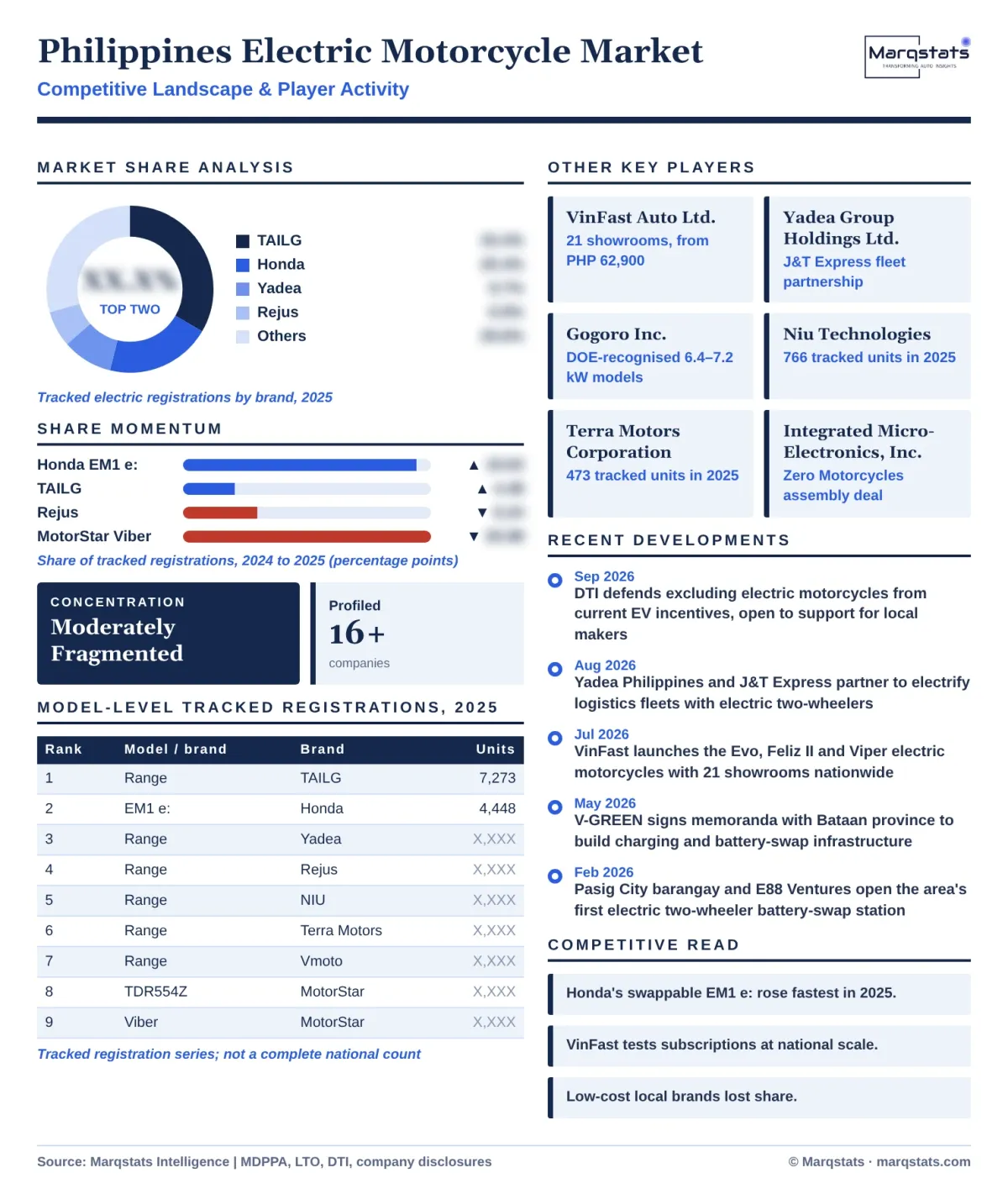
Model-level data for 21,797 tracked electric registrations in 2025, about 36.33% of the market, show a sharp change in brand order. TAILG registered 7,273 units, 33.37% of the tracked total, followed by Honda's EM1 e: with 4,448, Yadea with 2,121, Rejus with 1,511, NIU with 766, Terra Motors with 473 and Vmoto with 338. MotorStar's Viber fell from 6,331 units in 2024 to 134 in 2025 and its TDR554Z from 3,042 to 138, while the EM1 e: rose from 229 to 4,448. The tracked series covers named brands and models and is not a complete national registration count.
Honda's rise shows that the incumbent petrol leader can move buyers quickly. The EM1 e: uses Honda's swappable Mobile Power Pack and sells through Honda's national motorcycle dealer network, which gives it reach in provinces where specialist electric brands have few outlets. MotorStar, a local brand of low-cost electric mopeds, lost most of its volume in 2025 as buyers moved to brands with stronger service networks. TAILG and Yadea held their positions with wide ranges of low-cost scooters and mopeds.
Tracked brand data show how concentrated volume is among a few models. TAILG, Honda and Yadea together took 63.51% of tracked 2025 registrations, against 40.70% in 2024, and the share of unnamed brands rose from 5.61% to 21.08%. The tracked total fell from 29,324 to 21,797 while the market grew, which shows that new and smaller brands took volume outside the named series. The change makes national brand shares less certain than the model trends within the tracked series.
New entrants raise competition in 2026. VinFast launched the Evo, Feliz II and Viper on 31 July 2026 with 21 sales, service and parts dealers, priced at PHP 62,900, PHP 64,900 and PHP 73,900 with a battery subscription, or PHP 75,600 to PHP 99,300 with one or two batteries included. Subscribers pay PHP 439 a month per battery plus PHP 35 per swap, and VinFast positions the Viper against 125 cc petrol scooters such as the Honda Click. VinFast signed agreements with 14 electric motorbike distributors in April 2026 and with Bespoke Logistics for distribution in July 2026.
Policy support is limited to tariffs and does not include the wider incentive package given to electric cars. Executive Order No. 12 of 2023 cut tariffs on electric cars and left electric motorcycles at 30%, and the National Economic and Development Authority approved their inclusion at 0% until 2028 in May 2024 under Executive Order No. 62. The Department of Trade and Industry (DTI) defended excluding electric motorcycles from current electric vehicle incentives in September 2026, while saying it remained open to support for local electric motorcycle and tricycle makers. The Electric Vehicle Industry Development Act (EVIDA) of 2022 sets the wider framework for charging stations and fleet targets.
The average selling price in the market is approximately USD 1,598 in 2025, rising to USD 1,784 by 2030 as buyers move to higher-quality scooters and swap-ready models. VinFast's subscription prices of PHP 62,900 to PHP 73,900 sit close to entry petrol scooters once fuel savings are counted, and battery subscriptions move part of the cost into a monthly payment. Low-cost Chinese mopeds remain far cheaper and dominate the up-to-1.0 kW and 1.1–3.0 kW bands. Rising fuel prices during the 2026 oil crisis increased the running-cost advantage of electric models.
Swap infrastructure is the main investment theme for 2026 and 2027. VinFast prepared a battery-swapping network for its Evo, Feliz and Viper models in August 2026, and V-GREEN, Vingroup's charging-infrastructure company, signed memoranda in Bataan in May 2026. Singapore-founded Zion Mobility planned to launch electric motorcycles in Singapore, Indonesia and the Philippines in the first quarter of 2026. The number of swap networks in operation by 2027 will decide whether the 3.1–5.0 kW band keeps its growth lead.
Market Dynamics
Key Drivers
Five conditions drive the Philippines electric motorcycle market, and running-cost savings matter most.
- Fuel costs and the 2026 oil crisis. Riders and transport groups cited the oil crisis in 2026 when the Move As One Coalition asked the LTO by May 2026 to lift highway restrictions on e-bikes and e-trikes. High petrol prices widen the running-cost gap between electric and petrol scooters for daily commuters and delivery riders.
- Zero tariff on electric motorcycles until 2028. Executive Order No. 62 extended the zero-tariff treatment under Executive Order No. 12 to electric motorcycles and e-bicycles until 2028, against a previous 30% rate. Lower landed costs help importers such as VinFast, Yadea and TAILG price close to petrol scooters.
- Battery swapping and subscription models. VinFast offers battery subscriptions at PHP 439 a month, V-GREEN signed memoranda with Bataan province in May 2026 to build charging and swap infrastructure, and a Pasig City barangay opened its first electric two-wheeler swap station with E88 Ventures in February 2026. Swapping removes the battery from the purchase price and cuts charging time.
- Fleet electrification. Yadea Philippines and J&T Express partnered in August 2026 to electrify logistics fleets with electric two-wheelers, and Trio Industrial Electronics Group agreed an electric two-wheeler deployment with Bayambang City in October 2025. Delivery and municipal fleets add volume in blocks. Business motorcycles, the segment most used for deliveries, sold 148,989 units in the first half of 2026, so even a small electric share among fleets adds thousands of units a year.
- Incumbent brands enter. Honda's EM1 e: rose to 4,448 tracked registrations in 2025, and Gogoro introduced its Delight, Gogoro 2 and SuperSport models, recognised by the Department of Energy, in December 2023. Established brands bring dealer networks and financing that low-cost importers lack.
Key Restraints
Four constraints slow the market, and the lack of incentives beyond tariffs is the largest.
- No purchase incentives for electric motorcycles. The DTI defended the exclusion of electric motorcycles from current electric vehicle incentives in September 2026. Electric models remain at about 3.35% of motorcycle sales without a purchase subsidy. Electric cars receive a wider package under EVIDA and Executive Order No. 12, so two-wheeler buyers, the largest group of vehicle buyers in the country, receive the least support.
- Road restrictions on light electric vehicles. The LTO and the Metropolitan Manila Development Authority (MMDA) began enforcing a ban on e-bikes and e-trikes on EDSA, C-5, Roxas Boulevard and other major roads on 2 January 2026, and the LTO flagged more than 200 vehicles after the ban. The rules hurt low-speed mopeds and push buyers towards registered electric motorcycles.
- Thin charging and service networks. Battery swap stations remain concentrated in Metro Manila and a few provinces, and VinFast had not announced opening dates for its swap stations at launch. Riders outside major cities depend on home charging and dealers with limited parts supply.
- Price gap with petrol scooters. Petrol scooters such as the Honda Click dominate a market where automatic scooters take nearly 70% of sales, and financing is widely available for them. Electric models need lower total costs, not only lower running costs, to win credit-dependent buyers.
Key Trends
Four shifts show where the market is moving and which companies gain.
- Vietnamese and Chinese brands scale up. VinFast named the Philippines among five priority markets for its electric scooters in January 2026, launched with 21 showrooms in July 2026, and Vingroup ran a 'Trade Gas for Electric' programme in March 2026. TAILG and Yadea held 33.37% and 9.73% of tracked 2025 registrations. VinFast's subscription model, priced to compete with the Honda Click, tests whether a swap network can scale outside Vietnam.
- Consolidation of the brand base. MotorStar's two tracked models fell from 9,373 units in 2024 to 272 in 2025, and Rejus fell from 3,862 to 1,511. Buyers move to brands with national service networks and swap or warranty support.
- Local supply chains and assembly. Cebu stakeholders pushed to build a local electric two-wheeler supply chain and export hub in September 2026, and Integrated Micro-Electronics, Inc. agreed with Zero Motorcycles, Inc. in 2023 to assemble up to 18,000 electric vehicles a year. Local assembly would qualify makers for the support the DTI says it is open to.
- Regulation of light electric vehicles. The LTO restricted e-bikes and e-trikes to city and municipal roads in 2026 pending joint guidelines from the Department of Transportation. Clearer rules move demand from unregistered mopeds to registered electric motorcycles. Joint guidelines from the Department of Transportation, the LTO and the MMDA are expected to define which light electric vehicles need registration and a driver's licence.
Market Segmentation
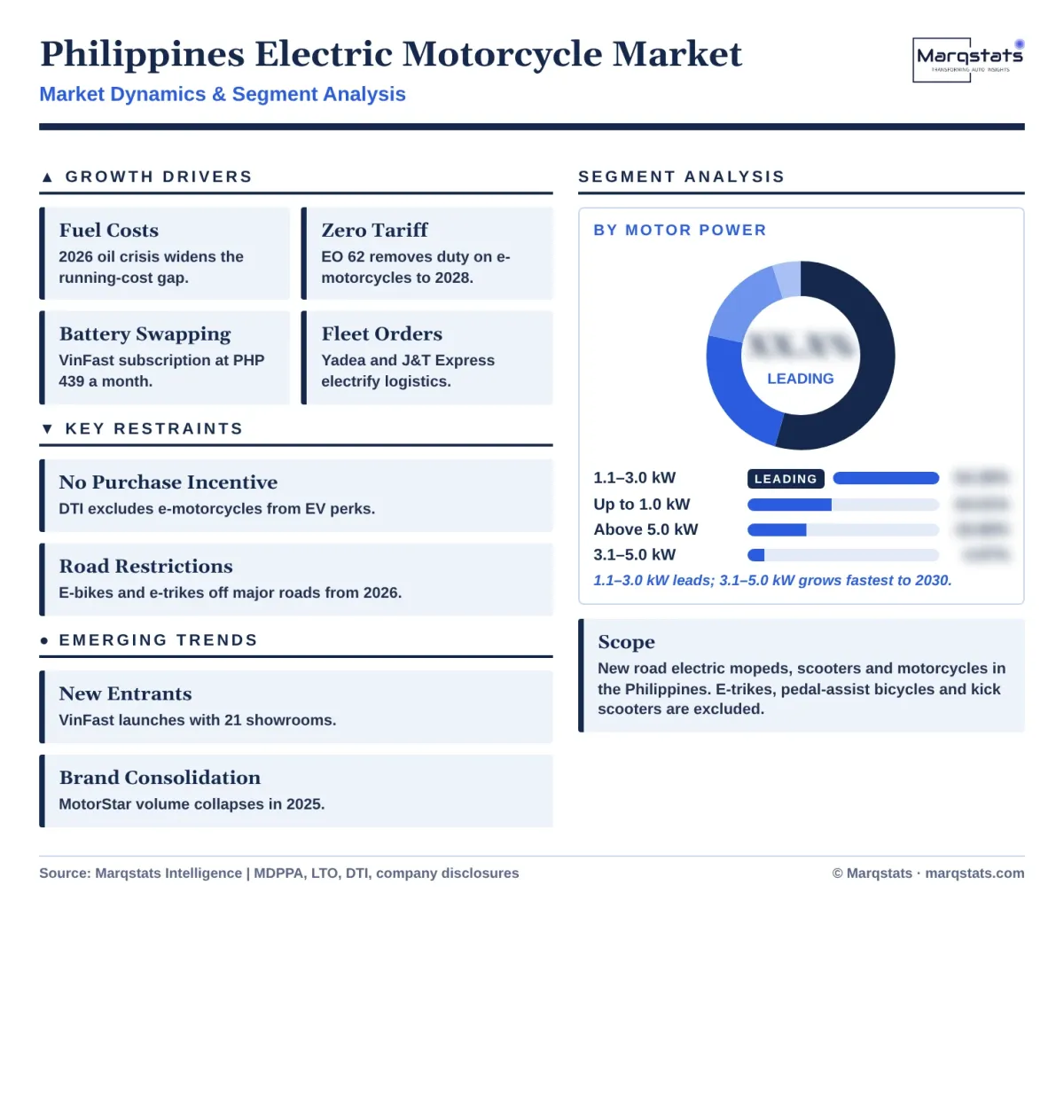
The 1.1–3.0 kW band is the dominant segment and covers urban electric scooters. It accounts for 32,614 units in 2025, 54.36% of the total, and reaches 68,514 units by 2030 at a 16.00% CAGR, taking 56.18% of the market. TAILG, Yadea, NIU and Honda's EM1 e: compete in this band with 110 cc-equivalent performance.
The up-to-1.0 kW band covers low-speed mopeds. It accounts for 14,408 units in 2025, 24.01% of the total, and reaches 28,058 units by 2030 at a 14.26% CAGR, taking 23.01% of the market. Low-cost mopeds face the 2026 road restrictions on light electric vehicles in Metro Manila. The band's share falls from 24.01% to 23.01% by 2030, because buyers who need to ride on national roads move up to registered motorcycles.
The above-5.0 kW band covers higher-power scooters and motorcycles. It accounts for 9,998 units in 2025, 16.66% of the total, and reaches 17,479 units by 2030 at a 11.82% CAGR, taking 14.33% of the market. Gogoro's Delight and Gogoro 2 at 6.4 kW and SuperSport at 7.2 kW, recognised by the Department of Energy, sit in this band. The band grows more slowly than the market at 11.82% a year, because higher prices limit buyers to premium urban riders.
The 3.1–5.0 kW band is the fastest-growing segment. It accounts for 2,980 units in 2025, 4.97% of the total, and reaches 7,906 units by 2030 at a 21.55% CAGR, taking 6.48% of the market. VinFast's Evo, Feliz II and Viper target this commuter tier against 125 cc petrol scooters.
Fixed and plug-in battery models account for most of the market, because low-cost Chinese and local brands sell scooters charged at home. Buyers pay for the battery upfront and avoid subscription fees. Plug-in models dominate outside Metro Manila, where swap stations are scarce and most riders charge at home overnight.
Swappable battery models are the fastest-growing energy model, led by Honda's EM1 e: with the Mobile Power Pack and VinFast's subscription at PHP 439 a month plus PHP 35 per swap. V-GREEN and E88 Ventures build swap networks that support fleet and commuter use.
By Geography
Metro Manila
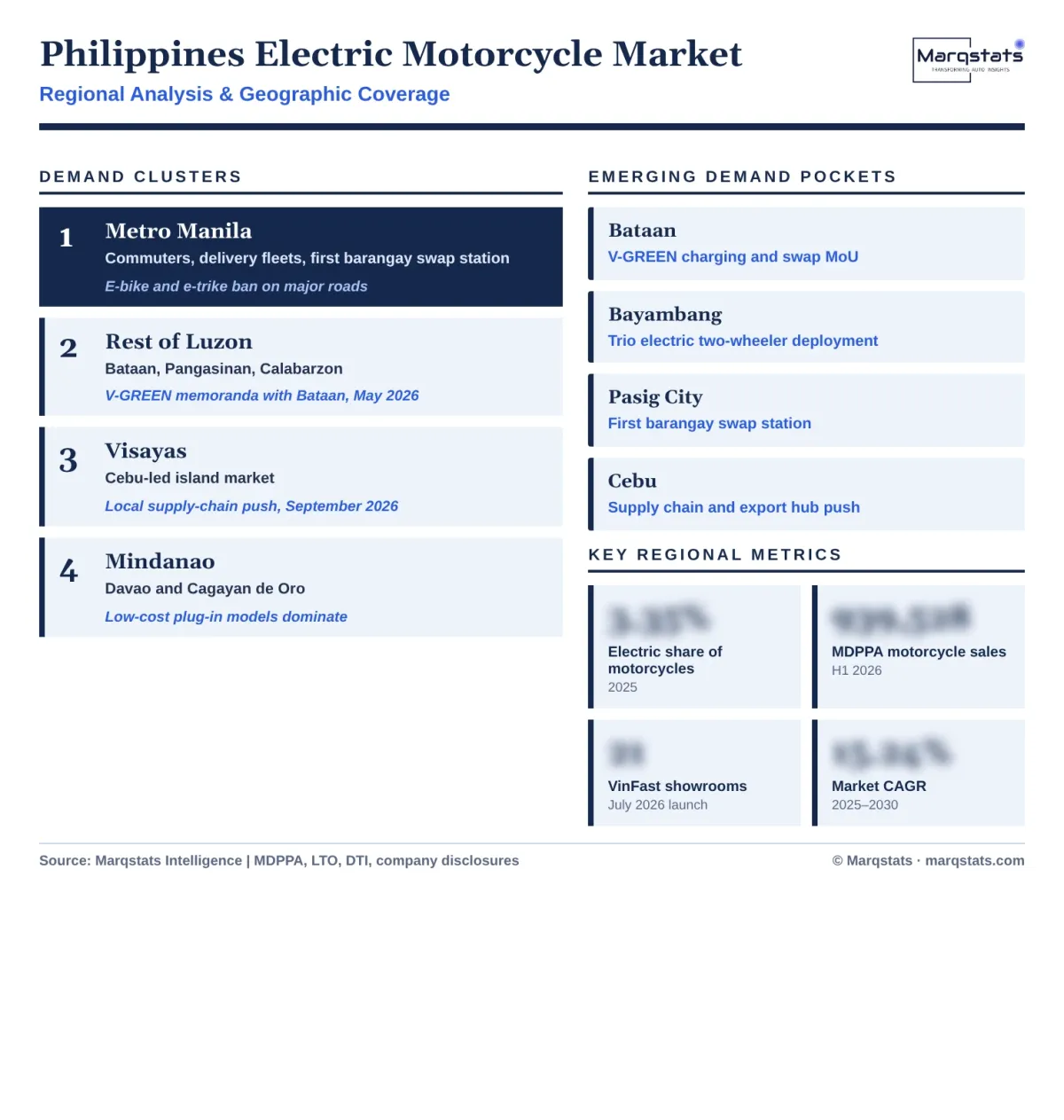
Metro Manila is the largest demand cluster, with dense commuting, delivery demand and the first barangay battery-swap station in Pasig City. The ban on e-bikes and e-trikes on EDSA, C-5 and Roxas Boulevard from January 2026 shifts demand towards registered electric motorcycles. Delivery platforms concentrate fleet demand for electric two-wheelers in the capital.
Rest of Luzon
Central Luzon, Calabarzon and northern Luzon form the second cluster, where commuters ride longer distances between towns. V-GREEN signed memoranda with Bataan province in May 2026 for charging and swap infrastructure, and Trio Industrial Electronics Group agreed an electric two-wheeler deployment with Bayambang City in Pangasinan in October 2025. Provincial governments act as early fleet buyers. Longer trips between towns favour swappable batteries and higher-power scooters over low-speed mopeds.
Visayas
Cebu leads the Visayas cluster and is the focus of efforts to build a local electric two-wheeler supply chain and export hub, launched by stakeholders in September 2026. Island geography limits long trips and favours scooters for short urban commutes. A local supply chain in Cebu would cut shipping costs for dealers across the Visayas and Mindanao and give local assemblers a base for exports.
Mindanao
Davao and Cagayan de Oro lead the Mindanao cluster, where motorcycles are a primary means of transport for families and small businesses. Limited charging infrastructure outside cities slows adoption, and buyers favour low-cost plug-in models. Business motorcycles used for deliveries and tricycle conversions are common in the region, which makes fleet models the most likely entry point for electric brands.
How Competition Is Evolving
The market is moderately fragmented. TAILG, through Tailg Technology Co., Ltd., held 33.37% of tracked 2025 registrations, Honda Motor Co., Ltd. 20.41% and Yadea Group Holdings Ltd. 9.73%, and the top three together held 63.51%. Rejus, Niu Technologies, Terra Motors Corporation and Vmoto Limited held between 1.55% and 6.93% each, and unnamed brands 21.08%.
Competitive strategy splits three ways. Chinese brands TAILG, Yadea and NIU compete on price and model range through distributors and online channels. Honda and, from 2026, VinFast Auto Ltd. compete on swappable batteries, financing and national dealer networks. Local brands such as MotorStar and Rejus lost share in 2025 as buyers moved to brands with stronger service.
Pricing gives a clear view of the competitive tiers. VinFast's Evo, Feliz II and Viper sell at PHP 62,900 to PHP 73,900 with a battery subscription and up to PHP 99,300 with two batteries, which places them in the mid-range of the market. Low-cost Chinese mopeds sell far below that level, while Gogoro's 6.4 kW and 7.2 kW models and Honda's EM1 e: sit in the upper tier with swappable batteries. Each tier sells to a different buyer: price-driven first-time riders, commuters who finance their purchase and premium urban riders.
Partnerships with logistics and infrastructure companies shape the next phase. Yadea partnered with J&T Global Express Limited's Philippine operation in August 2026, VinFast works with Bespoke Logistics and 14 distributors, and V-GREEN builds charging and swap stations. Gogoro Inc. entered with Department of Energy-recognised models in December 2023, and Integrated Micro-Electronics, Inc. agreed to assemble Zero Motorcycles' electric vehicles.
The competitive question to 2030 is whether swap-based brands can take share from low-cost plug-in scooters. Honda's rise to 20.41% of tracked registrations in one year shows that dealer reach and a swappable battery can move buyers quickly. VinFast's subscription prices from PHP 62,900 test the same model at a larger scale.
Companies Covered
Companies covered in the report include:
Recent Market Activity
Table of Contents
Coverage & Segmentation
The Philippines electric motorcycle market comprises new battery electric motorcycles, scooters and mopeds sold for road use in the Philippines, sized in units and in USD at retail selling prices. The market is segmented by motor power into four bands (up to 1.0 kW, 1.1–3.0 kW, 3.1–5.0 kW and above 5.0 kW) and by battery model into fixed and plug-in batteries and swappable and subscription batteries. Regional analysis covers Metro Manila, the rest of Luzon, the Visayas and Mindanao.
The base year is 2025, the historical period is 2021–2025 and the forecast period is 2026–2030. Electric tricycles, pedal-assist bicycles, kick scooters, used vehicles and petrol motorcycles are excluded. No official national series records electric two-wheeler sales, so the market size is a Marqstats construction from industry, import and company data. Brand and model shares come from a tracked registration series covering about 36.33% of 2025 volume, which is reported and not independently verified, and regional analysis is qualitative.