Market Snapshot
Middle bar: base-year value × (1 + CAGR), rounded to two decimals. This is a calculated illustration, not a separately researched annual estimate.
The Colombia electric motorcycle market is estimated at 27,290 units in 2025 and is projected to reach 81,191 units by 2030, registering a volume CAGR of 24.37% over 2026–2030. In value terms the market is estimated at USD 49.83 million in 2025 and is projected to reach USD 160.47 million by 2030, a CAGR of 26.35%. The market comprises new battery electric motorcycles, mopeds and seated scooters sold for road use in Colombia, whether or not they are entered in the national transit register (RUNT). The 1.1–3.0 kW band holds 50.38% of 2025 units, and electric models took about 2.48% of the more than 1.1 million new motorcycles registered in 2025.
Market size and forecast figures are generated using Marqstats' proprietary estimation framework, updated as of October 2026.
Colombia's electric motorcycle market doubled while its registered market shrank. Formal registrations recorded by the automotive association Andemos fell 35.42% to 1,353 in 2025, 4.96% of the 27,290-unit market, after Law 2486 of 2025 exempted light electric vehicles of up to 60 kg or 40 km/h from registration, mandatory SOAT insurance and a driving licence. The market grows 33.57% to 36,451 units in 2026 as Auteco's Starker and TVS brands, Gogoro with Terpel's battery-swap network and low-cost moped importers compete for buyers.
Growth to 2030 comes from both tiers, at different speeds. The exempt tier of mopeds and light scooters keeps most of the volume, while registered scooters and motorcycles grow faster in value, which lifts the average selling price from USD 1,826 to USD 1,976. Auteco, through Starker and TVS, Gogoro with Terpel, and low-cost specialists such as Minca hold the strongest positions entering the forecast period.
Key Takeaways
Market Overview & Analysis
Report Summary
The Colombia electric motorcycle market covers new battery electric motorcycles, electric mopeds and seated electric scooters sold for road use in Colombia, including units exempt from registration under Law 2486 of 2025. The market is estimated at 27,290 units in 2025, up 93.68% on 14,090 units in 2024, and grows 33.57% to 36,451 units in 2026. It reaches 81,191 units by 2030, adding 53,901 units over the forecast period. Pedal-assist bicycles, stand-up kick scooters, shared fleets, used vehicles and petrol motorcycles sit outside the perimeter.
Colombia is one of Latin America's largest motorcycle markets. The motorcycle chamber of the National Business Association (ANDI) and the trade federation Fenalco reported more than 1.1 million new motorcycle registrations in 2025, up 34.94%, and 899,078 in January to August 2026, up 28.94% on 697,272 a year earlier. Bajaj held 16.60%, AKT 15.13% and Suzuki 14.99% of August 2026 registrations, and the 101 cc to 125 cc segment took 46.43%. Electric models take about 2.48% of that market, far below their potential in a country where motorcycles are the main vehicle of lower-income households.
Colombia sits with Brazil and Mexico at the low end of electric adoption among large motorcycle markets. Marqstats estimates electric penetration of about 2.50% in Brazil and 2.20% to 2.35% in Mexico in 2025, against about 2.48% in Colombia, and all three markets share the same pattern of a small registered tier and a large informal tier. Brazil's Fenabrave registered 8,552 electric motorcycles in 2025 against Colombia's 1,353, so the registered share of the market is lower in Colombia. The Colombian market is the third-largest electric two-wheeler market in Latin America after Brazil and Mexico in the Marqstats regional model.
Formal registration data show a market moving out of the register. Andemos recorded 2,681 electric motorcycle registrations in 2021 against 741,819 new motorcycles, 2,688 in 2022 against 822,617, 2,541 in 2023, 2,095 in 2024 and 1,353 in 2025, and 74 in January 2026 against 97,897 new motorcycles. Registered electric mopeds fell 51% between 2022 and 2024, according to ANDI, while imports of electric bicycles rose 700% in 2024. ANDI estimated in February 2026 that about 167,000 light electric vehicles of all types entered Colombia in 2025 and that about 98% were never registered in RUNT.
Petrol model data show where electric products must compete. AKT's AK125NKD EIII was the most registered motorcycle in August 2026 with 7,297 units, followed by Yamaha's NMAX155 and Bajaj's CT100 ES Spoke, and the ten most registered models took 35.03% of the market. Vento grew 383.87% year on year in August 2026, TVS 34.81%, Honda 33.81% and Hero 20.33%, and the top ten registration municipalities took 38.73% of the market. Electric motorcycles compete against these 100 cc to 155 cc petrol models on price, while exempt mopeds compete against public transport and bicycles.
Law 2486 of 2025 explains the split. Enacted in July 2025, the law is Colombia's first comprehensive framework for light electric vehicles, and its Article 15 exempts personal electric vehicles weighing up to 60 kg including the battery, or unable to exceed 40 km/h, from registration, SOAT insurance and driving licence requirements. Its framework took effect in April 2026 with minimum ages, helmet rules and fines above COP 10 million, and pending legislation in June 2026 set out to clarify the use of Bogotá's cycle paths by electric motorbikes. Buyers therefore choose between registered electric motorcycles with full obligations and exempt mopeds and scooters with none.
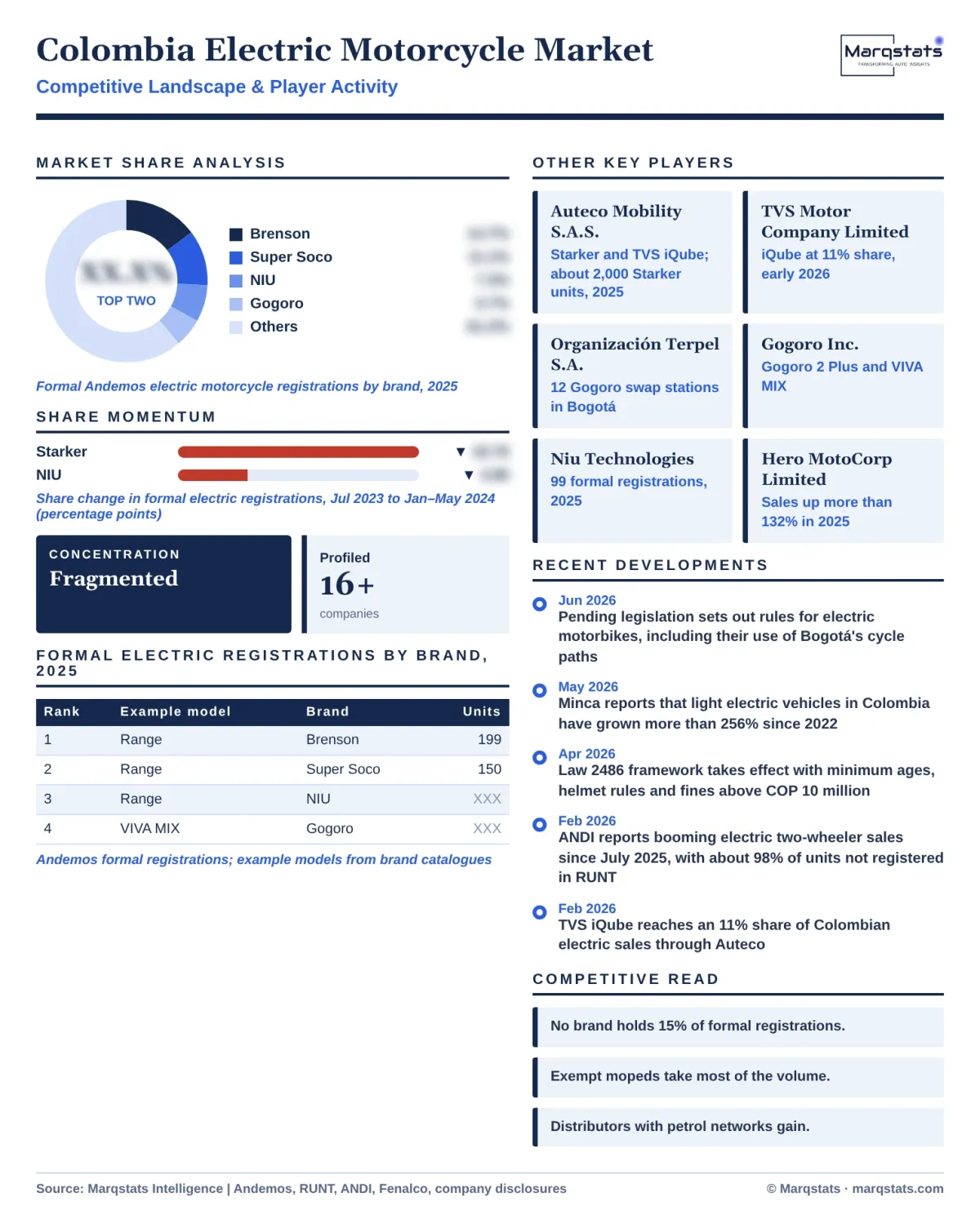
Brand data are available only for the registered tier. Among formal 2025 registrations, Brenson led with 199 units, Super Soco followed with 150, NIU with 99 and Gogoro with 77, together 38.81% of the total. Auteco's Starker brand led historically, with 2,053 registrations in 2019, 1,726 in 2020 and 1,841 in 2022, and held 38.24% of formal sales in January to May 2024, when NIU held 14.20% and Biobicis 7.46%. Starker, Biwee, Aima, TAILG and Wolf led registered electric moped sales in the first half of 2025, when 557 electric mopeds entered RUNT.
The unregistered tier is led by moped and scooter specialists. Minca projected about 3,000 electric moped sales in 2025, up 97%, and almost 16,000 vehicles across scooters, skateboards and electric mopeds, and said in May 2026 that light electric vehicles in Colombia had grown more than 256% since 2022. Auteco Mobility stated sales of about 2,000 Starker units in 2025 across registered and unregistered products, and TVS Motor Company Limited said its iQube, sold through Auteco, reached an 11% share in early 2026. Mopeds and scooters gained ground on electric motorcycles because of lower prices and access to cycle lanes.
The average selling price in the market is approximately USD 1,826 in 2025, rising to USD 1,976 by 2030 as registered motorcycles and swap-based scooters gain share. Organización Terpel S.A. launched Gogoro's Gogoro 2 Plus and VIVA MIX in Bogotá through Terpel Voltex in May 2024 with four GoStations and reported 12 battery-swap stations in the capital by the end of 2024, with Medellín planned for 2025. Swap networks give registered scooters a running-cost and convenience advantage that exempt mopeds charged at home cannot match.
The forecast assumes that exempt mopeds keep most of the volume and that registered models gain share slowly. Volume grows 33.57% in 2026 and at 24.37% a year to 2030, and the above-5.0 kW band rises from 9.09% to 14.54% of units as swap networks and Indian brands expand. Value grows faster, at 26.35% a year, because registered motorcycles carry higher prices than exempt mopeds. Stricter enforcement of the Law 2486 thresholds would move volume from the exempt tier to registered products and raise the average selling price.
Market Dynamics
Key Drivers
Five conditions drive the Colombia electric motorcycle market, and the size of the motorcycle market matters most.
- A fast-growing motorcycle market. New motorcycle registrations rose 34.94% to more than 1.1 million in 2025 and 28.94% in January to August 2026, and motorcycles are the main vehicle of lower-income households. Even a small electric share of that base adds tens of thousands of units a year, and the electric market grows 33.57% in 2026.
- Exemptions for light electric vehicles. Law 2486 exempts electric vehicles of up to 60 kg or 40 km/h from registration, SOAT and licences, and since July 2025 electric mopeds can use cycle lanes. Lower ownership costs bring new riders into electric mopeds and scooters.
- Battery-swap infrastructure. Terpel Voltex opened four GoStations at Gogoro's Bogotá launch in May 2024 and 12 by the end of 2024, with Medellín planned next. Swapping removes charging time for commuters and delivery riders. Gogoro's Gogoro 2 Plus and VIVA MIX launched on the Terpel network in Bogotá, and each new station widens the area where riders can rely on swapping instead of home charging.
- Incumbent distributors adopt electric brands. Auteco sells Starker, TVS and Bajaj motorcycles, and TVS's iQube reached an 11% share of electric sales in early 2026 through Auteco's network. Established distributors bring credit, service and national dealer coverage to electric models. Auteco's Colombian TVS website lists the iQube S electric scooter.
- Running-cost savings. Electric mopeds and scooters avoid petrol costs and, below the Law 2486 thresholds, SOAT premiums and technical inspections. Savings matter most for delivery riders and daily commuters in Bogotá, Medellín and Cali.
Key Restraints
Four constraints shape the market, and the registration gap is the largest.
- Registration gap and weak data. Only 4.96% of the market entered formal registration in 2025, and ANDI estimated that about 98% of light electric vehicles imported since July 2025 never entered RUNT. Unregistered sales leave brands, regulators and financiers without reliable demand data.
- Safety concerns and tighter rules. Law 2486's framework added minimum ages, helmet rules and fines above COP 10 million from April 2026, and public backlash over mopeds on cycle routes discouraged some buyers, according to Minca. Pending rules on Bogotá's cycle paths add uncertainty for sellers of faster mopeds.
- Price competition from petrol motorcycles. The 101 cc to 125 cc segment took 46.43% of registrations in August 2026, and AKT's AK125NKD EIII alone registered 7,297 units that month. Low-cost petrol motorcycles with wide credit and service networks set a price benchmark that electric motorcycles struggle to meet.
- Decline of the registered electric tier. Formal electric registrations fell from 2,688 in 2022 to 1,353 in 2025, down 35.42% in 2025 alone. Registered electric motorcycles carry SOAT, licence and inspection costs that exempt products avoid.
- Theft, safety and consumer protection. Unregistered vehicles have no plates or insurance, which complicates theft recovery, accident claims and warranty enforcement for buyers. Minca reported that public backlash over mopeds on cycle routes, including illegal signs placed on bike paths, discouraged some buyers in 2025.
Key Trends
Four shifts show where the market is moving and which companies gain.
- Mopeds and scooters replace electric motorcycles. La República reported in December 2025 that mopeds and scooters were replacing electric motorcycles in sales, and Minca's moped sales alone were set to roughly double the formal electric motorcycle market. Product design now targets the 60 kg and 40 km/h thresholds of Law 2486.
- Indian brands enter through Auteco. TVS's iQube reached an 11% share of electric sales in early 2026, and Hero grew its overall Colombian motorcycle sales more than 132% in 2025. Indian makers use the petrol networks of local distributors to add electric models. Bajaj, the top brand in August 2026 motorcycle registrations, also sells through Auteco, which gives the distributor the widest electric and petrol range in the country.
- Battery swapping with energy companies. Terpel, Colombia's largest fuel retailer, operates Gogoro's swap network in Bogotá, which ties electric scooters to an established fuel-station footprint. Energy companies become distribution partners for electric two-wheelers.
- Formalisation of light electric mobility. Law 2486 of 2025, its April 2026 framework and pending rules for Bogotá's cycle paths move light electric vehicles from an unregulated grey zone into a defined legal category. Clear rules favour brands with homologated products and dealer service. Fines above COP 10 million and the most serious sanctions above 30 daily minimum wages give the framework real enforcement weight from 2026.
Market Segmentation
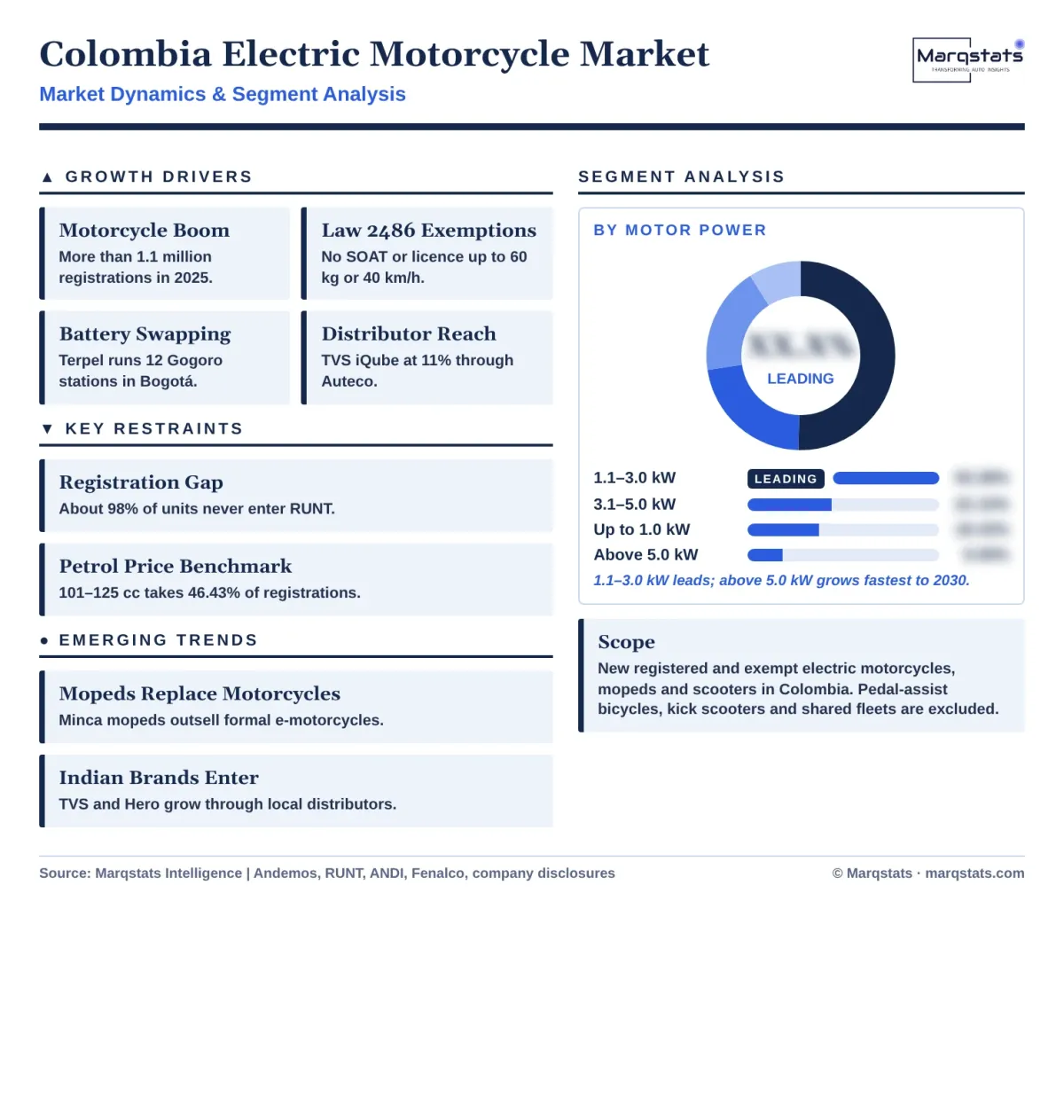
The 1.1–3.0 kW band is the dominant segment and covers electric mopeds and commuter scooters. It accounts for 13,750 units in 2025, 50.38% of the total, and reaches 35,880 units by 2030 at a 21.15% CAGR, taking 44.19% of the market. Most products in this band sit below the Law 2486 speed threshold and are sold without registration.
The 3.1–5.0 kW band covers registered commuter scooters. It accounts for 6,030 units in 2025, 22.10% of the total, and reaches 21,149 units by 2030 at a 28.53% CAGR, taking 26.05% of the market. TVS's iQube, Gogoro's VIVA MIX and NIU scooters compete here with 110 cc to 125 cc petrol models.
The up-to-1.0 kW band covers light mopeds and seated scooters for short trips. It accounts for 5,030 units in 2025, 18.43% of the total, and reaches 12,354 units by 2030 at a 19.69% CAGR, taking 15.22% of the market. Low prices and cycle-lane access support demand, and the band grows more slowly as buyers move up.
The above-5.0 kW band is the fastest-growing segment. It accounts for 2,480 units in 2025, 9.09% of the total, and reaches 11,808 units by 2030 at a 36.63% CAGR, taking 14.54% of the market. Super Soco, Gogoro and premium imports sit in this band and must be registered.
Registered electric motorcycles accounted for 1,353 formal Andemos registrations in 2025, 4.96% of the market, led by Brenson, Super Soco, NIU and Gogoro. They carry plates, SOAT insurance and licence requirements, and appeal to buyers who need speed and access to all roads. Formal registrations fell from 2,681 in 2021 to 1,353 in 2025, so this tier shrinks in share even as the market grows.
Exempt mopeds and scooters below 60 kg or 40 km/h make up most of the market under Law 2486, sold by Minca, Starker and low-cost importers. They avoid registration costs and use cycle lanes, which makes them the cheapest motorised option for urban commuters. Minca projected about 3,000 electric moped sales in 2025, more than double the registered electric motorcycle tier, and almost 16,000 light electric vehicles of all types.
By Geography
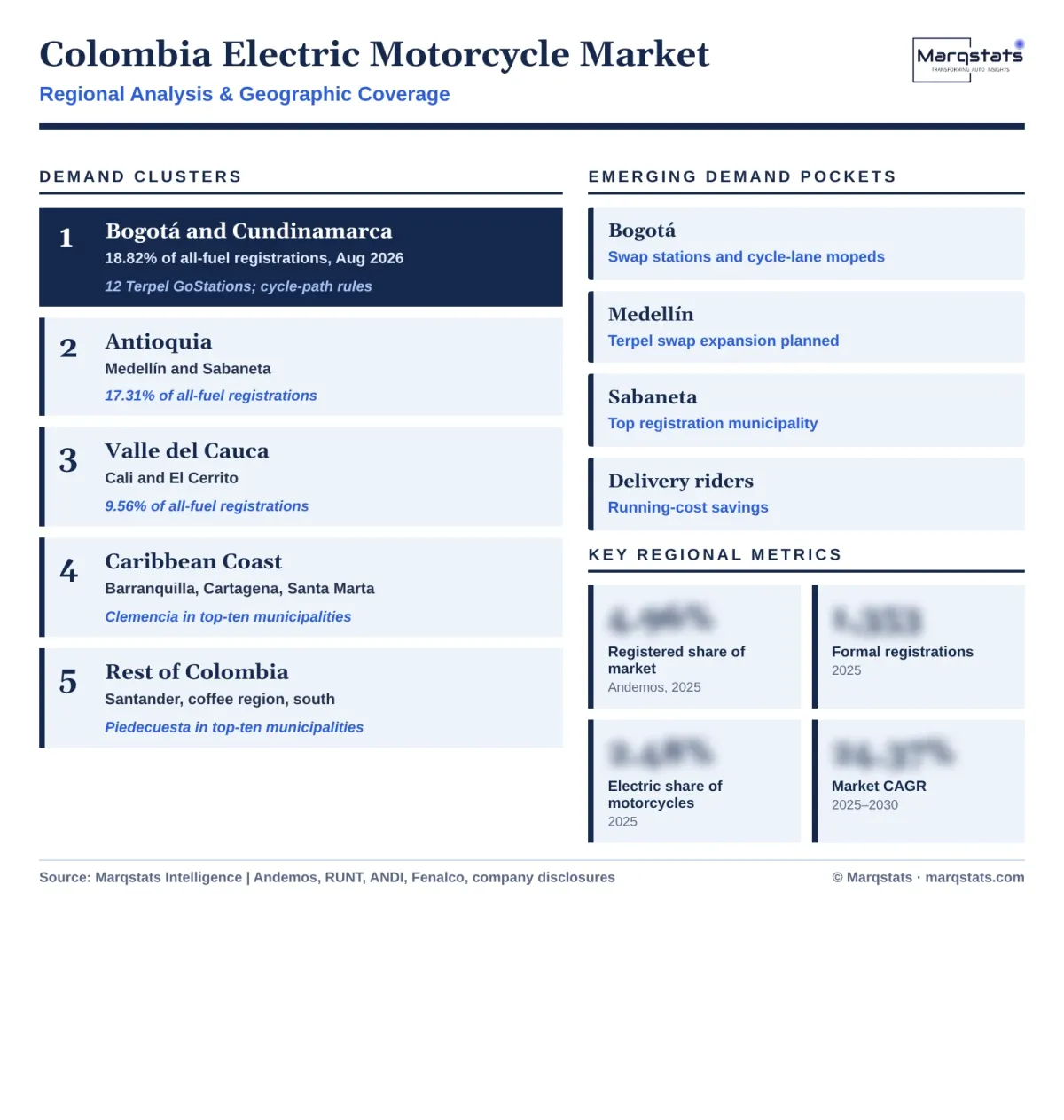
Bogotá and Cundinamarca
Bogotá and Cundinamarca form the largest demand cluster, and Cundinamarca took 18.82% of all new motorcycle registrations in August 2026. Terpel's 12 Gogoro swap stations, the city's cycle-lane network and pending rules on cycle-path use make the capital the test market for electric mopeds and scooters.
Antioquia
Antioquia, led by Medellín and the registration hub of Sabaneta, took 17.31% of new motorcycle registrations in August 2026, and Sabaneta alone registered 9,173 motorcycles that month. Terpel planned to extend battery swapping to Medellín in 2025.
Valle del Cauca
Valle del Cauca, led by Cali, took 9.56% of new motorcycle registrations in August 2026, and El Cerrito registered 5,006 units. Commuters and delivery riders in Cali form the core electric moped demand in the southwest.
Caribbean Coast
Barranquilla, Cartagena and Santa Marta form a large motorcycle market where motorcycle taxis and delivery riders dominate demand. Low-cost exempt mopeds suit short urban trips. Clemencia in Bolívar ranked among the top ten registration municipalities in August 2026, which shows the weight of the Caribbean region in national volume.
Rest of Colombia
Santander, the coffee region and the southern departments complete the market, and Piedecuesta in Santander ranked among the top ten registration municipalities in August 2026. Hilly terrain in parts of the country favours higher-power motorcycles. Smaller cities depend on the dealer networks of Auteco, AKT and Suzuki, which carry few electric models today.
How Competition Is Evolving
The market is fragmented. In the registered tier, Brenson held 14.71% of 2025 Andemos registrations, Super Soco, sold by Vmoto Limited, 11.09%, Niu Technologies 7.32% and Gogoro Inc. 5.69%, and no brand held more than 15%. In the unregistered tier, Minca, Auteco's Starker and hundreds of importers compete without published shares.
Distributors with petrol networks hold the strongest position. Auteco Mobility S.A.S. sells Starker electric products alongside TVS and Bajaj motorcycles, and TVS Motor Company Limited's iQube reached an 11% share of electric sales in early 2026. Bajaj Auto Limited, AKT, owned by Colombiana de Comercio S.A., and Suzuki Motor de Colombia S.A. held the top three places in all motorcycle registrations in August 2026, so their electric strategies decide how fast the market grows.
Brand leadership has shifted within the registered tier. Auteco's Starker held 55% of electric motorcycles and mopeds in July 2023, with NIU, distributed by AKT, at 19%, according to the ANDI motorcycle chamber, and Starker's share fell to 38.24% in January to May 2024. By 2025, Brenson, Super Soco, NIU and Gogoro each held less than 15% of formal registrations, as Starker moved volume into exempt products. The registered tier is now the most fragmented part of the market.
Infrastructure partnerships differentiate the registered tier. Organización Terpel S.A. runs Gogoro's swap network in Bogotá, and Gogoro expanded its battery-swapping scooter business in Latin America, including Colombia, in January 2025. Brands without swap or service networks compete on price in the exempt tier.
The competitive question to 2030 is whether registered brands can win back buyers from exempt mopeds. Rules on cycle-path use, enforcement of Law 2486 thresholds and the entry of Indian and Chinese brands through local distributors will decide the balance. Hero MotoCorp Limited, which grew Colombian sales more than 132% in 2025, and Yamaha's local partner Incolmotos Yamaha S.A. are the largest petrol makers yet to scale electric models. Chinese moped makers including TAILG and AIMA, which ranked among the top registered electric moped brands in the first half of 2025, also sell through local importers and compete with Starker in both tiers.
Companies Covered
Companies covered in the report include:
Recent Market Activity
Table of Contents
Coverage & Segmentation
The Colombia electric motorcycle market comprises new battery electric motorcycles, electric mopeds and seated electric scooters sold for road use in Colombia, registered or exempt, sized in units and in USD at retail selling prices. The market is segmented by motor power into four bands (up to 1.0 kW, 1.1–3.0 kW, 3.1–5.0 kW and above 5.0 kW) and by registration status into registered electric motorcycles and exempt mopeds and scooters. Regional analysis covers Bogotá and Cundinamarca, Antioquia, Valle del Cauca, the Caribbean coast and the rest of Colombia.
The base year is 2025, the historical period is 2021–2025 and the forecast period is 2026–2030. Pedal-assist bicycles, kick scooters, shared fleets, used vehicles and petrol motorcycles are excluded. Formal Andemos registrations cover only 4.96% of the market, so the market size is a Marqstats construction from registration, import and company data, and ANDI's 167,000-unit import estimate includes vehicles outside the perimeter. Brand shares are available only for the registered tier, company-stated sales are as reported and not independently verified, and regional analysis is qualitative, using all-fuel motorcycle registrations by department as context.