Market Snapshot
Middle bar: base-year value × (1 + CAGR), rounded to two decimals. This is a calculated illustration, not a separately researched annual estimate.
The Brazil electric motorcycle market is estimated at 55,000 units in 2025 and is projected to reach 185,259 units by 2030, registering a volume CAGR of 27.49% over 2026–2030. In value terms the market is estimated at USD 189.75 million in 2025 and is projected to reach USD 704.26 million by 2030, a CAGR of 29.99%. The market comprises new battery electric motorcycles, scooters and mopeds for road use, including electric mopeds (ciclomotores) that entered the registration system under National Traffic Council (CONTRAN) Resolution 996. Delivery riders and urban commuters in São Paulo and Rio de Janeiro account for most demand, and the market is equivalent to 2.50% of Brazil's 2,197,308 registered motorcycles in 2025.
Market size and forecast figures are generated using Marqstats' proprietary estimation framework, updated as of October 2026.
The 1.1–3.0 kW band is the dominant power segment at 47.00% of units, and the above-5.0 kW band is the fastest-growing at 31.64% a year. Vmoto Limited leads registered sales, with 29.88% of 2025 Fenabrave registrations and 58% in January to September 2026. The average selling price rises from USD 3,450 in 2025 to USD 3,801 by 2030 as delivery fleets move to 3 kW-plus motorcycles. Fleet operators, led by Vammo with about 5,000 electric motorcycles in São Paulo, add a second channel alongside importer dealers.
Key Takeaways
Market Overview & Analysis
Report Summary
The Brazil electric motorcycle market covers new battery electric two-wheelers for road use, from sub-1.0 kW electric mopeds to motorcycles above 5.0 kW, sold through dealers, importers, fleet operators and online retailers. The market is estimated at 55,000 units in 2025, up 83.33% on 30,000 units in 2024, and has grown from 4,000 units in 2021. It reaches 69,592 units in 2026 and 185,259 units by 2030, adding 130,259 units over the forecast period. Pedal-assist electric bicycles, self-propelled personal devices, hybrid motorcycles and internal combustion motorcycles sit outside the perimeter.
Registration, not demand, has defined the visible market until 2026. The Brazilian vehicle dealers' federation (Fenabrave) registered 8,552 electric motorcycles in 2025, up 9.35% on 7,821, which equals 15.55% of the 55,000-unit market and 0.39% of 2,197,308 registered motorcycles. The balance consisted of electric mopeds and scooters sold without registration, which CONTRAN Resolution 996 of June 2023 classified as ciclomotores and required to be registered, plated and ridden with a CNH category A licence or an ACC permit from 1 January 2026. Registrations rose 90.6% to 12,813 in January to September 2026, already 18.41% of the full-year 2026 market estimate, so the registry is converging on the market rather than the market growing into the registry.
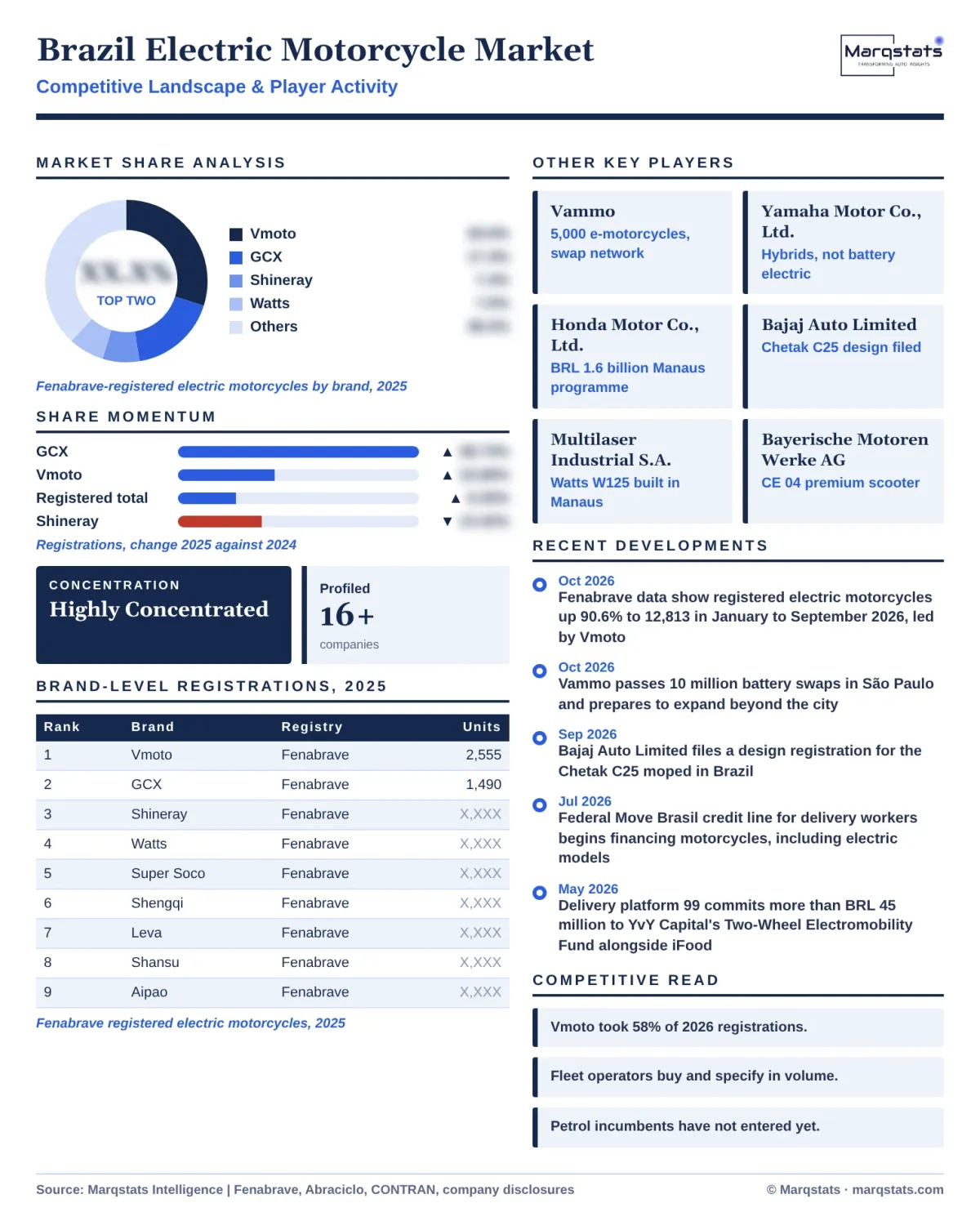
Brand-level registration data show a market led by importers of Chinese platforms. Vmoto Limited registered 2,555 units in 2025, 29.88% of the total and up 15.66% on 2,209 units, followed by GCX with 1,490 units and 17.42%, up 38.73% on 1,074. Shineray do Brasil S.A. registered 632 units (7.39%), down from 730, Watts 601 (7.03%), Super Soco 394 (4.61%), Shengqi 258 (3.02%) and Leva 240 (2.81%). Chinese manufacturers Tailing, Aima and Luyuan registered 157, 93 and 74 units, a combined 3.80%, and brands outside the top 15 took 1,135 units.
Concentration rose sharply in 2026. Vmoto took 58% of registered electric motorcycles in January to September 2026 and 76% of September registrations alone, with 916 units in that month, while GCX registered 1,239 units and Shineray 535 over the nine months. Registrations reached 1,209 units in September 2026, against 463 in September 2025. Honda Motor Co., Ltd., which held 67% of Brazil's total motorcycle market in September 2026, did not appear among the top 15 electric brands.
Registration growth accelerated through 2025 and into 2026. Registered electric motorcycles reached 7,133 units in January to October 2025, up 20.53% on 5,918 a year earlier, with Vmoto at 33.72%, GCX at 15.48%, Watts at 7.21%, Shineray at 7.07% and Super Soco at 5.52% of that period. Monthly registrations rose from 463 in September 2025 to 1,209 in September 2026, when Brazil sold about 205,000 motorcycles of all types and electrified models took 1.7% of the month. The step change from January 2026 matches the start of mandatory ciclomotor registration, which shows that much of the 2026 growth in registered units reflects formalisation of existing demand.
Leadership has changed three times in five years. Voltz registered 967 of 1,615 electric motorcycles in 2021 and 4,546 of 7,280 in 2022, a 62.4% share, supported by an iFood delivery-rider programme that offered purchase terms of BRL 9,999.90 with battery subscriptions. Voltz volume fell to 1,734 units in 2023, and iFood's sustainability report stated that the 2022 electric motorcycle project did not work as planned, citing battery-swap infrastructure needs. Shineray, GCX and fleet operator Mottu, with 620 registrations in 2023, filled the gap before Vmoto took the lead in 2024.
Model-level evidence shows a low-power product mix. Shineray's SE1 uses a 2.0 kW motor with a removable 60 V battery, a 60 km range and a 59 km/h top speed, the SE2 a 2.4 kW peak motor, and the SHE-S a 3.0 kW motor with a 72 V LFP battery and 80 km range. Voltz's EVS registered 436 units in December 2022 and 259 in January 2023 before the brand's decline. Products of this class sit in the 1.1–3.0 kW and 3.1–5.0 kW bands, which together hold 76.51% of 2025 volume.
Fleet operators are becoming manufacturers. Vammo operated about 5,000 electric motorcycles in São Paulo in March 2026, planned to triple its fleet by the end of 2026 with 15,000 units produced in the Manaus Free Trade Zone, and expected to run about 500 battery-swap stations by year-end, backed by BRL 300 million from Grupo DBS over two years. Mottu, whose rental fleet made it one of Brazil's largest registrants of petrol motorcycles, is testing electric units in its delivery-rider fleet. Fleet production of this scale would equal more than a fifth of the 69,592-unit 2026 market.
Prices span a tenfold range. The Watts W125, assembled in Manaus by Watts Mobility, part of Grupo Multi (Multilaser Industrial S.A.), carries a suggested retail price of BRL 19,990, while BMW's CE 04 electric scooter lists at BRL 99,900. The market's average selling price of approximately USD 3,450 in 2025 sits between the two, and rises to USD 3,801 by 2030 as the 3.1–5.0 kW and above-5.0 kW bands gain share. Value grows from USD 189.75 million to USD 704.26 million, a 29.99% CAGR, faster than the 27.49% unit CAGR.
Hybrid motorcycles are an unexpected competitor. Yamaha Motor Co., Ltd. registered 11,787 hybrid motorcycles in January to September 2026, all its own, with monthly volume rising from 12 units in January to 2,279 in September, when hybrids made up 7.9% of Yamaha's Brazilian sales. Electrified motorcycles reached 24,600 units, about 1.4% of motorcycles sold, against 6,724 in the same period of 2025. Hybrids sit outside the perimeter, although they compete for the same buyers who want lower fuel costs without range or charging constraints.
Market Dynamics
Key Drivers
Five conditions drive the Brazil electric motorcycle market, and delivery-fleet finance matters more than consumer incentives.
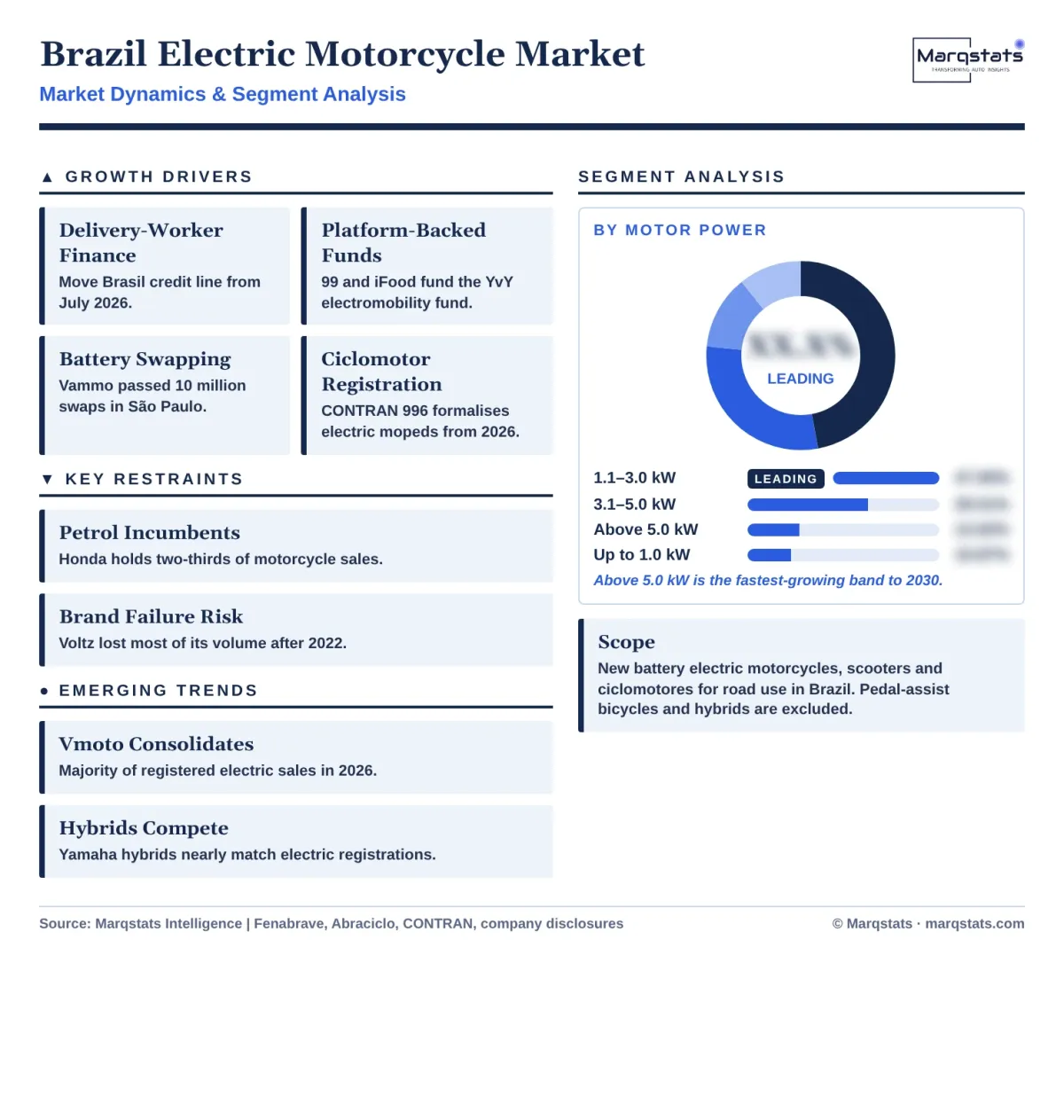
- Delivery-worker finance. The federal Move Brasil credit line for delivery workers and professional motorcyclists began operating in July 2026, with banks accepting applications from 13 July, and finances electric as well as petrol motorcycles. The Ministry of Entrepreneurship's Empreender Clima initiative offered credit for electric two-wheelers to delivery workers in Presidente Prudente in December 2025.
- Delivery platforms fund fleet electrification. Delivery platform 99 committed more than BRL 45 million in May 2026 to YvY Capital's Two-Wheel Electromobility Fund alongside iFood, and increased its Brazilian investment in September 2025. Platform-backed finance supports the 28.55% growth of the 3.1–5.0 kW band used for app deliveries.
- Battery swapping removes the battery cost. Vammo raised USD 45 million in a Series B round in November 2025 and passed 10 million battery swaps in São Paulo in October 2026. Swap subscriptions let riders pay per kilometre rather than for a battery that accounts for a large share of the purchase price.
- Registration under CONTRAN 996. Mandatory registration, plates and licences for ciclomotores from 1 January 2026 move electric mopeds into the formal market, where finance, insurance and dealer service are available. Registered electric motorcycles rose 90.6% in January to September 2026.
- Record motorcycle production and demand. Manaus factories produced 561,448 motorcycles in the first quarter of 2026, up 12.1%, and the motorcycle industry association (Abraciclo) forecast 2.07 million units for 2026. A growing motorcycle market enlarges the pool of buyers, especially delivery riders, who can switch to electric. Honda's capacity rises from 1.4 million to 1.6 million motorcycles a year under its 2026 to 2029 Manaus investment.
Key Restraints
Four constraints limit adoption, and the strongest is the price and service advantage of petrol motorcycles.
- Petrol incumbents dominate the motorcycle market. Honda held 67% of Brazil's motorcycle market in September 2026 and does not sell an electric model in the top 15, and Yamaha chose hybrids over battery electric for its first electrified volume product. Electric units equal 2.50% of registered motorcycles, so incumbent dealer networks and resale values remain the reference point for buyers.
- Brand failure risk. Voltz fell from 4,546 registrations in 2022 to 1,734 in 2023, and iFood reported that its electric motorcycle project did not work as planned. Owners of failed brands lose parts and service, which raises perceived risk for every new entrant. The 2022 Voltz programme with iFood offered purchase terms of BRL 9,999.90 with battery subscriptions, a model that Vammo has since revived with a dedicated swap network.
- Registration costs for moped buyers. Plates, licences and possible state vehicle tax (IPVA) on registered ciclomotores raise the cost of owning low-power electric mopeds from 2026. The up-to-1.0 kW band grows at 25.22% a year, the slowest of the four power bands.
- Charging and swap infrastructure outside São Paulo. Vammo's 10 million swaps are concentrated in São Paulo, and the operator is only now preparing to expand beyond the city. Delivery riders in other state capitals rely on home charging, which limits daily range for high-mileage use.
Key Trends
Four shifts show where the market is moving and which companies benefit.
- Vmoto consolidates the registered market. Vmoto's share of registrations rose from 28.25% in 2024 and 29.88% in 2025 to 58% in January to September 2026. The Australian-listed company sells motorcycles built at its Chinese plant through Brazilian distributors and fleet contracts.
- Indian manufacturers prepare entry. Bajaj Auto Limited filed a design registration for the Chetak C25 moped in Brazil in September 2026 ahead of a mass-market electric scooter launch. Bajaj already sells petrol motorcycles in Brazil, so the Chetak would reach buyers through an existing network. TVS Motor Company Limited's iQube reached an 11% share of Colombia's formal electric market in early 2026 through a local distributor, a model that Indian brands can repeat in Brazil.
- Local brands with Brazilian design. Leva Motors opened its first São Paulo dealership in October 2025 and registered 240 units in 2025, and Lev Group's Onn brand opened its first Rio de Janeiro store in June 2025 with a Brazilian-designed urban scooter. Local design targets the CONTRAN categories and BRL price points directly.
- Electrification of Manaus output. Electric bicycles made up 22.8% of bicycle production at the Manaus Industrial Pole in January to September 2026, up from 12.3% in 2025, with output up 85.7% to 61,885 units. The same industrial base produces Brazil's motorcycles, and electric two-wheeler assembly is following bicycles into the free trade zone.
- Premium scooters arrive from European brands. BMW's CE 04 electric scooter lists at BRL 99,900 in Brazil, and premium importers use the above-5.0 kW band to reach high-income urban commuters. The above-5.0 kW band rises from 6,940 units in 2025 to 27,435 by 2030.
Market Segmentation
The 1.1–3.0 kW band is the dominant segment and the urban commuter base of the market. It accounts for 25,850 units in 2025, 47.00% of the total, and reaches 82,440 units by 2030 at a 26.11% CAGR, taking 44.50% of the market. Shineray's SE1 and SE2 and most imported electric mopeds sit in this band, which carries the ciclomotor registration requirement from 2026.
The 3.1–5.0 kW band is the delivery segment and the largest source of incremental volume. It accounts for 16,230 units in 2025, 29.51% of the total, and reaches 56,976 units by 2030 at a 28.55% CAGR, taking 30.75% of the market. Vmoto, GCX and battery-swap fleets operated by Vammo serve app delivery riders who need motorcycle-class speed and payload. Locally assembled models such as the Watts W125, priced at BRL 19,990, compete for the same delivery riders.
The up-to-1.0 kW band is the entry tier and the declining share. It accounts for 5,980 units in 2025, 10.87% of the total, and reaches 18,408 units by 2030 at a 25.22% CAGR, taking 9.94% of the market. Low-speed mopeds sold online and through informal retailers face new plate and licence costs under CONTRAN 996.
The above-5.0 kW band is the fastest-growing segment. It accounts for 6,940 units in 2025, 12.62% of the total, and reaches 27,435 units by 2030 at a 31.64% CAGR, taking 14.81% of the market. Highway-capable motorcycles from Super Soco, Watts and premium importers compete with 150 to 160 cc petrol motorcycles for commuting and delivery. BMW's CE 04 at BRL 99,900 sets the top of the price range in this band.
By Geography
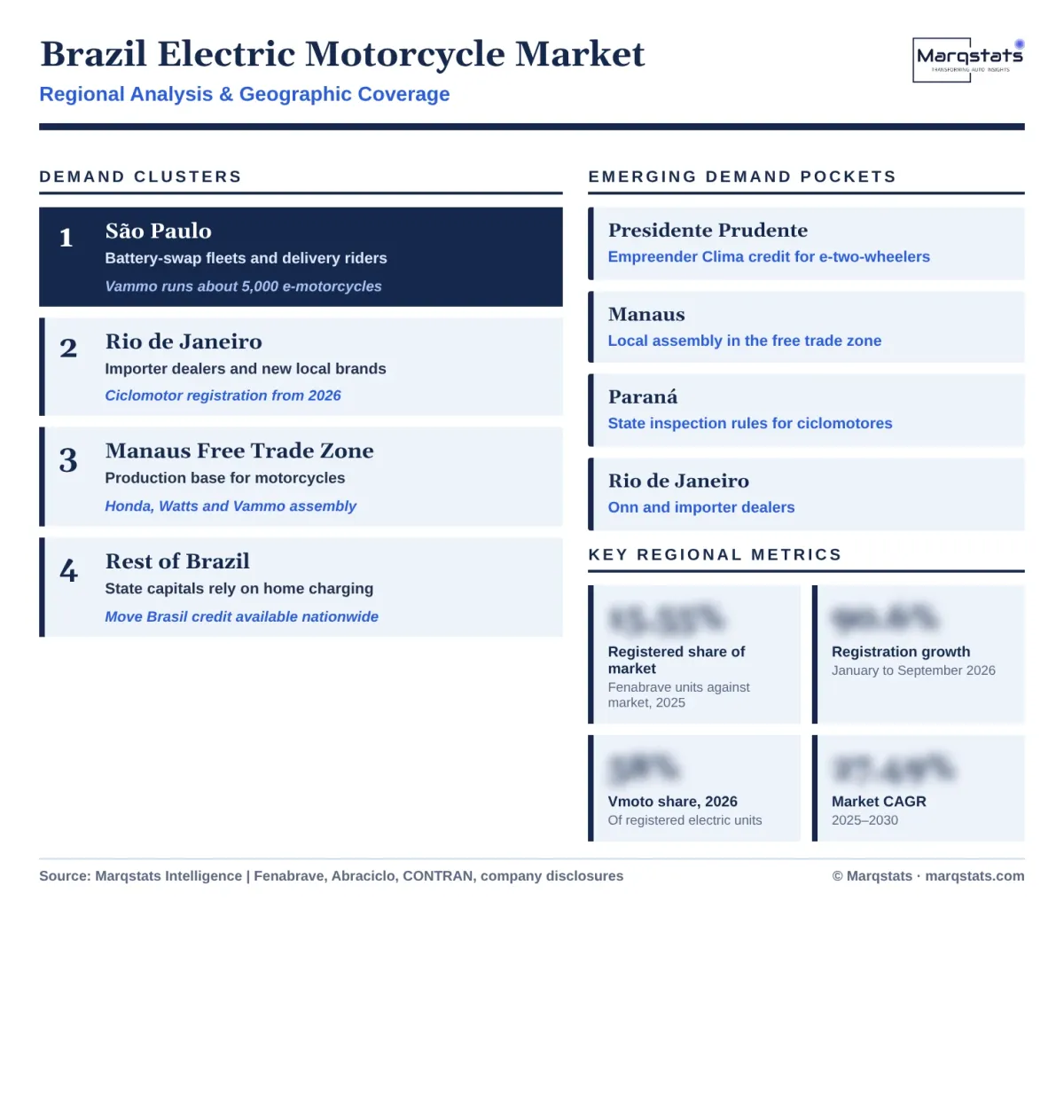
São Paulo
São Paulo is the largest and most developed electric motorcycle market in Brazil, with the country's only large-scale battery-swap network and the highest concentration of app delivery riders. Vammo passed 10 million swaps in the city in October 2026, Leva Motors opened its first dealership there in October 2025, and Presidente Prudente in the state interior received Empreender Clima credit for electric two-wheelers in December 2025. Swap subscriptions make the São Paulo metropolitan region the main market for 3.1–5.0 kW delivery motorcycles. Vammo's fleet of about 5,000 electric motorcycles and its planned 500 swap stations operate only in the city and its metropolitan region, which makes São Paulo the reference market for fleet economics.
Rio de Janeiro
Rio de Janeiro is the second urban cluster, served by importer dealers and new local brands. Lev Group's Onn brand opened its first store in Rio de Janeiro in June 2025, and 99 and iFood delivery riders form the core buyer base. Mandatory ciclomotor registration from January 2026 brings previously unregistered electric mopeds in Rio de Janeiro into the formal market. Importer dealers in Rio de Janeiro sell Vmoto, GCX and Super Soco models, and the city's delivery riders can apply for the Move Brasil credit line launched in July 2026, which finances motorcycles for professional riders across the country.
Manaus Free Trade Zone
The Manaus Industrial Pole is the production base for Brazil's motorcycle industry and the most likely location for local electric motorcycle assembly. Manaus factories produced 561,448 motorcycles in the first quarter of 2026 and 61,885 electric bicycles in January to September 2026, up 85.7%. Tax incentives in the free trade zone favour assembly over imports of finished vehicles. Honda's BRL 1.6 billion programme for 2026 to 2029 and Watts Mobility's W125 line both sit in Manaus, and Vammo plans to produce 15,000 electric units in the free trade zone in 2026.
Rest of Brazil
Southern, northeastern and centre-west state capitals account for the balance of demand, where delivery riders rely on home charging. Federal Move Brasil credit for delivery workers, available nationwide from July 2026, extends finance beyond São Paulo, and Vammo is preparing to expand its swap network to other cities. State-level vehicle tax treatment of registered ciclomotores differs across states, which affects running costs. Registered ciclomotores face state-level inspection procedures, such as chassis and motor checks defined by the Paraná traffic department, which add cost and time for buyers outside the main cities.
How Competition Is Evolving
The registered market is highly concentrated and becoming more so. Vmoto Limited and GCX together took 47.30% of 2025 Fenabrave registrations, and Vmoto alone took 58% in January to September 2026. Below them, Shineray do Brasil S.A., Watts, Super Soco, Shengqi and Leva each hold 2% to 8%, and more than 15 smaller importers share the rest.
Competitive strategy splits three ways. Importers such as Vmoto and GCX sell Chinese-built motorcycles through dealers and fleet contracts and compete on product range and price. Fleet operators and delivery platforms, including Vammo, Mottu, 99 (owned by Didi Global Inc.) and iFood, buy in volume, specify battery-swap compatibility and finance riders. Honda, with 67% of the motorcycle market in September 2026, and Yamaha have not launched battery electric volume products in Brazil, and Yamaha sells hybrids instead. Mottu became one of the five most registered motorcycle names in Brazil through its rental fleet without selling to consumers, which shows how quickly a fleet operator can move registrations once it switches its fleet to electric.
Incumbent capacity is expanding in petrol first. Honda announced in October 2025 an investment of about BRL 1.6 billion in its Manaus plant over 2026 to 2029, operated by Moto Honda da Amazônia Ltda., lifting capacity from 1.4 million to 1.6 million motorcycles a year without naming an electric model. Honda's plans for low-displacement electric urban models remain unannounced for Brazil, which leaves the battery electric segment to importers and fleet operators for now. Watts Mobility's Manaus assembly of the W125 shows that local production is feasible for importers that commit to the free trade zone.
The competitive question to 2030 is whether the petrol incumbents or Indian entrants take the market Vmoto is consolidating. Bajaj Auto Limited's Chetak C25 filing in September 2026 signals the first entry by a large Indian manufacturer, and Chinese manufacturers Aima, Tailing and Luyuan already register small volumes directly. The history of Voltz shows that a 62.4% share can disappear within a year when service and battery infrastructure fail, so after-sales capability will decide which brands hold share.
Companies Covered
Companies covered in the report include:
Recent Market Activity
Table of Contents
Coverage & Segmentation
The Brazil electric motorcycle market comprises new battery electric motorcycles, scooters and mopeds for road use, sized in units and in USD at manufacturer selling prices, including electric mopeds sold before mandatory registration took effect. The market is segmented by motor power into four bands: up to 1.0 kW, 1.1–3.0 kW, 3.1–5.0 kW and above 5.0 kW. Geographic coverage spans São Paulo, Rio de Janeiro, the Manaus Free Trade Zone and the rest of Brazil.
The base year is 2025, the historical period is 2021–2025 and the forecast period is 2026–2030. Pedal-assist electric bicycles, self-propelled personal devices, hybrid motorcycles, internal combustion motorcycles and used-vehicle transactions are excluded. Brand analysis draws on Fenabrave registrations, Abraciclo production data and company disclosures.