Market Snapshot
Middle bar: base-year value × (1 + CAGR), rounded to two decimals. This is a calculated illustration, not a separately researched annual estimate.
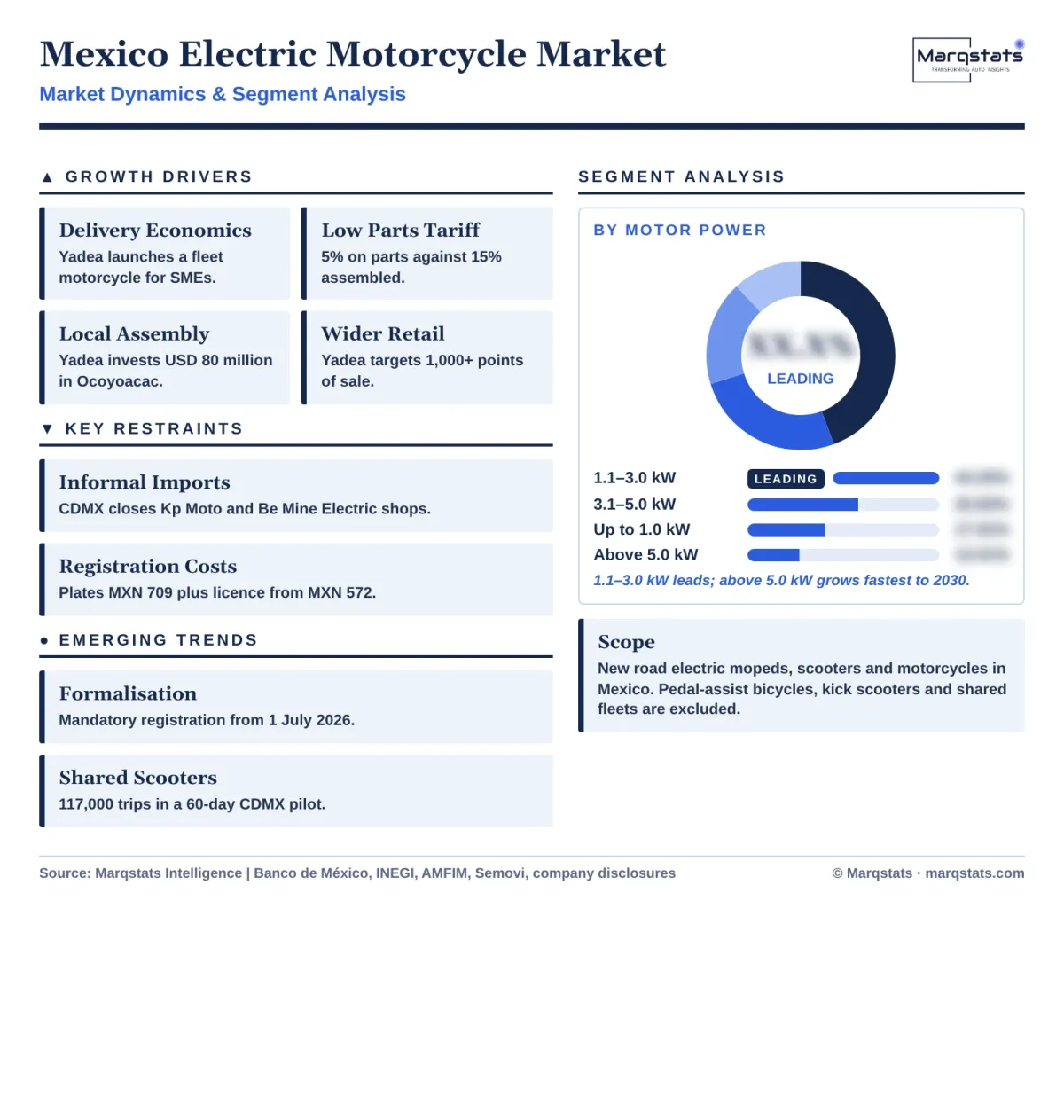
The Mexico electric motorcycle market is estimated at 35,240 units in 2025 and is projected to reach 155,053 units by 2030, registering a volume CAGR of 34.49% over 2026–2030. In value terms the market is estimated at USD 65.60 million in 2025 and is projected to reach USD 305.47 million by 2030, a CAGR of 36.02%. The market comprises new battery electric motorcycles, scooters and mopeds sold for road use in Mexico, from low-speed mopeds to motorcycles above 5 kW. The 1.1–3.0 kW band holds 44.25% of 2025 units, and the above-5.0 kW band grows fastest at 44.18% a year.
Market size and forecast figures are generated using Marqstats' proprietary estimation framework, updated as of October 2026.
Mexico's electric two-wheeler market grew up informally and is now being brought into the registration system. Mexico City required plates and registration for electric motorcycles, scooters and e-bikes faster than 25 km/h from 1 July 2026, yet the Secretaría de Movilidad (Semovi) recorded only 1,440 registrations by 4 August 2026 against an estimated 200,000 units in circulation. Electric models take about 2.20% to 2.35% of the 1.5 million to 1.6 million motorcycles sold in Mexico in 2025, and Yadea Group Holdings Ltd. began local production in Ocoyoacac, State of Mexico, in May 2025.
Growth to 2030 depends on formal channels taking volume from informal sellers. The market grows 52.99% in 2026 and at 34.49% a year to 2030, driven by delivery fleets, local assembly by Yadea and wider dealer networks. Value grows faster than volume, at 36.02% a year, as buyers move up to higher-power scooters and motorcycles.
Key Takeaways
Market Overview & Analysis
Report Summary
The Mexico electric motorcycle market covers new battery electric two-wheelers sold for road use in Mexico, including mopeds, scooters and motorcycles. The market is estimated at 35,240 units in 2025, up 13.79% on 30,970 units in 2024, and more than doubles from 15,750 units in 2021. It grows 52.99% to 53,914 units in 2026 and reaches 155,053 units by 2030, adding 119,813 units over the forecast period. Electric bicycles with pedal assistance, stand-up kick scooters, shared micromobility fleets, used vehicles and petrol motorcycles sit outside the perimeter.
Mexico is a large motorcycle market with a small electric share. The consultancy IDF estimates that Mexico sold 1.5 million to 1.6 million motorcycles in 2025, against about 1.4 million new cars, the second year in a row that motorcycles matched or exceeded car sales. The Asociación Mexicana de Fabricantes e Importadores de Motocicletas (AMFIM), whose 16 member brands account for 95% of sales, expects the market to exceed 2 million units in 2026. Electric models take about 2.20% to 2.35% of motorcycle sales, so the market has room to grow without new buyers entering the two-wheeler category.
No official series records electric two-wheeler sales in Mexico. The Instituto Nacional de Estadística y Geografía (INEGI) publishes a circulating vehicle stock that excludes motorcycles from its monthly estimate, and its RAIAVL light-vehicle sales series covers only cars and light trucks. AMFIM members do not report to INEGI in the way that carmakers do, so the market is sized from imports, company disclosures, retail checks and city registration data. A commercial tracker reported 7,544 electric two-wheelers through September 2026, about 0.5% of the industry, which covers only part of the market.
Imports and local assembly supply the market. Mexico imported motorcycles and parts worth about USD 649.2 million in 2025 and exported USD 90.66 million, up 76.5%, according to Banco de México data reported by Autocosmos. About 90% of electric motorcycles enter the country as parts and components at a tariff of about 5%, against 15% for assembled motorcycles, according to El Heraldo de México and Expansión. Most units come from China, and INEGI data show that the number of businesses selling electric motorcycles, mopeds and scooters rose about 1,900% between 2021 and 2026.
Battery swapping and fleet models are at an early stage. Grupo IUSA's Zonder unit develops swappable-battery work motorcycles and told the Guanajuato government's Puerto Interior blog in December 2023 that it projected sales of 5,000 units in 2024, 10,000 in 2025 and 20,000 in 2026, figures that were company targets and have not been reported as achieved. Yadea's October 2026 launch of a delivery and distribution motorcycle targets e-commerce last-mile demand, where daily distances and running costs favour electric models. Fleet demand matters more in Mexico than in most Latin American markets, because delivery platforms concentrate riders in a few large cities.
Mexico sits close to Brazil in electric penetration and far behind Asia. Marqstats estimates that electric models took about 2.50% of Brazilian motorcycle sales in 2025, close to Mexico's 2.20% to 2.35%, while Vietnam, Taiwan and China run far higher shares. Industry estimates put motorcycle ownership in Mexico at about 10% to 11% of households, against about 30% in Colombia and 35% in Brazil, according to AMFIM, so the base of riders is still growing. Electric models enter a market that adds hundreds of thousands of new riders each year, which supports high growth from a small base.
Brand and model data are thin, and the brand mix splits between formal and informal sellers. Yadea, Grupo Elektra's Italika, Vento and Vmoto's Super Soco sell electric models through dealer networks, while hundreds of small importers sell low-cost Chinese mopeds in city centres and online. Yadea's Mexican line-up includes the Kemper motorcycle, with a claimed top speed of 160 km/h and 0–100 km/h in 4.9 seconds, the Keeness, with a top speed of 100 km/h, the X-Bull Plus, the Modern, the GFX6, the Voltguard and the OVA smart scooter launched in June 2026. No brand publishes Mexican unit sales, so model-level analysis relies on line-ups, prices and retail checks.
The average selling price in the market is approximately USD 1,862 in 2025, rising to USD 1,970 by 2030. Prices range from about MXN 6,000 for basic e-bikes and mopeds to more than MXN 150,000 for premium motorcycles. The low entry price explains the size of the informal market, because many low-cost units sold as bicycles exceed 25 km/h and now fall under Mexico City's registration rules. Formal brands compete on warranty, service and financing, where Italika's Elektra store network and Yadea's planned 1,000 points of sale give them reach.
Mexico City's new rules redraw the market boundary. Congress approved Mobility Law reforms in August 2025 that require plates, licences and registration for electric scooters, mopeds and motorcycles above 25 km/h or 250 W, and new units must leave stores with plates from 1 July 2026. Plates cost MXN 709 and licences MXN 572 to MXN 1,142, and Semovi proposed cutting the plate cost to MXN 355 in September 2026. Retailers expected sales to dip after registration became mandatory, so the 2026 estimate assumes slower growth in Mexico City than in the rest of the country.
Market Dynamics
Key Drivers
Five conditions drive the Mexico electric motorcycle market, and running-cost savings for delivery riders matter most.
- Running-cost savings for delivery and work riders. Delivery platforms and small businesses use motorcycles for last-mile trips, and Yadea launched an electric motorcycle for delivery and SME distribution fleets in October 2026. Electric models cut fuel and maintenance costs for riders who cover long daily distances in congested cities. Industry estimates put the total cost of an electric scooter up to 60% below a 125 cc or 150 cc petrol motorcycle over 24 months, counting fuel, maintenance and depreciation.
- Low tariffs on parts and local assembly. Parts and components enter at a tariff of about 5% against 15% for assembled motorcycles, and about 90% of electric motorcycles enter as parts. Yadea invested USD 80 million in its Ocoyoacac plant, which rolled off its first vehicle in May 2025 and targets 500,000 units of annual capacity in Phase II.
- Wider retail networks from formal brands. Yadea plans to end 2026 with more than 1,000 points of sale and service in Mexico, and Segway-Ninebot appointed Édgar Suárez as country manager in August 2026 to expand its distributor network. Italika sells through Grupo Elektra's national store network with consumer credit.
- Local tax benefits. Article 161 Bis 10 of the Mexico City fiscal code exempts electric motorcycles from the vehicle tenure tax, and Semovi proposed halving the plate cost for electric vehicles to MXN 355. These benefits reduce the cost of formal ownership in the largest city.
- Growth of the motorcycle market. Motorcycle sales of 1.5 million to 1.6 million in 2025 and AMFIM's expectation of more than 2 million in 2026 widen the pool of buyers who can switch to electric. Mexico City Metro has lost about 20% of its demand since the pandemic, and riders move to motorcycles for commuting.
Key Restraints
Four constraints slow the market, and the informal sales channel is the largest.
- Informal imports and quality concerns. Authorities closed the electric scooter shops Kp Moto and Be Mine Electric in Mexico City's Historic Centre in February 2026 amid scrutiny of informal Chinese imports. Low-cost units without warranty or spare parts damage buyer confidence in electric two-wheelers.
- Registration costs and compliance. Mexico City requires plates, licences and an electric mobility badge for vehicles above 25 km/h, with fines from 20 November 2026, and retailers expected sales to dip after mandatory registration began on 1 July 2026. Registration adds about MXN 1,281 to MXN 1,851 to the cost of a new unit at current plate and licence fees. Owners of vehicles bought before 1 July 2026 must register them on the Semovi platform by 20 November 2026, which adds paperwork and cost for existing owners as well as new buyers.
- Higher duties on Asian imports. Mexico published higher import duties on 1,463 tariff lines from countries without trade agreements in December 2025, affecting imported two-wheeler and component categories. Higher duties raise costs for importers that bring in assembled units.
- Low share of high-power models. The above-5.0 kW band holds only 12.01% of 2025 units, so most electric two-wheelers compete with mopeds rather than with 125 cc and 150 cc petrol motorcycles. Range and charging access remain concerns for riders outside city centres. Public charging for two-wheelers is scarce outside Mexico City, Guadalajara and Monterrey, so most riders charge removable batteries at home or at work.
Key Trends
Four shifts show where the market is moving and which companies gain.
- Formalisation of the market. Mexico City began mandatory registration for VEMEPE vehicles on 1 July 2026, and Semovi recorded 1,440 registrations in the first five weeks against an estimated 200,000 vehicles in circulation. Formal brands that sell plated vehicles with warranties gain share as enforcement starts.
- Chinese brands build local plants. Yadea opened its first plant outside Asia in Ocoyoacac, and CFMoto opened a plant in Lerma in 2025, while QJMotor assembles in Toluca. Local assembly lowers tariff costs and shortens delivery times for dealers. Bajaj's planned Valle de Toluca plant and GS Motos' expansion show that petrol makers are also adding capacity, which keeps price competition high.
- Shared electric scooters return to Mexico City. Mexico City's shared electric scooter pilot recorded about 117,000 trips in 60 days, with Lime, JET and Whoosh operating under temporary permits that ended in September 2026. Shared fleets introduce new riders to electric two-wheelers. Whoosh launched electric scooter rentals in Mexico City in June 2026 as part of its Latin American expansion.
- Premium and smart models enter. Yadea unveiled its Keeness motorcycle and full line-up at EXPO MOTO CDMX in December 2025, and the Kemper offers a claimed 160 km/h top speed and fast charging. Premium models lift the above-5.0 kW band to 17.00% of units by 2030.
Market Segmentation
The 1.1–3.0 kW band is the dominant segment and covers urban scooters and mopeds. It accounts for 15,594 units in 2025, 44.25% of the total, and reaches 63,768 units by 2030 at a 32.53% CAGR, taking 41.13% of the market. Yadea's smart scooters and most dealer-sold commuter models sit in this band.
The 3.1–5.0 kW band covers 110 cc-equivalent commuter and delivery scooters. It accounts for 9,103 units in 2025, 25.83% of the total, and reaches 43,283 units by 2030 at a 36.59% CAGR, taking 27.91% of the market. Delivery riders choose this band for its balance of price, speed and range.
The up-to-1.0 kW band covers low-speed mopeds and seated e-bikes. It accounts for 6,312 units in 2025, 17.91% of the total, and reaches 21,638 units by 2030 at a 27.94% CAGR, taking 13.96% of the market. Many units in this band sit near the 25 km/h threshold of Mexico City's registration rules, so enforcement slows its growth.
The above-5.0 kW band is the fastest-growing segment. It accounts for 4,231 units in 2025, 12.01% of the total, and reaches 26,364 units by 2030 at a 44.18% CAGR, taking 17.00% of the market. Yadea's Kemper and Keeness, Super Soco models and premium imports compete with 125 cc to 150 cc petrol motorcycles.
Formal channels include brand stores, motorcycle dealers and national retailers such as Grupo Elektra. These channels sell plated vehicles with warranties and credit, and they gain share as Mexico City enforces registration. Yadea's target of more than 1,000 points of sale by the end of 2026 extends formal reach beyond the largest cities. Segway-Ninebot added a country manager in August 2026 to build its distributor network, and Grupo Elektra offers credit that lowers the upfront cost for low-income buyers.
Independent importers sell low-cost Chinese mopeds and scooters through small stores and online marketplaces. INEGI data show that the number of businesses selling electric two-wheelers rose about 1,900% between 2021 and 2026. This channel carries most of the unregistered fleet and faces the largest compliance burden.
By Geography
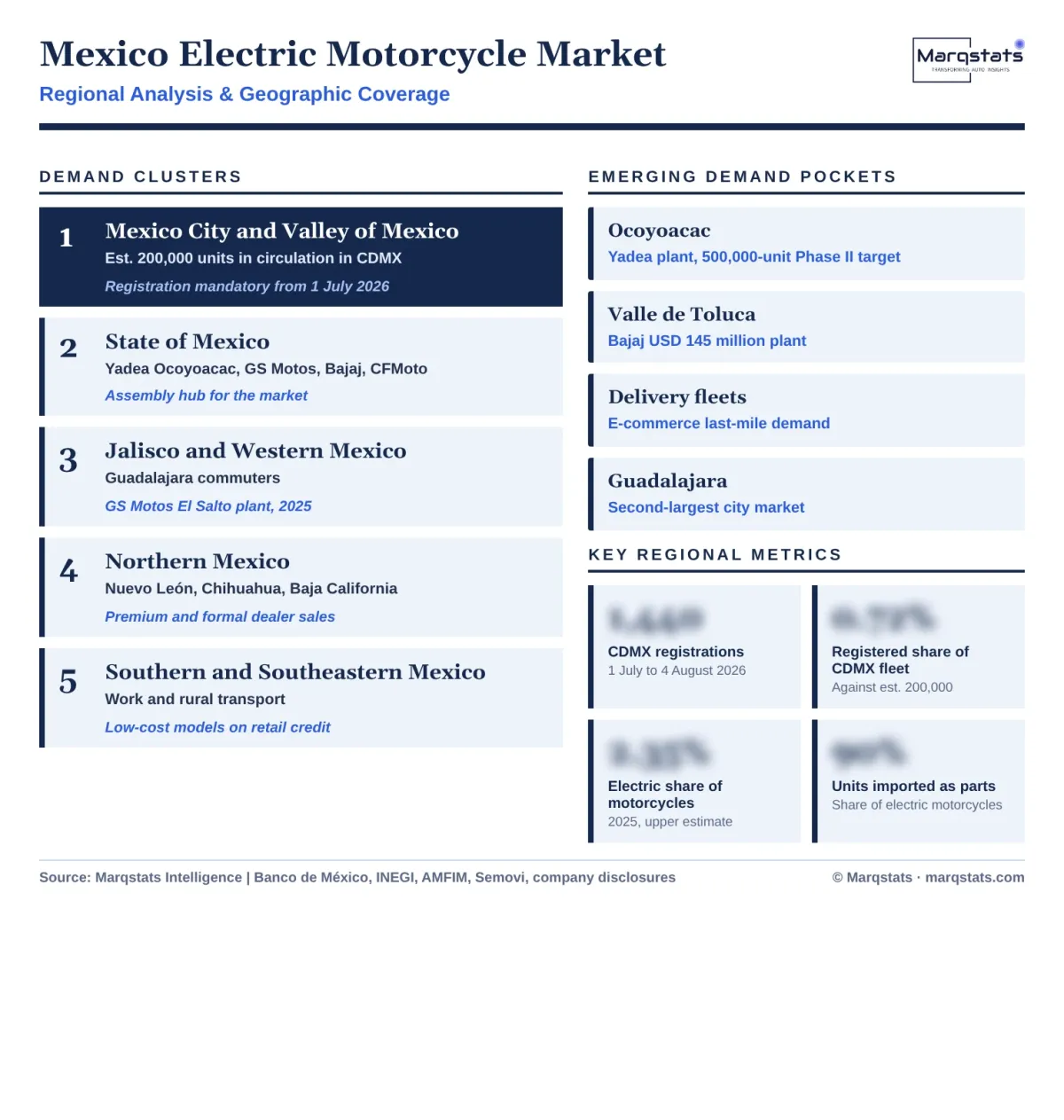
Mexico City and the Valley of Mexico
Mexico City and the surrounding Valley of Mexico form the largest demand cluster, with an estimated 200,000 electric two-wheelers and e-bikes in circulation in the capital. The city exempts electric motorcycles from the tenure tax and introduced mandatory registration from 1 July 2026, with fines from 20 November 2026. Delivery riders and commuters who avoid the Metro drive demand. Semovi registered about 41 vehicles a day in the first five weeks of the scheme, and the city projected up to MXN 385 million of revenue from registering electric mopeds and scooters faster than 25 km/h.
State of Mexico
The State of Mexico is the manufacturing centre of the market, with Yadea's plant in Ocoyoacac, GS Motos' Ensamblika plant and Bajaj's facilities in the Toluca area, CFMoto in Lerma and Vento's assembly operations. Bajaj announced a USD 145 million investment in March 2026 for a new Valle de Toluca plant with capacity near 500,000 units a year. Proximity to plants gives dealers in the state short supply chains.
Jalisco and Western Mexico
Guadalajara is the second-largest city market, and GS Motos opened a second assembly plant in El Salto, Jalisco, in 2025, where Honda has built motorcycles since 1988. Yadea debuted its brand at Expo Moto Guadalajara in May 2025. Commuting demand in the Guadalajara metropolitan area supports scooter sales.
Northern Mexico
Nuevo León, Chihuahua and Baja California form an industrial and border cluster, where motorcycle component plants in Ciudad Juárez serve export markets. Higher incomes support premium models, and longer distances favour higher-power motorcycles. Formal dealer networks dominate sales in this cluster.
Southern and Southeastern Mexico
Southern and southeastern states rely heavily on motorcycles for work and rural transport, and Grupo Elektra's store network gives Italika national reach in these regions. Low incomes favour low-cost mopeds and scooters bought on credit. Limited charging access outside cities slows the switch to electric models.
How Competition Is Evolving
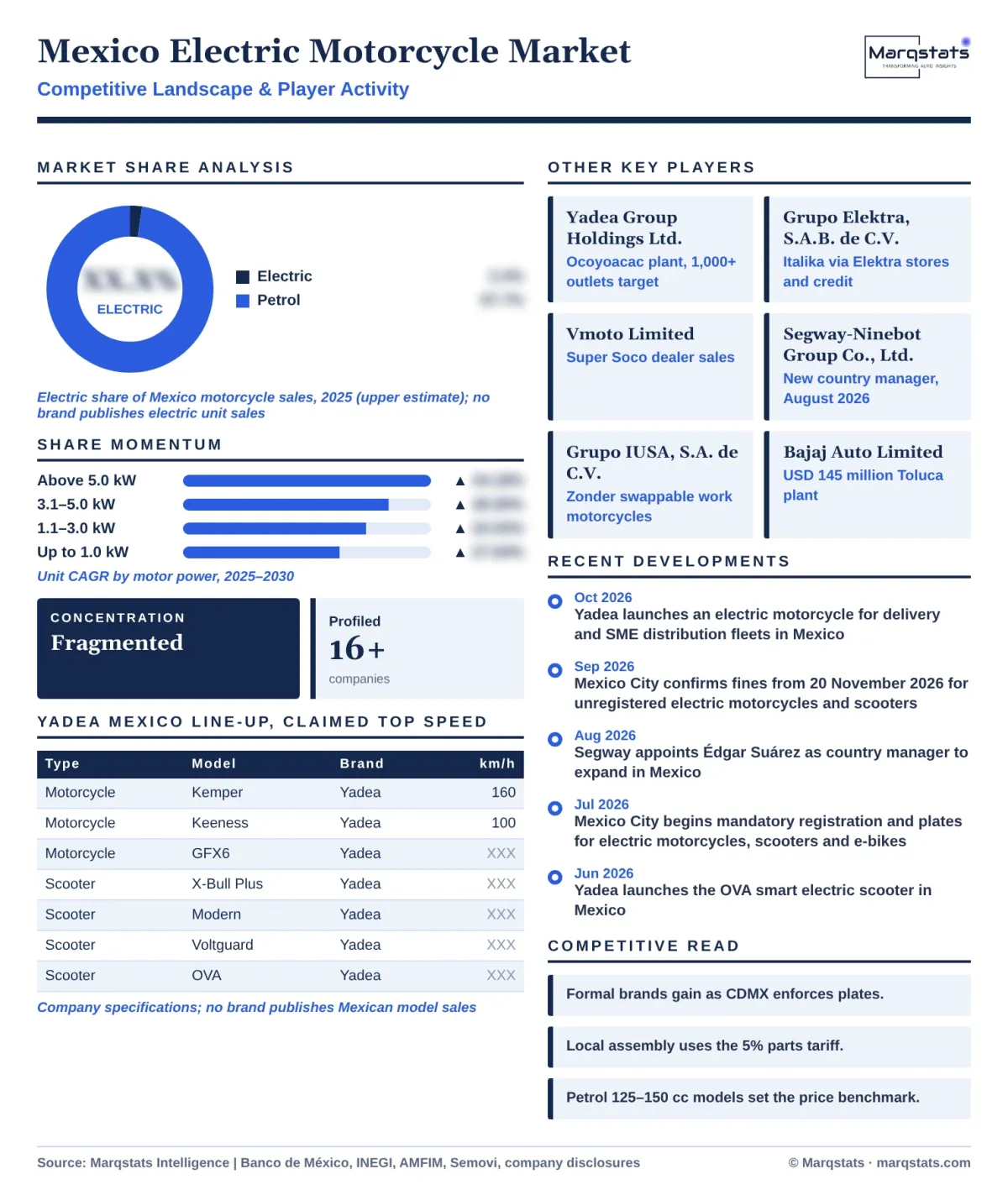
The market is fragmented. Yadea Group Holdings Ltd., Grupo Elektra, S.A.B. de C.V. (Italika), Vento, Vmoto Limited (Super Soco), Segway-Ninebot Group Co., Ltd. and Niu Technologies sell through formal channels, while hundreds of independent importers sell unbranded or lesser-known Chinese models. No company publishes Mexican electric unit sales, and no official series records brand shares. Expansión found electric scooter brands such as Evobike and E-Hermas sold by at least five stores on Mexico City's Eje Central Lázaro Cárdenas in December 2024, which shows how quickly small importers add brands that never appear in dealer statistics.
Competitive strategy splits between local assembly and imports. Yadea invested USD 80 million in local production and plans more than 1,000 points of sale, and GS Motos, which assembles Italika, Hero and Benelli motorcycles, has capacity above 1.6 million units a year across its Toluca and El Salto plants. Importers compete on price, using the 5% tariff on parts to assemble kits locally.
Grupo Elektra's Italika holds the strongest retail position. GS Motos assembles Italika motorcycles in Toluca and El Salto and sells them through Elektra stores with consumer credit, and its owners set a target of 3 million motorcycles a year for 2026, according to Xataka México in February 2026. Italika's electric range competes at the low end of the market, where credit terms matter more than technology, and its national store network reaches buyers in towns where specialist electric brands have no dealers.
Petrol motorcycle makers set the benchmark. Italika, Honda Motor Co., Ltd., Yamaha Motor Co., Ltd., Suzuki Motor Corporation, Bajaj Auto Limited and Zhejiang CFMOTO Power Co., Ltd. sell most of Mexico's 1.5 million to 1.6 million motorcycles. Electric brands compete against 125 cc and 150 cc petrol models on total cost, and financing through retail credit decides many purchases.
The competitive question to 2030 is whether formal brands can take the informal market. Mexico City's registration rules raise the cost of selling unregistered units, and Yadea, Italika and Segway gain from formal channels with plated vehicles and warranties. Fleet buyers, including delivery companies and SME distributors, favour brands with service networks and battery replacement.
Companies Covered
Companies covered in the report include:
Recent Market Activity
Table of Contents
Coverage & Segmentation
The Mexico electric motorcycle market comprises new battery electric motorcycles, scooters and mopeds sold for road use in Mexico, sized in units and in USD at retail selling prices. The market is segmented by motor power into four bands (up to 1.0 kW, 1.1–3.0 kW, 3.1–5.0 kW and above 5.0 kW) and by sales channel into formal dealer and retail networks and independent importers and online sellers. Regional analysis covers Mexico City and the Valley of Mexico, the State of Mexico, Jalisco and Western Mexico, Northern Mexico and Southern and Southeastern Mexico.
The base year is 2025, the historical period is 2021–2025 and the forecast period is 2026–2030. Pedal-assist bicycles, kick scooters, shared fleets, used vehicles and petrol motorcycles are excluded. No official national series records electric two-wheeler sales, so the market size is a Marqstats construction, built from import data, company disclosures, retail checks and city registration data. No brand publishes Mexican unit sales, so brand and model analysis relies on line-ups, prices and channel checks, and regional analysis is qualitative. Market figures are not independently verified against a government sales register, because none exists, and the city registration count is as reported by Semovi.