Market Snapshot
Middle bar: base-year value × (1 + CAGR), rounded to two decimals. This is a calculated illustration, not a separately researched annual estimate.
The Argentina electric motorcycle market is estimated at 10,730 units in 2025 and is projected to reach 33,735 units by 2030, registering a volume CAGR of 25.75% over 2026–2030. In value terms the market is estimated at USD 16.89 million in 2025 and is projected to reach USD 57.70 million by 2030, a CAGR of 27.85%. The market comprises new battery electric motorcycles, mopeds and scooters sold for road use in Argentina, whether or not they are registered with the national motor vehicle registry. The 1.1–3.0 kW band holds 48.65% of 2025 units, and the above-5.0 kW band grows fastest at 30.68% a year.
Market size and forecast figures are generated using Marqstats' proprietary estimation framework, updated as of October 2026.
Volume doubled in 2025, up 102.07% from 5,310 units, in a year when Argentina registered a record 650,325 motorcycles of all types, so electric models equal about 1.65% of the registered total. Sunra, Super Soco, NIU, Elpra and the Córdoba-based Okinoi supply most electric models, and Newsan's Siam brand and Lifan add local distribution reach. The market grows 36.57% to 14,654 units in 2026, although trade press reported a sharp slowdown in electric motorcycle sales in mid-2026 after fiscal incentives ended.
Key Takeaways
Market Overview & Analysis
Report Summary
The Argentina electric motorcycle market covers new battery electric motorcycles, mopeds and scooters sold for road use in Argentina. Volume fell from 3,840 units in 2021 to 1,810 in 2022, then rose to 2,510 in 2023, 5,310 in 2024 and 10,730 in 2025. The market grows 36.57% to 14,654 units in 2026 and reaches 33,735 units by 2030, adding 23,005 units over the forecast period. Electric bicycles, kick scooters, electric tricycles and quadricycles, used vehicles and internal combustion motorcycles sit outside the perimeter.
The signature finding is a policy asymmetry. Electric motorcycles took about 1.65% of a record two-wheeler market in 2025, and then lost fiscal incentives that electric and hybrid cars kept. Electrified car registrations rose 339.4% to 42,238 in the first half of 2026, while Ámbito reported in July 2026 that electric motorcycles were losing competitiveness after the incentives ended. The same buyers respond strongly to incentives, so the policy gap, not technology, explains why cars accelerated and motorcycles slowed. The Marqstats forecast of 36.57% growth in 2026 assumes the slowdown is temporary, and it carries more risk than any other figure on the page.
Registry data and sales estimates differ in coverage. The National Directorate of Motor Vehicle Registries (DNRPA) requires all motor vehicles to be registered, and a model can be registered only after its maker or importer obtains a Model Configuration Licence (LCM) from the Secretariat of Industry, and in 2021 Enrique Levantini of the dealer association ACARA estimated that fewer than 3% of electric motorcycles in circulation were registered. The SIOMAA market information system recorded 1,929 electric motorcycle registrations in 2022, and Newsan estimated sales of about 1,400 to 1,500 units in 2023. Cumulative Marqstats volume of 24,200 units from 2021 to 2025 is consistent with the more than 20,000 electric motorcycles in circulation reported in October 2025.
The petrol motorcycle market is booming. Argentina registered 650,325 motorcycles in 2025, up 33.8% from 486,061 in 2024, according to ACARA's motorcycle division, and the Gilera Smash led models with 58,402 units ahead of the Honda Wave with 56,283. Electric sales of 10,730 units equal about 1.65% of that registered total, so electric models remain a niche in a market that buys low-cost 110 cc commuters in large numbers. Petrol registrations kept growing in 2026, rising more than 30% in July, which shows that the barrier to electric adoption is price, not demand for two-wheelers.
Policy has moved in both directions. Import tariffs on electric motorcycles fell from 35% to 20% in 2025, and Economía Sustentable reported that they would fall to zero if battery production were localised, according to Economía Sustentable in October 2025. Ámbito reported in July 2026 that the end of fiscal incentives had become a turning point for electric motorcycles, raising import costs and widening the price gap with petrol models, while electric and hybrid cars kept incentives. Electrified cars reached 42,238 registrations in the first half of 2026, up 339.4%, which shows how strongly incentives move Argentine buyers.
Brand data are limited to company statements and partial registry counts. Sunra, the brand of Jiangsu Xinri E-Vehicle Co., Ltd., says it has led electric motorcycle registrations for three years and claims about 70% of the electric fleet in circulation. SIOMAA data show Elpra Electric registered 366 units in January to October 2023 and 264 in the same period of 2024, down 27.9%, and Newsan's Siam brand stated that it sold one in four electric motorcycles around 2024. Super Soco, owned by Vmoto Limited and distributed by Grupo Simpa, and NIU, sold locally as Nuuv, compete in the mid and premium tiers.
Model prices show a wide spread. Sunra's Amalfi, Hawk and Tango K3 sell at about ARS 3 million to ARS 8 million, and Super Soco's CPX and TC Max at about ARS 3.5 million to ARS 8 million, according to Economía Sustentable in October 2025. The Elpra Indie costs about USD 2,442 and the Folk scooter about USD 2,400, while NIU's UQi GT sells at USD 4,690, its XQi3 at USD 10,200 and its RQi Sport at about USD 14,450. Ámbito put electric prices at ARS 2.5 million to ARS 5.5 million in July 2026 and described petrol alternatives as considerably cheaper.
Local assembly and distribution are expanding. Okinoi, based in Córdoba, planned a USD 5 million investment in a 7,000 m² building and two electric models for 2025, and launched the RS Road electric motorcycle in April 2025. Newsan signed an exclusive agreement to sell Lifan motorcycles in Argentina in February 2025, and Newsan's Siam Motos and Lifan announced new models and a three-year warranty on the Siam line for 2026. Spare parts can take several months to arrive, which makes local stock and service a competitive advantage.
The average selling price in the market is approximately USD 1,574 in 2025, rising to USD 1,710 by 2030. The average reflects the weight of low-power scooters from Sunra, Elpra and Folk, and it rises as the 3.1–5.0 kW and above-5.0 kW bands gain share. Prices in pesos move with the exchange rate, because most vehicles, cells and parts are imported.
The conclusion for suppliers is that registration access and price, not consumer interest, decide growth. Makers that obtain LCM certificates can sell registered models to delivery riders and commuters, who make up most of the 650,325-unit petrol market, while unregistered models stay limited to private urban use. The 2026 slowdown reported in trade press is the main risk to the forecast, and a return of incentives or a further tariff cut is the main upside.
The value chain is import-led. Most electric motorcycles, kits, cells and motors come from China, importers such as Grupo Simpa and Newsan bring them in, and local players such as Okinoi add assembly, warehousing and service in Córdoba. Dealers sell to private buyers in the large cities, and parts supply is the weakest link, with waits of several months reported in 2026. Localised battery production is the step that would change the economics, because it would qualify for a lower tariff and cut the share of the price exposed to the exchange rate.
The forecast rests on a shift toward faster models. The 3.1–5.0 kW and above-5.0 kW bands raise their combined share from 31.87% in 2025 to 37.43% by 2030, as buyers seek models that match 110 to 125 cc petrol motorcycles on speed and range. Volume reaches 33,735 units by 2030, still a small fraction of a market that registered 650,325 motorcycles in 2025. Faster growth requires registered, financeable models that delivery riders and commuters can use for work.
Three named policy levers would move the forecast. The first is a return of fiscal incentives for electric motorcycles on the terms that electric and hybrid cars kept in 2026. The second is a tariff cut from 20% to zero, which Economía Sustentable linked to localised battery production. The third is faster LCM certification, which would let more models be registered, financed and used for commercial work. Each lever acts on price or access rather than demand, because the record petrol market shows Argentine buyers already want low-cost two-wheelers.
Petrol market structure shows where electric brands must compete. Honda led December 2025 petrol registrations with 11,608 units, followed by Motomel with 7,864, Gilera with 7,517, Corven with 5,820 and Zanella with 5,443, according to ACARA. These brands sell low-cost 110 cc commuters through national dealer networks, and none of them leads the electric segment. An electric entry by one of them, or a partnership with an electric importer, would change the competitive field faster than any new import brand.
Market Dynamics
Key Drivers
Five conditions drive the Argentina electric motorcycle market, and the size of the petrol motorcycle market matters most.
- A record two-wheeler market. Argentina registered 650,325 motorcycles in 2025, up 33.8%, and petrol registrations rose more than 30% in July 2026. A large commuter and delivery base gives electric models a market to convert.
- Lower import tariffs. Import tariffs on electric motorcycles fell from 35% to 20% in 2025, and would fall to zero with localised battery production. Lower tariffs narrow the price gap with petrol models.
- Local assembly and investment. Okinoi planned a USD 5 million investment in Córdoba and launched the RS Road in April 2025, and Newsan took the Lifan franchise in February 2025. Local players shorten parts supply and add dealer reach, which addresses the parts delays reported in 2026.
- Running-cost savings in cities. The electric fleet of more than 20,000 units concentrates in Buenos Aires, Córdoba, Rosario and Santa Fe, where commuting distances suit battery range. Charging at home replaces fuel for short daily trips, and the fleet of more than 20,000 units in October 2025 gives used-vehicle and service businesses a base to build on.
- Wider model choice. Sunra, Super Soco, NIU, Elpra, Folk, Okinoi and Siam offer models from about USD 2,400 to USD 14,450. Choice across price tiers widens the buyer base beyond early adopters.
Key Restraints
Four constraints slow the market, and the end of fiscal incentives is the most immediate.
- End of fiscal incentives. Ámbito reported in July 2026 that the end of fiscal incentives raised import costs and widened the gap with petrol prices, while electric cars kept their incentives. Trade press reported falling electric motorcycle sales in 2026, and Ámbito put electric models at about 0.2% of total motorcycle sales, a figure that reflects registered units, while the Marqstats estimate of about 1.65% also counts unregistered models.
- Registration barriers. Models need a Model Configuration Licence (LCM) before they can be registered, and ACARA estimated in 2021 that fewer than 3% of electric motorcycles in circulation were registered. Unregistered models face limits on road use, financing and insurance.
- High prices against petrol commuters. Electric models cost ARS 2.5 million to ARS 8 million, against petrol 110 cc commuters such as the Gilera Smash and Honda Wave that lead the market. Batteries make up a large share of the price, and the price gap widened after incentives ended.
- Parts and charging gaps. Spare parts can take several months to arrive, and charging infrastructure does not yet support mass daily use, according to Ámbito in July 2026. Service gaps raise ownership risk.
Key Trends
Four shifts show where the market is moving and which companies gain.
- Petrol brands add electric models. Newsan, which owns Siam and distributes Lifan, and Okinoi offer both petrol and electric models. Dual-range brands use existing dealers to sell electric models to petrol buyers, and Newsan's three-year warranty on the Siam line from 2026 lowers the perceived risk of switching.
- Premium imports widen the top end. NIU's XQi3 at USD 10,200 and RQi Sport at about USD 14,450 bring motorcycle-class electric models to Argentina. The above-5.0 kW band grows at 30.68% a year.
- Localisation of batteries. Economía Sustentable reported in October 2025 that tariffs would fall to zero if battery production were localised. Battery assembly in Argentina would cut import costs and exchange-rate exposure.
- Incentives decide the pace. Electrified car registrations rose 339.4% in the first half of 2026 with incentives in place, while electric motorcycle sales slowed after incentives ended. Policy on two-wheelers is the main swing factor to 2030, and an extension of car-style incentives to motorcycles would change the forecast more than any product launch.
Market Segmentation
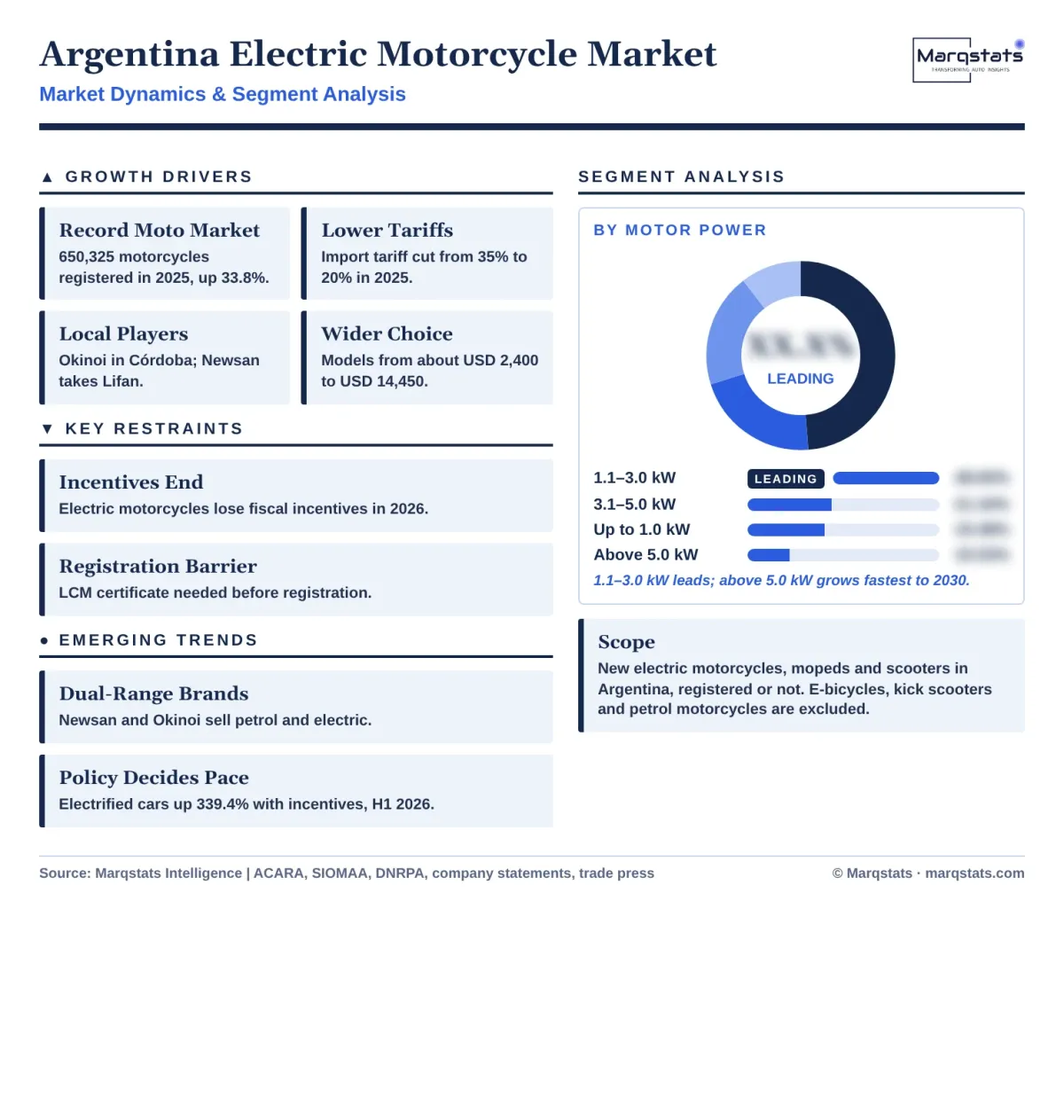
The 1.1–3.0 kW band is the dominant segment and covers urban scooters from Sunra, Elpra, Folk and Super Soco. It accounts for 5,220 units in 2025, 48.65% of the total, and reaches 15,290 units by 2030 at a 23.98% CAGR, taking 45.33% of the market. Its share eases to 2030 as buyers move to faster models, while it remains the largest band because it fits urban commuting at the lowest price.
The 3.1–5.0 kW band covers scooters and light motorcycles that match 110 to 125 cc petrol models. It accounts for 2,290 units in 2025, 21.34% of the total, and reaches 8,323 units by 2030 at a 29.45% CAGR, taking 24.67% of the market. It is the band most likely to win delivery riders once models are registered, and its share rises by more than three points by 2030.
The up-to-1.0 kW band covers low-speed mopeds for short urban trips. It accounts for 2,090 units in 2025, 19.48% of the total, and reaches 5,816 units by 2030 at a 22.71% CAGR, taking 17.24% of the market. Its share falls as faster models become cheaper, and its buyers are mainly short-distance private riders.
The above-5.0 kW band is the smallest and fastest-growing segment. It accounts for 1,130 units in 2025, 10.53% of the total, and reaches 4,306 units by 2030 at a 30.68% CAGR, taking 12.76% of the market. NIU's XQi3 at USD 10,200 and RQi Sport at about USD 14,450 compete here as premium imports.
Registered models hold an LCM certificate and can be used for commercial work, financed and insured more easily. Sunra says it has led registrations for three years, and Elpra registered 366 units in January to October 2023.
Unregistered models are sold mainly for private urban use, and ACARA estimated in 2021 that fewer than 3% of electric motorcycles in circulation were registered. More models have since obtained LCM certificates, and their volume is visible only through import and dealer data.
By Geography
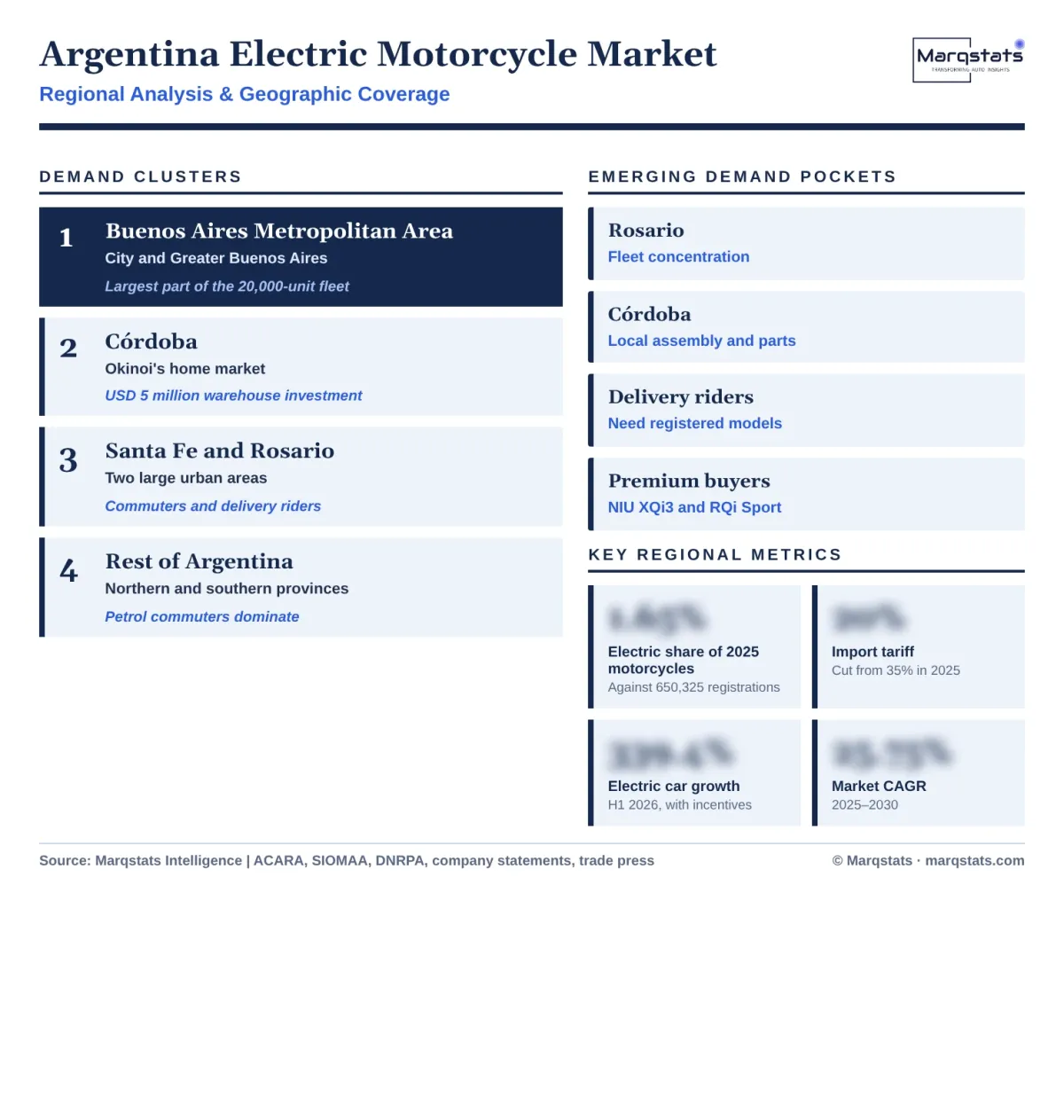
Buenos Aires Metropolitan Area
The City of Buenos Aires and Greater Buenos Aires hold the largest share of the electric fleet and the densest dealer networks. Short commuting trips and home charging make the capital the main market to 2030. Importers such as Grupo Simpa and Newsan base their distribution in the metropolitan area, and the metropolitan area holds the largest part of the electric fleet of more than 20,000 units reported in October 2025.
Córdoba
Córdoba is a major market and home to Okinoi, which planned a USD 5 million investment in a new 7,000 m² building. Local assembly gives Córdoba buyers shorter waits for parts, and Okinoi's two electric models for 2025 extend its petrol range into electric.
Santa Fe and Rosario
Rosario and the city of Santa Fe are among the four main concentrations of the electric fleet, together with Buenos Aires and Córdoba. Dealers in the province serve commuters and delivery riders in two large urban areas, and electric demand there follows the national pattern of private urban use.
Rest of Argentina
The northern and southern provinces buy mainly petrol commuter motorcycles, and electric models remain rare. Longer distances and limited service networks slow adoption outside the large cities, so electric sales there depend on dealers carrying parts and offering service.
How Competition Is Evolving
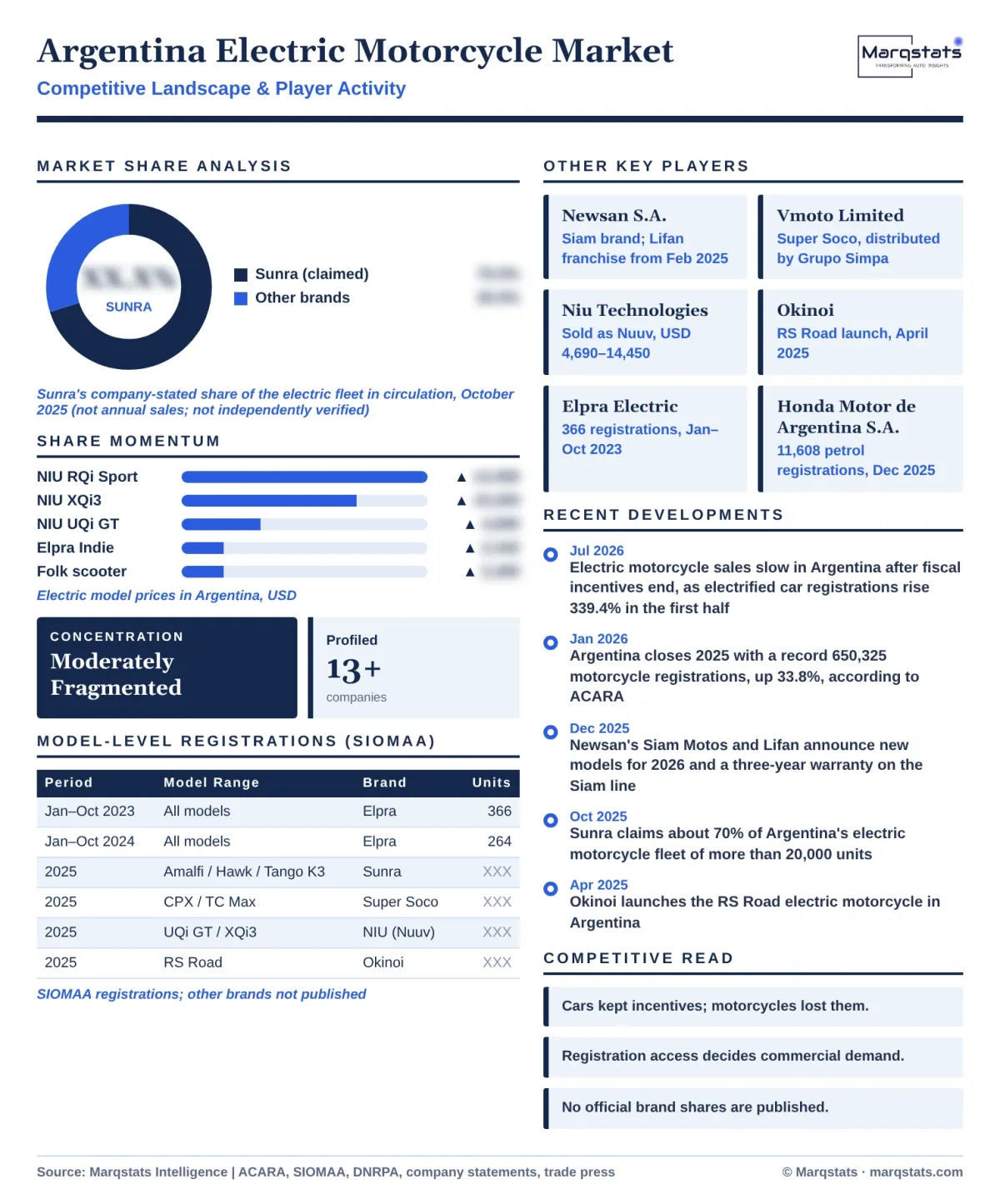
The market is moderately fragmented. Sunra, Super Soco, NIU, Elpra, Folk, Okinoi and Siam compete across price tiers, and no official brand shares are published. Sunra claims about 70% of the electric fleet in circulation and leadership in registrations for three years, both company-stated and not independently verified.
Strategies split between importers and local players. Grupo Simpa imports Super Soco from Vmoto Limited and NIU is sold as Nuuv, while Okinoi in Córdoba and Newsan with Siam and Lifan build local service and distribution. Newsan's three-year warranty on the Siam line from 2026 shows how local players use after-sales terms to compete with imports, and Okinoi's Córdoba warehouse supports parts supply for its own range.
Petrol brands set the benchmark. Honda, Motomel, Gilera, Corven and Zanella led December 2025 petrol registrations, with Honda at 11,608 units, and the Gilera Smash and Honda Wave each sold more than 56,000 units in 2025. Electric brands compete against low-cost 110 cc commuters that buyers can register, finance and service anywhere in the country.
The competitive question to 2030 is who secures registration and price access first. Brands with LCM certificates and local stock can sell to delivery riders and on credit, while brands without them remain limited to private buyers. A return of incentives or a further tariff cut would reward importers with established dealer networks.
Model-level data show a wide price ladder and little published volume. Elpra's 366 registrations in January to October 2023 and 264 in the same period of 2024 are the clearest model-family counts in the registry, and Sunra's Amalfi, Hawk and Tango K3 and Super Soco's CPX and TC Max cover the mass tier. NIU's UQi GT, XQi3 and RQi Sport span USD 4,690 to about USD 14,450, and Okinoi's RS Road adds a locally supported option. The lack of published brand volumes means share claims, such as Sunra's 70% of the fleet, should be read as company positioning rather than measured share.
Companies Covered
Companies covered in the report include:
Recent Market Activity
Table of Contents
Coverage & Segmentation
The Argentina electric motorcycle market comprises new battery electric motorcycles, mopeds and scooters sold for road use in Argentina, registered or not, sized in units and in USD at retail selling prices. The market is segmented by motor power into four bands (up to 1.0 kW, 1.1–3.0 kW, 3.1–5.0 kW and above 5.0 kW) and by registration status into registered and unregistered models. Regional analysis covers the Buenos Aires Metropolitan Area, Córdoba, Santa Fe and Rosario, and the rest of Argentina, and is qualitative.
The base year is 2025, the historical period is 2021–2025 and the forecast period is 2026–2030. Electric bicycles, kick scooters, electric tricycles and quadricycles, used vehicles and internal combustion motorcycles are excluded. Registry data from SIOMAA and ACARA capture only registered electric models, so the market size is a Marqstats construction from import, dealer and company data and is not independently verified against registrations. Company statements such as Sunra's fleet share are as reported, and the reported 2026 slowdown is not yet quantified in published data.