Market Snapshot
Middle bar: base-year value × (1 + CAGR), rounded to two decimals. This is a calculated illustration, not a separately researched annual estimate.
The Malaysia electric motorcycle market is estimated at 10,781 units in 2025 and is projected to reach 57,569 units by 2030, registering a volume CAGR of 39.80% over 2026–2030. In value terms the market is estimated at USD 27.77 million in 2025 and is projected to reach USD 165.26 million by 2030, a CAGR of 42.86%. The market comprises new electric motorcycles and scooters registered with the Road Transport Department (JPJ), sized on JPJ registration data by fuel type. The 1.1–3.0 kW band holds 63.40% of 2025 units, and electric models took 1.53% of the 704,715 new motorcycles registered in 2025.
Market size and forecast figures are generated using Marqstats' proprietary estimation framework, updated as of October 2026.
Malaysia's electric motorcycle market is growing without the two brands that dominate its motorcycle market. Yamaha registered 257,465 motorcycles and Honda 89,562 in January to August 2026, together 64.8% of the market, and neither registered a single electric motorcycle. Electric registrations doubled to 12,507 over the same period, led by Yadea, the Malaysian brand GGR and Keeway's Ezi, and the market grows 102.84% to 21,868 units in 2026.
Growth rests on price, rebates and distribution rather than on the incumbent brands. Value grows faster than volume, at 42.86% a year to USD 165.26 million by 2030, as the above-5.0 kW and 3.1–5.0 kW bands gain share. Yadea, GGR, Ezi and Zeeho lead registrations today, and the entry of Yamaha or Honda electric models is the largest single risk to their position. Local assembly by EP Manufacturing and Blueshark, and Malton's plans with Benling, add domestic supply to an import-led market.
Key Takeaways
Market Overview & Analysis
Report Summary
The Malaysia electric motorcycle market covers new battery electric motorcycles and scooters registered for road use in Malaysia, from low-speed scooters to motorcycles above 5 kW. JPJ registered 125 electric motorcycles in 2021, 210 in 2022, 877 in 2023, 4,818 in 2024 and 10,781 in 2025, up 123.77% on 2024. The market grows 102.84% to 21,868 units in 2026 and reaches 57,569 units by 2030, adding 46,788 units over the forecast period. Pedal-assist bicycles, stand-up kick scooters, used vehicles and petrol motorcycles sit outside the perimeter, and the series measures registration dates, which can lag purchase dates.
Electric models remain a small share of a large and growing motorcycle market. New motorcycle registrations rose from 615,586 in 2021 to 719,042 in 2022, 642,864 in 2023, 656,511 in 2024 and 704,715 in 2025, and reached 534,866 in January to August 2026, against 475,426 a year earlier. The electric share rose from 0.02% in 2021 to 0.73% in 2024, 1.53% in 2025 and 2.34% in January to August 2026, against 8.39% for new cars over the same 2026 period. Electric registrations peaked in April and May 2026, with 3,223 and 3,113 units, which together made up 50.7% of the year-to-date total.
Malaysia sits in the middle of Southeast Asia's electric adoption range. Marqstats estimates electric penetration of 15.23% in Vietnam, about 3.35% in the Philippines and 0.86% in Indonesia in 2025, against 1.53% in Malaysia. Malaysia's motorcycle market is smaller than Vietnam's or Indonesia's, and its buyers have higher incomes, which supports faster adoption once prices fall. The doubling of electric registrations in 2026 lifts the January to August 2026 share to 2.34%, still far below Vietnam.
The January to August series shows how recent the growth is. Electric registrations were 255 in January to August 2018, 235 in 2019, 75 in 2020, 69 in 2021, 155 in 2022, 485 in 2023, 2,233 in 2024, 6,166 in 2025 and 12,507 in 2026. Volume grew about 180 times between 2021 and 2026 over the same eight-month window, and the share of new motorcycles rose from 0.019% to 2.338%. The total motorcycle market grew 12.5% over the same comparison in 2026, so electric growth came on top of a stronger market.
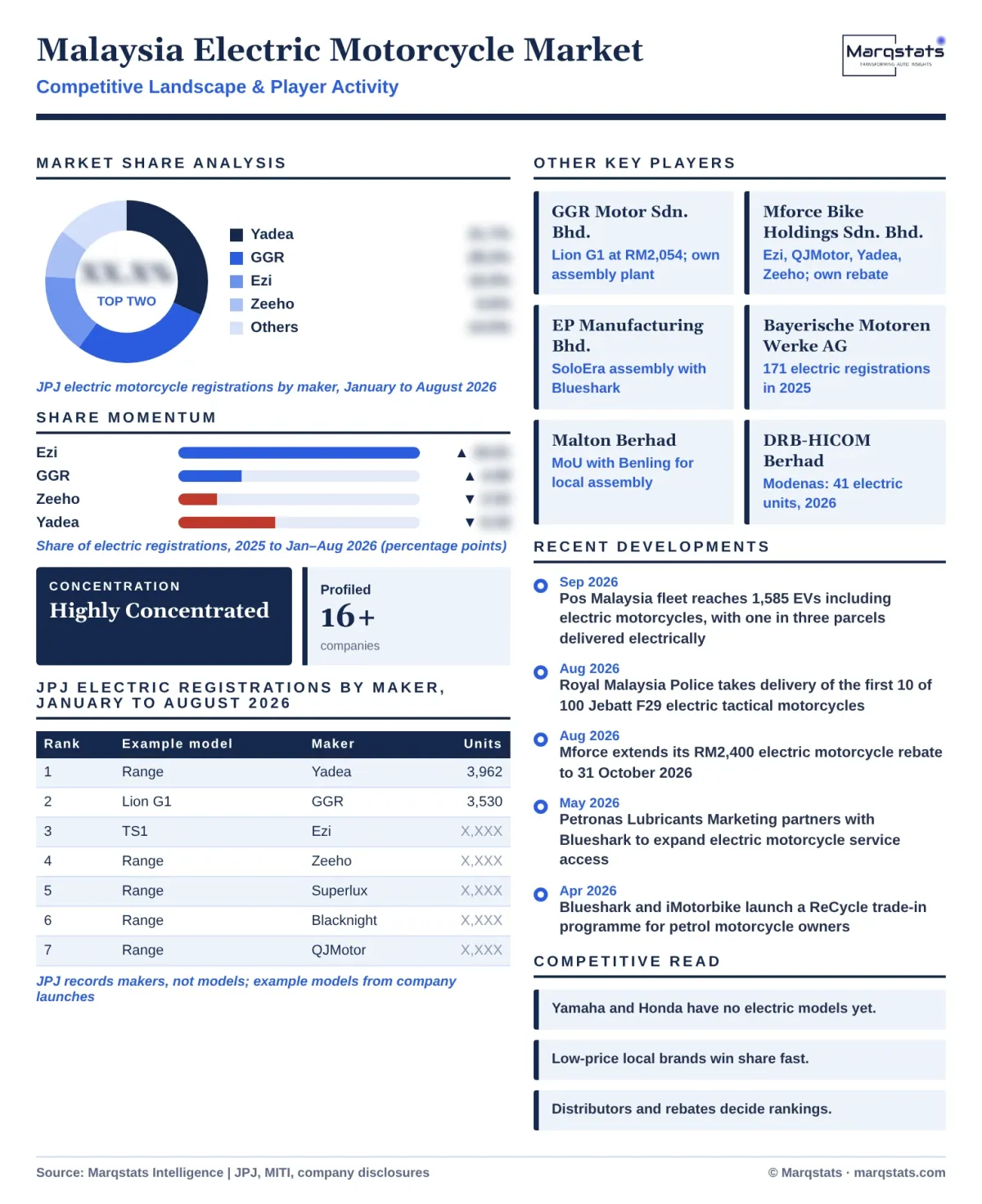
JPJ data record the maker of each electric motorcycle and not the model, which gives an official brand ranking without model detail. Yadea registered 4,098 units in 2025, GGR 2,601, Zeeho 1,303, Blueshark 652, Superlux 633, Vmoto 549, Roda Prestasi 226, BMW 171, Lytron 150 and TAILG 140. The top three makers took 74.23% of the market. In January to August 2026, Yadea registered 3,962 units, GGR 3,530, Ezi 2,002, Zeeho 1,196, Superlux 519, Blacknight 400 and QJMotor 383, and the top three took 75.9%.
The petrol market shows who electric brands must win buyers from. Yamaha registered 257,465 motorcycles in January to August 2026 (48.1%), Honda 89,562 (16.7%), Aveta 38,628 (7.2%), Modenas 25,327 (4.73%) and QJMotor 22,920 (4.29%), and these five makers took 81.1% of the market. QJMotor is the only top-five maker with a meaningful electric range, with 383 electric registrations in the period. Electric brands therefore sell mostly through separate dealer networks, which limits their reach in towns where Yamaha and Honda dealers dominate.
Model and price data show a market built on low-cost commuter scooters. GGR Motor, a Malaysian brand, launched its Lion G1 at RM2,054 in June 2025 with its distributor PMH Motor and opened its own assembly plant, and Keeway's Ezi TS1, sold by Mforce Bike Holdings, uses a 2 kW hub motor with a 65 km/h top speed and 100 km range at RM4,288. Blueshark's R Series offers a claimed range of 110 km, and BMW's CE 04 serves the premium tier. Ezi entered the top three in 2026 within a year of launch, which shows how quickly price-led models win share.
Electric cars are moving faster than electric motorcycles. Electric cars took 8.39% of new car registrations in January to August 2026, 47,508 of 566,616, more than three times the 2.34% electric share of new motorcycles. Car buyers benefit from import and excise exemptions and a wider charging network, while motorcycle buyers rely on rebates and home charging. The gap shows that the two-wheeler market has room to catch up as model ranges and service networks grow.
Rebates explain the timing of demand. The Ministry of Investment, Trade and Industry (MITI) MARiiCAS programme paid RM2,400 to buyers of eligible electric motorcycles earning up to RM120,000 a year, with 3,582 recipients in 2024 and 7,018 from January to 1 September 2025, and 10,600 by October 2025 against a target of 12,155. Mforce launched its own RM2,400 rebate for selected QJMotor, Yadea and Zeeho models in 2026, open to all buyers, and extended it to 31 October 2026. The April and May 2026 peak followed these offers, so the second half of 2026 depends on whether rebates continue.
The average selling price in the market is approximately USD 2,576 in 2025, rising to USD 2,871 by 2030 as higher-power models gain share. Entry prices of RM2,054 to RM4,288 before the rebate make electric scooters cheaper to buy than many 110 cc petrol models, and electric models also save on fuel. Premium models from BMW and Blueshark sit far above that range.
Regional data are limited. 84.6% of 2026 motorcycle registrations are filed under JPJ's 'Rakan Niaga' business-partner channel rather than by state, so state-level electric demand cannot be measured from registrations. Regional analysis therefore describes demand clusters by city and fleet activity.
The forecast assumes rebates continue in some form and that a large petrol brand enters before 2030. The 2026 estimate of 21,868 units scales the January to August total by the share of 2025 registrations recorded in the same months, and growth then slows from 35% in 2027 to 20% in 2030 as the rebate effect fades and the base grows. Electric registrations reach 57,569 units by 2030, about 7% to 8% of a motorcycle market of roughly 750,000 units a year. A Yamaha or Honda electric launch in Malaysia would push volume above that path, and an end to rebates without a replacement would push it below.
Market Dynamics
Key Drivers
Five conditions drive the Malaysia electric motorcycle market, and purchase rebates matter most in the near term.
- Purchase rebates. The MARiiCAS rebate of RM2,400 reached 10,600 buyers by October 2025 with an allocation of RM29.17 million, and Budget 2025 allocated RM10 million to an electric motorcycle usage promotion scheme. Mforce's own RM2,400 rebate, extended to 31 October 2026, keeps the price advantage in place for its brands. MARiiCAS offered 19 models in 2024 and 28 models in 2025, which widened the eligible range across price points.
- Low-cost local and Chinese brands. GGR launched at RM2,054 in June 2025 and reached 3,530 registrations in January to August 2026, and Ezi's TS1 sells at RM4,288. Low prices bring first-time buyers into the electric segment. GGR's entry price of RM2,054 shows how far the price floor for electric scooters has fallen.
- Local assembly. EP Manufacturing Bhd. and Blueshark began local assembly of SoloEra electric motorcycles in August 2025 with initial capacity of 12,000 units a year, and Malton Berhad signed a memorandum with Dongguan Benling Vehicle Technology in January 2026 to explore local assembly. Local assembly lowers costs and can qualify models for completely-knocked-down rebate categories.
- Fleet electrification. Pos Malaysia's fleet reached 1,585 electric vehicles, including electric motorcycles, in September 2026, with one in three parcels delivered electrically, and the Royal Malaysia Police took delivery of the first 10 of 100 Jebatt F29 electric tactical motorcycles in August 2026. Public-sector fleets give new brands reference customers.
- Service and trade-in networks. Petronas Lubricants Marketing partnered with Blueshark in May 2026 to expand service access for electric motorcycles, and Blueshark and iMotorbike launched a ReCycle trade-in programme for petrol motorcycle owners in April 2026. Wider service reduces the ownership risk that holds back buyers.
Key Restraints
Four constraints limit growth, and the absence of the two largest brands is the most important.
- No electric models from the market leaders. Yamaha and Honda held 64.8% of motorcycle registrations in January to August 2026 and registered no electric motorcycles, and Modenas registered only 41. Their dealers and financing networks reach most Malaysian buyers, and none of that network sells electric models today.
- Rebate dependence. Electric registrations peaked in April and May 2026 at 3,223 and 3,113 units around rebate deadlines, and MITI was still considering an extension of MARiiCAS under Budget 2026 in October 2025. A gap in rebates would slow volume in the second half of 2026.
- Low share of higher-power models. The above-5.0 kW band holds only 5.60% of 2025 units, and the 1.1–3.0 kW band 63.40%, so most electric models compete with small petrol scooters rather than with the 110 cc to 150 cc models most riders use. Range and charging time remain concerns for long commutes.
- Charging and battery replacement costs. Most low-cost models charge at home over eight hours or more, such as the Ezi TS1 at 8 hours 30 minutes, and battery replacement costs are uncertain for buyers of new brands. Swapping networks are at an early stage outside fleet use. Buyers in apartments without private parking face the hardest charging problem, which slows adoption in dense urban areas.
Key Trends
Four shifts show where the market is moving and which companies gain.
- Local brands challenge Chinese leaders. GGR's share of registrations rose from 24.13% in 2025 to 28.22% in January to August 2026, close to Yadea at 31.68%. Malaysian brands Blueshark, Roda Prestasi and Lytron also hold places in the top ten. Local brands win on price and on local assembly, and their share gains came within a year of launch.
- Distributor-led brands. Mforce Bike Holdings distributes Ezi, QJMotor, Yadea and Zeeho and funds its own rebate, and PMH Motor distributes GGR. Large distributors decide which electric brands reach dealers outside the Klang Valley. A distributor that carries several electric brands can shift volume between them quickly, as Mforce did when Ezi entered the top three in 2026.
- Entry of Vietnamese and Chinese newcomers. VinFast named Malaysia among five initial international markets for its electric scooters in January 2026, and Malton's memorandum with Benling adds another Chinese brand to the local assembly pipeline. New entrants increase price competition in the scooter tier.
- Public fleets adopt electric motorcycles. The Royal Malaysia Police's order for 100 Jebatt F29 tactical motorcycles and Pos Malaysia's electric delivery fleet show government-linked buyers moving first. Fleet demand supports the above-5.0 kW and 3.1–5.0 kW bands.
- Trade-in and service programmes. Blueshark and iMotorbike's ReCycle trade-in programme and the Petronas Lubricants Marketing service partnership target the main worries of petrol riders, resale value and servicing. Programmes that take an old petrol motorcycle in part-exchange lower the effective price of a new electric model.
Market Segmentation
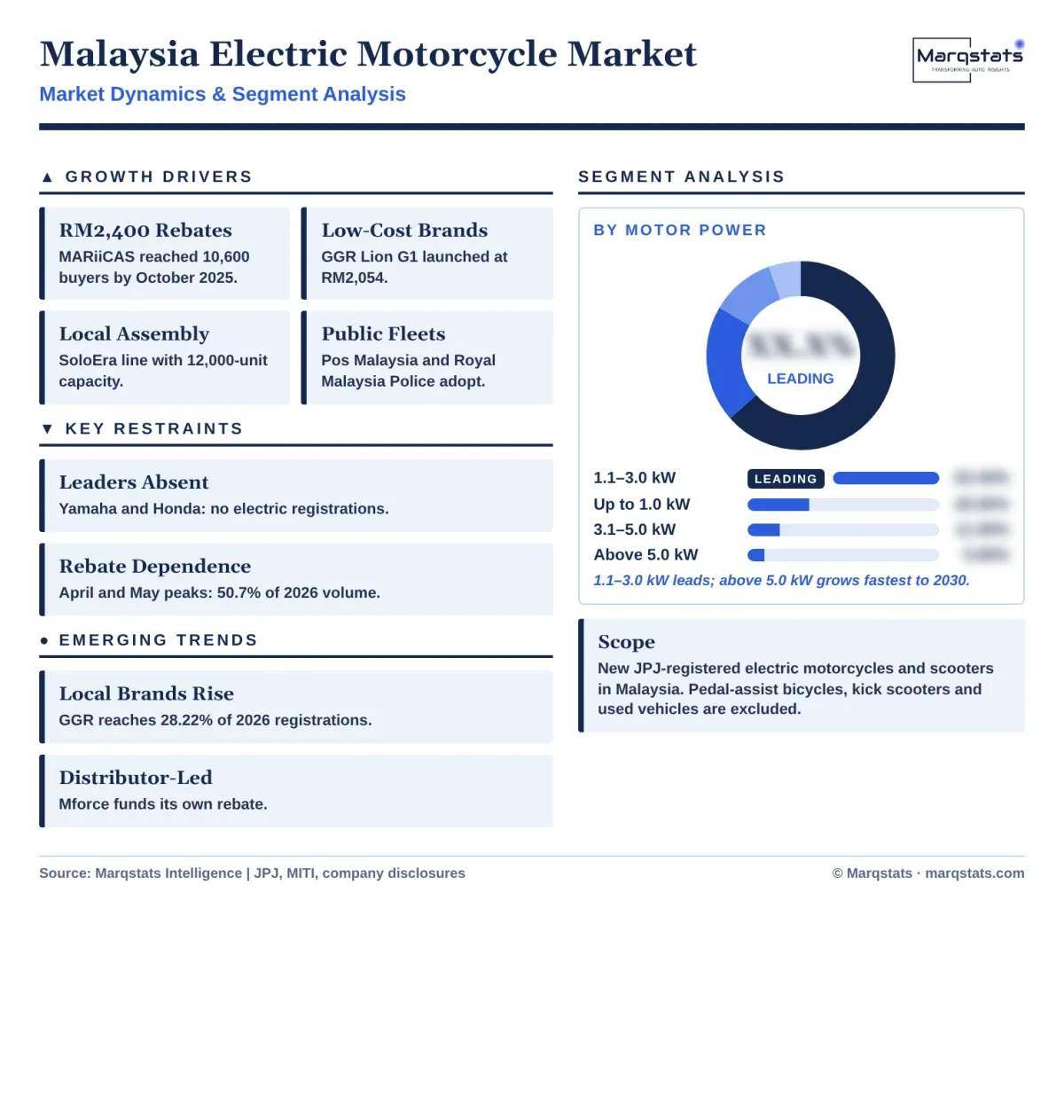
The 1.1–3.0 kW band is the dominant segment and covers commuter scooters. It accounts for 6,835 units in 2025, 63.40% of the total, and reaches 32,063 units by 2030 at a 36.22% CAGR, taking 55.70% of the market. Yadea, GGR and Ezi's 2 kW TS1 compete in this band at prices from RM2,054 to RM4,288. The band's share falls from 63.40% to 55.70% by 2030 as buyers trade up to faster scooters.
The up-to-1.0 kW band covers low-speed scooters for short trips. It accounts for 2,156 units in 2025, 20.00% of the total, and reaches 10,650 units by 2030 at a 37.64% CAGR, taking 18.50% of the market. Low prices and short ranges suit students and town riders. The band grows at 37.64% a year, close to the market, because rebates and low entry prices keep it attractive to first-time riders.
The 3.1–5.0 kW band covers 110 cc-equivalent scooters for daily commuting and deliveries. It accounts for 1,186 units in 2025, 11.00% of the total, and reaches 8,348 units by 2030 at a 47.74% CAGR, taking 14.50% of the market. Zeeho, Superlux and Vmoto models compete here with petrol 110 cc to 125 cc scooters. Its share rises from 11.00% to 14.50% as delivery riders and commuters move to models with highway-capable speeds.
The above-5.0 kW band is the fastest-growing segment. It accounts for 604 units in 2025, 5.60% of the total, and reaches 6,508 units by 2030 at a 60.87% CAGR, taking 11.30% of the market. BMW's CE 04, Blueshark's higher-power models and police and fleet motorcycles such as the Jebatt F29 sit in this band.
Private riders account for most registrations and respond strongly to rebates, as the April and May 2026 peak showed. Students, young workers and first-time buyers favour the lowest-priced models from GGR, Ezi and Yadea.
Fleets and public-sector buyers, including Pos Malaysia and the Royal Malaysia Police, buy higher-power models with service contracts. Fleet registrations are included in JPJ data, so large orders can lift monthly totals.
By Geography
Klang Valley
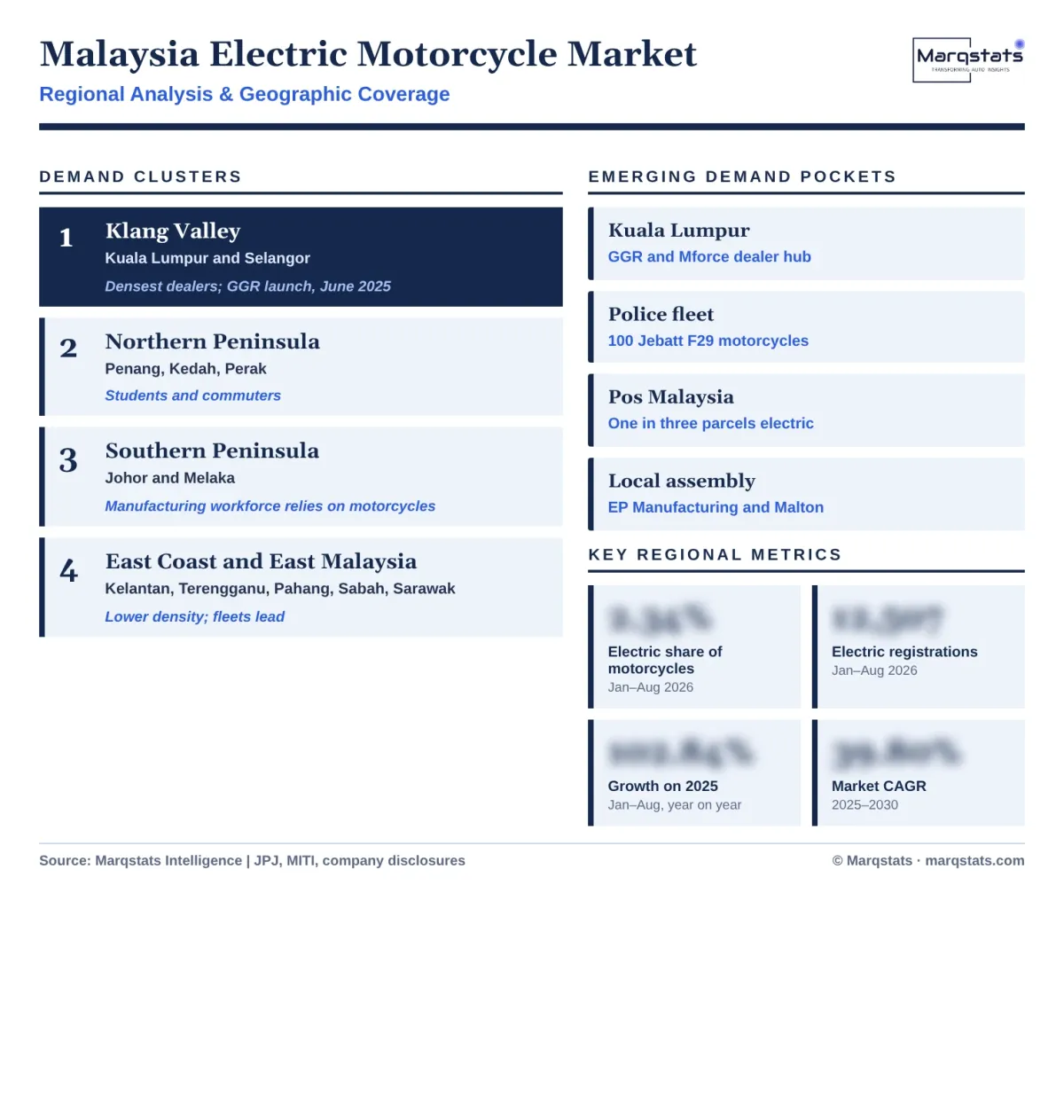
Kuala Lumpur and Selangor form the largest demand cluster, with the densest dealer networks and the June 2025 launch of GGR in Kuala Lumpur. Traffic congestion and short commuting distances favour electric scooters.
Northern Peninsula
Penang, Kedah and Perak form an industrial and university cluster, where commuters and students buy low-cost scooters. Distributor networks such as Mforce's authorised dealers give buyers access outside the capital.
Southern Peninsula
Johor and Melaka combine urban commuting with a large manufacturing workforce that relies on motorcycles. Delivery and courier demand in Johor Bahru supports electric scooters for short urban trips.
East Coast and East Malaysia
Kelantan, Terengganu, Pahang, Sabah and Sarawak form a lower-density cluster where long distances and fewer service points slow adoption. Low-cost models and petrol motorcycles dominate, and electric demand grows from a small base. Fleet and public-sector programmes, such as police and postal fleets, are the most likely early buyers in these states.
How Competition Is Evolving
The market is highly concentrated at the top. Yadea Group Holdings Ltd., GGR Motor and Zeeho took 74.23% of 2025 registrations, and Yadea, GGR and Ezi took 75.9% in January to August 2026. Blueshark, Superlux, Vmoto Limited, Roda Prestasi, Bayerische Motoren Werke AG, Lytron and TAILG make up most of the rest, and 22 maker labels registered at least one electric motorcycle in 2026.
Brand rankings changed quickly between 2025 and 2026. Yadea's share fell from 38.01% in 2025 to 31.68% in January to August 2026 while GGR rose from 24.13% to 28.22%, and Ezi, absent from the 2025 ranking, took 16.01%. Zeeho fell from 12.09% to 9.56%, and Blacknight entered with 400 registrations. The market rewards the lowest-priced new entrants, and no brand has yet built a lasting lead.
Distribution decides competition. Mforce Bike Holdings Sdn. Bhd. distributes Ezi, QJMotor, Yadea and Zeeho through authorised dealers nationwide and funds its own RM2,400 rebate, and PMH Motor distributes GGR. EP Manufacturing Bhd. assembles Blueshark's SoloEra models locally, which gives the brand a manufacturing base and access to local rebate categories.
The premium tier is small and served by a few brands. BMW registered 171 electric motorcycles in 2025, and Blueshark registered 652 with its locally assembled range. Police and postal fleets add demand for higher-power models with service contracts, which favours brands with local assembly and parts stock. The above-5.0 kW band grows from 604 units in 2025 to 6,508 by 2030, which makes it the most attractive tier for brands that cannot win on price.
Petrol market leaders are the main threat and the main opportunity. Yamaha Motor Co., Ltd. and Honda Motor Co., Ltd. hold 64.8% of the motorcycle market without electric models in Malaysia, and DRB-HICOM's Modenas registered 41 electric units in January to August 2026. Their entry would change the market, because their dealers and financing reach buyers that current electric brands do not.
The competitive question to 2030 is whether the rebate-driven brands can keep share without subsidies. GGR and Ezi won share on price, while Blueshark, BMW and Zeeho compete on performance and service. VinFast Auto Ltd.'s planned entry and Malton's local assembly plans add pressure in the commuter tier.
Companies Covered
Companies covered in the report include:
Recent Market Activity
Table of Contents
Coverage & Segmentation
The Malaysia electric motorcycle market comprises new battery electric motorcycles and scooters registered with JPJ, sized in units and in USD at retail selling prices. The market is segmented by motor power into four bands (up to 1.0 kW, 1.1–3.0 kW, 3.1–5.0 kW and above 5.0 kW) and by end use into private riders and fleets and public sector. Regional analysis covers the Klang Valley, the northern peninsula, the southern peninsula and the east coast and East Malaysia.
The base year is 2025, the historical period is 2021–2025 and the forecast period is 2026–2030. Historical volumes follow JPJ registrations by fuel type, and the 2026 estimate scales the January to August 2026 total by the January to August share of 2025 registrations; the 2027–2030 path is a Marqstats construction. Pedal-assist bicycles, kick scooters, used vehicles and petrol motorcycles are excluded. JPJ data record makers and not models, and most registrations are filed under a national business-partner channel, so model detail and regional splits are not available from official data. Maker totals are as reported in the JPJ open dataset and are not independently verified against company sales.