Market Snapshot
Middle bar: base-year value × (1 + CAGR), rounded to two decimals. This is a calculated illustration, not a separately researched annual estimate.
The North America sewer cleaning truck market is estimated at USD 1,504.80 million in 2025 and is projected to reach USD 2,043.58 million by 2030, a CAGR of 6.31%, on new truck deliveries rising from 3,090 to 3,385 units at a 1.84% CAGR. Value compounds well ahead of volume because the average complete truck rises from about USD 486,990 to USD 603,716, as fleets specify water-recycling units and absorb the cost of chassis built to new emissions rules.
Market size and forecast figures are generated using Marqstats' proprietary estimation framework, updated as of October 2026. The estimate is constructed from new truck deliveries by truck type and country, valued at complete-truck prices benchmarked to municipal awards and cooperative contract schedules, and it is most sensitive to federal clean water funding and to the cost of model year 2027 chassis.
The market comprises new truck-mounted sewer cleaning equipment sold as a complete truck with the chassis included, spanning combination sewer cleaners that jet and vacuum in one unit, water-recycling combination units that filter and reuse sewer water for jetting and truck-mounted jetters that clear lines without a debris body. Combination sewer cleaners account for 72.68% of 2025 value at USD 1,093.75 million, municipal and utility owners purchase 65.31% of value and the United States represents 86.97% of the regional total.
Municipal award records document a sustained upward movement in complete-truck pricing across the region. Grosse Pointe Farms, Michigan, paid USD 507,730.58 for a Vactor combination unit in 2024, Ann Arbor approved USD 662,395.74 for a Sewer Equipment jetting and vacuum truck in July 2026 and Savannah approved two Vac-Con units at USD 1,191,208.80 each in August 2026. Federal Signal Corporation, the largest manufacturer, reported a USD 36.3 million increase in sewer cleaner sales in 2025 within record group revenue.
Key Takeaways
Market Overview & Analysis
Report Summary
A sewer cleaning truck clears blockages, roots, grease and sediment from sanitary and storm sewers, and its equipment configuration determines both its price and its role within a maintenance programme. Combination units carry a high-pressure water pump, a hose reel and a vacuum system with a debris body, which allows one crew to jet a line clean and recover the material at the downstream manhole in a single visit. Water-recycling units add a filtration system that reuses water drawn from the sewer for jetting, while truck-mounted jetters carry only the water tank, pump and hose and are deployed for preventive line cleaning where vacuum recovery is not required.
Neither industry bodies nor manufacturers publish North American sewer truck deliveries, and the market size is a Marqstats estimate covering 1,960 combination sewer cleaners, 250 water-recycling units and 880 truck-mounted jetters delivered new in 2025, valued at complete-truck prices benchmarked to municipal awards and cooperative contract schedules. Value includes the chassis because most public buyers procure a complete truck, and the chassis accounts for roughly 28% of the price, or about USD 421 million in 2025.
The outlook rests on three conditions, namely continued replacement of trucks by cities and contractors on eight to fifteen-year cycles, complete-truck price increases of about 5% in 2026 and 4% in 2027 as chassis, metals and emissions costs pass through before settling at about 3% a year, and sustained share gains by water-recycling units over conventional combinations. The body and equipment portion of the market, about USD 1,083 million in 2025, sits within the cranes, aerial devices and vocational equipment slice of the Marqstats North America work truck upfitting estimate, which keeps the two sizings consistent with one another.
The boundary with hydro-excavation is the principal definitional judgement in the sewer cleaning truck market. Many manufacturers build sewer cleaners and hydro-excavators on shared platforms and some buyers use one truck for both tasks, but trucks sold mainly for safe digging around buried utilities, such as Federal Signal's TRUVAC units, are excluded because their demand follows utility locating and construction activity rather than sewer maintenance. Industrial vacuum loaders used in refineries and plants are excluded on the same basis, while a municipal combination unit that performs occasional excavation remains in scope because the buyer specified and funded it as a sewer cleaner.
North America Sewer Cleaning Truck Market Size and Forecast
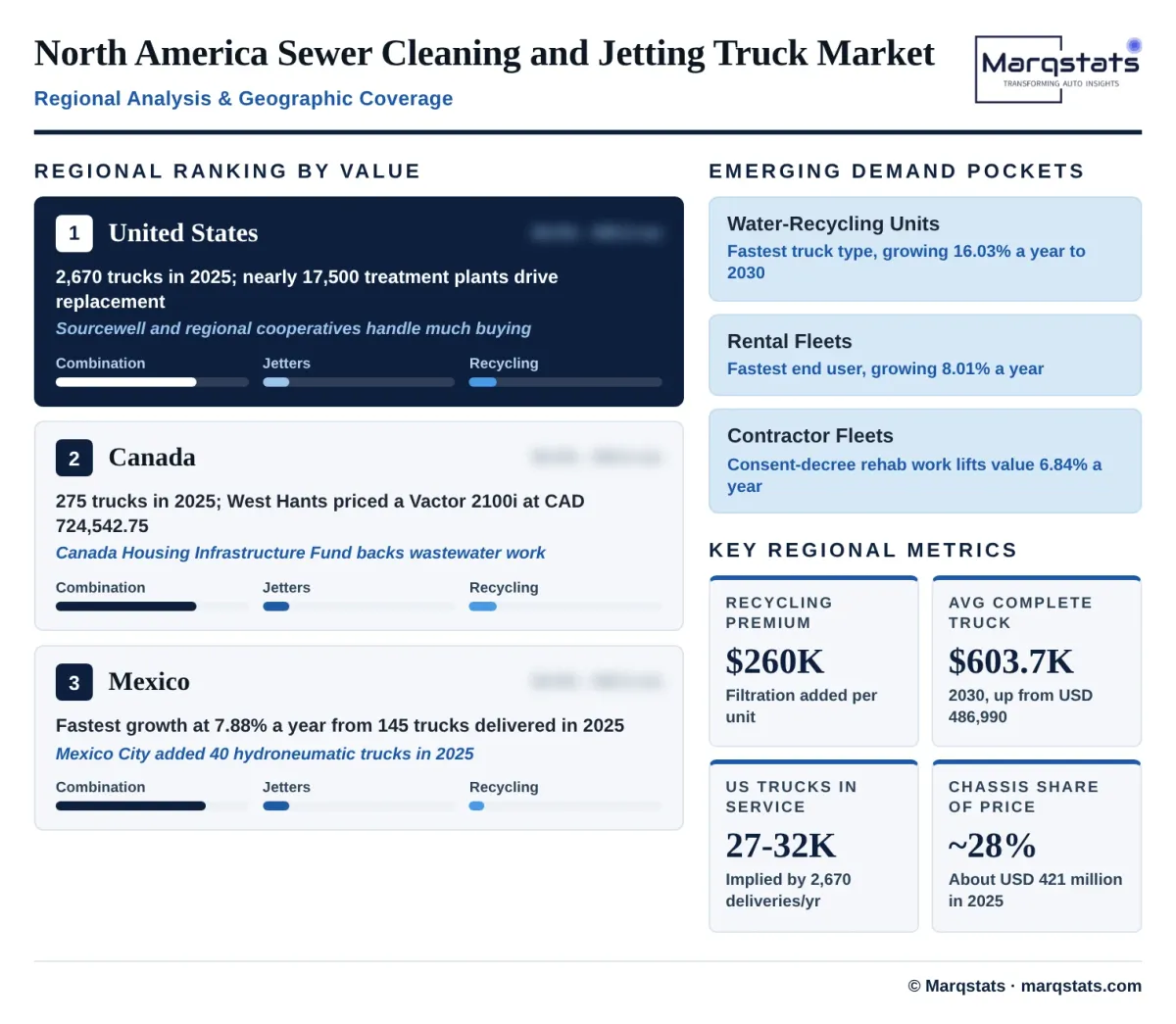
North American buyers took delivery of an estimated 3,090 new sewer cleaning and jetting trucks in 2025, comprising 2,670 units in the United States, 275 in Canada and 145 in Mexico, and deliveries are forecast to reach 3,385 by 2030 at a 1.84% compound annual growth rate. Volume is the anchor series, and value is derived from volume and a weighted average complete-truck price that rises from about USD 486,990 to USD 603,716 across the forecast period.
- 2025: 3,090 trucks, USD 1,504.80 million
- 2026: 3,148 trucks, USD 1,620.09 million
- 2027: 3,052 trucks, USD 1,645.29 million
- 2028: 3,145 trucks, USD 1,759.90 million
- 2029: 3,261 trucks, USD 1,894.77 million
- 2030: 3,385 trucks, USD 2,043.58 million
The 2026 value of USD 1,620.09 million, a 7.66% annual increase, runs ahead of the USD 1,599.75 million implied by the compound growth path, because buyers commit the final year of infrastructure law funding and pull orders forward ahead of model year 2027 engine changes. Deliveries then decline 3.05% to 3,052 trucks in 2027 as that pre-buying unwinds and base revolving fund support remains lower, before annual growth of 3% to 4% resumes from 2028 onward.
The delivery series implies a substantial installed fleet, since at replacement cycles of ten to twelve years, 2,670 US deliveries a year correspond to roughly 27,000 to 32,000 trucks in service. Municipal records confirm long service lives across the buyer base, with Ann Arbor planning an eight-year replacement schedule, Fresno replacing a ten-year-old unit with more than 9,000 operating hours, San Leandro replacing a 2016 unit in 2025 and Grosse Pointe Farms retiring a truck that was 22 years old against a typical 15-year life.
Water Recycling Is the Fastest-Growing Sewer Truck Type
Water-recycling combination units represent the clearest growth segment in the sewer cleaning truck market. They account for 8.09% of 2025 deliveries, or 250 trucks, but 13.64% of value, because the filtration system adds about USD 260,000 to the price of a conventional combination unit. Deliveries rise to 441 by 2030 and value grows from USD 205.20 million to USD 431.54 million at 16.03% a year, lifting the segment to 21.12% of the market.
The commercial case for recycling rests on productive time rather than on equipment cost. A conventional truck must leave the line to refill from a hydrant whenever its fresh-water tank runs dry, which can interrupt a crew several times a shift, whereas a recycling unit filters water from the manhole and reuses it, keeping the truck on station longer and reducing potable water consumption. Federal Signal promotes a water recycler option for its Vactor line and GapVax lists recycling jet-vac units on its cooperative contract, although the benefit depends on filter maintenance, operator training and the frequency with which a crew refills on its own network.
Conventional units continue to carry the market in absolute terms, growing at 4.48% a year from USD 1,093.75 million to USD 1,361.82 million as their average price rises from about USD 558,036 to USD 665,276. Truck-mounted jetters grow at 3.98% a year to USD 250.22 million, a slower trajectory that reflects buyers selecting combination units capable of both jetting and vacuum recovery.
Municipal Awards Place Combination Trucks Above USD 500,000
Published municipal awards show how far complete-truck prices have moved over the past two years. Grosse Pointe Farms approved USD 507,730.58 for a Vactor combination sewer cleaner in August 2024, and Monticello, Iowa, purchased a 2027 Vactor 2100 for USD 555,000 after a USD 35,000 trade-in in February 2026. The Northwest Municipal Conference cooperative schedule for 2025 to 2026 priced 10-yard and 12-yard configurations at USD 617,368.50 and USD 652,075.20, and Fresno approved USD 629,333 for a Vactor unit on a Kenworth T880 chassis in December 2025, inclusive of tax and delivery.
Higher-specification trucks command materially higher prices across the region. San Leandro authorised USD 767,056.60 for a GapVax combination unit on a Freightliner chassis in July 2025, and Ann Arbor approved USD 662,395.74 for a Sewer Equipment body on a Western Star chassis in July 2026. Savannah approved two Vac-Con combination units for USD 2,382,417.59 in August 2026, about USD 1.19 million each, Tampa approved two Vactor 2100i units with a four-year maintenance agreement for USD 1,273,993.14 and, in Canada, West Hants recommended a Vactor 2100i on a Western Star 47X chassis at CAD 724,542.75 in 2024.
Award values reflect specification rather than a list price, since body capacity, pump rating, vacuum type, hose length, winterisation, cameras, chassis choice, trade-ins and service agreements all move the figure, and some awards include tax. The average complete price for a conventional combination unit is therefore about USD 558,036 in 2025, below many individual awards because compact and non-CDL units sell for less, against about USD 820,800 for a recycling unit and about USD 233,920 for a truck-mounted jetter.
Funding Shifts as Infrastructure Law Money Ends
Federal funding exerts more influence on the sewer cleaning truck market than its direct contribution to purchases suggests. Most sewer trucks are bought from local utility capital budgets, but state revolving fund loans and grants release local cash for equipment and for the rehabilitation contracts that keep contractor fleets employed. Congress set the FY2026 Clean Water State Revolving Fund base appropriation at USD 746.1 million, down from USD 1,638.9 million in FY2025, and directed a further USD 892.8 million to earmarked community projects.
The larger funding stream is the infrastructure law supplement of USD 2,603.0 million a year for the clean water fund, which continues through FY2026 and then expires, with about 49% of that money available as grants or principal forgiveness. That expiry accounts for the strength of 2026 and the softness of 2027 in the forecast. Utilities operating under consent decree schedules continue to buy regardless of the funding cycle, whereas smaller towns that relied on forgivable loans are expected to extend truck lives instead.
Operating Cost and Crew Rules Shape the Purchase
Buyers increasingly assess a sewer truck on cost per productive hour rather than on purchase price, a measure that combines annual ownership and finance cost, maintenance, crew labour, fuel, water, disposal and expected downtime and divides the total by the hours the truck spends cleaning. A recycling unit lowers that cost by reducing refill trips, and a compact unit lowers it by reaching lines that a tandem-axle truck cannot access.
Crew regulation weighs on every configuration, beginning with the requirement that trucks above 26,000 lb gross vehicle weight be driven by the holder of a commercial driver's licence, which explains the emergence of non-CDL units. Sewer entry and some manhole work fall under OSHA confined-space rules that require training, gas monitoring and rescue procedures, and debris must be delivered to an approved receiving site where disposal distance can determine whether a crew completes one run or two in a shift. Each of these costs favours trucks that accomplish more per visit, which supports higher average prices across the forecast period.
Market Dynamics
Key Drivers
Five structural forces support growth in the North America sewer cleaning truck market through 2030, led by deteriorating collection networks and the enforcement of overflow controls.
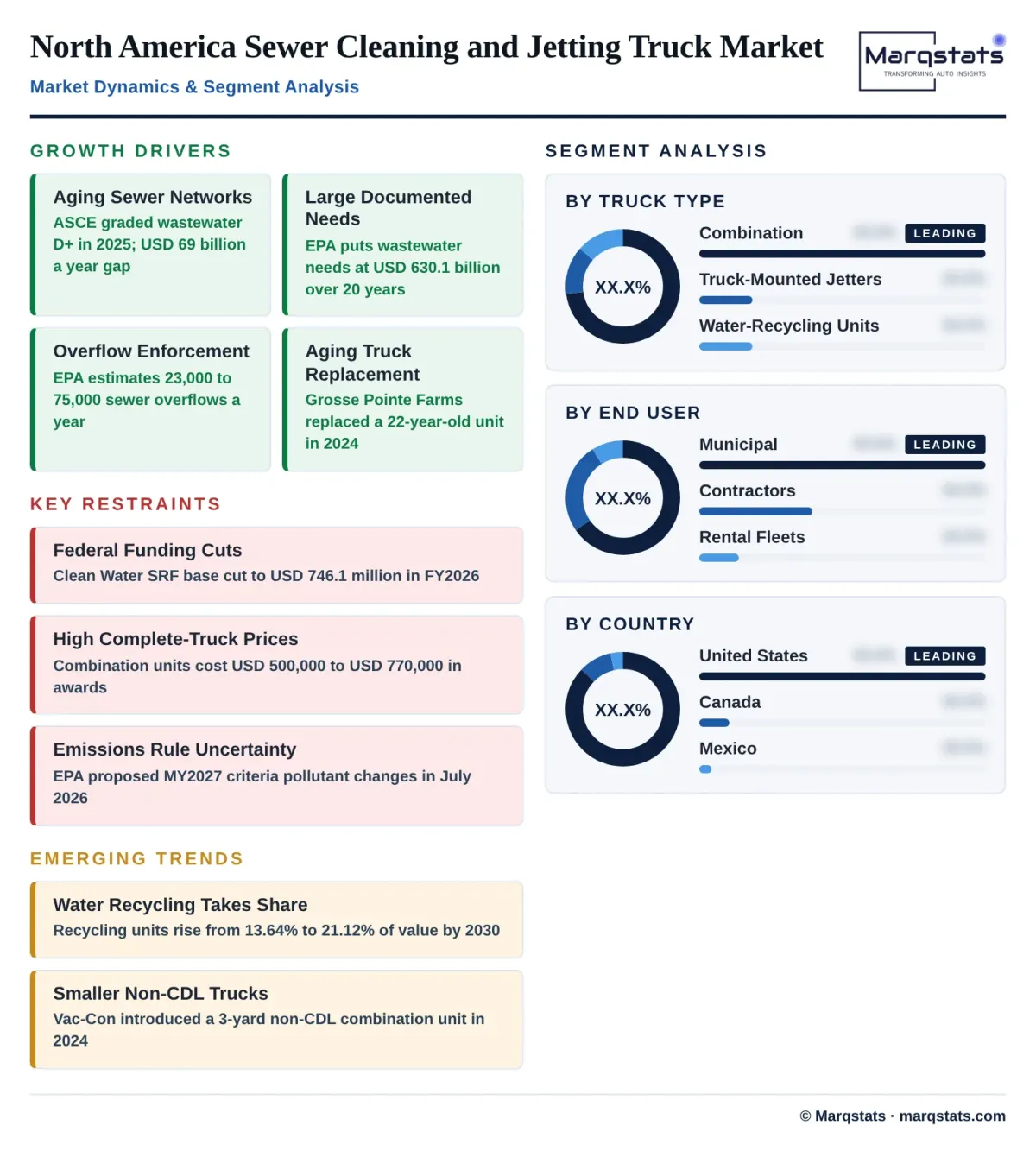
- Aging sewer networks. Wastewater infrastructure earned a D+ grade in the 2025 report card of the American Society of Civil Engineers, with a combined wastewater and stormwater investment gap of USD 69 billion a year, and preventive cleaning remains the lowest-cost means of deferring pipe failures.
- Large documented needs. The EPA Clean Watersheds Needs Survey places US wastewater and stormwater needs at USD 630.1 billion over 20 years, a large proportion of it in the collection systems that sewer cleaning trucks maintain.
- Overflow enforcement. EPA has estimated 23,000 to 75,000 sanitary sewer overflows a year, and consent decrees together with capacity, management, operation and maintenance programmes require utilities to clean lines on fixed schedules.
- Replacement of aging trucks. Buyers replace units after eight to fifteen years, and many fleets operate well beyond that range, as the 22-year-old unit retired by Grosse Pointe Farms in 2024 demonstrates.
- Productivity upgrades. Water-recycling units grow at 16.03% a year through 2030 because they keep crews on station longer and reduce potable water consumption, lifting the segment from 13.64% to 21.12% of market value.
Key Restraints
Four constraints limit growth across the forecast period, and their combined effect is most visible in the 3.05% decline in deliveries projected for 2027.
- Lower federal support. The FY2026 Clean Water State Revolving Fund base appropriation fell to USD 746.1 million from USD 1,638.9 million, and FY2026 is the final year of the USD 2,603.0 million infrastructure law supplement.
- High truck prices. Complete combination units cost USD 500,000 to USD 770,000 in typical awards and above USD 1 million for large or heavily equipped trucks, a price level that strains small municipal budgets.
- Emissions rule uncertainty. EPA rescinded heavy-duty greenhouse gas standards in February 2026 but only proposed changes to model year 2027 criteria pollutant rules in July 2026, leaving buyers without clarity on future chassis costs.
- Operator requirements. Chassis above 26,000 lb gross vehicle weight trigger commercial driver's licence requirements and sewer work falls under OSHA confined-space rules, which raises training costs and constrains crew availability.
Key Trends
Four trends are changing the specifications that municipal and contractor buyers place on new sewer cleaning trucks.
- Water recycling as a mainstream specification. Recycling units rise from 13.64% to 21.12% of market value by 2030, a 7.48-point gain that makes filtration a standard consideration in combination unit tenders.
- Smaller, non-CDL trucks. Vac-Con introduced a 3-yard non-CDL combination unit in 2024, and Vactor markets its compact iMPACT unit for work in narrow streets and alleys where tandem-axle trucks cannot operate.
- Cooperative purchasing. Most recent awards run through Sourcewell contracts, including Vac-Con contract 101221-VAC and Sewer Equipment contract 101221-SCA, and a new Sourcewell sewer cleaning contract for GapVax runs to June 2030.
- Bundled service. Tampa paired its two Vactor 2100i trucks with a four-year maintenance agreement that includes a loaner unit, and Federal Signal grew aftermarket revenue by USD 61.2 million in 2025 as service revenue expanded alongside equipment sales.
Strategic Implications
- Water recycling across body sizes. Recycling units gain 7.48 points of value share by 2030, which favours manufacturers that offer the option across every body size in the fastest-growing segment at 16.03% a year.
- Rental and demonstration fleets. Rental fleet purchases grow at 8.01% a year, and dealer-held rental and demonstration units allow municipal buyers to test trucks on their own networks before committing capital.
- Order timing ahead of model year 2027. Chassis changes for model year 2027 make 2026 prices likely to be the lowest of the forecast period, which favours municipal orders placed before the transition.
- Service priced with the truck. Maintenance agreements and uptime guarantees now feature in municipal awards, as the four-year agreement attached to the Tampa order shows, and suppliers that price service with the truck align with that procurement pattern.
Market Segmentation
Combination sewer cleaners form the largest segment at USD 1,093.75 million, or 72.68% of 2025 value, from 1,960 trucks, and grow at 4.48% a year to USD 1,361.82 million by 2030. The configuration spans compact non-CDL trucks with 3-yard bodies through to 15-yard units on tandem-axle chassis, and Sewer Equipment's Model 900 ECO alone is offered in 6, 9, 12 and 15 cubic yard sizes, which illustrates the breadth of specification within a single product line.
Water-recycling combination units are valued at USD 205.20 million in 2025, or 13.64% of the market, and grow fastest at 16.03% a year to USD 431.54 million by 2030. Large cities and contractors with long daily runs account for most purchases, because those operators recover the greatest amount of refill time per shift.
Truck-mounted jetters are valued at USD 205.85 million in 2025, or 13.68% of the market, from 880 trucks at about USD 233,920 each, and grow at 3.98% a year to USD 250.22 million by 2030. Contractors purchase 38% of jetters and deploy them for preventive cleaning and pre-inspection flushing ahead of camera surveys and pipe lining.
Municipal and utility owners purchase USD 982.83 million, or 65.31% of 2025 value, and grow at 5.85% a year to USD 1,306.26 million by 2030. These buyers procure through council awards and cooperative contracts and retain trucks for eight to fifteen years, so their demand follows capital budgets and replacement schedules more closely than workload.
Contractors account for USD 385.87 million, or 25.64% of value, and grow at 6.84% a year to USD 537.29 million by 2030. Sewer rehabilitation, pipe lining and inspection work commissioned by utilities under consent decrees sustains high utilisation, and contractors replace trucks on accumulated use rather than on age.
Rental fleets purchase USD 136.10 million, or 9.04% of value, and grow fastest among end users at 8.01% a year to USD 200.03 million by 2030. Rental capacity allows cities to cover peak workloads, storm response and the interval while a new truck is on order, and it allows contractors to accept work without committing to a full purchase.
By Geography
United States
The United States holds USD 1,308.65 million, or 86.97% of 2025 value, from 2,670 trucks, and reaches USD 1,770.68 million by 2030 at 6.23% a year. Nearly 17,500 wastewater treatment plants and the collection systems that feed them generate steady replacement demand, with Sourcewell and regional cooperatives such as the Northwest Municipal Conference handling a large share of purchasing, and funding represents the principal risk after base revolving fund support fell sharply in FY2026.
Demand is distributed across thousands of small buyers, ranging from large cities that operate a dozen or more combination units across sewer and stormwater departments, as Savannah's 2026 order for replacements and stormwater fleet additions shows, to small towns that retain a single truck for decades. Southern and western states generate additional storm and flood-response demand, and northern buyers specify winterisation packages that raise average prices.
Canada
Canada accounts for USD 140.05 million, or 9.31% of value, from 275 trucks, and grows at 6.39% a year to USD 190.93 million by 2030. Municipal buyers tender through public portals, and the federal Canada Housing Infrastructure Fund supports water and wastewater upgrades tied to new housing. West Hants, Nova Scotia, recommended a Vactor 2100i at CAD 724,542.75 in 2024 to serve 33 lift stations and more than 106 kilometres of sewer and storm mains, a representative scale for a smaller Canadian municipality.
Mexico
Mexico is the smallest and fastest-growing country market, holding USD 56.10 million, or 3.73% of 2025 value, from 145 trucks and growing at 7.88% a year to USD 81.97 million by 2030. Mexico City placed 40 new hydroneumatic trucks into service in 2025 as part of a MXN 1,595 million flood response package, and its water agency planned a large drain-cleaning programme for January to May 2026, with seasonal flooding and aging drainage in large cities sustaining demand.
How Competition Is Evolving
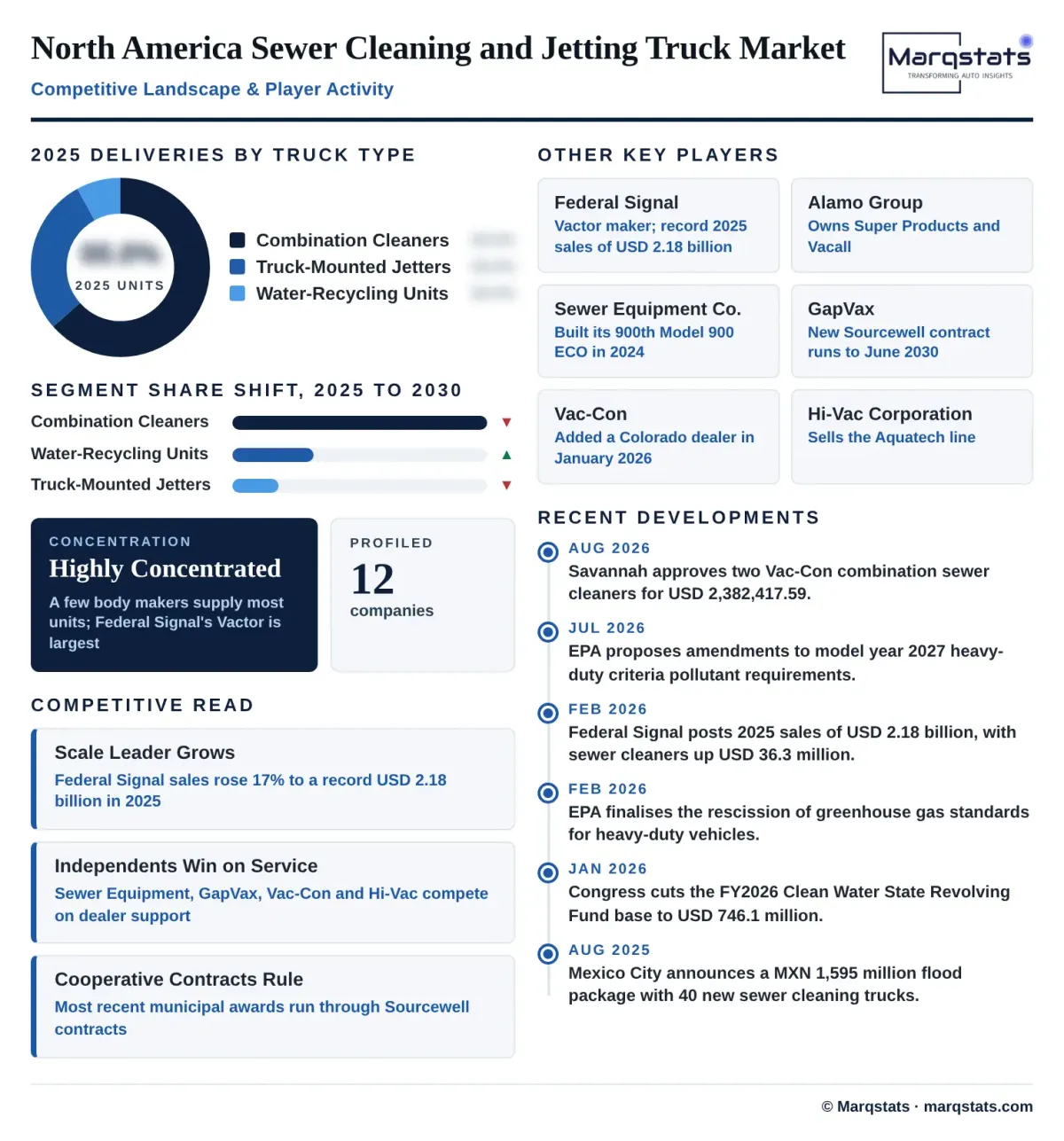
The North America sewer cleaning truck market is highly concentrated, with a small number of body manufacturers supplying most combination units and Federal Signal Corporation, through its Vactor brand, holding the largest position. Unit shares could not be sourced from public disclosure, so competitive position is assessed on reported scale, product breadth and channel strategy rather than on market share.
Federal Signal reported record 2025 sales of USD 2.18 billion, up 17%, with sewer cleaner sales up USD 36.3 million and aftermarket revenue up USD 61.2 million, and it guides 2026 sales of USD 2.55 billion to USD 2.65 billion. Its Environmental Solutions Group also sells Guzzler and TRUVAC vacuum and hydro-excavation trucks and Jetstream waterblasters, and the group owns Joe Johnson Equipment, a Canadian dealer. Super Products and Vacall belong to Alamo Group Inc., whose Industrial Equipment Division grew sales 12.6% to USD 949.7 million in 2025, with double-digit growth in its excavator and vacuum truck business.
Independent manufacturers compete on product specialisation and dealer service rather than on breadth of portfolio. Sewer Equipment Company of America built its 900th Model 900 ECO in 2024, GapVax won a new Sourcewell contract running to June 2030, Vac-Con added a Colorado dealer in January 2026 and Hi-Vac Corporation sells the Aquatech line. Chassis manufacturers including Daimler Truck North America, PACCAR, International Motors and Mack Trucks supply the platforms on which the bodies are built, and dealers such as Haaker Equipment Company and Environmental Products Group win municipal awards through cooperative contracts.
Companies Covered
Companies covered in the report include:
Recent Market Activity
Table of Contents
Coverage & Segmentation
Coverage spans new sewer cleaning and jetting trucks in North America, segmented into the United States, Canada and Mexico, with 2025 as the base year, 2021 to 2025 as the historical period and 2026 to 2030 as the forecast period. Value is expressed in USD million of complete-truck sales including the chassis and excluding sales tax, trade-ins, maintenance agreements and aftermarket parts and service, while volume is measured in new trucks delivered. Segmentation covers truck type across three segments and end user across three segments, and twelve companies are profiled.
Hydro-excavation trucks, industrial vacuum loaders, septic tankers, trailer-mounted jetters, used trucks and rental revenue are excluded and treated as adjacent markets. Prices are benchmarked to municipal awards and cooperative contract schedules, demand context draws on EPA, ASCE and federal appropriations data and company data are taken from annual reports and earnings releases.