Market Snapshot
Middle bar: base-year value × (1 + CAGR), rounded to two decimals. This is a calculated illustration, not a separately researched annual estimate.
The North America work truck upfitting market is estimated at USD 14.99 billion in 2025 and is projected to reach USD 20.22 billion by 2030, a CAGR of 6.17%, on completed upfits rising from 611,114 to 695,798 at a 2.63% CAGR. Value therefore compounds well ahead of volume, because equipment content and installed prices per job rise faster than the number of chassis. The defining feature of the market is the concentration of value at the top of the weight range, where Class 8 vocational trucks account for 12.51% of completed upfits but 36.89% of 2025 value.
Market size and forecast figures are generated using Marqstats' proprietary estimation framework, updated as of October 2026. The estimate is constructed from published chassis sales by weight class in the United States, Canada and Mexico together with installed upfit values observed in municipal procurements and dealer listings, and it is most sensitive to Class 8 vocational chassis volumes.
The market measures the incremental value that truck upfitters add to a bare chassis, comprising work bodies, installed vocational equipment such as cranes, aerial devices, hoists and plows and the engineering and installation labour that converts a chassis cab into a work-ready vehicle, with the chassis itself excluded. On that basis the US upfit layer of USD 13.44 billion is equivalent to about 8% of the USD 168.8 billion that NTEA reported for broad US work truck industry sales in 2024, a total that includes the chassis.
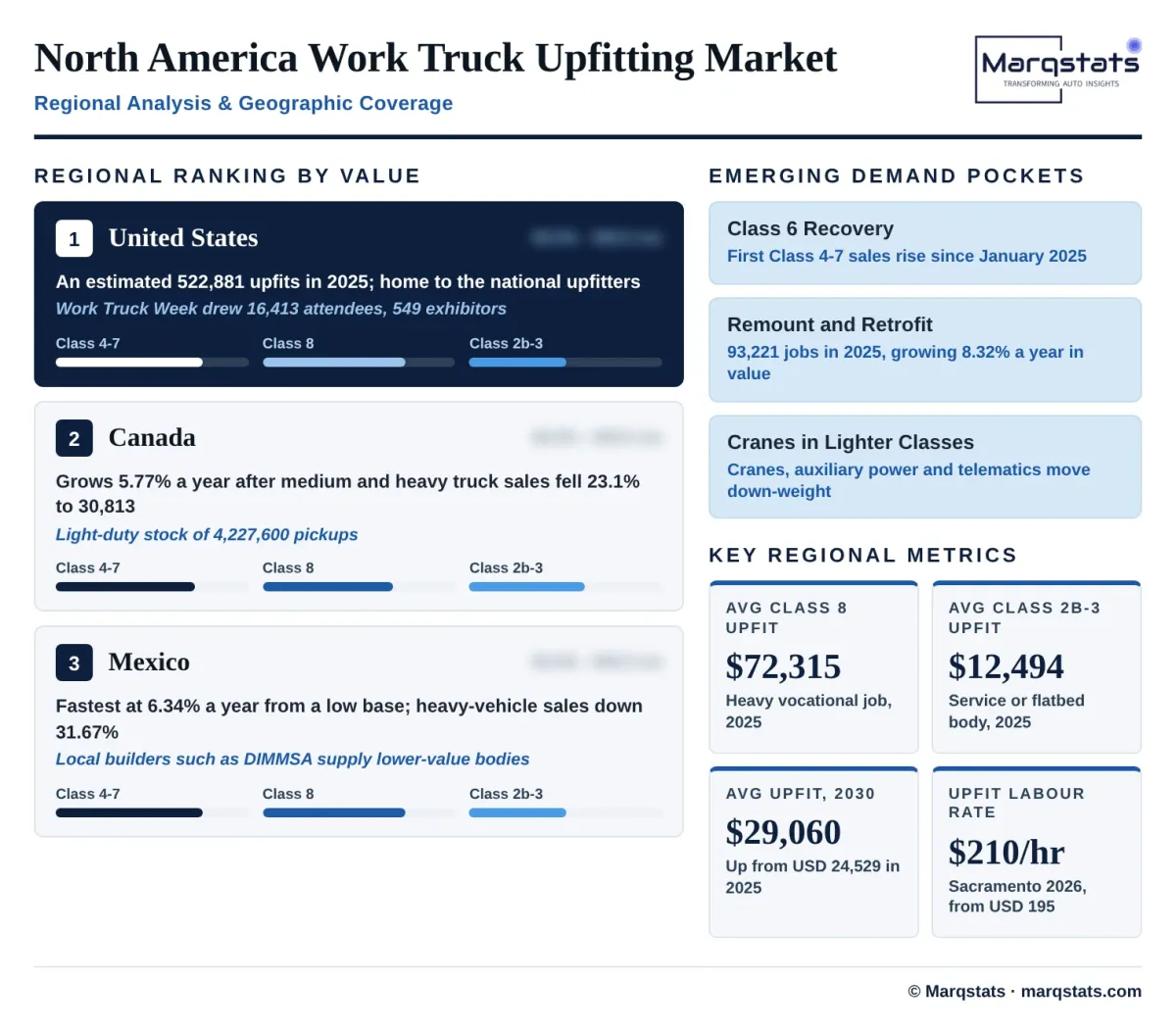
Heavy vocational trucks carry a disproportionate share of value, with an average Class 8 upfit worth about USD 72,315 against USD 12,494 for a Class 2b-3 service or flatbed body. Medium-duty Class 4-7 trucks nonetheless form the largest value class at USD 5.73 billion, or 38.23% of the total, and the United States accounts for 89.66% of regional value on the strength of its national upfitter base and OEM ship-through programmes.
Chassis supply turned against the market in 2025 and 2026, as US Class 8 retail sales fell 13.3% to 208,386 in 2025, Canadian medium and heavy truck sales fell 23.1% to their lowest level since 2010 and Mexican heavy-vehicle retail sales fell 31.67%. Value nonetheless holds almost flat at USD 14.96 billion in 2026, because installed upfit prices absorb steel, aluminium and imported-truck tariffs while completed upfits decline 4.75%.
Key Takeaways
Market Overview & Analysis
Report Summary
Work truck upfitting converts a commercial chassis into a vehicle equipped for a specific task, and the market spans four upfit types. Service and utility bodies form the first; cargo bodies, including dry-freight and refrigerated van bodies and box, flatbed and stake bodies, form the second; dump and material-handling bodies with hoists and plows form the third; and cranes, aerial devices and other chassis-mounted vocational equipment such as mixers and refuse bodies form the fourth. The scope includes engineering and installation labour and the remounting of existing bodies onto new chassis, while the chassis, trailers, cargo-van interior shelving and loose accessories sold without installation are excluded.
No public body publishes an upfit total for North America and NTEA shipment surveys circulate only to members, so the market size is a Marqstats construction calibrated to published chassis sales by weight class in the United States, Canada and Mexico. Average incremental upfit values are anchored to published municipal procurements and dealer listings, and retrofit and remount activity is sized in proportion to new-vehicle upfits.
The forecast depends on three conditions, the first being a recovery in chassis sales from the 2025 and 2026 decline that returns completed upfits to 2025 levels in 2027. The second is installed price growth of about 4.5% in 2026 on tariffs and about 3% a year thereafter, and the third is a rise in content per upfit of about 0.8% a year as cranes, auxiliary power and electronics spread into lighter weight classes. An extension of the 2026 chassis slump into 2027 would fall hardest on Class 8 dump and vocational bodies, where value per job is highest.
The analysis is directed at body and equipment manufacturers allocating capacity across weight classes, national upfitters competing for OEM ship-through and pool-stock volume, fleet buyers comparing installed quotations under a shifting duty schedule and investors weighing remount and service capacity against exposure to the new-vehicle upfit cycle.
North America Work Truck Upfitting Market Size and Forecast
Volume is the anchor series, and value is derived from completed upfits and an average incremental value per job that rises from about USD 24,529 in 2025 to USD 29,060 in 2030, an increase of 3.45% a year. Truck upfitters in the United States, Canada and Mexico completed an estimated 611,114 work truck upfits in 2025, comprising 517,893 new-vehicle upfits and 93,221 retrofit or remount jobs, and each upfit is counted as one completed job on one chassis regardless of the number of components installed.
Completed upfits fall to 582,078 in 2026 as chassis sales remain weak and value eases to USD 14.96 billion, before the chassis recovery lifts the market to 616,227 upfits and USD 16.33 billion in 2027. The series then advances to 645,787 upfits and USD 17.65 billion in 2028, 670,312 upfits and USD 18.89 billion in 2029 and 695,798 upfits and USD 20.22 billion in 2030, a 2.63% compound annual growth rate in volume against 6.17% in value.
The chassis base beneath the series remained broad at the light end and contracted at the heavy end in 2025. US Class 4-7 retail sales totalled about 208,065 units, of which an estimated 85% receive a body or vocational equipment, while an estimated 27% of the 208,386 US Class 8 retail sales were vocational straight trucks rather than tractors, and about 210,000 Class 2b-3 chassis cabs and heavy-duty pickups are estimated to have received a work body. General Motors alone sold 206,184 Silverado HD and 118,066 Sierra HD pickups in 2025, and Ford reported its best Super Duty year since 2004.
Light-duty upfits grow fastest in count, from 298,540 in 2025 to 350,470 in 2030, because pickup and chassis-cab demand held up in 2025 while medium and heavy chassis sales declined. The light-duty share of value rises accordingly, from 24.88% to 26.31% over the forecast period.
Heavy Vocational Trucks Are One Upfit in Eight but More Than a Third of Value
Value in the North America work truck upfitting market is concentrated at the top of the weight range to a degree that job counts conceal. Class 8 vocational trucks account for 76,471 of 611,114 completed upfits in 2025, or 12.51%, but USD 5.53 billion of USD 14.99 billion in value, or 36.89%, with the average heavy upfit worth about USD 72,315 against about USD 24,269 for a Class 4-7 upfit and about USD 12,494 for a Class 2b-3 upfit.
Public procurement records illustrate the spread, beginning with the City of Little Rock, which in July 2026 approved USD 148,300 for two 12-yard dump beds on 2027 International chassis from Brown's Dump Bodies Inc., or about USD 74,150 each. In December 2025 the same city authorised USD 198,937 for an Altec Industries bucket truck with chipper bed through a Sourcewell cooperative contract, whereas an 11-foot Knapheide steel service body for a one-ton chassis was advertised at USD 12,487 in 2026 before installation.
The commercial consequence is that the Class 8 cycle matters more to supplier revenue than the count of jobs suggests, since a 10% fall in heavy vocational chassis removes roughly as much upfit value as a 15% fall in light-duty bodies. Suppliers weighted toward dump, crane and aerial work therefore carry materially greater cyclical exposure than those weighted toward service bodies on one-ton trucks.
Tariffs Hold 2026 Value Flat While Completed Upfits Fall
Chassis demand weakened through the first half of 2026, with US Class 8 retail sales falling 12.9% to 93,866 and US Class 4-7 sales remaining below the prior year for 17 consecutive months until July 2026, when they rose 4.8% to 18,023 on Class 6 strength. Completed upfits are forecast to fall 4.75% in 2026 to 582,078, with Mexico and Canada declining faster than the United States.
Installed prices move in the opposite direction, beginning with the 25% Section 232 tariff on imported medium and heavy trucks above 10,000 pounds that took effect on 1 November 2025 and covered a flow the Commerce Department put at about 245,000 trucks worth more than USD 20 billion in the preceding year. Steel, aluminium and derivative tariffs were adjusted again in June 2026 and an additional tariff on certain Canadian goods was announced in July 2026, so installed upfit prices are estimated to rise 4.5% in 2026, leaving value almost flat at USD 14.96 billion, a 0.20% decline.
The 2026 value sits below the CAGR path of USD 15.91 billion and represents a cyclical trough, with value recovering 9.16% to USD 16.33 billion in 2027 as chassis sales return. The degree of pass-through is a commercial outcome rather than the statutory rate, because contract escalation clauses, inventory timing and domestic sourcing determine how much of each duty ultimately reaches the fleet buyer.
Regulation Shapes Who Can Upfit and What It Costs
Every upfitter that completes or alters a vehicle in the United States assumes certification duties as a final-stage manufacturer or alterer under 49 CFR Parts 567 and 568, while Canadian work falls under the Canada Motor Vehicle Safety Standards and the National Safety Mark framework and Mexican heavy-diesel chassis are subject to NOM-044 emissions rules. These requirements favour upfitters with repeatable engineering documentation and penalise one-off fabricators, which rewards scale in engineering and compliance as much as scale in fabrication.
The emissions outlook shifted in 2026, when the US Environmental Protection Agency finalised the rescission of vehicle greenhouse-gas standards in February and, on 14 July 2026, proposed amendments to how model-year 2027 heavy-duty criteria-pollutant rules are implemented, a proposal that stops short of a final repeal. The federal 45W commercial clean vehicle credit is unavailable for vehicles acquired after 30 September 2025, and the combined effect is to slow the electric work truck case and remove the incentive-driven pull-forward that had supported some 2025 orders.
Tax and weight rules further shape the installed cost, since the 12% federal excise tax applies to the first retail sale of qualifying heavy chassis and bodies, subject to weight-based exclusions, and every installed body must remain within gross vehicle and axle ratings. Upfit design therefore trades payload against equipment, which is one reason aluminium bodies and composite components continue to gain ground across the weight classes.
Five Cost Layers Determine the Installed Price of a Truck Upfit
An installed truck upfit price comprises five cost layers, and buyers who compare only the body price overlook most of the variance between quotations. The first layer is equipment and fabrication, covering steel or aluminium, compartments, shelving, hydraulics, cranes, generators and power take-off systems, while the second is integration, covering engineering, brackets, harnesses, welding, paint and the programming of chassis electronics, where custom jobs consume far more engineering and skilled labour than repeat fleet specifications.
The third layer is fulfilment, comprising chassis transfer, freight, storage, financing and delivery, and its long work-in-progress cycles tie up capital, which is why OEM ship-through and pool-stock programmes matter as much to upfitters as to fleets. The fourth is ownership cost after delivery, including fuel, payload lost to body weight, maintenance, downtime and insurance, so the lowest installed quotation does not necessarily deliver the lowest lifecycle cost. The fifth is tax and trade, spanning sales tax, the federal excise tax on heavy trucks and bodies and import duties that differ between an imported completed truck, a domestic body made from imported metal and a separately imported component.
Published contracts demonstrate the width of the range, with Sacramento's 2026 body and upfitting agreements billing labour at USD 195 to USD 210 an hour, an 11-foot steel service body listing at USD 12,487 before installation and a municipal 12-yard dump bed costing about USD 74,150 installed on a new chassis. Fleet buyers obtain the most reliable comparison from a normalised quotation that specifies the same body, the same equipment, the same delivery terms and the same treatment of tax and duty changes after order.
Market Dynamics
Key Drivers
Five demand forces support growth in the North America work truck upfitting market through 2030, led by a wide light-duty chassis base and rising equipment content per job.
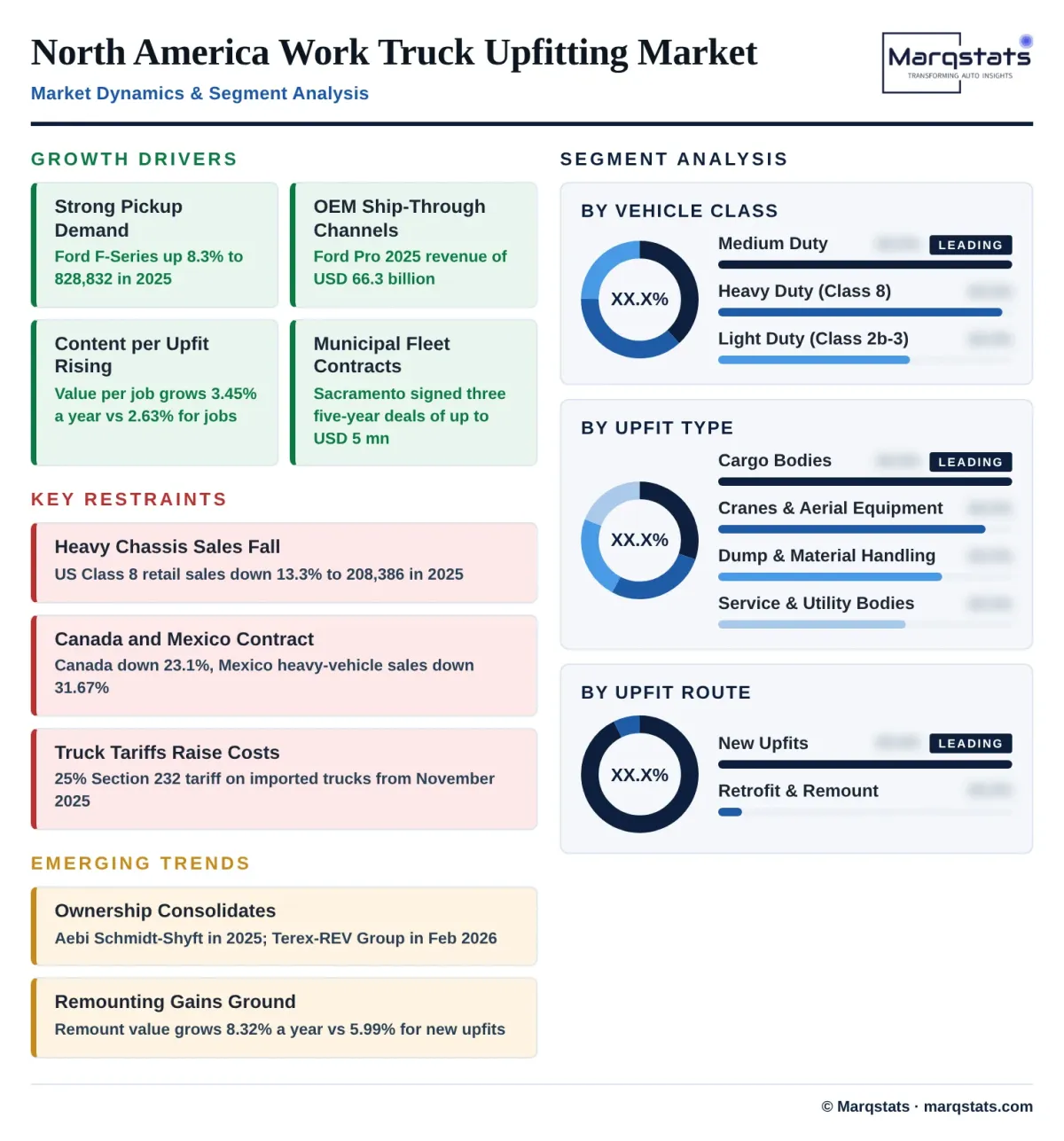
- Sustained pickup and chassis-cab demand at the light end. Ford F-Series sales rose 8.3% to 828,832 in 2025, Ford reported Super Duty growth of 9.5% and General Motors sold 324,250 Silverado HD and Sierra HD pickups, which keeps the Class 2b-3 upfit base wide entering the forecast period.
- Rising equipment content per upfit across weight classes. Cranes, auxiliary power, compressors, lighting and telematics are moving into lighter classes, lifting value per job by about 3.45% a year between 2025 and 2030 against 2.63% annual growth in completed upfits.
- OEM ship-through channels pulling upfit into the vehicle order. Ford Pro reported 2025 revenue of USD 66.3 billion and EBIT of USD 6.843 billion, and its ship-through programme routes chassis to approved upfitters before delivery, embedding the upfit in the original vehicle order.
- Capacity and geographic reach added by national upfitters. Reading Truck reached 28 facilities after acquiring General Body Manufacturing in February 2024, and Knapheide described a network of more than 250 distributors, more than 20 equipment centres and three plants in January 2024.
- Continued municipal and utility procurement through cooperative contracts. Sacramento signed three five-year body and upfitting agreements of up to USD 5 million each in June 2026, with labour billed at USD 195 to USD 210 an hour, giving upfitters multi-year visibility on public fleet demand.
Key Restraints
Four constraints restrain the market, three of which sharpened during 2026 as chassis supply weakened and trade costs rose.
- Falling heavy chassis sales in the United States since 2025. US Class 8 retail sales dropped 13.3% to 208,386 in 2025 and a further 12.9% in the first half of 2026, reducing the number of high-value vocational upfits available to body and equipment suppliers.
- Sharp chassis market contraction in Canada and Mexico during 2025. Canadian medium and heavy truck sales fell 23.1% to 30,813 in 2025, and Mexican heavy-vehicle retail sales fell 31.67% to 39,833 according to ANPACT, compressing upfit demand in both countries.
- Tariffs raising input costs and complicating fleet quotations. The 25% Section 232 truck tariff effective from November 2025 and the June 2026 metal tariff changes require upfitters to classify each imported item rather than apply a single rate across a quotation.
- Skilled labour and engineering lead time limiting installation capacity. Upfit labour is billed at USD 195 to USD 210 an hour on Sacramento's 2026 contracts, and the availability of skilled installers and engineering hours limits how quickly backlogs clear when chassis supply recovers.
Key Trends
Four structural shifts are changing how work truck upfits are purchased, engineered and delivered across North America.
- Ownership consolidation among body makers and equipment suppliers. Aebi Schmidt Group completed its merger with The Shyft Group on 1 July 2025 and Clarience Technologies acquired Ranger Design in January 2025, while Terex completed its merger with REV Group on 2 February 2026.
- Supplier expansion into lifting and lube body equipment. Stellar Industries acquired Elliott Machine Works in 2024 and announced an agreement to acquire Elliott Equipment Company in December 2025, extending its service and lube body range into lifting equipment.
- Launch of heavier and more specialised body designs by national builders. Reading Truck introduced its Combo, RHD46 and RHD67 bodies at Work Truck Week in March 2026, aimed at heavier and more specialised work configurations.
- Growing use of remounting as chassis prices rise. Higher chassis prices make it more economical to move a sound body onto a new truck, and retrofit and remount value grows at 8.32% a year against 5.99% for new-vehicle upfits.
Strategic Implications
- Capacity weighting toward Class 4-7 for body and equipment makers. Medium-duty upfits form the largest value class at USD 5.73 billion in 2025, and the first year-on-year rise in US sales came from Class 6 in July 2026, which favours capacity aligned to that weight band.
- OEM ship-through and pool access as the volume determinant for national upfitters. Upfitters approved for chassis pools and ship-through programmes are positioned to convert more of the 2027 recovery, when value rises 9.16% to USD 16.33 billion, than those dependent on local dealer orders.
- Quotation discipline against the duty schedule for fleet buyers. The estimated 4.5% price increase in 2026 is a pass-through decision rather than a fixed rate, so fleet contracts benefit from specifying whether a price includes imported parts and which party carries tariff changes after order.
- Remount and service capacity as the steadier asset for investors. Retrofit and remount value grows fastest at 8.32% a year, and installed-base service is less tied to the chassis cycle than new-vehicle upfits, which grow at 5.99% a year.
Market Segmentation
Light-duty upfits are valued at USD 3.73 billion in 2025, or 24.88% of the market, and grow fastest among vehicle classes at a 7.36% CAGR to USD 5.32 billion, or 26.31% of value, by 2030. The class is also the largest by count, with 298,540 completed upfits in 2025, concentrated in service, flatbed and stake bodies on one-ton chassis cabs and on heavy-duty pickups after box removal.
Medium-duty upfits constitute the largest value class at USD 5.73 billion in 2025, or 38.23% of the market, and rise at a 6.28% CAGR to USD 7.77 billion, or 38.43% of value, by 2030. The class spans box and refrigerated van bodies, mechanics bodies, crane bodies and small dump bodies, and it accounted for 236,103 completed upfits in 2025.
Heavy-duty upfits account for USD 5.53 billion in 2025, or 36.89% of value, and grow at a 5.21% CAGR, the slowest rate among vehicle classes, to USD 7.13 billion, or 35.26% of value, by 2030. With 76,471 upfits at an average value of about USD 72,315, the class is dominated by dump, mixer, refuse, crane and aerial applications.
Service and utility bodies are valued at USD 2.89 billion in 2025, or 19.28% of the market, and record the fastest growth among upfit types at a 6.88% CAGR to USD 4.03 billion, or 19.93% of value, by 2030. Growth tracks the expanding light-duty base and rising compartment, drawer and crane content on mechanics bodies.
Cargo bodies form the largest upfit type at USD 4.53 billion in 2025, or 30.22% of value, rising at a 6.41% CAGR to USD 6.18 billion, or 30.56% of value, by 2030. Dry-freight and refrigerated van bodies on Class 4-7 chassis generate most of the segment value, while flatbed and stake bodies are concentrated in Class 2b-3.
Dump and material-handling bodies account for USD 3.45 billion in 2025, or 23.02% of value, and grow at a 5.78% CAGR to USD 4.57 billion, or 22.60% of value, by 2030. Municipal dump-and-plow packages range from about USD 74,150 for a 12-yard bed to roughly USD 95,000 with hoist and front plow, which places the segment among the highest-value applications per job.
Cranes, aerial devices and vocational equipment are valued at USD 4.12 billion in 2025, or 27.48% of the market, rising at a 5.72% CAGR to USD 5.44 billion, or 26.90% of value, by 2030. The segment is concentrated in Class 8 and utility work, where a bucket truck with chipper bed can cost close to USD 200,000.
New-vehicle upfits account for USD 13.87 billion in 2025, or 92.53% of value, and grow at a 5.99% CAGR to USD 18.55 billion, or 91.74% of value, by 2030. The route comprises ship-through, pool-stock and dealer-ordered upfits completed before first delivery and covered 517,893 jobs in 2025.
Retrofit and remount upfits account for USD 1.12 billion in 2025, or 7.47% of value, and grow fastest among routes at an 8.32% CAGR to USD 1.67 billion, or 8.26% of value, by 2030. The route covers the transfer of existing bodies to new chassis and the addition of equipment to trucks already in service, with 93,221 jobs in 2025 at an average value of about USD 12,014.
By Geography
United States
The United States holds USD 13.44 billion in 2025, or 89.66% of regional value, and grows at a 6.19% CAGR to USD 18.15 billion, or 89.76% of value, by 2030. The country completed an estimated 522,881 upfits in 2025 and hosts the principal national upfitters, the OEM ship-through programmes and the NTEA Work Truck Week, which drew 16,413 attendees and 549 exhibiting companies in 2025.
Canada
Canada accounts for USD 1.05 billion in 2025, or 7.00% of value, and grows at a 5.77% CAGR, the slowest of the three countries, to USD 1.39 billion, or 6.87% of value, by 2030. Statistics Canada reported 30,813 medium and heavy truck sales in 2025, down 23.1%, against a light-duty stock of 4,227,600 pickups, and Drive Products, whose brands include Voth and ORO Design, ranks among the national upfit suppliers.
Mexico
Mexico accounts for USD 0.50 billion in 2025, or 3.34% of value, and grows fastest at a 6.34% CAGR to USD 0.68 billion, or 3.36% of value, by 2030. ANPACT reported heavy-vehicle retail sales of 39,833 in 2025, down 31.67%, and production of 138,954, down 34.8%, while local body builders such as DIMMSA supply specialised bodies at lower average values than US upfitters.
How Competition Is Evolving
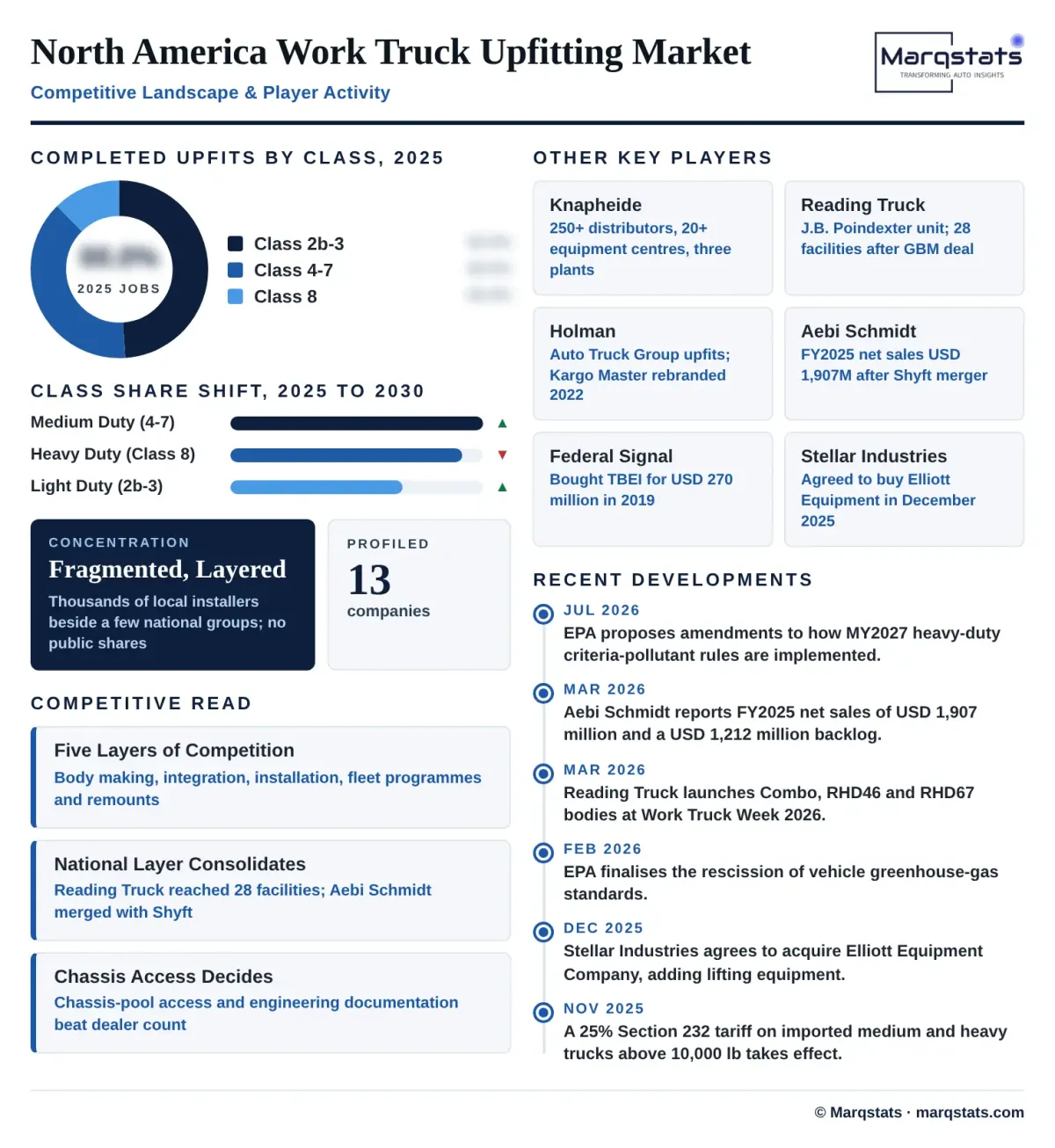
The North America work truck upfitting market is fragmented, with thousands of local distributors and installers operating alongside a small number of national groups. Upfit market shares could not be sourced from any public disclosure, so competition is assessed by layer across body and component manufacturing, engineering and final-stage integration, regional installation, national fleet programme management and repair and remount service. A body maker and a national installer can act as partners on one fleet contract and as rivals on the next, which makes channel position as consequential as product range.
Consolidation is concentrating the national layer of the market, where The Knapheide Manufacturing Company combines body plants with company-owned equipment centres and a distributor network. Reading Truck Group, a business unit operating within J.B. Poindexter & Co., reached 28 facilities after acquiring General Body Manufacturing in February 2024, while Holman runs design, manufacturing and installation through Auto Truck Group and rebranded Kargo Master as Holman in 2022. Aebi Schmidt Group, formed when Aebi Schmidt merged with The Shyft Group in July 2025, reported FY2025 net sales of USD 1,907 million and cited weakness in truck bodies at the legacy Shyft business, which had acquired Independent Truck Upfitters in August 2024.
Equipment specialists are broadening their ranges through acquisition. Federal Signal Corporation owns Truck Bodies and Equipment International, acquired for USD 270 million in 2019, and Stellar Industries added Elliott Machine Works before agreeing to acquire Elliott Equipment Company in December 2025. Clarience Technologies acquired Ranger Design in January 2025 to combine upfit storage with its safety and lighting brands, and Terex Corporation absorbed REV Group in February 2026. Competitive strategy across the market turns on chassis-pool access, installer capacity, engineering documentation and national-account retention rather than on a larger dealer count.
Companies Covered
Companies covered in the report include:
Recent Market Activity
Table of Contents
Coverage & Segmentation
Coverage spans the North America work truck upfitting market across the United States, Canada and Mexico, with 2025 as the base year, 2021 to 2025 as the historical period and 2026 to 2030 as the forecast period. Value is expressed in USD billion of incremental upfit revenue, excluding the chassis, sales tax and federal excise tax, and volume in completed upfits, with segmentation across three vehicle classes, four upfit types and two upfit routes and thirteen companies profiled.
Chassis, trailers, cargo-van interior shelving and racking, loose accessories sold without installation, complete fire apparatus and ambulances and police and emergency equipment packages fall outside the scope. US Class 4-7 volumes are compiled from monthly retail reports, Canadian figures draw on Statistics Canada new vehicle sales and registrations and Mexican figures on ANPACT retail sales, and all upfit values are stated in nominal US dollars.