Market Snapshot
Middle bar: base-year value × (1 + CAGR), rounded to two decimals. This is a calculated illustration, not a separately researched annual estimate.
The India truck body building market is estimated at USD 2,455.18 million (INR 20,991.80 crore) in FY2026 and is projected to reach USD 3,673.90 million (INR 33,138.54 crore) by FY2031, a CAGR of 8.39% in US dollars and 9.56% in rupees. Truck bodies fitted rise from 407,160 to 511,359 over the same period, a 4.66% CAGR, while OEM fully built vehicles lift their share of body value from 47.35% to 54.92% as fitment migrates from independent fabricators to factory and partner plants.
Market size and forecast figures are generated using Marqstats' proprietary estimation framework, updated as of October 2026. The estimate is constructed from rigid truck sales by class and body type valued at published body price indications, and it is most sensitive to medium and heavy truck demand and to steel-led body price inflation.
The market covers load bodies mounted on rigid trucks above 3.5 tonnes gross vehicle weight, comprising tipper bodies, open cargo and platform bodies, closed container and box bodies, refrigerated and insulated bodies and tanker, bulker and specialist bodies. Road tractors and their trailers, the cab, separately sold hydraulic power take-offs and refrigeration units are excluded. Tipper bodies hold the largest share at 39.95% of FY2026 value, although open cargo bodies are the most common at 44.51% of units, and freight volumes, infrastructure work and cold-chain demand lift both the number and the value of bodies across the forecast.
The channel through which Indian trucks are bodied is changing. About half of Indian trucks have historically left the factory with a fitted body, with the remainder bodied by independent fabricators after sale, but air-conditioned cabins became mandatory for N2 and N3 trucks built from 1 October 2025 and vehicle makers are selling more fully built tippers and cargo trucks. SATRAC opened an INR 250 crore body and trailer plant near Chennai in February 2026, the most recent indication that truck body building in India is moving to industrial scale.
Key Takeaways
Market Overview & Analysis
Report Summary
Truck body building in India is the fabrication of the load-carrying structure on a rigid truck chassis. The chassis maker sells either a fully built vehicle, with the body fitted at its own plant or at a partner plant, or a bare chassis that the buyer takes to a body builder of its choice. The India truck body building market is defined as body-only revenue, excluding the chassis, cab, GST, refrigeration units and separately sold hydraulic equipment, and it includes tipper hoists supplied as part of the body together with new bodies fitted to existing trucks to replace worn or damaged structures.
No public body reports national truck body output, and the market size is a Marqstats construction calibrated to SIAM data, cited in trade press, that put FY2026 medium and heavy truck sales at about 356,000 units including road tractors. The FY2026 base comprises about 292,000 rigid medium and heavy trucks and about 85,000 light trucks of 3.5 to 7.5 tonnes that received new bodies, together with about 30,000 replacement and remount bodies. Body values are anchored to published price indications, including the INR 7 to 10 lakh range for a tipper body quoted by a SATRAC executive in February 2026.
The market is reported on Indian fiscal years, with FY2026 (April 2025 to March 2026) as the base year and FY2027 to FY2031 as the forecast period, shown as 2026 to 2030 in the data panel. Values are converted at INR 85.5 per US dollar in FY2026, moving to INR 90.2 by FY2031, so rupee growth runs about 1.2 points a year ahead of dollar growth. The outlook assumes medium and heavy truck demand grows 5% to 7% in FY2027, in line with April 2026 industry outlooks, and 4% to 6% a year thereafter, with steel-led body price increases of about 4% a year.
India Truck Body Building Market Size and Forecast
Indian vehicle makers and body builders fitted an estimated 407,160 truck bodies in FY2026, of which 377,000 were mounted on new trucks and 30,160 replaced bodies on existing trucks, and output is forecast to reach 511,359 bodies by FY2031, a 4.66% compound annual growth rate. Volume is the anchor series, and value is derived from volume and a weighted average body value that rises from about INR 5.16 lakh in FY2026 to INR 6.48 lakh in FY2031.
The annual path runs from 407,160 bodies worth USD 2,455.18 million (INR 20,991.80 crore) in FY2026 to 428,568 bodies worth USD 2,661.84 million (INR 23,003.61 crore) in FY2027 and 449,005 bodies worth USD 2,892.50 million (INR 25,265.92 crore) in FY2028. The market then reaches 469,971 bodies and USD 3,139.33 million (INR 27,717.07 crore) in FY2029, 490,360 bodies and USD 3,396.76 million (INR 30,312.60 crore) in FY2030 and 511,359 bodies and USD 3,673.90 million (INR 33,138.54 crore) in FY2031, an absolute gain of USD 1,218.72 million across the forecast.
FY2027 tracks the trend line, with value rising 8.42% to USD 2,661.84 million against USD 2,661.17 million on the CAGR path, as truck sales extend the recovery that followed the GST cut of September 2025. Value per body rises faster than volume because box, refrigerated and specialist bodies gain share and steel prices rise, so market value compounds at 8.39% against 4.66% for units, a gap of 3.73 points that reflects specification and mix rather than fleet growth alone.
Medium and heavy trucks carry 77.45% of bodies and 89.31% of value, while light trucks of 3.5 to 7.5 tonnes take 91,800 bodies, mostly open decks and boxes, at an average of about INR 2.4 lakh each. Pickups and small commercial vehicles below 3.5 tonnes fall outside the market because they almost always leave the factory with a standard deck.
Fully Built Trucks Take Share from Independent Fabricators
The India truck body building market is migrating from roadside fabrication into factories. In 2019 only about half of Indian trucks left the factory with a fitted body and cabin, with the remainder bodied after sale, whereas OEM fully built vehicles, including bodies fitted by partner plants under a vehicle maker's programme, account for 47.35% of FY2026 body value and rise to 54.92% by FY2031. The fully built channel grows at 11.66% a year against 4.68% for independent post-sale body building.
Three forces underpin the shift toward factory and partner fitment. Air-conditioned cabins became mandatory for N2 and N3 trucks built from 1 October 2025, and for drive-away chassis the maker must supply a type-approved air-conditioning kit, which narrows the scope for local cab building and encourages fully built sales. Fleet buyers prefer a single warranty, a single invoice and faster delivery, particularly for tippers and cargo trucks, while organised builders such as SATRAC, which supplies Daimler India Commercial Vehicles, Tata Motors, Ashok Leyland, Eicher, Volvo and Scania, now offer the volume and quality that factory programmes require.
Independent fabricators still build almost half of all bodies, competing on customisation, short delivery distance, local repairs and credit, and they dominate open cargo bodies for regional haulage and agriculture. As fully built sales expand, a growing share of independent capacity is likely to move toward replacement bodies, repairs and specialist work.
Replacement fitment provides a stable demand base that the channel shift leaves largely intact. A truck frequently outlives its first body, particularly in tipper and open cargo duty where impact and abrasion wear the structure, and about 30,160 replacement and remount bodies were fitted in FY2026, equivalent to about 8% of new-truck bodies, at about 70% of the value of a new body. Local fabricators win most of this work, because a truck without a body earns nothing and operators favour the builder able to return the vehicle to service within days, so speed and proximity count for more than brand.
Truck Body Costs Turn on Specification Rather Than on Builder
Truck body prices in India span a wide range, and specification determines price more than the identity of the body maker. A SATRAC executive put tipper body prices at INR 7 lakh to INR 10 lakh in February 2026, with the company pricing trailers above INR 15 lakh. Average FY2026 body values stand at about INR 8.5 lakh for a medium or heavy tipper body, INR 2.8 lakh for an open cargo body on a heavy truck, INR 5.0 lakh for a heavy box body, INR 14 lakh for an insulated refrigerated box excluding the refrigeration unit and INR 11 lakh for a tanker, bulker or specialist body.
The cost stack of a truck body comprises five elements. The shell reflects steel or aluminium grade, thickness, cutting yield and scrap, while fabrication and finish cover labour, painting, shot blasting, the mounting subframe, lighting and protection devices. Application equipment covers hydraulic cylinders, refrigeration, tank fittings and discharge systems, and indirect costs include engineering, jigs, compliance, warranty, freight and working capital. Operating cost over the life of the truck then depends on the payload lost to body weight and on the repairs the body requires in service.
Lightweight construction commands a premium only where the operator can carry more legal payload or reduce operating cost. Parcel and retail operators that fill a box before reaching the weight limit value additional cubic capacity and loading speed above kilograms saved, whereas tipper operators prioritise wear resistance and hydraulic reliability.
Type Approval and the GST Reset Favour Documented Builders
AIS-093 sets the construction and approval framework for truck cabs and load bodies in India, and body mounting must respect permissible axle loads and the restrictions specified by the chassis maker. Incomplete final-stage records or unapproved structural changes can delay registration and raise warranty claims, which favours builders with engineering teams and documented processes over informal fabricators.
The tax basis of the market changed when GST on trucks fell to 18% from 28% on 22 September 2025, and industry analyses identify that cut as the main driver of FY2026 demand, with domestic commercial vehicle wholesales up 12.6%. Notification 9/2025 places motor vehicle bodies under heading 8707 and non-agricultural trailers under heading 8716 in the 18% schedule. Body work on a customer's chassis can be treated as a service rather than a supply of goods, which makes correct contract classification a compliance requirement for builders.
The Cab Air-Conditioning Mandate Erodes the Drive-Away Chassis Model
For decades many Indian medium and heavy trucks left the factory as cowl or drive-away chassis, with the cab and the load body built locally, and that practice is now in decline. The government required air-conditioned cabins on N2 and N3 trucks manufactured from 1 October 2025, and where a truck is still sold as a drive-away chassis, the vehicle maker must supply a type-approved air-conditioning kit for the body builder to install.
The mandate raises the technical threshold for local cab building, since a builder must now integrate a certified kit, wiring and ducting, and an installation error can affect the approval of the vehicle. Most vehicle makers already sell factory cabs on their main models, so the rule mainly removes the remaining cowl-chassis volume. The load body is not directly affected, but buyers who take a factory cab are more likely to take a factory or partner body as well, which reinforces the shift to fully built trucks.
Cabs fall outside the value of the India truck body building market, yet they remain strategically significant, because builders that lose cab work also lose a reason for the customer to visit their premises.
Cold Chain Drives Refrigerated Body Demand
Refrigerated and insulated bodies form a small but fast-growing niche of the market, accounting for 11,815 bodies in FY2026, or about one in thirty-five, at an average value of about INR 10.5 lakh, because insulated panels, doors, floors and sealing cost far more than a steel box. Demand comes from dairy, frozen food, meat, quick-service restaurants and pharmaceuticals, where temperature control is a condition of the contract.
The body and the refrigeration unit are bought together but made by different firms, with box builders supplying the insulated structure and transport refrigeration makers such as Thermo King and Subros supplying the cooling unit. Thermal performance, panel density and door sealing determine how long a load stays at temperature, and buyers increasingly specify documented insulation values rather than a nominal wall thickness.
Market Dynamics
Key Drivers
Five demand, policy and logistics factors support growth in the India truck body building market through FY2031.
- Truck demand recovery. Domestic commercial vehicle wholesales rose 12.6% in FY2026, and industry analyses expect medium and heavy truck volumes to grow 5% to 7% in FY2027, sustaining new-body demand on the rigid truck base.
- Infrastructure and mining activity. Tipper bodies, worth USD 980.95 million in FY2026, grow at 8.44% a year on road building, construction and mineral transport, which keeps the largest body type expanding in step with the market.
- Cold-chain expansion. Refrigerated and insulated bodies grow at 14.50% a year through FY2031 as food, dairy and pharmaceutical distribution expand, the fastest rate of any body type.
- Organised logistics. Parcel and retail fleets buy closed container bodies for security and weather protection, and the segment grows at 9.81% a year as operators standardise on enclosed boxes.
- Lower tax on trucks and bodies. The GST cut to 18% in September 2025 reduced the cost of new trucks and bodies and drove the FY2026 demand recovery.
Key Restraints
Four constraints limit the pace of growth in the market.
- Steel price volatility. Bodies are predominantly steel, and fixed-price orders expose builders to raw-material movements between quotation and delivery, in a market where body prices already rise about 4% a year on steel.
- Working capital. Builders often hold the customer's chassis while awaiting payment, which ties up cash across long fabrication cycles and limits the order book that smaller fabricators can finance.
- Overloading and quality risk. Overloaded configurations and unapproved modifications raise warranty exposure and slow registration under the AIS-093 framework for cabs and load bodies.
- Rupee depreciation. The rupee is assumed to weaken from INR 85.5 to INR 90.2 per US dollar between FY2026 and FY2031, which reduces dollar growth to 8.39% against 9.56% in rupees.
Key Trends
Four trends are reshaping the supply base of the market.
- Industrial-scale body plants. SATRAC opened a robotic welding plant at Sriperumbudur in February 2026 and plans three further facilities in Jamshedpur, Pune and Gujarat backed by INR 900 crore of investment.
- Specialist capacity additions. JCBL Marrel Tippers is adding 60,000 sq ft and then 50,000 sq ft at Oragadam for tipper, tank and bowser bodies, expanding specialist output in Tamil Nadu.
- Component consolidation. JOST completed its acquisition of Hyva, a leading tipper hydraulics supplier, in February 2025, combining coupling systems and tipping hydraulics under one owner.
- Component makers moving into bodies. Kross, an axle and suspension maker, began tipping-jack production in January 2026 and plans to expand axle capacity to 7,500 units a month.
Strategic Implications
- Body builders. Securing OEM fully built programmes aligns builders with the channel that gains 7.57 points of value share by FY2031 and grows at 11.66% a year.
- Independent fabricators. Investment in documented processes and approvals preserves access to fleet and OEM work, while fabricators without that capacity are better placed concentrating on replacement bodies, repairs and specialist work.
- Refrigerated body makers. Expansion of insulated panel and box capacity positions makers for the fastest-growing body type, which compounds at 14.50% a year through FY2031.
- Fleet buyers. Cost per delivered tonne or usable cubic metre gives a sounder basis for comparing bodies than purchase price alone, since payload, cubic capacity and repair needs drive operating cost over the life of the truck.
Market Segmentation
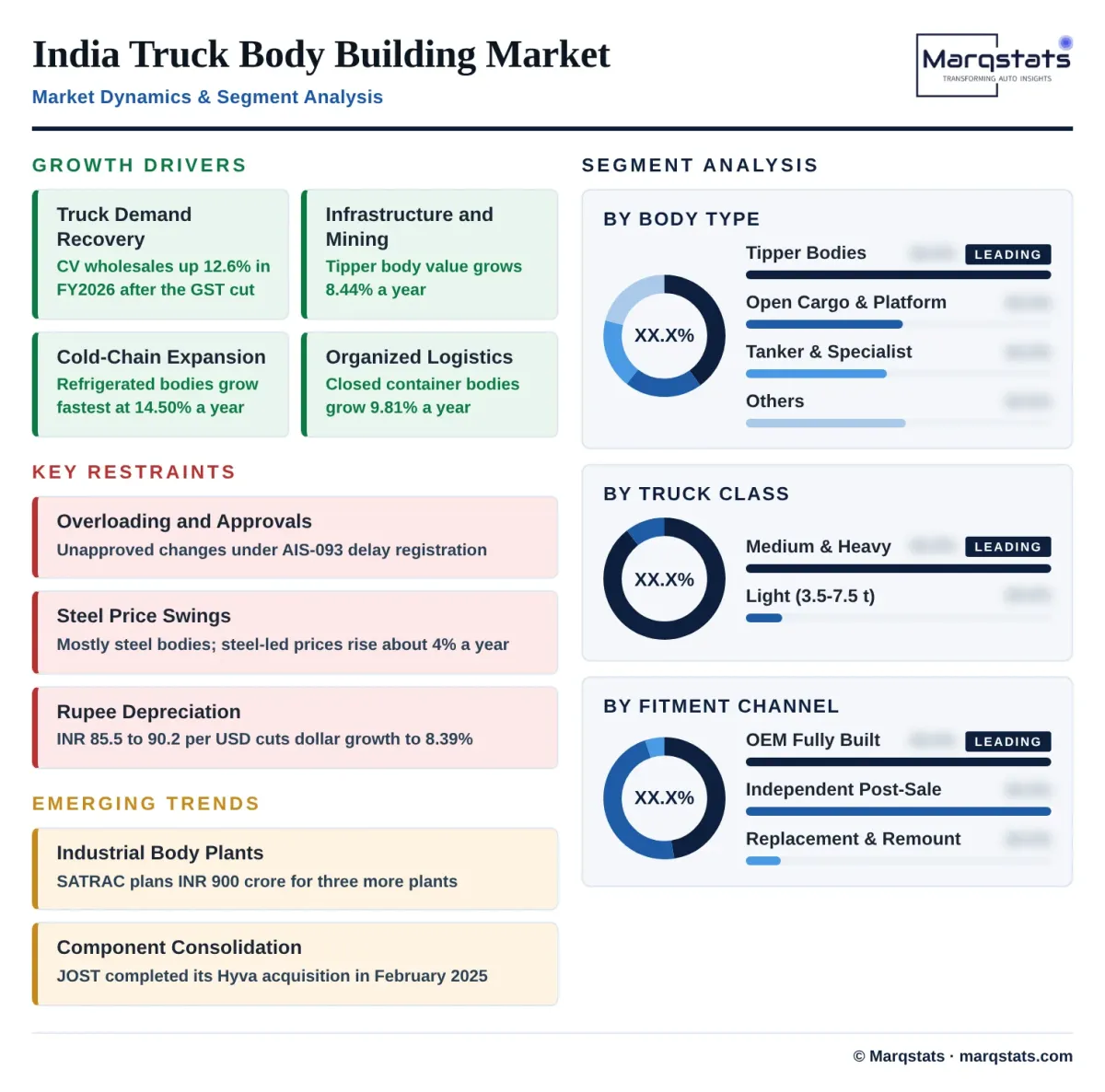
Tipper bodies are the largest segment of the India truck body building market at USD 980.95 million, or 39.95% of FY2026 value, from 100,915 bodies at about INR 8.3 lakh each. Value grows at 8.44% a year to USD 1,471.12 million by FY2031, supported by road building, construction and mining, and the segment holds its share at 40.04% across the forecast.
Open cargo and platform bodies are the most common body type at 181,224 units, or 44.51% of the total, but account for only USD 504.71 million, or 20.56% of value, because they are simple steel structures. Value grows at 5.37% a year to USD 655.50 million by FY2031, and the segment share falls to 17.84% as operators switch to closed bodies.
Closed container and box bodies are worth USD 371.27 million, or 15.12% of value, from 74,844 bodies, and grow at 9.81% a year to USD 592.84 million by FY2031. Parcel, retail and white-goods logistics favour these bodies for security and weather protection, which lifts the segment share to 16.14%.
Refrigerated and insulated bodies are worth USD 145.07 million, or 5.91% of value, from 11,815 bodies, and grow fastest at 14.50% a year to USD 285.52 million by FY2031. Segment value covers the insulated box only, with the refrigeration unit excluded.
Tanker, bulker and specialist bodies are worth USD 453.18 million, or 18.46% of value, from 38,362 bodies at about INR 10.1 lakh each. Value grows at 8.10% a year to USD 668.92 million by FY2031, and the segment requires approvals, material compatibility and application engineering that favour builders with engineering depth.
Medium and heavy trucks account for USD 2,192.72 million, or 89.31% of FY2026 value, from 315,360 bodies, and value grows at 8.42% a year to USD 3,284.78 million by FY2031. The class carries most tipper and tanker bodies, which sets the value trajectory of the market.
Light trucks account for USD 262.46 million, or 10.69% of value, from 91,800 bodies at about INR 2.4 lakh each, and value grows at 8.19% a year to USD 389.12 million by FY2031, mainly in open and box bodies for urban distribution.
OEM fully built vehicles account for USD 1,162.49 million, or 47.35% of FY2026 value, and grow fastest at 11.66% a year to USD 2,017.86 million by FY2031. The channel covers bodies fitted at the plants of vehicle makers and at partner plants under their programmes.
Independent post-sale body building also accounts for USD 1,162.49 million, or 47.35% of FY2026 value, but grows at only 4.68% a year to USD 1,461.21 million as fully built sales expand, which reduces its share to 39.77% by FY2031.
Replacement and remount bodies account for USD 130.20 million, or 5.30% of value, from 30,160 bodies, and grow at 8.39% a year to USD 194.83 million by FY2031. These bodies are fitted to trucks whose original body has worn out or been damaged, and local fabricators win most of the work.
By Geography
West India
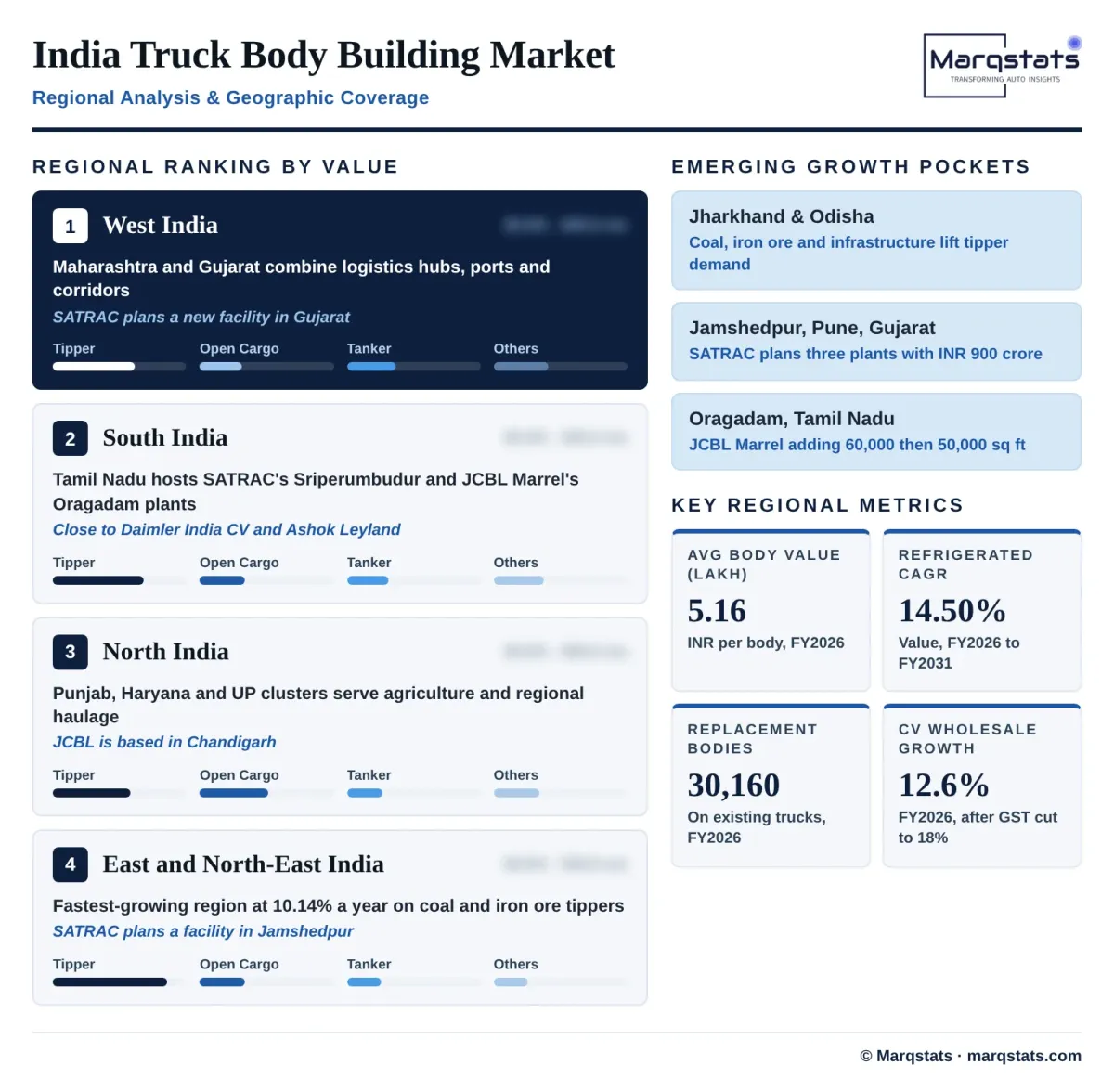
West India is the largest regional market at USD 736.55 million, or 30.00% of FY2026 value, and grows at 8.03% a year to USD 1,083.80 million by FY2031. Maharashtra and Gujarat combine large logistics hubs, ports and industrial corridors, and SATRAC plans a facility in Gujarat. Regional splits are Marqstats allocations, because national body output by state is not published.
South India
South India accounts for USD 662.90 million, or 27.00% of value, and grows at 8.39% a year to USD 991.95 million by FY2031. Tamil Nadu hosts the SATRAC plant at Sriperumbudur and the JCBL Marrel plant at Oragadam, close to Daimler India Commercial Vehicles and Ashok Leyland, which places organised body capacity alongside two large chassis makers.
North India
North India holds USD 613.80 million, or 25.00% of value, and grows at 7.51% a year to USD 881.74 million by FY2031. Punjab, Haryana and Uttar Pradesh host large fabrication clusters serving agriculture and regional haulage, and JCBL is based in Chandigarh.
East and North-East India
East and North-East India is the smallest region at USD 441.93 million, or 18.00% of value, but grows fastest at 10.14% a year to USD 716.41 million by FY2031, as coal, iron ore and infrastructure projects in Jharkhand and Odisha drive tipper demand. SATRAC plans a facility in Jamshedpur, which places organised capacity inside the fastest-growing regional market.
How Competition Is Evolving
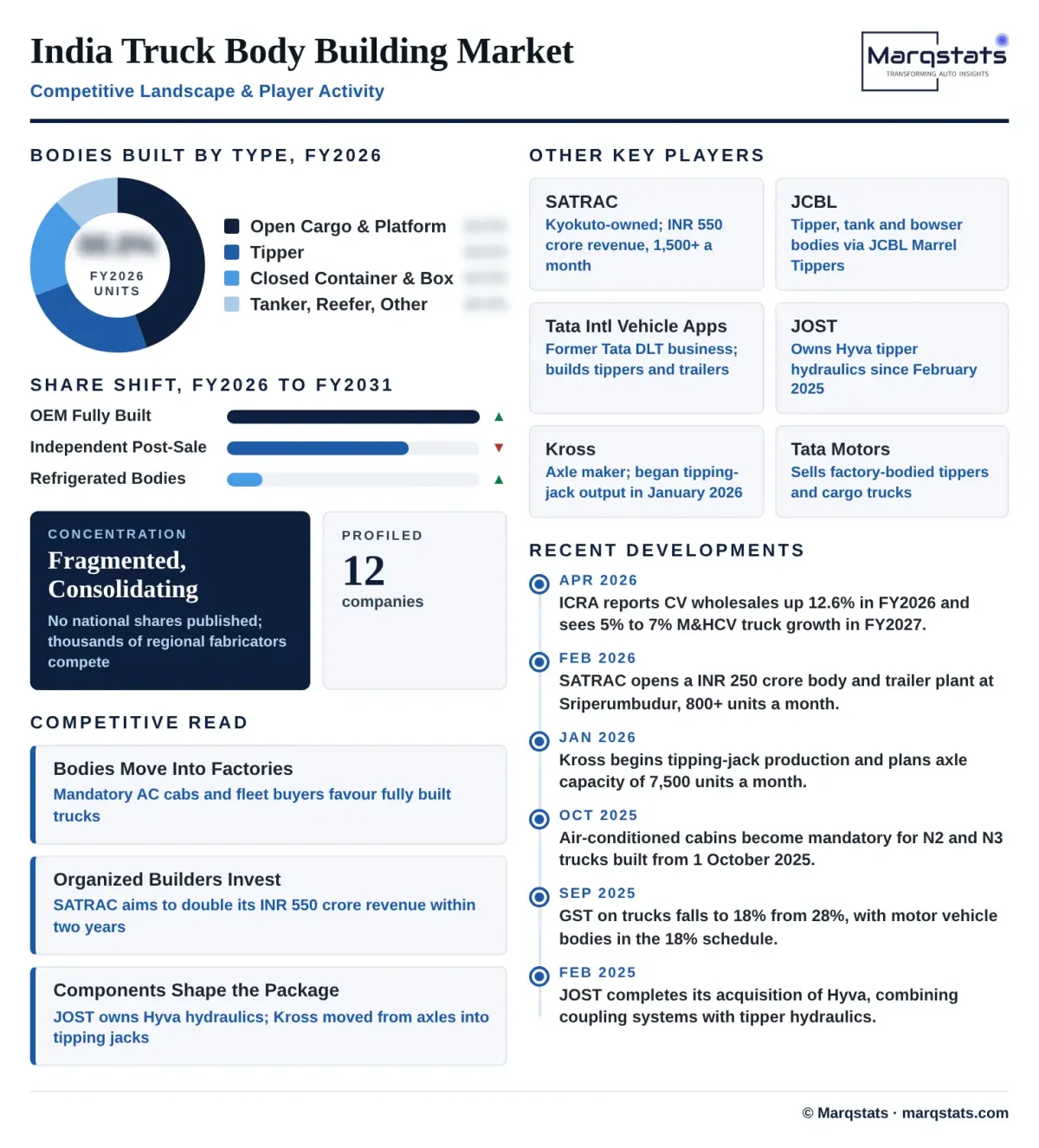
The India truck body building market is fragmented, with vehicle makers and a small number of organised builders accounting for a growing share while thousands of regional fabricators still build a large share of bodies. No public source reports national shares or a count of active builders, so market shares could not be sourced and competition is analysed by supplier tier.
The organised builder tier is expanding capacity and revenue. SATRAC, owned by Japan's Kyokuto Kaihatsu Kogyo since 2020, reported revenue of INR 550 crore in its previous fiscal year, aims to double it within two years and has capacity of more than 1,500 units a month across its Chennai and Bengaluru plants. JCBL builds tipper, tank and bowser bodies through JCBL Marrel Tippers, and Tata International Vehicle Applications, the former Tata DLT business, builds tippers and trailers. Component suppliers also shape the package, with JOST now owning the tipping hydraulics business of Hyva and Kross moving from axles into tipping jacks.
Vehicle makers compete through fully built programmes, with Tata Motors, Ashok Leyland, Daimler India Commercial Vehicles, VE Commercial Vehicles and Mahindra and Mahindra selling factory-bodied tippers and cargo trucks alongside bare chassis and using partner builders for volume. Refrigeration and cab air-conditioning suppliers, including Subros and Trane Technologies through Thermo King, influence refrigerated body specification and compliance with the new cab rules. Competition turns on OEM approvals, delivery reliability, weld quality, service networks and the capacity to fund chassis held in the plant.
Companies Covered
Companies covered in the report include:
Recent Market Activity
Table of Contents
Coverage & Segmentation
Coverage spans truck body building in India across West, South, North and East and North-East India, with FY2026 as the base year, FY2022 to FY2026 as the historical period and FY2027 to FY2031 as the forecast period, shown as 2026 to 2030 in the data panel. Value is expressed in USD million of body-only revenue converted from rupees, with rupee values reported alongside, and excludes the chassis, cab, GST, refrigeration units and separately sold hydraulics. Volume is measured in bodies fitted, and the market is segmented by body type into five segments, by truck class into two and by fitment channel into three, with twelve companies profiled.
Road tractors and towed trailers, pickups and small commercial vehicles below 3.5 tonnes, bus bodies and body repairs are excluded from the market. Truck volumes draw on SIAM data and independent credit-rating commentary, prices draw on company and trade-press indications and regulatory content draws on Ministry of Road Transport and Highways releases and tax notifications.