Market Snapshot
Key Takeaways
Market Overview & Analysis
Report Summary
The global hydrogen truck market comprises fuel-cell electric commercial trucks, spanning medium and heavy gross-vehicle-weight classes, sold new to fleet operators, logistics companies, and other commercial end users. This study segments the market by gross vehicle weight class, application, and region, with a 2025 base year, historical coverage from 2021 to 2025, and forecasts to 2030. Market size is stated as new-vehicle transaction revenue in United States dollars, explicitly excluding hydrogen refuelling station capital expenditure, which Marqstats tracks as a separate, related infrastructure market. Hydrogen internal combustion engine trucks, a distinct emerging technology some manufacturers are exploring as an alternative path to fuel-cell propulsion, are tracked separately from the fuel-cell trucks this report's core figures measure, given their materially different powertrain architecture and current developmental stage.
This report's sizing methodology begins from verified deployed fleet data by country, OEM, and application rather than a top-down market assumption, reflecting the genuine data scarcity this nascent category presents: many announced pilot programmes do not disclose the specific number of vehicles actually commissioned or operating at a given time, and vehicle registration systems in most countries do not reliably distinguish hydrogen fuel-cell trucks from other electric powertrain types within broader zero-emission vehicle categories. Findings in this report were cross-validated against operator and OEM primary interviews specifically to address this registration-data gap. This bottom-up, fleet-verified approach stands in deliberate contrast to top-down market models that extrapolate from adjacent zero-emission vehicle spending, an approach this report's methodology avoids given the risk of materially overstating genuine hydrogen-specific deployment. Readers should treat any hydrogen truck market figure, from this report or elsewhere, with appropriate caution given how thin the underlying verified data currently is relative to more mature vehicle categories this report covers in its companion series.
Transaction pricing for hydrogen trucks remains heavily grant-dependent in nearly every current commercial deployment, meaning a single average selling price figure would understate the wide variation between subsidised pilot-programme pricing and the pre-incentive list price an unsubsidised buyer would face. This report tracks pre-incentive and post-incentive transaction values as distinct figures rather than blending them, since policy support levels vary considerably by country and are subject to change independent of underlying vehicle cost trends. Fuel-cell stack cost specifically has followed a consistent annual decline since 2020, a pattern this report tracks as a distinct input into its total-cost-of-ownership and forecast modelling rather than folding into vehicle transaction price alone. Hydrogen fuel cost itself, separate from vehicle and fuel-cell system pricing, represents a further distinct variable this report's total-cost-of-ownership modelling tracks, given the meaningful gap between current green hydrogen production cost and the price point most analysts consider necessary for unsubsidised fleet competitiveness against diesel.
Market Dynamics
Key Drivers
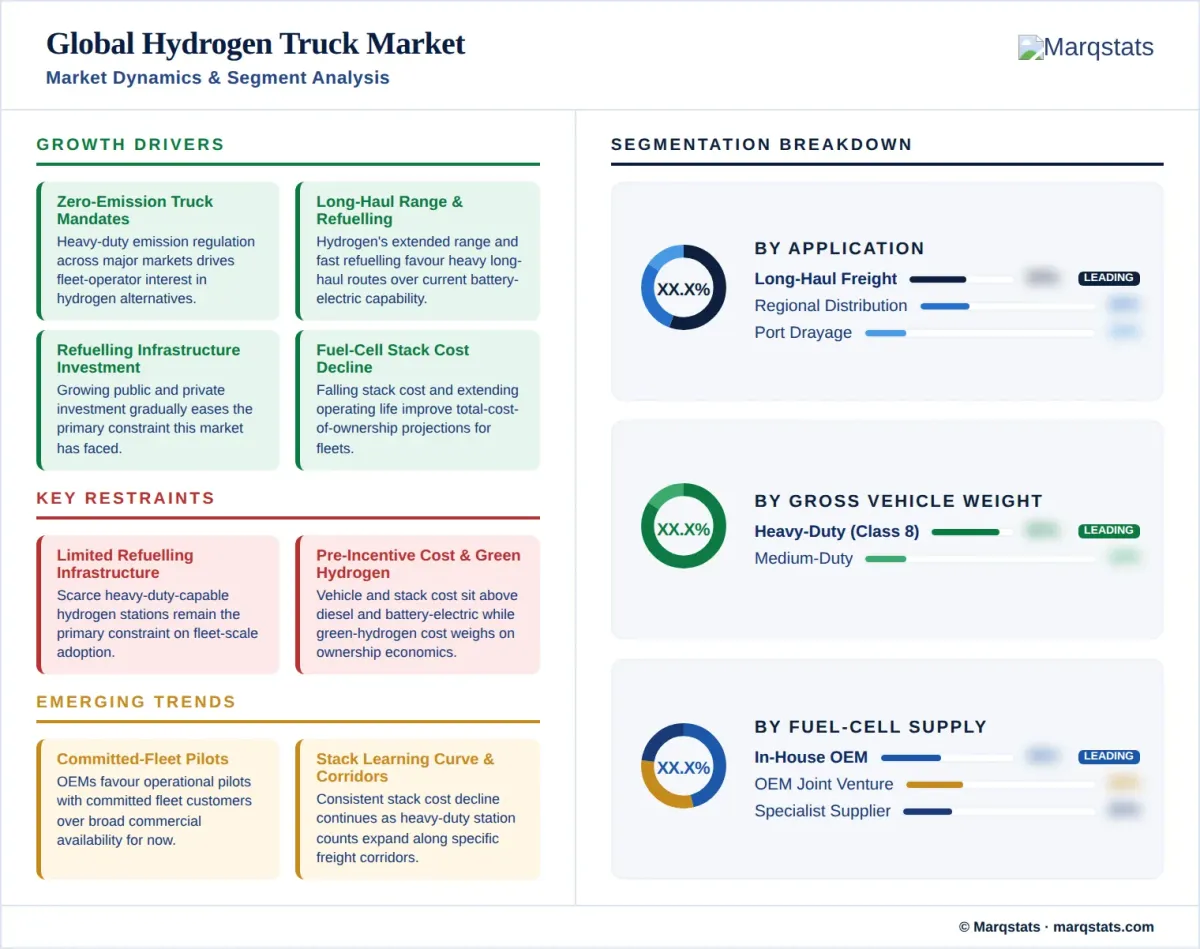
- Zero-emission truck mandates and heavy-duty vehicle emission regulations in multiple major markets are directly driving fleet operator interest in hydrogen alternatives.
- Long-haul and heavy-duty applications favour hydrogen's extended range and fast refuelling time relative to current battery-electric truck capability.
- Growing public and private investment in hydrogen refuelling infrastructure is gradually easing the primary adoption constraint this market has faced.
- Fuel-cell stack cost decline and extending stack operating life are improving total cost of ownership projections for fleet operators evaluating the technology.
- Government grant and subsidy programmes in multiple countries continue supporting pilot and early-commercial fleet deployment economics.
Key Restraints
- Limited heavy-duty-capable hydrogen refuelling infrastructure remains the primary constraint on fleet-scale hydrogen truck adoption.
- Pre-incentive vehicle and fuel-cell system costs remain substantially above diesel and battery-electric alternatives for most current applications.
- Green hydrogen production and delivery cost, though declining, continues to affect total cost of ownership competitiveness in most markets.
Key Trends
- OEM deployment strategy continues favouring operational pilots with committed fleet customers over broad commercial availability.
- Fuel-cell stack costs continue declining on a consistent learning curve, improving long-term total cost of ownership projections.
- Heavy-duty-capable hydrogen refuelling station counts continue expanding, though remain concentrated in specific corridors and regions.
- Policy support, including production and purchase incentives, continues shaping near-term deployment economics more than underlying vehicle cost alone.
Market Segmentation
Heavy-duty trucks represent the large majority of verified hydrogen truck deployments to date, reflecting the application where hydrogen's range and refuelling-speed advantages over battery-electric alternatives are most pronounced, particularly for long-haul freight routes exceeding typical battery-electric range without extended charging stops. Payload capacity considerations reinforce this concentration, since the weight of large battery packs required for extended battery-electric range directly reduces available cargo payload in a way hydrogen's comparatively lighter storage and fuel-cell system does not to the same degree. Driver acceptance has also proven favourable in early deployments specifically because hydrogen refuelling closely mirrors familiar diesel refuelling routines, requiring comparatively little change to established driver behaviour and route planning practices, a factor fleet operators consistently cite as easing the broader operational transition.
Medium-duty hydrogen trucks represent a smaller, present deployment category, typically concentrated in regional and return-to-base applications where operators are piloting hydrogen alongside battery-electric alternatives to compare real-world operating economics across both zero-emission technologies. This side-by-side piloting approach gives several fleet operators direct comparative data on total cost of ownership between the two zero-emission technologies under genuinely comparable operating conditions, data that is proving valuable to the broader industry as operators and policymakers alike assess how each zero-emission technology fits specific application profiles.
Long-haul freight represents the primary application driving hydrogen truck interest specifically, since this is the use case where extended daily distance and fast refuelling turnaround most clearly favour hydrogen over current battery-electric truck range and charging-time capability. Cross-border and international corridor freight represents a particularly relevant sub-application, since these routes often traverse multiple jurisdictions with differing charging infrastructure availability, making hydrogen's refuelling speed and existing liquid-fuel-like operational pattern comparatively easier to plan around for fleet operators managing complex, multi-country logistics networks.
Regional and return-to-base operations, including port drayage and regional distribution, represent a secondary application where operators can more readily control refuelling access through dedicated or near-site hydrogen infrastructure, reducing dependence on broader public refuelling network availability. This application category has proven a practical entry point for several fleet operators specifically because a single dedicated refuelling facility can support an entire operating fleet without requiring the broader corridor infrastructure long-haul freight applications ultimately depend on, making it a lower-risk starting point for operators new to hydrogen vehicle operations.
By Geography
Europe
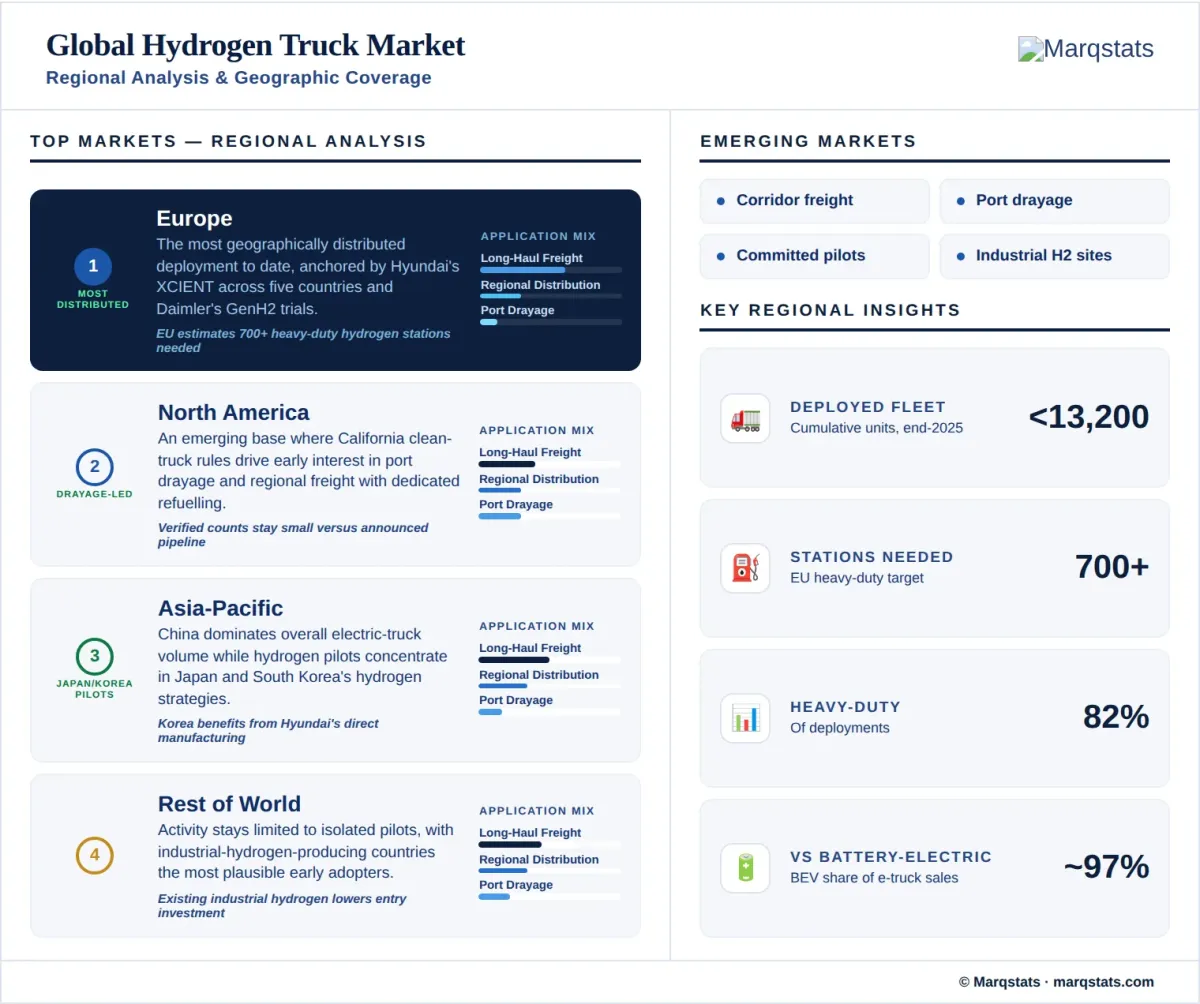
Europe represents the most geographically distributed hydrogen truck deployment to date, anchored by Hyundai's XCIENT programme operating across five countries and reinforced by Daimler Truck's GenH2 customer trials with logistics and industrial partners. The European Union's own enabling-conditions assessment estimates at least 700 heavy-duty-capable hydrogen stations are needed to support broader fleet transition, alongside roughly 50,000 public heavy-duty-vehicle chargers under the region's 2030 zero-emission truck infrastructure targets. This dual charging-and-hydrogen infrastructure target reflects the European Union's approach of supporting both zero-emission truck technologies in parallel rather than favouring one over the other at a policy level, an approach several other major markets covered in this report have broadly mirrored in their own zero-emission transport policy design.
North America
North America represents an emerging deployment base, with California's regulatory environment, including advanced clean truck requirements and emission-zone restrictions around major port complexes, driving early fleet operator interest specifically in port drayage and regional freight applications where dedicated refuelling access is more readily achievable. Several announced pilot programmes in the region remain in early operational stages, with verified commissioned vehicle counts still small relative to announced order and grant-funding figures, reinforcing this report's emphasis on verified deployment over announced pipeline alone. Canadian deployment activity, while smaller in absolute scale than the United States, follows a broadly similar pattern of early-stage regional and drayage-focused piloting ahead of any broader commercial rollout.
Asia-Pacific
Asia-Pacific combines China's overwhelming dominance of overall electric-truck sales, accounting for more than 90% of global electric-truck volume in 2025, with hydrogen-specific pilot activity in Japan and South Korea tied to each country's domestic hydrogen economy strategy and, in South Korea's case, Hyundai's direct manufacturing presence. China's own hydrogen truck activity, while smaller in proportion to its overall electric-truck dominance, benefits from the country's broader hydrogen production and infrastructure investment, positioning several domestic manufacturers to scale hydrogen truck production alongside their established battery-electric truck manufacturing base, a dual-technology manufacturing strategy few other markets can currently replicate at similar scale.
Rest of World
Deployment activity elsewhere remains limited to isolated pilot programmes, with broader adoption in these markets contingent on both hydrogen infrastructure investment and the broader commercial and policy validation larger markets are still working through. Countries with existing industrial hydrogen production capacity, often tied to refining or chemical manufacturing, represent the most plausible early adoption candidates within this group, since they already possess a portion of the supply infrastructure a hydrogen truck fleet would require, materially lowering the incremental investment needed to support even a modest initial fleet deployment.
How Competition Is Evolving
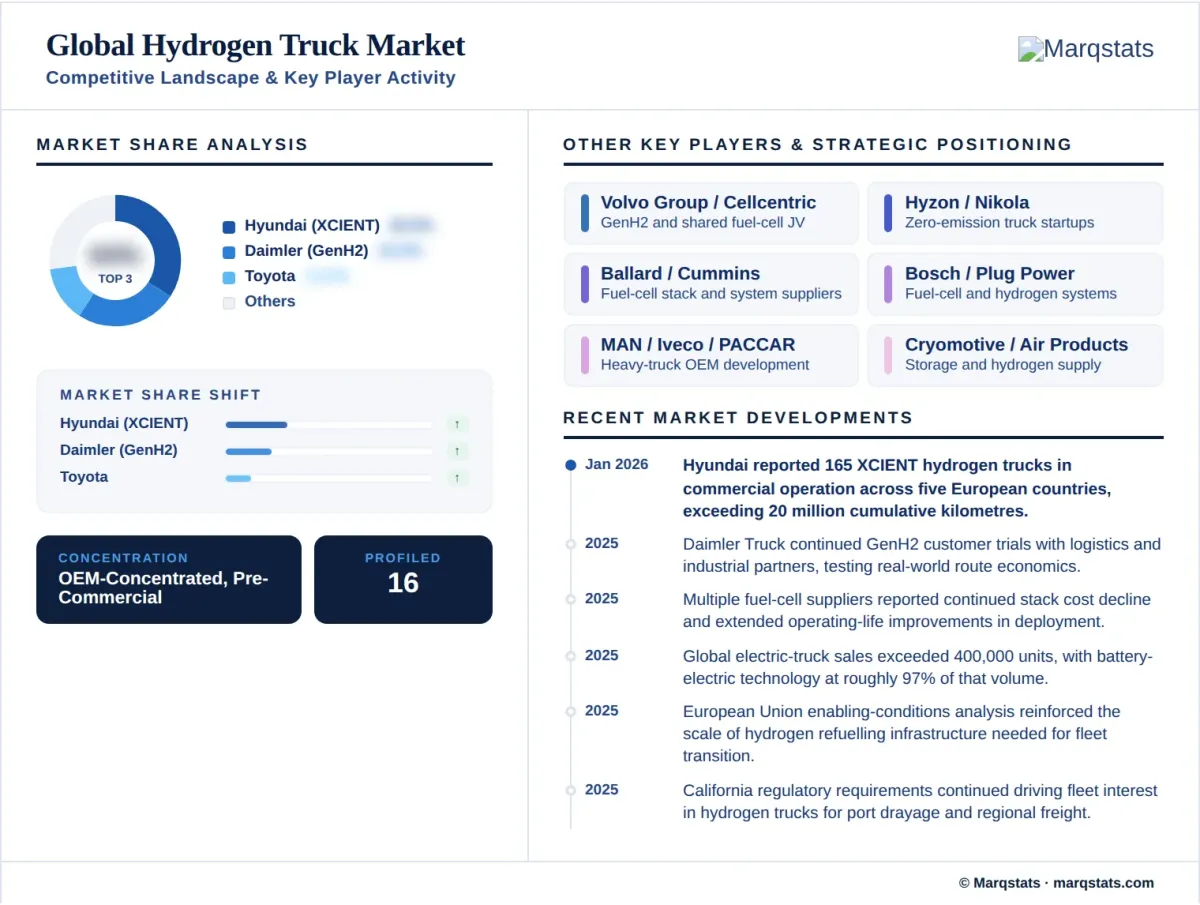
The market remains concentrated among a small group of OEMs actively deploying commercial hydrogen trucks, led by Hyundai's XCIENT programme and Daimler Truck's GenH2 platform, alongside Toyota and Volvo Group's parallel development efforts. This concentration reflects the capital intensity and technical complexity of hydrogen truck development relative to the market's current small deployed scale, favouring established heavy-truck manufacturers with substantial engineering resources over newer entrants. Newer entrants including Hyzon Motors and Nikola have pursued hydrogen truck development with varying degrees of commercial traction, illustrating the execution risk this technically demanding, capital-intensive category presents even for companies built specifically around zero-emission truck technology. This risk profile is a further reason established heavy-truck manufacturers with existing engineering, manufacturing, and dealer-network resources hold a structural advantage over newer, more narrowly focused entrants in this specific category.
Competitive strategy centers on securing committed fleet customers for extended operational pilots that generate real-world durability and route-economics data, ahead of any broader commercial scale-up decision. Fuel-cell system supply represents a distinct competitive layer from vehicle assembly itself, with specialist suppliers and joint ventures between established truck manufacturers playing a significant role in fuel-cell stack and system development specifically. Cellcentric, the joint venture between Daimler Truck and Volvo Group focused specifically on fuel-cell system development, illustrates how even directly competing truck manufacturers have found collaborative fuel-cell development preferable to fully independent programmes, given the shared technical challenge and capital burden involved. This collaborative pattern may extend further as the category matures, particularly among manufacturers lacking either partner's existing scale in heavy-truck engineering and manufacturing.
Companies Covered
The report profiles 16+ companies with full strategy and financials analysis, including:
Recent Market Activity
Table of Contents
Coverage & Segmentation
This report provides a comprehensive assessment of the global hydrogen truck market across a 2025 base year, historical data from 2021 to 2025, and forecasts spanning 2026 to 2030. Market size is stated as new-vehicle transaction revenue in United States dollars, built from verified deployed fleet and delivery data rather than a top-down market assumption. Segmentation covers three dimensions: gross vehicle weight class, application, and region, alongside dedicated coverage of refuelling infrastructure and policy support as demand-enabling factors.
The scope covers hydrogen fuel-cell electric commercial trucks specifically. The study excludes hydrogen refuelling station capital expenditure and broader hydrogen production and supply chain investment, which Marqstats covers as separate, related infrastructure markets, and battery-electric trucks, which Marqstats covers within its broader electric commercial vehicle coverage. Prototype and demonstration vehicles not operating within a genuine commercial fleet are excluded from this report's deployed-fleet figures, consistent with the verified-deployment standard this report's methodology applies throughout. Hydrogen internal combustion engine trucks, light-duty hydrogen vehicles, and hydrogen-powered buses are similarly excluded, each representing a distinct category with its own developmental stage and supplier base that Marqstats covers, where warranted, in separate dedicated coverage. This scope discipline is particularly important in a nascent category where blending adjacent hydrogen mobility applications into a single headline figure would meaningfully obscure the specific commercial truck deployment pattern this report is designed to track. Country-level detail beyond the four-region split covered here is available under customization, alongside deeper cuts by weight class, application, or fuel-cell system supplier.