Market Snapshot
Middle bar: base-year value × (1 + CAGR), rounded to two decimals. This is a calculated illustration, not a separately researched annual estimate.
The North America service truck body market is estimated at USD 2,894.70 million in 2025 and is projected to reach USD 4,034.75 million by 2030, a CAGR of 6.87%, on service and utility truck body installations rising from 158,945 to 184,396 at a 3.02% CAGR. Slightly more than half of the value growth therefore comes from heavier, better-equipped bodies and higher installed prices rather than from additional trucks, and the substitution of aluminum for steel, at 11.24% a year against 4.14%, is the most consequential change in the product mix.
Market size and forecast figures are generated using Marqstats' proprietary estimation framework, updated as of October 2026. The estimate is constructed as the service and utility body share of North America work truck upfitting, valued at installed body prices benchmarked to manufacturer and dealer listings, and it is most sensitive to cab-chassis supply and to tariff-driven material costs.
The market comprises the compartmented steel, aluminum and composite bodies that convert a pickup or cab-chassis into a working service vehicle for utilities, telecom, construction, oil and gas, municipal fleets and equipment dealers. Open service bodies hold the largest share at 45.28% of 2025 value, while mechanics and crane-ready bodies carry the highest value per unit because they are engineered to take truck-mounted crane, compressor and outrigger loads. Light-duty Class 2b-3 chassis account for 77.78% of body installations but only 60.64% of value.
Demand for utility truck bodies is tied to two separate capital cycles. Electric utilities that are members of the Edison Electric Institute planned to invest nearly USD 208 billion in 2025 after a record USD 178.2 billion in 2024, and their line, metering and substation crews operate on service and utility bodies. The 25% Section 232 tariff on imported trucks over 10,000 lb from 1 November 2025 and the metal tariff changes of 2026 hold the market close to flat in 2026, at USD 2,909.30 million, before growth resumes in 2027.
Key Takeaways
Market Overview & Analysis
Report Summary
A service truck body is a compartmented body mounted on a pickup cab-chassis or on a medium or heavy-duty chassis in place of the factory pickup box, and the market is defined across four body types. Open service bodies combine side compartments with an open cargo bed, enclosed service bodies add a lockable roof over the cargo area, and mechanics and crane-ready bodies carry reinforced compartments and mounts for a crane, compressor and outriggers. Utility line and specialty bodies include line bodies, tool bodies and the bodies that carry aerial devices and digger derricks, and value is measured as the installed body and its mounting, excluding the chassis, the crane or aerial device, the compressor and sales tax.
No published total exists for the service truck body market, because the Association of Industrial Service Body Manufacturers, a division of NTEA since 1979, runs a quarterly shipments survey for its members without releasing the results, so the market size is a Marqstats construction. The estimate represents the service and utility body share of the North America work truck upfitting market, valued at installed body prices benchmarked to manufacturer and dealer listings and segmented by body type, material, vehicle class and country. A Knapheide 11-foot steel service body for a dual-rear-wheel chassis, listed at USD 12,487 in 2026 before installation, provides the light-duty price anchor.
Service and utility bodies form the largest single body type within North America work truck upfitting, at 19.28% of 2025 upfit value, and the two estimates reconcile exactly because they rest on a common base. Growth to 2030 depends on three conditions holding together. Class 2b-3 cab-chassis supply must recover from the 2026 tariff year and utility and telecom capital spending must remain near current levels, while the shift from steel to aluminum and composite bodies must continue as fleets pursue payload and corrosion life.
Service Truck Body Market Size and Forecast
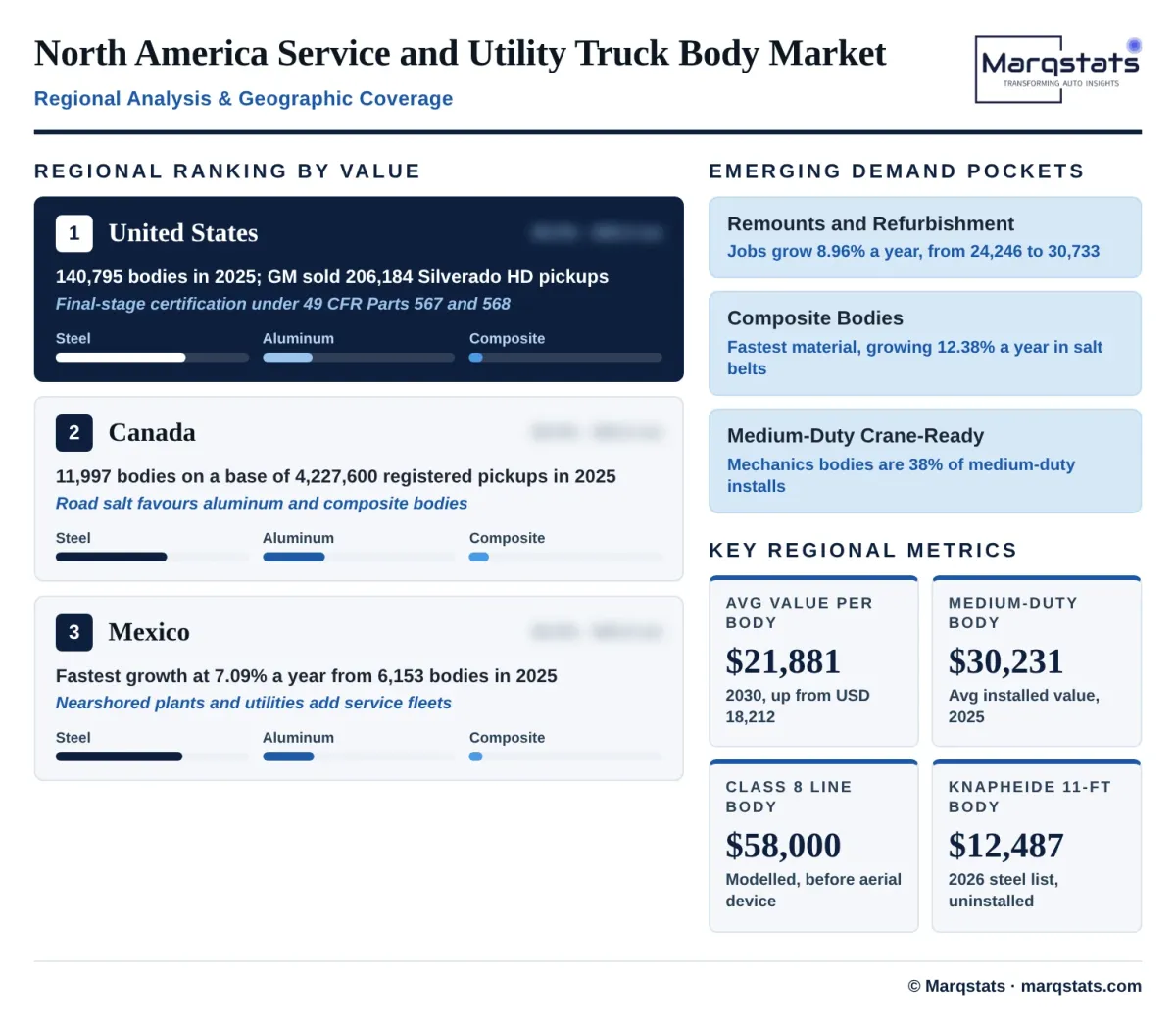
North America body manufacturers and upfitters installed an estimated 158,945 service and utility truck bodies in 2025, comprising 134,699 new body installations and 24,246 remounts and refurbishments of existing bodies onto new chassis. Body installations are the anchor series, and value is derived from installations and a weighted average installed value per body that rises from USD 18,212 in 2025 to USD 21,881 in 2030, which lifts the service truck body market at 6.87% a year against 3.02% for units.
Installations move from 158,945 bodies valued at USD 2,894.70 million in 2025 to 152,231 bodies and USD 2,909.30 million in 2026 and 161,657 bodies and USD 3,195.71 million in 2027. The series then reaches 169,988 bodies and USD 3,476.03 million in 2028, 177,045 bodies and USD 3,744.92 million in 2029 and 184,396 bodies and USD 4,034.75 million in 2030.
The 2026 tariff year is the principal departure from trend, with units falling 4.22% while value rises 0.50%, because tariff-driven price increases on steel, aluminum and imported heavy trucks offset the lower count. On the 6.87% CAGR path the market would reach USD 3,093.57 million in 2026, which places the 2026 estimate about USD 184 million below trend ahead of the recovery from 2027.
Light-duty bodies number 123,622 in 2025 and 145,083 in 2030, medium-duty bodies rise from 32,202 to 35,992 and heavy-duty Class 8 bodies rise from 3,121 to 3,321. Remounts grow faster than new installations, rising from 24,246 to 30,733 jobs, because a well-built aluminum or composite body can outlast two chassis.
Aluminum Grows Nearly Three Times Faster Than Steel
Material choice is the clearest structural shift in the service truck body market. Steel still holds 66.00% of 2025 value, at USD 1,910.50 million, because steel bodies are cheaper and easier to repair in the field, but its share falls to 58.00% by 2030. Aluminum bodies grow from USD 781.57 million to USD 1,331.47 million at 11.24% a year, and composite and other materials grow from USD 202.63 million to USD 363.13 million at 12.38% a year.
Payload is the decisive purchase criterion, because a light-duty cab-chassis has a fixed gross vehicle weight rating and every pound saved on the body becomes payload for tools, parts and materials, while an aluminum body can also keep a truck below a weight class threshold. Knapheide showed an aluminum service body with over 20% more storage than its standard steel version on an International chassis at Work Truck Week 2026. Corrosion is the second factor, since road salt in Canada and the northern United States shortens the life of a steel body, whereas aluminum and composite bodies can be remounted onto a new chassis, which supports remount value growth of 8.96% a year.
Tariffs moderate the pace of substitution without reversing it. The 2026 changes to Section 232 duties on steel and aluminum raised material costs for both, and aluminum bodies carry a price premium that small contractors resist, so steel retains its price advantage. Steel therefore remains the majority material through 2030, with aluminum gaining share gradually rather than in a single step.
Utility and Telecom Capital Spending Sets Demand for Utility Bodies
Utility line and specialty bodies, worth USD 482.85 million in 2025, depend more on electric utility spending than on the general truck cycle. Edison Electric Institute members invested a record USD 178.2 billion in 2024, planned nearly USD 208 billion for 2025 and projected more than USD 1.1 trillion over 2025 to 2029, while the Energy Information Administration put US utility distribution capital spending at USD 50.9 billion in 2023. Each additional line, metering or substation crew requires a dedicated truck, which links body demand directly to grid investment.
Utility line bodies on heavy chassis carry some of the highest prices in the market. A line body built to carry an aerial device or digger derrick is valued at about USD 58,000 on a Class 8 chassis before the device itself, against about USD 33,000 for a new medium-duty service body. Altec Industries, Time Manufacturing Company through Versalift and Stellar Industries combine bodies with the aerial devices and cranes mounted on them, and they compete on delivering a complete truck rather than a body alone.
Chassis Class and Material Determine Installed Body Value
Chassis class is the primary determinant of installed body price, followed by material, with brand exerting the least influence on what fleets pay. A Knapheide 11-foot steel KSS service body for a dual-rear-wheel chassis, primed and unpainted, was listed at USD 12,487 in 2026 before freight, mounting and accessories. Once installation, lighting, ladder racks, drawers and a receiver hitch are added, the average installed light-duty body reaches about USD 14,200 in 2025, blending lower-priced single-rear-wheel steel bodies with higher-priced aluminum and enclosed bodies.
Medium-duty bodies average about USD 30,231 because they are longer, carry more compartments and are often built crane-ready with reinforced subframes and outrigger mounts. Heavy-duty Class 8 bodies average about USD 53,127, as most are line or mechanics bodies sized for large cranes and aerial devices. None of these values includes the crane, aerial device or compressor, which can cost more than the body itself and is sold as separate equipment.
New body installations average about USD 19,880 in 2025, while remounts and refurbishments average about USD 8,946, because the customer reuses the body and pays mainly for removal, repair, repainting and refitting to the new chassis. Installed prices are expected to rise by about 4.5% in 2026 on tariff-driven steel and aluminum costs and by about 3% a year thereafter, with content per body adding about 0.8% a year through LED lighting, power inverters and interior shelving, and these price effects explain why value grows more than twice as fast as units.
Market Dynamics
Key Drivers
Five structural forces support growth in the North America service truck body market through 2030.
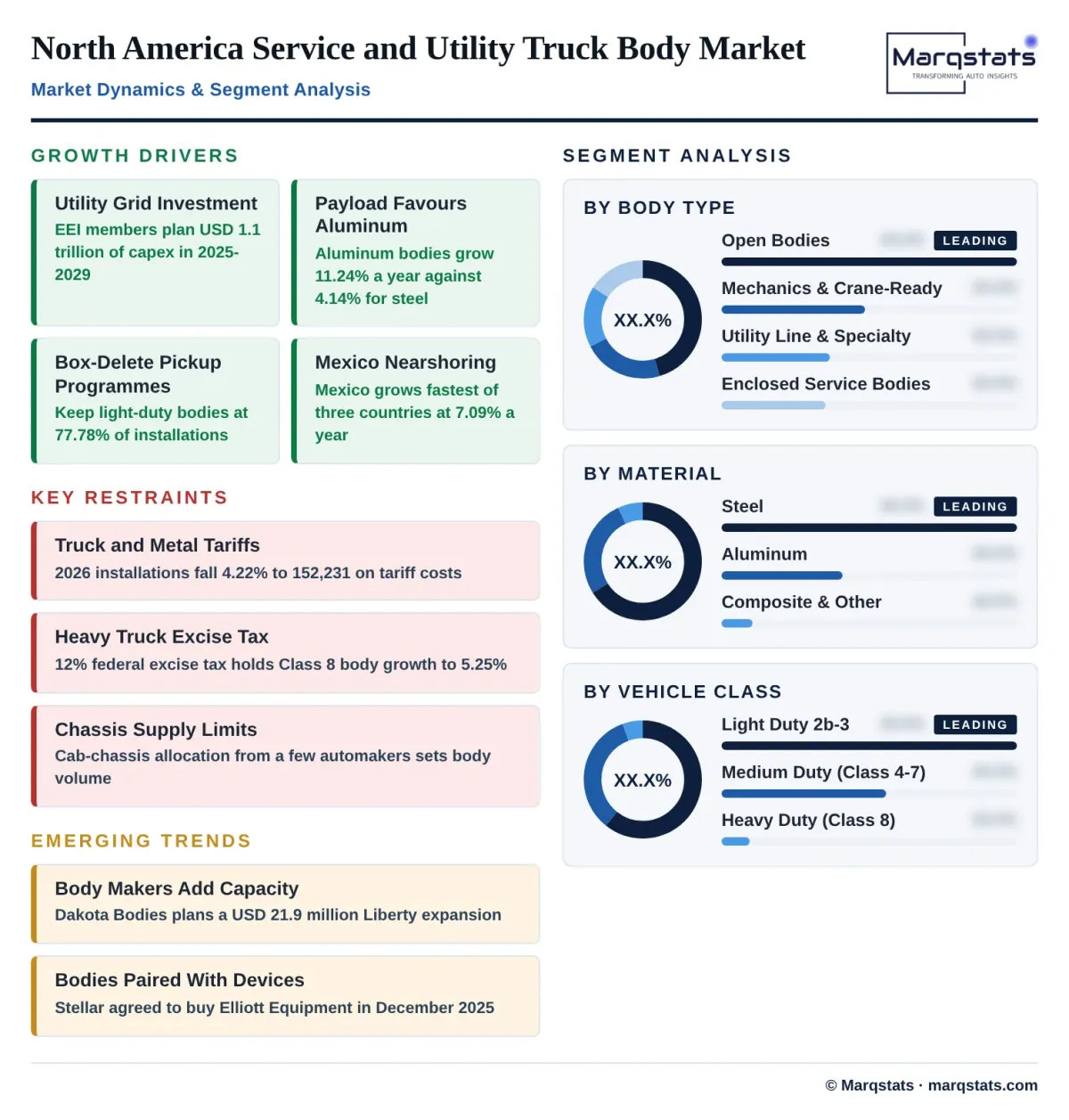
- Electric utility investment in transmission and distribution networks. Edison Electric Institute members projected more than USD 1.1 trillion of capital spending over 2025 to 2029, adding line, metering and substation crews that operate on service and utility bodies, a segment worth USD 482.85 million in 2025.
- Payload and corrosion life favouring aluminum and composite bodies. Aluminum and composite bodies grow at 11.24% and 12.38% a year as fleets gain payload and remount bodies onto new chassis, lifting the average value per body from USD 18,212 in 2025 to USD 21,881 in 2030.
- Pickup box removal programmes offered by the major chassis manufacturers. Chassis makers offer cab-chassis or box-delete pickups, and AISBM promoted the continuation of these programmes with chassis manufacturers in March 2026, sustaining the 77.78% of installations mounted on light-duty chassis.
- Infrastructure and construction work funded by federal programmes. Federal highway, broadband and water programmes fund contractor fleets that require mechanics and crane-ready bodies, a segment worth USD 636.67 million in 2025.
- Nearshoring of manufacturing capacity into Mexican industrial parks. New plants and industrial parks require maintenance and utility fleets, which makes Mexico the fastest-growing of the three countries at 7.09% a year from 2025 to 2030.
Key Restraints
Four constraints restrain the market, with the sharpest effect falling in 2026.
- Section 232 tariffs on imported trucks and metals. The 25% Section 232 tariff on imported trucks over 10,000 lb from 1 November 2025 and the 2026 metal tariff changes raise chassis and body costs, reducing 2026 installations by 4.22% to 152,231.
- Dependence on cab-chassis allocation from a few automakers. Service body volume depends on cab-chassis allocation from a small number of automakers, with light-duty chassis alone carrying 77.78% of 2025 installations, so allocation cuts or model changeovers delay body installations regardless of fleet demand.
- Federal excise tax on heavy trucks including the body. The 12% federal excise tax applies to heavy trucks over 33,000 lb gross vehicle weight including the body, adding cost to Class 8 utility trucks, where body value grows only 5.25% a year from 2025 to 2030.
- Competition for skilled welders, painters and electricians in manufacturing. Body plants and upfit centres compete with other manufacturers for skilled trades, which limits how quickly capacity can respond to order spikes such as the expected recovery to 161,657 installations in 2027.
Key Trends
Four trends are reshaping product design and the structure of the supply base.
- Lighter body materials gaining share across utility and contractor fleets. Aluminum rises from 27.00% to 33.00% of value by 2030, and composite bodies such as those built by BrandFX gain ground in salt-belt fleets.
- Consolidation among body builders and aerial device manufacturers. Reading Truck bought General Truck Body in February 2024 to reach 28 facilities, and Stellar Industries agreed in December 2025 to acquire Elliott Equipment, combining bodies with aerials and digger derricks.
- Capacity investment by established service body manufacturers in the Midwest. Dakota Bodies announced a USD 21.9 million expansion in Liberty, Missouri, in April 2026, adding 172 jobs and doubling its manufacturing space.
- Greater storage density and load capacity in new body designs. New designs focus on storage density, shelf loading and hitch capacity, with Knapheide showing an aluminum service body offering over 20% more storage than its steel equivalent at Work Truck Week 2026 and an aluminum body with 250 lb shelves and a hitch rated to 21,000 lb.
Strategic Implications
- Aluminum and composite capacity as the priority for body manufacturers. Aluminum alone gains 6 points of value share by 2030, from 27.00% to 33.00%, and carries higher value per body, so capacity added ahead of demand captures the fastest-growing part of the market.
- Remount capacity as a growing revenue line for upfitters. Remount jobs grow from 24,246 in 2025 to 30,733 in 2030 as long-life aluminum and composite bodies move onto new chassis.
- Complete-truck offers as the strongest position for utility-focused suppliers. Bodies sold together with cranes and aerial devices capture the highest-value body type, which utility capital spending of nearly USD 208 billion in 2025 continues to support.
- Early ordering as a hedge against chassis and tariff constraints for fleet buyers. Chassis supply and tariff costs are likely to keep lead times long as volume recovers to 161,657 installations in 2027, which favours fleets that place 2027 orders early.
Market Segmentation
Open service bodies form the largest segment at USD 1,310.80 million, or 45.28% of 2025 value, and rise to USD 1,851.29 million by 2030 at 7.15% a year. They account for 62% of light-duty installations and serve as the standard body for plumbers, electricians, telecom crews and general contractors, which ties segment demand closely to the pickup cab-chassis cycle.
Enclosed service bodies are valued at USD 464.38 million in 2025, or 16.04% of value, and reach USD 648.42 million by 2030 at 6.90% a year. The lockable roof protects tools and meters from theft and weather, which sustains demand from utility metering, telecom and HVAC fleets that leave trucks on job sites.
Mechanics and crane-ready bodies are valued at USD 636.67 million in 2025, or 21.99% of value, and grow at 6.43% a year to USD 869.57 million by 2030. The segment is concentrated on medium and heavy-duty chassis, where it accounts for 38% and 55% of installations respectively, and serves equipment dealers and construction, mining and oil and gas fleets that require on-site lifting and compressed air.
Utility line and specialty bodies are valued at USD 482.85 million in 2025, or 16.68% of value, and reach USD 665.47 million by 2030 at 6.63% a year. Line bodies carrying aerial devices and digger derricks dominate the segment, so its growth follows utility capital spending and the delivery capacity of aerial device manufacturers.
Steel bodies hold USD 1,910.50 million, or 66.00% of 2025 value, but grow only 4.14% a year to USD 2,340.15 million by 2030, which reduces their share to 58.00%. Steel remains the default material for cost-sensitive contractors and for heavy mechanics bodies that carry crane loads, so it retains a clear majority throughout the forecast period.
Aluminum bodies grow from USD 781.57 million in 2025 to USD 1,331.47 million in 2030 at 11.24% a year, the second-fastest rate of any material. Payload gains, corrosion resistance and the ability to remount the body onto a new chassis justify a price premium for utilities and large fleets, lifting aluminum from 27.00% to 33.00% of value.
Composite and other bodies, mostly fibreglass-reinforced panels, grow from USD 202.63 million to USD 363.13 million at 12.38% a year, the fastest rate in the segmentation, raising their share from 7.00% to 9.00% of value. Utilities in salt-belt states and Canadian provinces favour composite bodies because they resist corrosion and retain resale value.
Light-duty chassis carry USD 1,755.38 million, or 60.64% of 2025 value, from 123,622 bodies at an average of about USD 14,200. Value grows to USD 2,500.13 million by 2030 at 7.33% a year, the fastest of the three classes, as pickup cab-chassis supply from Ford, General Motors and Stellantis recovers after the 2026 tariff year.
Medium-duty chassis account for USD 973.51 million, or 33.63% of value, from 32,202 bodies at an average of about USD 30,231. Value grows at 6.29% a year to USD 1,320.50 million by 2030, supported by mechanics and utility bodies mounted on Class 4-6 chassis.
Heavy-duty bodies form a small but high-value segment at USD 165.81 million, or 5.73% of value, from 3,121 bodies averaging about USD 53,127. Growth is the slowest of the three classes at 5.25% a year, reaching USD 214.12 million by 2030, because the Section 232 truck tariff and the 12% federal excise tax both weigh on Class 8 purchases.
By Geography
United States
The United States holds USD 2,574.21 million, or 88.93% of 2025 value, from 140,795 bodies, and reaches USD 3,591.90 million by 2030 at 6.89% a year. General Motors sold 206,184 Silverado HD and 118,066 Sierra HD pickups in 2025, part of the heavy-duty pickup base from which cab-chassis service trucks are drawn, and body installers complete trucks under 49 CFR Parts 567 and 568, which govern final-stage manufacturer certification.
Canada
Canada accounts for USD 214.75 million, or 7.42% of 2025 value, from 11,997 bodies, and grows at 6.48% a year to USD 293.90 million by 2030, with a stronger orientation toward aluminum than the United States. The country registered 4,227,600 pickup trucks in 2025, and harsh winters and road salt make aluminum and composite bodies more popular than south of the border. Bodies must meet Canada Motor Vehicle Safety Standards and final-stage manufacturers apply the National Safety Mark, while the July 2026 US tariffs on certain Canadian goods add cost to cross-border body supply.
Mexico
Mexico is the smallest but fastest-growing country market, holding USD 105.74 million, or 3.65% of 2025 value, from 6,153 bodies and growing at 7.09% a year to USD 148.95 million by 2030. Nearshored manufacturing, industrial park construction and utility expansion drive demand, and domestic body builders such as DIMMSA compete with US manufacturers on price and delivery.
How Competition Is Evolving
The North America service truck body market is moderately fragmented, with a small group of manufacturers operating national distributor networks supplying most light and medium-duty bodies while a long tail of regional body builders and upfitters serves local fleets. Market shares by manufacturer are not publicly reported and could not be sourced, so competitive position is assessed on strategy, distribution reach and manufacturing scale.
The Knapheide Manufacturing Company is the reference supplier in light-duty service bodies, with more than 250 distributors, over 20 equipment centres and three plants, and it announced a Quincy, Illinois, expansion of more than 150,000 sq ft in July 2024. Reading Truck Group grew to 28 facilities after acquiring General Truck Body in February 2024 as part of J.B. Poindexter and Co., while ATW Truck Equipment, which bought Dakota Bodies in December 2020, sells the CM, PJ and Warrior truck bed brands and is doubling its Liberty, Missouri, plant.
Omaha Standard, owned by Palfinger AG since 2008, runs nine body workshops and about 400 distribution points, and Royal Truck Body joined Spartan Motors in 2019 before passing to Aebi Schmidt Holding AG when Shyft merged with Aebi Schmidt in July 2025.
In mechanics and utility bodies, competition turns on pairing the body with the device it carries. Stellar Industries agreed to acquire Elliott Equipment in December 2025, and Time Manufacturing Company bought composite body maker BrandFX in November 2019 to pair it with Versalift aerials. Altec Industries builds bodies for its own aerial devices and digger derricks, Oshkosh Corporation sells IMT Dominator mechanics trucks and Maintainer Corporation of Iowa builds mechanics and crane bodies for dealers and municipal fleets. Regional players such as Drive Products in Canada, whose portfolio includes Voth and ORO Design, and DIMMSA in Mexico compete on lead time and local service.
Companies Covered
Companies covered in the report include:
Recent Market Activity
Table of Contents
Coverage & Segmentation
Coverage spans service and utility truck bodies in North America across the United States, Canada and Mexico, with 2025 as the base year, 2021 to 2025 as the historical period and 2026 to 2030 as the forecast period. Value is expressed in USD million of installed body revenue, excluding the chassis, cranes, aerial devices, compressors, sales tax and federal excise tax, and volume is measured in bodies installed, including remounts. Segmentation covers four body types, three materials and three vehicle classes, with new installations and remounts tracked separately, and twelve companies are profiled.
Dump bodies, van bodies, flatbeds, stake bodies and truck caps are excluded and treated as adjacent markets within North America work truck upfitting. Body prices are benchmarked to manufacturer and dealer listings, chassis volumes draw on automaker sales releases and registration data and utility demand draws on Edison Electric Institute and Energy Information Administration capital spending data.