Market Snapshot
Middle bar: base-year value × (1 + CAGR), rounded to two decimals. This is a calculated illustration, not a separately researched annual estimate.
The Saudi Arabia autonomous logistics truck market size is estimated at USD 1.78 million in 2025 and is projected to reach USD 180.00 million by 2030, expanding at a 151.75% CAGR across the 2026 – 2030 forecast period. The market covers autonomous trucks in freight and logistics service on public highways and between logistics nodes, valued as annual spend on vehicles entering service. The operating logistics fleet rises from 5 vehicles in 2025 to approximately 1,440 by 2030. Mining haulage, port-yard shunting and closed-campus operation are excluded throughout.
Market size and forecast figures are generated using Marqstats' proprietary estimation framework, updated as of September 2026.
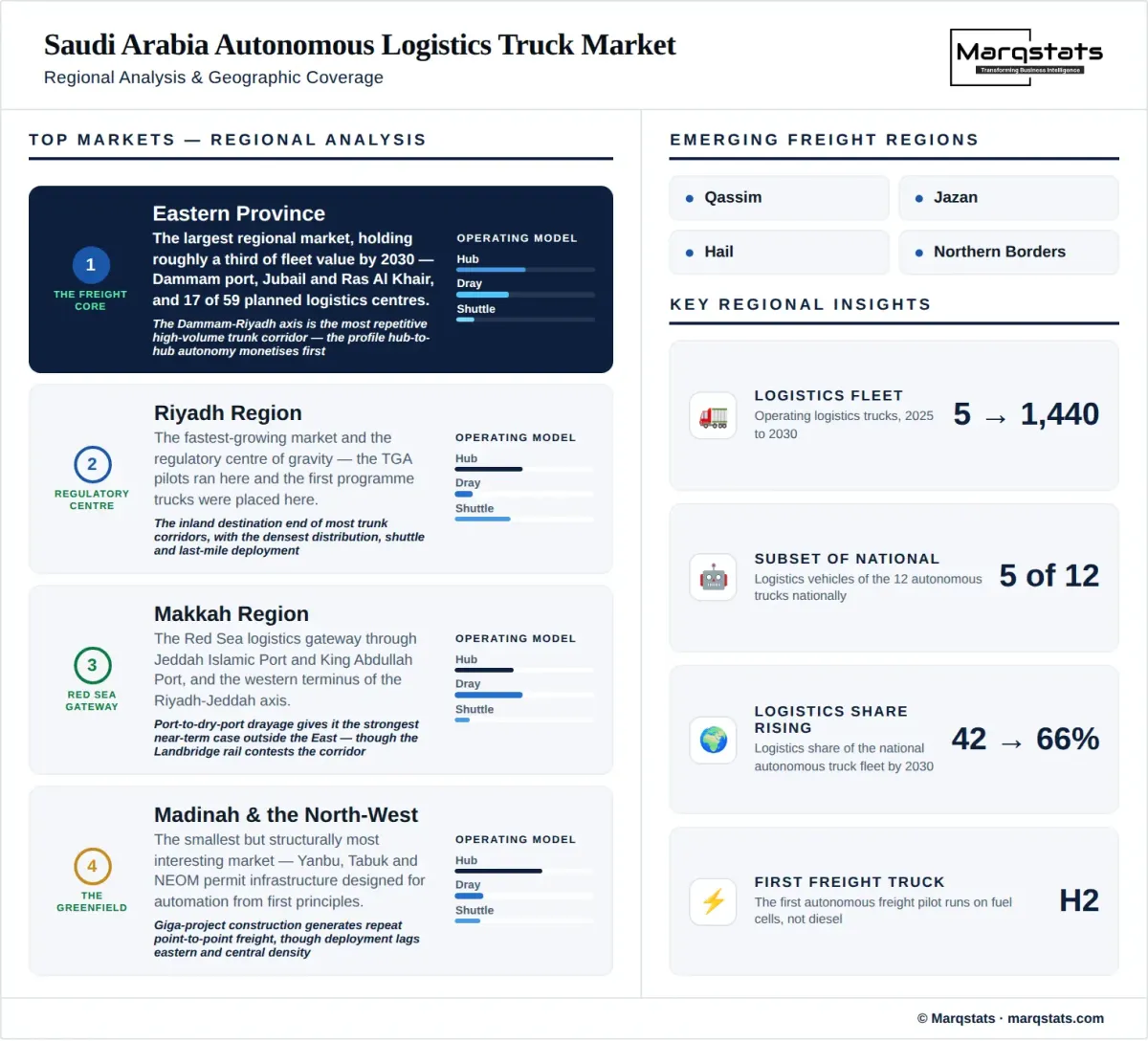
Saudi Arabia had roughly twelve autonomous trucks in operation across all domains at the end of 2025, of which five were running freight and logistics duty cycles. The remaining seven worked in mining haulage, port-yard shunting and closed industrial campuses, which carry different operating design domains, different safety cases and different buyers. The logistics-corridor fleet is the population the announced national programme targets, and it captures the large majority of commercial value created over the period. Its share of the national autonomous truck fleet rises from 41.7% in 2025 to 65.5% by 2030 and 72.4% by 2031. Small in absolute terms today, it becomes the centre of Saudi autonomous freight well before the end of the decade.
Growth is paced by route authorisation rather than by vehicle supply, which distinguishes this market from conventional commercial vehicle demand. The August 2026 collaboration between HUMAIN and Applied Intuition targets thousands of autonomous trucks across key logistics corridors by 2030 while naming no route, no fleet operator and no investment figure. The first vehicle to move commercial freight under regulatory supervision arrived separately, in June 2026, as a hydrogen fuel-cell autonomous heavy truck carrying consumer goods. Fleet expansion consequently follows the rate at which the Transport General Authority authorises specific corridors and operators, and the forecast is built on those permitting milestones.
Key Takeaways
Market Overview & Analysis
Report Summary
The Saudi Arabia autonomous logistics truck market comprises trucks operating with SAE Level 4 or higher automation in commercial freight and logistics service, moving goods on public highways or between logistics nodes such as ports, dry ports, industrial cities, distribution centres and fulfilment sites. Market value is annual spend on vehicles entering service, calculated as in-year fleet additions multiplied by a blended vehicle-plus-autonomy-system price, and the operating logistics fleet is reported in vehicles alongside it. On this basis the market stood at USD 1.78 million and five operating vehicles in 2025.
Fleet size and market value move on markedly different curves, and both are carried for every year of the forecast. The operating fleet is the physical measure of adoption; annual spend is the commercial measure of what that adoption is worth to vehicle manufacturers, autonomy providers and service suppliers. Because the installed base compounds while vehicle prices fall, the two diverge: the fleet expands at 210.37% a year against 151.75% for market value. Each measure answers a different planning question, and the gap between them is itself commercially significant.
Three adjacent activities fall outside the market. Mining and quarry haulage is excluded, since autonomous haul trucks in pit operations run a fundamentally different operating design domain on private roads under mine-site rules rather than road-transport regulation. Port-yard and terminal shunting is excluded, as container-handling tractors working inside a fenced terminal are terminal equipment rather than road freight vehicles. Closed-campus and industrial-site circulation is excluded on the same basis. A logistics transfer that begins or ends outside the closed site — a port-to-dry-port drayage run, for example — falls inside the market, with the public-road leg qualifying it.
The market forms a subset of the broader Saudi Arabia autonomous truck market rather than a parallel one. The five logistics vehicles operating in 2025 are five of the twelve autonomous trucks running nationally across all domains, so the two figures describe the same vehicle population at different levels of aggregation and combining them would count each logistics vehicle twice. An all-domain view of Saudi autonomous freight is given by the broader market; corridor economics, fleet operator strategy and logistics-specific demand are captured at this level.
The forecast is calibrated to confirmed regulatory and project milestones rather than extrapolated, because no historical series exists on which to fit a trend. Four anchors carry it: the Transport General Authority's 2025 opening of a formal market-entry route for autonomous vehicle operators subject to technical evaluation; the first supervised autonomous freight movement in June 2026; the announced national programme targeting thousands of trucks across logistics corridors by 2030; and the infrastructure commitments around automated depot charging and fleet telematics that make high-utilisation autonomous operation viable. The resulting path is heavily back-loaded, with double-digit fleet counts through 2026, a step change across 2028 and 2029 as corridor authorisations convert to fleet contracts, and approximately 1,440 vehicles by 2030.
Market Dynamics
Key Drivers
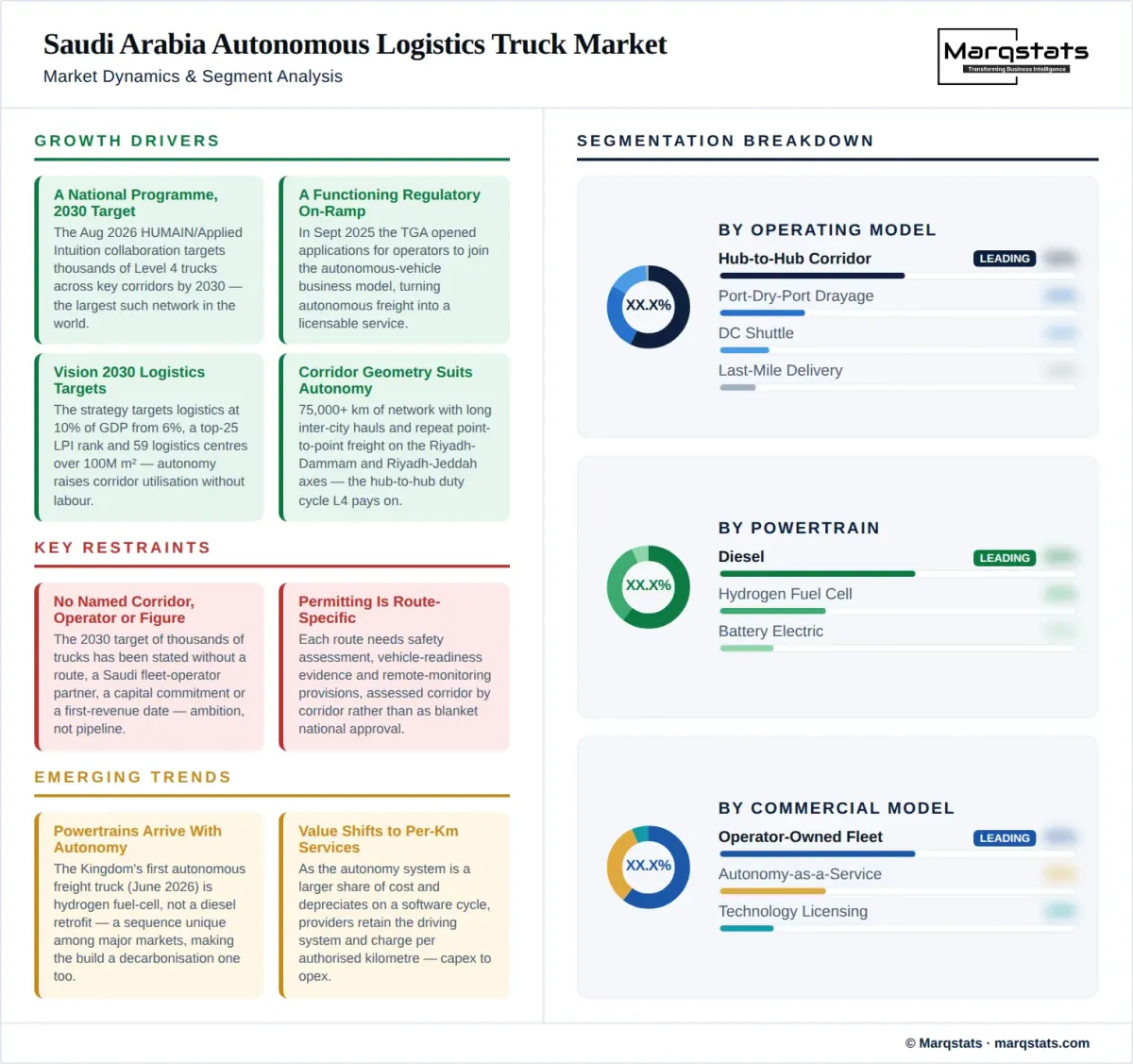
- A national programme with an explicit 2030 fleet target. The August 2026 collaboration between HUMAIN, a Public Investment Fund company, and Applied Intuition set a target of thousands of autonomous trucks across Saudi Arabia's key logistics corridors by 2030, described by the partners as the largest autonomous trucking network in the world. Applied Intuition supplies a Level 4-capable Self-Driving System and a vehicle operating system built for national-scale fleet deployment, and has opened a Riyadh office with a local hiring commitment. This is the single largest demand anchor in the forecast.
- A functioning regulatory on-ramp rather than a legislative vacuum. In September 2025 the Transport General Authority opened applications for local and international companies to join the Kingdom's autonomous-vehicle business model, subject to technical evaluation. That converts autonomous freight from a demonstration activity into a licensable commercial service and gives an operator a defined path from pilot to contract, which is the precondition for any fleet purchase decision.
- Vision 2030 logistics targets that require throughput gains road labour alone cannot deliver. The National Transport and Logistics Strategy targets a rise in the transport and logistics contribution to GDP from approximately 6% to 10% by 2030, a Logistics Performance Index rank inside the global top 25 from a baseline of 55th, container clearance within 24 hours, port capacity above 20 million TEU, and around SAR 45 billion in annual non-oil revenues. Autonomous freight raises asset utilisation on fixed corridors without proportional labour growth, which maps directly onto those targets.
- Corridor geometry that suits autonomy better than almost any market on earth. The Kingdom operates a road network of more than 75,000 kilometres with very long inter-city hauls, low traffic density outside urban centres, and repeat point-to-point freight between a small number of high-volume nodes. The Riyadh–Dammam and Riyadh–Jeddah axes carry dense, predictable, scheduled movements — the exact duty cycle where hub-to-hub autonomy generates savings, and the opposite of the dense mixed-traffic urban environments where Level 4 deployment has proved hardest elsewhere.
- Logistics infrastructure being built to autonomous specifications from the outset. Fifty-nine logistics centres exceeding 100 million square metres are planned by 2030, with 17 in the Eastern Province and 12 across Riyadh and Makkah, and 21 already in progress. Because these are new-build assets rather than retrofits, gate automation, yard layout, dwell scheduling and depot charging can be specified for driverless operation at design stage, removing the retrofit cost that constrains autonomous freight in mature logistics markets.
Key Restraints
- No named corridor, operator or investment figure attached to the headline programme. The 2030 target of thousands of trucks has been stated repeatedly without a route, a Saudi fleet operator partner, a capital commitment or a first-revenue date. Public coverage confirms trucks on the ground in Riyadh and a local office, and nothing beyond that. Until a corridor is authorised and a fleet operator signs, the target functions as an ambition rather than a pipeline, and it is the largest single source of forecast variance.
- Permitting is route-specific and therefore slow to compound. Commercial logistics deployment must satisfy route safety assessment, vehicle readiness evidence, telematics and remote monitoring provisions, and defined operator responsibilities. Each of those is assessed against a specific route rather than granted as a blanket national approval, so fleet growth advances corridor by corridor. Claims circulating in trade coverage that the Kingdom has legally authorised driverless trucks nationally are not supported by the primary regulatory record; authorisation remains route-specific.
- The environment is unusually hard on perception hardware. Autonomous operation in the Kingdom must handle dust, blowing sand, sustained extreme heat and long remote highway stretches with minimal roadside infrastructure. Sensor stacks and thermal management validated in temperate markets require re-qualification, and the validation burden falls on a five-vehicle installed base with no accumulated Saudi operating history to draw on.
- Neither vehicle supply nor a domestic supply chain currently exists at fleet scale. There is no Saudi-built autonomous truck platform in series production, no established regional retrofit channel, and no depth of local remote-supervision, specialised maintenance or sensor-calibration capability. Every element of a 2028 fleet order is presently an import or a first-of-kind local build, which lengthens lead times and concentrates counterparty risk in a very small number of suppliers.
Key Trends
- Alternative powertrains are arriving with autonomy rather than after it. The Kingdom's first autonomous heavy-duty freight truck, piloted from June 2026, is a hydrogen fuel-cell platform rather than a diesel retrofit — a sequence unique among major markets, where autonomy has generally been layered onto conventional powertrains first. Saudi Arabia's hydrogen production ambitions make the pairing rational domestically, and it means the fleet build is simultaneously a decarbonisation programme, which changes both the buyer and the funding route.
- Depot infrastructure is being designed around autonomous duty cycles before the fleet exists. The May 2026 agreement between HEVO and Fleet Tracking Technologies covers wireless charging hardware with integrated fleet management, targeting a first commercial installation within twelve months and explicitly scoping automated depot charging, API-linked telematics and operator-specific workflows. Automated energy transfer is a precondition for driverless operation, because a vehicle with no driver cannot plug itself in, and it is being specified ahead of the vehicles it will serve.
- Last-mile autonomous delivery is running ahead of heavy freight and is building the regulatory precedent. The Transport General Authority's July 2025 pilot with Jahez and ROSHN at ROSHN Business Front in Riyadh tests unmanned vehicle workflows, commercial-site operations and regulator-supervised deployment in a live environment. Heavy autonomous freight inherits the supervisory framework, incident-reporting practice and public-acceptance groundwork that these lighter deployments establish first.
- Commercial models are shifting from vehicle purchase toward per-kilometre autonomy services. Because the autonomy system is a larger share of vehicle cost than in any conventional truck and depreciates on a software rather than a chassis cycle, technology providers increasingly retain the driving system and charge for authorised distance travelled. This suits Saudi fleet operators facing a first-of-kind asset with no residual-value history, and it moves a material share of forecast value out of capital expenditure and into operating expenditure over the period.
Market Segmentation
Hub-to-hub corridor freight is the dominant segment across the forecast and the direct target of the announced national programme. It covers scheduled trunk movements between fixed nodes on long inter-city highway runs, typically port to inland distribution centre or industrial city to consolidation hub. The duty cycle is the most tractable case for Level 4 automation because the route is repeatable, mapped once and driven thousands of times, with human handling confined to the first and last few kilometres. The segment holds the majority of fleet value from 2027 onward as corridor authorisations convert into multi-vehicle contracts.
Port-to-inland drayage covers repeated short-to-medium hauls between a seaport gate and an inland container depot or dry port. The movement crosses public road, which places it inside this market and separates it from in-terminal shunting. Very high daily trip repetition on a route measured in tens rather than hundreds of kilometres makes payback arithmetic unusually favourable, and the Eastern Province and Makkah Region port complexes give the segment its natural geography.
Distribution-centre shuttle operation moves trailers between adjacent warehouses, fulfilment sites and cross-dock facilities within a logistics cluster. Speeds are lower and routes shorter than corridor freight, which lowers the technical bar, but revenue per vehicle is correspondingly lower. The segment grows fastest in the second half of the forecast as the new logistics centres reach operational density and clusters generate enough internal movement to justify dedicated autonomous assets.
Autonomous last-mile delivery covers light goods vehicles operating driverless on final-delivery duty. It is included where the vehicle is a goods vehicle in commercial logistics service and is currently the most operationally mature deployment in the Kingdom, having been tested under regulatory supervision since 2025. Value per vehicle is a fraction of a heavy tractor, so the segment carries a small share of market value while contributing disproportionately to fleet count and to the regulatory learning curve.
Level 4 operation with a safety operator onboard accounts for essentially the entire installed base through 2027 and remains the dominant configuration to 2029. The vehicle drives itself within its operating design domain while a trained operator is present to assume control, which is the configuration regulators authorise first and the one insurers price most readily. It carries the full autonomy hardware cost without delivering the labour saving, so the economics rest on utilisation and safety performance rather than headcount.
Driver-out Level 4 operation removes the onboard operator and substitutes remote supervision, and it is where the commercial case for autonomous freight is actually realised. The transition is gated by route-specific regulatory approval and by accumulated incident-free operating distance rather than by vehicle technology, which is largely the same in both configurations. The segment is modelled as beginning to appear on the most mature corridors late in the forecast period and is the principal upside variable in the model.
Level 5 operation, meaning unrestricted automation across all conditions and routes, is not commercially present in Saudi Arabia and is not forecast to appear within the period. The distinction carries commercial weight, because Level 4 systems operating within a defined domain are frequently marketed in language implying unrestricted capability, and it is the certified operating design domain rather than the marketing claim that determines where a vehicle may legally run.
Diesel autonomous tractors carry most of the fleet through the early years because the platforms are available, serviceable through existing dealer networks, and unconstrained by refuelling infrastructure. The powertrain is separable from the autonomy decision, and operators taking on first-of-kind automation risk have consistently preferred to hold the powertrain variable constant. Diesel share declines steadily across the forecast as zero-emission alternatives reach fleet availability.
Hydrogen fuel cell is the powertrain of the Kingdom's first autonomous heavy freight pilot, launched in June 2026 on a platform rated above 40 tonnes payload with 350-bar storage and refuelling measured in minutes. Long single-fill range and short refuelling downtime suit high-utilisation corridor duty far better than depot charging, and the pairing aligns with national hydrogen production ambitions. The segment's growth is bounded by refuelling station coverage on the target corridors rather than by vehicle availability.
Battery-electric autonomous tractors are most viable on drayage and shuttle duty, where daily distance is bounded and the vehicle returns to a fixed depot. The segment is directly enabled by automated depot charging, since a driverless vehicle cannot connect a cable, which is why the wireless charging and fleet management commitments made in 2026 matter more to this segment than to any other. Adoption on long corridor duty remains constrained by charging time against utilisation targets.
Operator-owned fleets, in which a logistics company purchases the vehicle and the autonomy system outright and runs it on its own contracts, account for the largest share of market value across the forecast. The model suits large domestic logistics groups and industrial shippers with captive corridor volume and balance sheets able to absorb first-of-kind residual risk. It is the configuration assumed in the base valuation, since market value here is defined as spend on vehicles entering service.
Under autonomy-as-a-service the technology provider retains ownership of the driving system, and often of the vehicle, and charges the operator per authorised kilometre or per completed movement. It removes technology-obsolescence risk from the fleet operator and gives the provider recurring revenue and control of the software update path. The model grows fastest across the period and progressively shifts market value from capital expenditure into operating expenditure, so an increasing share of activity ceases to be visible in vehicle purchase volumes.
Technology licensing covers arrangements in which an operator integrates a licensed self-driving system and vehicle operating system into its own vehicle procurement, retaining asset ownership while paying for the software stack. It is the model implied by the announced national programme's structure, in which the technology partner supplies the driving system and vehicle operating system for national-scale deployment rather than supplying vehicles. Licensing revenue sits inside the blended per-vehicle price rather than forming a separate revenue line.
By Geography
Eastern Province
The Eastern Province is the largest regional market across the forecast, holding roughly a third of fleet value by 2030. It combines King Abdulaziz Port at Dammam, the Jubail and Ras Al Khair industrial complexes, the Kingdom's densest concentration of heavy freight generation, and 17 of the 59 planned national logistics centres — more than any other region. The Dammam–Riyadh axis is the most repetitive high-volume trunk corridor in the country, which is precisely the profile hub-to-hub autonomy monetises first, and the province also carries the largest adjacent pool of excluded industrial and port-yard automation.
Riyadh Region
Riyadh is the fastest-growing regional market and the regulatory centre of gravity for the entire sector. The Transport General Authority's autonomous-vehicle initial operating phase and the autonomous delivery pilot with Jahez and ROSHN both ran in the capital, the technology partner to the national programme opened its Saudi office there, and the first autonomous trucks under that programme were placed on the ground in Riyadh. As an inland consumption centre, the region is the destination end of most trunk corridors, giving it the highest concentration of distribution centres and the densest shuttle and last-mile deployment.
Makkah Region
The Makkah Region anchors the Kingdom's Red Sea logistics gateway through Jeddah Islamic Port and King Abdullah Port at King Abdullah Economic City, and it is the western terminus of the Riyadh–Jeddah trunk axis that the 1,300-kilometre Landbridge rail project also targets. That overlap is commercially significant: autonomous road freight and the Landbridge address the same corridor, and operators will divide volume between them on service characteristics rather than treat road automation as uncontested. The region's port-to-dry-port drayage volume gives it the strongest near-term case outside the Eastern Province.
Madinah Region and the North-West
The Madinah Region and the wider north-west, including Yanbu, Tabuk and the NEOM development area, form the smallest but structurally most interesting regional market. Greenfield development permits transport infrastructure to be specified for automation from first principles rather than retrofitted, and the giga-project construction and supply movements generate exactly the repeat point-to-point freight that autonomy suits. Deployment is later than in the eastern and central regions because freight density is currently lower and corridor authorisation follows commercial volume.
Rest of Saudi Arabia
The remaining regions, principally Qassim, Asir, Jazan, Najran, Hail and the Northern Borders, hold a small share of fleet value throughout. Freight movements are longer, thinner and less repetitive, which weakens the utilisation case that makes autonomous operation pay, and corridor authorisation follows commercial density. Jazan's industrial city and the northern land crossings toward Jordan and Iraq are the most likely sources of later-period deployment, with cross-border movement remaining outside the scope of any current authorisation.
How Competition Is Evolving
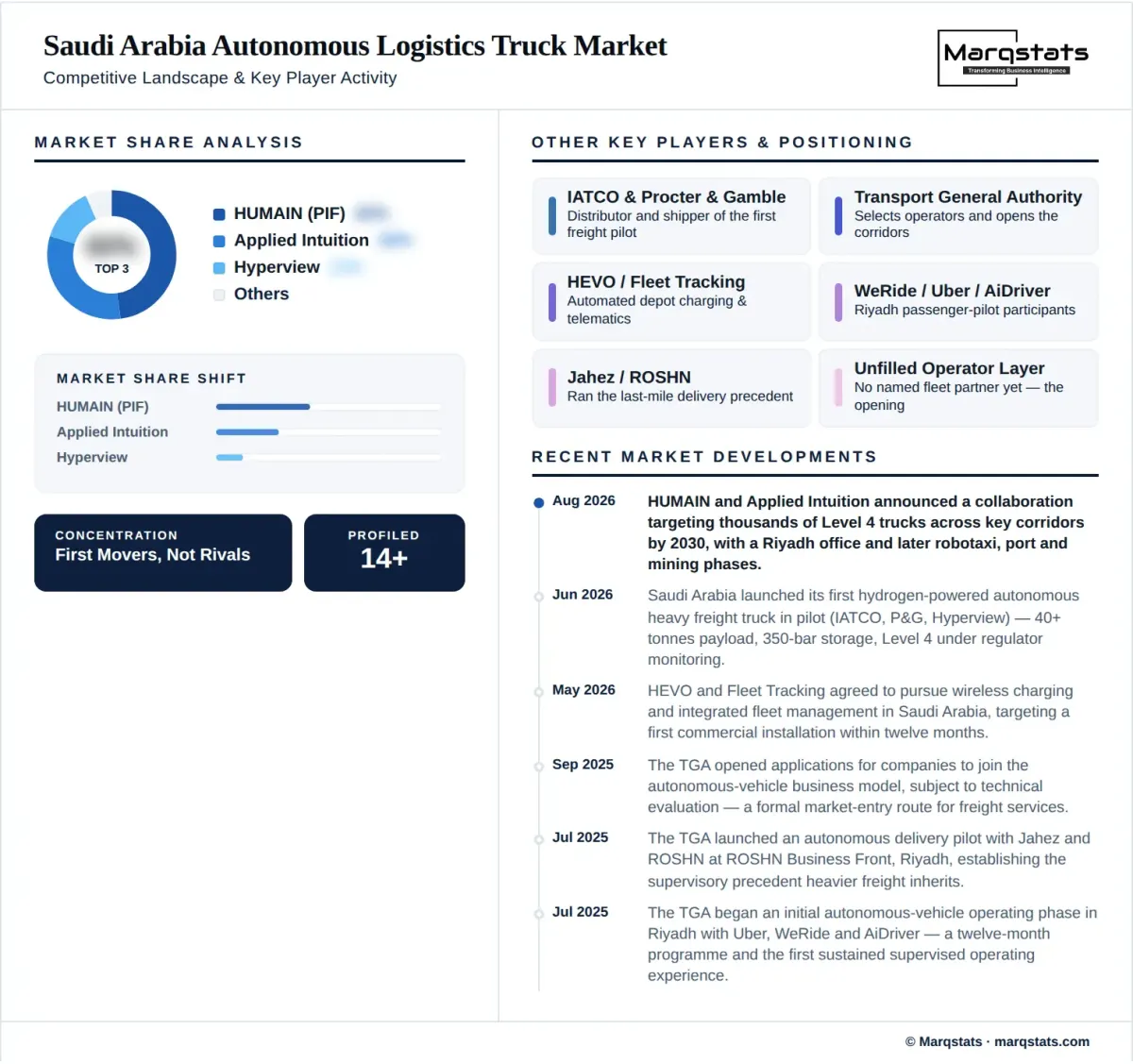
The Saudi Arabia autonomous logistics truck market is highly concentrated and is best understood as an ecosystem of first movers rather than a competitive field. A single announced programme — HUMAIN with Applied Intuition — accounts for the overwhelming majority of forecast fleet value, and a single supervised pilot involving Hyperview, Ismail Abudawood Trading Company and Procter & Gamble accounts for the first commercial freight movement. There is no second national-scale programme, no incumbent autonomous freight operator, and no competitive tender history to reference. Concentration falls only modestly across the forecast, and any market-share discussion before 2028 is a discussion about two deployments.
The value chain divides into four roles that rarely sit in one company. Technology providers supply the self-driving system, vehicle operating system, simulation and safety validation. Vehicle platform providers supply the truck itself, which in the Kingdom's first freight deployment is a hydrogen fuel-cell platform rather than a conventional diesel tractor. Fleet and logistics operators hold the freight contracts, the corridor knowledge and the customer relationships. Infrastructure and energy providers supply automated depot charging, telematics integration and remote supervision. The commercially decisive question for a new entrant is which role to occupy, because the announced programme has already claimed the technology layer at national scale while the operator layer remains conspicuously unfilled.
That unfilled operator layer is the clearest opening in the market. No Saudi logistics company has been publicly named as the fleet partner to the national programme, and the first freight pilot was assembled instead around a shipper, its distribution partner and a technology firm. An operator that can bring corridor volume, depot assets and a regulator relationship is therefore negotiating from a stronger position than the vehicle count implies. Merger and acquisition activity has been absent to date, and the more probable near-term consolidation is not acquisition but exclusive corridor partnership, in which a technology provider and a logistics operator lock up a route pair before permitting opens it to others.
The regulator is an unusually active market participant rather than a passive rule-setter. The Transport General Authority has run the pilots, opened the business-model application route, evaluated applicants technically and monitored operations through the national freight platform. In practice it selects which operators enter and which corridors open, so the entity most able to change competitive position over the next three years is not a company at all. Competitive strategy in this market accordingly consists of regulatory engagement, corridor-level partnership and demonstrable safety performance, in roughly that order, and not of product differentiation or price.
Companies Covered
Companies covered in the report include:
Recent Market Activity
Table of Contents
Coverage & Segmentation
This report covers trucks operating at SAE Level 4 or above in commercial freight and logistics service in Saudi Arabia, with 2025 as the base year and 2026 – 2030 as the forecast period. Market size is reported as annual spend on vehicles entering service in US dollars and corroborated at every point by the operating logistics fleet in vehicles. Segmentation covers operating model, automation level, powertrain and commercial model, with regional analysis for the Eastern Province, the Riyadh Region, the Makkah Region, the Madinah Region and the north-west, and the rest of Saudi Arabia.
Four boundaries define the market perimeter. First, it is a subset of the broader Saudi Arabia autonomous truck market rather than an addition to it: the five logistics vehicles operating in 2025 are five of the twelve autonomous trucks running nationally across all domains. Second, mining and quarry haulage, port-yard and terminal shunting, and closed-campus circulation fall outside the market, while a logistics transfer that crosses public road falls inside it. Third, operating fleet is a stock and annual spend is a flow: market value is in-year additions multiplied by price rather than installed base multiplied by price, a distinction that widens from parity in 2025 to a factor of nearly two by 2030. Fourth, remote supervision services, mapping, telematics subscriptions, depot automation and specialised maintenance are analysed as adjacent pools and excluded from market value.
No pre-2025 series exists for this market, as commercial autonomous freight operation in the Kingdom began in 2025. The historical period is accordingly the single base year 2025 rather than a constructed history. Confidence in the base is low, with an indicative 2025 range of three to eight vehicles and a 2026 range of twelve to thirty. The compound growth rates carried throughout are a small-base arithmetic effect characteristic of a market moving from pilot operation into early commercial adoption, and are presented alongside absolute vehicle counts and confirmed programme milestones at every point.
The forecast is calibrated to permitting and project milestones rather than fitted to a trend, and the rate at which route authorisations convert into multi-vehicle fleet contracts is the variable that most affects the outcome. The 2030 fleet of approximately 1,440 vehicles sits on the same geometric path as the 2031 endpoint of 4,200 logistics vehicles, so the two horizons describe a single curve rather than two forecasts. Measured against national commercial vehicle demand the scale remains modest: the 800 trucks projected to enter service in 2030 equal 0.80% of the 100,556 commercial vehicles the Kingdom sold in 2025.