Market Snapshot
Middle bar: base-year value × (1 + CAGR), rounded to two decimals. This is a calculated illustration, not a separately researched annual estimate.
The Saudi Arabia autonomous vehicle depot infrastructure market size is estimated at USD 2.80 million in 2025 and is projected to reach USD 20.90 million by 2030, expanding at a 49.49% CAGR across the 2026 – 2030 forecast period. The market covers depots providing automated energy transfer, staging, remote supervision, maintenance and orchestration for autonomous fleets, valued as annual investment in sites entering service. The AV-ready depot count rises from one site in 2025 to 31 by 2030. Conventional fleet charging depots without autonomous operating functions are excluded.
Market size and forecast figures are generated using Marqstats' proprietary estimation framework, updated as of September 2026.
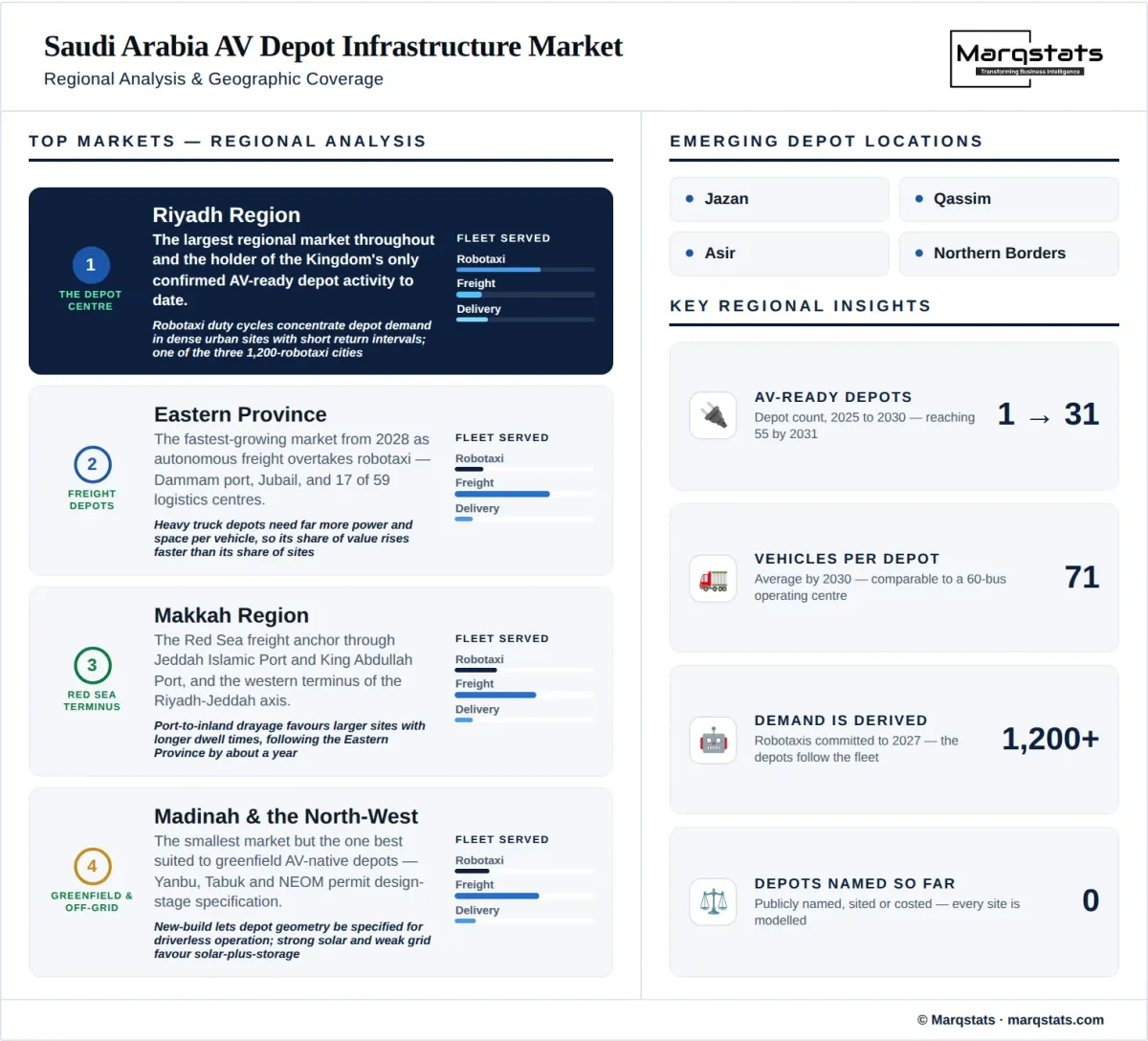
Demand here is derived, not autonomous. Depot investment follows the size of the fleet that has to be parked, charged, cleaned, calibrated and supervised, so the forecast is anchored to vehicle deployment rather than to charging-infrastructure targets. Two committed fleets set the scale. WeRide and Uber agreed in February 2026 to deploy at least 1,200 robotaxis across Abu Dhabi, Dubai and Riyadh as soon as 2027, and the national autonomous trucking programme targets thousands of vehicles across logistics corridors by 2030. Set against a modelled 2,200 autonomous trucks operating nationally in 2030, the 31 AV-ready depots forecast for that year work out at 71 vehicles per site — a depot scale directly comparable to conventional bus and truck operating centres.
What separates this from conventional depot charging is the removal of the driver, and it changes the specification rather than the size. A vehicle with no one in it cannot plug in a cable, walk itself through a wash bay, report a cracked sensor cover or move itself between stands on instruction. Automated energy transfer, autonomous yard movement, remote supervision and sensor calibration therefore become site requirements rather than upgrades, and they are what distinguishes an AV-ready depot from a fleet charging depot serving driven vehicles. Sites without those functions belong to the fleet depot charging market and are excluded throughout.
Key Takeaways
Market Overview & Analysis
Report Summary
The Saudi Arabia autonomous vehicle depot infrastructure market comprises dedicated or AV-ready depots that provide automated charging or refuelling, vehicle staging, telematics, remote operations, maintenance and fleet orchestration for autonomous vehicles operating in the Kingdom. Market value is annual investment in sites entering service, calculated as newly commissioned depots multiplied by a blended per-site investment covering energy transfer hardware, grid or off-grid power provision, yard automation, remote operations facilities and calibration and maintenance capability. The installed depot count is reported alongside value at every point. On this basis the market stood at USD 2.80 million and one operating site in 2025.
AV-Ready Depot Count and Site Forecast
The AV-ready depot count rises from one site in 2025 to 31 sites by 2030, a 98.73% compound annual growth rate, with the installed base reaching 55 sites by 2031. Site counts and annual spend move on different curves: the installed base is a stock that accumulates, while market value reflects only the depots commissioned in each year. Eleven sites are projected for commissioning in 2030 against one in 2025, a 61.54% compound rate on new-site additions.
Site count and market value diverge by 49 percentage points, 98.73% against 49.49%, because blended investment per depot falls from USD 2.80 million to USD 1.90 million as designs standardise, wireless charging hardware moves from pilot pricing to volume pricing, and off-grid architectures remove civil works from an increasing share of sites. A supplier sizing addressable revenue from the site curve alone overstates it by roughly half. The indicative range around the base is wide by construction — nought to one site in 2025, two to four in 2026 and 35 to 70 in 2031 — and confidence is low, because no depot census exists in the Kingdom or anywhere else.
Three exclusions define the boundary against adjacent infrastructure markets. Conventional fleet charging depots serving driven vehicles fall outside the market, however large their power draw, because a driver performs the connection, inspection and yard movement that automation must otherwise replace. Public and destination charging is excluded entirely, since a robotaxi charging on a public network is using retail infrastructure rather than depot infrastructure. General-purpose parking, warehousing and logistics yards without AV-specific operating functions are excluded on the same reasoning. A brownfield fleet depot enters the market at the point AV-specific functions are added, and only the incremental AV-specific investment is counted.
The relationship to the Saudi Arabia fleet depot charging market is subset to adjacent rather than subset to superset. Fleet depot charging covers energy transfer to commercial fleets at their operating bases irrespective of who drives them; this market covers the automation layer that makes a depot usable by vehicles with nobody aboard. Where a single site carries both, the conventional charging investment belongs to the fleet depot charging market and the automated transfer, staging, supervision and calibration investment belongs here. The two are complementary rather than overlapping, and the split is by function within the site, not by the site itself.
Market Dynamics
Key Drivers
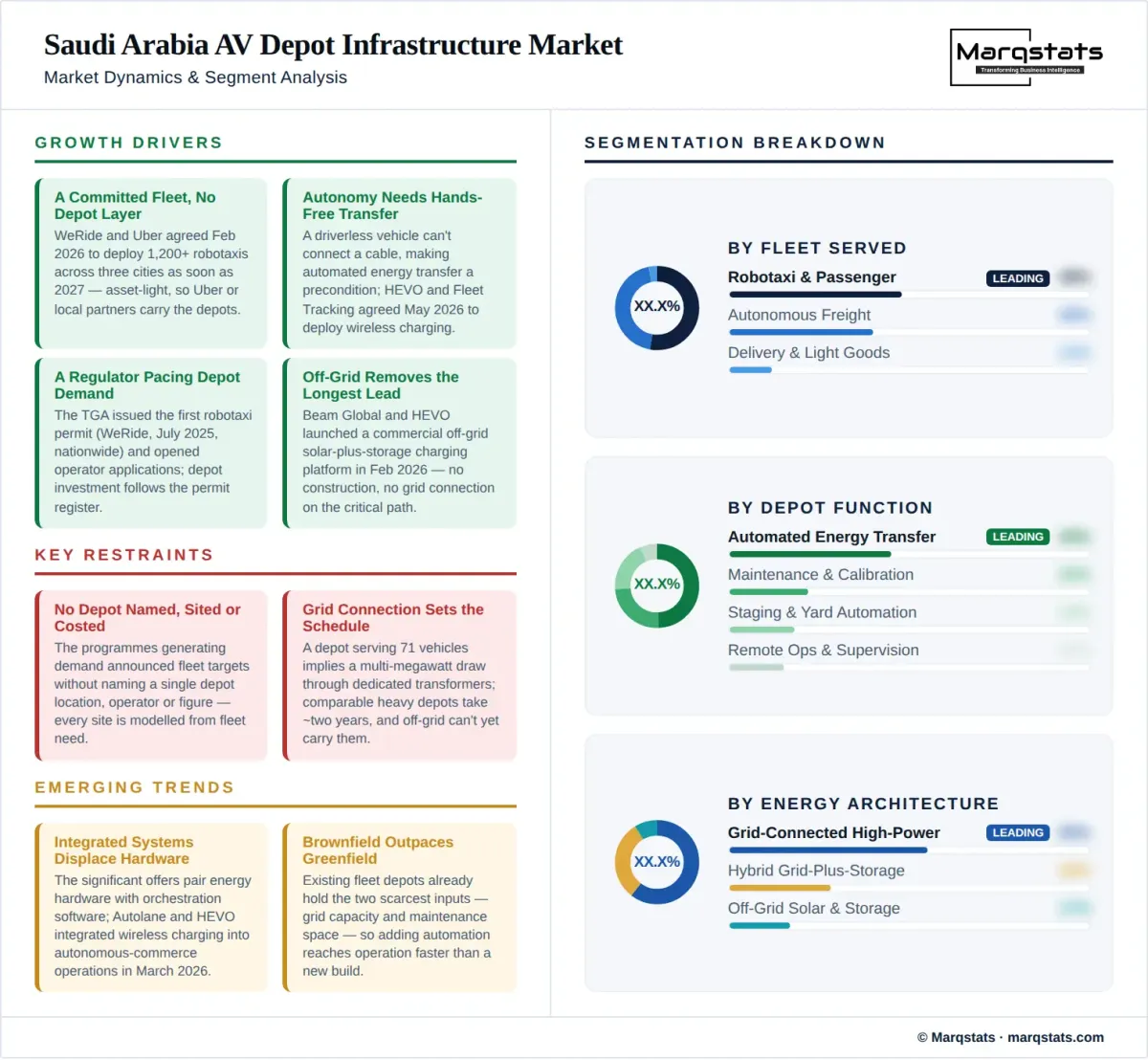
- A committed regional robotaxi fleet with no depot layer yet named. WeRide and Uber agreed in February 2026 to deploy at least 1,200 robotaxis across Abu Dhabi, Dubai and Riyadh as soon as 2027, three of fifteen cities under a broader agreement with twelve more expected by 2030. The arrangement runs on WeRide's asset-light model, in which Uber or local third-party partners carry fleet operations — which is precisely the depot, staging and energy burden. More than 200 robotaxis already operate regionally, so the requirement is immediate rather than prospective.
- Autonomy that cannot function without automated energy transfer. A driverless vehicle cannot connect a charging cable, which makes hands-free energy transfer a precondition rather than a convenience. HEVO and Fleet Tracking Technologies agreed in May 2026 to deploy Rezonant wireless charging hardware and the Journey software platform across Saudi Arabia and the wider region, targeting a first commercial installation within twelve months and explicitly scoping automated depot workflows, fleet telematics and autonomous vehicle charging.
- A regulator that licenses operators and therefore paces depot demand. The Transport General Authority issued Saudi Arabia's first robotaxi autonomous driving permit to WeRide in July 2025, authorising nationwide deployment, and opened autonomous-vehicle business-model applications subject to technical evaluation in September 2025. Depot investment follows permitted operator pipelines rather than general infrastructure targets, which makes the permit register the leading indicator for this market.
- Off-grid architectures that remove the longest lead time from the critical path. Beam Global and HEVO launched a commercially available autonomous charging platform in February 2026 combining wireless energy transfer with off-grid solar and storage, explicitly requiring no construction and no grid connection. High-power fleet hubs otherwise depend on utility connection, electrical safety approval and site permitting, where grid lead time routinely exceeds charger procurement by a wide margin.
- A national charging build-out that supplies the surrounding ecosystem. EVIQ, a joint venture owned 75% by the Public Investment Fund and 25% by the Saudi Electricity Company and established in 2023, targets more than 5,000 chargers across the Kingdom and joined CharIN to align on interoperability standards. AV depots draw on that supply chain, installer base and standards environment even though they are a specialised subset of it rather than a proportional share.
Key Restraints
- No depot has been publicly named, sited or costed. The programmes that generate depot demand — the national autonomous trucking collaboration and the regional robotaxi commitment — have announced fleet targets without naming a single depot location, operator or investment figure. Every site in the forecast is therefore modelled from fleet requirement rather than counted from an announcement, which is why base-year confidence is low and the 2031 range spans 35 to 70 sites.
- Grid connection, not equipment, sets the schedule. High-power fleet hubs require utility connection, electrical safety certification and site approval, and a depot serving 71 vehicles implies a power draw in the multi-megawatt range through dedicated transformer capacity. Comparable heavy-vehicle depots elsewhere take around two years to build at roughly 110 kW per vehicle. Off-grid solar and storage relieves this for lighter duty cycles but cannot yet carry a heavy autonomous truck depot at full utilisation.
- The asset-light operating model leaves depot ownership unassigned. Under the announced robotaxi structure the technology provider supplies autonomy while Uber or local third-party partners handle fleet operations, and no party has been publicly identified as the depot owner or investor in the Kingdom. Infrastructure whose owner is undetermined attracts capital slowly, and the commercial question of who funds, owns and earns from an AV depot is unresolved.
- Standards for automated energy transfer are not settled. Wireless charging power classes, alignment tolerances and communication protocols for hands-free transfer remain less mature than plug-in fast charging, where CharIN-aligned CCS practice is established. A depot specified around one wireless vendor's hardware today carries stranding risk if fleet procurement later standardises elsewhere, which pushes early operators toward pilot-scale commitments rather than full-site build-outs.
Key Trends
- Integrated depot systems are displacing hardware procurement. The commercially significant offers pair energy hardware with orchestration software — wireless charging with a fleet software platform, off-grid power with autonomous docking, automated arrival with mission planning and real-time charging visibility. Autolane and HEVO announced integration of wireless charging into autonomous commerce operations in March 2026 with joint trials validating automated vehicle arrival and docking, dwell-time charging and mission-planning integration. The value pool is the integrated system rather than the connector.
- Brownfield conversion is outpacing greenfield AV hubs. Existing fleet depots already hold the two scarcest inputs, grid capacity and maintenance space, so adding automated energy transfer and remote supervision to a working site reaches operation faster than building an AV-native facility. The July 2025 agreement between EVIQ and Blacklane follows this shape, establishing dedicated fleet-charging hubs including an integrated charging centre at an existing corporate headquarters rather than a purpose-built depot.
- Depot design is being specified ahead of the fleets that will use it. Commitments to automated depot workflows, telematics integration and operator-specific fleet software were made in 2026 against autonomous fleets that are still measured in dozens of vehicles. Infrastructure normally lags vehicle deployment; here it is being designed first, because retrofitting automation into a depot built for driven vehicles is materially more expensive than specifying it at design stage.
- Public network access is being blended with private depot capacity. The EVIQ and Blacklane arrangement integrates a public fast-charging network into a fleet operator's own operations alongside dedicated hubs, treating public infrastructure as overflow capacity for high-utilisation fleets. For autonomous fleets this hybrid model reduces the depot capacity that must be built and owned, and shifts part of the energy requirement into an operating cost.
Market Segmentation
Automated energy transfer is the largest function by investment across the forecast and the one without which no other depot function matters, since a vehicle that cannot recharge itself cannot complete a second duty cycle unattended. The segment covers wireless inductive charging, robotic plug-in systems and the power provisioning behind them. Its cost trajectory drives the decline in blended per-site investment, as wireless hardware moves from pilot pricing toward volume pricing across the period.
Staging and yard automation covers the movement, positioning and queuing of vehicles inside the depot perimeter without a driver — arrival sequencing, charging-bay assignment, holding areas and dispatch order. It is invisible in a conventional depot because drivers perform it implicitly, and it becomes a designed system the moment they are removed. The segment grows in share across the forecast as depot vehicle counts rise and manual yard marshalling stops being viable.
Remote operations and supervision covers the control rooms, connectivity and teleoperation capability through which a human monitors and, where required, intervenes in autonomous operation. Regulatory requirements for remote monitoring and incident response make this a licensing prerequisite rather than an efficiency measure. Investment per site is modest against energy hardware, but the function is centralising: one supervision centre can serve several depots, which pulls its cost out of the per-site figure over time.
Maintenance, calibration and sensor servicing covers the bays and equipment for keeping perception hardware within specification — camera and radar alignment, cleaning systems, and the diagnostic capability to detect a degraded sensor before dispatch. Saudi operating conditions make this segment structurally more important than in temperate markets, because dust, blowing sand and sustained extreme heat degrade sensor performance and shorten calibration intervals. It is the function most often omitted from early depot specifications.
Robotaxi and passenger autonomous vehicle depots are the largest served-fleet segment through 2028, reflecting the committed regional deployment of at least 1,200 robotaxis across three cities as soon as 2027. Duty cycles are high-utilisation and urban, with short dwell times and frequent returns, which favours rapid automated energy transfer and dense staging over heavy maintenance capability. Riyadh carries the segment almost entirely in the early years.
Autonomous freight and logistics depots serve heavy autonomous trucks on corridor duty, and the segment takes the larger share of investment from 2029 as truck fleets scale. Requirements differ sharply from robotaxi sites: higher power per vehicle, larger footprint per unit, longer dwell during charging and substantially heavier maintenance capability. These are the sites where grid connection rather than equipment supply determines the delivery schedule.
Autonomous delivery and light goods depots serve driverless vehicles on final-delivery duty, the most operationally mature autonomous category in the Kingdom following regulator-supervised pilots from 2025. Power and space requirements per vehicle are the lowest of the three segments, so the segment contributes more to site count than to investment value, and it is the most likely to be served from converted commercial premises rather than purpose-built depots.
Grid-connected high-power sites draw from utility supply through dedicated transformer capacity and are the only architecture currently able to serve a heavy autonomous truck depot at full utilisation. The segment holds the majority of investment value across the forecast and carries the longest lead times, since utility connection, electrical safety approval and site permitting run in sequence rather than in parallel with equipment procurement.
Off-grid solar and storage architectures pair photovoltaic generation with battery storage to deliver charging without utility interconnection, and became commercially available for autonomous fleets in February 2026. Removing grid connection, trenching and construction from the critical path makes the segment the fastest to deploy and the best suited to remote corridor sites and temporary staging. Saudi solar resource is exceptional, but energy throughput per site limits the architecture to lighter duty cycles for now.
Hybrid architectures combine a constrained grid connection with on-site storage, using the battery to meet peak charging demand that the connection alone cannot support. The configuration lets an operator commission a depot on a smaller connection than peak draw would otherwise require, converting a multi-year grid upgrade into a shorter storage procurement. The segment grows fastest across the forecast as depots scale beyond what early connections were sized to carry.
Brownfield conversion adds AV-specific functions to an operating fleet depot that already holds grid capacity, maintenance space and site approvals. It is the dominant route to market throughout the forecast because it reaches operation fastest and because only the incremental AV-specific investment is required. Investment per site is correspondingly lower than a greenfield build, and the segment is the reason blended per-site investment declines across the period.
Greenfield AV-native depots are designed for driverless operation from first principles, with yard geometry, charging-bay layout, sequencing and supervision specified together rather than retrofitted. Investment per site is materially higher and lead times longer, but throughput per square metre and per megawatt is better, which matters as depot vehicle counts approach 71 units. The segment concentrates in the later forecast years and in the new-build logistics zones.
By Geography
Riyadh Region
Riyadh is the largest regional market throughout the forecast and holds the Kingdom's only confirmed AV-ready depot activity to date. The capital hosted the Transport General Authority's autonomous-vehicle initial operating phase, the autonomous delivery pilot at ROSHN Business Front, and the integrated fleet-charging centre agreed for Blacklane's Gulf regional headquarters, and it is one of the three cities named in the 1,200-robotaxi regional commitment. Robotaxi duty cycles concentrate depot demand in dense urban locations with short return intervals.
Eastern Province
The Eastern Province is the fastest-growing regional market from 2028 onward as autonomous freight overtakes robotaxi in depot investment. King Abdulaziz Port at Dammam, the Jubail and Ras Al Khair industrial complexes and 17 of the 59 planned national logistics centres give the province the densest concentration of corridor freight origins and destinations. Heavy autonomous truck depots require substantially more power and space per vehicle than robotaxi sites, so the province's share of value rises faster than its share of site count.
Makkah Region
The Makkah Region anchors Red Sea freight through Jeddah Islamic Port and King Abdullah Port, making it the natural western terminus for corridor depots serving autonomous trucks on the Riyadh–Jeddah axis. Depot demand here is driven by port-to-inland drayage and consolidation rather than by urban passenger autonomy, which favours larger sites with longer dwell times. Deployment follows the Eastern Province by roughly a year in the modelled path.
Madinah Region and the North-West
The Madinah Region and the wider north-west, including Yanbu, Tabuk and the NEOM development area, form the smallest regional market but the one most suited to greenfield AV-native depots and off-grid energy architectures. New-build development allows depot geometry, sequencing and power provision to be specified for driverless operation at design stage, and remote corridor locations with strong solar resource and weak grid access are the clearest case for solar-plus-storage sites.
Rest of Saudi Arabia
The remaining regions, principally Qassim, Asir, Jazan, Najran, Hail and the Northern Borders, hold a small share of depot investment throughout. Freight and passenger volumes are too thin to justify dedicated AV depots, and autonomous operation on these routes is more likely to be served from staging points at corridor ends than from local sites. Jazan's industrial city is the most probable source of later-period deployment.
How Competition Is Evolving
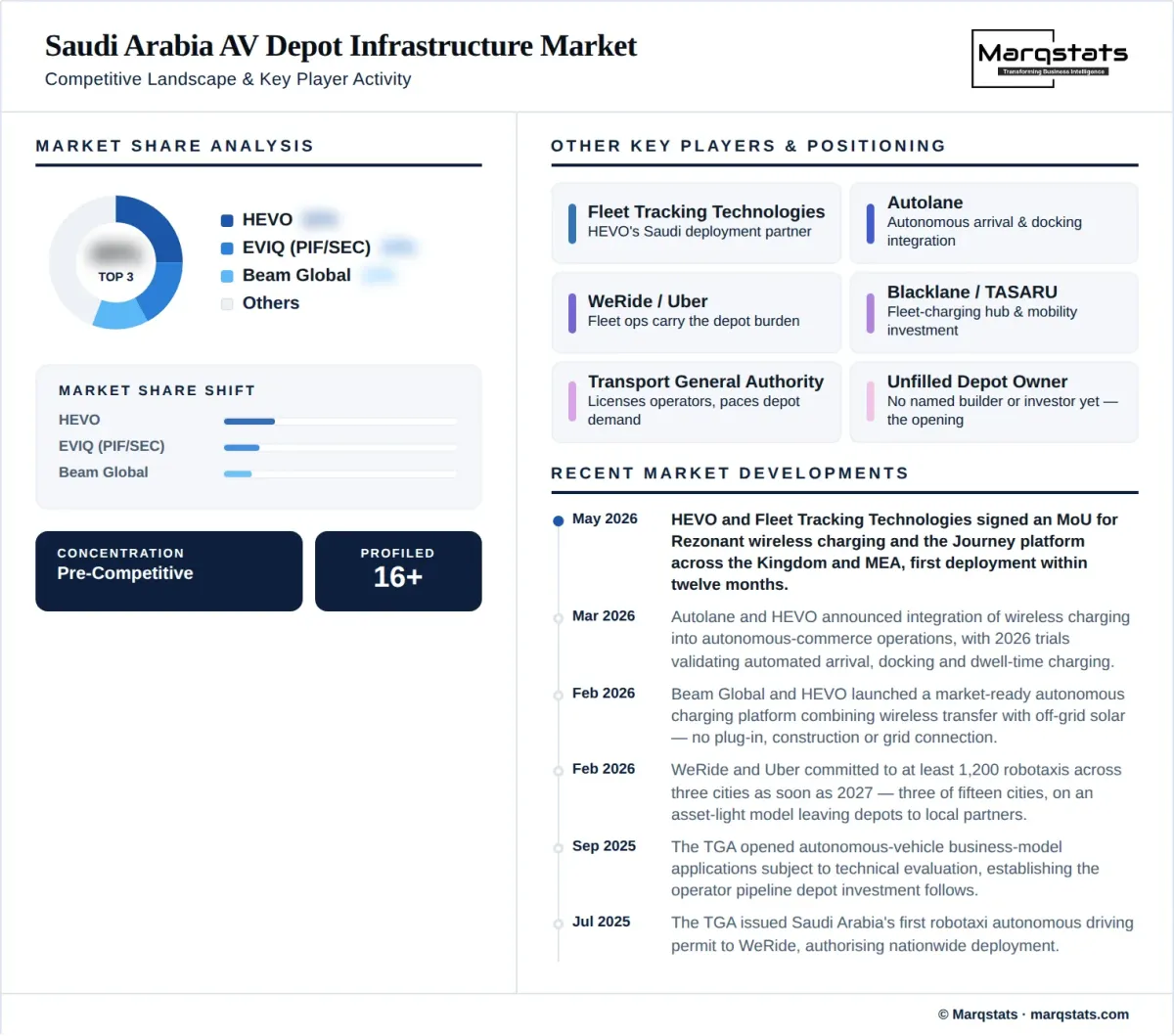
The Saudi Arabia autonomous vehicle depot infrastructure market is highly concentrated and remains pre-competitive. No depot operator has been publicly named in the Kingdom, no site has been publicly costed, and no competitive tender for AV depot infrastructure has been reported. The participants that can be evidenced are technology suppliers, charging network operators, fleet operators, sovereign investors and the regulator, arranged around a market that has agreed its requirements before it has awarded its first contract. Concentration falls only slowly across the forecast, and any market-share discussion before 2028 describes announced partnerships rather than competitive outcomes.
Four roles make up the value chain and they sit in different companies. Automated energy transfer technology is supplied by specialist wireless charging firms pairing hardware with fleet software. Power provision comes either from the national charging network operator and the utility, or from off-grid solar and storage suppliers who bypass both. Fleet operations — and therefore the depot requirement — sit with the ride-hailing platform or a local third-party partner under the asset-light model that the announced robotaxi programme uses. Autonomy technology providers set the specification that all three must meet. No participant currently occupies more than one role in the Kingdom.
The depot owner-operator role is the conspicuous vacancy, and it is where the commercial opportunity concentrates. The robotaxi structure explicitly assigns fleet operations to Uber or local third-party partners without naming who builds or owns the facilities, and the autonomous trucking programme has named no depot partner at all. An operator that can assemble grid capacity, site control and a regulator relationship is negotiating against a requirement that already exists rather than bidding for one that might. Existing fleet depots with spare power and maintenance space are the strongest entry position, which is why brownfield conversion rather than acquisition is the likely consolidation route.
Sovereign ownership shapes the field more than commercial rivalry does. The Public Investment Fund holds the national charging joint venture alongside the Saudi Electricity Company on a 75:25 basis, owns the artificial intelligence company behind the national autonomous trucking programme, backs the mobility investment vehicle supporting fleet electrification, and is the principal shareholder in the region's most visible electric vehicle manufacturer. Coordination rather than competition therefore determines which depots get built and in what order, and an entrant's route to market runs through partnership with that structure rather than around it.
Companies Covered
Companies covered in the report include:
Recent Market Activity
Table of Contents
Coverage & Segmentation
This report covers depots in Saudi Arabia providing automated energy transfer, staging, telematics, remote operations, maintenance or orchestration for autonomous vehicle fleets, with 2025 as the base year and 2026 – 2030 as the forecast period. Market size is annual investment in sites entering service, reported in US dollars and corroborated at every point by the installed AV-ready depot count. Segmentation covers depot function, fleet served, energy architecture and site origin, with regional analysis for the Riyadh Region, the Eastern Province, the Makkah Region, the Madinah Region and the north-west, and the rest of Saudi Arabia.
Four boundaries define the market perimeter. First, conventional fleet charging depots serving driven vehicles fall outside it and belong to the Saudi Arabia fleet depot charging market; where one site carries both, only the AV-specific functions are counted here and the split is by function within the site rather than by the site itself. Second, public and destination charging is excluded, since a vehicle charging on a retail network is not using depot infrastructure. Third, installed depot count is a stock and annual investment is a flow: the 2030 value reflects the 11 sites commissioned that year, not the 31 then operating. Fourth, ongoing depot operating costs, energy purchase, remote supervision staffing and software subscriptions are analysed as adjacent pools and excluded from market value.
No depot census exists for Saudi Arabia or for any comparable market, and no AV depot in the Kingdom has been publicly named, sited or costed. The base year is therefore a site-equivalent count constructed from evidenced pilot and fleet-charging activity rather than a register, and confidence is low by construction, with an indicative range of nought to one site in 2025, two to four in 2026 and 35 to 70 in 2031. Per-site investment is a blended construct across depot types that vary by more than a factor of two between a light-vehicle delivery site and a heavy autonomous truck depot, and it is presented as an order of magnitude rather than a transaction price.
The forecast is derived from fleet requirement rather than from infrastructure targets, which is the material methodological choice in the report. Depot count is modelled against the autonomous vehicle population those depots must serve, cross-checked at a depot scale of 71 vehicles per site in 2030 against 2,200 autonomous trucks operating nationally. Sizing this market as a percentage of national charging infrastructure would be the common error and would overstate it substantially, since the national network targets more than 5,000 chargers of which AV-specific depot capacity is a small specialised subset. The 2030 installed base of 31 sites sits on the same geometric path as the 2031 endpoint of 55 sites, so the two horizons describe a single curve.