Market Snapshot
Key Takeaways
Market Overview & Analysis
Report Summary
The Philippines electric vehicle market covers all electrified powertrain categories across four distinct demand layers. Layer one comprises electric and hybrid passenger cars, SUVs, and MPVs. Layer two comprises electric commercial utility vehicles for fleet operators. Layer three comprises e-jeepneys, electric buses, and electric shuttles for public transport modernization. Layer four comprises e-trikes, e-bikes, and light electric vehicles for urban short-distance mobility. The market is segmented by propulsion type, vehicle category, brand origin, price band, and sales channel.
Total industry volume reached 491,395 units in 2025, a record high for the Philippine auto market. CAMPI-TMA members accounted for 463,646 units, while non-member brands contributed 27,749 units. Electrified vehicle penetration rose from 5.5% in 2024 to 12% in 2025. Q1 2025 CAMPI data showed 5,311 xEV units, of which 4,544 were HEVs, 692 were BEVs, and 75 were PHEVs, confirming the market’s hybrid-heavy structure. LTO-linked registration data cited 41,857 EV registrations between January and September 2025, up from 24,286 for the full-year 2024.
The competitive dynamic shifted in 2025 as BYD Philippines scaled rapidly. BYD sold 26,122 units at 446% year-on-year growth, driven by the Seagull BEV (4,608 units) and the Sealion 6 DM-i plug-in hybrid. ACMobility, the parent distributor, recorded 42,684 total unit sales across its portfolio at 82% year-on-year growth. VinFast ranked as the second-highest-selling BEV brand in the Philippines as of March 2026, supported by the VF 6 launch and the V-GREEN free-charging programme through May 2027. For further detail on the regional EV ecosystem, the ASEAN Electric Vehicle Market report on Marqstats provides country-level cross-comparison data.
Policy stability anchors long-term market formation. The Electric Vehicle Industry Development Act (Republic Act 11697), signed in April 2022, established the EVIDA framework for vehicle adoption, charging stations, manufacturing, R&D, and fleet conversion. The Comprehensive Roadmap for the Electric Vehicle Industry (CREVI) extends the strategy through 2040. The zero-tariff policy was extended through 2028 in 2024 and expanded in scope. The Department of Trade and Industry is finalizing the PHP 60 billion Electric Vehicle Incentive Strategy (EVIS), expected for completion before the July 2026 State of the Nation Address.
Market Dynamics
Key Drivers
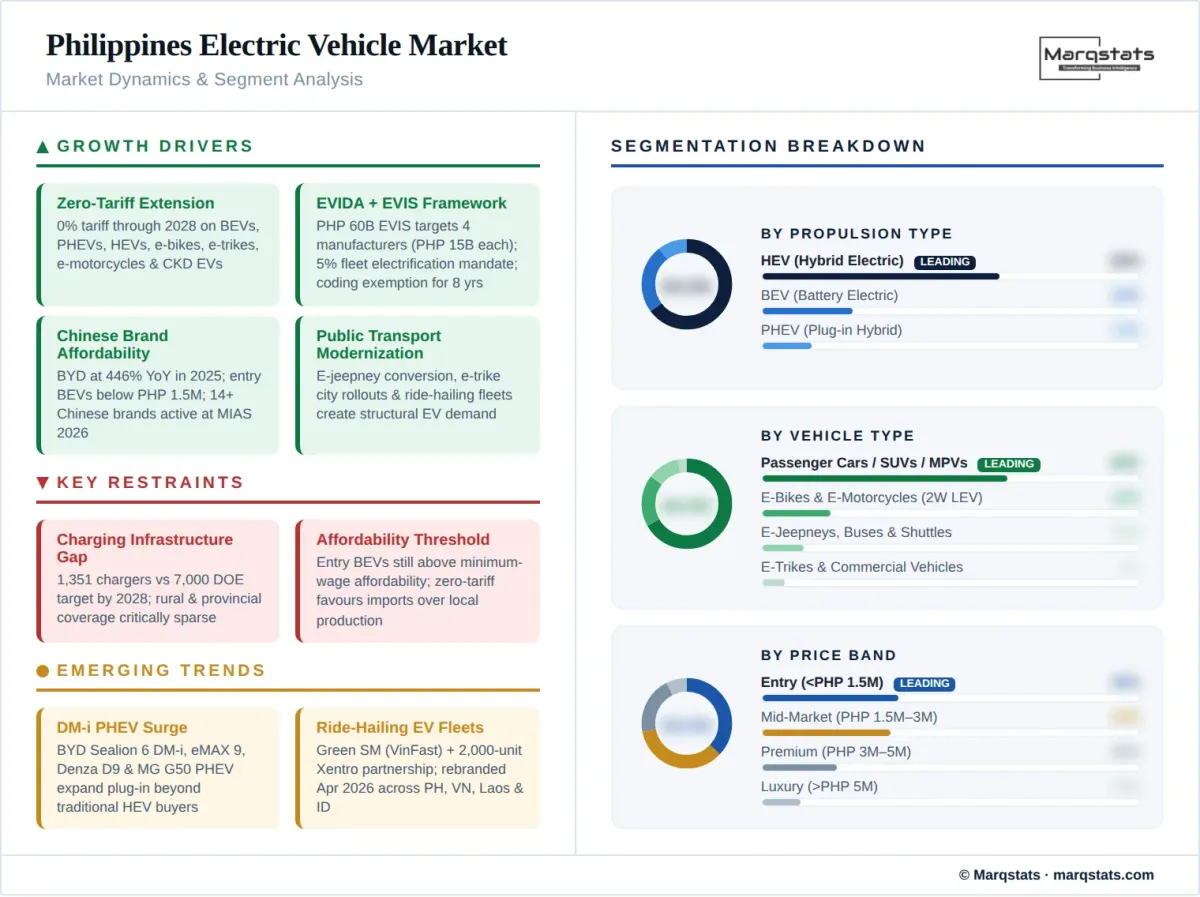
- Zero-tariff policy extension through 2028 reduces import costs for BEVs, PHEVs, HEVs, e-motorcycles, e-bikes, e-trikes, quadricycles, PHEV jeepneys and buses, and CKD EVs. The policy is the single strongest near-term growth accelerator.
- EVIDA (Republic Act 11697) mandates 5% fleet electrification for qualifying public and private fleets and exempts electrified vehicles from the Metro Manila number-coding scheme for eight years, lowering total cost of ownership for urban fleet operators.
- The proposed PHP 60 billion Electric Vehicle Incentive Strategy (EVIS) targets four manufacturers at PHP 15 billion each for local electrified vehicle production. Mitsubishi Motors Philippines has committed to hybrid production at Santa Rosa, Laguna by 2028.
- Chinese brand affordability is reshaping demand. BYD Philippines achieved 446% year-on-year growth in 2025. MG, GAC, Chery, Jetour, Denza, Changan, Omoda, Foton, BAIC, and Radar are expanding product portfolios through 2026.
- Imported fuel price volatility supports fleet-level electrification economics. Public-transport modernization for e-jeepneys, e-buses, and e-trikes creates structural demand independent of private passenger car adoption trends.
Key Restraints
- Charging infrastructure remains below the 7,000-station DOE target for 2028. Coverage is heavily concentrated in the National Capital Region, with rural and secondary-city access gaps constraining long-distance BEV adoption.
- High upfront pricing limits mass-market BEV adoption. Entry-level BEVs such as the BYD Seagull and Chevrolet Spark EUV remain priced above Philippine minimum-wage affordability thresholds, sustaining HEV and PHEV preference.
- Zero-tariff policy structurally favours imports over local manufacturing. The Electric Vehicle Association of the Philippines (EVAP) has flagged the need for complementary localization incentives beyond 2028.
- E-bike and e-trike regulatory enforcement is tightening. The Land Transportation Office (LTO) began enforcing restrictions on unregistered e-bikes and e-trikes on national roads in late 2025, introducing short-term demand uncertainty.
Key Trends
- Plug-in hybrid DM-i technology is gaining rapid share. BYD Sealion 6 DM-i, Denza D9 PHEV (launched February 2026 at PHP 3,998,000), BYD eMAX 9 DM-i, and MG G50 PHEV (launched April 2026 at PHP 1,398,888) expand the PHEV lineup beyond traditional HEV options.
- Ride-hailing EV fleet deployment is accelerating. Green GSM (VinFast) launched ride-hailing operations in the Philippines in 2025 and partnered with Xentro Motors for 2,000 VinFast Nerio Green electric vehicles. The Green SM platform rebrand in April 2026 aligned branding across Vietnam, Laos, Indonesia, and the Philippines.
- E-trike urban conversion programmes are scaling. Quezon City targets traditional tricycle replacement with e-trikes by 2030. LTO registration enforcement is formalizing the e-trike and e-bike market structure.
- Public transport electrification is anchored in the public utility vehicle modernization agenda. The DOE, Department of Trade and Industry, and EVAP are aligning charging-fee unbundling, EVCS accreditation, and grid-readiness initiatives with Meralco to support fleet-scale deployment.
Market Segmentation
HEVs dominate the Philippine electrified vehicle mix. Q1 2025 CAMPI data showed HEVs at 4,544 units of the 5,311 xEV total, representing approximately 86% of member sales. Toyota leads the segment through the Corolla Cross, RAV4, Yaris Cross, Alphard, Camry, Corolla Altis, Ativ, and Zenix hybrid variants. Toyota Motor Philippines recorded 16,986 xEV units in Jan–Nov 2025 at 45% year-on-year growth. Mitsubishi Motors Philippines plans local HEV production at Santa Rosa, Laguna by 2028, subject to EVIS approval.
PHEV volumes are rising rapidly through 2025 and into 2026. BYD Sealion 6 DM-i anchors the mid-market PHEV segment. BYD eMAX 9 DM-i launched at the 13th Philippine Electric Vehicle Summit in October 2025 at PHP 2,678,000 (Advanced) and PHP 2,998,000 (Premium), offering 95 km to 170 km electric range and 945 km to 1,000 km combined range. Denza D9 PHEV launched in February 2026 at PHP 3,998,000 with 180 km electric range. MG G50 PHEV opened reservations in April 2026 at PHP 1,398,888.
BEV volumes remain a smaller share of the electrified mix, however entry-level pricing is bringing mass-market access. BYD Seagull recorded 4,608 unit sales in 2025, anchoring the affordable BEV segment. Chevrolet Spark EUV launched in February 2026 at PHP 1,449,000 with 360 km NEDC range. Toyota bZ4X BEV began retail sales in December 2025. VinFast VF 6, Tesla Model Y, and Denza premium BEVs round out the segment. BEV share is forecast to rise from approximately 13% of xEV sales in 2025 to 32% by 2030.
LEVs include e-bikes, e-trikes, and quadricycles registered under DOE Electric Vehicle Recognition Guidelines. The segment comprises the largest installed unit base in the Philippines, driven by urban short-distance mobility and logistics use cases. Regulatory formalization under LTO registration rules and the zero-tariff extension for e-bikes, e-motorcycles, and e-tricycles is expected to accelerate volume growth through 2030.
SUVs, crossovers, and MPVs dominate the four-wheeler electrified mix. Toyota Corolla Cross, RAV4, and Zenix; BYD Sealion 6 DM-i, Atto 3, and eMAX 9; Denza D9; Chery Tiggo rEV LE; Jetour T1 Lightning i-DM; Lynk & Co 08 EM-P; and Chevrolet Spark EUV represent core SUV and crossover demand. Sedan adoption remains limited outside premium segments. The category accounts for approximately 65% of 2025 electrified vehicle volume.
Electric two-wheelers comprise e-motorcycles and e-bikes. The segment is supported by the zero-tariff extension and the VinFast motorcycle expansion under the Green SM ride-hailing platform. Registration formalization under LTO in late 2025 is consolidating supply to DOE-accredited models listed on the Electric Vehicle Industry Portal. The segment is forecast to advance at 34% CAGR through 2030.
E-trikes serve last-mile passenger transit and urban logistics. Quezon City targets tricycle-to-e-trike conversion by 2030. Multiple provincial and city-level programmes support fleet transition. The segment is structurally important for public transport modernization and is expected to scale through local-government procurement rather than private passenger demand.
Public transport electrification addresses the public utility vehicle modernization agenda. E-jeepneys, electric buses, and electric shuttles are supported by EVIDA fleet conversion mandates. Foton Traveller Sierra EV (12-seat, 303 km range, V2L) and Radar RD6 electric pickup introduced at MIAS 2026 signal commercial platform expansion. Financing, depot charging, and operator affordability remain the primary deployment constraints.
Electric commercial vehicles include delivery vans, light trucks, and utility pickups. The Radar RD6 electric pickup (Geely) and BAIC B40e Trailmaster rEV plug-in hybrid off-roader (1,200 km range) entered the market at MIAS 2026. Fleet operators are piloting electric delivery platforms supported by the EVIDA 5% fleet conversion mandate.
Chinese-origin brands collectively secured approximately 48% of electrified vehicle sales in 2025. BYD recorded 26,122 units at 446% year-on-year growth. GAC, MG, Chery, Jetour, Denza, Changan, Omoda and Jaecoo, Foton, BAIC, Lynk & Co, Radar, Geely, Deepal, and Aito are accelerating product launches. MIAS 2026 hosted 212 (Beijing Automobile Works), Aito, BAIC, Bestune, BYD, Changan, Chery, Denza, Deepal, DFSK, Foton, GAC Motor, Geely, GWM, Jetour, Kia, Lynk & Co, MG, Omoda-Jaecoo, Radar, and Rox.
Japanese brands hold approximately 34% share of electrified vehicle sales in 2025, concentrated in HEV. Toyota Motor Philippines anchors the segment with eight electrified models and 16,986 xEV units in Jan–Nov 2025. Mitsubishi Motors Philippines plans local HEV production at Santa Rosa, Laguna by 2028. Nissan and Honda maintain HEV portfolios with limited BEV entry through 2026.
American and European brands collectively hold approximately 12% share in 2025. Tesla expanded operations supporting premium BEV demand. Ford, Chevrolet (via HARIPhil Asia Resources), BMW, and Mercedes-Benz compete in higher-priced electrified segments. The Chevrolet Spark EUV launch in February 2026 at PHP 1,449,000 expanded American brand access to the mid-market BEV band.
VinFast represents the Vietnamese brand cohort, operating through direct retail and the Green SM ride-hailing platform. VinFast ranked as the second-highest-selling BEV brand in the Philippines as of March 2026 per CAMPI data. The Green GSM-Xentro partnership for 2,000 VinFast Nerio Green units signed in October 2025 supports fleet-scale deployment.
The entry-level band serves mass-market consumers and small fleet operators. BYD Seagull, Chevrolet Spark EUV (PHP 1,449,000), MG G50 PHEV (PHP 1,398,888), and Toyota Corolla Cross HEV anchor this segment. The band is forecast to drive the largest unit-volume growth through 2030 as Chinese brands deepen local supply.
The mid-market band captures mainstream SUV and MPV demand. BYD Sealion 6 DM-i, Atto 3, eMAX 9 DM-i (PHP 2,678,000 to PHP 2,998,000), Toyota RAV4 HEV, and premium Chinese PHEV SUVs operate in this segment. The band captured the largest revenue share of 2025 electrified sales.
The premium band includes higher-specification PHEV MPVs and luxury BEV SUVs. Denza D9 PHEV (PHP 3,998,000), BMW, Mercedes-Benz, Audi, and Lexus electrified models compete in this segment. Fleet acquisitions for corporate and government use anchor segment volumes.
The luxury band serves high-net-worth consumers with premium BEV and PHEV models. Porsche, BMW i-series, Mercedes-EQ, and upcoming Denza Z9 GT and B8 luxury SUVs occupy this tier. Volume is limited, however the segment anchors brand positioning and after-sales ecosystem development.
By Geography
National Capital Region (Metro Manila)
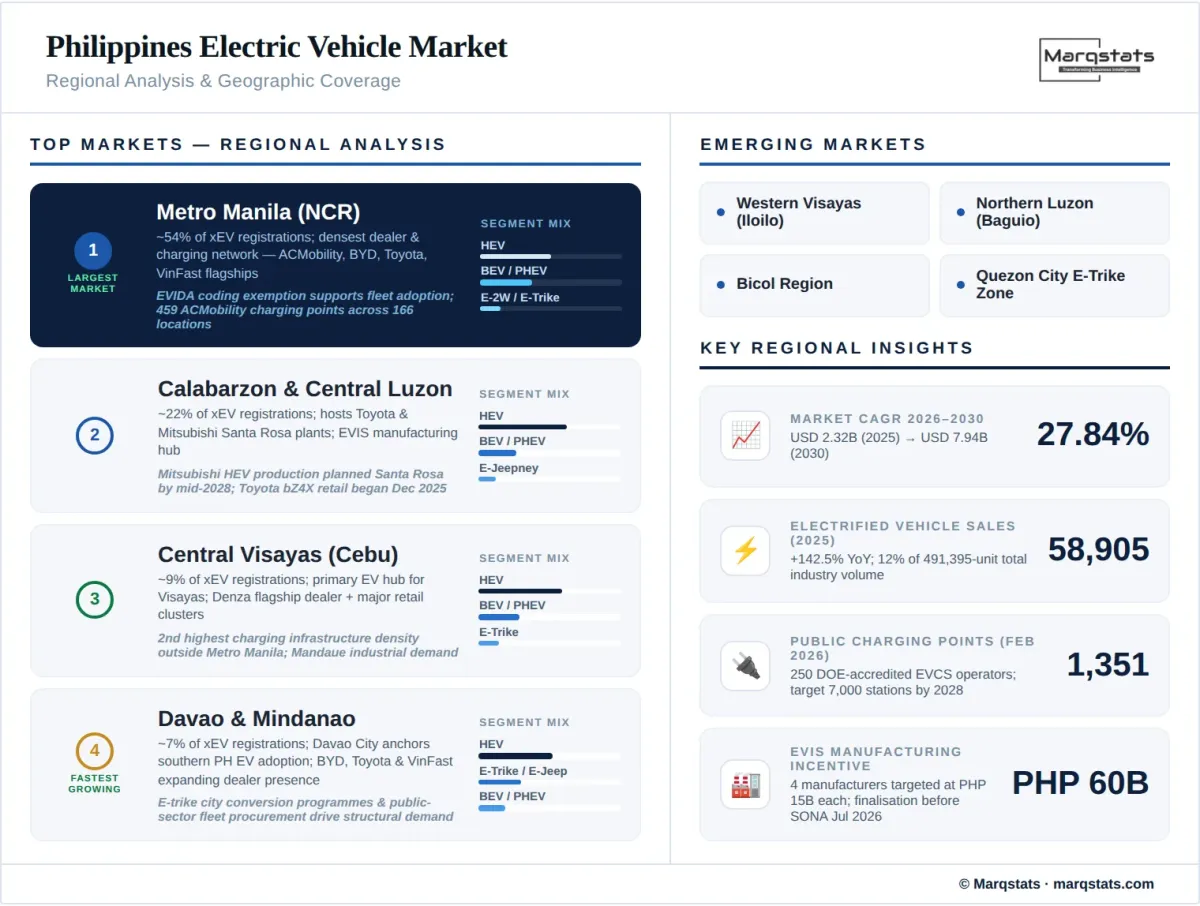
Metro Manila is the primary electrified vehicle demand cluster, accounting for approximately 54% of Philippine xEV registrations in 2025. Quezon City, Makati, Taguig, Pasay, San Juan, Alabang, and Manila City host the densest dealer and charging networks. ACMobility, Green GSM-Xentro, VinFast, BYD, and Toyota concentrate flagship showrooms and service centres in the region. The number-coding exemption under EVIDA supports commercial-fleet adoption in the region.
Calabarzon and Central Luzon
Calabarzon (Region IV-A) and Central Luzon (Region III) hold approximately 22% of Philippine xEV registrations in 2025. The corridor hosts major automotive manufacturing facilities, including Mitsubishi Motors Philippines Santa Rosa (Laguna), Toyota Motor Philippines Santa Rosa, and Honda Cars Philippines Sta. Rosa. Planned Mitsubishi HEV production by 2028 under EVIS will reinforce the region’s manufacturing leadership.
Central Visayas and Cebu
Central Visayas, anchored by Cebu, accounts for approximately 9% of Philippine xEV registrations in 2025. Cebu City hosts Denza’s flagship dealership alongside major automotive retail clusters. The region serves as the primary EV demand hub for the Visayas island group. Charging infrastructure is concentrated around Cebu City and Mandaue.
Davao and Mindanao
Davao and Mindanao collectively hold approximately 7% share in 2025. Davao City anchors southern Philippines EV adoption, supported by expanding dealer networks for BYD, Toyota, and VinFast. Regional coverage gaps in charging infrastructure constrain long-distance BEV adoption beyond urban centres.
Other Regions and Emerging Clusters
The remaining eight Philippine regions hold approximately 8% combined share in 2025. Western Visayas (Iloilo), Northern Luzon (Baguio and La Union), and Bicol represent secondary demand clusters. Public-sector fleet procurement, e-jeepney conversion programmes, and local-government e-trike initiatives drive structural demand in these regions.
How Competition Is Evolving
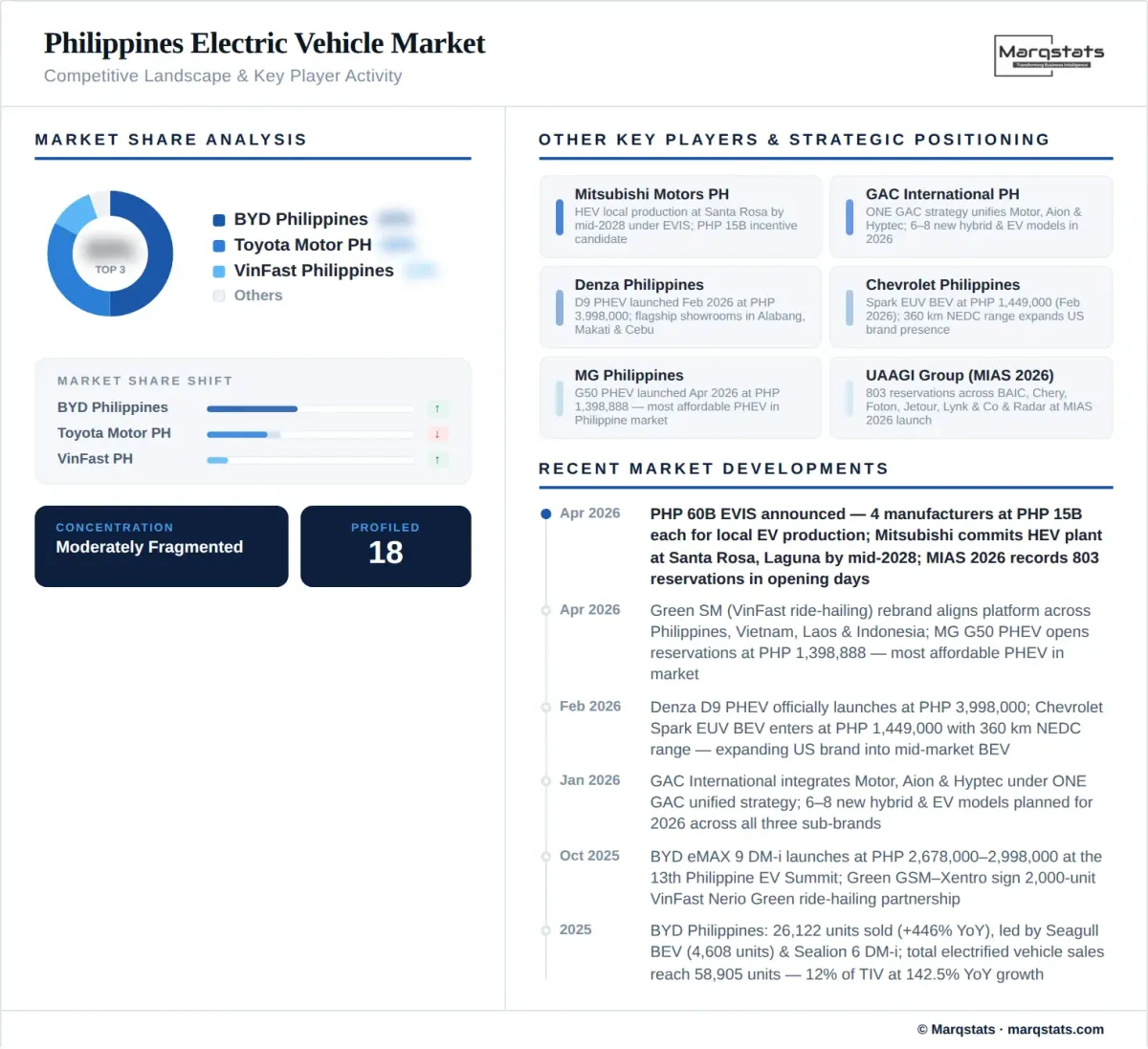
The competitive environment in the Philippines electric vehicle market is moderately fragmented with rapid structural rebalancing. The top five OEM groups accounted for approximately 68% of electrified vehicle sales in 2025. Market structure is shifting from Japanese hybrid dominance toward Chinese plug-in hybrid and BEV leadership, with Vietnamese and American brands expanding their footprint through ride-hailing fleets and entry-level product introductions.
BYD Philippines, distributed by ACMobility, secured the strongest growth in 2025 with 26,122 unit sales at 446% year-on-year growth. ACMobility’s total portfolio sales reached 42,684 units at 82% year-on-year growth. The BYD Seagull (4,608 units) anchored affordable BEV demand, while the Sealion 6 DM-i led plug-in hybrid volumes. Toyota Motor Philippines recorded 16,986 xEV units between January and November 2025 at 45% year-on-year growth, anchored by eight electrified models including the newly launched bZ4X BEV.
VinFast ranked as the second-highest-selling BEV brand in the Philippines as of March 2026 per CAMPI data, supported by the VF 6 launch, the V-GREEN free-charging programme through May 2027, the Green GSM-Xentro 2,000-unit ride-hailing partnership, and the Green SM platform rebrand in April 2026. Denza, Chery, MG, GAC (integrating Motor, Aion, and Hyptec under the ONE GAC strategy with six to eight new models planned for 2026), Jetour, Foton, BAIC, Radar, Chevrolet, and Mitsubishi round out the organized cohort. Strategic partnerships, fleet contracts, charging-network commitments, and CKD assembly readiness under EVIS are the primary competitive differentiators for 2026–2030.
Companies Covered
The report profiles 18 company profiles+ companies with full strategy and financials analysis, including:
Recent Market Activity
Table of Contents
Coverage & Segmentation
The Philippines Electric Vehicle Market report analyzes the market across propulsion type, vehicle category, brand origin, price band, sales channel, and regional geography for the period 2021 to 2030. The report covers historical data for 2021-2025, with 2025 as the base year, and forecasts spanning 2026-2030. Market sizing is conducted in USD billions and unit volumes. The study examines the full electrified vehicle value chain, including OEM imports, CKD assembly readiness, battery supply, charging infrastructure, ride-hailing fleet deployment, and aftermarket service.
The scope encompasses all electrified powertrain categories including battery-electric (BEV), plug-in hybrid (PHEV), and hybrid electric (HEV) vehicles. Vehicle categories covered include passenger cars, SUVs, MPVs, electric two-wheelers, electric three-wheelers (e-trikes), e-jeepneys, electric buses, electric commercial vehicles, and electric pickups. The study evaluates policy impact from EVIDA (Republic Act 11697), CREVI 2023–2040, the zero-tariff extension through 2028, the proposed PHP 60 billion EVIS programme, and DOE Electric Vehicle Recognition Guidelines. Competitive profiling covers 18 OEM groups operating in the Philippines.