Market Snapshot
Middle bar: base-year value × (1 + CAGR), rounded to two decimals. This is a calculated illustration, not a separately researched annual estimate.
The Ethiopia electric motorcycle market is estimated at 46,750 units in 2025 and is projected to reach 136,494 units by 2030, registering a volume CAGR of 23.90% over 2026–2030. In value terms the market is estimated at USD 38.30 million in 2025 and is projected to reach USD 131.52 million by 2030, a CAGR of 27.98%. The market comprises new battery electric motorcycles, mopeds and scooters sold for road use in Ethiopia, imported whole, as semi-knocked-down kits or assembled locally from completely knocked-down kits. The 1.1–3.0 kW band holds 54.62% of 2025 units, and the above-5.0 kW band grows fastest at 31.13% a year.
Market size and forecast figures are generated using Marqstats' proprietary estimation framework, updated as of October 2026.
Ethiopia is the first country to ban imports of petrol and diesel vehicles, and its electric motorcycle market multiplied after the ban. Volume rose 17.31 times from 2,700 units in 2024 to 46,750 in 2025, after the January 2024 import ban and Addis Ababa's April 2024 decision to issue new motorcycle service licences only for electric models. The market grows 38.51% to 64,753 units in 2026, led by Yadea through its assembler Lodric Trading PLC, the Addis Ababa battery-swap start-up Dodai and low-cost Chinese imports.
Key Takeaways
Market Overview & Analysis
Report Summary
The Ethiopia electric motorcycle market covers new battery electric motorcycles, electric mopeds and seated electric scooters sold for road use in Ethiopia. The market grew from 190 units in 2021 to 550 in 2022, 1,250 in 2023 and 2,700 in 2024, before rising to 46,750 units in 2025. It grows 38.51% to 64,753 units in 2026 and reaches 136,494 units by 2030, adding 89,744 units over the forecast period. Electric three-wheelers, electric cars and buses, pedal-assist bicycles, stand-up kick scooters, used vehicles and petrol motorcycles sit outside the perimeter.
Policy created the market. Ethiopia banned imports of petrol- and diesel-powered private vehicles in January 2024, the first blanket ban of its kind, to cut a fuel import bill of more than USD 4.5 billion a year and use a power system that is about 90% hydroelectric. Electric vehicle imports are exempt from VAT, excise tax and surtax, and pay customs duty of 15% when fully built, 5% as semi-knocked-down kits and nothing as completely knocked-down kits assembled locally. The Ministry of Transport and Logistics reported more than 100,000 electric vehicles imported since the ban and targets 500,000 by the end of the decade.
Addis Ababa reinforced national policy with city rules. The Addis Ababa Transport Bureau announced on 3 April 2024 that new motorcycle transport service licences would be issued only for electric motorcycles, that existing motorcycles must convert to electric models within a period it sets, and that new operators must form unions of at least 250 members. Directive 155/2024 of the city administration governs motorcycle and electric motorcycle transport services. Unlicensed riders may use bike lanes at up to 30 km/h, while licensed riders with plates may use main roads at higher speeds.
Brand and model data are limited to company disclosures. Dodai, an Addis Ababa start-up that assembles electric motorcycles locally and runs battery-swap stations, sold about 850 units between its launch in the second half of 2023 and early 2025, with the Ethiopian Postal Service as its largest customer, and had deployed more than 2,000 by April 2026. Dodai's bikes cost about 150,000 birr (about USD 1,170), with a range of USD 1,170 to USD 1,800 and monthly plans from 8,000 birr through VisionFund, and its deployed fleet equals about 4.28% of 2025 market volume. Lodric Trading PLC has assembled and distributed China-made Yadea electric two-wheelers in Addis Ababa and five other cities since Yadea's first Ethiopian shop opened in March 2025, and sales rose 30% in its second half-year of operation.
Local assembly is expanding. Ethio-Engineering Group, the state-owned engineering company, began producing electric scooters with a Chinese partner at its Bishoftu automotive plant in March 2025, with a light model of 15 kg, a range of up to 30 km and a speed of 20 to 30 km/h. Dodai assembles its motorcycles in Addis Ababa, and Lodric assembles Yadea models from kits. Zero duty on completely knocked-down kits makes local assembly the lowest-cost route to market.
Fuel costs and rider economics sustain demand. Ethiopia removed fuel subsidies for many users from 2022, and a taxi rider earned about 900 birr a day after the change, according to Climate Home News in April 2025. Dodai says riders who switch from petrol bikes cut fuel and maintenance costs by 80% to 90%, and the Ministry of Transport and Logistics called for faster electric mobility adoption in 2026 amid oil price shocks linked to the Middle East conflict. Delivery firm Klik operates about 100 electric two-wheeler riders in Addis Ababa delivering food, groceries, medicines and parcels. Electricity in Ethiopia comes mainly from hydropower, so each conversion replaces imported fuel with domestic power, which is the economic case behind the government's policy.
The average selling price in the market is approximately USD 819 in 2025, rising to USD 964 by 2030. Electric two-wheelers cost 150,000 to 200,000 birr, about USD 1,100 to USD 1,500, according to Climate Home News, and low-speed models assembled from kits sell for less. The low average reflects the weight of the up-to-1.0 kW and 1.1–3.0 kW bands, which together hold more than 80% of units.
The history shows a market made by rules, not by gradual adoption. Before the ban, volume stayed below 2,700 units a year, as petrol motorcycles from Indian and Chinese brands supplied commuters and taxi riders at lower prices and with established service. The ban and the capital's licensing rule changed the choice set for new buyers, and volume in 2025 was 17.31 times the 2024 level. Growth slows from 38.51% in 2026 to a 23.90% CAGR over the forecast period, because the first wave of fleet conversions in Addis Ababa is a one-time step and later growth depends on registration capacity, charging and credit outside the capital.
The value chain runs from China to Addis Ababa. Most vehicles, kits, cells and motors come from Chinese suppliers and arrive through the Djibouti corridor, local assemblers such as Dodai, Lodric and Ethio-Engineering Group build them into finished vehicles, and dealers, swap operators and microfinance lenders sell them to riders. The assembly step captures the duty advantage, while the swap and finance steps decide whether low-income riders can buy at all. Companies that control assembly, batteries and credit together, as Dodai does, hold the strongest position in the commercial segment.
The conclusion for buyers and suppliers is that the market will keep growing at a fast rate, and the bottleneck is no longer demand. Registration delays of up to six months, plate shortages, road restrictions and limited grid access cap how fast the national fleet can convert. Suppliers that help riders clear registration, finance the purchase and keep a battery charged gain share faster than suppliers that compete on vehicle price alone.
Market Dynamics
Key Drivers
Five conditions drive the Ethiopia electric motorcycle market, and the ban on petrol vehicle imports matters most.
- Ban on petrol and diesel vehicle imports. Ethiopia banned imports of internal combustion engine private vehicles in January 2024, and more than 100,000 electric vehicles had been imported since then by April 2025. The electric motorcycle market rose from 2,700 units in 2024 to 46,750 in 2025.
- Tax and duty advantages for local assembly. Electric vehicle imports are exempt from VAT, excise tax and surtax, and completely knocked-down kits pay no customs duty, against 5% for semi-knocked-down kits and 15% for fully built vehicles. Dodai, Lodric and Ethio-Engineering Group assemble locally to capture the lowest rate.
- Addis Ababa's electric-only licensing. New motorcycle service licences in Addis Ababa have been issued only for electric models since April 2024, and existing motorcycles must convert. The rule turns the capital's commercial motorcycle fleet into an electric market.
- Fuel costs and rider economics. Fuel imports cost Ethiopia more than USD 4.5 billion a year, and riders switching to Dodai's bikes cut fuel and maintenance costs by 80% to 90%, according to the company. Oil price shocks in 2026 strengthened the running-cost case.
- Battery-swap investment. Dodai raised USD 13 million in April 2026, USD 8 million in equity and USD 5 million in debt, from investors including British International Investment, which put in USD 5 million, and Nagase & Co., Ltd. Dodai targets 3,000 active swap users and 30 stations in Addis Ababa within 12 months and 30,000 users and 1,000 stations within three years.
Key Restraints
Four constraints slow the market, and slow registration is the most immediate.
- Slow registration and plate issuance. Registration of electric motorcycles can take up to six months, and Yadea's Ethiopian distributor cited slow issuance of plates as a limit on expansion. Customs clearance for electric components can take more than three weeks.
- Restricted road access. Dodai's electric motorbikes have been restricted from major roads, which limits sales mainly to city-based gig workers, and unlicensed riders are limited to bike lanes at 30 km/h. Speed and road rules hold back higher-power motorcycles.
- Limited electricity access and charging. Only about half of Ethiopia's 120 million people are connected to the grid or off-grid systems, and the ministry's target of charging points no more than 120 km apart remains a plan. Rural demand depends on home charging where power is available.
- Foreign exchange and financing constraints. Ethiopia defaulted on a sovereign bond in 2023 and agreed a USD 3.4 billion IMF support package in 2024, and importers face foreign exchange shortages for vehicles and parts. Monthly plans from 8,000 birr help riders, while most buyers still need credit to switch.
Key Trends
Four shifts show where the market is moving and which companies gain.
- Battery swapping for commercial riders. Dodai partnered with the Addis Ababa Transport Bureau on an electric mobility pilot in June 2025, after Ethiopian Investment Holdings ended its battery-swap partnership with Dodai Group in March 2025. Swap networks cut downtime for delivery and taxi riders.
- Chinese brands assembled by local partners. Yadea opened its first Ethiopian shop in March 2025 and five more outlets, including in Mekelle and Hawassa, through Lodric Trading PLC, and Ethio-Engineering Group produces scooters with a Chinese partner. Local assembly lets Chinese brands use the zero-duty kit route.
- Delivery platforms electrify. Klik's 100 electric riders and the Ethiopian Postal Service's purchases from Dodai show delivery fleets moving first. Fleet buyers need swap access and service, which favours organised brands.
- Regional expansion from Ethiopia. Dodai plans expansion to Abidjan, Kinshasa and Accra, and Roam ran a 1,600 km Nairobi to Addis Ababa electric motorcycle expedition in October 2025 to promote cross-border adoption. Investors favoured Ethiopia over Tanzania in East Africa's electric mobility race, citing Ethiopia's policy support, according to The East African in June 2026.
Market Segmentation
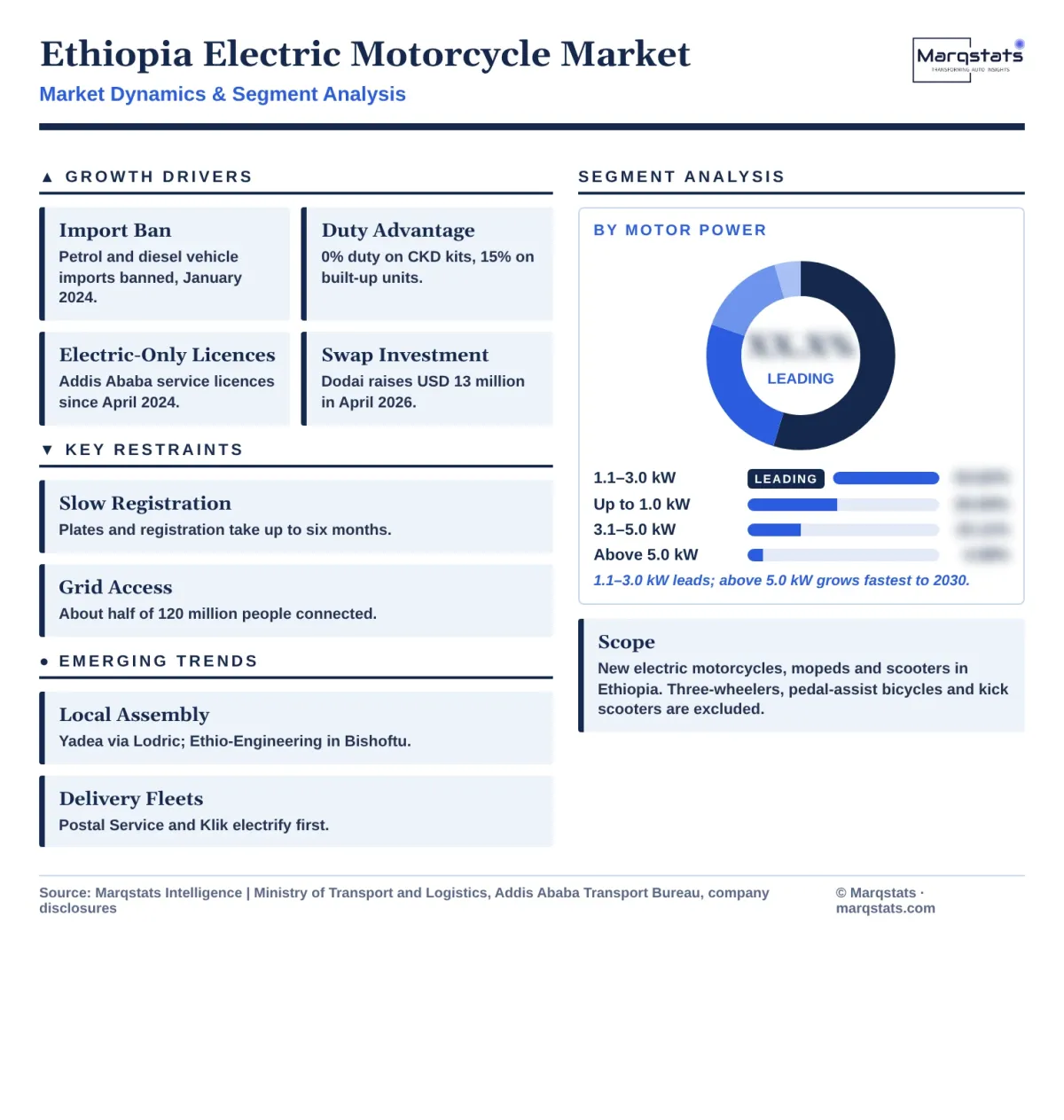
The 1.1–3.0 kW band is the dominant segment and covers commuter scooters and delivery mopeds. It accounts for 25,539 units in 2025, 54.62% of the total, and reaches 73,884 units by 2030 at a 23.67% CAGR, taking 54.13% of the market. Yadea models assembled by Lodric and many Chinese imports compete in this band, and the segment keeps its lead to 2030, because it balances price, range and speed for city riders.
The up-to-1.0 kW band covers low-speed mopeds and light scooters. It accounts for 12,009 units in 2025, 25.69% of the total, and reaches 33,010 units by 2030 at a 22.41% CAGR, taking 24.18% of the market. These models suit bike lanes limited to 30 km/h, and Ethio-Engineering Group's light scooter targets this tier. Its share falls slightly to 2030, as riders move to faster models once registration improves.
The 3.1–5.0 kW band covers electric motorcycles for taxi and delivery work. It accounts for 7,062 units in 2025, 15.11% of the total, and reaches 21,303 units by 2030 at a 24.71% CAGR, taking 15.61% of the market. Dodai's locally assembled motorcycles with swappable batteries compete here with petrol motorcycles. Swap access removes the range concern that holds back this band for taxi riders.
The above-5.0 kW band is the smallest and fastest-growing segment. It accounts for 2,140 units in 2025, 4.58% of the total, and reaches 8,297 units by 2030 at a 31.13% CAGR, taking 6.08% of the market. Higher-power motorcycles grow as licensing and road access rules allow electric models on main roads. The band stays small, because prices above USD 1,800 exceed what most commercial riders can finance.
Locally assembled vehicles from completely knocked-down kits pay no customs duty and form the fastest-growing route, used by Dodai in Addis Ababa, Lodric for Yadea and Ethio-Engineering Group in Bishoftu. Local assembly also creates jobs that support government policy goals.
Fully built imports pay 15% duty and semi-knocked-down kits 5%, and many low-cost Chinese models enter through these routes. Importers face foreign exchange shortages and customs delays of more than three weeks for components.
Commercial riders form the core of demand in Addis Ababa, where new motorcycle service licences go only to electric models and existing operators must convert. The Ethiopian Postal Service, Klik and gig riders buy for running-cost savings of 80% to 90% claimed by Dodai, and swap access matters more to them than top speed.
Private buyers choose low-power scooters for short urban trips, often in bike lanes limited to 30 km/h, and buy through retail outlets such as Yadea's six shops. Private demand outside the capital grows more slowly, because home charging depends on grid access that only about half of the population has.
By Geography
Addis Ababa
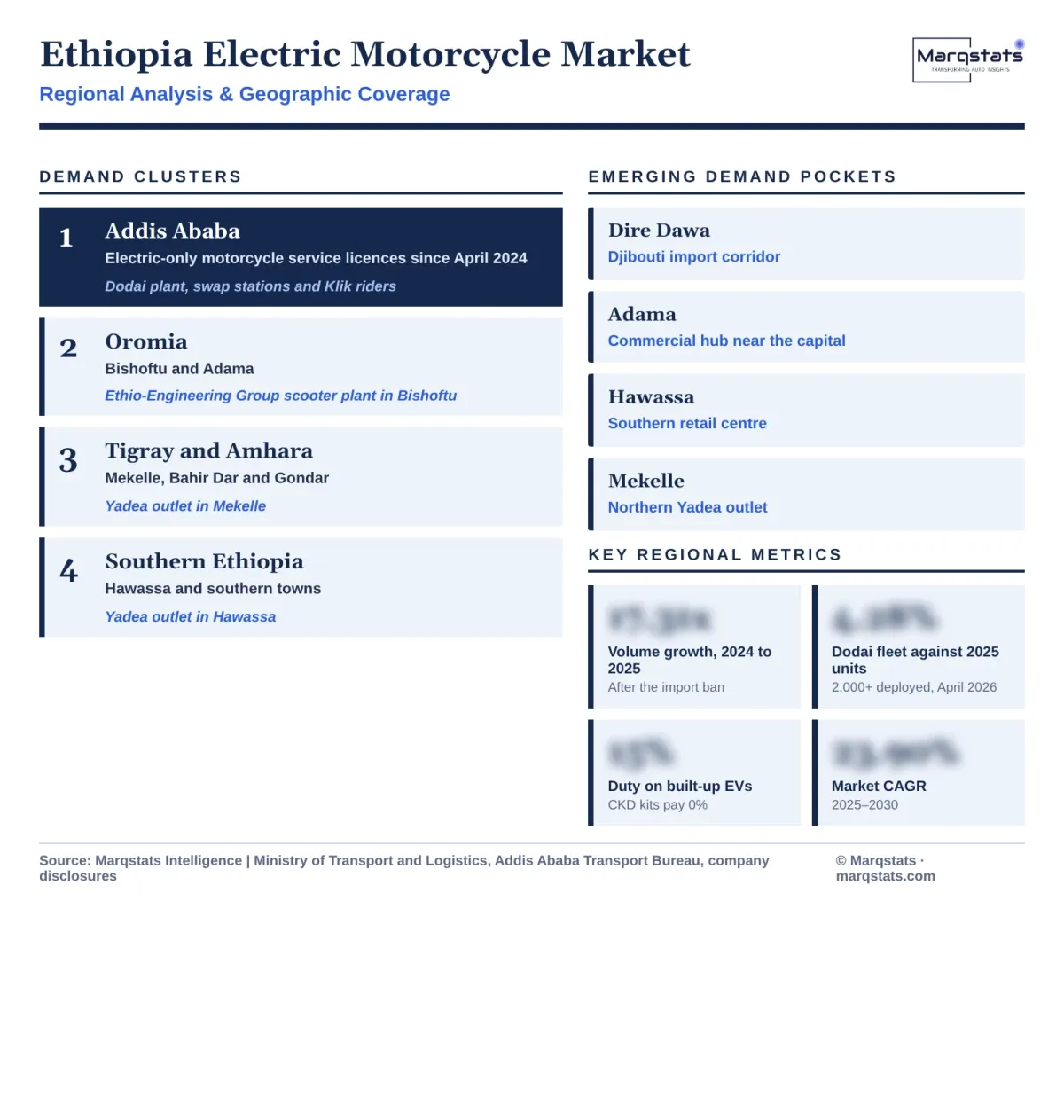
Addis Ababa is the largest demand cluster, with electric-only motorcycle service licensing since April 2024, Dodai's assembly plant and swap stations, Klik's delivery riders and Yadea's first shop. Dodai targets 1,000 swap stations in the city within three years. The capital remains the largest market to 2030, because licensing rules, swap stations, fleet buyers and dealers all concentrate there.
Oromia
Oromia surrounds the capital and includes Bishoftu, where Ethio-Engineering Group produces electric scooters, and Adama, a commercial hub on the Addis Ababa to Djibouti corridor. Commuting between the capital and nearby towns supports scooter demand. Oromia is the most likely second market, because it is close to the capital's assembly base and swap network.
Tigray and Amhara
Mekelle in Tigray hosts a Yadea outlet, and Bahir Dar and Gondar in Amhara are large regional cities with motorcycle taxi demand. Grid access and dealer coverage outside city centres limit growth.
Southern Ethiopia
Hawassa in the Sidama region hosts a Yadea outlet and serves as a centre for southern Ethiopia. Motorcycles are widely used for passenger and goods transport in towns across the south, where low-cost electric models compete with petrol motorcycles.
Dire Dawa and the East
Dire Dawa and Harar form the eastern cluster on the Djibouti trade corridor, through which most imports arrive. Proximity to the import route lowers distribution costs for dealers in the east, and traders in Dire Dawa handle a large share of goods moving inland from Djibouti. Demand in the east depends on dealers extending service and parts support beyond the capital.
How Competition Is Evolving
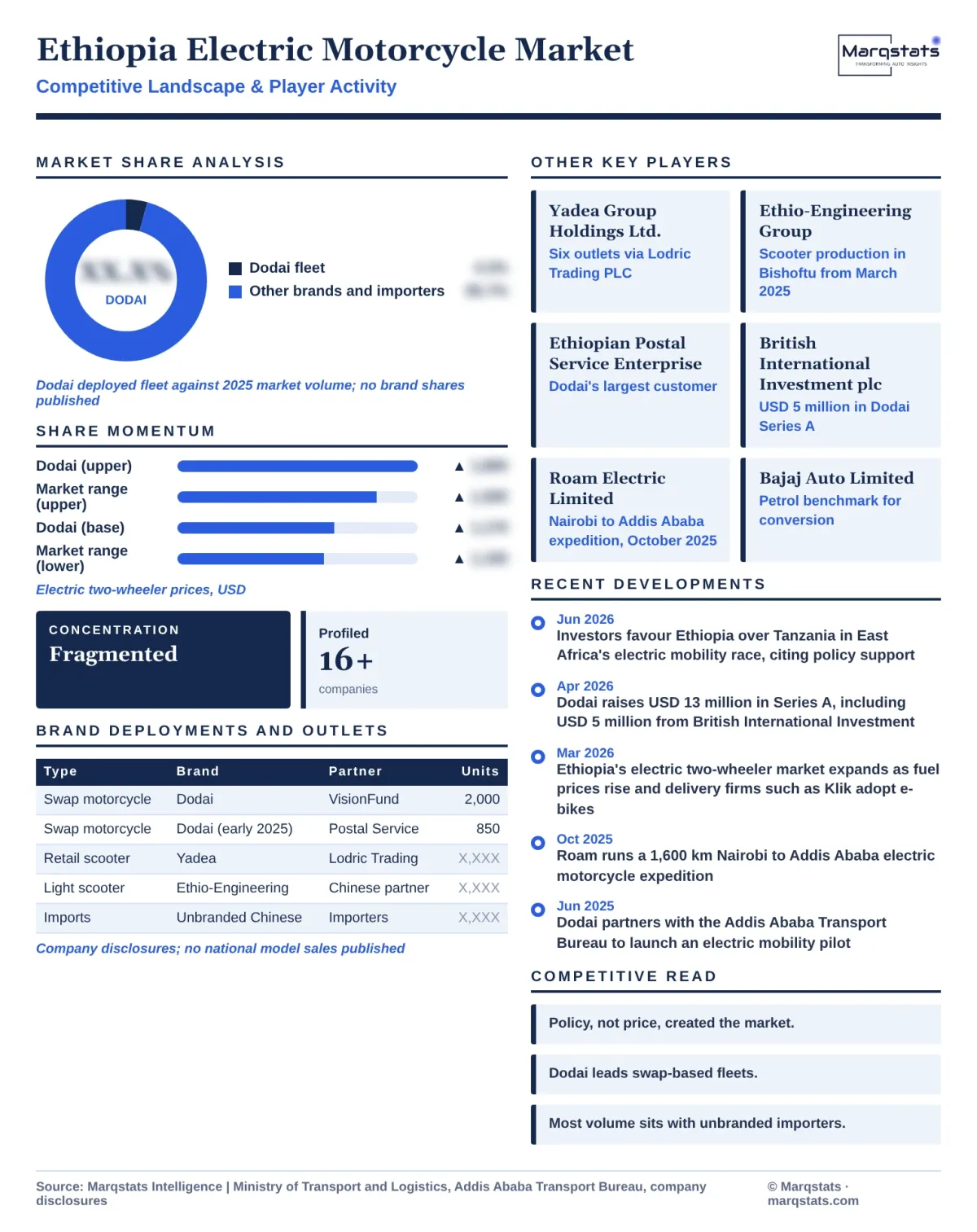
The market is fragmented. Organised brands include Dodai, Yadea Group Holdings Ltd. through Lodric Trading PLC, and Ethio-Engineering Group, while many importers sell low-cost Chinese models without published volumes. Dodai's deployed fleet of more than 2,000 motorcycles equals about 4.28% of 2025 volume, so most of the market sits outside the organised players.
Strategies split between swap-based fleets and retail scooters. Dodai assembles motorcycles locally, runs battery-swap stations and sells to delivery firms and the Ethiopian Postal Service Enterprise with financing from VisionFund, and it raised USD 13 million from British International Investment plc, Nagase & Co., Ltd., UTokyo Innovation Platform Co., Ltd. and other investors in April 2026. Yadea sells retail scooters through six outlets in Addis Ababa, Mekelle, Hawassa and other cities. The two models serve different buyers: fleets and gig riders want uptime and credit, while private buyers want a low purchase price and a nearby dealer, so the two leaders compete less with each other than with unbranded importers.
Petrol motorcycle brands remain the benchmark. Bajaj Auto Limited and TVS Motor Company Limited supply many of the petrol motorcycles and three-wheelers used for transport in Ethiopia, and their buyers are the main conversion target for electric brands. The import ban covers private vehicles, so existing petrol motorcycles stay on the road until cities require conversion.
The competitive question to 2030 is who builds the infrastructure. Swap networks, registration support and financing decide which brands scale, and Dodai's target of 1,000 stations in Addis Ababa would give it a lead in the capital. Roam, the Kenyan electric motorcycle maker, and other East African brands are testing cross-border demand, which adds competition in the commercial segment.
Partnerships with the state shape the field. Ethiopian Investment Holdings ended its battery-swap partnership with Dodai Group in March 2025, and Dodai then partnered with the Addis Ababa Transport Bureau on a pilot in June 2025, which shows that access to city programmes depends on direct links with the authorities. Ethio-Engineering Group, as a state-owned company, brings government links to its Bishoftu scooter production. Ethiopian Electric Utility, which runs the grid, matters to every swap operator, because station growth depends on reliable power supply.
Companies Covered
Companies covered in the report include:
Recent Market Activity
Table of Contents
Coverage & Segmentation
The Ethiopia electric motorcycle market comprises new battery electric motorcycles, mopeds and scooters sold for road use in Ethiopia, sized in units and in USD at retail selling prices. The market is segmented by motor power into four bands (up to 1.0 kW, 1.1–3.0 kW, 3.1–5.0 kW and above 5.0 kW) and by assembly route into locally assembled vehicles and imported built-up and semi-knocked-down vehicles. Regional analysis covers Addis Ababa, Oromia, Tigray and Amhara, southern Ethiopia, and Dire Dawa and the east.
The base year is 2025, the historical period is 2021–2025 and the forecast period is 2026–2030. Electric three-wheelers, cars and buses, pedal-assist bicycles, kick scooters, used vehicles and petrol motorcycles are excluded. No official series records electric two-wheeler sales or registrations in Ethiopia, so the market size is a Marqstats construction from import, assembly and company data, and the 2025 step change reflects the import ban and is not independently verified against registrations. Prices convert birr to USD at the rates cited by each source, and the birr has weakened since the 2024 currency reform, so USD prices vary by date. Company figures such as Dodai's deployments are as reported, the national 100,000 electric vehicle total covers all vehicle types, and regional analysis is qualitative.