Market Snapshot
Key Takeaways
Market Overview & Analysis
Report Summary
The electric refuse truck market comprises new battery-electric refuse collection vehicle sales worldwide, covering chassis and compaction body combinations used for household, commercial and industrial waste collection. This study segments the market by loader configuration, battery capacity, gross vehicle weight class, application, fleet ownership model and region, with a 2025 base year, historical coverage from 2021 to 2025, and forecasts to 2030. The parent all-fuel refuse truck market is reported alongside as context.
Scope is the principal source of confusion in this category and requires explicit statement. Published figures range across roughly an order of magnitude, and the range is driven by three separate decisions rather than by analytical disagreement. The first is whether the count covers refuse collection vehicles specifically or the wider electric sanitation fleet including sweepers, washers and small utility vehicles. The second is whether figures represent annual new sales or cumulative units deployed. The third is whether the parent all-fuel market or the electric segment alone is being quoted.
This report counts annual new sales of battery-electric refuse collection vehicles only. On that basis the market reached about 2,300 units in 2025 within a parent market of roughly 46,000 units across all fuel types. Estimates that count cumulative sanitation vehicle deployment across all vehicle types reach figures several times larger, and both can be correct simultaneously provided the basis is stated.
Demand concentration is unusual and shapes the market's dynamics. A small number of large waste haulers and municipal authorities account for a disproportionate share of orders, and single procurement decisions of 40 to 150 vehicles are common. One North American hauler ordered 150 electric collection vehicles across 2023 and 2024 and has stated that electric vehicles should represent half of its new truck purchases within five years, alongside a target to reduce greenhouse gas emissions 35% by 2030. Order timing is therefore lumpy in a way that annual averages conceal.
Market Dynamics
Key Drivers
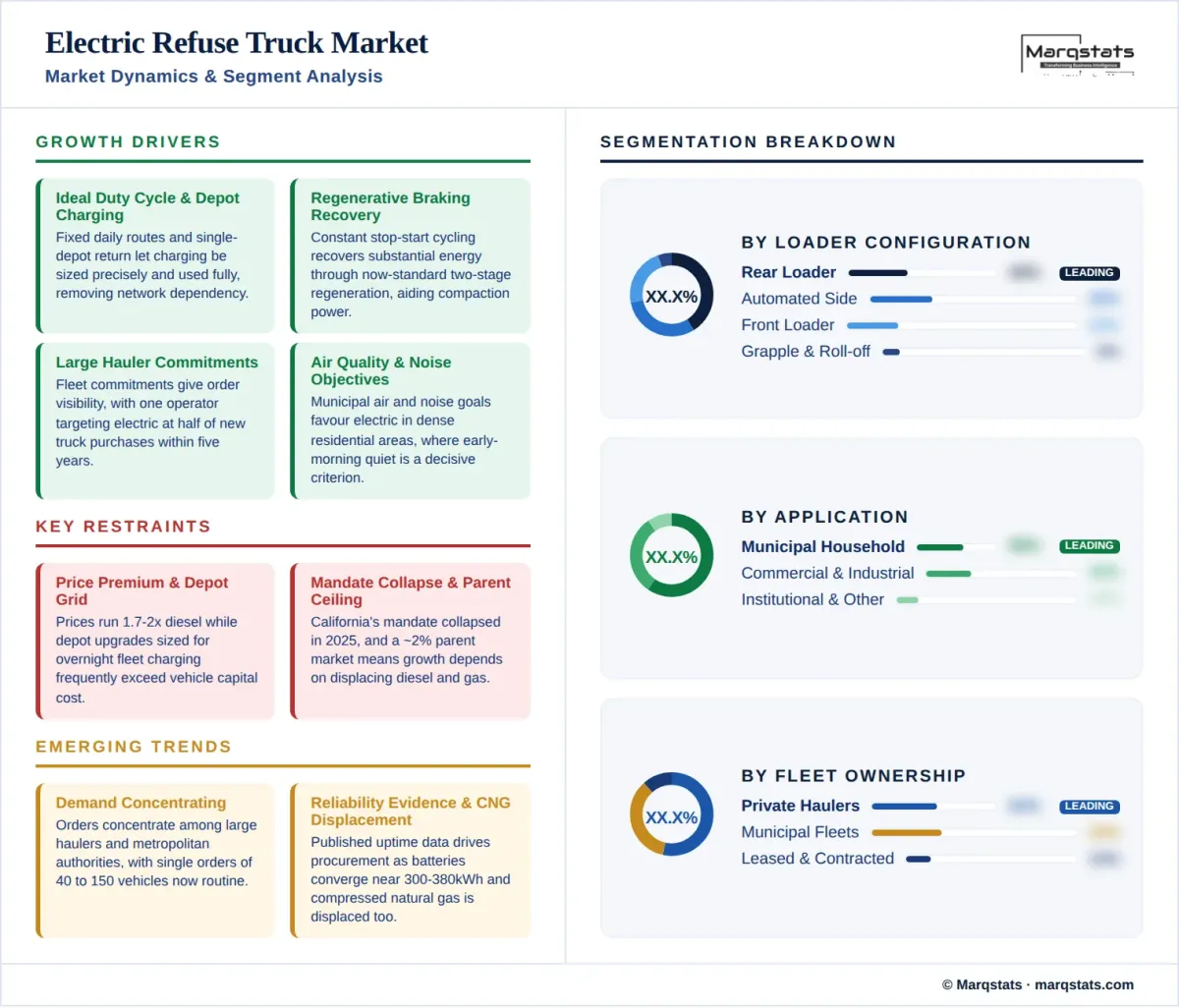
- Fixed daily routes and single-depot operation allow charging infrastructure to be sized precisely and utilised fully, removing the network dependency that constrains long-haul electrification.
- Constant stop-start cycling recovers substantial energy through regenerative braking, and two-stage regeneration is now standard on current-generation products.
- Large hauler commitments provide order visibility, with one operator targeting electric vehicles at half of new truck purchases within five years.
- Municipal air quality and noise objectives favour electric collection in dense residential areas, where early-morning operation makes noise a decisive procurement criterion.
- Voucher and incentive programmes continue to fund adoption at state and municipal level even where broader mandates have lapsed.
Key Restraints
- Purchase prices remain roughly 1.7 to 2 times diesel equivalents, requiring operators to underwrite long payback periods on high-utilisation assets.
- The California Advanced Clean Fleets rule collapsed across 2025, removing the strongest zero-emission purchasing mandate in the largest single market.
- Depot charging requires grid upgrades sized for simultaneous overnight charging of entire fleets, frequently exceeding vehicle capital cost.
- The parent market grows at only about 2.06% annually, so electric volume depends entirely on displacing diesel and compressed natural gas rather than on category expansion.
Key Trends
- Demand is concentrating among large haulers and metropolitan authorities, with single orders of 40 to 150 vehicles now routine.
- Operational reliability evidence is accumulating, with one early deployment reporting 500 miles and 600 tons collected across eight weeks without downtime.
- Battery capacities are converging around 300 to 380 kilowatt-hours as operators size for full-shift route completion without opportunity charging.
- Compressed natural gas is being displaced alongside diesel, as haulers that transitioned to gas in the 2010s reassess against electric.
Market Segmentation
Rear loaders account for the largest share of refuse truck deployment at roughly 40% of the parent market and dominate household collection across Europe and much of Asia-Pacific. The configuration suits narrow residential streets and crew-based collection, and it is the primary electric application in European markets where one manufacturer has more than 100 units operating across the United Kingdom and Ireland with a 19 cubic metre body and a 300 kilowatt-hour battery.
Front loaders serve commercial and industrial container collection and are proportionally more significant in North America than elsewhere. Automated side loaders have grown rapidly in North American residential collection because they allow single-operator crews, and they represent a strong electric application since the loading arm draws power that an electric driveline supplies without engine idling. Other configurations including grapple and roll-off units account for the remainder.
Configurations below 300 kilowatt-hours serve shorter residential routes and lighter gross weight classes, and they dominate European deployment where route lengths are shorter and vehicle sizes smaller. The band carries a lower capital premium over diesel and shorter charging times, and it is where most first-vehicle trial purchases are concentrated. Route modelling has become a standard part of procurement, since undersizing the pack risks mid-shift charging that removes the operational case.
Configurations above 300 kilowatt-hours serve North American routes and heavier gross weight classes, and grow faster than the lower band as operators size for full-shift completion without opportunity charging. Current-generation North American products carry packs near 376 kilowatt-hours across four lithium nickel manganese cobalt modules, delivering approximately 448 continuous horsepower and 4,051 pound-feet through twin motors, with charging at 150 kilowatts through a standard connector.
Vehicles below 18 tonnes serve narrow-street and rural collection and represent a small share of deployment. The 18 to 26 tonne class is the volume core of European and Asia-Pacific collection, matching typical municipal route densities and household collection volumes, and it carries the most mature electric product range because battery requirements remain within economically viable pack sizes.
Vehicles above 26 tonnes dominate North American collection, where longer routes, larger container volumes and greater distances to transfer stations require higher payload and energy capacity. The class carries the largest battery requirement and therefore the largest capital premium, and electric penetration lags the lighter classes for that reason. Growth is nonetheless strong because North American haulers have made the largest fleet commitments.
Municipal household collection is the largest application and the primary driver of electric adoption, because route predictability is highest and because local authorities weight air quality and noise alongside cost. Early-morning residential operation makes noise reduction a decisive procurement criterion in dense urban areas, and it is a benefit electric powertrains deliver immediately rather than over a payback period. One London borough ordered 40 electric collection vehicles operated under contract.
Commercial and industrial collection involves container services to businesses, construction sites and institutions, typically using front loaders and roll-off configurations. Routes are less predictable than household collection and vehicle utilisation is more variable, which complicates battery sizing. The application is nonetheless electrifying as large national haulers extend fleet commitments across their full vehicle mix rather than confining electric purchases to residential routes.
Private waste haulers account for the largest share of electric refuse truck purchases, driven by corporate emissions commitments and by the scale economics of fleet-wide depot charging. Large national operators can amortise charging infrastructure across many vehicles at a single site, which improves the investment case substantially relative to small operators. Corporate targets have become explicit, with one hauler committing to electric vehicles at half of new truck purchases within five years.
Directly municipal fleets purchase through public procurement, where whole-life costing and local air quality objectives frequently outweigh capital cost, and where grant funding is most accessible. Contracted operators running municipal services occupy an intermediate position, purchasing vehicles against contract terms that may not extend to full vehicle life. Leasing has grown as a route around the capital premium, transferring residual value risk to the lessor at a point when electric residuals remain unproven.
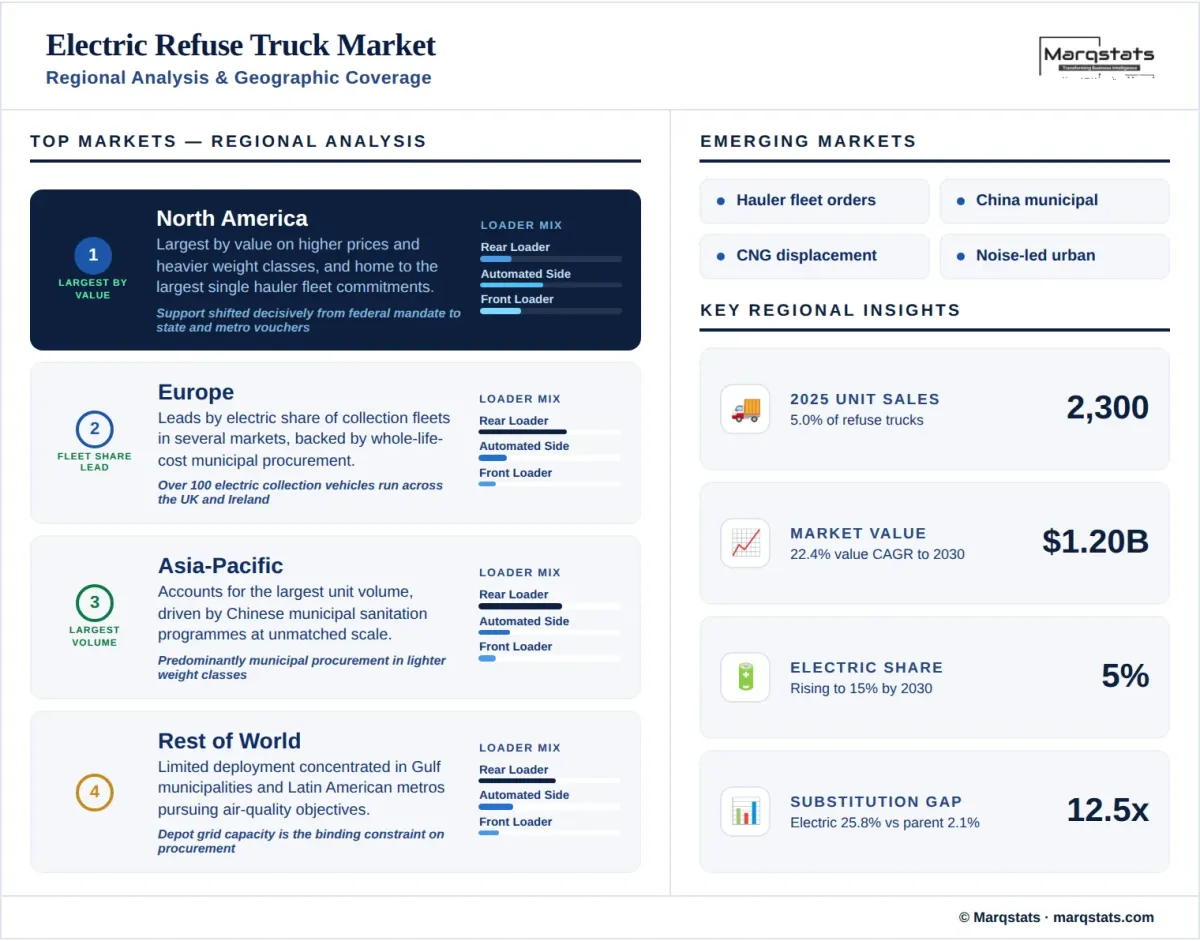
North America is the largest regional market by value, reflecting higher vehicle prices and larger gross weight classes, and it hosts the largest single fleet commitments. Deployment has been supported by state voucher programmes and metropolitan clean transportation awards rather than by the federal mandate that lapsed in 2025. Europe leads by unit share of collection fleets in several countries, with more than 100 electric collection vehicles operating across the United Kingdom and Ireland alone and strong municipal procurement across Northern Europe.
Asia-Pacific accounts for the largest unit volume, driven by Chinese municipal sanitation electrification programmes that have proceeded at a scale unmatched elsewhere and by a domestic manufacturing base supplying both local and export demand. Regional deployment concentrates in municipal household collection rather than commercial applications. Rest of World deployment remains limited, concentrated in Gulf municipalities and Latin American metropolitan authorities pursuing air quality objectives.
By Geography
North America
North America is the largest regional market by value and hosts the largest fleet commitments, with one national hauler ordering 150 electric collection vehicles across 2023 and 2024 and deploying further units in Chicago during 2025. Support has shifted decisively from mandate to incentive: a New York metropolitan clean transportation award funded a first deployment in early 2025, followed by additional orders in February 2026 through a state truck voucher programme. That first vehicle logged more than 500 miles and 600 tons collected with zero downtime across its initial eight weeks.
Europe
Europe leads by electric share of collection fleets in several national markets, supported by municipal procurement frameworks that weight whole-life cost and urban air quality. One manufacturer has more than 100 electric collection vehicles operating across the United Kingdom and Ireland, specified with a 300 kilowatt-hour battery, a 200 kilowatt drivetrain and a 19 cubic metre body, and a London borough ordered 40 units operated under contract. Northern European municipalities have been the earliest and most consistent adopters.
Asia-Pacific
Asia-Pacific accounts for the largest electric refuse vehicle unit volume, driven by Chinese municipal sanitation electrification programmes operating at a scale unmatched in any other region and supported by a domestic manufacturing base producing both collection vehicles and the wider sanitation fleet. Procurement is predominantly municipal rather than private, and vehicle specifications skew toward lighter gross weight classes than North American equivalents. Japanese, Korean and Australian adoption remains at pilot scale by comparison.
Rest of World
Rest of World deployment remains limited and concentrated in Gulf municipalities and Latin American metropolitan authorities where air quality objectives and sovereign or municipal funding coincide. Depot grid capacity is the principal constraint in most of these markets, frequently more binding than vehicle capital cost, and several authorities have deferred procurement pending electrical infrastructure upgrades. Growth from a very small base is expected as regional municipalities standardise fleet specifications.
How Competition Is Evolving
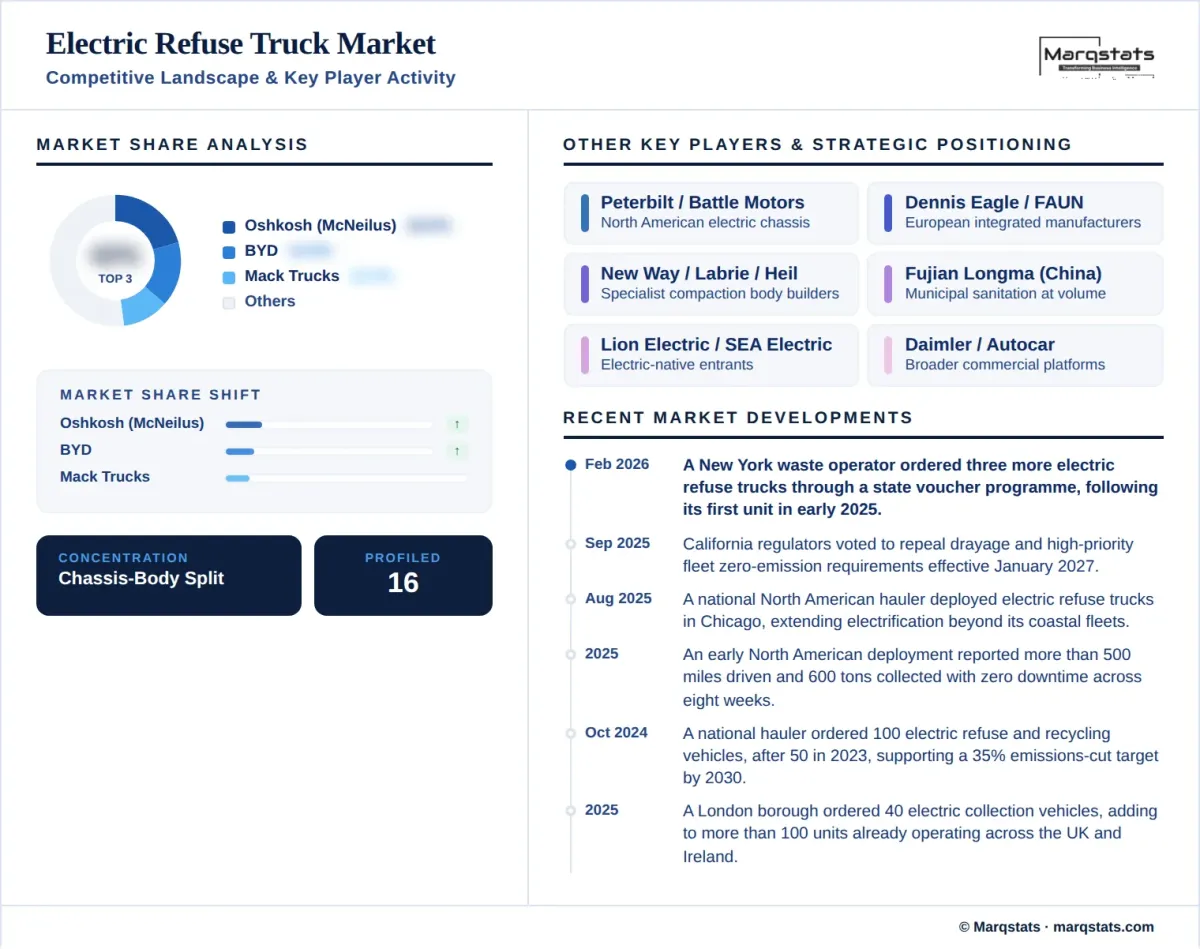
The electric refuse truck market divides between chassis manufacturers and body builders, and competitive positions differ across the two. Chassis supply is concentrated among established commercial vehicle manufacturers extending existing platforms alongside electric-native entrants, while body building remains a separate and highly specialised activity in which a small number of manufacturers hold strong positions across both diesel and electric applications. Most deployments pair a chassis from one supplier with a body from another.
North American competition centres on established truck manufacturers with electric variants of proven refuse platforms, supported by dealer networks and service coverage that fleet buyers weight heavily. Current products deliver approximately 448 continuous horsepower and 4,051 pound-feet from twin motors drawing on four battery modules totalling around 376 kilowatt-hours, charging at 150 kilowatts. Body builders have developed dedicated electric collection vehicle ranges that integrate compaction and lift functions with the electric driveline rather than adapting hydraulic systems designed for engine power take-off.
European competition is structured around integrated manufacturers producing both chassis and body, which suits the region's preference for purpose-designed collection vehicles over adapted general-purpose chassis. One manufacturer has established a substantial installed base across the United Kingdom and Ireland with a dedicated electric product, and continental manufacturers have introduced comparable ranges. Asia-Pacific competition is dominated by Chinese manufacturers supplying municipal sanitation programmes at volume, increasingly with export ambitions.
Reliability evidence has become the decisive commercial asset, as it has across commercial vehicle electrification generally. Waste collection is unforgiving of downtime because routes must be completed daily regardless of vehicle availability, and early adopters have consequently published operational data rather than treating it as commercially sensitive. Documented performance of 500 miles and 600 tons collected without downtime across an initial eight-week deployment carries more procurement weight than specification comparisons, and manufacturers without comparable evidence face a structural disadvantage.
Companies Covered
The report profiles 16+ companies with full strategy and financials analysis, including:
Recent Market Activity
Table of Contents
Coverage & Segmentation
This report provides a comprehensive assessment of the electric refuse truck market across a 2025 base year, historical data from 2021 to 2025, and forecasts spanning 2026 to 2030. Market sizing is presented in new unit sales and complemented by value analysis in United States dollars. Segmentation covers six dimensions. Only battery-electric refuse collection vehicles are counted; street sweepers, skip loaders, hook lifts and the wider electric sanitation fleet are excluded, as are hydrogen fuel cell prototypes.
The scope covers demand drivers, restraints and structural trends, with particular focus on the divergence between parent-market and electric-segment growth, the collapse of the California zero-emission fleet mandate and the shift from mandate to incentive, duty-cycle suitability, demand concentration among large haulers, and the role of operational reliability evidence in procurement. Comparable off-highway electrification is covered in the Electric Terminal Tractor Market report. An extended forecast to 2035 is available under customization, alongside fleet-level procurement analysis on request.