Market Snapshot
Middle bar: base-year value × (1 + CAGR), rounded to two decimals. This is a calculated illustration, not a separately researched annual estimate.
The India truck cabin air conditioning market was valued at approximately USD 45 million in 2025 and is projected to reach USD 132 million by 2030, expanding at a CAGR of 24.01% over 2026–2030. Growth is attributed to a regulatory mandate: all N2 and N3 goods vehicles manufactured on or after October 1, 2025 must be fitted with cabin air-conditioning, tested per IS 14618:2022, under the notification issued by the Ministry of Road Transport and Highways. The mandate converts cabin air-conditioning from a premium option into a statutory requirement across medium and heavy commercial vehicles.
India recorded around 215,000 medium and heavy goods-vehicle sales across the first two mandate quarters of FY2026, per Society of Indian Automobile Manufacturers data, establishing a substantial annual base for factory-fitted AC systems. Demand is increasing owing to near-universal fitment across new N2 and N3 trucks, together with a type-approved AC-kit requirement for drive-away chassis supplied to body-builders. The market is non-cyclical relative to feature-led demand, as fitment is set by regulation rather than by buyer preference.
Scope covers factory-fitted cabin AC systems — compressor, condenser, evaporator and blower unit, and controls — for N2 (3.5–12 tonnes) and N3 (above 12 tonnes) goods vehicles, together with type-approved kits for drive-away chassis. Per-system content is estimated at ₹25,000–30,000. Bus HVAC is treated as an adjacent segment. The supply side is highly concentrated, with Subros holding the largest share of truck AC supply.
The market is anchored in a defensible bottom-up model of statutory vehicle volumes multiplied by per-system content. Value scales with commercial-vehicle production, incremental content on electric trucks, and retrofit kits for the pre-mandate fleet. The price impact on vehicles is modest — an estimated 0.5–1% on heavy trucks and up to 1.2–2% on medium and light goods vehicles — which supports rapid, compliance-driven adoption across the fleet.
The base year reflects a partial-year mandate, as enforcement began on October 1, 2025, so 2025 captures only the first mandated quarter alongside limited pre-mandate premium fitment. The forecast reflects the transition to full-year enforcement from 2026, when the entire annual production of N2 and N3 goods vehicles carries cabin air-conditioning. This transition, combined with commercial-vehicle volume growth and rising electric-compressor content, drives the market from an estimated USD 45 million in 2025 toward USD 132 million by 2030.
Key Takeaways
Market Overview & Analysis
Report Summary
The India truck cabin air conditioning market covers factory-fitted air-conditioning and HVAC systems for medium and heavy goods vehicles in the N2 and N3 categories, comprising the compressor, condenser, evaporator and blower unit, and control electronics. Scope includes type-approved AC kits supplied by chassis manufacturers for installation on drive-away chassis by body-builders, while bus HVAC is treated as an adjacent segment. The market is defined by original-equipment fitment mandated across new N2 and N3 trucks, an adjacency to the Marqstats India telematics and fleet safety systems market report.
The mandate is the structural foundation of the market. The gazette notification requires that N2 and N3 goods vehicles manufactured on or after October 1, 2025 carry cabin air-conditioning tested per IS 14618:2022, according to Press Information Bureau records. The rule follows a decade-long policy process, first proposed in 2016, and rests on driver-welfare grounds, as cab temperatures exceed 45°C in summer over duty cycles of twelve to eighteen hours.
The commercial rationale is anchored in statutory volume. Medium and heavy goods-vehicle sales establish a large annual base, and the mandate lifts AC fitment toward universal coverage across new trucks. Growth is attributed to compliance-driven fitment, incremental electric-compressor content on electric trucks, and retrofit demand for pre-mandate vehicles. Per-system content of ₹25,000–30,000 anchors the value model, and the addressable base extends below 12 tonnes into the N2 segment, which begins at 3.5 tonnes.
Market structure follows the mandate. In the base year, only a partial quarter of production is covered, and value reflects early mandated fitment plus limited pre-mandate premium AC. From 2026, near-universal fitment across new N2 and N3 trucks sets a stable demand floor, and value is driven by the blend of medium-truck and heavy-truck content, the split between OEM-line and body-builder-kit channels, and the gradual introduction of electric-compressor systems. This combination underpins the reconciled estimate and positions the market as one of the most predictable, regulation-anchored opportunities in the Indian commercial-vehicle component base.
Market Dynamics
The India truck cabin air conditioning market is governed by regulation rather than by discretionary demand. The mandate sets a fitment floor across new N2 and N3 vehicles, so the primary variables are commercial-vehicle production volume, per-system content, and the pace of electric-truck and retrofit adoption. The dynamics below separate the compliance-driven demand base from the cost and integration constraints that shape adoption.
Key Drivers
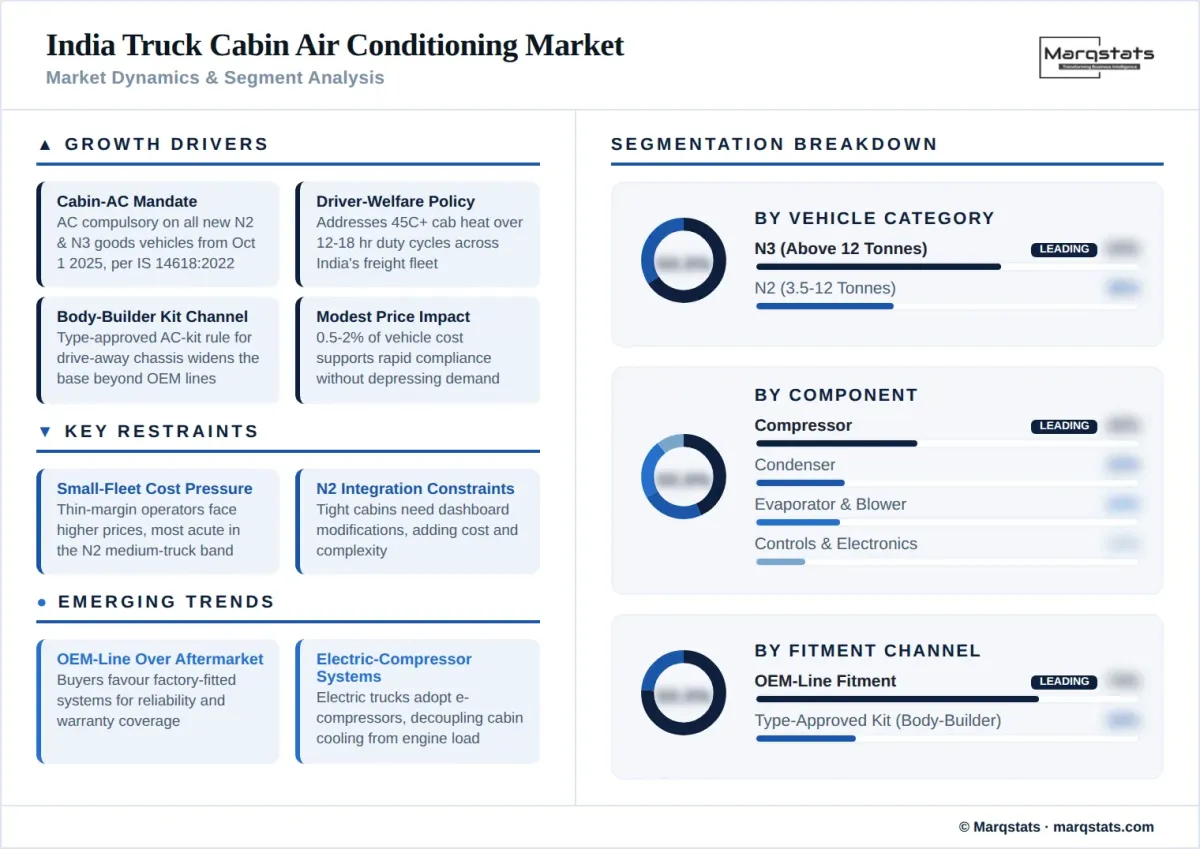
- Cabin-AC mandate for all new N2 and N3 goods vehicles from October 1, 2025 converts air-conditioning into a statutory requirement, creating structural, non-cyclical demand.
- Driver-welfare policy anchors the mandate, addressing cab temperatures above 45°C and duty cycles of twelve to eighteen hours across India's freight fleet.
- Type-approved AC-kit requirement for drive-away chassis extends fitment to the body-builder channel, broadening the addressable base beyond OEM-line production.
- Modest price impact of 0.5–2% relative to vehicle cost supports rapid compliance without materially depressing demand across most segments.
- Commercial-vehicle production recovery and freight growth expand the annual base of trucks requiring cabin AC content.
Key Restraints
- Cost pressure on small fleet operators, who work on thin margins and face higher purchase prices, is most pronounced in the N2 medium-truck segment.
- Technical integration challenges in smaller N2 cabins, owing to limited space, require dashboard modifications and add cost.
- Fuel-efficiency concerns, as air-conditioning draws engine power and affects mileage, temper operator sentiment in price-sensitive segments.
- Cyclicality of commercial-vehicle sales, which follow freight and infrastructure cycles, introduces volume variability around the mandated fitment base.
Key Trends
- Shift toward integrated OEM-line fitment over aftermarket installation, as buyers favour factory-fitted systems for reliability and warranty.
- Emergence of electric-compressor AC systems on electric trucks, decoupling cabin cooling from engine load.
- Consolidation of supply around a small number of thermal-system specialists with mandate-integration capability.
- Development of retrofit AC kits for the pre-October-2025 fleet, addressing driver-welfare demand beyond new-vehicle fitment.
Market Segmentation
Component segmentation identifies the compressor as the highest-value element, followed by the condenser, evaporator and blower unit, and control electronics. The compressor and thermal loop carry most of the per-system content.
The compressor is the highest-value component and the core of the cabin AC system. Diesel trucks use belt-driven compressors, while electric trucks adopt electric compressors. Compressor technology and sourcing are the principal determinants of per-system cost and supplier value capture.
The condenser dissipates heat from the refrigerant and is engineered for heavy-duty duty cycles and high ambient temperatures. Durability under sustained load is central to specification. The condenser is a steady share of system value across N2 and N3 vehicles. Heat-rejection capacity is sized to Indian ambient conditions, which places a premium on thermal robustness.
The evaporator and blower unit deliver cooled air into the cabin and are packaged around available cabin space. Integration is more constrained in smaller N2 cabins. This subsystem determines cooling performance and cabin comfort. Airflow design and blower capacity are tuned to sustained high-temperature operation typical of Indian long-haul routes.
Controls and electronics manage temperature regulation and system operation. Content rises with climate-control sophistication and telematics integration. This element grows as trucks adopt connected and electric platforms. Climate-control automation and integration with telematics extend the electronic content per system over the forecast period.
Fitment segmentation separates OEM-line installation from type-approved kits fitted through the body-builder channel. OEM-line fitment is the dominant channel, while the drive-away-chassis kit requirement creates a defined secondary channel.
OEM-line fitment integrates the AC system on the assembly line and is the dominant channel by value. Buyers favour factory-fitted systems for reliability and warranty. This channel captures the majority of mandated fitment volume. OEM-line integration also enables tighter packaging, standardised validation, and consistent warranty terms across a manufacturer’s range.
Type-approved AC kits are supplied by chassis manufacturers for installation on drive-away chassis by body-builders, as required by the mandate. This channel addresses the significant share of trucks built on bare chassis. Kit standardisation and type approval govern quality and compliance. Because a material share of medium and heavy trucks is delivered as bare chassis, this channel represents a durable and defined portion of mandated demand.
Vehicle-category segmentation distinguishes N2 medium trucks from N3 heavy trucks. N3 trucks carry higher content and volume in the heavy-duty freight base, while N2 trucks face tighter cabin-integration constraints.
N2 medium trucks span 3.5 to 12 tonnes gross vehicle weight and extend the addressable base below the heavy-truck segment. Cabin-integration constraints and higher relative price impact shape adoption. The segment broadens the mandate's reach into medium goods vehicles.
N3 heavy trucks above 12 tonnes gross vehicle weight anchor market value, owing to larger cabins and higher AC content. The segment covers long-haul freight, where driver-welfare benefits are most pronounced. N3 trucks account for the largest share of mandated AC fitment by value. Larger cabins accommodate higher-capacity systems, and long-haul duty cycles strengthen the welfare rationale for robust cooling performance.
Propulsion segmentation separates diesel trucks, which use belt-driven compressors, from electric trucks, which adopt electric-compressor systems. Diesel dominates the base, while electric trucks introduce higher-value electric-compressor content.
Diesel trucks constitute the overwhelming majority of the mandated base and use belt-driven compressors coupled to the engine. The segment defines baseline system volume and cost. Diesel fitment governs near-term market value. Belt-driven systems are well established and cost-optimised, which keeps baseline per-system content stable across the diesel base.
Electric trucks adopt electric-compressor AC systems that decouple cabin cooling from engine load, raising per-system content. Growth is attributed to fleet electrification in short-haul and regional freight. This shift is an adjacency to the Marqstats India electric vehicle components market report.
By Geography
Regional distribution reflects the geography of commercial-vehicle manufacturing and the freight corridors that drive truck demand. Southern and Western India concentrate assembly capacity, while Northern and Central India anchor freight movement along the primary highway corridors.
Southern India
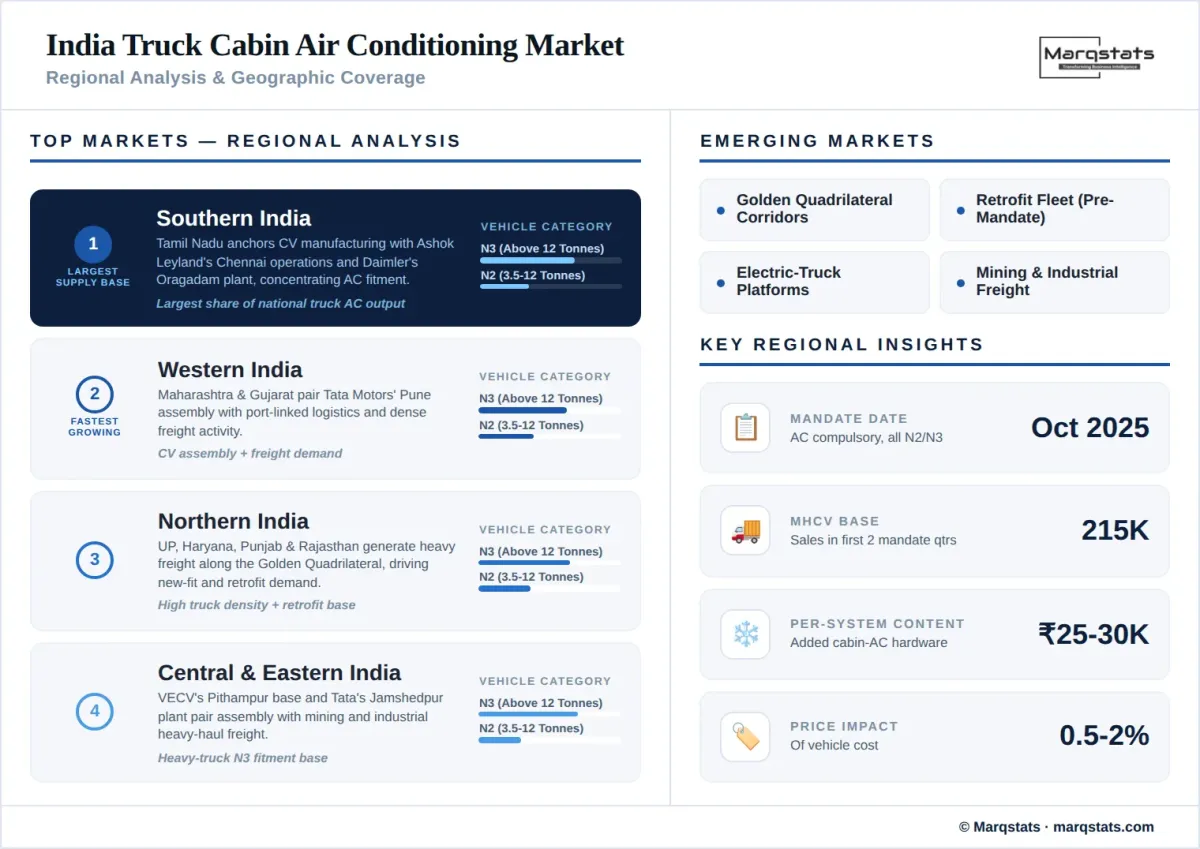
Southern India, anchored by Tamil Nadu, is the core of commercial-vehicle manufacturing, with Ashok Leyland's Chennai operations and Daimler India Commercial Vehicles' Oragadam plant. The region concentrates truck production and, consequently, AC-system fitment. Southern India holds the largest share of national truck cabin AC output.
Western India
Western India, covering Maharashtra and Gujarat, combines commercial-vehicle assembly with dense freight activity. Tata Motors' Pune operations and strong port-linked logistics anchor demand. The region ranks among the fastest-growing for truck cabin AC fitment.
Northern India
Northern India, spanning Uttar Pradesh, Haryana, Punjab, and Rajasthan, is a primary freight-generating region along the Golden Quadrilateral and dedicated freight corridors. High truck density drives both new-fitment and retrofit demand. The region is a major source of goods-vehicle registrations subject to the mandate. Dense long-haul movement along these corridors also underpins a sizeable retrofit opportunity for the pre-mandate fleet operating in the region.
Eastern India
Eastern India, including West Bengal, Jharkhand, Bihar, and Odisha, pairs Tata Motors' Jamshedpur commercial-vehicle base with mining and industrial freight. Growth is attributed to industrial goods movement and heavy-truck demand. The region contributes both production and freight-driven fitment.
Central India
Central India, comprising Madhya Pradesh and Chhattisgarh, hosts VE Commercial Vehicles' Pithampur manufacturing base and mining-linked freight. The region combines assembly capacity with heavy-haul demand. Central India supports both truck production and long-haul AC fitment. Proximity to mining and industrial clusters sustains heavy-truck demand, reinforcing the region’s N3 fitment base.
How Competition Is Evolving
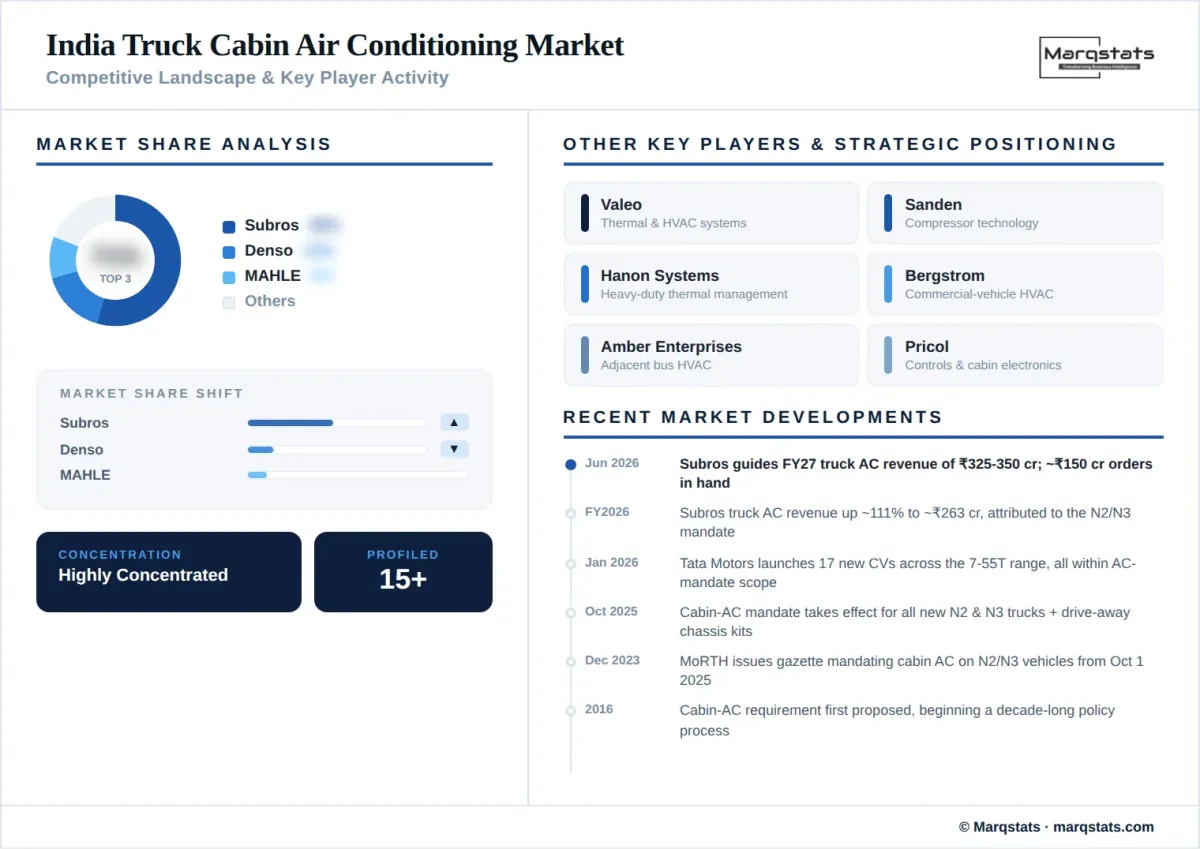
The India truck cabin air conditioning market is highly concentrated at the supply level. Subros holds an estimated 41–54% share of truck AC and blower systems, supported by a technical collaboration with Denso and integration programmes with Tata Motors, Ashok Leyland, Mahindra, Daimler, and SML Isuzu. Concentration is attributable to the engineering and validation requirements of mandate-compliant systems, which raise barriers to entry.
Competition centres on OEM integration, capacity, and the ability to serve both the OEM-line and body-builder-kit channels. Subros reported truck AC revenue growth of about 111% for FY2026 to around ₹263 crore, attributed to the N2 and N3 mandate, and guided ₹325–350 crore for FY2027 as the first full mandate year takes effect. Global thermal-system specialists and commercial-vehicle HVAC makers compete on technology and heavy-duty durability.
Original-equipment manufacturers shape the structure through sourcing strategy and platform standardisation across the 7-to-55-tonne range. Growth is attributed to multi-year supply agreements that lock in compressor and thermal-loop volumes, alongside electric-compressor content on electric-truck platforms. The near-term determinant of share is mandate-integration capability across a broad OEM base, which favours suppliers with established commercial-vehicle relationships.
Amber Enterprises anchors the adjacent roof-mounted bus air-conditioning segment, which is flagged separately from truck cabin AC. As commercial-vehicle electrification advances, suppliers able to offer electric-compressor systems and integrated thermal management gain positioning. The competitive structure rewards scale, OEM proximity, and the capacity to serve retrofit demand for the pre-mandate fleet.
Companies Covered
Companies covered in the report include:
Recent Market Activity
Table of Contents
Coverage & Segmentation
This report provides a comprehensive analysis of the India truck cabin air conditioning market for the historical period 2021–2025 and the forecast window 2026–2030, with 2025 as the base year. Coverage spans factory-fitted cabin AC systems — compressor, condenser, evaporator and blower unit, and controls — for N2 and N3 goods vehicles, together with type-approved kits for drive-away chassis. The study examines market sizing by value, segment-level forecasts by component, fitment, vehicle category, and propulsion, regional distribution across Indian zones, competitive positioning, and the regulatory drivers that govern demand. Bus HVAC is treated as an adjacent segment.
The market is modelled bottom-up from statutory commercial-vehicle volumes multiplied by per-system content, and validated against supplier disclosures. The forecast reflects the transition from a partial-year mandate in 2025 to full-year enforcement from 2026, incremental electric-compressor content on electric trucks, and retrofit demand for the pre-mandate fleet. Deliverables include market sizing and forecasts, segment and regional splits, company profiles, and a regulatory-impact assessment. The report is intended for thermal-system suppliers, commercial-vehicle OEMs, body-builders, investors, and policy stakeholders.
The forecast provides annual estimates across the 2026–2030 window with sensitivity to three variables: commercial-vehicle production volume, per-system content by vehicle category, and electric-truck penetration. Per-system average content was benchmarked separately for N2 and N3 vehicles and reconciled against supplier revenue and market-share disclosures to keep the volume and value forecasts internally consistent. The report also assesses the retrofit opportunity for the pre-October-2025 fleet, which extends demand beyond new-vehicle fitment where driver-welfare considerations support voluntary installation.