Market Snapshot
Key Takeaways
Market Overview & Analysis
Report Summary
Thailand's pickup market is shrinking at home and consolidating as an export platform, and reading it as a single market produces a wrong answer about both halves. Domestic sales of about 142,900 units in 2025 are a fraction of a base that historically ran 400,000 to 500,000 a year, while export production of one-tonne pickups ran more than three times domestic sales. The vehicle that built the Thai automotive industry is now largely built for somewhere else.
The measure is annual new one-tonne pickup trucks sold domestically in Thailand across all powertrains and cab configurations. Pickup-derived passenger vehicles built on the same platform are excluded, which is the scope difference that explains a 23.42% gap against the broader published forecast. Export production is carried as a named dimension with its own ratio and is never added to the domestic panel. Heavy and medium trucks are excluded, as are electric commercial vans, which are covered separately.
The analysis is written for manufacturers deciding how much Thai pickup capacity a shrinking home market justifies, component suppliers whose plants were built around a segment at more than 90% local content, lenders and captive finance arms whose rejection rates set the segment's ceiling, and policy analysts weighing an excise structure that raised pickup rates while lowering battery-electric ones in the same month.
Thailand Pickup Truck Market Size and Forecast
Domestic sales are estimated at 142,900 units in 2025, 139,000 in 2026 and 152,000 by 2030, an increase of 9,100 units a year across the window. Market value moves from USD 3.49 billion to USD 3.88 billion on an average transaction price rising from about USD 24,431 to USD 25,538, which at a disclosed constant THB 32.5 per USD is THB 794,008 rising to THB 829,985.
Two growth rates apply and both are published. The five-year value rate connecting 2025 and 2030 is 2.14%; the four-year rate connecting 2026 and 2030 is 2.54%. The gap runs the unusual way because 2026 is a further decline year at about 2.73% rather than a growth year, and the mechanism is credit rather than product: the segment is passing through a volume trough before stabilising on genuine commercial and agricultural replacement demand. Units compound at 1.24% across the five-year window and at 2.26% across the four-year one.
Value compounds ahead of units at 2.14% against 1.24%, a 0.90-point inversion and the only one of its kind across the Thai pages in this programme. The mechanism is the January 2026 excise restructuring, which moved pickup bands from a 2% to 10% range to a 2% to 13% range and lifted new vehicle prices about 2% to 10%, together with electrification arriving at the top of the range rather than at the bottom.
The mix inside the segment is moving down while the price moves up, which is a genuine tension worth naming. The single and extended cab band between THB 600,000 and THB 799,000 grew from 58% of the market in 2022 to 62% in 2025, while the THB 800,000 to THB 999,000 band fell from 39% to 33.5%, so buyers are trading down inside a segment whose tax has risen.
A sizing range is published rather than a point. The 2030 figure sits within a band of 128,000 to 176,000 units and USD 3.27 billion to USD 4.49 billion, and the lower half of that band is a contracting market rather than a slow-growing one, at a negative 1.30% value rate. Which half applies turns on household credit conditions and on whether battery-electric substitution reaches the commercial buyer, neither of which is a product question.
The Segment That Localised Thailand Is the One Losing Share
The most consequential fact about Thai pickups is not their volume but their content, and it is the reason the segment's decline matters beyond its own sales line. Thai pickup production uses more than 90% domestically produced parts, sustained across two plants employing more than 6,000 people at one manufacturer alone, and that depth took four decades to build.
The segment replacing it is nothing like as local. Locally assembled battery-electric vehicles run at around 50% domestic content at the two largest Chinese plants and 46% at one Korean entrant against a 40% requirement, and at least 62.16% of Thai battery-electric demand between January and July 2026 was met by imports outright. A unit of demand that moves from a pickup to an imported battery-electric vehicle takes more than 90% of its local content with it.
The scale of the transfer is measurable. Had pickups held their 2022 share of about 46% of light vehicle sales, they would have accounted for roughly 285,736 units of the 621,166 vehicles sold in Thailand in 2025 rather than about 142,900, so approximately 142,836 units of annual demand have moved out of the most localised segment in the market.
That is the correction this page exists to make. Thai policy debate treats electrification and localisation as complements, and on the evidence of the last four years they have been substitutes: the share gained by the least localised segment came almost entirely from the most localised one, and no battery-electric local-content requirement set at 40% recovers content lost from a base above 90%.
The supplier consequence is concentrated rather than diffuse. A parts base built around pickup volumes at more than 90% local content cannot be redeployed to a battery-electric programme that imports its cells, which is why the entries and exits in the Thai component sector are running in both directions at once rather than rotating cleanly from one powertrain to the other.
Credit, Not Product, Sets the Ceiling
Pickup demand in Thailand is a financing outcome more than a vehicle choice, and the segment's decline tracks household balance sheets rather than model cycles. Sales that historically ran 400,000 to 500,000 units a year have fallen to a range of 200,000 to 300,000 on the broader definition, with a 2026 forecast of 171,000 units described as the lowest in 24 years.
The buyer base explains why credit binds so hard here. Provincial markets account for 60% to 70% of the nationwide pickup market, which is agricultural and small-business income rather than salaried income, and it is the part of the borrower population that a tightening lending standard removes first.
The trade-down inside the segment is the visible symptom. The THB 600,000 to THB 799,000 single and extended cab band rose from 58% to 62% of sales between 2022 and 2025 while the THB 800,000 to THB 999,000 band fell from 39% to 33.5%, which is the signature of buyers qualifying for smaller loans rather than of preference shifting.
Excise moved the wrong way for that buyer at exactly the wrong moment. Pickup bands went from a 2% to 10% range to a 2% to 13% range from January 2026 and prices rose about 2% to 10%, while excise on compliant domestically produced battery-electric vehicles can fall as low as 2% from the same date and entry battery-electric models list from THB 429,900, below the THB 600,000 floor of the pickup volume band.
The forecast therefore treats stabilisation rather than recovery as the base case. Reaching 152,000 units in 2030 asks the segment to hold roughly 19.5% of an assumed 780,000-unit market against 19.90% between January and July 2026, which is a share floor set by commercial and agricultural replacement need rather than a return to the 46% of 2022.
The Export Base Is Three Times the Home Market
Thailand's pickup industry has quietly reversed its orientation and the ratio is reported. Export production of one-tonne pickups in complete built-up form ran more than three times domestic sales in 2025, against one to one and a half times in earlier years, which means the home market has moved from being the reason the plants exist to being a minority of what they produce.
The national figures put that in proportion. Thailand produced more than 1.45 million vehicles in 2025 and exported more than 935,000 complete built-up units, which is 1.51 times the 621,166 vehicles sold domestically across all segments, and the Federation of Thai Industries planned 2026 production of 1.45 million units split 900,000 for export and 550,000 for the domestic market.
Capital is still being committed to that export base rather than withdrawn from it. More than THB 15 billion was approved in April 2026 across two projects covering automation and robotics in chassis welding, body assembly, painting and vehicle assembly, solar generation, and development of Euro 6 compliant pickups aimed at European and other developed markets.
The capacity arithmetic shows how completely the plants have outgrown the country. Two plants at 385,000 units of combined annual capacity represent 2.69 times the entire Thai domestic pickup market of about 142,900 units, and 64.2 units of annual capacity per employee across more than 6,000 workers.
Euro 6 is the strategic detail rather than a compliance footnote. A pickup line upgraded for Euro 6 is a line built to sell into Europe, and the same plants building for a shrinking domestic market on more than 90% Thai parts are being re-equipped to serve emissions regimes that Thailand itself does not apply.
The Electric Pickup Is an Export Product, Not a Domestic One
Thailand launched the region's first locally built electric pickup and priced it out of its own volume market. The D-MAX EV listed at THB 1,591,000 in March 2026 with a 66.9 kWh battery, 331 kilometres of NEDC range, a 140 kilowatt dual-motor drivetrain producing 325 Newton-metres, 600 millimetres of wading depth and 11 kilowatt alternating current and 50 kilowatt direct current charging.
Against the band where 62% of Thai pickups are sold, that price is between 1.99 and 2.65 times the going rate. A vehicle at THB 1,591,000 competes with premium double cabs rather than with the THB 600,000 to THB 799,000 working pickup, which is why the model was described at launch as the first electric pickup produced in Thailand for export to the European market.
Domestic electric pickup volume confirms the point rather than contradicting it. Battery-electric pickup sales were 726 units in 2025 against none in 2024, which is 0.51% of the segment, and range-extended pickups added 19 units, while electric pickup sales grew 161.11% year on year in March 2026 from that near-zero base.
For the domestic buyer the electrified pickup that matters may not be battery-electric at all. Hybrid and range-extended configurations reaching the THB 800,000 to THB 999,000 band would meet the trade-down pattern that has already moved 4 points of share into the cheapest cab configurations, where a THB 1,591,000 battery-electric model cannot go.
Two Forecasts, Two Denominators, and Why Both Are Right
Published Thai pickup forecasts differ by roughly a quarter and the difference is definitional rather than analytical. A 2026 forecast of 171,000 units sits against a Federation of Thai Industries series that annualises to 138,554 for the same year, a gap of 23.42%.
The wider figure counts pickup-derived passenger vehicles built on the same ladder-frame platform, which are a large and distinct segment in Thailand, while the narrower one counts internal combustion pickups as a body type within the monthly domestic sales split. Neither is wrong and adding them would double-count the platform.
This analysis uses the narrower series, and says so, because it is published monthly with a consistent definition and because the platform-derived passenger vehicles behave like passenger vehicles rather than like working trucks. A reader modelling supplier volumes on a ladder-frame basis should use the wider figure and should not mix the two.
The historical range needs the same treatment. Sales of 400,000 to 500,000 units a year, and a recent range of 200,000 to 300,000, are quoted on the broader definition, so the 46% share of light vehicle sales in 2022 and the 19.90% recorded between January and July 2026 are not directly comparable to each other unless the same basis is used throughout, and on this page it is.
The Brand-Level Damage, and Who Is Reinvesting Anyway
The decline is concentrated rather than general, and the leader is gaining share inside it. Toyota sold 61,060 Hilux units in 2025 to make it the top-selling model in Thailand, taking a record 48.7% pickup share and 38.7% of commercial vehicles, while its Pure Pick Up segment covering the Hilux Travo, Revo and Champ reached 43,082 units in January to July 2026, up 5.6%, on 91% local content with Hilux exports of 137,400 units.
Second place absorbed the fall. Isuzu sold 51,268 D-Max units within a total of 73,465 vehicles in 2025, down 14.2%, and responded by committing rather than retreating: the Board of Investment approved an additional THB 15 billion in April 2026 across two plants with combined capacity of 385,000 units a year, over 6,000 employees and over 90% local parts content.
The export-led producers are investing on a scale the domestic decline does not justify on its own. Ford runs Ranger and Everest capacity above 270,000 units a year with about 90% exported, on cumulative Thai investment above THB 133 billion, and acquired the 412.5-rai former Suzuki plant in January 2026. Mitsubishi announced a further THB 16 billion by 2030 for electric vehicle technology against cumulative investment above THB 100 billion and more than 5 million vehicles exported.
Monthly demand tells the story more plainly than any annual figure. Internal combustion pickups are selling around 10,000 units a month against roughly 30,000 before the pandemic, with January to July 2026 domestic sales of 80,823 units split 37,369 one-ton and 43,454 double-cab, and 10,686 units in July alone. Household debt at 86.7% of gross domestic product in the fourth quarter of 2025 is the constraint behind that, not product.
Electrification Arrives While the Segment Contracts
Electric pickups are entering a shrinking market and gaining ground inside it. Geely Riddara recorded 409 registrations in July 2026, a record month, against about 1,000 sales across the whole of 2025, targets 3,000 to 5,000 units in 2026, and prices between THB 739,000 and THB 1,149,000 across 29 showrooms. Battery electric pickup and van registrations reached 488 units in January to July 2026 against 662 for the whole of 2025.
The incumbents are answering with product rather than price. Isuzu launched the D-Max EV in March 2026 from THB 1,591,000 with a 66.9 kWh battery, 331 kilometres of NEDC range and 50 kW direct current charging, while Ford launched the Ranger Super Duty in the same month from THB 1,599,000 with a 3.0-litre V6 diesel and a 4,500 kilogram gross vehicle mass, which is a capability answer rather than an electrification one.
Order data from the 2026 Bangkok International Motor Show shows where intent sits. Toyota took 15,750 bookings, Isuzu 3,568 and Riddara 2,569 within a show total of 132,951, so the electric challenger took roughly 72% of the second-placed incumbent's bookings from a fraction of its network. Diesel compatibility work continues in parallel, with 1,135 vehicle models confirmed compatible with B20 as of May 2026.
Market Dynamics
Key Drivers
- An export base running more than three times domestic sales in 2025, sustaining capacity, supplier volume and model development that domestic demand alone could not.
- More than THB 15 billion of upgrade investment approved in April 2026 across two plants with 385,000 units of combined capacity and more than 6,000 employees.
- Commercial and agricultural replacement demand concentrated in provincial markets that account for 60% to 70% of the nationwide pickup market.
- Euro 6 product development aimed at European and other developed markets, opening destinations that the Thai domestic standard does not require.
- Electrification of the segment beginning locally, with the first Thai-built electric pickup launched in March 2026 at THB 1,591,000 with a 66.9 kWh battery and 331 kilometres of range.
Key Restraints
- A 26.1-point share loss from about 46% of light vehicle sales in 2022 to 19.90% between January and July 2026, with 2026 volume forecast at a 24-year low.
- Excise bands moving from a 2% to 10% range to a 2% to 13% range from January 2026, lifting prices about 2% to 10% for a credit-constrained buyer.
- Household credit conditions in provincial markets that supply 60% to 70% of demand, visible in the trade-down from the THB 800,000 to THB 999,000 band to the THB 600,000 to THB 799,000 band.
- Battery-electric substitution at the entry price point, where models list from THB 429,900 against a pickup volume band starting at THB 600,000.
Key Trends
- Value compounding ahead of units at 2.14% against 1.24% as excise-driven price increases outpace a nearly flat volume line.
- Trade-down inside the segment, with the cheapest cab band rising from 58% to 62% of sales between 2022 and 2025 while the mid band fell from 39% to 33.5%.
- Electrification entering at the top of the range, with a THB 1,591,000 electric pickup against 726 battery-electric pickup sales in 2025, or 0.51% of the segment.
- Production re-equipping for export compliance, with Euro 6 pickup development approved alongside automation and solar generation in April 2026.
Market Segmentation
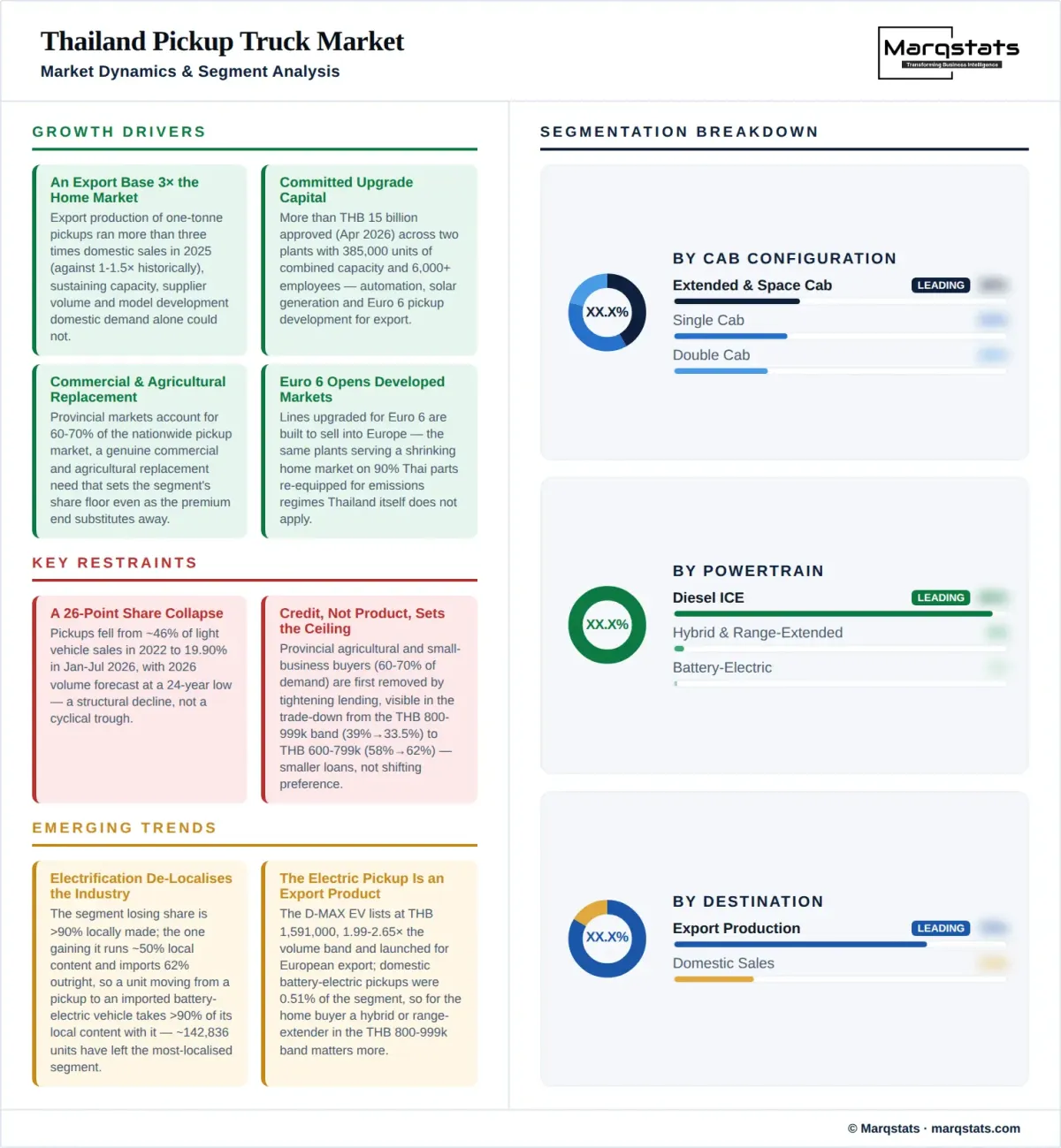
The pure working configuration and the core of the THB 600,000 to THB 799,000 band that grew from 58% to 62% of sales between 2022 and 2025. This is where provincial demand, which is 60% to 70% of the nationwide market, is concentrated and where credit conditions bind hardest.
The bridge configuration sharing the THB 600,000 to THB 799,000 band, and the one that absorbs buyers trading down out of double cabs as loan sizes shrink. The combined band is 62% of a market of about 142,900 units.
The lifestyle and family configuration concentrated in the THB 800,000 to THB 999,000 band that fell from 39% to 33.5% of sales between 2022 and 2025, and in the premium tier above THB 1 million where more than 60% of volume sits in Bangkok and its metropolitan area.
The volume band at 62% of 2025 sales, up from 58% in 2022, and the one most exposed to an excise structure that moved from a 2% to 10% range to a 2% to 13% range. It is also the band a THB 429,900 entry battery-electric vehicle now sits below.
The band losing share fastest, down from 39% of sales in 2022 to 33.5% in 2025, and the natural home for hybrid and range-extended pickup configurations that a THB 1,591,000 battery-electric model cannot reach.
A small band where more than 60% of volume is concentrated in Bangkok and its metropolitan area, and where the Thai-built electric pickup at THB 1,591,000 competes at between 1.99 and 2.65 times the entry band price.
Effectively the entire segment, at 80,823 of 406,162 domestic vehicle sales between January and July 2026 and an annualised 138,554 units, now being re-engineered to Euro 6 for export markets under an April 2026 investment approval.
A 726-unit segment in 2025 against none in 2024, or 0.51% of pickup sales, growing 161.11% year on year in March 2026 and led by a THB 1,591,000 model with a 66.9 kWh battery and 331 kilometres of range built primarily for export.
The configuration with the clearest domestic logic and the smallest current volume, at 19 range-extended pickups in 2025, because it can reach the THB 800,000 to THB 999,000 band that holds 33.5% of sales while battery-electric cannot.
The majority configuration and the one aligned with the 62% of sales in the THB 600,000 to THB 799,000 band, where load capacity rather than terrain capability is what the buyer is paying for.
Concentrated in double cabs and the premium tier above THB 1 million, where more than 60% of volume sits in Bangkok and its metropolitan area, and the configuration most exposed to the 39% to 33.5% mid-band decline.
The 142,900 units measured by this panel, about 23.01% of the 621,166 vehicles sold in Thailand in 2025, in a segment that supplied roughly 46% of light vehicle sales as recently as 2022.
More than three times domestic sales in complete built-up form in 2025, against one to one and a half times historically, within national exports of more than 935,000 vehicles from production of over 1.45 million.
The structural core of demand, concentrated in the provincial markets that supply 60% to 70% of the nationwide pickup market, and the buyer group whose replacement need sets the roughly 19.5% share floor the 2030 forecast assumes.
Double cab and premium buyers concentrated in Bangkok and its metropolitan area, which holds more than 60% of the above-THB 1 million tier, and the group most readily substituted by a battery-electric passenger vehicle from THB 429,900.
Utility, service and municipal fleets buying on total cost across a 385,000-unit national capacity base, and the buyer type most able to absorb a THB 1,591,000 electric pickup where duty cycles return to a depot.
By Geography
Bangkok Metropolitan Region
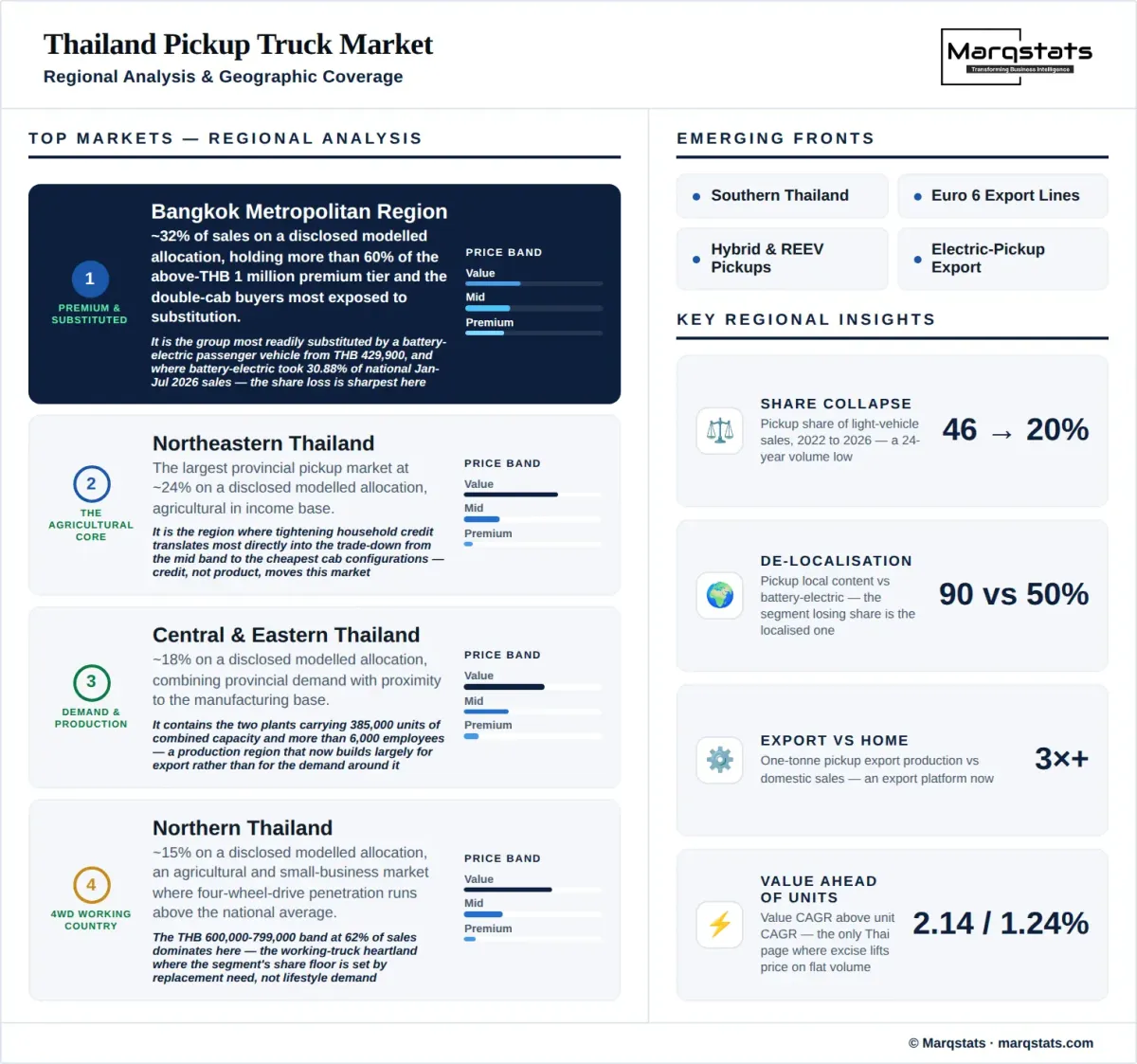
Approximately 32% of sales on a disclosed modelled allocation calibrated to the reported 60% to 70% provincial share, and the region holding more than 60% of the above-THB 1 million premium tier. It is also where battery-electric substitution is strongest, at a national battery-electric share of 30.88% of January to July 2026 sales.
Northeastern Thailand
The largest provincial pickup market at approximately 24% on a disclosed modelled allocation, agricultural in income base and therefore the region where household credit conditions translate most directly into the trade-down from the 39% to 33.5% mid band.
Central and Eastern Thailand
Approximately 18% on a disclosed modelled allocation, combining provincial demand with proximity to the manufacturing base, including two plants carrying 385,000 units of combined capacity and more than 6,000 employees.
Northern Thailand
Approximately 15% on a disclosed modelled allocation, an agricultural and small-business market where four-wheel drive penetration is above the national average and where the THB 600,000 to THB 799,000 band at 62% of sales dominates.
Southern Thailand
Approximately 11% on a disclosed modelled allocation, a plantation and fishing economy where commercial replacement demand is the whole of the market and where the roughly 19.5% share floor assumed for 2030 is most secure.
How Competition Is Evolving
This is a concentrated segment defended by incumbents with four decades of local content behind them, and the barrier is a supplier base rather than a model. Thai pickup production runs at more than 90% domestically produced parts, a depth no entrant can replicate quickly, and the two largest plants alone carry 385,000 units of capacity against a domestic market of about 142,900.
The Japanese incumbents are investing into a shrinking home market because the home market is not the point. More than THB 15 billion was approved in April 2026 for automation, solar generation and Euro 6 development at plants employing more than 6,000 people, which is a commitment to export competitiveness rather than to Thai volume.
Chinese entrants have arrived at the top of the range rather than in the volume bands. Electrified and range-extended pickup entries sit above the THB 800,000 to THB 999,000 band that holds 33.5% of sales, and one Chinese electric pickup recorded roughly 1,000 units in 2025 against a total battery-electric pickup segment of 726 units and range-extended pickups of 19 units, which places the entrants in a category still measured in hundreds.
The one segment where competitive position could move quickly is hybrid. A hybrid or range-extended pickup priced into the THB 800,000 to THB 999,000 band addresses the trade-down that has moved 4 points of share to the cheapest configurations since 2022, and no incumbent has yet occupied it at volume.
For an entrant the decisive judgement is whether Thailand is a market or a platform. As a market it is at a 24-year low with a 171,000-unit forecast on the broader definition and about 139,000 on the narrower one; as a platform it exports more than three times what it sells, at more than 90% local content, with Euro 6 capability being installed now.
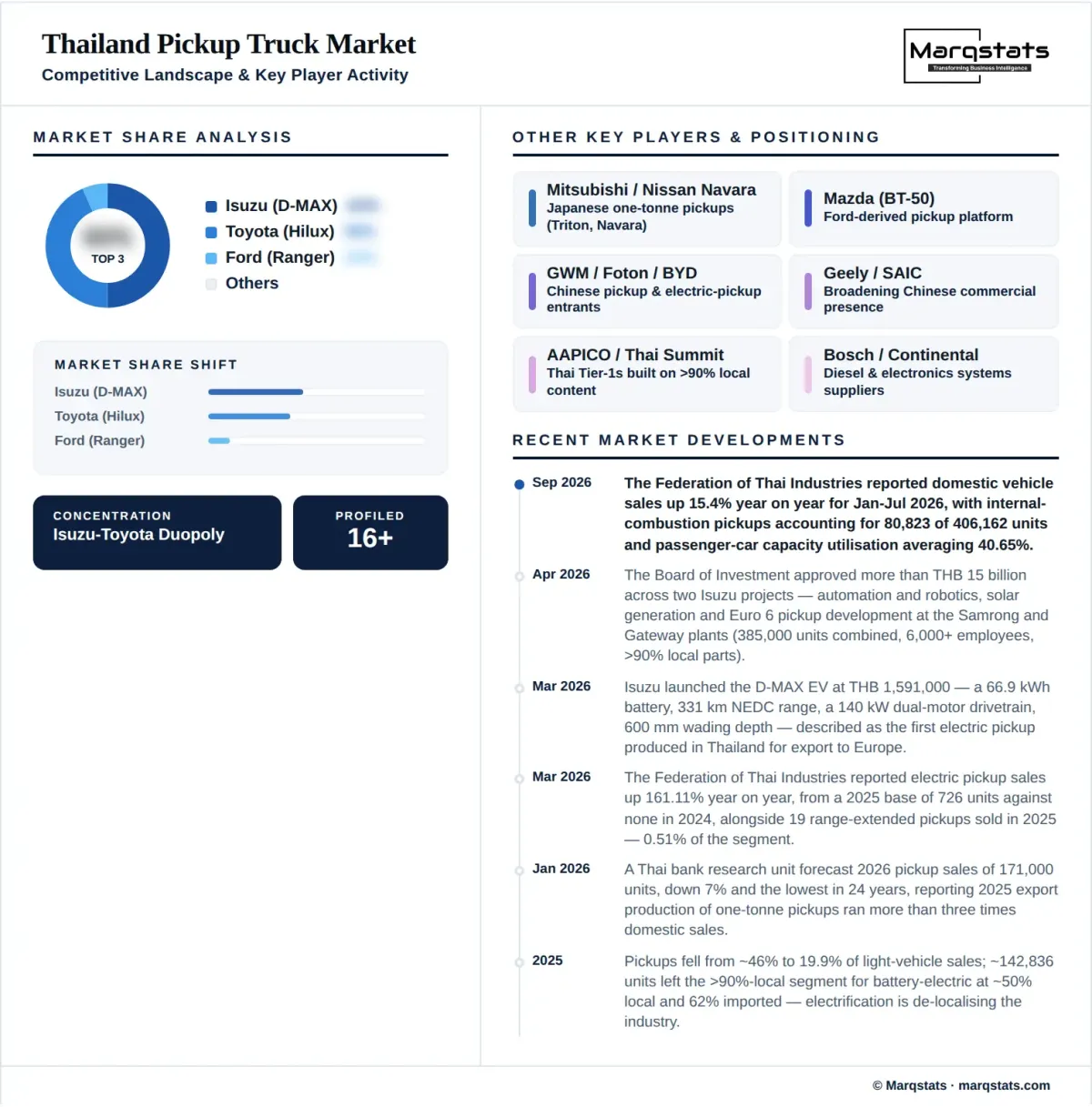
Companies Covered
The report profiles 15+ companies with full strategy and financials analysis, including:
Recent Market Activity
Table of Contents
Coverage & Segmentation
This analysis measures annual new one-tonne pickup trucks sold domestically in Thailand from 2021 to 2030, with 2025 as the base year and 2026 to 2030 as the forecast period, across all powertrains, cab configurations and drivetrains. Pickup-derived passenger vehicles built on the same ladder-frame platform are excluded, which is the scope difference producing a 23.42% gap against the broader published 2026 forecast of 171,000 units, and the two are never added. Heavy and medium trucks and electric commercial vans are excluded and covered separately. Market value is expressed in USD on a disclosed average transaction price rising from about USD 24,431 to USD 25,538 at a constant THB 32.5 per USD, so value moves on volume, mix and excise rather than on exchange rate assumptions.
Coverage spans three cab configurations, three price bands, three powertrains, two drivetrains, two destinations and three buyer types, with five regional clusters analysed on income base, credit conditions and manufacturing presence rather than on population. Export production is carried as a named dimension with its own ratio at more than three times domestic sales in 2025 and is never merged into the domestic panel. Fifteen entities are profiled across Japanese, American, Chinese and European manufacturers and the principal Thai component suppliers.