Market Snapshot
Key Takeaways
Market Overview & Analysis
Report Summary
The North America commercial van upfitting market operates through a structurally different supply chain than the European van body conversion market. While European van bodybuilding is anchored by the Regulation (EU) 2018/858 multi-stage type approval (ECWVTA) framework, North American van upfitting is governed by NHTSA's Federal Motor Vehicle Safety Standards and the NTEA multi-stage vehicle manufacturer (MSVM) framework, which grants certified upfitters the legal authority to modify completed or incomplete vehicles and re-certify them for fleet use. This regulatory foundation underpins the entire commercial ecosystem of Adrian Steel, Knapheide, Ranger Design, and the broader network of NTEA-member upfitter companies across the US and Canada.
The van upfit market in North America is primarily a Class 2 and Class 3 vehicle market. Class 2 vans (8,501–10,000 lbs GVWR) including the Ford Transit, Ram ProMaster, Mercedes Sprinter, and Chevy Express account for approximately 50–55% of upfitted van volume by units, with Class 3 chassis-cab variants (10,001–14,000 lbs GVWR) serving higher-payload vocational applications in construction, utilities, and fleet service. The cargo van upfitting segment — panel van to functional service vehicle — is the market's volume backbone, while the vocational van conversion market serving ambulances, accessible transit, and specialist mobile-workshop builds commands the highest per-vehicle revenue. Fleet van upfitting solutions for corporate and government fleet operators represent the most strategically important commercial channel, where multi-year preferred-upfitter contracts with utilities (Verizon, AT&T, National Grid), construction companies, and last-mile logistics operators define revenue visibility and volume scale for upfitter companies.
The electric van upfitting market in the United States is the most structurally significant change to the work van conversion market in a generation. The Rivian EDV, deployed by Amazon in its last-mile delivery fleet, and the Ford E-Transit, which has become the standard electric platform for telecommunications, utilities, and field-service fleets, are not compatible with the legacy drill-and-bolt upfit methodologies developed for Transit, Sprinter, and ProMaster diesel platforms. High-voltage battery architectures, software-defined vehicle (SDV) access protocols, OEM-warranty constraints on body modifications, and the unique floor and sidewall configurations of battery-electric vans require upfitters to develop EV-certified product lines, EV-specific installation tools, and technician training curricula. This transition is both a disruption risk for upfitters that fail to adapt and a premium revenue opportunity for those that build EV-certified upfit capabilities ahead of the broader fleet transition.
Market Dynamics
Key Drivers
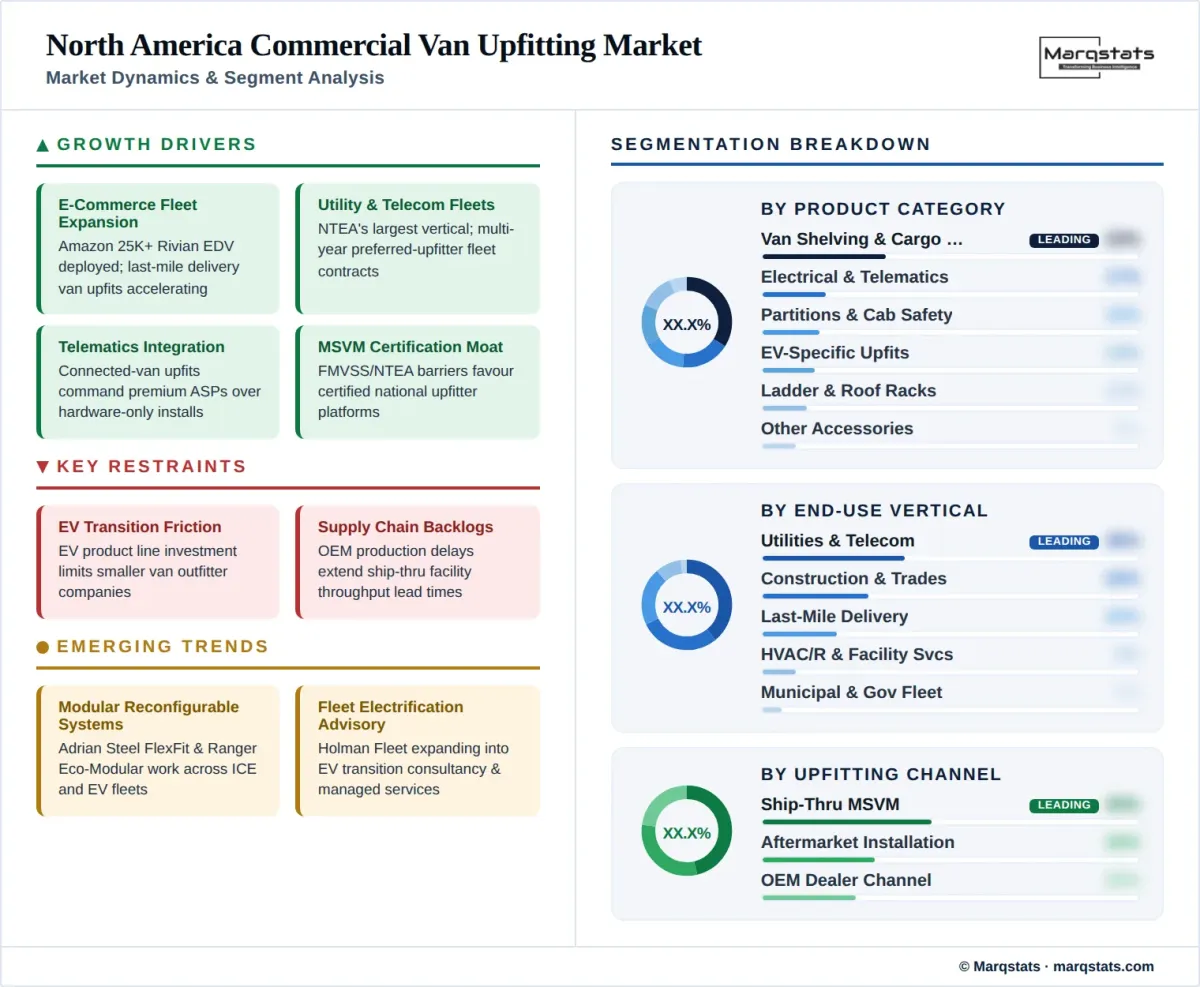
- E-commerce last-mile delivery fleet expansion driving structural demand for cargo van upfitting: The continued expansion of Amazon, UPS, FedEx, USPS, and regional last-mile delivery operators is the single most powerful structural demand driver in the cargo van upfitting segment. Each new delivery van added to these fleets requires cargo management systems, partition installation, shelving for package organisation, driver safety barriers, and increasingly telematics-integrated cargo monitoring — making last-mile delivery van upfitting a high-volume, repeat-procurement market category. Amazon's Rivian EDV deployment — with purpose-designed electric upfit architecture, integrated cargo management, and branded delivery equipment — has established the EV-native van upfit specification as the industry benchmark for next-generation last-mile delivery van upfitting market investment.
- Fleet van upfitting solutions for utilities, telecom, and construction remain the market's largest recurring revenue base: NTEA data consistently identifies utilities and construction as the two largest end-use verticals in the work truck outfitting market, and this holds equally for the commercial van upfitting segment. Service van upfitting for field technicians in HVAC/R, electrical contracting, plumbing, broadband installation, and utility maintenance requires modular van shelving systems, drawer units, partition systems, electrical upgrades (power inverters, shore power), and ladder rack and roof rack configurations — all representing recurring fleet replacement contracts that provide upfitters with stable, multi-year revenue visibility.
- NTEA work truck upfitting market growth projections supporting investment in upfit capacity: NTEA's annual State of the Industry report consistently projects multi-year growth for the commercial vehicle upfitting market US, driven by infrastructure investment programmes, utility grid modernisation, broadband expansion, and last-mile logistics fleet renewal. NTEA's certification and education programmes for MSVM upfitters also directly support the commercial van upfitting market's capacity expansion by training and certifying additional upfitter technicians and facility operators, maintaining the quality and compliance standards that fleet operators require from preferred-upfitter programmes.
- Telematics-integrated van upfitting creating a premium hardware-plus-services revenue segment: The fleet management industry's shift toward comprehensive connected-vehicle ecosystems — where GPS tracking, engine diagnostics, cargo monitoring, driver safety coaching, and energy management are integrated as a unified platform — is creating a premium telematics-integrated van upfitting product tier that commands meaningfully higher per-vehicle ASPs than hardware-only shelving and partition installs. Knapheide's integration of telematics hardware with its upfit product portfolio, and Holman Fleet's upfitting and fleet management service bundle, are early examples of how the leading commercial vehicle upfitter companies in the US are capturing telematics-driven revenue expansion.
- FMVSS van upfitter certification and MSVM compliance supporting premium-tier upfitter consolidation: NHTSA's FMVSS requirements for multi-stage vehicle manufacturers, combined with NTEA's MSVM accreditation programme, create meaningful barriers to entry for non-certified upfitters and support industry consolidation around certified, warranty-compliant upfit providers. Fleet operators managing tens of thousands of vans require upfitters with MSVM certification, OEM-programme endorsement, and quality management systems — conditions that favour the established platforms of Adrian Steel, Knapheide, Ranger Design, and Holman while creating competitive pressure on smaller regional van customisation market participants.
Key Restraints
- Electric van upfitting technical transition creating near-term friction and capital investment requirement: The EV upfitting transition is simultaneously the market's most important long-run growth driver and its most significant near-term operational restraint. Upfitters must invest in new product development for EV-compatible shelving systems (non-conductive materials, modified mounting hardware), develop EV-specific installation tools and procedures, train technicians on high-voltage safety, and navigate OEM warranty constraints on body modifications. Smaller van outfitter companies that lack the capital for EV product line development face competitive disadvantage as fleet customers shift toward E-Transit, Rivian EDV, and EV ProMaster platforms.
- Supply chain and component availability constraining upfit lead times for fleet operators: The commercial van upfitting market's growth creates capacity and supply-chain management challenges as upfitter facilities face extended backlogs for popular configurations. Modular van shelving system lead times, custom fabrication delays, and vehicle supply constraints (OEM production scheduling affects ship-thru vehicle conversion facility throughput) can extend fleet deployment timelines, pushing fleet operators to qualify multiple upfitter suppliers or accept standardised configurations rather than fully customised vocational builds.
- OEM warranty complexity on electric van modifications limiting upfitter design freedom: Unlike ICE van platforms where upfitters have decades of established modification experience within OEM body builder guidelines, electric van OEM warranty constraints — covering battery systems, high-voltage wiring, floor penetrations, and software-defined vehicle access — are less well-defined and more restrictive for aftermarket modification. Ford E-Transit's body builder guidelines and Rivian's cargo van upfitting specifications both impose constraints on where and how upfitters may mount equipment, limiting design freedom relative to diesel platform equivalents.
Key Trends
- Modular and reconfigurable van shelving systems replacing fixed-fabrication upfits: The fleet van upfitting market is shifting from custom-welded and permanently installed shelving and cargo management configurations toward modular van shelving systems that can be reconfigured, transferred between vehicles, and adapted to evolving operational requirements without requiring facility-based reinstallation. Adrian Steel's FlexFit and Ranger Design's Eco-Modular product lines, along with Sortimo's GlobalLiner system introduced to the North American market, all reflect this modular architecture trend. For fleet operators managing large mixed-technology van fleets, transferable modular systems that work across both ICE and EV van platforms reduce total upfit lifecycle cost significantly.
- Ship-thru upfitting partnerships with OEMs creating competitive moats for certified upfitter companies: The ship-thru vehicle conversion facility model — in which Ford, Ram, Mercedes-Benz, and increasingly Rivian ship incomplete or configured base vans directly to certified upfitter facilities before fleet delivery — is becoming a primary competitive battleground. Upfitters that secure OEM-endorsed ship-thru programme status gain access to pre-delivery fleet volumes at scale, exclusivity advantages for specific platforms, and warranty-chain continuity that independent aftermarket upfitters cannot offer. Knapheide's Ford ship-thru programme relationship and Adrian Steel's Ram ProMaster upfitting network are the clearest examples of OEM-aligned commercial channel development in the North American market.
- Van partition market growing as safety and ergonomic upfit specifications tighten: The commercial van partition market — physical dividers separating the driver's cab from the cargo area for safety, noise reduction, and load containment — is growing as OSHA guidance on cargo separation, corporate fleet safety standards, and driver ergonomic requirements become more stringent. Partition installation is typically bundled with shelving system orders, increasing per-vehicle upfit revenue. Lightweight composite partition systems for EV vans, where every kilogram of upfit weight reduces payload and range, are an active product development area across the van partition market North America.
- Work van conversion companies expanding upfitting scope into fleet electrification consultancy: Leading commercial van upfitting market participants are broadening their commercial offerings from hardware installation to fleet electrification transition consulting — advising fleet operators on vehicle spec selection, charging infrastructure requirements, upfit compatibility across EV platforms, and total lifecycle cost of EV fleet conversion. Holman Fleet's combined fleet management, upfitting, and EV transition services, and NTEA's EV upfitter education programmes, both reflect how the work van conversion market is evolving from a transactional upfit business into a more consultative, fleet-lifecycle role.
Market Segmentation
The commercial van shelving market is the largest single product category in North American commercial van upfitting by revenue, accounting for approximately 30–35% of total market value. Van shelving encompasses fixed and modular racking units, drawer systems, bin storage, overhead compartments, and integrated cargo management solutions installed in the cargo area of panel vans for service technicians, delivery operators, and field engineers. Adrian Steel, Knapheide, and Ranger Design are the three dominant competitors in the van shelving market North America, each offering product lines designed for the Ford Transit, Ram ProMaster, and Mercedes Sprinter van platforms. The shift toward modular van shelving systems compatible across both ICE and EV van bases is the product category's primary structural change, driven by fleet operators seeking transferable assets that retain value across van replacement cycles.
The van partition market North America — comprising full-height and partial cab-cargo partitions, sliding partition windows, and integrated partition-shelf combinations — is one of the fastest-growing component segments as fleet safety requirements tighten and EV van adoption introduces new cargo separation requirements. Standard steel or aluminium partitions have given way to lightweight composite and polymer partitions designed to minimise EV payload penalty. Partition installations are typically specified alongside shelving systems, and their bundle value-add is a meaningful contributor to per-vehicle upfit economics, particularly for utility fleet van upfitting where OSHA compliance drives standardised safety equipment specifications across large fleet orders.
Ladder racks and roof racks are essential upfit components for construction trades, HVAC contractors, electricians, and utility field-service operators who carry long-format materials and equipment on van exteriors. The commercial vehicle accessories market for roof and ladder rack systems is mature and price-competitive in standard configurations, but the EV van transition is creating a premium segment for lightweight composite or aluminium rack systems that minimise roof-load payload penalty. Knapheide and Adrian Steel both offer integrated ladder-rack and interior-shelving configurations that allow fleet operators to spec complete exterior-plus-interior upfit packages through a single supplier relationship.
Electrical system upfitting — including shore-power connections, power inverters, auxiliary battery systems, interior lighting upgrades, and telematics hardware installation — represents approximately 15–18% of total commercial van upfitting market revenue and is the fastest-growing component segment in value terms. For electric van upfitting specifically, OEM Vehicle-to-Load (V2L) capability is becoming a standard power-sourcing mechanism for tool and equipment loads, replacing diesel-generator or auxiliary-battery approaches. Telematics-integrated van upfitting, where GPS tracking, cargo monitoring, driver-behaviour systems, and energy management hardware are installed as a unified connected-vehicle platform, is the highest-margin product tier available to North American upfitters and the segment most directly competing with OEM telematics embedded in Ford E-Transit's Ford Pro Intelligence platform and GM's OnStar fleet services.
The electric van upfitting market US is the market's structurally most significant emerging segment. Amazon's fleet of over 25,000 Rivian EDV vans — custom-built with integrated last-mile delivery upfits including cargo management systems, branded delivery equipment, and integrated telematics — established the commercial precedent for a dedicated EV-native van upfit architecture in North America. Ford E-Transit upfitting for telecom, utilities, and municipal fleet operators is the most active commercial upfitting programme in the transition period, with Adrian Steel, Knapheide, and Ranger Design all having developed E-Transit-certified product lines. The electric fleet van conversion kit market — adaptable shelving and cargo management systems that preserve floor integrity, avoid high-voltage system penetrations, and comply with Ford E-Transit or Rivian body builder guidelines — is the primary near-term product development priority for North America's leading commercial vehicle upfitter companies.
Utilities and telecommunications are the commercial van upfitting market's largest end-use verticals, representing approximately 35–40% of total upfitted van volume. Broadband installation operators, electric utility field-service crews, telecommunications tower and fibre deployment teams, and grid-maintenance operators all require highly standardised, fleet-wide van upfit configurations with consistent shelving layouts, tool organisation, cable management, and equipment-mounting solutions. Fleet van upfitting solutions for these verticals typically involve preferred-upfitter programme relationships — where a single upfitter is specified for an entire national fleet deployment — creating high-volume, multi-year revenue contracts for the qualifying commercial vehicle upfitter companies. The transition to electric fleet vans in the utilities sector (Verizon, AT&T, National Grid, Pacific Gas & Electric) is creating active demand for EV-certified upfit configurations across the top North American upfitter companies.
Construction trades — plumbers, electricians, HVAC/R technicians, general contractors, and equipment service technicians — represent the commercial van upfitting market's highest-volume segment for service van upfitting configurations, with modular shelving systems, drawer units, ladder racks, and exterior toolboxes spec'd to individual trade requirements. This segment is characterised by high fragmentation at the fleet operator level (many SME trade businesses with small van fleets) alongside high volume from large multi-trade contractor companies managing hundreds or thousands of vans. Adrian Steel's dealer network and Knapheide's van products division serve this segment through both OEM-dealership channel and aftermarket installation, with van customisation market North America activity spread across independent installer networks as well as dedicated upfitter facilities.
Last-mile delivery van upfitting — serving Amazon, UPS, FedEx, USPS, DoorDash, and regional parcel delivery operators — is the fastest-growing end-use vertical in North American commercial van upfitting by revenue growth rate. Unlike trade and utility upfits where modular shelving and tool organisation are the primary products, last-mile delivery van upfitting is centred on cargo organisation, package separation, delivery workflow optimisation, and telematics integration. Rivian EDV's purpose-built delivery upfit architecture — co-designed with Amazon's last-mile delivery operations team — represents the most advanced commercial example of an OEM-integrated delivery van upfit system in the North American market.
By Geography
United States
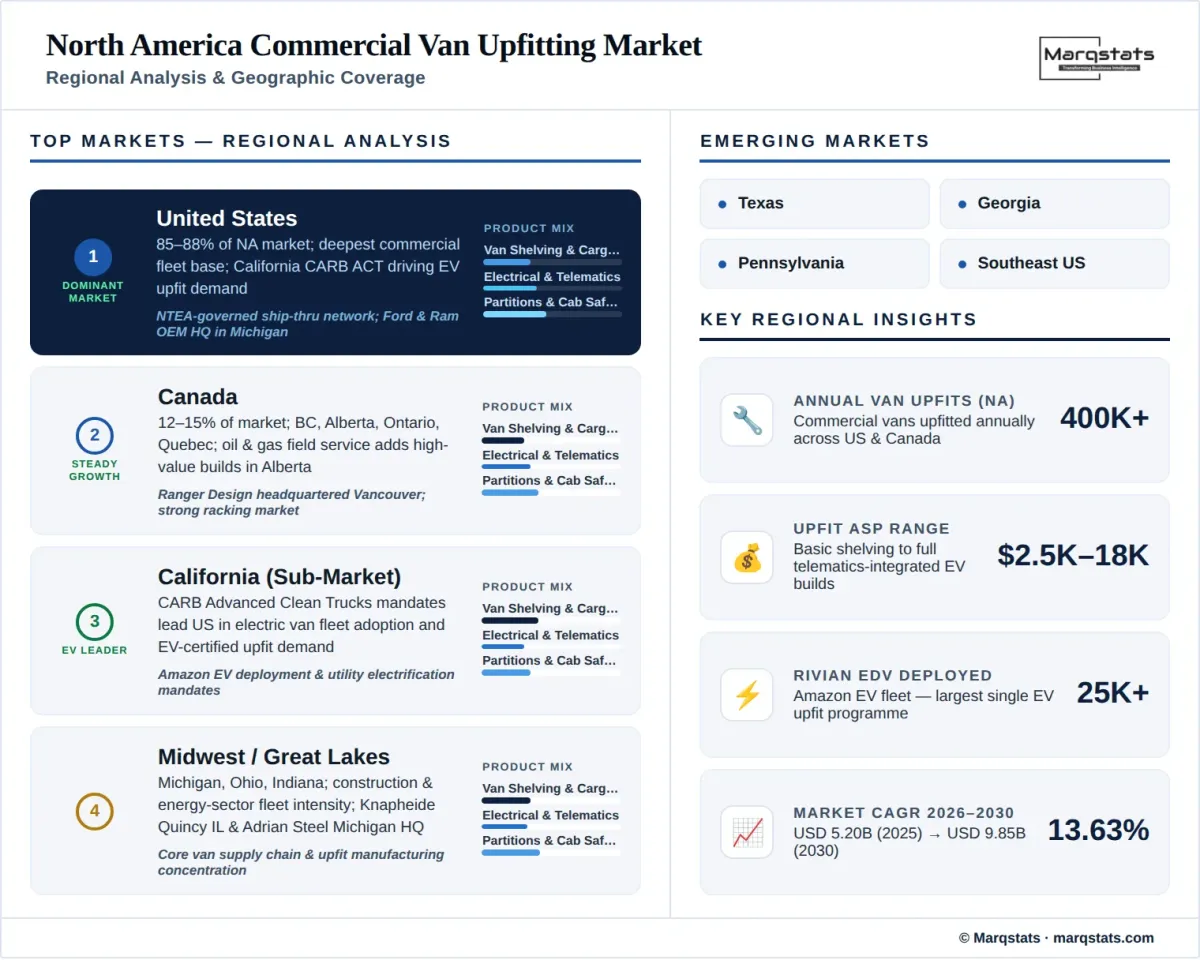
The United States accounts for approximately 85–88% of the North America commercial van upfitting market by revenue, anchored by the world's deepest commercial fleet van base, the most mature NTEA-governed upfitter industry, and the most advanced EV fleet transition programmes among major fleet operators. California leads in electric van upfitting demand driven by CARB Advanced Clean Trucks regulations, Amazon's EV fleet deployment in major metro areas, and utility fleet electrification mandates. The Texas, Ohio, Georgia, Michigan, and Pennsylvania markets are the largest mid-continental van upfitting markets by volume, reflecting construction and energy-sector fleet intensity. Ford's headquarters in Michigan, Ram/Stellantis's operations in Michigan and Indiana, and Knapheide's Ohio-based national upfit operations reflect the Midwest's structural importance as both a van supply and upfit manufacturing centre. Adrian Steel, headquartered in Adrian, Michigan, and Ranger Design, headquartered in Vancouver (with major US operations), both illustrate the geography of the leading commercial vehicle upfitter companies North America.
Canada
Canada represents approximately 12–15% of the North American commercial van upfitting market, with the British Columbia, Alberta, Ontario, and Quebec markets the primary demand centres. Canadian van upfitting market activity closely mirrors the US in end-use vertical mix — utilities, construction, and last-mile delivery — with the addition of oil-and-gas field service as a distinct high-upfit-value vocational category in Alberta and Saskatchewan. Ranger Design, headquartered in Vancouver, is the most prominent Canadian-origin commercial van upfitter with significant North American market presence. The work van conversion companies North America category includes several Canadian-based operators serving both domestic and cross-border fleet upfitting needs, with van racking system North America sales (the term 'racking' being more commonly used in Canadian markets versus 'shelving' in the US) an active competitive arena across the border markets.
How Competition Is Evolving
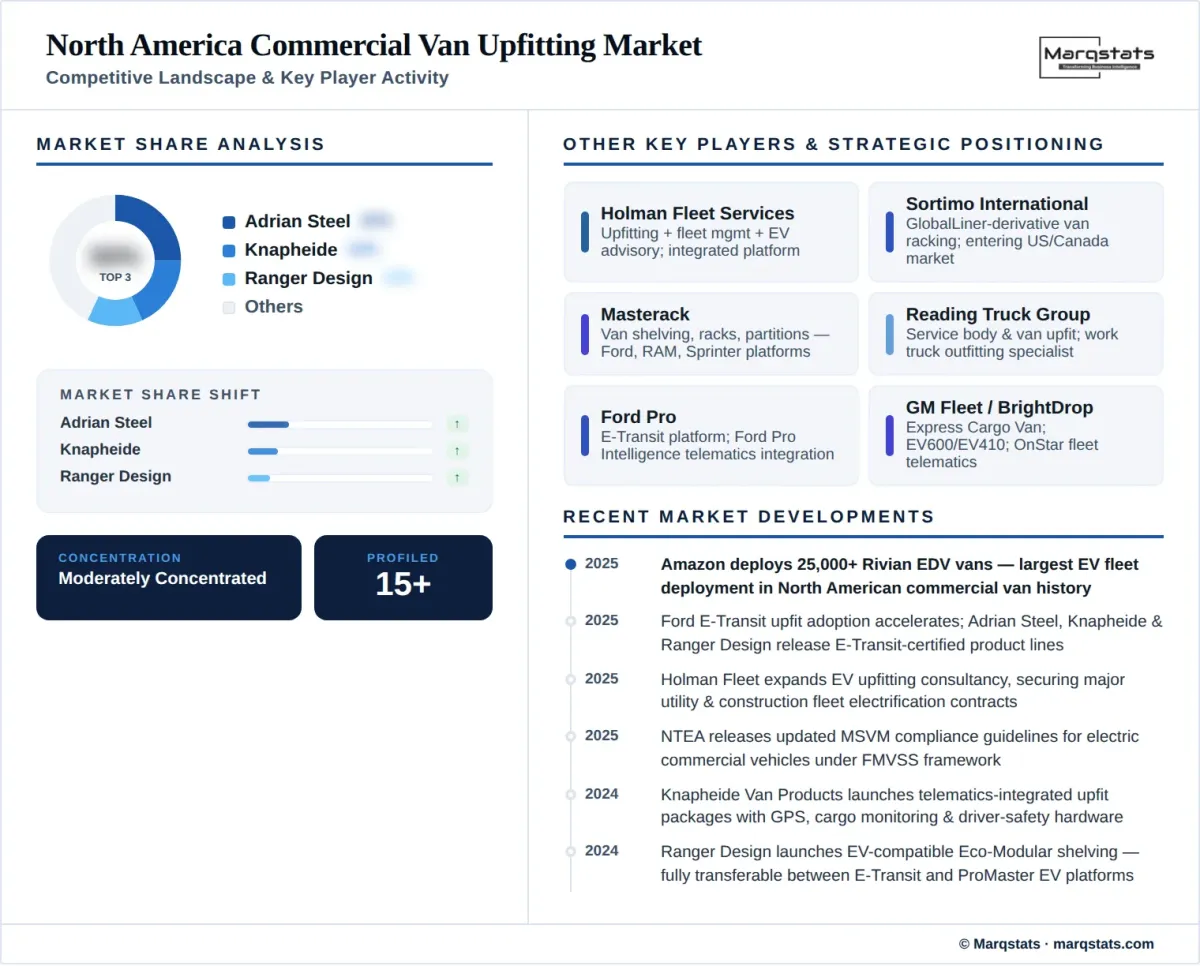
The North America commercial van upfitting market is moderately concentrated at the national platform level and highly fragmented at the regional installation level. Three market tiers define the competitive structure. The national scale tier — Adrian Steel, Knapheide, Ranger Design, and Holman Fleet — serves large fleet operators through NTEA-certified ship-thru facilities, OEM-endorsed preferred-upfitter relationships, and proprietary modular product lines across all major van platforms. The mid-tier regional upfitter tier — comprising hundreds of NTEA-member companies with regional fleet relationships and specialised vocational expertise — serves SME fleet operators, government contracts, and specialised vertical applications. The single-location van customisation market tier — independent shops without NTEA MSVM certification — serves consumer, small-fleet, and highly bespoke vocational clients outside the fleet procurement channel.
Adrian Steel is the North American commercial van shelving market's volume leader, with the broadest product range across Ford Transit, Ram ProMaster, Mercedes Sprinter, and EV platform configurations. Knapheide — historically known for truck bodies and beds — has expanded its van products division with significant investment in telematics-integrated van upfitting, ship-thru programme scale, and fleet upfitting solutions for utility and construction verticals. Ranger Design, with strong Canadian roots and a growing US commercial channel, is particularly competitive in modular van shelving systems and cargo management van market categories where transferability and EV compatibility are primary procurement criteria. Holman Fleet Services differentiates through its combined upfitting, fleet management, remarketing, and EV transition advisory services — making it the most vertically integrated fleet upfitting platform in North America.
The arrival of Sortimo International in the North American market — transferring its European van racking system expertise to the US and Canadian fleet upfitting market — represents the most significant competitive entry from an established international player, bringing modular GlobalLiner-equivalent systems that compete directly with Adrian Steel and Ranger Design in the premium fleet shelving segment. The commercial van outfitter revenue share US is shifting toward national platforms as fleet operators consolidate preferred-upfitter lists, tighten EV compliance requirements, and demand managed-service fleet upfitting relationships rather than transactional hardware purchases.
Companies Covered
The report profiles 15+ companies with full strategy and financials analysis, including:
Recent Market Activity
Table of Contents
Coverage & Segmentation
This report provides a comprehensive analysis of the North America commercial van upfitting market covering the 2021–2030 period, with 2025 as the base year. The study covers van shelving systems and modular cargo management, partition and cab safety systems, ladder racks and roof racks, electrical system upgrades and power management, telematics and connected-fleet hardware integration, electric van upfitting (EV-specific product lines and EV-certified installation programmes), and ship-thru vehicle conversion facility operations. End-use vertical coverage includes utilities and telecommunications, construction and trades, last-mile delivery and e-commerce logistics, HVAC/R and facility services, municipal and government fleet, and healthcare and specialty mobile services. Platform coverage spans Ford Transit and E-Transit, Ram ProMaster and ProMaster EV, Mercedes-Benz Sprinter and Metris, Rivian EDV, GM Express and BrightDrop, and emerging EV commercial van platforms. Regulatory coverage spans NHTSA Federal Motor Vehicle Safety Standards (FMVSS), NTEA multi-stage vehicle manufacturer (MSVM) framework, CARB Advanced Clean Trucks regulations (California), and OEM body builder guideline frameworks for EV van platforms.
Primary research included 40+ interviews with commercial van upfitter operations managers, fleet procurement directors at utility and logistics companies, NTEA programme officers, OEM van commercial and fleet sales managers, telematics system integration specialists, and EV transition programme leads at major US fleet operators. Secondary research drew from NTEA State of the Industry reports, Ford Pro commercial fleet data, NHTSA FMVSS documentation, CARB Advanced Clean Trucks regulation, Bureau of Transportation Statistics commercial vehicle data, Amazon and Rivian fleet deployment communications, and company press releases and investor materials.